- Home
- »
- Clothing, Footwear & Accessories
- »
-
Workwear Market Size, Share, Growth, Industry Report 2033GVR Report cover
![Workwear Market Size, Share & Trends Report]()
Workwear Market (2026 - 2033) Size, Share & Trends Analysis Report By Product (Workwear Apparel, Workwear Footwear), By Demography (Men, Women), By Application (Construction, Chemical, Power, Food and Beverage, Biological), By Region, And Segment Forecasts
- Report ID: GVR-3-68038-186-3
- Number of Report Pages: 110
- Format: PDF
- Historical Range: 2021 - 2024
- Forecast Period: 2026 - 2033
- Industry: Consumer Goods
- Report Summary
- Table of Contents
- Segmentation
- Methodology
- Download FREE Sample
-
 Download Sample Report
Workwear Market Summary
The global workwear market size was estimated at USD 19.20 billion in 2025 and is projected to reach USD 28.08 billion by 2033, growing at a CAGR of 4.9% from 2026 to 2033. The market growth is primarily driven by growing awareness of workplace safety standards, increased enforcement of occupational health and safety regulations, and the rising need for durable, functional apparel across various industries.
Key Market Trends & Insights
- Asia Pacific dominated the global workwear market with the largest revenue share of 44.67% in 2025.
- The workwear market in China is projected to grow at a CAGR of 5.4% from 2026 to 2033
- By product, the workwear apparel segment led the market with the largest revenue share of 74.67% in 2025.
- By demography, the men’s segment led the market with the largest revenue share of 87.24% in 2025
- By application, the construction segment led the market with the largest revenue share of 23.75% in 2025.
Market Size & Forecast
- 2025 Market Size: USD 19.20 Billion
- 2033 Projected Market Size: USD 28.08 Billion
- CAGR (2025-2033): 4.9%
- Asia Pacific: Largest market share in 2025
In addition, expanding industrialization, urban infrastructure development, and the growing demand for customized and branded workwear solutions are accelerating market growth across the industrial workwear industry. As workplace safety regulations tighten and awareness of occupational health increases across industries, global demand for durable and compliant workwear within the workwear industry continues to rise. The growing focus on employee comfort, brand identity, and professional appearance encourages companies to invest in high-quality, functional, and customized uniforms.Technological advances in fabric innovation, such as moisture-wicking, flame-resistant, and antimicrobial features, along with the rising popularity of sustainable and eco-friendly materials, are further transforming the industrial workwear industry. Furthermore, the growth of e-commerce and digital platforms is making procurement processes more efficient and broadening access to a wider variety of workwear solutions worldwide, strengthening distribution reach within the workwear industry.
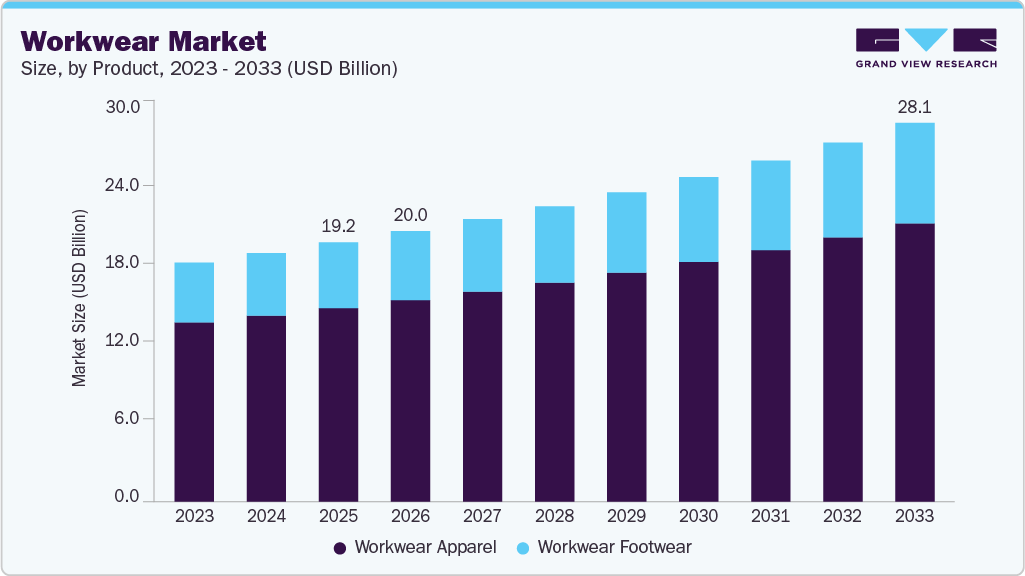
The global workwear industry is fueled by rising employment in the manufacturing, construction, and healthcare sectors, which are core demand contributors to the industrial workwear industry. As reported in January 2024, the construction industry added approximately 17,000 jobs in December 2023, based on an analysis by the Associated Builders and Contractors (ABC) using data from the U.S. Bureau of Labor Statistics.
Increasing demand for gender-specific and plus-size workwear is also boosting sales across the workwear industry. Rapid urbanization and infrastructure projects in emerging economies continue to support workforce expansion, directly contributing to the sustained growth of the industrial workwear industry. Furthermore, growing corporate focus on employee well-being and productivity supports continued investment in quality work apparel.
Rising demand for specialized protective clothing in high-risk environments, such as oil & gas and chemical industries, is driving the global industrial workwear industry. Essential protective workwear includes flame-resistant clothing, safety goggles and gloves, hard hats, and steel-toed boots used across oil, gas, and chemical operations. The increasing emphasis on workforce uniformity and corporate branding further supports the expansion of the workwear industry. Growing awareness around environmental sustainability is also pushing manufacturers toward eco-friendly materials and cleaner production methods. In addition, advancements in smart textiles and wearable technology are introducing new functionalities, enhancing performance and safety standards across the modern industrial workwear industry.
Brand Market Share Insights
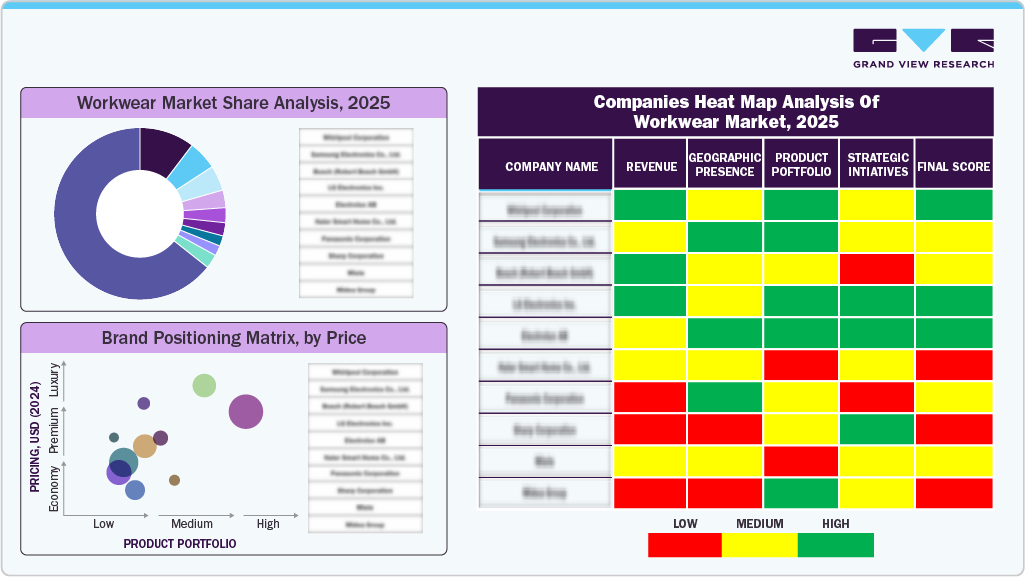
Many brands in the global workwear industry have identified untapped potential within specialized industry segments and are strategically innovating to capture these opportunities. This involves introducing advanced fabric technologies, expanding size and fit inclusivity, and offering customizable solutions tailored to specific job functions and environments. Companies are also refining their branding and distribution strategies to better align with regional regulations, workforce demographics, and shifting consumer expectations. By targeting emerging sectors and evolving workplace needs, these brands aim to enhance their market share and reinforce their global competitiveness.
Consumer Insights
The global workwear industry is undergoing a significant transformation as industries incorporate automation, stricter occupational safety frameworks, and more sustainable procurement policies. Organisations across various sectors, including heavy engineering, transportation, energy, warehousing, pharmaceuticals, and food processing, are shifting toward clothing systems designed to support consistent performance under variable temperatures, chemical exposure, and mechanical strain. The rise of younger employees in industrial and service environments has accelerated demand for workwear that feels less restrictive, incorporates modern textile engineering, and aligns with brands that demonstrate clear environmental responsibility. Digital channels have become central to product discovery, with buyers increasingly relying on detailed fabric performance walkthroughs, certification explanations, and peer-led demonstrations that assess durability, stain resistance, and comfort in real-life situations.
Globally, companies are placing strong emphasis on workwear that offers anatomical shaping, multi-directional stretch, and climate-adaptive features. Lightweight insulation, anti-odor treatments, liquid-repellent coatings, and ergonomic seam placements are now standard expectations in higher-use categories such as utilities and industrial maintenance. Consumers and procurement teams tend to favour garments that balance longevity with ease of care, especially in sectors with frequent laundering cycles or exposure to oils and particulates.
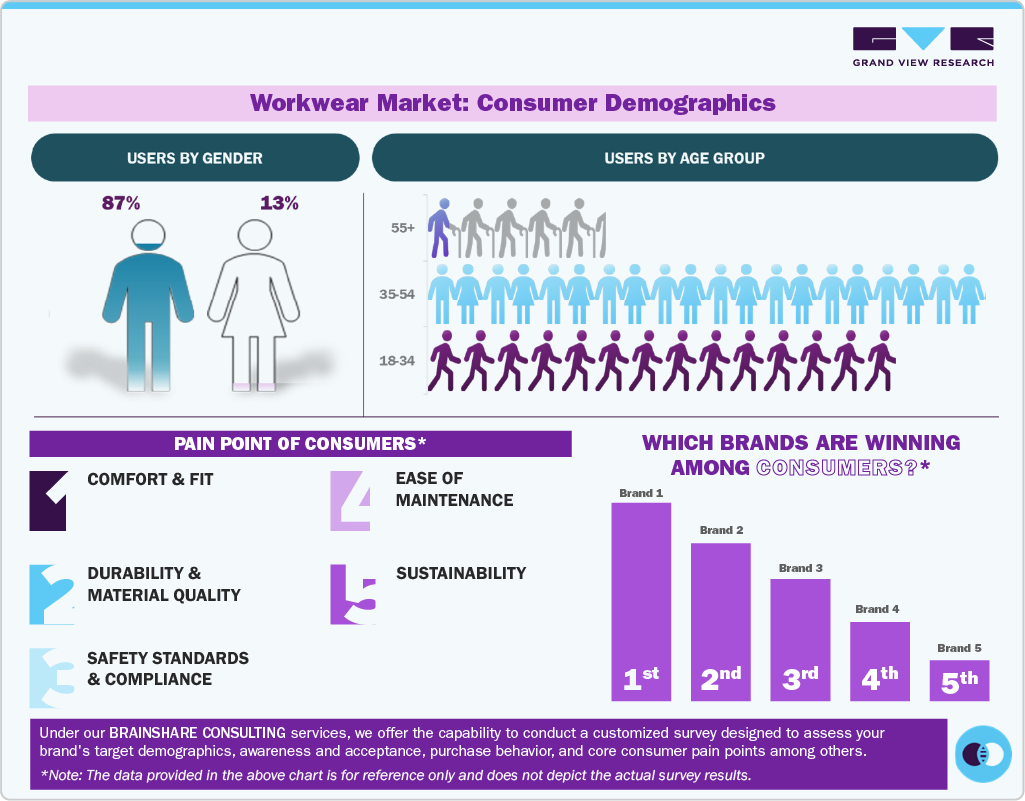
Across regions, purchasing decisions are guided by compliance with international benchmarks, including EN ISO 13688 for general protective clothing, EN 343 for rainwear, and arc-flash standards such as ASTM F1506. Global brands such as Helly Hansen Workwear, Dickies, Portwest, 3M, and DuPont maintain strong credibility due to transparent reporting on fabric testing, abrasion performance, and product traceability. Newer manufacturers often differentiate themselves through the use of recycled-material blends, modular garment systems, or aggressive value positioning. User communities on digital forums and video platforms have become influential, as real-world testimonials increasingly shape expectations around garment lifespan and comfort.
Price dynamics vary widely, with cost-sensitive buyers prioritising functional basics. At the same time, large industrial operators and technical service providers invest in premium lines that reduce replacement frequency and enhance employee safety outcomes. Seasonal shifts, infrastructure programs, and climate-related disruptions are increasingly influencing demand, reinforcing the global shift toward durable, adaptive workwear designed for continuous use.
Product Insights
The workwear apparel segment led the market with the largest revenue share of 74.67% in 2025. The market is witnessing substantial growth driven by a heightened emphasis on safety and functionality in the workplace. Employees frequently face environments that pose heat-related health risks, including dehydration, heatstroke, and fainting. These challenging conditions have prompted workwear manufacturers to continually innovate with advanced fabrics and apparel technologies. The goal is to enhance protection and ensure a safer, more comfortable environment for workers. For instance, in April 2025, the Arco Limited brand Trojan launched an advanced workwear range, including performance trousers engineered for high flexibility and long-lasting wear, jackets and gilets built with weather-resistant insulation, and fleeces that are lightweight, warm, and designed to allow unrestricted movement.
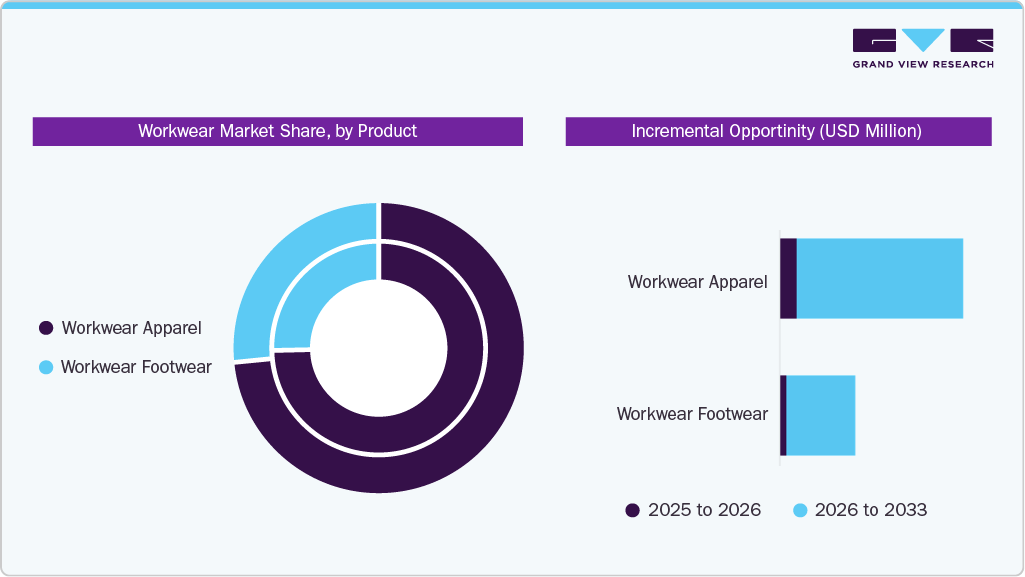
The protective footwear segment is projected to grow at the fastest CAGR of 5.6% from 2026 to 2033. The protective footwear industry is expanding due to the rising demand for protective shoes across various industries, including construction, mining, and logistics. Increasing government regulations mandating the use of safety footwear in hazardous workplaces are a key growth driver. The growing awareness of foot health and injury prevention among workers is also influencing purchasing decisions. In addition, the shift toward lightweight, ergonomic, and stylish safety footwear is attracting a broader consumer base. Technological advancements, such as anti-slip soles, steel toes, waterproof materials, and shock absorption, are further enhancing product appeal and performance. For instance, in April 2025, the Arco Limited brand Trojan launched an advanced workwear range, including footwear focused on comfort, featuring advanced grip, shock absorption, and GORE-TEX options.
Demography Insights
The men’s segment led the market with the largest revenue share of 87.24% in 2025. The steady growth of male-dominated industries, such as construction, manufacturing, and transportation, propels the growth. According to the Organization for Economic Co-operation and Development (OECD) data published in April 2024, male employment in 2023 across all age groups increased to 76.9%. Increasing demand for durable and versatile apparel that withstands tough working conditions is a significant factor. The rising preference for functional designs that offer comfort and mobility drives market growth. In addition, the trend toward branded and stylish workwear for a professional appearance is gaining traction. Innovations in fabric technology, which enhance breathability and wear resistance, are further driving demand in this segment. For instance, in September 2023, Cat Footwear introduced its latest addition to the Invader collection, the Invader Mid Vent, a high-traction safety shoe that boasts unparalleled traction and exceptional style.
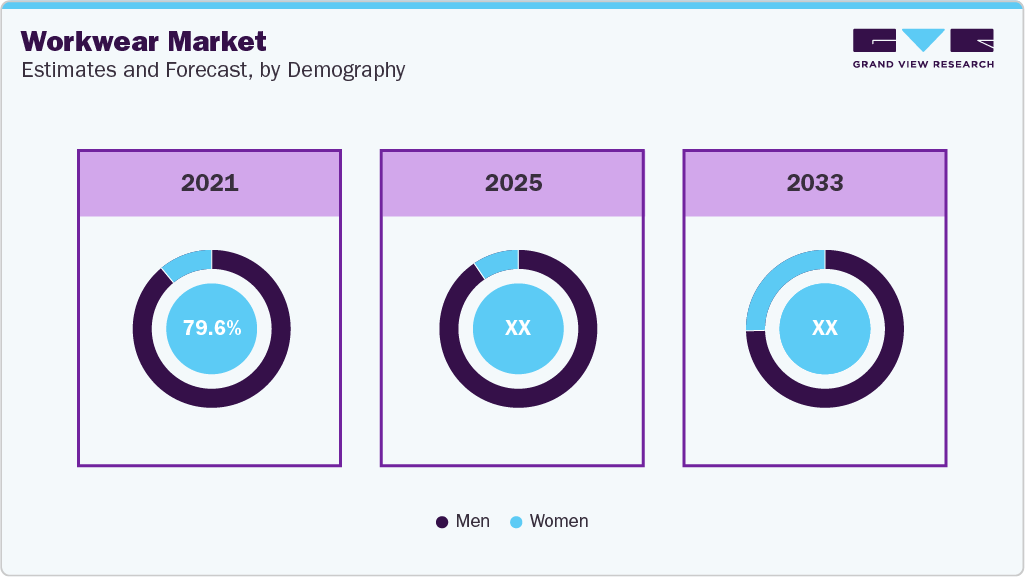
The women’s segment is projected to grow at the fastest CAGR of 5.2% from 2026 to 2033. The women’s workwear industry is growing rapidly as more women enter traditionally male-dominated sectors, such as construction, manufacturing, and engineering. According to the Organization for Economic Co-operation and Development (OECD) data published in April 2024, female employment in 2023 across all age groups increased to 63.2%. There is an increasing demand for workwear tailored to fit women’s body shapes, providing both comfort and functionality. The growing emphasis on gender diversity and inclusion in the workplace is encouraging companies to invest in uniforms tailored to women. In addition, the rise of professional women seeking stylish yet practical workwear contributes to market expansion. Moreover, firms are increasingly collaborating to develop better workwear solutions and empower women in the workforce. For instance, in April 2025, Deere & Company announced a collaboration with Dovetail Workwear to develop apparel & gear for women designed to suit he needs of women working in the agriculture industry.
Application Insights
The construction segment led the market with the largest revenue share of 23.75% in 2025, driven by the sector’s stringent safety requirements and the need for durable, protective clothing that can withstand harsh environments. Increasing infrastructure development and urbanization globally are boosting demand for specialized construction apparel. The rising adoption of high-visibility and flame-resistant materials enhances worker safety and compliance with regulations. In addition, the focus on ergonomic designs to improve comfort during long working hours supports market growth. Growing investment in smart construction technologies is also encouraging the integration of advanced features in workwear for better performance and protection.
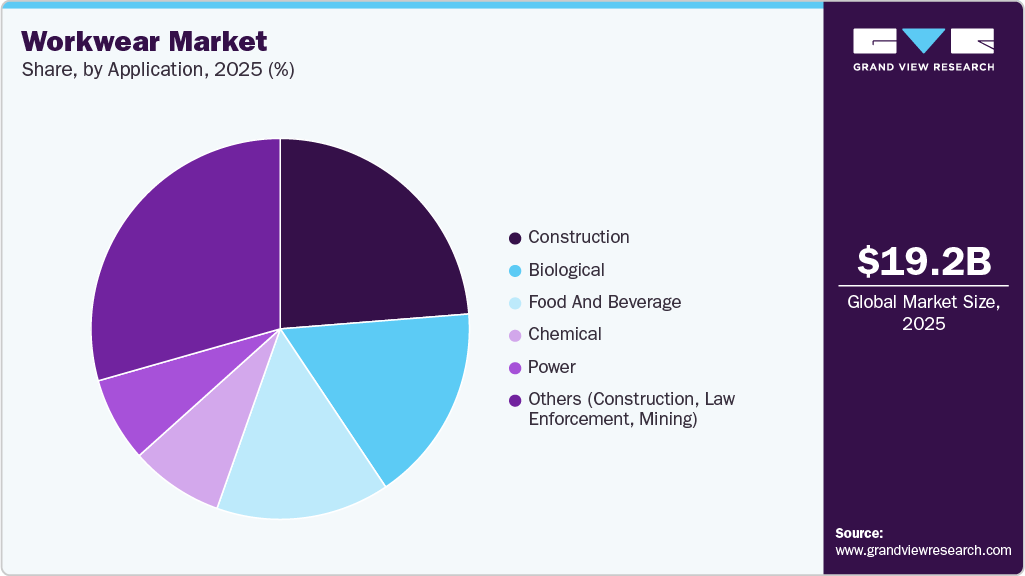
The biological segment is projected to grow at the fastest CAGR of 5.7% from 2026 to 2033, driven by the increasing need for infection control and patient safety in clinical environments. Rising hospital admissions and the expansion of healthcare infrastructure globally are increasing the demand for specialized medical apparel. There's a growing emphasis on comfortable, breathable, and long-wear garments that support extended shifts for medical staff. The shift toward reusable and sustainable medical textiles is also influencing purchasing trends in the sector. Furthermore, the rise in personalized and department-specific uniforms is promoting brand identity and operational efficiency in healthcare institutions.
Regional Insights
The workwear market in the North America is anticipated to grow at a significant CAGR during the forecast period. The market growth is driven by a strong industrial base, increasing investment in infrastructure projects, and a growing emphasis on occupational safety across various sectors. The rise of automation and advanced manufacturing is also pushing demand for technologically enhanced, task-specific apparel. In addition, the region’s focus on sustainability encourages the adoption of eco-friendly workwear materials.
U.S. Workwear Market Trends
The workwear market in the U.S. accounted for the largest market revenue share in North America in 2025. In the U.S., stringent federal and state-level labor safety regulations, particularly those enforced by OSHA, are a significant factor driving workwear demand. In January 2024, the U.S. Department of Labor launched a multi-year initiative to reduce worker fatalities and injuries in the tree and landscape services sectors across New Jersey, New York, Puerto Rico, and the U.S. Virgin Islands. The growth of sectors such as energy, logistics, and emergency services has created a steady demand for specialized uniforms. The trend toward local manufacturing and “Made in USA” branding is also influencing consumer preferences in work apparel.
The Canada workwear market in Canada is projected to grow at a substantial CAGR of 4.5% from 2026 to 2033, supported by ongoing infrastructure activity, energy and utilities operations, construction, warehousing, and industrial manufacturing demand. Canada’s workwear landscape is influenced by strict occupational health and safety requirements (including high-visibility and protective apparel needs), strong procurement standards from large employers, and a growing preference for durable, weather-adapted clothing suited to cold and variable climates. Sustainability is also becoming more important, with increasing interest in recycled fabrics, longer-life garments, repair programs, and responsible sourcing.
Asia Pacific Workwear Market Trends
Asia Pacific dominated the global workwear market with the largest revenue share of 44.67% in 2025 and is anticipated to grow at the fastest CAGR during the forecast period, driven by large-scale industrialization, urban development, and expanding manufacturing hubs. The increasing presence of global companies in the region is encouraging the adoption of standardized safety practices and uniform usage. Moreover, increasing disposable incomes and awareness of worker rights are fueling demand for higher-quality work apparel. Recognizing the rising demand, key players are collaborating to cater to it. For instance, in April 2024, BASF collaborated with KPR King Power to introduce safety footwear in China made with Elastopan Loop, a recycled polyurethane solution that reclaims PU waste using advanced liquefaction techniques, thereby preserving both durability and comfort.
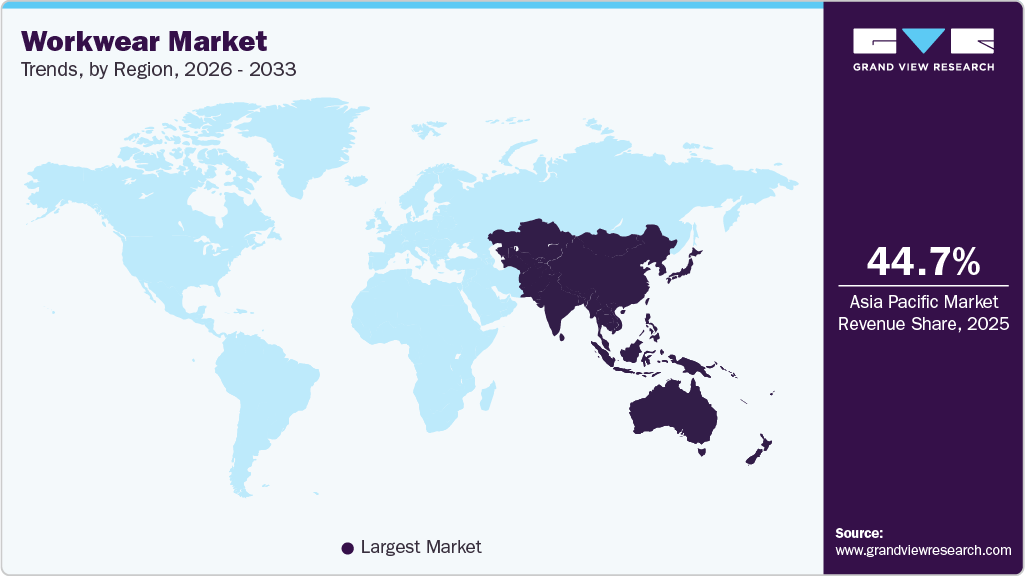
The workwear market in China is projected to grow at a CAGR of 5.4% from 2026 to 2033, driven by large-scale manufacturing, logistics, construction, and infrastructure activity, along with stricter workplace compliance in organized industrial settings. Rising emphasis on worker safety and standardization is driving demand for functional protective clothing (e.g., high-visibility, flame-resistant, anti-static, chemical-resistant) and higher-quality uniforms for services, industrial parks, and large enterprises.
The India workwear market is witnessing rapid growth, driven by growth in construction, manufacturing, logistics, mining, and expanding organized services such as facility management, security, and healthcare support. Greater enforcement of workplace safety practices-especially among large corporations and regulated industrial sites-is increasing demand for compliant PPE-linked workwear, including reflective/high-visibility garments, protective fabrics, and job-specific uniforms.
Europe Workwear Market Trends
The workwear market in Europe is projected to grow at a CAGR of 3.9% from 2026 to 2033. Strong labor unions shape Europe’s workwear landscape, strict EU workplace safety standards, and a focus on ethical sourcing and production. The increasing adoption of circular economy principles is driving the use of recyclable, long-lasting materials. Moreover, the rising demand for gender-specific, fashion-forward workwear is redefining product development strategies.
The Germany workwear market held a significant share in Europe in 2025. Germany’s industrial strength in automotive, engineering, and manufacturing drives consistent demand for high-quality protective clothing. The country’s strong vocational training culture supports the uniform adoption of skills across various trade professions. In addition, innovation in technical textiles and the integration of wearable tech are key trends shaping the market.
Central & South America Workwear Market Trends
The workwear market in Central & South America is projected to grow significantly from 2026 to 2033, driven by a growing emphasis on formalizing the workforce and improving labor conditions across key industries. The expansion of the healthcare and public service sectors is driving demand for professional, hygienic uniforms. In addition, the rise of local manufacturing capabilities is making workwear more accessible and affordable within the region. Increasing awareness of climate-specific apparel needs, such as lightweight and breathable fabrics for hot environments, is also influencing product development and adoption.
Middle East & Africa Workwear Market Trends
The workwear market in the Middle East & Africa is expected to grow at a significant CAGR of 4.7% from 2026 to 2033, driven by large investments in infrastructure, construction, oil & gas, utilities, mining, and expanding logistics and industrial parks. Demand is strongly shaped by stricter workplace safety requirements in high-risk sectors, driving adoption of high-visibility and protective workwear such as flame-resistant, anti-static, and chemical-resistant garments.
Key Workwear Companies:
The following key companies have been profiled for this study on the workwear market.
- Carhartt, Inc.
- Aramark (Vestis)
- Alsico Group
- Alexandra
- A. Lafont SAS
- Hard Yakka
- 3M
- Ansell Ltd.
- Honeywell International, Inc.
- Snickers Workwear
Recent Developments
-
In September 2025, the Chile Army Contracting Command announced it had awarded a contract for protective personnel equipment to Galvion, valued at USD 9.2 million over approximately two years. The newly awarded contract tasks Galvion with supplying protective personnel equipment for foreign military sales to Chile. The work will be carried out at the company’s Portsmouth, New Hampshire, facility, with an estimated completion date of August 24, 2026.
-
In July 2024,Ansell completed the acquisition of Kimberly‑Clark’s Personal Protective Equipment (KCPPE) business, bringing the Kimtech (scientific/cleanroom PPE) and KleenGuard (industrial safety PPE) brands into its portfolio. This strategic move broadens Ansell’s product offering with new capabilities, including the RightCycle sustainable disposal program and APEX cleanroom services, reinforcing its global leadership in personal protection solutions.
Workwear Market Report Scope
Report Attribute
Details
Market size value in 2026
USD 20.04 billion
Revenue forecast in 2033
USD 28.08 billion
Growth rate
CAGR of 4.9% from 2026 to 2033
Base year for estimation
2025
Historical data
2021 - 2024
Forecast period
2026 - 2033
Quantitative units
Revenue in USD million/billion, and CAGR from 2026 to 2033
Report coverage
Revenue forecast, company ranking, competitive landscape, growth factors, and trends
Segments covered
Product, demography, application, region
Regional scope
North America; Europe; Asia Pacific; Central & South America; Middle East & Africa
Country scope
U.S.; Canada; Mexico; UK; Germany; France; Italy; Spain; China; India; Japan; Australia & New Zealand; South Korea; Brazil; UAE
Key companies profiled
Carhartt, Inc.; Aramark (Vestis); Alsico Group; Alexandra; A. Lafont SAS; Hard Yakka; 3M; Ansell Ltd.; Honeywell International, Inc.; Snickers Workwear
Customization scope
Free report customization (equivalent up to 8 analysts working days) with purchase. Addition or alteration to country, regional & segment scope.
Pricing and purchase options
Avail customized purchase options to meet your exact research needs. Explore purchase options
Global Workwear Market Report Segmentation
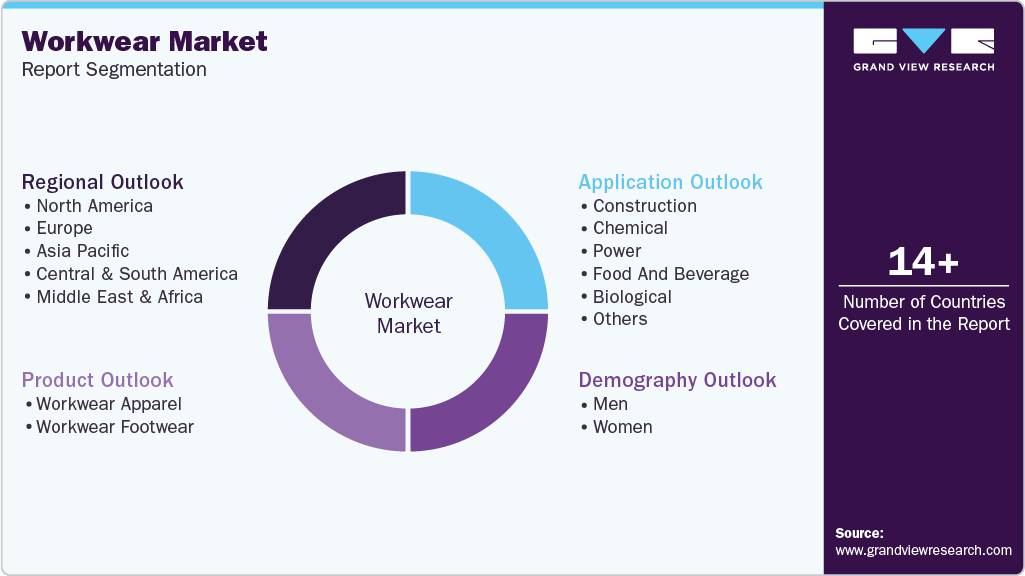
This report forecasts revenue growth at the global, regional & country levels and provides an analysis on the latest trends and opportunities in each of the sub-segments from 2021 to 2033. For this study, Grand View Research has segmented the global workwear market report based on product, demography, application, and region:
-
Product Outlook (Revenue, USD Billion, 2021 - 2033)
-
Workwear Apparel
-
General Workwear
-
Protective Workwear
-
-
Workwear Footwear
-
General Footwear
-
Protective Footwear
-
-
-
Demography Outlook (Revenue, USD Billion, 2021 - 2033)
-
Men
-
Women
-
-
Application Outlook (Revenue, USD Billion, 2021 - 2033)
-
Construction
-
Chemical
-
Power
-
Food and Beverage
-
Biological
-
Others
-
-
Regional Outlook (Revenue, USD Billion, 2021 - 2033)
-
North America
-
U.S.
-
Canada
-
Mexico
-
-
Europe
-
Germany
-
UK
-
France
-
Italy
-
Spain
-
-
Asia Pacific
-
China
-
Japan
-
India
-
South Korea
-
Australia & New Zealand
-
-
Central & South America
-
Brazil
-
-
Middle East & Africa
-
UAE
-
-
Frequently Asked Questions About This Report
b. Key factors driving growth in the workwear market include increasing awareness of workplace safety, stringent government regulations, and rising demand for protective and functional clothing. The expansion of industries such as construction, manufacturing, and oil & gas further fuels this demand. Additionally, the adoption of stylish and comfortable workwear is influencing purchasing decisions, blending utility with modern design.
b. The workwear apparel market accounted for a revenue share of 74.67% in 2025, driven by rising demand for durable, functional clothing and increased workplace safety regulations. The workwear apparel market is also fueled by growth in the industrial and construction sectors.
b. Some key players operating in workwear market include Carhartt, Inc.; Aramark (Vestis); Alsico Group; Alexandra; A. Lafont SAS; Hard Yakka; 3M; Ansell Ltd.; Honeywell International, Inc.; and Kimberly-Clark Corporation
b. The global workwear market size was estimated at USD 19.20 billion in 2025 and is expected to reach USD 20.04 billion in 2026.
b. The global workwear market is expected to grow at a compound annual growth rate (CAGR) of 4.9% from 2026 to 2033 to reach USD 28.08 billion by 2033.


Share this report with your colleague or friend.
Need a Tailored Report?
Customize this report to your needs — add regions, segments, or data points, with 20% free customization.


ISO 9001:2015 & 27001:2022 Certified
We are GDPR and CCPA compliant! Your transaction & personal information is safe and secure. For more details, please read our privacy policy.
Trusted market insights - try a free sample
See how our reports are structured and why industry leaders rely on Grand View Research. Get a free sample or ask us to tailor this report to your needs.