
- Home
- »
- Next Generation Technologies
- »
-
Wearable Technology Market Size, Industry Report, 2033GVR Report cover
![Wearable Technology Market Size, Share & Trends Report]()
Wearable Technology Market (2026 - 2033) Size, Share & Trends Analysis Report By Product (Wrist-Wear, Eyewear & Headwear, Footwear, Neckwear, Body-wear), By Application (Consumer Electronics, Healthcare), By Region, And Segment Forecasts
- Report ID: 978-1-68038-165-8
- Number of Report Pages: 120
- Format: PDF
- Historical Range: 2021 - 2025
- Forecast Period: 2026 - 2033
- Industry: Technology
- Report Summary
- Table of Contents
- Interactive Charts
- Methodology
- Download FREE Sample
-
 Download Sample Report
Wearable Technology Market Summary
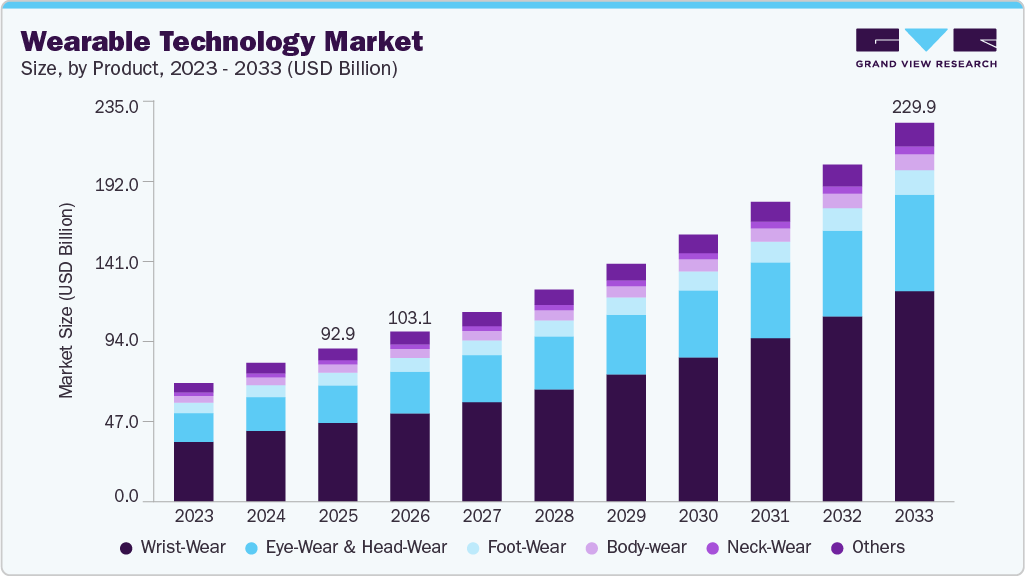
The global wearable technology market size was estimated at USD 92.90 billion in 2025 and is projected to reach USD 229.97 billion by 2033, growing at a CAGR of 12.1% from 2026 to 2033. The rising concerns for obesity and chronic diseases are significantly contributing to the adoption of wearable products such as body monitors and activity trackers.
Key Market Trends & Insights
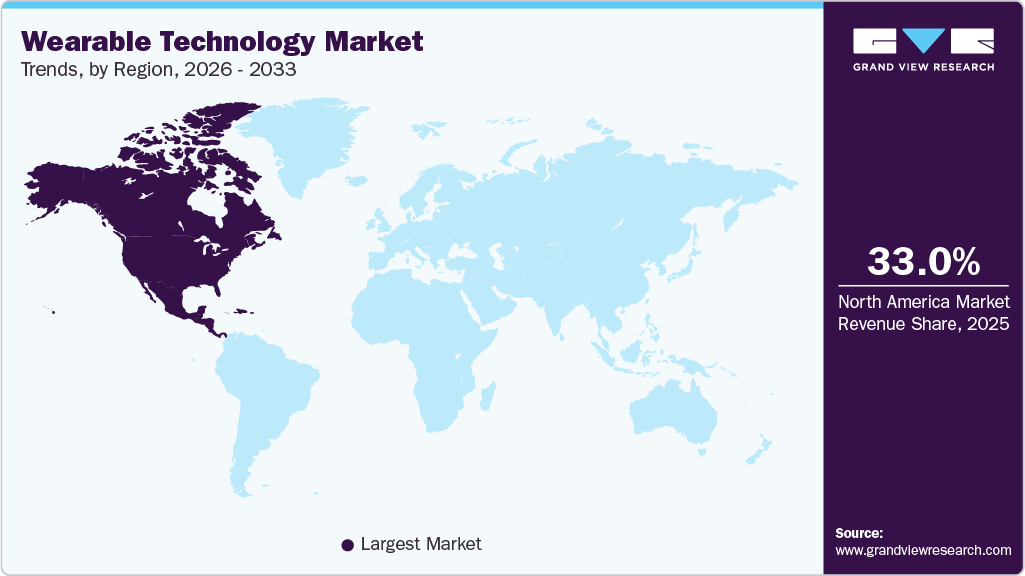
- North America held over 33.0% revenue share of the wearable technology market.
- The wearable technology market in U.S. is expected to grow significantly over the forecast period.
- By product, wrist-wear segment held the largest revenue share of 51.4% in 2025.
- By application, consumer electronics segment held the largest revenue share in 2025.
Market Size & Forecast
- 2025 Market Size: USD 92.90 Billion
- 2033 Projected Market Size: USD 229.97 Billion
- CAGR (2026-2033): 12.1%
- North America: Largest Market in 2025
Wearable devices help people track their health by showing information about heartbeat, sleep quality, blood pressure, cholesterol, oxygen levels, calories burned, and other important daily health data. In addition, devices such as smartwatches, earbuds, and smart shoes are becoming popular among a wide range of users, including athletes, adventurers, and fitness lovers. These devices give useful fitness information and encourage a healthier lifestyle by tracking things such as calories eaten, water intake, and steps walked. All of these factors are the main reasons expected to drive the growth of the wearable technology market during the forecast period.
The use of wearable devices is increasing quickly in the health and fitness field due to increasing awareness among consumers about physical health, proper diet, daily step counts, and different ways to monitor physical activities. Wearable devices allow users to track their activity levels, sleep quality, heart rate, and other important health indicators, helping them understand their habits and make improvements in their daily activities, lifestyle choices, and fitness routines. Modern and advanced wearable devices, such as fitness-tracking smartwatches, come equipped with features such as heart rate sensors, oxygen level monitoring, and glucose tracking, along with several other functions. These features help users monitor key health parameters and receive regular health updates that support better day-to-day health management.
The adoption of technology is increasing, and this is offering sports players such as runners, golf ball players, and football enthusiasts high-end wearable product categories such as smart sunglasses, smart shoes, smartwatches, smart body gear, and headphones. In July 2025, a new neural gesture-control wristband called Mudra Link was introduced, a wearable that uses advanced nerve conduction sensors to capture subtle finger movements and turn them into touch-free commands for devices such as phones, computers, AR/VR headsets, and more, showing how wearable tech continues to expand into intuitive and cutting-edge interaction. These kinds of innovations demonstrate how wearables are moving beyond traditional fitness tracking toward more immersive and interactive experiences, helping users monitor performance and engage with technology in new ways. Overall, these developments are helping drive the growth of the wearable technology market by making devices more useful, engaging, and applicable for sports, fitness, and daily life.
Product Insights
The wrist-wear segment dominated the wearable technology market in 2025, owing to the rising popularity of health and fitness, entertainment, gaming, and connected technology devices. The use of smartwatches is not only limited to sharing and receiving text messages and notifications, but it is now being actively used for health monitoring, calling, and music-controlling purposes. With the introduction of advanced technologies in wearable devices, key players are offering users information on health updates, fitness monitoring, and performance tracking when engaged in sports, gaming, music, and other related activities. For instance, in August 2025, the Google Pixel Watch 4 was officially announced, featuring upgraded health- and fitness-tracking capabilities powered by Wear OS and enhanced sensors that help users monitor a wide range of daily wellness metrics directly from their wrist. Overall, the growing functionality and versatility of wrist-wear devices continue to strengthen their adoption, reinforcing their leading position in the wearable technology market.
The eyewear & headwear segment is projected to grow at a significant CAGR from 2026 to 2033. Eyewear & headwear wearable devices, such as smart sunglasses, headbands, and helmets, are designed to monitor and track users’ biometric data, such as body temperature, brainwave, body pressure, and heart rate. Smart helmets help sports enthusiasts, including swimmers, riders, hikers, and travelers, gain insights, capture moments, and share real-time location updates with others. Furthermore, smart eyewear devices offer features to control music and take calls via intuitive and simple gesture controls.
Application Insights
The consumer electronics segment dominated the wearable technology market in 2025. The use of fashionable wearable devices provides influencers with a unique platform to showcase interactive content that can increase engagement and assist them in developing their brands. Moreover, companies approach influencers such as boAt, Xiaomi, and Samsung to partner with and promote their wearable device brands. The companies in the market target various customer groups looking for specifications, including brand name, affordability, durability, features, technology, and the latest product offerings.
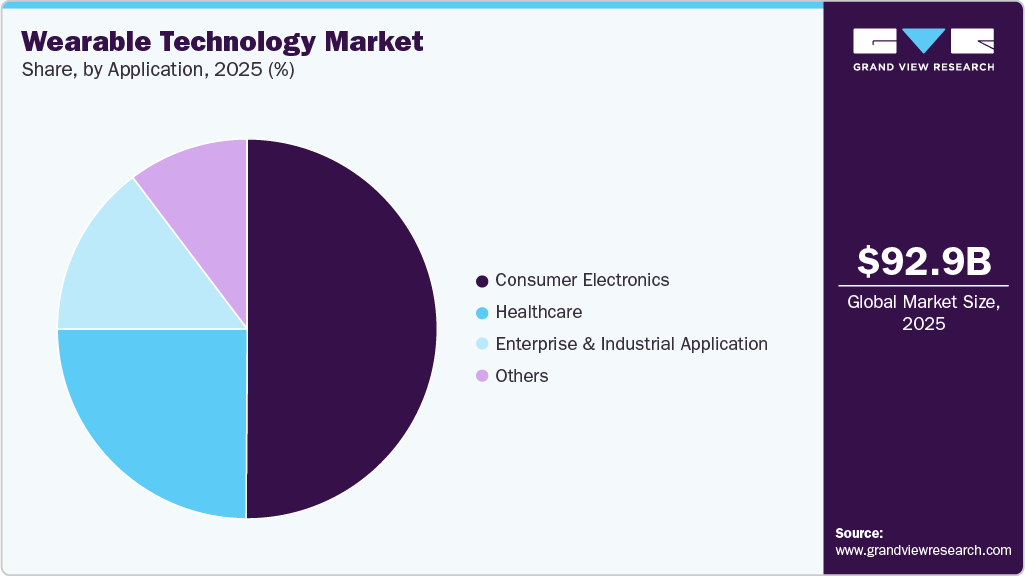
The healthcare segment is expected to grow at a significant CAGR from 2026 to 2033. Key market players are focusing on innovating and introducing breakthrough wearable technologies for monitoring everyday consumer health, including blood sugar levels, heart rate, oxygen rate, and stress levels, among others. Furthermore, the rising innovations in wearable rings, bodywear, and wristwear devices to gain real-time health updates, early detection and prevention, and unwanted healing issues are expected to drive the growth of the segment over the forecast period.
Regional Insights
North America wearable technology industry held the major revenue share of over 33% of the wearable technology market in 2025. Countries in this region, including the U.S. and Canada, are home to some of the world’s leading technology companies, such as Google LLC and Apple Inc., which are actively involved in developing and selling wearable technology products. Factors such as rising health concerns, increasing awareness about fitness and healthy lifestyles, and the growing popularity of sports activities have been key contributors to the growth of the wearable technology market in North America over the last few years.
U.S. Wearable Technology Market Trends
The wearable technology industry in the U.S. is expected to grow significantly from 2026 to 2033. Some of the major trends supporting this growth include a rising preference for wearable devices such as smartwatches, smart shoes, and smart sunglasses that offer features such as long battery life and water resistance. In addition, the increasing demand for earbuds and headphones equipped with active noise cancellation and advanced sound-control technologies is further driving the expansion of the U.S. wearable technology market.
Asia Pacific Wearable Technology Market Trends
The wearable technology market in the Asia Pacific is growing at a significant CAGR from 2026 to 2033. The rising demand for affordable wearable devices that offer advanced and innovative features is driving the growth of the Asia Pacific wearable technology market. Because of this, manufacturers are increasingly including advanced functions in newly launched wearable products in the region, such as voice assistant compatibility, water-resistant designs, health monitoring and management features, as well as personal alerts and notification capabilities, among other features.
The Japan wearable technology industry is expected to grow rapidly in the coming years. Rapid technological progress, a high level of reliance on private-sector jobs, and relatively long working hours and commuting times are some of the major factors expected to fuel the growth of the wearable technology market in Japan during the forecast period.
The wearable technology market in China held a significant revenue share in 2025. The presence of large contract manufacturers and component suppliers, along with the easy availability of raw materials and manufacturing resources, is expected to strongly support the growth of the wearable technology market in China over the forecast period.
Europe Wearable Technology Market Trends
The wearable technology industry in Europe is growing significantly from 2026 to 2033. A huge customer base scouting for zero-impact and sustainable electronic devices has been building up lately across Europe. At the same time, various governments across Europe have also been drafting favorable regulations for environmental safety, thereby promoting the adoption of sustainable, high-tech wearable gadgets in the region.
The UK wearable technology market is growing significantly from 2026 to 2033. In the UK, the demand for earbuds, smartwatches, and smart shoes, which offer standard features, such as Bluetooth connectivity, tracking, controlling, and better synchronization with other smart devices, is particularly prompting market players to diversify their product offerings to meet the unique requirements and specifications across different categories of customers in the country.
The Germany wearable technology market is expected to grow significantly from 2026 to 2033. In Germany, the growing preference for high-quality audio products, fitness watches, and smart eyewear is prompting key market players to pursue technological improvements, thereby driving the growth of the German wearable technology market over the forecast period.
Key Wearable Technology Company Insights
Some of the key companies operating in the market include Google LLC, Apple Inc., adidas AG., Garmin Ltd., Huawei Technologies Co., Ltd., Nike, Inc., among others. Some of the leading participants in the wearable technology industry are.
-
Apple Inc. is an American multinational technology company known for designing and selling consumer electronics, software, and digital services worldwide. It offers products such as the iPhone, iPad, Mac, AirPods, and Apple Watch, with the Apple Watch and AirPods leading the global wearable market through advanced health, fitness tracking, connectivity, and ecosystem integration. Apple continues innovating wearables with enhanced features and capabilities.
-
Garmin Ltd., founded in 1989, is an American multinational technology company that develops, designs, and sells GPS-enabled products and wearable devices globally. The company offers smartwatches, fitness trackers, cycling and outdoor wearables, and services focused on health, fitness, and navigation. Garmin is known for purpose-built wearables with long battery life and advanced tracking, particularly for sports and active users.
Key Wearable Technology Companies:
The following key companies have been profiled for this study on the wearable technology market
- adidas AG
- Apple Inc.
- Fossil Group
- Garmin Ltd.
- Google LLC
- Huawei Technologies Co., Ltd.
- Imagine Marketing Ltd.
- Nike, Inc.
- Oura Health Oy
- Polar Electro
- Samsung Electronics Co., Ltd.
- Sony Corporation
- SUUNTO
- WHOOP
- Xiaomi
Recent Developments
-
In July 2025, Samsung Electronics agreed to acquire U.S. digital health platform Xealth, aiming to combine its advanced wearable technology ecosystem with Xealth’s clinical integration tools to bridge the gap between everyday wellness monitoring and medical care. This move will link data from Samsung wearables with hospital systems across more than 500 healthcare providers, supporting connected preventive care and real‑time health insights.
-
In April 2025, Wearable Devices Ltd. secured a U.S. patent for its gesture and voice‑controlled interface technology, strengthening its intellectual property in AI‑powered touchless wearables. The patent enables seamless, hands‑free control by combining natural gestures with voice commands, improving interaction for devices such as AR glasses, smart home systems, and other wearable interfaces. This development marks a key milestone in advancing intuitive wearable tech.
Wearable Technology Market Report Scope
Report Attribute
Details
Market size value in 2026
USD 103.10 billion
Revenue forecast in 2033
USD 229.97 billion
Growth rate
CAGR of 12.1% from 2026 to 2033
Actual data
2021 - 2025
Forecast period
2026 - 2033
Quantitative units
Revenue in USD million/billion and CAGR from 2026 to 2033
Report coverage
Revenue forecast, company share, competitive landscape, growth factors, and trends
Segments covered
Product, application, region
Regional scope
North America; Europe; Asia Pacific; Latin America; MEA
Country scope
U.S.; Canada; Mexico UK; Germany; France; China; India; Japan; Australia; South Korea; Brazil; UAE; Saudi Arabia; South Africa
Key companies profiled
adidas AG; Apple Inc.; Fossil Group; Garmin Ltd.; Google LLC; Huawei Technologies Co., Ltd.; Imagine Marketing Ltd.; Nike, Inc.; Oura Health Oy; Polar Electro; Samsung Electronics Co., Ltd.; Sony Corporation; SUUNTO; WHOOP; Xiaomi
Customization scope
Free report customization (equivalent to 8 analysts working days) with purchase. Addition or alteration to country, regional & segment scope.
Pricing and purchase options
Avail customized purchase options to meet your exact research needs. Explore purchase options
Global Wearable Technology Market Report Segmentation
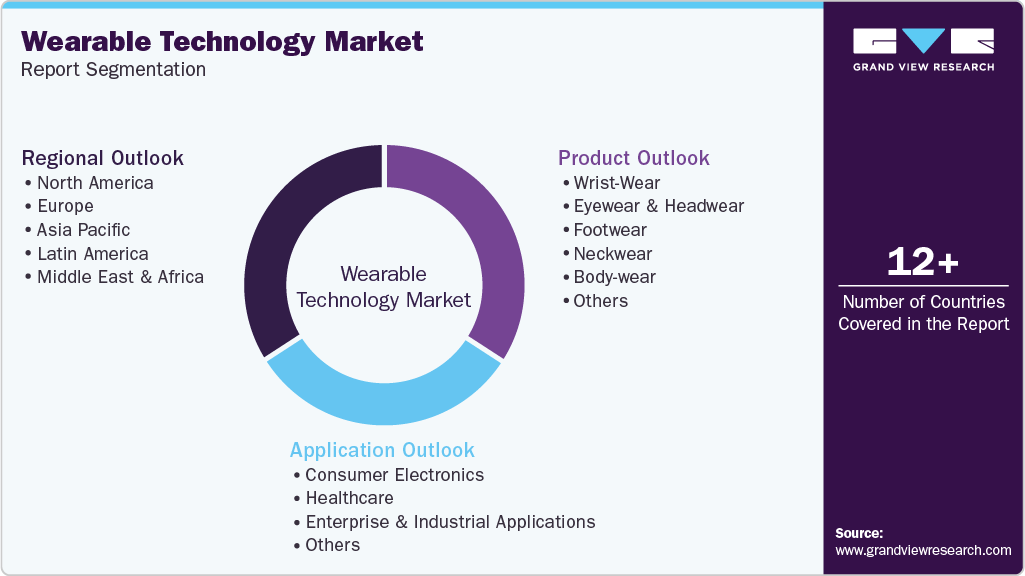
This report forecasts revenue growth at global, regional, and country levels and provides an analysis of the latest industry trends in each of the sub-segments from 2021 to 2033. For this study, Grand View Research has segmented the global wearable technology market report based on product, application, and region.
-
Product Outlook (Revenue, USD Billion, 2021 - 2033)
-
Wrist-Wear
-
Eyewear & Headwear
-
Footwear
-
Neckwear
-
Body-wear
-
Others
-
-
Application Outlook (Revenue, USD Billion, 2021 - 2033)
-
Consumer Electronics
-
Healthcare
-
Enterprise & Industrial Applications
-
Others
-
-
Regional Outlook (Revenue, USD Billion, 2021 - 2033)
-
North America
-
U.S.
-
Canada
-
Mexico
-
-
Europe
-
Germany
-
UK
-
France
-
-
Asia Pacific
-
China
-
India
-
Japan
-
South Korea
-
Australia
-
-
Latin America
-
Brazil
-
-
Middle East & Africa
-
UAE
-
Saudi Arabia
-
South Africa
-
-
Frequently Asked Questions About This Report
b. The global wearable technology market is expected to grow at a compound annual growth rate of 12.1% from 2026 to 2033 to reach USD 229.97 billion by 2033.
b. North America dominated the wearable technology market with a share of 33% in 2025. This is attributable to the increasing health awareness and multimedia device demand in the region.
b. Key factors that are driving the wearable technology market growth include increasing smartphones & multimedia device demand, infrastructure developments in the mobile industry, and rising disposable income in developing economies.
b. The global wearable technology market size was estimated at USD 92.90 billion in 2025 and is expected to reach USD 103.10 billion in 2026.
b. Some key players operating in the wearable technology market include adidas AG; Apple Inc.; Fossil Group; Garmin Ltd.; Google LLC; Huawei Technologies Co., Ltd.; Imagine Marketing Ltd.; Nike, Inc.; Oura Health Oy; Polar Electro; Samsung Electronics Co., Ltd.; Sony Corporation; SUUNTO; WHOOP; Xiaomi


Share this report with your colleague or friend.
Need a Tailored Report?
Customize this report to your needs — add regions, segments, or data points, with 20% free customization.


ISO 9001:2015 & 27001:2022 Certified
We are GDPR and CCPA compliant! Your transaction & personal information is safe and secure. For more details, please read our privacy policy.
Trusted market insights - try a free sample
See how our reports are structured and why industry leaders rely on Grand View Research. Get a free sample or ask us to tailor this report to your needs.












