- Home
- »
- Homecare & Decor
- »
-
Travel Retail Market Size And Share, Industry Report, 2033GVR Report cover
![Travel Retail Market Size, Share & Trends Report]()
Travel Retail Market (2026 - 2033) Size, Share & Trends Analysis Report By Product (Perfume & Cosmetics, Wines & Spirits, Fashion & Accessories, Tobacco Products, Electronics and Gifts, Food and Confectionery), By Distribution Channel, By Region, And Segment Forecasts
- Report ID: GVR-2-68038-668-4
- Number of Report Pages: 100
- Format: PDF
- Historical Range: 2021 - 2025
- Forecast Period: 2026 - 2033
- Industry: Consumer Goods
- Report Summary
- Table of Contents
- Interactive Charts
- Methodology
- Download FREE Sample
-
 Download Sample Report
Travel Retail Market Summary
The global travel retail market size was estimated at USD 81.89 billion in 2025 and is projected to reach USD 172.64 billion in 2033, growing at a CAGR of 9.9% from 2026 to 2033. The market is being structurally reshaped by rising international passenger traffic, the growing financial centrality of duty-free retail, and shifting purchasing behavior among younger and high-spending traveler segments.
Key Market Trends & Insights
- Based on region, Asia Pacific held the largest market share of 53.5% in 2025.
- The China travel retail industry held a 29.4% revenue share of Asia Pacific in 2025.
- Based on product, the perfume and cosmetics segment held the largest revenue share of 41.3% in 2025.
- By distribution channel, sales of travel retail products through airports and airlines dominated the market, with a share of 56.3% in 2025.
Market Size & Forecast
- 2025 Market Size: USD 81.89 Billion
- 2033 Projected Market Size: USD 172.64 Billion
- CAGR (2026-2033): 9.9%
- Asia Pacific: Largest market in 2025
According to UN Tourism, international tourist arrivals reached approximately 1.52 billion in 2025, up 4% year-on-year, reflecting sustained global travel demand and near stabilization at pre-pandemic growth levels. This recovery directly supports higher throughput at airports and travel hubs, which remain the primary commercial engines of travel retail. Increased passenger mobility translates into higher exposure to duty-free and travel-exclusive retail formats, reinforcing sales growth across fragrances, cosmetics, confectionery, alcohol, and luxury goods.
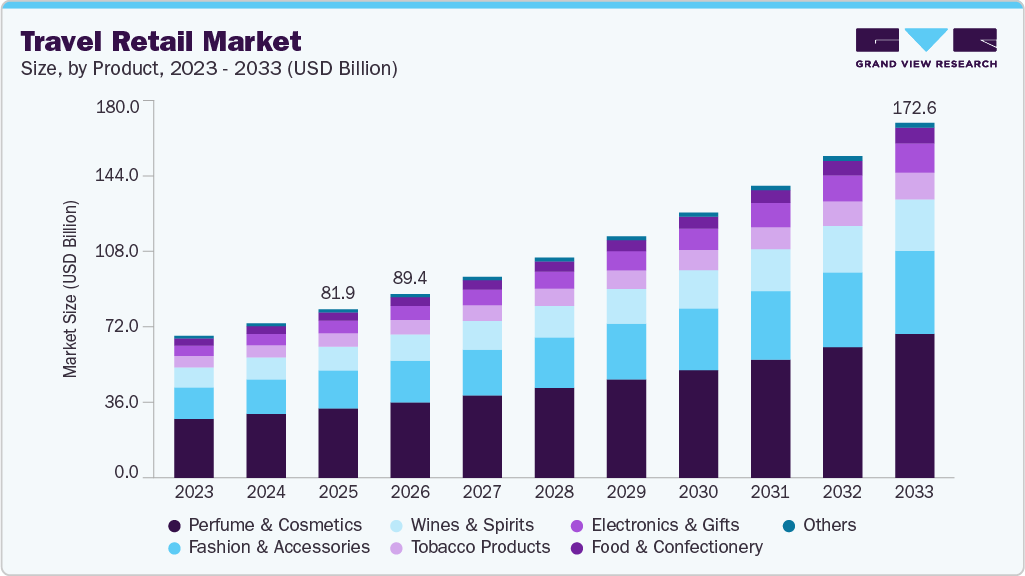
Passenger traffic growth at regional airports further illustrates this momentum. According to a Times of India article in February 2026, Sardar Vallabhbhai Patel International Airport in Ahmedabad recorded a 9.3% increase in passenger traffic in 2025, with total footfall rising from 12.79 million in 2024 to 13.98 million in 2025, adding nearly 1.2 million additional passengers within a single year. The increase was attributed to rising business and leisure travel, economic activity, and large-scale events. This traffic growth is commercially significant because airport retail performance is directly proportional to passenger throughput. Every incremental million passengers increases conversion opportunities in duty-free, particularly in departure lounges where dwell time supports impulse purchasing.
Duty-free retail has evolved from a supplementary revenue stream to the financial backbone of airport economics, particularly across Asia-Pacific and the Middle East. In the Middle East, duty-free sales contribute exceptionally high shares of total airport retail revenue. Duty-free accounts for 31% of total sales in Saudi Arabia, 36% in the UAE, 38% in Qatar, 34% in Bahrain, and 31% in Oman. Revenue dependence is even more pronounced, reaching around 60% in Saudi Arabia and Qatar, and exceeding 50% in the UAE, Bahrain, and Oman. This demonstrates that airport commercial viability in these regions is deeply intertwined with duty-free performance. Product mix also varies regionally. Middle Eastern baskets skew toward confectionery and perfumes, while Asia-Pacific and Oceania hubs exhibit stronger premium and alcohol-driven demand.
Furthermore, retail purchase behavior within airports remains predominantly in-store and impulse-led. Approximately 70% of travel retail purchases are impulse-driven, highlighting the importance of product visibility, pricing, and promotional intensity over experiential ambience alone. Product choice accounts for 39% of purchase motivation, while pricing and promotions contribute 29%, collectively explaining nearly 70% of purchase drivers. “Experience” as a standalone factor influences only 20% of purchasing decisions, while ease of access, time efficiency, and frictionless checkout rank higher in importance. Although digital engagement among Gen Z is rising, digital tools currently account for only 2% of incremental sales uplift, functioning more as journey support than as direct conversion channels.
A strategic gap is also emerging around sustainability. While 65% of Gen Z travelers indicate willingness to pay more for sustainable products, only 20% of airports currently treat sustainability as a core retail decision factor, revealing misalignment between traveler expectations and airport retail execution.
Brand Market Share Insights
The global travel retail market is characterized by the presence of major international duty-free operators, airport concessionaires, cruise retail specialists, and brand-owned travel-exclusive stores, all competing to capture high-spending international travelers across airports, border shops, and seaports. Operators are focusing on premium store layouts, optimized product zoning, and high-margin categories such as fragrances, cosmetics, premium spirits, confectionery, electronics, and luxury accessories to maximize per-passenger spend.
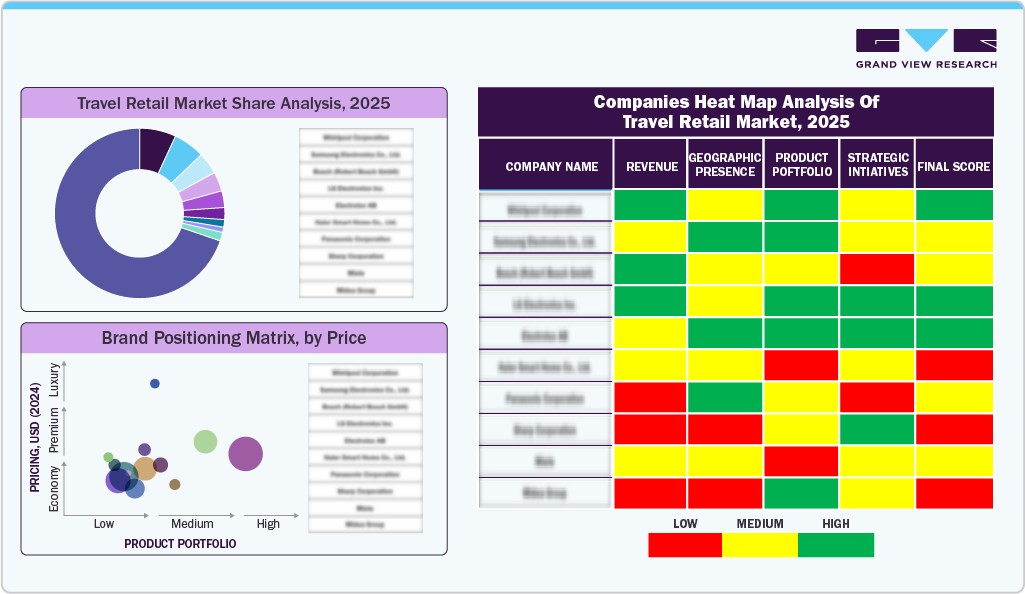
Retailers are also enhancing omnichannel integration through pre-order platforms, click-and-collect services, loyalty programs, and mobile payment solutions to improve conversion rates. Passenger analytics and nationality-based assortment planning are increasingly guiding merchandising strategies, while structured concession and revenue-sharing agreements continue to position travel retail as a core commercial pillar within the global aviation ecosystem.
Consumer Insights
Consumer buying behavior in travel retail is influenced by a mix of emotional, situational, and cultural factors that are unique to the travel environment. Travelers are often drawn to perceived value through tax-free pricing and discounts, leading them to make purchases they might not consider in regular retail settings. The convenience of shopping during idle time at airports or cruise terminals encourages impulse buying, while the availability of exclusive or limited-edition items adds urgency and appeal. A wide selection of luxury and premium brands further enhances this, with many consumers viewing travel as an opportunity to indulge or reward themselves.
Emotional connections to well-known brands play a significant role, as travelers often associate these names with status, quality, or personal identity. Cultural influences also shape buying decisions, with tourists seeking products that reflect their destination or make thoughtful souvenirs. Marketing efforts, including eye-catching displays and time-limited promotions, are designed to capture attention and drive quick decisions. Social proof via peer recommendations or influencer endorsements adds another layer of influence. Ultimately, a smooth, engaging shopping experience, combined with these drivers, makes travel retail a powerful channel for consumer spending.
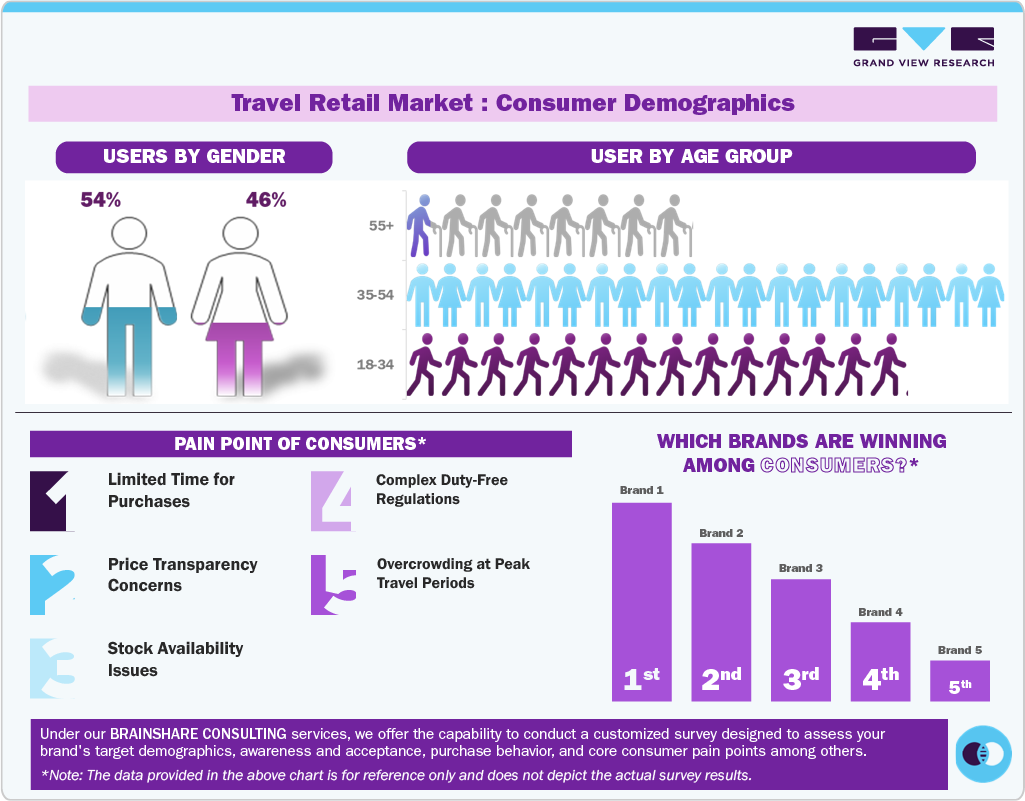
According to a survey conducted by China Trading Desk in January 2025, over 70% of Gen Z travelers rely on social media platforms for product discovery before travel, and more than 60% report that influencer recommendations directly impact their purchasing decisions. This indicates that purchase intent is often formed before arriving at airports, shifting the traditional impulse-driven nature of duty-free shopping toward pre-planned, digitally influenced buying behavior.
The survey further highlights that nearly 50% of Gen Z consumers actively compare products online before making travel retail purchases, and a substantial proportion prioritize authenticity, sustainability, and brand transparency when selecting products. Social proof plays a decisive role, with trending beauty, fragrance, and luxury items frequently generating immediate demand in airport stores when amplified through platforms such as TikTok and Xiaohongshu. While tax-free pricing remains attractive, value perception among this cohort is increasingly linked to exclusivity, limited editions, and shareable product experiences rather than discounts alone. These insights demonstrate that global travel retail growth is becoming closely tied to pre-trip digital engagement strategies. Airports and duty-free operators must therefore align in-store availability with online trends, integrate mobile payment systems, and ensure visibility for viral or influencer-endorsed products to convert digitally primed travelers into buyers effectively.
Trump’s Tariff Impact
The global travel retail market is increasingly exposed to geopolitical trade tensions and tariff uncertainty, particularly in relation to U.S. - China economic relations. According to the Moodie Davitt Report published in April 2025, Chinese consumers account for an estimated 30% to 40% of global luxury spending, a substantial share historically captured through international travel retail channels. The report highlights that Chinese travelers remain the single most influential nationality in duty-free and airport retail, particularly in premium beauty, fragrance, watches, jewelry, and high-end spirits. Given this concentration, any disruption to Chinese outbound travel, currency strength, or discretionary luxury spending carries direct implications for global airport commercial revenues.
The April 2025 analysis also underscores that tariff volatility introduces structural cost pressures across globally integrated supply chains. Travel retail relies heavily on multi-country production networks, cross-border ingredient sourcing, and international logistics systems. The imposition or escalation of tariffs can increase landed product costs, compress retailer margins, and reduce the tax-price advantage that duty-free channels depend upon. If pricing differentials between airport retail and domestic markets narrow due to tariff-driven cost inflation, the competitive positioning of travel-exclusive retail weakens, particularly among value-conscious international travelers.
Additionally, the report notes that travel retail operators operate under a high-dependency model, in which luxury categories drive a disproportionate share of airport commercial income. In several global hubs, premium beauty and luxury goods represent the largest revenue contributors within duty-free assortments. Any slowdown in Chinese outbound luxury demand, therefore, has a multiplier effect across the airport retail ecosystems in Asia-Pacific, the Middle East, and Europe. The combination of tariff risk, concentration of luxury spending among Chinese consumers, and supply chain exposure introduces a layer of macroeconomic vulnerability that could redefine pricing strategy, assortment planning, and profitability dynamics across the global travel retail market.
Product Insights
The demand for perfumes and cosmetics dominated the travel retail industry, accounting for a share of 41.3% in 2025. The growing number of international travelers provides a captive audience for these high-margin products, which are often viewed as convenient and desirable purchases during travel. Duty-free pricing offers significant savings, making luxury brands more accessible and appealing. For instance, in July 2025, Dubai Duty Free reported its strongest-ever half-year performance, generating over USD 1.12 billion in revenue, reflecting solid growth compared to the previous year. Perfumes remained the leading category, accounting for a significant share of total sales, while cosmetics also contributed to overall gains. The results underscore the continued strength of travel retail, with fragrance and beauty purchases driving higher passenger spending during peak travel periods.
Additionally, travelers are drawn to exclusive product ranges and travel-exclusive sets that are not available in regular retail outlets. The convenience of purchasing high-quality beauty products at travel hubs, coupled with the allure of tax-free shopping, drives robust sales growth in this segment.
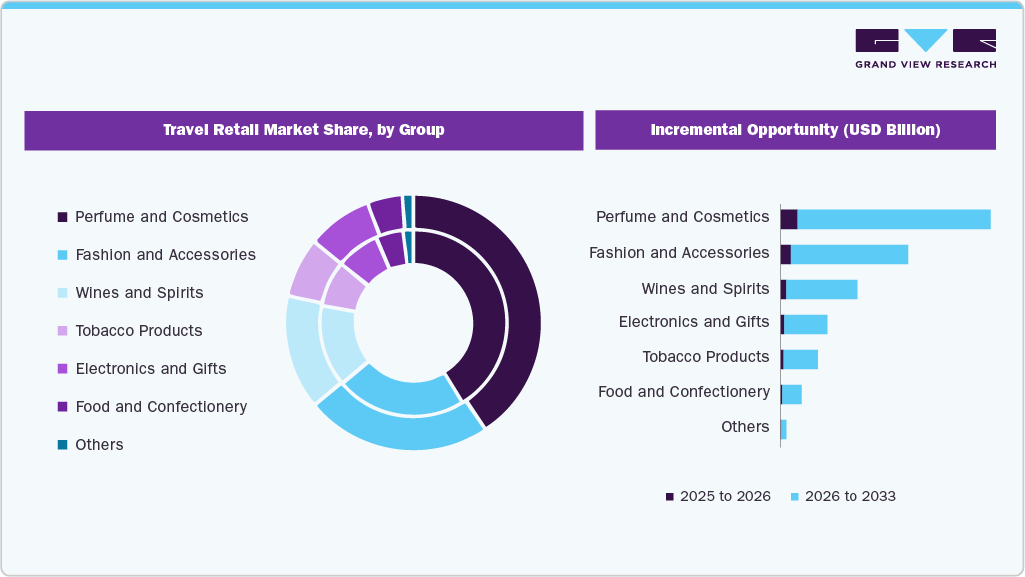
The demand for electronics and gifts is expected to grow at a CAGR of 11.2% from 2026 to 2033. Tech-oriented travelers are leveraging travel retail to acquire branded gadgets, such as wireless audio devices, smart accessories, travel adapters, and portable electronics, at tax-advantaged prices. The perceived savings on globally recognized technology brands enhance purchase motivation, particularly for premium products with higher price points. At the same time, electronics and branded lifestyle accessories are frequently purchased as gifts, especially among outbound travelers from Asia-Pacific and the Middle East, where gifting culture supports higher transaction values. Limited-time promotions, travel-exclusive bundles, and compact, carry-friendly formats further stimulate demand, reinforcing strong projected growth for electronics and gifts within the global travel retail market.
Distribution Channel Insights
The demand for travel retail products at airports and airline outlets held a market share of 56.3% in 2025. Increasing long-haul connectivity, expanded flight routes, and higher outbound tourism volumes have significantly enlarged the captive shopper base for duty-free and travel-exclusive outlets. Airport environments benefit from extended dwell times, structured store layouts, and concentrated exposure to premium brands, which collectively encourage impulse purchases across high-margin categories such as fragrances, cosmetics, spirits, luxury accessories, and travel essentials. In addition, airline onboard retail programs and pre-order duty-free services further strengthen channel penetration by reaching passengers during flight. Continued investment in terminal modernization, commercial space expansion, and curated brand partnerships reinforces airports and airline outlets as the primary revenue-generating channel.
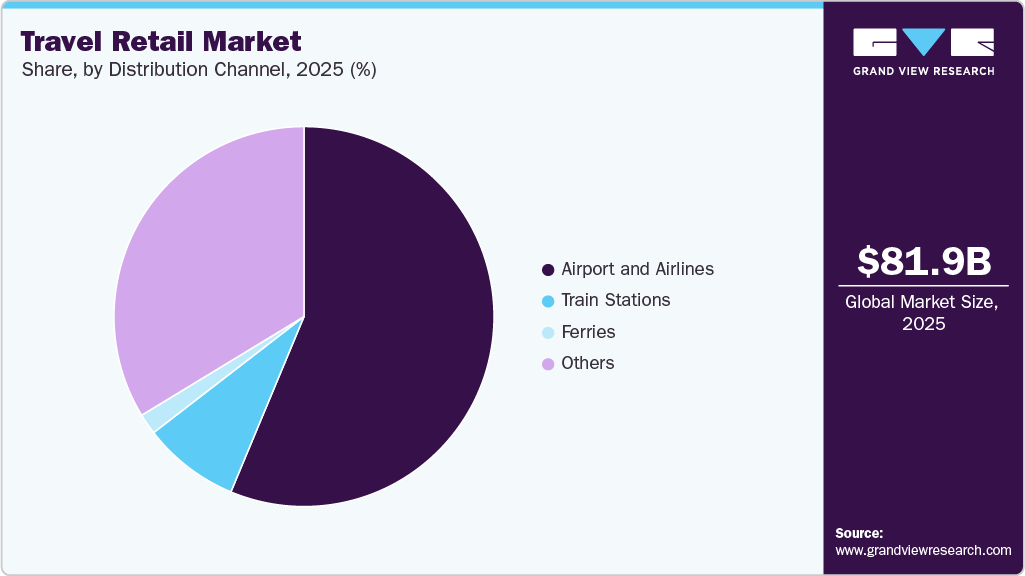
The demand through railway station outlets/shops is projected to grow at a CAGR of 9.6% over the forecast period of 2026-2033. The growing number of rail passengers, driven by improved infrastructure and expanded services, increases foot traffic at railway stations. The convenience and accessibility of retail outlets within these transit hubs cater to travelers seeking quick, high-quality purchases during their journey. Additionally, the availability of a diverse range of products, from snacks and beverages to travel essentials and souvenirs, meets the immediate needs of travelers.
Regional Insights
The North America travel retail market held a market share of 12.4% of the global revenue in 2025, driven by high outbound travel frequency, strong cross-border shopping flows between the U.S., Canada, and Mexico, and a well-developed duty-free border store network, in addition to airport retail. The region benefits from a mature aviation ecosystem with extensive international route connectivity, which supports steady passenger throughput across major gateway airports. Growth is further supported by premiumization trends, with travelers increasingly purchasing high-value categories such as luxury fragrances, spirits, and designer accessories. In addition, structured concession agreements, revenue-sharing models between airports and retail operators, and data-driven merchandising strategies enhance commercial performance and maximize per-passenger spend.
U.S. Travel Retail Market Trends
The U.S. travel retail industry led North America, accounting for a revenue share of 82.2% in 2025, driven by high international passenger throughput across major hub airports, strong consumer spending on premium goods, and the country’s position as a leading global travel destination. Large gateway airports such as New York, Los Angeles, and Miami handle substantial long-haul traffic, creating consistent footfall for duty-free outlets. Growth is further supported by strong demand in high-margin categories, including fragrances, luxury spirits, and beauty products, as well as by advanced airport retail infrastructure and established concession partnerships that maximize per-passenger spend.
The Canada travel retail market is expected to grow at a CAGR of 9.4% from 2026 to 2033, driven by rising international arrivals, strong cross-border travel with the U.S., and expanding long-haul connectivity through major hubs such as Toronto and Vancouver. Increasing outbound leisure travel and a steady influx of tourists are strengthening passenger volumes across key airports, supporting higher retail footfall. Growth is further supported by demand for premium spirits, fragrances, and confectionery, particularly among Asian and U.S. travelers.
Europe Travel Retail Market Trends
The Europe travel retail industry accounted for a share of 25.9% in 2025. It benefits from dense short-haul and long-haul connectivity, supporting consistent passenger throughput across airports in the UK, France, Germany, Spain, and Italy. A large base of outbound and transit travelers with strong purchasing power sustains demand for luxury fragrances, premium spirits, fashion accessories, and confectionery within duty-free channels. In addition, Europe’s mature concession frameworks, competitive tender processes, and well-developed airport retail layouts enhance category performance and maximize per-passenger spending, reinforcing the region’s significant contribution to the global travel retail market.
The travel retail market in the UK led Europe, accounting for a revenue share of 26.5% in 2025, driven by its position as a major international aviation gateway, with London’s multi-airport system handling substantial long-haul and transit passenger traffic. Strong outbound leisure travel and high-spending international visitors support robust sales across duty-free categories such as premium spirits, fragrances, cosmetics, and luxury confectionery. The reinstatement of duty-free sales on outbound travel has further strengthened price competitiveness and basket sizes. In addition, established concession partnerships, premium brand presence, and continuous terminal upgrades enhance retail visibility and conversion rates.
France’s travel retail marketis expected to grow at a CAGR of 10.2% from 2026 to 2033. The growth is driven by strong inbound tourism, high passenger volumes at major hubs such as Charles de Gaulle and Orly in Paris, and the country’s global positioning as a luxury and fashion capital. A steady flow of long-haul travelers from Asia, the Middle East, and North America supports sustained demand for premium fragrances, cosmetics, wines, and designer accessories within airport retail channels. France also benefits from its reputation in beauty and gastronomy, which enhances conversion rates in high-margin categories such as perfumes, skincare, champagne, and gourmet products.
Asia Pacific Travel Retail Market Trends
The Asia Pacific travel retail industry accounted for a share of 53.5% in 2025, driven by its position as the world’s largest international passenger corridor, supported by dense aviation networks, rapid airport expansion, and strong outbound tourism from China, South Korea, India, and Southeast Asia. Major hubs such as Singapore, Seoul, Hong Kong, and Bangkok function as high-volume transit centers, generating substantial dwell time and retail conversion opportunities. Rising middle-class incomes and a strong appetite for premium beauty, luxury fashion, watches, and high-end spirits continue to elevate per-passenger spending across duty-free formats.
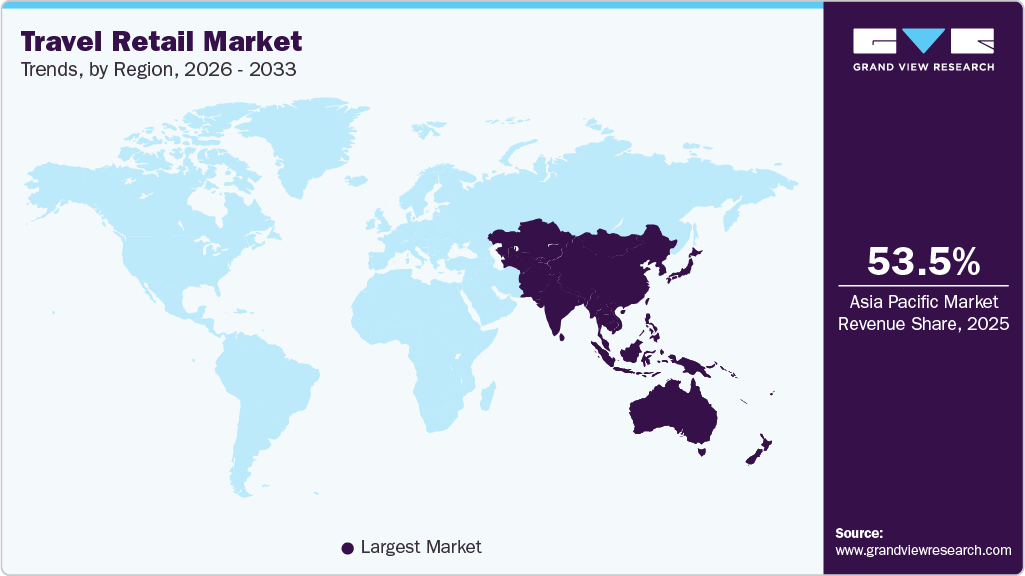
The travel retail market in China dominated Asia Pacific, accounting for a revenue share of 29.4% in 2025, driven by expanding offshore and downtown duty-free networks, rising middle-class purchasing power, and strong consumer preference for premium international brands. Growth is further supported by high spending on beauty, skincare, luxury accessories, and premium liquor, particularly for gifting purposes. In addition, integrated digital payment systems and mobile-driven promotions enhance purchase convenience and basket size, reinforcing China’s leading contribution within the Asia Pacific travel retail market.
The India travel retail market is expected to grow at a CAGR of 10.6% from 2026 to 2033, driven by rapid growth in international air traffic, expansion of airport infrastructure across metro and tier-two cities, and rising outbound travel among middle- and upper-income consumers. Major hubs such as Delhi, Mumbai, and Bengaluru are witnessing higher long-haul connectivity, longer passenger dwell times, and retail conversion opportunities. Strong demand for premium fragrances, cosmetics, confectionery, and imported spirits is supported by brand aspiration and price advantages in duty-free formats. In addition, terminal modernization programs and expanded retail concessions are enhancing store footprints and product assortments, reinforcing the sustained market growth.
Central & South America Travel Retail Market Trends
The Central & South America travel retail industry is expected to grow at a CAGR of 7.0% from 2026 to 2033. The Central & South America travel retail industry is driven by rising international tourism, expanding air connectivity across key hubs such as São Paulo, Mexico City, and Panama City, and increasing outbound travel within the region. Growth in middle-income travelers and stronger regional business travel are supporting higher passenger volumes and retail footfall. Demand is particularly strong in categories such as premium spirits, fragrances, confectionery, and luxury accessories, where duty-free pricing provides a clear value advantage.
Middle East & Africa Travel Retail Market Trends
The Middle East & Africa travel retail industry is expected to grow at a CAGR of 8.1% from 2026 to 2033, driven by rapid aviation capacity expansion, national tourism diversification strategies, and rising outbound travel among affluent Gulf populations. Government-backed investments in mega-airport developments and integrated airport cities are increasing commercial retail space and enhancing passenger circulation through duty-free zones. The region also benefits from high spending on luxury beauty, watches, electronics, and premium confectionery, particularly among transit and long-haul travelers. In Africa, improving international connectivity and growing middle-class air travel are gradually expanding the retail customer base, supporting the sustained market growth.
Key Travel Retail Companies:
The following key companies have been profiled for this study on the travel retail market.
- Avolta AG
- Lotte Corporation
- China Duty Free Group Co. Ltd.
- LVMH Moët Hennessy Louis Vuitton (DFS Group)
- Gebr. Heinemann SE & Co. KG
- Lagardere Travel Retail Group
- The Shilla Duty Free
- The King Power International Group
- Aer Rianta International cpt
- Duty Free Americas
Recent Developments
-
In February 2026, Michael Kors expanded its travel retail presence in India with the opening of a new store at Navi Mumbai International Airport. The outlet offers a curated selection of the brand’s handbags, accessories, and lifestyle products, tailored for international and domestic travellers, reinforcing its focus on premium airport retail environments. The launch supports the brand’s strategy to enhance luxury shopping experiences in key transit hubs and deepen its footprint in India’s growing travel retail market.
-
In August 2025, Lagardère Travel Retail secured new retail contracts at Madinah and Tabuk airports, further strengthening its presence in Saudi Arabia. The company will operate a mix of duty-free and travel retail concepts tailored to passenger needs at both airports. This move supports its broader strategy to expand across key Middle Eastern aviation hubs amid rising regional air traffic and infrastructure development.
Travel Retail Market Report Scope
Report Attribute
Details
Market size value in 2026
USD 89.39 billion
Revenue forecast in 2033
USD 172.64 billion
Growth rate
CAGR of 9.9% from 2026 to 2033
Actual data
2021 - 2025
Forecast period
2026 - 2033
Quantitative units
Revenue in USD million/billion, and CAGR from 2026 to 2033
Report coverage
Revenue forecast, company ranking, competitive landscape, growth factors, and trends
Segments covered
Product, distribution channel, region
Regional scope
North America; Europe; Asia Pacific; Central & South America; Middle East & Africa
Country scope
U.S.; Canada; Mexico; UK; Germany; France; Italy; Spain; China; India; Japan; Australia & New Zealand; South Korea; Brazil; South Africa
Key companies profiled
Avolta AG; Lotte Corporation; China Duty Free Group Co. Ltd.; LVMH Moët Hennessy Louis Vuitton (DFS Group); Gebr. Heinemann SE & Co. KG; Lagardere Travel Retail Group; The Shilla Duty Free; The King Power International Group; Aer Rianta International cpt; Duty Free Americas
Customization scope
Free report customization (equivalent up to 8 analysts working days) with purchase. Addition or alteration to country, regional & segment scope.
Pricing and purchase options
Avail customized purchase options to meet your exact research needs. Explore purchase options
Global Travel Retail Market Report Segmentation
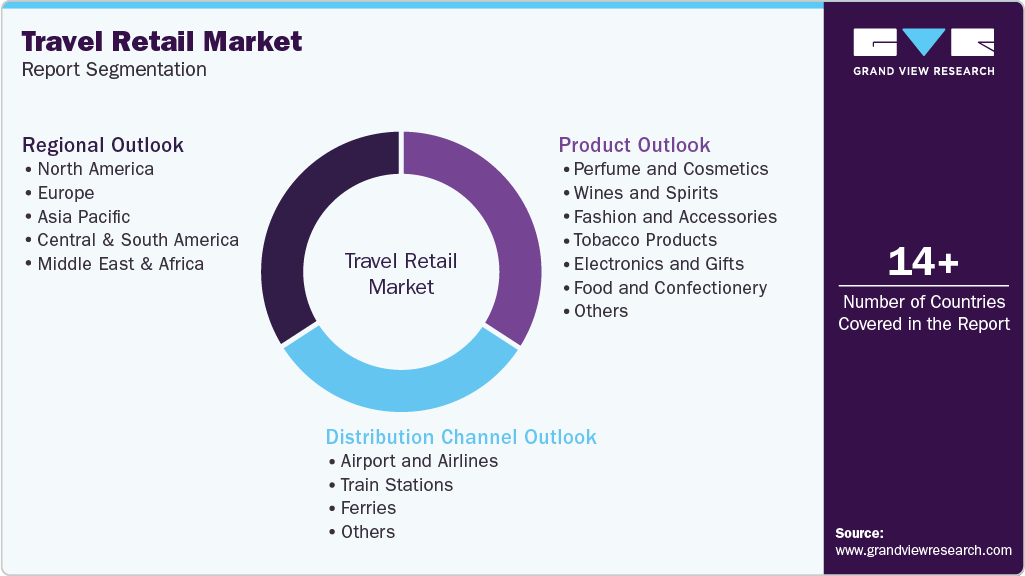
This report forecasts revenue growth at the global, regional & country levels and provides an analysis of the latest trends and opportunities in each of the sub-segments from 2021 to 2033. For this study, Grand View Research has segmented the global travel retail market report based on product, distribution channel, and region:
-
Product Outlook (Revenue, USD Billion, 2021 - 2033)
-
Perfume and Cosmetics
-
Wines and Spirits
-
Fashion and Accessories
-
Tobacco Products
-
Electronics and Gifts
-
Food and Confectionery
-
Others
-
-
Distribution Channel Outlook (Revenue, USD Billion, 2021 - 2033)
-
Airport and Airlines
-
Train Stations
-
Ferries
-
Others
-
-
Regional Outlook (Revenue, USD Billion, 2021 - 2033)
-
North America
-
U.S.
-
Canada
-
Mexico
-
-
Europe
-
UK
-
Germany
-
France
-
Italy
-
Spain
-
-
Asia Pacific
-
China
-
India
-
Japan
-
Australia & New Zealand
-
South Korea
-
-
Central & South America
-
Brazil
-
-
Middle East & Africa (MEA)
-
South Africa
-
-
Frequently Asked Questions About This Report
b. Some of the key players operating in the travel retail market include Avolta AG; Lotte Corporation; China Duty Free Group Co. Ltd.; LVMH Moët Hennessy Louis Vuitton (DFS Group); Gebr. Heinemann SE & Co. KG; Lagardere Travel Retail Group; The Shilla Duty Free; The King Power International Group; Aer Rianta International cpt; Duty Free Americas.
b. Key factors driving the growth of the travel retail market include increasing travel and tourism activities worldwide, expanding travel infrastructure, and increasing focus on luxury and premium products.
b. The global travel retail market was estimated at USD 81.89 billion in 2025 and is expected to reach USD 89.39 billion in 2026.
b. The global travel retail market is expected to grow at a compound annual growth rate of 9.9% from 2026 to 2033, reaching USD 172.64 billion by 2033.
b. Asia Pacific dominated the travel retail market, with a share of over 53.54% in 2025. The regional market's growth is mainly driven by the proliferation of low-cost carriers, which have bolstered passenger traffic while raising disposable incomes.


Share this report with your colleague or friend.
Need a Tailored Report?
Customize this report to your needs — add regions, segments, or data points, with 20% free customization.


ISO 9001:2015 & 27001:2022 Certified
We are GDPR and CCPA compliant! Your transaction & personal information is safe and secure. For more details, please read our privacy policy.
Trusted market insights - try a free sample
See how our reports are structured and why industry leaders rely on Grand View Research. Get a free sample or ask us to tailor this report to your needs.