- Home
- »
- Beauty & Personal Care
- »
-
Fragrance Market Size & Share, Industry Report, 2033GVR Report cover
![Fragrance Market Size, Share & Trends Report]()
Fragrance Market (2026 - 2033) Size, Share & Trends Analysis Report By Product (Fine Fragrances, Body Mists & Body Sprays, Deodorants), By End User (Men, Women), By Price Range, By Distribution Channel (Hypermarkets/Supermarkets), By Region, And Segment Forecasts
- Report ID: GVR-2-68038-859-6
- Number of Report Pages: 90
- Format: PDF
- Historical Range: 2021 - 2024
- Forecast Period: 2026 - 2033
- Industry: Consumer Goods
- Report Summary
- Table of Contents
- Segmentation
- Methodology
- Download FREE Sample
-
 Download Sample Report
Fragrance Market Summary
The global fragrance market size was estimated at USD 58.89 billion in 2025 and is projected to reach USD 89.41 billion by 2033, growing at a CAGR of 5.5% from 2026 to 2033. The market is witnessing strong structural growth, driven by premiumization, rising disposable incomes, and increasing consumer focus on personal identity and self-expression.
Key Market Trends & Insights
- North America held the largest market share of 33.2% in 2025.
- By products, the deodorants segment held the largest revenue share of 32.6% in 2025.
- By end user, the women segment accounted for the largest share of 70.7% in 2025.
- By price range, the mass fragrance segment held the largest revenue share of 45.7% in 2025.
- By distribution channel, the hypermarkets/supermarkets segment dominated the fragrance market, with a share of 32.8% in 2025.
Key Market Trends & Insights
- 2025 Market Size: USD 58.89 Billion
- 2033 Projected Market Size: USD 89.41 Billion
- CAGR (2026-2033): 5.5%
- North America: Largest market in 2025
Luxury and niche perfumes are expanding faster than mass segments, with brands such as Chanel and Dior reporting sustained fragrance-led momentum within their beauty portfolios. The surge of celebrity and influencer-backed launches, including lines from Rihanna and Ariana Grande, demonstrates the commercial power of fandom-driven scent branding. In parallel, Middle Eastern perfume houses are gaining global traction, reflecting growing demand for oud-based and high-concentration extrait formats. Travel retail recovery and e-commerce expansion are further accelerating category penetration, particularly across the Asia Pacific. As consumers increasingly layer scents and trade up to long-lasting formulations, the industry is shifting from volume-driven expansion toward high-value, brand-centric growth.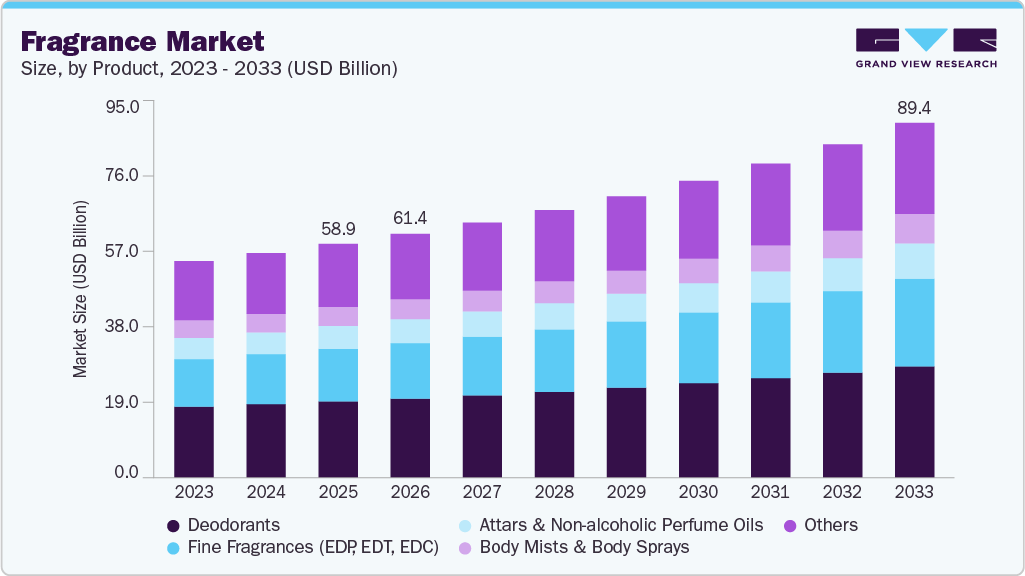
Fragrance is no longer reserved for special occasions; it has become embedded in daily routines across professional, social, and personal environments. Within the broader perfume market, consumers increasingly see scent as a reflection of personality, mood, and lifestyle, leading to higher usage and multiple-product ownership. The growing concept of a “scent wardrobe,” where individuals rotate fragrances based on season, time of day, or setting, is strengthening repeat purchase patterns in both the mass market and the luxury perfume sector. Younger consumers, especially millennials and Gen Z, are driving this trend through strong engagement with digital content, fragrance reviews, layering tutorials, and influencer-led discovery. According to an article published by Cosmetics Business in May 2025, The Fragrance Shop reported a 70% year-on-year rise in younger shoppers, highlighting the increasing participation of Gen Z in fragrance buying. Social media platforms have made experimenting with niche and artisanal brands normal, expanding the potential market for luxury fragrances while also supporting independent brands within the larger flavor and fragrance industry.
Product innovation remains a central growth engine within the global fragrance industry, spanning the natural fragrance market, premium segments, and the luxury perfume market. Manufacturers are increasingly focused on enhancing longevity, projection, and formulation stability, responding to consumer demand for scents that last throughout the day without frequent reapplication. For instance, in January 2025, The Estée Lauder Companies entered into an exclusive agreement with Exuud to introduce a next-generation fragrance delivery technology across its brands. The system is designed to enable controlled scent diffusion using plant-based, biodegradable materials, offering a more sustainable and customizable fragrance experience aligned with the evolving expectations of the luxury fragrance market. The partnership reflects Estée Lauder’s focus on combining innovation with environmental responsibility in its product development strategy.
Advances in encapsulation technology, higher fragrance oil concentrations, and improved fixative systems are being incorporated into both premium and mass-market offerings across the perfume market. At the same time, there is a noticeable shift toward cleaner ingredient profiles, alcohol-free formulations, and reduced allergen content, accelerating growth within the natural fragrance market segment. Refillable bottles, sustainable packaging formats, and responsibly sourced raw materials are gaining importance as consumers evaluate brands on environmental credentials alongside scent performance. Companies within the broader flavor and fragrance market are also utilizing artificial intelligence and data analytics to study consumer feedback, online reviews, and purchasing trends, enabling faster development cycles and more targeted fragrance launches tailored to regional and demographic preferences.
Rising disposable incomes and expanding middle-class populations, particularly across the Asia Pacific, Latin America, and parts of the Middle East, are further contributing to growth in the global perfume market. As consumers experience income progression, discretionary spending on premium and aspirational personal care products increases, with fragrance often serving as an accessible luxury purchase that feeds into the luxury perfume market and the luxury fragrance market. Entry-level premium lines, travel-sized formats, and gift sets have broadened market accessibility, encouraging trial and brand switching. In mature markets, consumers are trading up to niche and high-concentration formulations, supporting premiumization within the category. The expansion of organized retail, specialty beauty stores, and digital commerce platforms has significantly improved product availability, while online channels provide extensive product descriptions, scent notes, and user reviews that reduce purchase hesitation. In India alone, over 120 million households are now opting for higher-quality personal care products, including fragrances, reflecting the rising middle-class consumer base and heightened discretionary expenditure on grooming and luxury categories.
Furthermore, the expansion of e-commerce and digital discovery channels has become a defining growth lever across the global luxury fragrance market and mass perfume market alike. Online retail platforms, brand-owned websites, and beauty-focused marketplaces have significantly broadened consumer access to both mainstream and niche labels. Detailed scent descriptions, ingredient breakdowns, user-generated reviews, and AI-driven recommendation engines reduce the traditional hesitation associated with purchasing fragrance without physical sampling. Virtual try-on tools, scent quizzes, and personalized fragrance profiling are further enhancing online conversion rates.
Social commerce, livestream selling, and influencer-led fragrance reviews have accelerated product discovery, particularly among younger consumers who rely heavily on digital validation before purchase. According to Perfume E-Commerce: Mobile Trends 2025 by Scento, by late 2024 smartphones were accounted for roughly 80% of global retail site traffic and accounting for around two-thirds of online perfume orders, with mobile apps also delivering 10-50% higher average order values and conversion rates as much as seven times higher than mobile web, reflecting the power of digital platforms in driving fragrance sales across the perfume market. Subscription models, discovery kits, and sample programs allow consumers to trial multiple scents before committing to full-size bottles, supporting experimentation and repeat buying across both the natural fragrance market and the luxury perfume market. The integration of data analytics into digital retail also enables brands operating within the wider flavor and fragrance market to refine launch strategies, optimize pricing, and tailor marketing campaigns to specific consumer segments, reinforcing the importance of online channels in overall market expansion.
Brand Market Share Insights
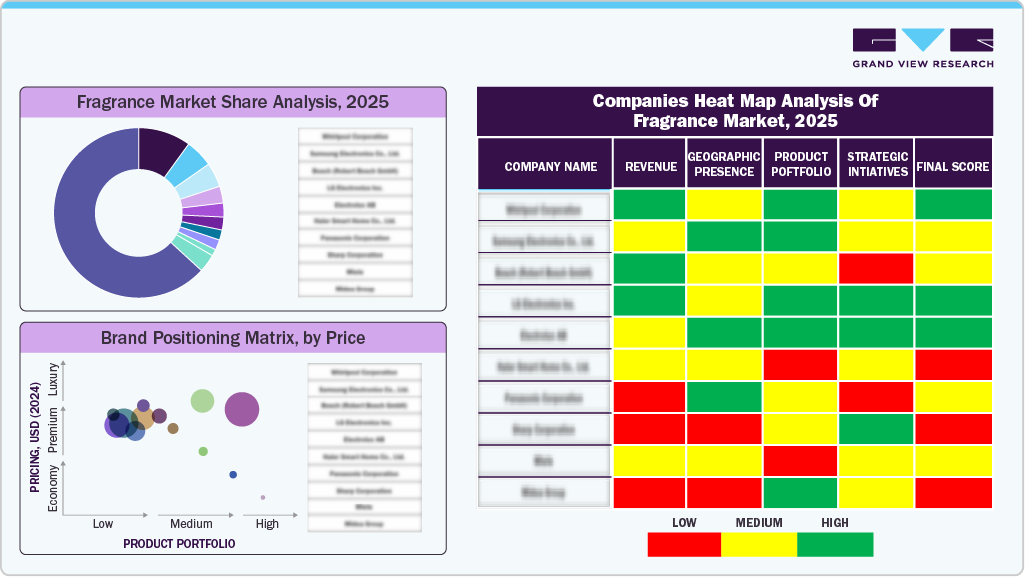
The presence of large multinational beauty conglomerates characterizes the global fragrance market alongside heritage perfume houses, niche artisanal labels, and digitally native brands, all competing to meet evolving consumer expectations around scent differentiation, longevity, ingredient transparency, and brand storytelling. Market participants are increasingly investing in advanced formulation techniques, enhanced fixation systems, and responsibly sourced raw materials to improve performance and reinforce authenticity. Brands are expanding portfolios across multiple concentration formats, refillable options, travel sizes, and limited-edition releases to cater to varied intensity preferences and price tiers, while strengthening omnichannel distribution through specialty retail, department stores, and direct-to-consumer platforms. At the same time, data-driven scent profiling, consumer analytics, and trend forecasting are guiding product development and launch strategies, enabling companies to refine offerings and build stronger emotional engagement across mass, premium, and luxury fragrance categories.
Cosumer Insights
Younger demographics and shifting lifestyle patterns are increasingly shaping consumer spending behavior in the global fragrance market. Gen Z is emerging as a primary growth engine, with rising participation from male consumers further expanding category breadth. According to insights published by the U.S. Chamber of Commerce in 2024, Gen Z is purchasing fragrances at a younger age compared to previous generations and is driving demand for multiple scent ownership rather than relying on a single “signature” perfume. This cohort is highly influenced by TikTok-driven fragrance trends, peer reviews, and viral product discussions, reinforcing experimentation and frequent product rotation across moods and occasions. Male fragrance usage is also broadening beyond traditional colognes, with younger men demonstrating greater openness to premium and niche scent categories.
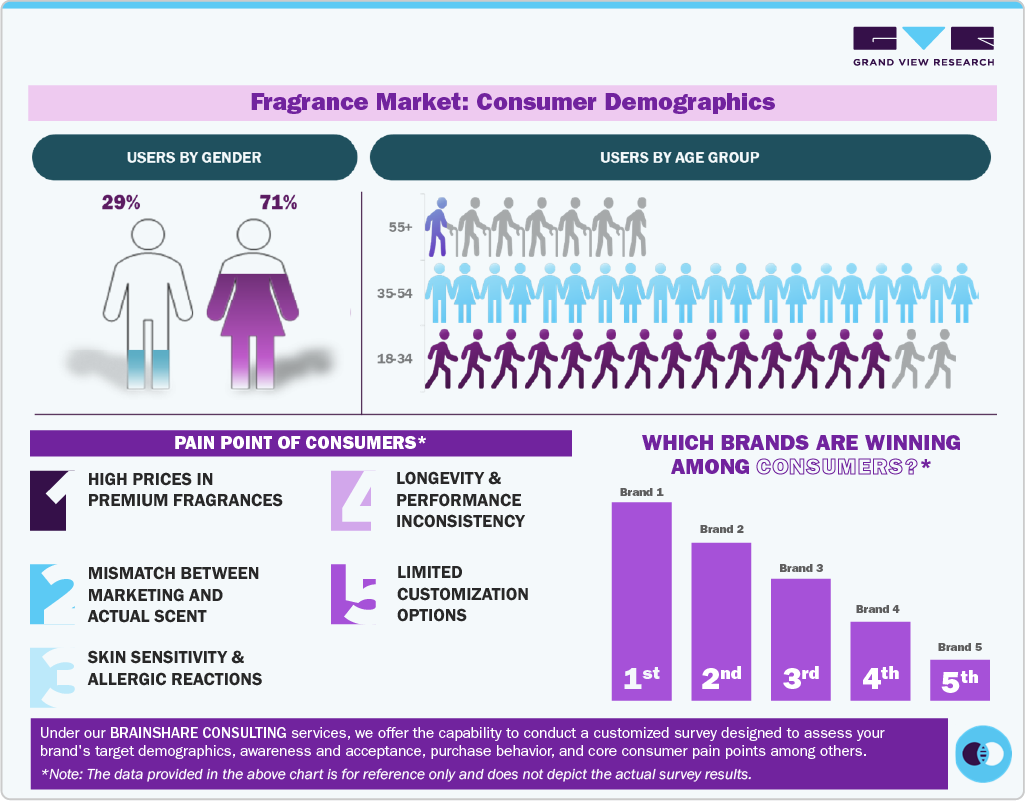
Spending preferences show a clear split between functional daily wear and emotionally driven purchases. Consumer survey insights published by in-cosmetics Global highlight that scent preference is closely linked to mood, personality expression, and occasion-based usage, with a significant proportion of consumers selecting fragrances specifically to feel confident, relaxed, or energized. While mass and accessible prestige products dominate everyday use, premium and niche fragrances are increasingly associated with gifting, special events, and self-reward purchases. Importantly, consumers are not exclusively trading up; instead, they are distributing expenditure across price tiers and formats, including body mists, eau de parfums, and layered scent combinations, increasing overall basket size.
Behavioral patterns further demonstrate that fragrance is an experiential purchase anchored in emotional value rather than necessity. According to survey findings from in-cosmetics Global, there is a strong interest in personalized scents, unique fragrance notes, and sustainability-led formulations, particularly among younger buyers. Limited editions, gender-fluid fragrances, and ingredient transparency are gaining traction, reflecting demand for individuality and conscious consumption. These dynamics are segmenting the global fragrance market along lifestyle, identity, and experience-driven lines, with brands adapting portfolios to capture diversified usage occasions and evolving consumer motivations.
Product Insights
Deodorants accounted for the largest revenue share of 32.60% in 2025. Demand is particularly strong for long-lasting 24-hour and 48-hour protection claims, sweat-control technologies, and quick-drying formats suited to humid and high-temperature climates. Consumers are increasingly seeking deodorants that combine odor protection with additional benefits such as skin-soothing ingredients, stain-free formulations, and alcohol-free or sensitive-skin variants. Product diversification across sprays, roll-ons, sticks, creams, and clinical-strength formats further expands the addressable base.
For instance, in January 2026, Unilever expanded its Dove brand beyond deodorants to enter the broader whole-body care market. The move involves extending the Dove portfolio with products designed for full-body use, reflecting the brand’s shift toward comprehensive personal care solutions. This expansion aims to leverage Dove’s strong reputation in skincare to meet growing consumer demand for gentle, everyday body care products.
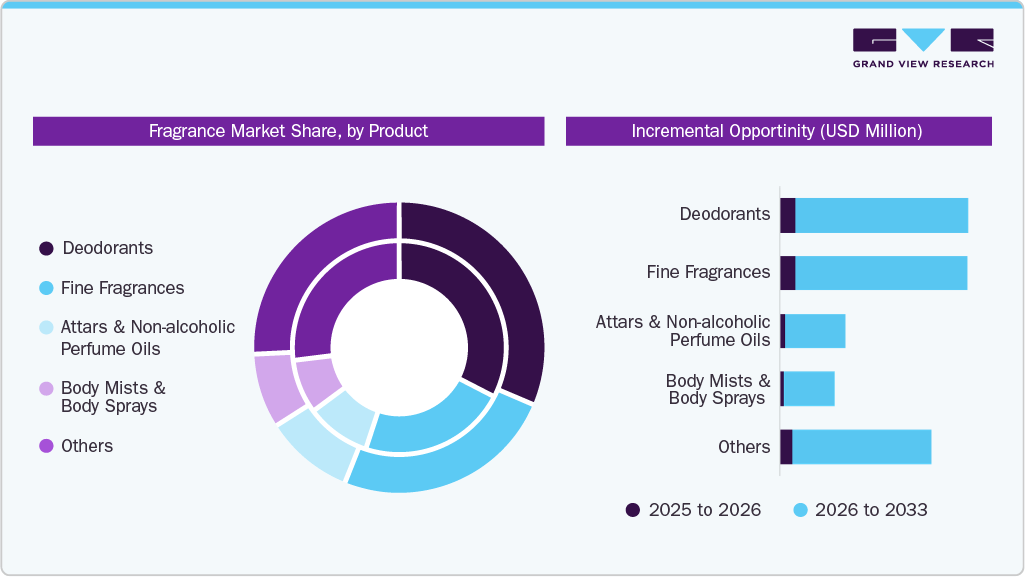
Widespread availability in supermarkets, drugstores, convenience outlets, and online platforms ensures high visibility and impulse purchasing, reinforcing deodorants’ dominant revenue contribution within the global fragrance and personal care market.
Fine Fragrances (EDP, EDT, EDC) are expected to grow at a CAGR of 6.7% from 2026 to 2033, driven by rising consumer preference for longer-lasting, higher-concentration scent formats that offer stronger projection and refined fragrance profiles. Increasing interest in signature scents, scent layering, and occasion-based fragrance use is encouraging consumers to invest in Eau de Fine fragrances and Eau de Toilette variants with improved longevity. Growth is further supported by the introduction of travel sizes, gift sets, and more accessible premium price points that expand adoption among first-time buyers, particularly in emerging markets.
In June 2024, Eze Perfumes expanded its product lineup with 18 ml travel-size perfume variants aimed at on-the-go consumers. The compact formats include a mix of fresh, floral, woody, and citrus scents for men, women, and unisex preferences, offering convenience without sacrificing fragrance quality.
End Use Insights
The women segment accounted for the largest share of 70.7% in 2025. Women typically own multiple fragrances for different occasions, seasons, and moods, contributing to higher per-capita consumption compared to other segments. Fragrance purchasing within this group is often influenced by emotional connection, self-confidence, and identity reinforcement, with consumers seeking scents that align with personality, lifestyle, and social settings. In addition, women demonstrate greater responsiveness to new launches, limited editions, and premium variants, supporting faster product turnover within the segment.
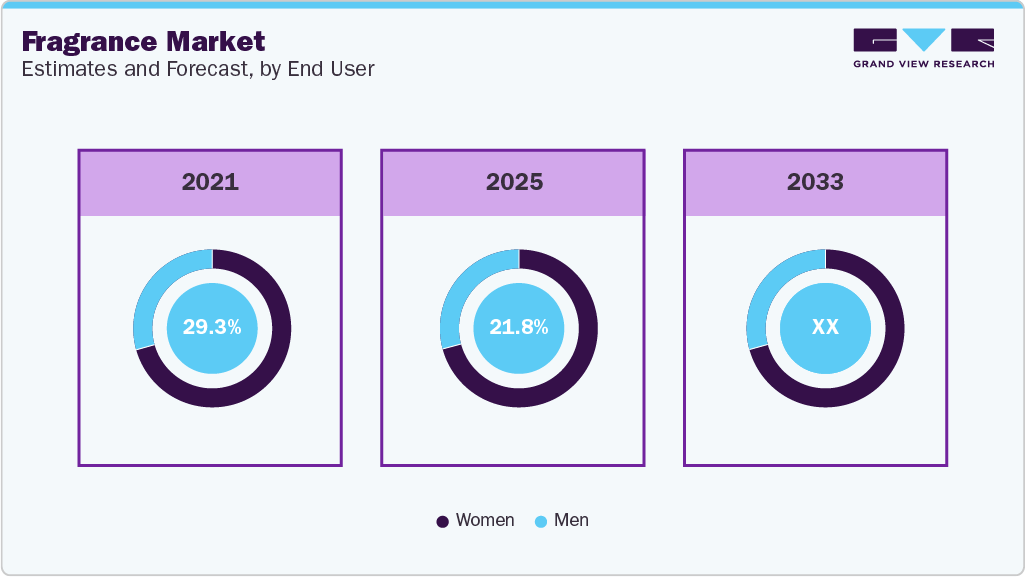
The men segment is expected to grow at a CAGR of 6.0% from 2026 to 2033. Male consumers are adopting fragrances for office wear, social gatherings, fitness environments, and travel, resulting in higher usage frequency and structured repeat purchases. Demand is particularly strong for woody, spicy, fresh, aquatic, and oud-based scent profiles, with a growing inclination toward Eau de Fine fragrances and parfum concentrations that offer extended longevity. Performance claims such as all-day wear, strong projection, and premium ingredient positioning significantly influence buying decisions.
Price Range Insights
Mass fragrances accounted for the largest share of 45.7% in 2025. Mass fragrances benefit from high unit sales, as consumers often purchase these products for daily hygiene and freshness rather than long-wear or luxury positioning. Demand is reinforced by accessible pricing that encourages impulse buying, multi-unit purchases, and brand switching without significant financial commitment. Mass fragrances are commonly marketed through youth-focused campaigns, seasonal promotions, and large retail displays, enhancing visibility and driving volume sales. In addition, a strong presence across neighborhood stores, supermarkets, discount retailers, and online marketplaces ensures continuous product availability.
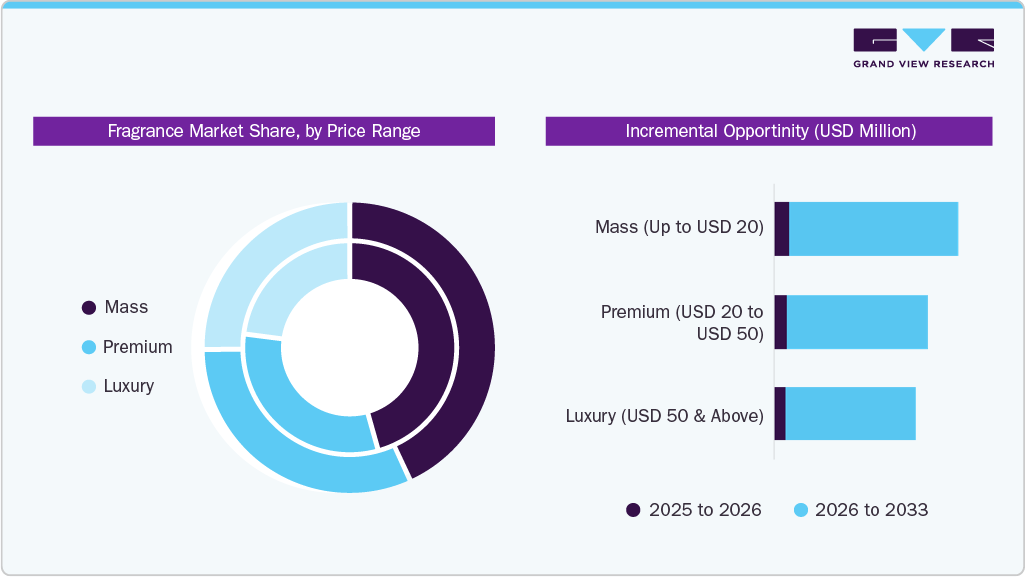
Luxury fragrances are expected to grow at a CAGR of 6.8% from 2026 to 2033. Luxury fragrances attract brand-conscious and quality-driven buyers who seek higher fragrance oil concentrations, longer-lasting performance, and complex scent structures that differentiate from mass offerings. Purchases are frequently linked to gifting occasions, milestone celebrations, and personal indulgence, contributing to higher average selling prices and sustained value growth. Consumers place considerable emphasis on packaging aesthetics, bottle craftsmanship, ingredient quality, and storytelling, viewing luxury fragrances as expressions of identity and lifestyle rather than routine grooming products.
Distribution Channel Insights
Sales for fragrances through hypermarkets/supermarkets accounted for the largest share of 32.8% in 2025. Hypermarkets/supermarkets offer convenient access to a broad assortment of mass and accessible-premium fragrance brands, allowing shoppers to combine fragrance purchases with routine grocery and household shopping. Competitive pricing, bundle offers, seasonal discounts, and in-store promotional displays significantly influence buying decisions, particularly for entry-level and mid-priced fragrances. The presence of tester units, visible shelf placement, and impulse-buy positioning near checkout counters further stimulates sales.
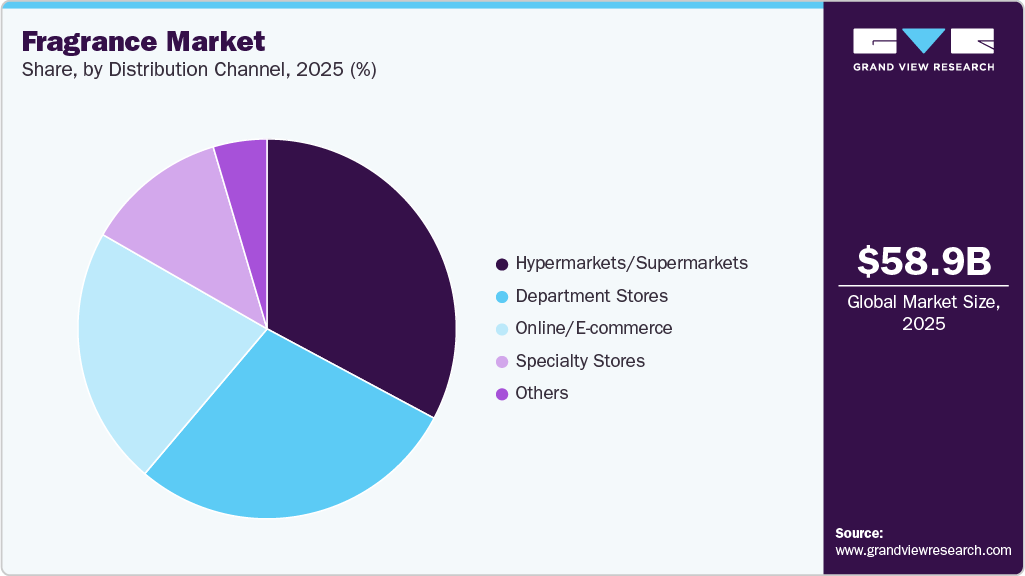
The sale of perfumes through online/e-commerce channels is expected to grow at a CAGR of 6.9% from 2026 to 2033. E-commerce platforms offer extensive product assortments, detailed scent descriptions, ingredient information, and customer reviews that assist buyers in making informed decisions despite the absence of physical testing. Competitive pricing, online-exclusive launches, subscription-based discovery kits, and promotional bundles further encourage repeat purchases. Growth is particularly strong in emerging markets such as China and India, where rising internet penetration, mobile-first shopping behavior, and social commerce trends are accelerating fragrance discovery and conversion. Enhanced logistics networks, faster delivery timelines, and simplified return policies continue to strengthen the role of online channels in global perfume distribution.
Regional Insights
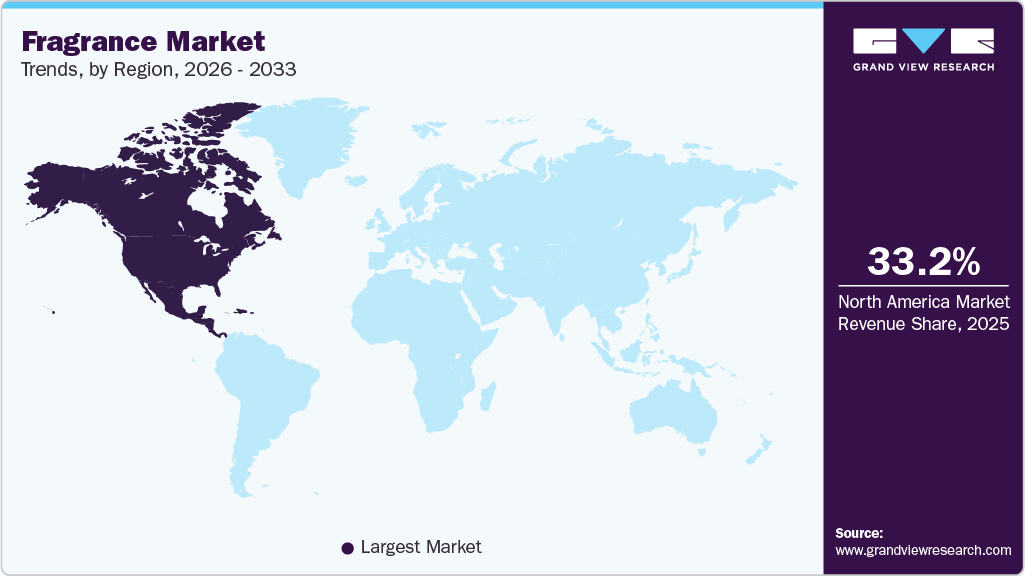
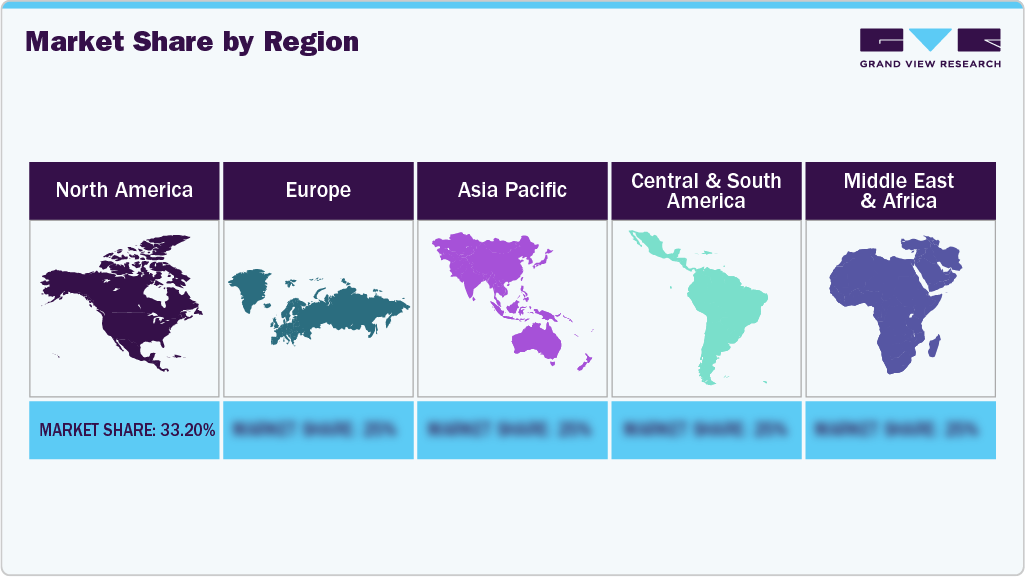
The fragrance market in North America accounted for the largest share of 33.2% in 2025. The U.S. represents the primary revenue contributor, driven by high per-capita spending on personal care products and strong adoption of premium and niche fragrance brands. Consumers in North America frequently purchase fragrances for both personal use and gifting during major retail periods such as holiday seasons and promotional sales events, which generate predictable demand spikes. The region also benefits from a strong presence of specialty beauty retailers, department store fragrance counters, and brand-owned boutiques that emphasize sampling, discovery sets, and exclusive launches. In addition, high digital penetration, influencer-driven marketing, and rapid e-commerce fulfillment infrastructure further reinforce sustained fragrance sales across the U.S. and Canada.
U.S. Fragrance Market Trends
The fragrance market in the U.S. is expected to showcase a CAGR of 8.2% from 2026 to 2033. The market is driven by increasing consumer spending on beauty and self-care products. The U.S. fragrance industry is driven by strong domestic demand across both prestige and mass segments, supported by high consumer willingness to spend on personal care and lifestyle-enhancing products. The U.S. market benefits from a well-established prestige beauty ecosystem anchored by specialty retailers such as Ulta Beauty and Sephora, which actively promote fragrance discovery through sampling programs, in-store consultations, and exclusive launches.
Europe Fragrance Market Trends
The European fragrance market accounted for the largest revenue share of 28.6% in 2025. Europe remains a premium-oriented market, with strong demand for designer, niche, and heritage fragrance houses, particularly in countries such as France, Germany, Italy, Spain, and the UK Consumers in the region demonstrate a strong preference for refined, long-lasting formulations and are receptive to artisanal craftsmanship and ingredient provenance. The market is further supported by consistent gifting traditions, high tourist-driven sales in key retail hubs, and growing interest in gender-neutral and refillable formats. Established specialty perfumeries, department store counters, and expanding digital beauty platforms ensure strong product visibility and accessibility.
Fragrance industry in the UK driven by rising consumer interest in luxury and wellness-oriented scents. For instance, in October 2025, Boots expanded its fragrance offering by introducing more than 400 new scents and unveiling a dedicated fragrance boutique concept. The new retail format is designed to enhance product discovery with a broader assortment and a more immersive shopping environment. This move strengthens Boots’ position as a key destination for fragrance within the UK beauty market.
Fragrance market in France held the largest share in the European industry in 2025. France serves as a global center for fragrance formulation, ingredient sourcing, and high-end manufacturing, with a strong concentration of established perfume laboratories and creative houses. Domestic demand remains robust, driven by consumers who prioritize craftsmanship, olfactory complexity, and long-lasting formulations. French buyers show strong appreciation for extrait and Eau de Fine fragrances concentrations, reinforcing premium price realization across the market. In addition, France benefits from significant tourist-driven sales, particularly in luxury retail districts and duty-free channels, which contribute meaningfully to overall fragrance revenue.
Asia Pacific Fragrance Market Trends
The Asia Pacific fragrance industry is expected to grow at a CAGR of 6.6% from 2026 to 2033. Rapid urbanization and rising middle-class populations across China, India, Southeast Asia, and South Korea are increasing discretionary spending on personal care, including branded fragrances. Consumers in the region are increasingly incorporating fragrance into daily routines rather than reserving it for special occasions, supporting higher usage frequency and repeat purchases. There is growing demand for subtle, skin-friendly, and climate-appropriate formulations, particularly in markets with warm and humid conditions. In addition, strong digital penetration, influencer-led beauty content, and social commerce platforms are accelerating fragrance discovery and trial among younger consumers.
The fragrance market in India is expected to witness a CAGR of 10.2% from 2026 to 2033, driven by rising consumer demand for luxury and premium fragrances. Urban consumers are increasingly moving from traditional non-alcoholic attars toward branded Eau de Fine fragrances and deodorant formats, reflecting changing lifestyle preferences and rising exposure to international brands. Demand is particularly strong for long-lasting formulations that perform well in hot and humid climates, encouraging growth in higher oil concentration products. The market is also supported by the rapid expansion of organized retail in metropolitan cities, the rising penetration of beauty specialty chains, and the strong growth in online marketplaces that offer a wider product variety and price comparison.
Fragrance market in China held the largest share in the Asia Pacific industry in 2025. China serves as a key demand center for both international luxury houses and emerging domestic fragrance brands, driven by a young, brand-aware consumer base concentrated in major metropolitan cities. Domestic demand is expanding as fragrance shifts from occasional use to daily grooming, particularly among millennials and Gen Z consumers who actively explore niche and designer labels. Chinese buyers show increasing preference for Eau de Fine fragrances concentrations and long-lasting scent profiles, supporting premium price realization across the market.
Central & South America Fragrance Market Trends
The Central & South America fragrance industry is expected to grow at a CAGR of 5.9% from 2026 to 2033, supported by strong regional manufacturing presence and deep-rooted fragrance consumption habits. Countries such as Brazil maintain a well-developed domestic perfume industry, enabling competitive pricing and rapid product turnover. Consumers in the region display high engagement with seasonal launches, festive promotions, and limited-edition collections, which stimulate recurring demand cycles throughout the year.
Middle East & Africa Fragrance Market Trends
The Middle East & Africa fragrance industry is expected to grow at a CAGR of 4.4% from 2026 to 2033. Fragrance purchasing in the region is closely associated with status, hospitality, and personal presentation, encouraging consumers to invest in premium and niche scent houses. There is strong demand for layered fragrance routines, combining concentrated oils, bakhoor, and spray perfumes, which increases overall consumption per user. Growth is further reinforced by the expansion of regional perfume brands, private-label luxury collections, and exclusive mall-based retail formats that emphasize experiential shopping. In addition, rising tourism flows, particularly in major shopping hubs such as Dubai, contribute significantly to fragrance sales through duty-free and high-end retail channels.
Key Fragrance Companies:
The following key companies have been profiled for this study on the fragrance market.
- Natura & Co
- L’Oréal
- LVMH
- The Estée Lauder Companies Inc.
- KERING
- Coty Inc.
- CHANEL
- PVH Corp.
- Burberry Group plc
- Dolce & Gabbana S.R.L.
- Shiseido Company
Recent Developments
-
In February 2026, Balmain Beauty debuted its first prestige fragrance, Destin de Balmain, marking the brand’s entry into the high-end perfume segment. The launch reflects Balmain’s effort to translate its fashion-led identity into scent, combining bold composition with premium packaging, including a refillable format. The move signals the brand’s strategic expansion into the global luxury fragrance market.
-
In February 2026, Nykaa introduced Nykaa Perfumery in select Mumbai malls, marking its entry into dedicated premium fragrance retail. The concept features a curated assortment of designer and niche scents within an immersive in-store format. The launch highlights Nykaa’s strategy to deepen its presence in the high-end fragrance segment through experiential retail.
Fragrance Market Report Scope
Report Attribute
Details
Market size value in 2026
USD 61.43 billion
Revenue forecast in 2033
USD 89.41 billion
Growth rate
CAGR of 5.5% from 2026 to 2033
Base year for estimation
2025
Historical data
2021 - 2024
Forecast period
2026 - 2033
Quantitative units
Revenue in USD Million/Billion and CAGR from 2026 to 2033
Report coverage
Revenue forecast, company ranking, competitive landscape, growth factors, trends
Segments covered
Product, end user, price range, distribution channel, and regional
Regional scope
North America; Europe; Asia Pacific; the Middle & East; Central & South America
Country scope
U.S.; Canada; Mexico; Germany; France; UK; Spain; Italy; China; Japan; India; South Korea; Australia & New Zealand; Argentina; Brazil; Saudi Arabia; South Africa; UAE
Key company profiled
Natura&Co; L’Oréal; LVMH; The Estée Lauder Companies Inc.; KERING; Coty Inc.; CHANEL; PVH Corp.; Burberry Group plc; Dolce & Gabbana S.R.L.; Shiseido Company.
Customization scope
Free report customization (equivalent to up to 8 analysts working days) with purchase. Addition or alteration to country, regional & segment scope.
Pricing and purchase options
Avail customized purchase options to meet your exact research needs. Explore purchase options
Global Fragrance Market Report Segmentation
This report forecasts revenue growth at the global, regional, and country levels and provides an analysis of the latest industry trends and opportunities in each of the sub-segments from 2021 to 2033. For this study, Grand View Research has segmented the global fragrance market report based on product, end user, price range, distribution channel, and region:
-
Product Outlook (Revenue, USD Million, 2021 - 2033)
-
Fine Fragrances
-
Body Mists & Body Sprays
-
Deodorants
-
Attars & Non-alcoholic Perfume Oils
-
Others
-
-
End Use Outlook (Revenue, USD Million, 2021 - 2033)
-
Men
-
Women
-
-
Price Range Outlook (Revenue, USD Million, 2021 - 2033)
-
Mass (Up to USD 20)
-
Premium (USD 20 to USD 50)
-
Luxury (USD 50 & above)
-
-
Distribution Channel Outlook (Revenue, USD Million, 2021 - 2033)
-
Hypermarkets/Supermarkets
-
Department Stores
-
Specialty Stores
-
Online/E-commerce
-
Others
-
-
Regional Outlook (Revenue, USD Million, 2021 - 2033)
-
North America
-
U.S.
-
Canada
-
Mexico
-
-
Europe
-
Germany
-
UK
-
France
-
Italy
-
Spain
-
-
Asia Pacific
-
China
-
India
-
Japan
-
South Korea
-
Australia & New Zealand
-
-
Central & South America
-
Brazil
-
Argentina
-
-
Middle East & Africa
-
Saudi Arabia
-
South Africa
-
UAE
-
-
Frequently Asked Questions About This Report
b. Key players in the fragrance market are Natura&Co, L’Oréal, LVMH, The Estée Lauder Companies Inc., KERING, Coty Inc., CHANEL, PVH Corp., Burberry Group plc, Dolce & Gabbana S.R.L., and Shiseido Company.
b. Key factors that are driving the fragrance market growth include increasing popularity of unisex fragrances, the expansion of the luxury fragrance segment, the focus on sustainability and ethical sourcing, and social media influence on consumer preferences.
b. North America dominated the fragrance market in 2025 with a share of about 33.20%. The region’s market growth was fueled by a thriving economy, increasing demand for premium products, and rising living standards.
b. he global fragrance market was estimated at USD 58.89 billion in 2025 and is expected to reach USD 61.43 billion in 2026.
b. The global fragrance market is expected to grow at a compound annual growth rate of 5.5% from 2026 to 2033 to reach USD 89.41 billion by 2033.


Share this report with your colleague or friend.
Need a Tailored Report?
Customize this report to your needs — add regions, segments, or data points, with 20% free customization.


ISO 9001:2015 & 27001:2022 Certified
We are GDPR and CCPA compliant! Your transaction & personal information is safe and secure. For more details, please read our privacy policy.
Trusted market insights - try a free sample
See how our reports are structured and why industry leaders rely on Grand View Research. Get a free sample or ask us to tailor this report to your needs.