- Home
- »
- Beauty & Personal Care
- »
-
Perfume Market Size, Share & Growth, Industry Report, 2033GVR Report cover
![Perfume Market Size, Share & Trends Report]()
Perfume Market (2026 - 2033) Size, Share & Trends Analysis Report By Product (Parfum, Eau de Parfum, Eau de Toilette, Eau de Cologne, Eau Fraiche), By End Use (Men, Women), By Price Tier, By Distribution Channel (Offline Channels), By Region, And Segment Forecasts
- Report ID: GVR-2-68038-906-7
- Number of Report Pages: 90
- Format: PDF
- Historical Range: 2021 - 2025
- Forecast Period: 2026 - 2033
- Industry: Consumer Goods
- Report Summary
- Table of Contents
- Interactive Charts
- Methodology
- Download FREE Sample
-
 Download Sample Report
Perfume Market Summary
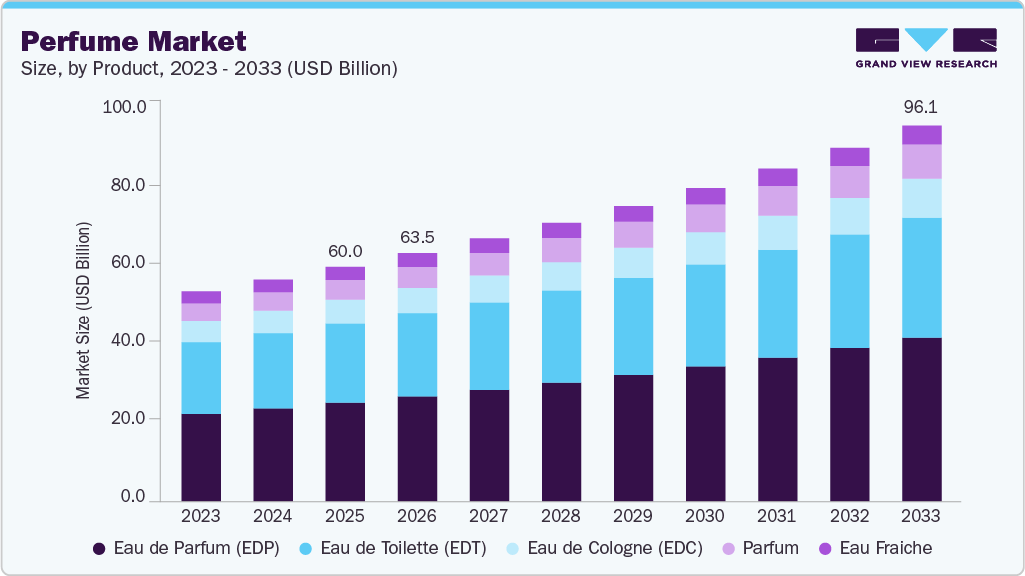
The global perfume market size was estimated at USD 60.01 billion in 2025 and is projected to reach USD 96.12 billion by 2033, growing at a CAGR of 6.1% from 2026 to 2033. Fragrance is increasingly viewed as a form of self-expression rather than a simple personal care item, prompting luxury fashion houses to elevate perfumery as a central pillar of brand storytelling.
Key Market Trends & Insights
- By region, Europe held the largest market share of 35.35% in 2025.
- By products, the Eau de Parfum segment held the largest revenue share of 42.1% in 2025.
- By end use, the women end use segment accounted for the largest share of 70.7% in 2025.
- By price tier, the mass perfume segment held the largest revenue share of 48.7% in 2025.
- By distribution channel, the department stores segment dominated the perfume industry, with a share of 32.8% in 2025.
Market Size & Forecast
- 2025 Market Size: USD 60.01 Billion
- 2033 Projected Market Size: USD 96.12 Billion
- CAGR (2026-2033): 6.1%
Iconic fashion brands regularly extend their lifestyle appeal with signature scent lines, blending runway prestige with olfactory artistry. In cities such as Paris and New York, flagship boutiques routinely dedicate prominent space to immersive scent experiences, allowing consumers to explore layered fragrance families. Digital platforms and social media further amplify launch impact, with influencers and scent curators shaping perception and desirability. As a result, perfumes occupy a distinctive cultural niche that transcends functional use and engages deeper emotional resonance.The changing fashion trends have a primary influence on the fragrance industry, particularly within the global luxury perfume industry. Key manufacturers operating in the industry are focusing on product innovations and launching unique fragrances that attract diverse consumer bases across the globe. In addition, light-scented fragrances are also gaining attraction among the millennial and Gen Z population, encouraging manufacturers to develop such products. The increasing focus of manufacturers on introducing natural fragrances in the premium category, owing to the rising concerns regarding allergies caused by synthetic perfume ingredients, is another significant factor driving growth across the luxury fragrance market. Celebrity endorsements and social media influencers greatly influence consumers and significantly affect their buying decisions. Companies are actively opting for and investing in such strategies and technology to attract consumers, augment sales, and widen their reach.
The growth of the global luxury perfume industry is driven by rising consumer demand for luxury and personalized items, supported by rapid technological advancements within the fragrance industry. For instance, as per an article published in May 2025, Ramsons Perfumes introduced various perfumes, including Lucas (for daily wear), Delano (blends spicy and woody notes to create an intense, masculine fragrance), One Black (mysterious and powerful), and One White (a refreshing, elegant modern fragrance), using AI technology by analyzing millions of online reviews, social media trends, and market data. Market players increasingly leverage AI to study customer feedback and scent reviews, refining formulations and creating highly personalized, trend-driven fragrances. Alongside such innovations, the luxury fragrance industry continues to expand with increasing disposable incomes, growing interest in premium and niche fragrances, and the accelerating influence of e-commerce and digital engagement.
Celebrity endorsements and social media influencers have a growing influence among consumers that affects their buying decisions, making them one of the trending advertising strategies within the fragrance industry. Companies actively opt for and invest in such strategies and technology to attract consumers and widen their reach. For instance, L'Oréal Groupe developed a tool dubbed cockpit, designed to measure the real-time ROI and productivity level of its media investments. This technology enabled better decision-making while formulating performance strategies. These factors have been aiding companies in understanding product performance and developing offerings that meet evolving consumer expectations, thereby contributing to sustained growth across the global luxury perfume industry and the broader luxury fragrance industry.
Innovation in product formats and brand collaborations has further invigorated the perfume category. Niche perfume houses and designer brands increasingly experiment with limited-edition releases, artisanal packaging, and cross-industry collaborations that resonate with younger, experience-oriented consumers. Celebrity and designer co-creations where a well-known personality curates or endorses a signature scent have elevated visibility, creating cultural buzz and broader market appeal. Retailer activations such as in-store personalization bars, scent layering consultations, and digital try-before-you-buy tools are enhancing purchase engagement. At the same time, sustainability initiatives, such as refillable formats and ethically sourced aromatic extracts, reflect shifting consumer values and regulatory expectations.
Brand Market Share Insights
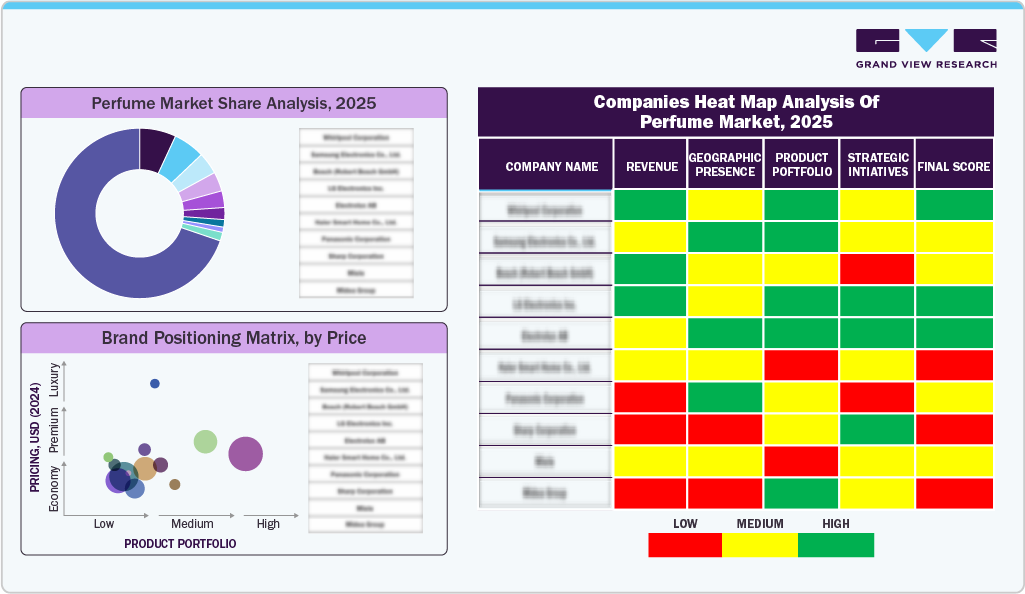
The global perfume industry is characterized by the presence of large, established fragrance and beauty conglomerates alongside a growing number of niche, artisanal, and digital-first brands, all competing to address evolving consumer expectations around scent quality, longevity, personalization, and brand storytelling. Market participants are increasingly focusing on next-generation fragrance development, supported by ingredient transparency, sustainable sourcing, advanced extraction techniques, and data-driven scent profiling. In parallel, brands are expanding offerings across varied concentration formats, travel sizes, and limited editions, while leveraging omnichannel distribution and direct-to-consumer platforms. These strategies are designed to enhance sensory experience, improve accessibility, and strengthen brand loyalty across core perfume categories, including mass, accessible prestige, and luxury fragrances.
Cosumer Insights
Consumer spending behavior in the perfume industry varies significantly by age and lifestyle. Gen Z and Millennials are increasingly shaping fragrance consumption through higher experimentation, ownership of multiple scents, and stronger engagement with trend-led products. Younger consumers are less likely to rely on a single signature fragrance and instead rotate perfumes across moods, occasions, and seasons. This cohort also shows higher engagement with digital discovery and omnichannel purchasing, reinforcing the importance of both online platforms and physical retail in fragrance buying journeys.
Spending preferences reveal a clear distinction between everyday usage and occasion-based consumption. Mass and accessible prestige fragrances are primarily used for daily wear, while premium and niche perfumes are more commonly purchased for gifting, social occasions, and personal indulgence. Consumers increasingly distribute their fragrance spending across multiple price tiers rather than trading up exclusively, enabling brands to drive higher cumulative spend per user through portfolio diversification across formats, scent families, and concentration levels.
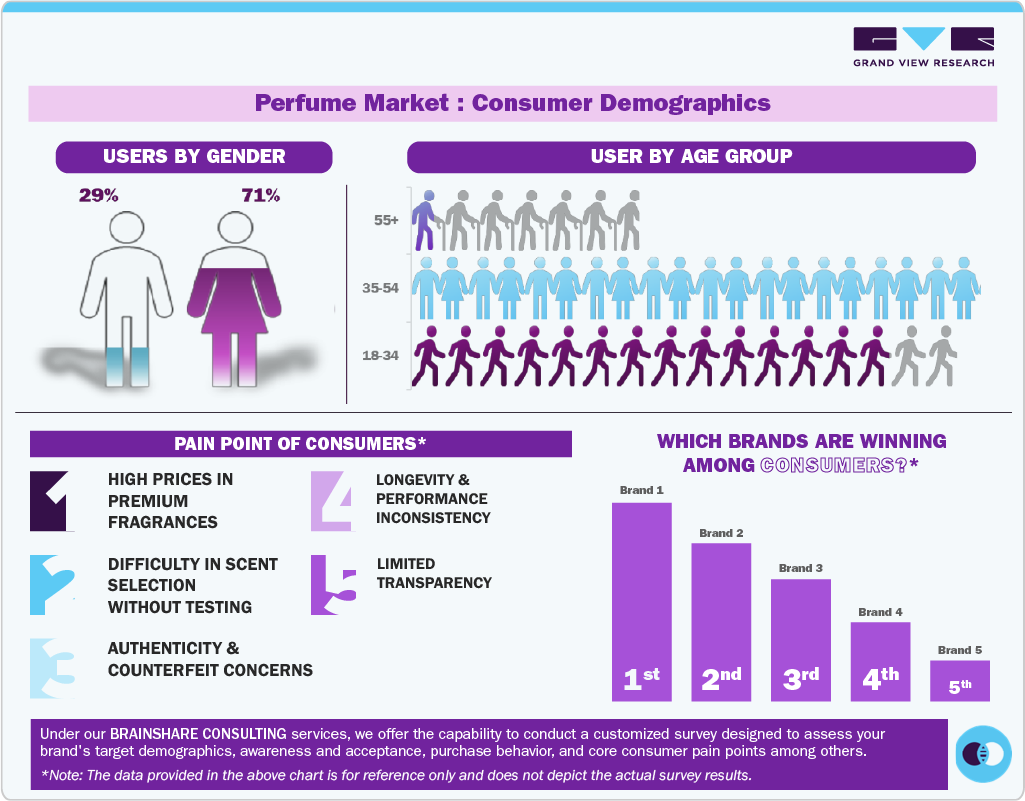
Behavioral patterns further indicate that perfume purchases are driven by emotional and experiential value rather than functional need alone. Fragrances are closely associated with confidence, mood enhancement, and self-expression, positioning them as an integral part of personal grooming routines. Younger demographics show a stronger inclination toward premiumization through unique scent profiles, limited editions, and sustainability-oriented offerings, while still valuing accessibility and variety. These dynamics continue to segment the perfume industry along lifestyle and experience-driven lines.
Product Insights
Eau de Parfum (EDP) accounted for the largest revenue share of 42.1% in 2025, driven by increasing consumer demand for luxury, personalized fragrances, and rapid technological advancements. In August 2025, Miu Miu launched the first premium fragrance, Miutine, a feminine eau de parfum under its new licensing agreement with L'Oréal. The fragrance features a chypre structure enhanced with wild strawberry and brown sugar. The premium segment leads in revenue due to its greater emphasis on quality, personalization, and exclusivity. Manufacturers are expanding high-end offerings to meet consumer preferences for unique and luxurious scent experiences.
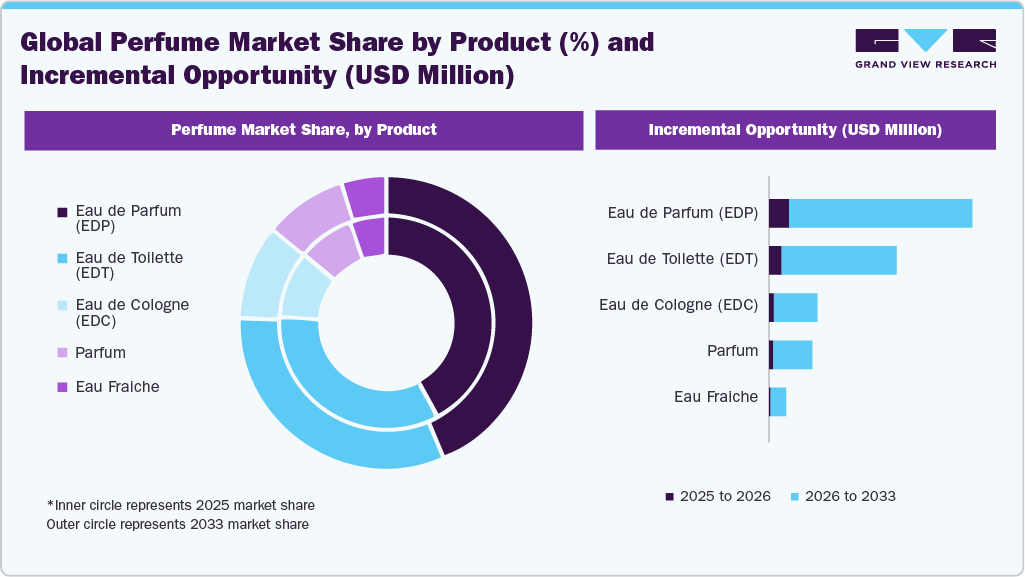
Parfum (Pure Perfume/Extrait de Parfum) is expected to grow at a CAGR of 5.9% from 2026 to 2033, driven by expanding demand for high-intensity fragrances that are increasingly accessible to mass consumers, particularly in emerging economies such as India and China. While traditionally positioned at the ultra-premium end due to high oil concentration and longevity, manufacturers are broadening appeal through simplified scent profiles, smaller pack sizes, and adjacent mass formats inspired by parfum compositions, including body mists, sprays, and colognes.
End Use Insights
The women's end use segment accounted for the largest share of 70.7% in 2025. The emotional and psychological appeal of fragrances is a key factor driving the growth of this segment. According to Avon's future fragrance, 18% of women globally reported that the second most important reason for wearing a perfume is to feel confident. In the Philippines, this effect is even stronger, with 35% of women stating that feeling confident is almost as important as smelling nice when choosing a fragrance. These insights highlight how perfumes are valued for their scent and the confidence and self-expression they impart, supporting the growing demand for premium and personalized fragrances tailored to women's preferences.
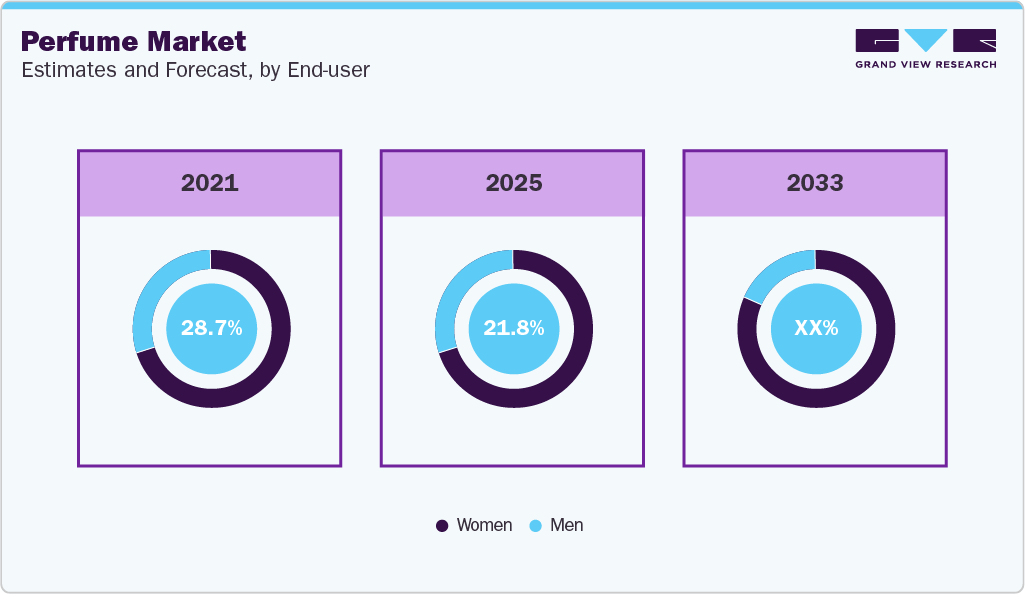
The men’s end use segment is expected to grow at a CAGR of 6.6% from 2026 to 2033. The growing trend of using fragrance products among men across the globe is one of the significant factors expected to drive this segment's growth over the coming years. Moreover, the ever-increasing demand for trendy perfumes, different fragrances, and premium fragrance products among men is projected to support the segment growth. Substantial celebrity endorsements encourage the male population to purchase personal care products, such as perfumes. These trends are anticipated to present noteworthy growth opportunities to the market players and drive the growth of this segment.
Price Tier Insights
Mass perfumes accounted for the largest share of 48.7% in 2025. driven by their everyday relevance, emotional appeal, and affordability. This segment is strongly positioned around confidence, self-expression, and personal identity rather than exclusivity, making it a routine purchase for daily wear, work, and casual social settings. Consumers value mass fragrances for their versatility and ease of use, with lighter compositions and multiple formats, such as body sprays, mists, and colognes, supporting frequent application and repeat purchases.
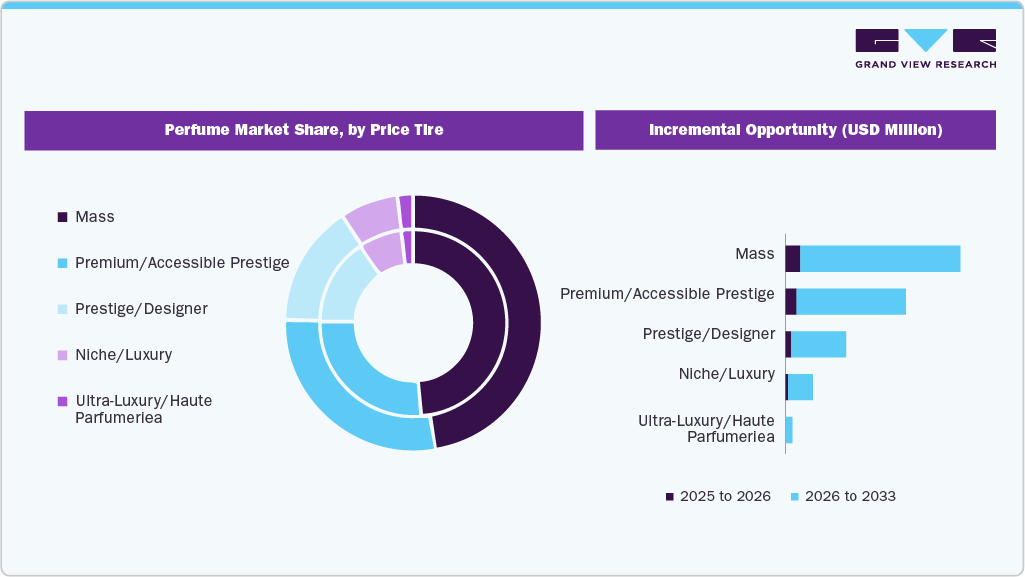
Premium/accessible prestige perfumes are expected to grow at a CAGR of 6.9% from 2026 to 2033. This segment appeals to consumers who are brand-conscious and quality-driven but unwilling to pay ultra-luxury prices, leading to strong uptake for gifting, special occasions, and personal upgrades. Buyers in this category place greater emphasis on packaging aesthetics, brand storytelling, and scent complexity, viewing fragrances as lifestyle accessories rather than daily commodities.
Distribution Channel Insights
Sales for perfumes through offline channels accounted for the largest share of 67.0% in 2025. Physical retail formats such as department stores, specialty beauty stores, and brand-owned boutiques allow consumers to sample scents, compare fragrance profiles, and receive personalized recommendations, which remains critical for a high-engagement category like perfumes. Offline channels also benefit from strong visibility of premium and luxury brands through dedicated counters and curated displays, reinforcing brand trust and exclusivity. In addition, in-store promotions, festive gifting campaigns, and limited-edition or exclusive launches continue to attract consumers, supporting the dominance of offline retail in global perfume sales.
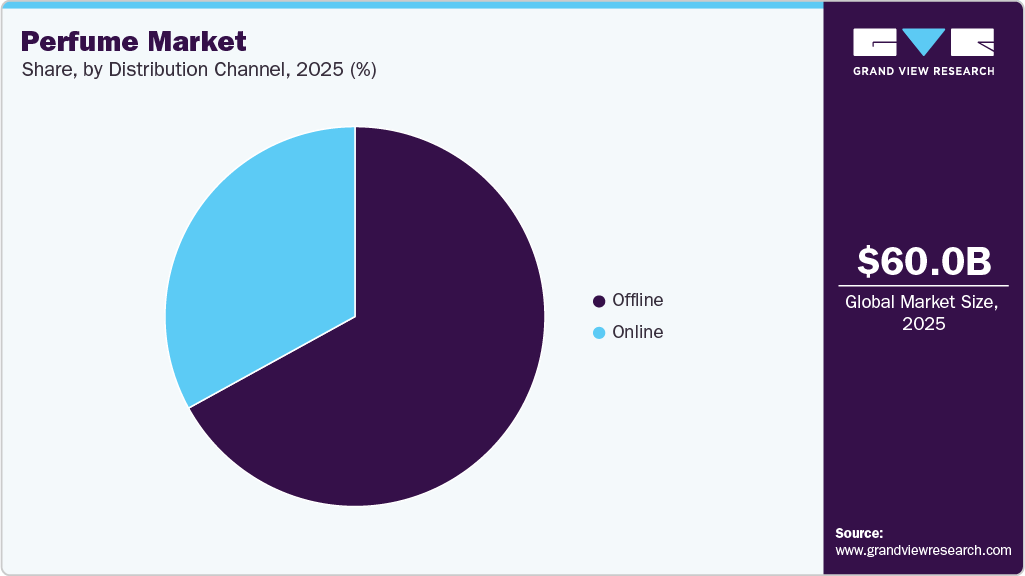
The sale of perfumes through online channels is expected to grow at a CAGR of 7.6% from 2026 to 2033. The evolution of online retail channels, such as Flaconi, Amazon, and Parfumdreams, has become a new and convenient way of distributing perfumes, despite consumers being unable to test the fragrance before purchase. Players adopt various advertising and promotional strategies to offer their products online. The growing popularity of e-commerce in emerging economies is another key factor driving the segment growth. In China, India, and other emerging economies, online channels are gaining traction for browsing and shopping for perfumes, which is projected to propel the growth of this segment during the forecast period.
Regional Insights
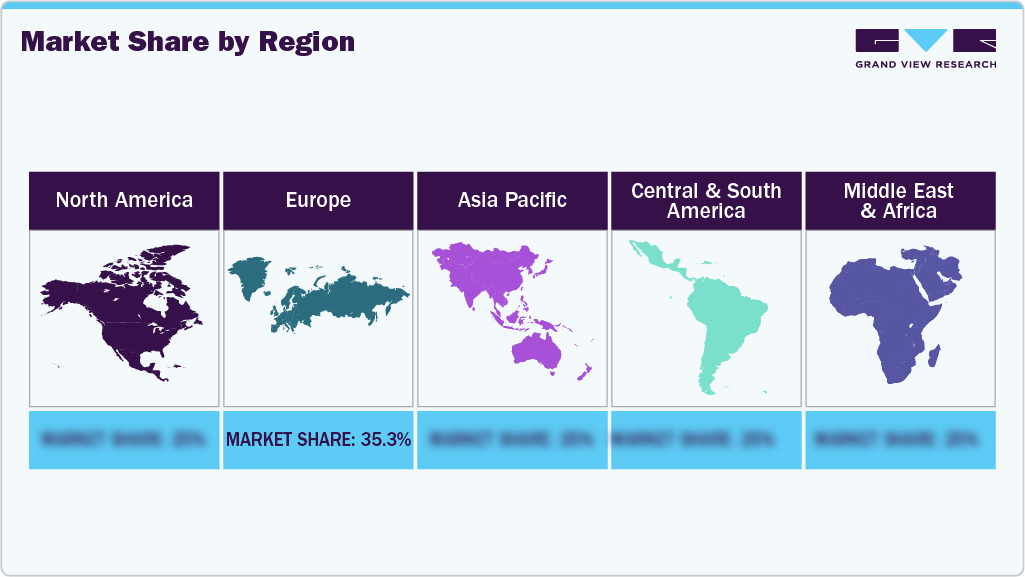
The North American perfume industry accounted for the largest share of 27.7% in 2025. Rising disposable incomes, interest in personalized scents, and innovative product launches fuel market expansion. Specialty retail stores and e-commerce platforms are key distribution channels, offering convenience and variety to consumers. For instance, in September 2025, Liberty London launched its in-house perfume brand in North America, capitalizing on the region’s growing demand for luxury fragrances and contributing to its continued growth.
U.S. Perfume Market Trends
The perfume industry in the U.S. was valued at USD 13.64 billion in 2025. The growth is driven by increasing consumer spending on beauty and self-care products. Rising brand awareness, innovative scent formulations, and the popularity of seasonal and limited-edition launches are boosting the demand for various perfumes. Retail expansion across department stores, specialty outlets, and online platforms also supports market growth.
Europe Perfume Market Trends
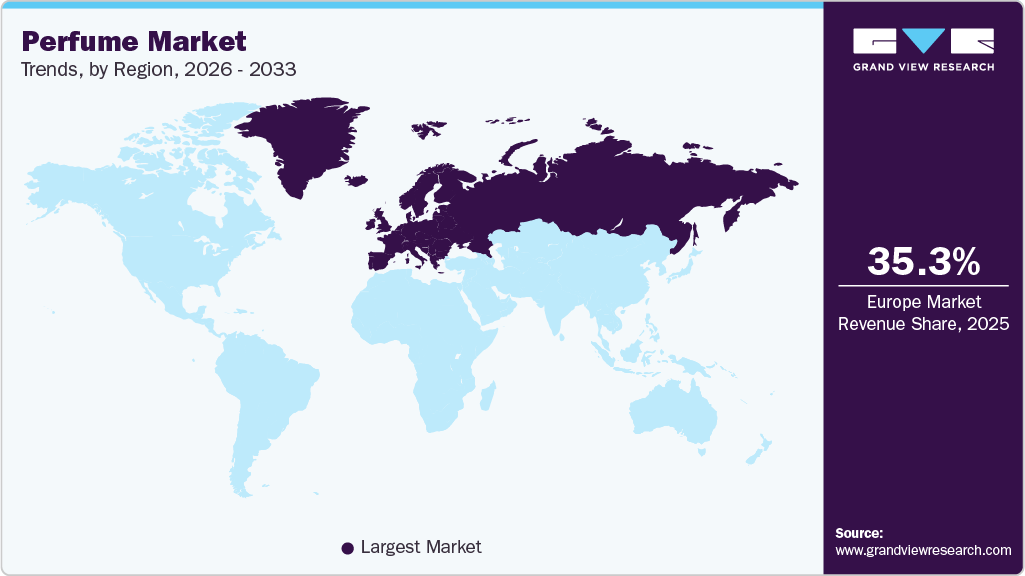
Europe perfume industry accounted for the largest revenue share of 35.35% in 2025. The European market is one of the most mature and high-value markets globally, driven by strong demand for niche and premium fragrances. The UK, France, Germany, and Italy are key markets contributing to the growth, with France maintaining a dominant position due to its rich heritage in perfumery and continued consumer preference for high-end scents. The market growth is fueled by increasing disposable incomes, rising consumer awareness of premium and artisanal fragrances, and the popularity of personalized and gender-neutral products.
The perfume industry in the UK is expected to showcase a growth rate of 4.4% from 2026 to 2033. The growth is driven by rising consumer interest in luxury and wellness-oriented scents. For instance, in May 2025, Bella Hadid launched her fragrance brand, Orebella, in the UK with an exclusive debut at Selfridges in London. The line features a unique alcohol-free, bi-phase formula using essential oils, combining skincare benefits with fragrance. The collection includes four scents: Window2Soul, Salted Muse, Blooming Fire, and Nightcap.
The perfume industry in France is expected to showcase a CAGR of 4.7% from 2026 to 2033. The country is home to iconic fragrance houses such as Christian Dior, Chanel, and Guerlain. France leads in producing and exporting perfumes, maintaining its reputation as a global hub for luxury and artisanal fragrances. French consumers’ preference for high-quality, premium scents continues to fuel innovation and limited-edition launches across the European region.
Asia Pacific Perfume Market Trends
The Asia Pacific perfume industry is expected to grow at a CAGR of 6.8% from 2026 to 2033. The changing beauty trends in the Asia Pacific region are creating a surge in the demand for luxury and premium fragrances. This is encouraging manufacturers to establish their footprint in this region. Moreover, the popularity of travel-size, mini, and pocket-size perfumes is rising owing to their convenience, further contributing to the market expansion. For instance, in April 2025, Chanel launched Chance Eau Splendide in Tokyo, Japan, a floral-fruity fragrance created by perfumer Olivier Polge, catering to the evolving preferences of consumers in the region.
The perfume industry in India is valued at USD 2.28 billion in 2025 and is driven by rising consumer demand for luxury and premium fragrances. Increasing disposable incomes and growing awareness of global fragrance trends are contributing to the product demand. Al Abbadi Fragrances launched its exclusive luxury collection in New Delhi in September 2025, offering artisan-crafted, limited-edition perfumes with 18-24 hours of longevity.
Central & South America Perfume Market Trends
The Central & South America perfume industry is expected to grow at a CAGR of 5.2% from 2026 to 2033. Consumers in the region commonly use perfumes as part of daily grooming rather than occasional wear, supporting repeat purchases across mass and accessible prestige price bands. Demand is further shaped by the popularity of compact, travel-size, and refillable formats, which align with urban lifestyles, gifting habits, and affordability considerations. Regional brands and global players are tailoring offerings to local scent preferences, often emphasizing floral, fruity, and fresh profiles, while expanding physical and direct-to-consumer presence.
Middle East & Africa Perfume Market Trends
The Middle East & Africa perfume industry is expected to grow at a CAGR of 4.7% from 2026 to 2033. supported by deep-rooted fragrance culture, high per-capita usage, and sustained demand for premium and luxury scents. Perfumes play a central role in daily grooming and social identity across the region, particularly in the Gulf countries, where consumers favor concentrated, long-lasting formats such as parfum and Eau de Parfum with oriental, woody, amber, and oud-based profiles. This cultural preference encourages frequent usage and repeat purchasing, sustaining demand across both luxury and accessible prestige segments.
Key Perfume Companies:
The following key companies have been profiled for this study on the perfume market.
- Avon
- CHANEL
- Coty Inc.
- LVMH Moet Hennessy-Louis Vuitton
- The Estée Lauder Companies
- Revlon
- Puig
- L'Oréal
- Shiseido Company, Ltd.
- Givaudan
- Hermès
- KERING
Recent Developments
-
In February 2026, Elizabeth Arden unveiled Eternal Aura Eau de Parfum, marking its first fragrance launch in eight years and positioning the scent as a celebration of contemporary femininity. The floral-amber fragrance was introduced with actress Leighton Meester as its global ambassador, anchoring a campaign focused on confidence, resilience, and self-expression. Eternal Aura opened with vibrant notes of dragon fruit, golden pear, and pink pepper, supported by magnolia, peony, and a bespoke rose-ambrette heart, before settling into warm sandalwood, musk, and tonka bean accords.
-
In February 2026, Balmain expanded its beauty portfolio with the debut of Destin de Balmain, the brand’s first prestige fragrance released under the Estée Lauder Companies license. The floral-fruity eau de parfum was crafted to embody the independent, youthful spirit associated with the House’s heritage, opening with juicy strawberry and rosy peony accord complemented by creamy sandalwood and nuanced spice elements. Designed in a refillable glass cube adorned with the iconic PB monogram and gold striations, the fragrance was positioned as a symbol of optimism and self-determination.
-
In October 2025, Estée Lauder launched the Global Fragrance Atelier in Paris. This newly established hub is set to advance next-generation innovations in perfume artistry while focusing on world-class fragrance expertise and cutting-edge technologies.
-
In October 2025, Loewe launched its exclusive fragrances under the Crafted Collection, transforming its common perfumery notes into exceptional fragrances. These scents are presented in weighty, artisan-blown glass vessels, with naturally formed bubbles creating unique patterns on each, and a tactile granite cap for a perfect finish.
Perfume Market Report Scope
Report Attribute
Details
Market size value in 2026
USD 63.51 billion
Revenue forecast in 2033
USD 96.12 billion
Growth rate
CAGR of 6.1% from 2026 to 2033
Base year for estimation
2025
Historical data
2021 - 2025
Forecast period
2026 - 2033
Quantitative units
Revenue in USD million/Billion and CAGR from 2026 to 2033
Report coverage
Revenue forecast, company ranking, competitive landscape, growth factors, trends
Segments covered
Product, end use, price tier, distribution channel, region
Regional scope
North America; Europe; Asia Pacific; Middle East & Africa; Central & South America
Country scope
U.S.; Canada; Mexico; Germany; France; UK; Spain; Italy; China; Japan; India; South Korea; Australia & New Zealand; Argentina; Brazil; Saudi Arabia; South Africa; UAE
Key company profiled
Avon; CHANEL; Coty Inc.; LVMH Moët Hennessy-Louis Vuitton; The Estée Lauder Companies; Revlon; Puig; L'Oréal Groupe; Shiseido Company, Ltd.; Givaudan; Hermès; KERING
Customization scope
Free report customization (equivalent to up to 8 analysts working days) with purchase. Addition or alteration to country, regional & segment scope.
Pricing and purchase options
Avail customized purchase options to meet your exact research needs. Explore purchase options
Global Perfume Market Report Segmentation
This report forecasts revenue growth at the global, regional, and country levels and provides an analysis of the latest industry trends and opportunities in each of the sub-segments from 2021 to 2033. For this study, Grand View Research has segmented the global perfume market report based on product, end use, price tier, distribution channel, and region.
-
Product Outlook (Revenue, USD Million, 2021 - 2033)
-
Parfum (Pure Perfume/Extrait de Parfum)
-
Eau de Parfum (EDP)
-
Eau de Toilette (EDT)
-
Eau de Cologne (EDC)
-
Eau Fraiche
-
-
End Use Outlook (Revenue, USD Million, 2021 - 2033)
-
Men
-
Women
-
-
Price Tier Outlook (Revenue, USD Million, 2021 - 2033)
-
Mass (Up to USD 30)
-
Premium/Accessible Prestige (USD 30 to USD 80)
-
Prestige/Designer (USD 80 to USD 150)
-
Niche/Luxury (USD 150 to USD 300)
-
Ultra-Luxury/Haute Parfumerie (Above USD 300)
-
-
Distribution Channel Outlook (Revenue, USD Million, 2021 - 2033)
-
Offline Channels
-
Department Stores
-
Brand-Owned Retail Stores
-
Specialty Stores
-
Supermarkets and Hypermarkets
-
Drugstores & Pharmacies
-
Travel Retail
-
Others
-
-
Online Channels
-
Brand-Owned E-commerce (DTC)
-
Third-Party Marketplaces and Beauty Retailers
-
Others
-
-
-
Regional Outlook (Revenue, USD Million, 2021 - 2033)
-
North America
-
U.S.
-
Canada
-
Mexico
-
-
Europe
-
Germany
-
UK
-
France
-
Italy
-
Spain
-
-
Asia Pacific
-
China
-
India
-
Japan
-
South Korea
-
Australia & New Zealand
-
-
Central & South America
-
Brazil
-
Argentina
-
-
Middle East & Africa
-
Saudi Arabia
-
South Africa
-
UAE
-
-
Frequently Asked Questions About This Report
b. Some key players operating in the perfume market include The Avon Company; CHANEL; Coty Inc.; LVMH Moet Hennessy - Louis Vuitton; L’Oreal Groupe; Estée Lauder Inc; Revlon; and Puig.
b. Key factors such as the growing trend of personal grooming, coupled with increasing demand for luxury and exotic fragrances are expected to drive the market growth over the forecast period.
b. The global perfume market size was estimated at USD 60.01 billion in 2025 and is expected to reach USD 63.51 billion in 2026.
b. The global perfume market is expected to witness a compound annual growth rate of 6.1% from 2026 to 2033 to reach USD 96.12 billion by 2033.
b. Women accounted for the largest share of 70.7% in 2025. It is observed that women in the U.S. purchase a new perfume as often as once a month, compared to men who buy it on average 1-2 times per year, mainly for replenishment purposes.


Share this report with your colleague or friend.
Need a Tailored Report?
Customize this report to your needs — add regions, segments, or data points, with 20% free customization.


ISO 9001:2015 & 27001:2022 Certified
We are GDPR and CCPA compliant! Your transaction & personal information is safe and secure. For more details, please read our privacy policy.
Trusted market insights - try a free sample
See how our reports are structured and why industry leaders rely on Grand View Research. Get a free sample or ask us to tailor this report to your needs.