- Home
- »
- Healthcare IT
- »
-
Generative AI In Healthcare Market, Industry Report, 2033GVR Report cover
![Generative AI In Healthcare Market Size, Share & Trends Report]()
Generative AI In Healthcare Market (2026 - 2033) Size, Share & Trends Analysis Report By Component (Solutions), By Function (Virtual Nursing Assistants), By End Use (Clinical Research), By Application (Clinical), By Region, And Segment Forecasts
- Report ID: GVR-4-68040-135-7
- Number of Report Pages: 120
- Format: PDF
- Historical Range: 2021 - 2025
- Forecast Period: 2026 - 2033
- Industry: Healthcare
- Report Summary
- Table of Contents
- Segmentation
- Methodology
- Download FREE Sample
-
 Download Sample Report
Generative AI In Healthcare Market Summary
The global generative AI in healthcare market size was estimated at USD 2.9 billion in 2025 and is projected to reach USD 28.2 billion by 2033, growing at a CAGR of 33.3% from 2026 to 2033. Generative AI is transforming healthcare by providing data-driven insights that improve patient care, enhance diagnostic accuracy, and streamline clinical workflows.
Key Market Trends & Insights
- North America generative AI in healthcare market held the largest share of over 41.0% of the global market in 2025.
- The generative AI in healthcare industry in the U.S. is expected to grow significantly over the forecast period.
- Based on component, the solutions segment held the largest market share of 71.2% in 2025.
- Based on function, the administrative process optimization segment held the largest market share of 32.9% in 2025.
- Based on application, the clinical segment held the highest market share of 62.1% in 2025.
- Based on end use, the medical centers segment held the largest market share of 44.0% in 2025.
Market Size & Forecast
- 2025 Market Size: USD 2.9 Billion
- 2033 Projected Market Size: USD 28.2 Billion
- CAGR (2026-2033): 33.3%
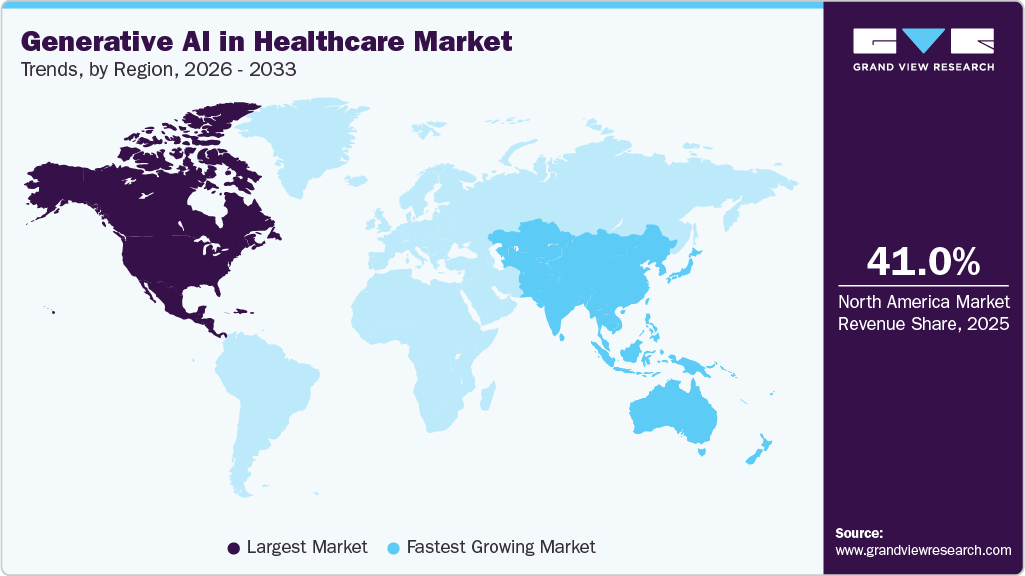
- North America: Largest market in 2025
- Asia Pacific: Fastest growing market
Moreover, the rising patient volumes, an aging population, and the increasing complexity of medical data are increasing the demand for AI in the healthcare market.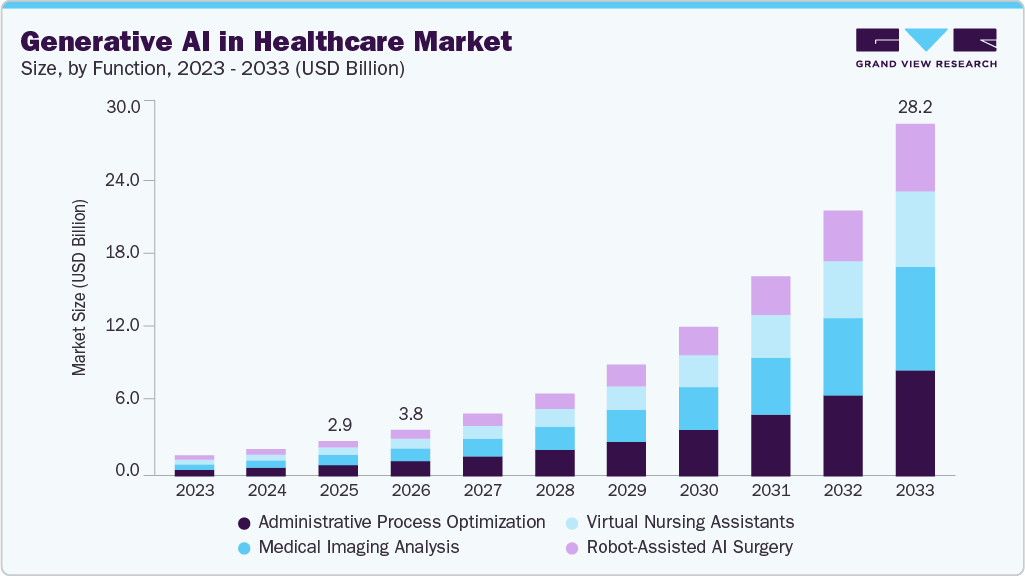
Market Drivers and Dynamics
The rising demand for personalized healthcare solutions is a key growth driver for the Generative AI in Healthcare Market. Generative AI benefits this trend by enabling tailored treatment plans through advanced data analysis, enhancing diagnostic accuracy, and streamlining administrative tasks. By aggregating and analyzing diverse data sources, including electronic health records (EHRs), genetic information, imaging datasets, and lifestyle factors, generative AI creates comprehensive patient profiles that support individualized care delivery.
In addition, generative AI is emerging as a key driver in healthcare by automating labor-intensive processes, improving clinical efficiency, and reducing physician burnout. One of the most significant applications is ambient documentation, where AI tools capture and structure physician-patient conversations in real time, minimizing administrative workload and enhancing the accuracy of medical records. For instance, in 2024, Kaiser Permanente tested ambient GenAI documentation in a 10-week pilot and, after strong results, expanded it across all eight regions, covering about 600 medical offices and 40 hospitals by 2025.
In addition, Northwestern Medicine rolled out DAX Copilot in Epic across its enterprise in August 2024, becoming an early mover in the large-scale integration of generative AI into clinical workflows. These deployments highlight a decisive shift from trials to system-wide adoption, signaling growing confidence in generative AI’s ability to streamline healthcare operations and drive the growth of the generative AI in healthcare industry.
Furthermore, the integration of AI-driven documentation tools into leading EHR platforms has been a major catalyst for adoption, as it streamlines physician workflows, minimizes manual data entry, improves documentation accuracy, and reduces burnout, ultimately enabling enterprise-wide deployment of generative AI across health systems. For instance, in 2024, Microsoft (Nuance) and Epic expanded the availability of DAX Copilot, embedding generative AI directly into Epic’s workflows.
More than 150 health systems were named as adopters, including large providers such as Lifespan and UNC Health. Several moved beyond pilots to enterprise deployment, with Northwestern Medicine confirming a full rollout in August 2024. Intermountain Health and Overlake Medical Center also implemented DAX Copilot during the same year. These large-scale deployments demonstrate how embedding generative AI into widely used EHRs accelerates adoption, reduces integration barriers, and reinforces the technology’s potential to drive market growth.
Market Concentration & Characteristics
The chart below illustrates the relationship between industry concentration, characteristics, and participants. The x-axis represents the level of industry concentration, ranging from low to high. The y-axis represents various industry characteristics, including industry competition, levels of partnerships & collaboration, degree of innovation, impact of regulations, and regional expansion. The generative AI in healthcare market is fragmented, with the presence of several emerging solution providers dominating the market. The degree of innovation is high, and the level of partnerships & collaboration activities is moderate. The impact of regulations on industry and the regional expansion of the industry is high.
The generative AI in healthcare industry experiences a high degree of innovation driven by technological advancements. The increasing adoption of healthcare IT solutions in revenue cycle management, drug discovery, personalized treatments, and hospital administration supports innovations in the market. For instance, in February 2025, Innovaccer launched Agents of Care-a suite of pre-trained AI Agents. This suite is expected to alleviate the strain of administrative overload in healthcare.
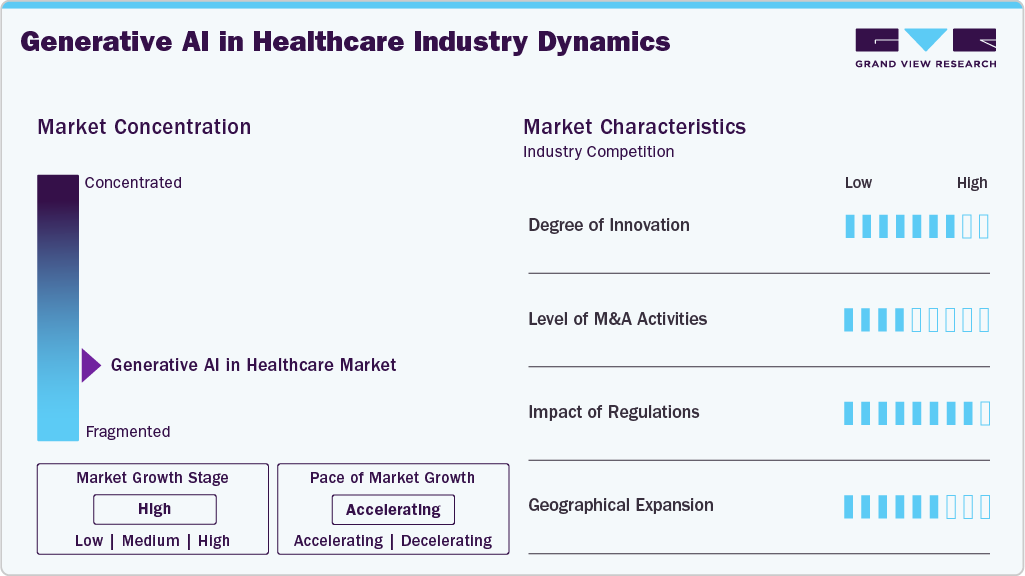
The industry is experiencing moderate levels of merger and acquisition activity driven by several key players. This is due to the desire to gain a competitive advantage in the industry, enhance technological capabilities, and consolidate in a rapidly growing market.
Regulations, such as the HIPAA in the U.S. and the GDPR in Europe, establish standards for safeguarding patient data privacy and security. Compliance with these regulations is crucial for AI applications in healthcare to ensure the safe and secure handling of patient information, reducing the risk of data breaches and unauthorized access.
Companies within the generative AI sector seek geographic expansion strategies to maintain their foothold in emerging markets and attract customers from these regions. Moreover, the industry is witnessing moderate geographical expansion, driven by an increasing customer base for generative AI software. With the growing adoption of digital healthcare solutions, the market is expected to grow significantly in the coming years, especially in developing countries.
Component Insights
The solutions segment dominated the generative AI in healthcare market, accounting for 71.2% of revenue in 2025. The rising demand for faster, more accurate diagnosis and the rapid expansion of drug discovery and personalized medicine are driving the segment’s growth. Pharmaceutical and biotechnology companies are increasingly using generative AI platforms to design novel drug molecules, predict outcomes, and optimize clinical trials. These solutions significantly shorten development timelines and lower R&D costs, creating strong demand from life sciences organizations.
In July 2025, Mayo Clinic deployed NVIDIA Blackwell-powered DGX SuperPOD infrastructure to accelerate generative AI, foundation model development for digital pathology, and precision medicine initiatives, thereby enhancing clinical innovation and operational efficiency.
"This compute power, coupled with Mayo’s unparalleled clinical expertise and platform data of over 20 million digitized pathology slides, will allow Mayo to build on its existing foundation models. We’re transforming healthcare by quickly and safely developing innovative AI solutions that can improve patient outcomes and enable clinicians to dedicate more time to patient care while also accelerating commercial affiliations with other industry leaders." - Jim Rogers, CEO of Mayo Clinic Digital Pathology.
The service segment is expected to grow at the fastest CAGR during the forecast period. The demand for the services segment is increasing due to the complexity of AI deployment, rising cybersecurity concerns, regulatory requirements, and the need for customized solutions. Many healthcare organizations lack in-house AI expertise, making external service providers critical partners in digital transformation initiatives. As generative AI adoption expands, the Services segment continues to grow alongside the Solutions segment, supporting sustainable and scalable implementation across the healthcare ecosystem.
Function Insights
The administrative process optimization segment dominated the generative AI in healthcare industry with a revenue share of 32.9% in 2025. Administrative process optimization is a significant function segment in the generative AI healthcare market, focusing on the automation and enhancement of non-clinical workflows. Unlike clinical applications, this segment directly addresses operational inefficiencies, enabling healthcare providers to reduce administrative burdens while improving service quality.
The medical imaging analysis segment is expected to grow at the fastest CAGR from 2026 to 2033. This segment focuses on the automated interpretation, enhancement, and generation of medical images. This segment leverages AI models to analyze imaging data from X-rays, CT scans, MRIs, and ultrasounds, enabling faster, more accurate diagnoses than conventional methods.
Application Insights
The clinical segment dominated the generative AI in the healthcare industry with a revenue share of 62.1% in 2025. In addition, this segment is anticipated to grow at the fastest CAGR during the forecast period. The clinical segment of the generative AI healthcare market is seeing rising demand as healthcare providers are seeking technologies that improve diagnostic accuracy and patient outcomes. Advancements in AI technologies, large language models, and medical imaging algorithms have further accelerated the adoption of generative AI in clinical applications. Improved computing power and access to large healthcare datasets have made these tools more accurate and reliable for real-world clinical use.
The system segment is expected to grow significantly during the forecast period. This segment is gaining demand as healthcare organizations increasingly focus on improving hospital management and operational efficiency. Healthcare systems handle a large amount of operational data related to patient admissions, scheduling, supply chain management, and hospital resources. Generative AI helps streamline these system-level processes by generating insights, automating workflows, and improving coordination across different departments. This enables healthcare institutions to operate more efficiently and manage resources more effectively.
End Use Insights
The medical centers segment dominated the generative AI in healthcare market, with the largest revenue share of 44.0% in 2025. Medical centers are increasingly adopting generative AI to enhance patient care, operational efficiency, and research capabilities. For instance, in February 2026, Japan Community Healthcare Organization Osaka Hospital, in collaboration with Fujitsu Japan Limited and Microsoft Japan Co., Ltd., launched a generative AI project to enhance clinical documentation, workforce efficiency, and governance frameworks across hospital operations.
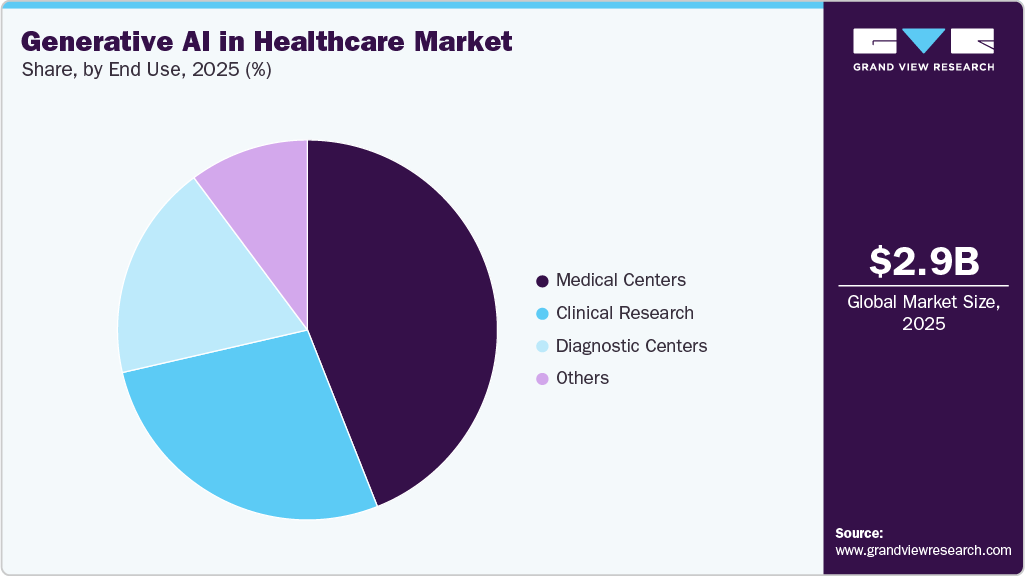
The clinical research segment is projected to grow at the fastest CAGR from 2026 to 2033. The demand for generative AI in clinical research is increasing rapidly due to its ability to accelerate and optimize the drug development process. Another factor driving demand is improved patient recruitment and retention. Identifying eligible patients for clinical trials has often been a bottleneck. Generative AI can analyze electronic health records to find suitable candidates, predict dropout risks, and suggest engagement strategies. These capabilities enable trials to recruit participants more efficiently and maintain higher retention rates, thereby improving the likelihood of trial success.
Regional Insights
North America dominated the generative AI in healthcare market, accounting for 41.0% of revenue in 2025. North America boasts a robust technological landscape and a well-established healthcare infrastructure, making it conducive to adopting and implementing advanced AI solutions. Moreover, significant investments in research and development, combined with strong support from governments and private sectors, have accelerated the growth of generative AI applications in healthcare. The region also houses numerous leading research institutions and tech companies focused on AI, fostering an environment of innovation and collaboration.
U.S. Generative AI in Healthcare Market Trends
The U.S. generative AI in healthcare market is expanding rapidly, driven by advanced healthcare infrastructure, widespread adoption of electronic health records (EHRs), and strong investment in digital health technologies. Healthcare providers are increasingly deploying generative AI to automate clinical documentation, summarize patient records, and support physician decision-making. For instance, according to a study published in JAMA Network, in December 2025, about 31.5% of U.S. hospitals had already implemented generative AI integrated with EHR systems by 2024, while nearly 25% planned implementation within the following year.
Europe Generative AI in Healthcare Market Trends
Europe generative AI in healthcare market is steadily growing, supported by strong public healthcare systems, advanced research institutions, and increasing adoption of AI-driven solutions across hospitals and research organizations. Countries such as the UK, Germany, and France are actively integrating generative AI into clinical workflows, medical imaging, clinical documentation, and healthcare data management to improve operational efficiency and patient outcomes.
The UK generative AI in healthcare market is advancing as the country integrates artificial intelligence into its publicly funded healthcare system and biomedical research ecosystem. Adoption is supported by strong digital health initiatives within the National Health Service (NHS), which is increasingly deploying AI technologies to improve clinical workflows, patient triage, medical imaging analysis, and healthcare administration.
The Germany generative AI in healthcare market is expanding as the country accelerates digital transformation across its healthcare system and strengthens the integration of artificial intelligence in medical research and clinical care. For instance, in November 2025, Sanofi’s operations in Germany revealed that it is systematically applying AI across its drug discovery value chain at its German research sites, from target and molecule identification to preclinical screening and clinical trial design.
Asia Pacific Generative AI in Healthcare Market Trends
The Asia Pacific generative AI in healthcare industry is expected to grow at the fastest CAGR of 34.3% from 2026 to 2033. Asia Pacific is rapidly emerging as a strategic hub for the generative AI in healthcare market, driven by accelerating digital transformation, supportive regulatory frameworks, rising healthcare demand, and robust data infrastructure.
The China generative AI in healthcare market is expected to grow significantly over the forecast period. China has rapidly emerged as a global leader in generative AI applications within the healthcare sector, fueled by strategic government policy, substantial capital investments, and an ambitious vision to transform national healthcare delivery. In August 2025, China outlined guidelines to expand AI integration across diagnosis, treatment support, intelligent health management, and insurance services, aiming for universal adoption of AI‑enabled diagnostic and treatment assistance in primary medical institutions by 2030, while embedding AI in hospitals at or above the second tier to improve efficiency, accessibility, and patient outcomes. This strategic focus has positioned China as a hub for innovation in AI‑driven healthcare services and research.
The India generative AI in healthcare market is expected to grow significantly over the forecast period. The country is increasingly adopting generative AI to accelerate healthcare innovation, driven by strategic investments in infrastructure, multi‑sector partnerships, and national AI health strategy initiatives. These efforts aim to enhance diagnostics, drug discovery, and predictive care models across the country. Government policies and research institutions are prioritizing AI tools that address public health challenges while improving clinical efficiency, and collaborations with global partners are feeding expertise and advanced technology into India’s healthcare ecosystem.
Latin America Generative AI in Healthcare Market Trends
Latin America generative AI in healthcare market is expected to grow significantly over the forecast period. Latin America is progressively adopting AI-enabled approaches to healthcare systems, driven by rising patient demand, chronic disease burdens, and the need for operational efficiency. Regional governments and private healthcare providers are investing in digital infrastructure and AI-driven solutions, including virtual health assistants, telemedicine platforms, and automated clinical documentation, contributing to market growth.
Middle East & Africa Generative AI in Healthcare Market Trends
The Middle East and Africa generative AI in healthcare market is expected to grow lucrative from 2026 to 2033. In the MEA region, AI is increasingly being adopted to accelerate healthcare transformation, particularly across clinical diagnostics, patient engagement, and hospital workflow optimization. Governments and healthcare providers are investing in digital health infrastructure and AI-driven platforms to improve care delivery and operational efficiency. Generative AI solutions are gaining traction in medical centers and diagnostic facilities, supporting predictive analytics, automated reporting, and personalized treatment planning.
Key Generative AI in Healthcare Company Insights
The market is characterized by strong competition, with a few major worldwide competitors owning a significant market share. The major focus is on developing new products and collaborating among the key players. For instance, in May 2023, DiagnaMed Holdings Corp., a biotechnology company in Canada unveiled FormGPT.io, a generative AI data analysis solution tailored for the healthcare sector. This launch represents the company's first commercial product in its effort to release a suite of customizable applications utilizing the power of GPT-4. These applications are designed to improve patient outcomes and streamline operations in real-world healthcare settings. These applications are designed to improve patient outcomes and streamline operations in real-world healthcare settings.
Key Generative AI in Healthcare Companies:
The following key companies have been profiled for this study on the generative AI in healthcare market.
- NVIDIA Corporation
- Google LLC
- IBM
- Johnson & Johnson
- Microsoft Corporation
- Oracle
- Tencent Holdings Ltd
- Neuralink Corporation
- NioyaTech
- OpenAI
- Saxon
- Syntegra
Recent Developments
-
In October 2025, Microsoft expanded Dragon Copilot with ambient and generative AI capabilities for nursing workflows and partner integrations, enhancing clinical intelligence, revenue cycle management and patient care efficiency.
“Microsoft continues to advance Dragon Copilot as a leading enterprise-wide AI clinical assistant for healthcare provider organizations, now adding support for specialized nursing workflows and an ecosystem of third-party AI extensions.” -Mary Varghese Presti, CVP and Chief Operating Officer, Microsoft Health and Life Sciences.
-
In August 2025, Epic unveiled new AI capabilities across its EHR platform, including generative AI tools for clinical documentation, revenue cycle management and patient engagement, and previewed Cosmos AI for predictive risk modeling.
-
In July 2025, Omega Healthcare expanded its collaboration with Microsoft to integrate Azure AI Foundry and Azure OpenAI capabilities into its Omega Digital Platform (ODP), launching more than 20 generative and agentic AI solutions to automate and optimize end-to-end revenue cycle management (RCM) operations for healthcare providers and payers.
“We are bringing scalable, tech-enabled services without requiring healthcare leaders to take on large, risky technology investments, freeing them up to focus on what matters most - delivering exceptional patient care.” -Anurag Mehta, CEO and Co-Founder, Omega Healthcare
-
In March 2024, NVIDIA Healthcare launched over 25 generative AI microservices, including NIM and CUDA-X tools, enabling pharmaceutical, biotech and healthcare organizations to accelerate drug discovery, genomics, imaging and digital health workflows.
"Generative AI is transforming drug discovery by allowing us to build sophisticated models and seamlessly integrate AI into the antibody design process.” -David M. Reese, executive vice president and chief technology officer at Amgen.
Generative AI in Healthcare Market Report Scope
Report Attribute
Details
Market size value in 2026
USD 3.8 billion
Revenue forecast in 2033
USD 28.2 billion
Growth rate
CAGR of 33.3% from 2026 to 2033
Actual data
2021 - 2025
Forecast period
2026 - 2033
Quantitative units
Market Value in USD million/billion, and CAGR from 2026 to 2033
Report coverage
Revenue forecast, company ranking, competitive landscape, growth factors, and trends
Segments covered
Component, function, application, end use and region
Regional scope
North America; Europe; Asia Pacific; Latin America; MEA
Country scope
U.S.; Canada; Mexico; Germany; UK; France; Italy; Spain; Norway; Denmark; Sweden; China; Japan; India; South Korea; Australia; Thailand; Brazil; Argentina; Saudi Arabia; South Africa; UAE; Kuwait
Key companies profiled
NVIDIA Corporation; Google LLC; IBM; Johnson & Johnson; Microsoft Corporation; Oracle; Tencent Holdings Ltd; Neuralink Corporation; NioyaTech; OpenAI; Saxon; Syntegra
Customization scope
Free report customization (equivalent up to 8 analysts working days) with purchase. Addition or alteration to country, regional & segment scope.
Pricing and purchase options
Avail customized purchase options to meet your exact research needs. Explore purchase options
Global Generative AI In Healthcare Market Report Segmentation
This report forecasts revenue growth at the global, regional, and country levels and provides an analysis of the industry trends in each of the sub-segments from 2021 to 2033. For this study, Grand View Research has segmented the generative AI in healthcare market report based on component, function, end use, application, and region:
-
Component Outlook (Revenue, USD Million, 2021 - 2033)
-
Solutions
-
Service
-
-
Function Outlook (Revenue, USD Million, 2021 - 2033)
-
Virtual Nursing Assistants
-
Robot-Assisted AI Surgery
-
Administrative Process Optimization
-
Medical Imaging Analysis
-
-
End Use Outlook (Revenue, USD Million, 2021 - 2033)
-
Clinical Research
-
Medical Centers
-
Diagnostic Centers
-
Others
-
-
Application Outlook (Revenue, USD Million, 2021 - 2033)
-
Clinical
-
System
-
-
Regional Outlook (Revenue, USD Million, 2021 - 2033)
-
North America
-
U.S.
-
Canada
-
Mexico
-
-
Europe
-
Germany
-
UK
-
France
-
Italy
-
Spain
-
Denmark
-
Sweden
-
Norway
-
-
Asia Pacific
-
China
-
Japan
-
India
-
South Korea
-
Australia
-
Thailand
-
-
Latin America
-
Brazil
-
Argentina
-
-
Middle East and Africa
-
Saudi Arabia
-
UAE
-
South Africa
-
Kuwait
-
-
Frequently Asked Questions About This Report
b. The global generative AI in healthcare market is expected to grow at a compound annual growth rate of 33.3% from 2026 to 2033 to reach USD 28.2 billion by 2033.
b. Some key players operating in the generative AI in healthcare market include Google LLC; IBM; Johnson & Johnson; Microsoft Corporation; Neuralink Corporation; NioyaTech; OpenAI; Oracle; Saxon; Syntegra; Tencent Holdings Ltd
b. Key factors that are driving the market growth include advancements in medical research, personalized medicine, improved diagnostics through medical imaging, data augmentation, natural language processing, virtual health assistants, medical simulation, cost-efficiency, and supportive regulatory frameworks.
b. The global generative AI in healthcare market size was estimated at USD 2.9 billion in 2025 and is expected to reach USD 3.8 billion in 2026.
b. North America dominated the generative AI in healthcare market with a revenue share of 41.0% in 2025. North America boasts a robust technological landscape and a well-established healthcare infrastructure, making it conducive to adopting and implementing advanced AI solutions. Moreover, significant investments in research and development, combined with strong support from governments and private sectors, have accelerated the growth of generative AI applications in healthcare.


Share this report with your colleague or friend.
Need a Tailored Report?
Customize this report to your needs — add regions, segments, or data points, with 20% free customization.


ISO 9001:2015 & 27001:2022 Certified
We are GDPR and CCPA compliant! Your transaction & personal information is safe and secure. For more details, please read our privacy policy.
Trusted market insights - try a free sample
See how our reports are structured and why industry leaders rely on Grand View Research. Get a free sample or ask us to tailor this report to your needs.