- Home
- »
- Animal Health
- »
-
Veterinary Microchips Market Size, Industry Report, 2033GVR Report cover
![Veterinary Microchips Market Size, Share & Trends Report]()
Veterinary Microchips Market (2026 - 2033) Size, Share & Trends Analysis Report By Animal (Dogs, Cats, Horses), By Product (Microchips, Scanner), By Frequency, By Application, By Distribution Channel (Veterinary Identification), By Region, And Segment Forecasts
- Report ID: GVR-4-68040-445-4
- Number of Report Pages: 150
- Format: PDF
- Historical Range: 2021 - 2024
- Forecast Period: 2026 - 2033
- Industry: Healthcare
- Report Summary
- Table of Contents
- Segmentation
- Methodology
- Download FREE Sample
-
 Download Sample Report
Veterinary Microchips Market Summary
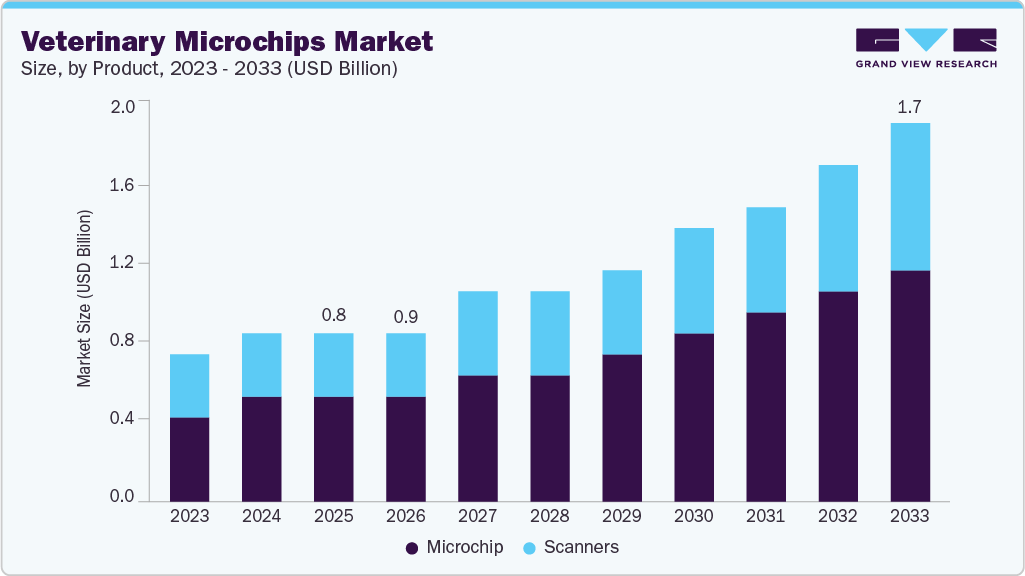
The global veterinary microchips market size was estimated at USD 0.82 billion in 2025 and is projected to reach USD 1.74 billion by 2033, growing at a CAGR of 10.4% from 2026 to 2033. The market is witnessing strong growth due to proliferating mandatory microchipping mandates across species and geographies, tightening ISO/ICAR compliance requirements favoring standardized 134.2 kHz adoption, expanding national livestock traceability programs linked to food safety and disease surveillance, and rising equine sport federation mandates for chip-based competition eligibility.
Key Market Trends & Insights
- North America dominated the global veterinary microchips market with the largest revenue share of 34% in 2025.
- By product, the scanners segment is expected to grow at the fastest CAGR of 10.7% over the forecast period.
- By animal, the dogs segment accounted for the largest market revenue share in 2025.
- By frequency, the 134.2 KHz segment accounted for the largest market revenue share in 2025.
- By application, the disease tracking & vaccination management segment is expected to grow at the fastest CAGR over 2026 - 2033.
- By distribution channel, the veterinary hospitals/clinics segment accounted for the largest market revenue share in 2025.
Market Size & Forecast
- 2025 Market Size: USD 0.82 Billion
- 2033 Projected Market Size: USD 1.74 Billion
- CAGR (2026-2033): 10.4%
- North America: Largest market in 2025
- Asia Pacific: Fastest growing in the market
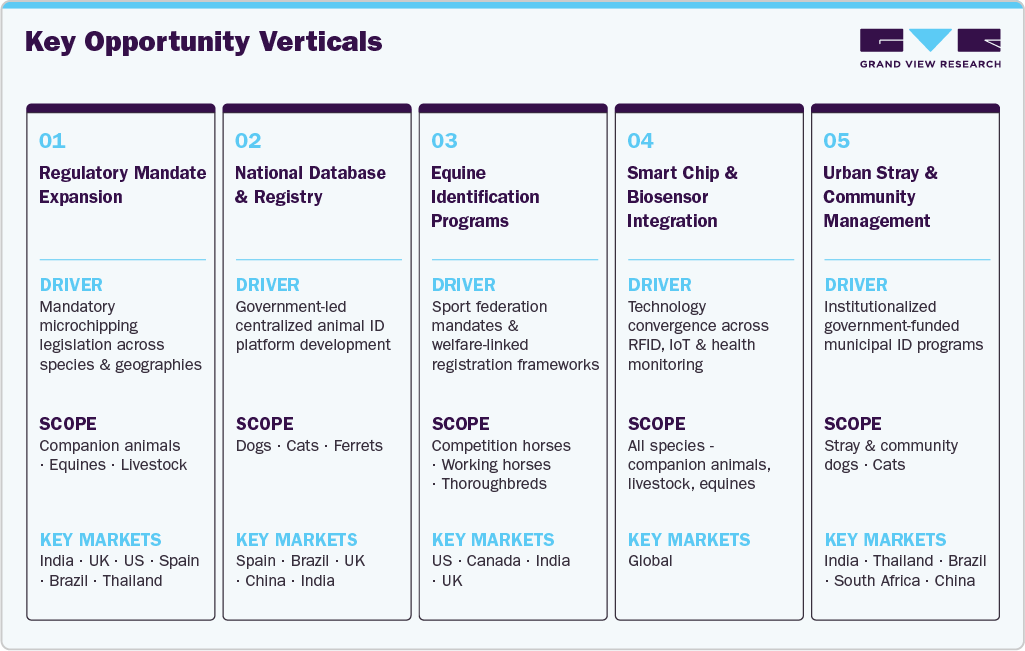
Government-enforced microchipping legislation has emerged as the most direct and measurable driver of demand in the global veterinary microchip market. Unlike awareness-driven adoption, regulatory mandates convert latent addressable populations into time-bound procurement obligations, creating near-term volume generation for chip manufacturers, scanner suppliers, and veterinary service providers simultaneously. The geographic breadth of active mandates has expanded materially across both companion animal and livestock categories.In the UK, mandatory microchipping for cats took effect in 2024, with non-compliant owners subject to fines of up to GBP 500, extending an obligation that had previously applied only to dogs. This positions the UK as one of the few markets with legally enforced cross-species companion animal identification requirements. Northern Ireland authorities have further initiated a public consultation on mandatory Electronic Identification for newborn cattle in February 2026, signaling imminent regulatory expansion into the livestock segment within the same jurisdiction.
In India, mandate activity has accelerated across both companion and production animal categories. The Greater Chennai Corporation issued a binding order requiring all dogs within Chennai city limits to be microchipped and vaccinated against rabies, with an initial compliance deadline of December 2025. Enforcement provisions include fines for non-compliant owners.
Simultaneously, Tamil Nadu mandated licensing and microchipping for cattle, while the Tamil Nadu Animal Welfare Board (TNAWB) initiated mandatory microchipping of working horses, with registration commencing March 10, 2026. These parallel mandates across dogs, cattle, and horses constitute a multi-species regulatory model with direct replicability in other Indian states and comparable emerging markets. Furthermore, the US Equestrian Federation's Presidential Modification to General Rule 1101.10, effective January 2026, established chip-based Horse Identification Numbers as a mandatory requirement for competition eligibility, translating organized equine sport participation directly into recurring chip demand.
These mandates function as structural baseline requirements for microchipping. Many countries, including all EU member states and key markets such as Japan, Australia, and the UAE, require ISO-compliant microchips as a prerequisite for cross-border animal entry, further institutionalizing demand at the international travel and trade interface. This regulatory architecture across companion animals, equines, and livestock categories establishes a durable, policy-driven demand base that operates independently of consumer discretionary behavior.
Market Concentration & Characteristics
The global veterinary microchip industry exhibits a moderately fragmented competitive structure. Established players such as Merck & Co., Virbac, Elanco, Datamars, and Avid Identification Systems hold significant share across companion animal and livestock segments, supported by broad distribution networks and established veterinary channel relationships. Mid-tier specialists such as Trovan Ltd., Datamars, and Wuxi Fofia Technology compete on frequency-specific and livestock-oriented product portfolios. Niche entrants, including Peeva Inc., Pet Pulse, and Pethealth Inc., target registry integration and software-linked identification platforms. No single player commands a dominant global share across all species and geographies, sustaining a competitive environment in which regulatory mandates, ISO compliance, and distribution reach serve as the primary differentiation axes.
Innovation activity within the veterinary microchip industry remains incremental rather than disruptive. Product development is concentrated in three areas: miniaturization of chip form factors for use across a broader species range, integration of temperature-sensing capability within standard identification chips (thermochips), and advancement of universal multi-frequency scanners capable of reading 125 KHz, 128 KHz, and 134.2 KHz formats simultaneously. Virbac's BackHome Eco-Pack and AVID's latest scanner launch indicate sustained but measured R&D output, with sustainability packaging and scanner interoperability representing the current innovation frontier.
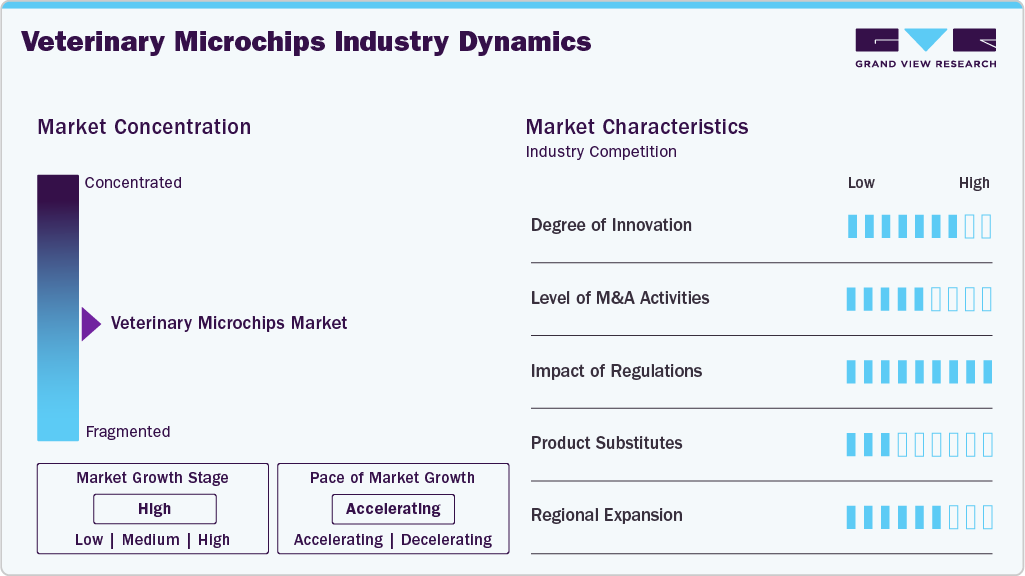
M&A activity has been relatively subdued compared to the broader animal health sector. Strategic consolidation has occurred primarily at the registry and database layer, where platform continuity and data ownership carry commercial value. Large animal health conglomerates, including Merck and Elanco, have pursued portfolio-level acquisitions that incidentally incorporate microchip and identification assets rather than targeted microchip-specific transactions.
Regulatory frameworks represent the single most consequential external variable shaping industry trajectory. Mandatory microchipping legislation directly converts unaddressed animal populations into active procurement volumes across veterinary clinics, retail channels, and government-run identification programs. ISO 11784/11785 and ICAR certification requirements have effectively standardized the 134.2 KHz frequency as the dominant technical benchmark, constraining non-compliant chip suppliers from accessing regulated markets. Cross-border pet travel requirements further institutionalize demand, while emerging livestock EID mandates in India and Northern Ireland are actively expanding the addressable market beyond companion animals.
The threat of product substitution remains low. Conventional alternatives like ear tags, tattoos, physical brands, and collar-based tags lack permanence, digital traceability, and regulatory acceptance. GPS tracking collars offer real-time location capability within the sector but function as complementary tools, constrained by battery dependency and higher unit costs. Regulatory mandates explicitly prescribe ISO-compliant subcutaneous microchips as the accepted identification standard, structurally limiting substitute viability at the compliance-driven demand layer.
Geographic expansion is most pronounced across Asia Pacific and the Middle East & Africa, where government-led animal traceability programs are at early-to-mid implementation stages, preserving substantial untapped addressable populations. India's multi-species mandate activity across Tamil Nadu signals broader national replication potential. North America and Europe maintain mature companion animal microchipping bases, with incremental growth driven by livestock EID mandates. Latin America remains at nascent regulatory development stages, representing a longer-horizon opportunity contingent on investment in institutional veterinary infrastructure.
Animal Insights
The dogs segment led the market with the largest revenue share of 50% in 2025, driven by the broadest and most mature mandatory microchipping legislative base globally. The UK established dog microchipping as a legal requirement ahead of other companion species, with comparable mandates institutionalized across the EU, Australia, and multiple US municipalities. High global pet dog populations, combined with organized adoption and shelter networks that require microchipping as a standard intake or release protocol, generate sustained, recurring chip demand. Additionally, dog owners exhibit a higher frequency of veterinary engagement, thereby increasing procedural attachment rates relative to other species. Cross-border travel requirements mandating ISO-compliant identification further concentrate procedural volumes within the canine segment.
The cats segment is expected to grow at the fastest CAGR over the forecast period, primarily driven by recent mandatory microchipping legislation extending legal obligations to felines. For instance, the UK's June 2024 cat microchipping mandate, carrying fines of up to GBP 500 for non-compliance, converted a historically under-chipped population into an active addressable market. Cats have consistently maintained lower historical microchipping rates relative to dogs across most geographies, preserving a proportionally larger untapped population base that active enforcement mechanisms are now systematically converting into procedural volumes.
Product Insights
The microchip segment accounted for the largest market share in 2025, driven by its status as the primary, non-substitutable procedural unit across all mandatory identification frameworks. Unlike scanners, which are capital purchases concentrated among veterinary facilities and shelters, microchips generate per-animal, per-procedure demand, producing a recurring volume dynamic. Advances in miniaturization and biocompatibility have broadened the species' applicability, while the long-term functionality of implanted chips eliminates replacement-driven attrition. Integration capability with national and regional animal databases further consolidates the microchip's position as the foundational identification medium across companion animal, equine, and livestock identification programs.
The scanner segment is expected to grow at the fastest CAGR during the forecast period, propelled by the accelerating implementation of the multi-species mandate, which requires parallel investment in reading infrastructure across veterinary clinics, shelters, border control points, and livestock management facilities. For instance, The Jockey Club's February 2026 distribution of free microchip scanners signals industry-led infrastructure seeding within the equine segment. Furthermore, recent scanner launches address interoperability gaps across legacy 125 KHz and 134.2 KHz chip populations, expanding the scanner replacement and upgrade cycle beyond new installation demand.
Frequency Insights
The 134.2 KHz frequency segment accounted for the largest market revenue share in 2025 and is expected to grow at the fastest CAGR over the forecast period. ISO 11784/11785 and ICAR certification frameworks designate 134.2 KHz as the internationally accepted standard for animal identification, mandating its adoption across all compliant identification programs. Cross-border pet travel requirements across 70+ countries, combined with expanding livestock EID mandates globally, concentrate procurement volumes exclusively within this frequency band.
The universal/multi-frequency devices segment is anticipated to grow at a significant CAGR during the forecast period, driven by the coexistence of legacy 125 KHz and 128 KHz chip populations alongside ISO-standard 134.2 KHz implants across active animal registries. Devices like the AVID MiniTracker 3, Datamars Black Label, and Trovan ProScan 700 address cross-protocol readability, covering ISO, AVID encrypted, FECAVA, and Trovan formats within a single handheld unit. Advancing Bluetooth connectivity, cloud-based database synchronization, and bio-sensor integration for health monitoring are further expanding functional utility beyond standard identification, broadening adoption across veterinary clinical and field settings.
Application Insights
The veterinary identification segment accounted for the largest market revenue share in 2025. The segment helps drive market growth by serving as the foundational application underpinning all microchip utility. Every implanted chip, regardless of species or geography, serves identification as its primary purpose, making this application category coextensive with total chip implantation volumes. The passive RFID architecture requires no internal power source, ensuring lifetime functionality without maintenance costs. Regulatory mandates across companion animals, equines, and livestock universally prescribe chip-based identification as the compliance mechanism, concentrating procedural and scanner procurement demand within this application segment across all distribution channels.
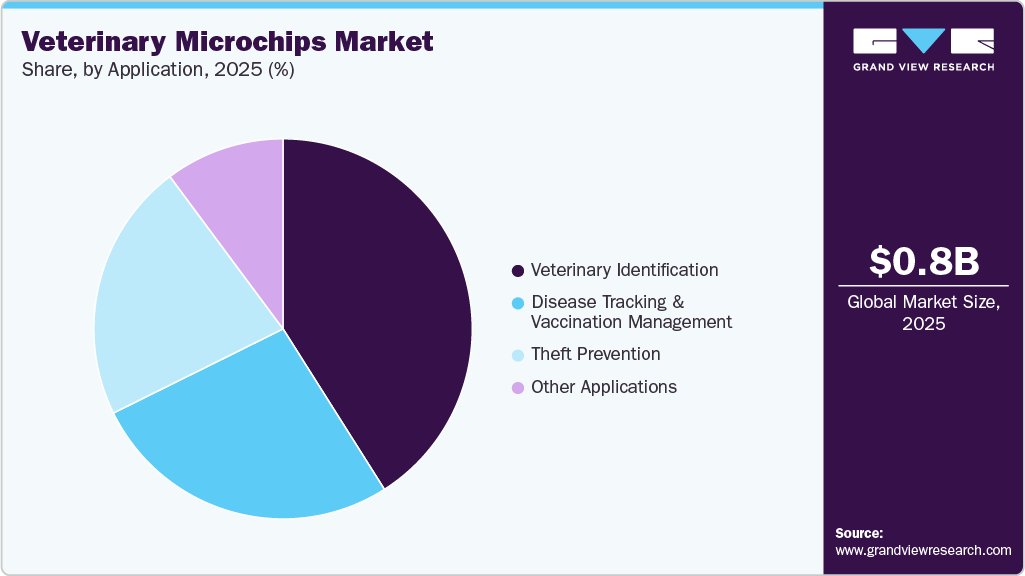
The disease tracking and vaccination management segment is anticipated to experience at the fastest CAGR during the forecast period, driven by the convergence of smart chip technology and expanding digital health infrastructure. Biosensor-integrated chips, such as VetChip, enable real-time monitoring of temperature, heart rate, and respiratory metrics, converting passive identification devices into active health surveillance tools. Large-scale municipal initiatives, such as Pune's stray dog sterilization and rabies-tracking program, demonstrate their applicability at the population level. For livestock, chip-linked permanent medical records from birth to slaughter are increasingly mandated for food safety compliance and international export certification, accelerating institutional adoption across agricultural markets.
Distribution Channel Insights
The veterinary hospitals and clinics segment accounted for the largest market revenue share in 2025, as microchip implantation remains an invasive procedure legally restricted to trained veterinary professionals across most regulated markets. Procurement occurs through established wholesale relationships with distributors, alongside direct manufacturer supply agreements with large hospital networks. Clinics also serve as primary database registration points, linking implanted chips to digital health records and consolidating identification, vaccination management, and medical history archiving within a single procedural interaction.
The e-commerce segment is anticipated to grow at the fastest CAGR during the forecast period, driven by increasing direct-access procurement of microchip kits and scanners by small-scale breeders, rescue organizations, and price-sensitive individual owners bypassing traditional veterinary supply chains. Competitive pricing, bundled registration packages, and home delivery convenience accelerate platform adoption. Mandatory microchipping legislation across the globe has generated high-volume consumer demand gravitating toward accessible, price-transparent digital storefronts. Strategic online-to-offline partnerships between e-commerce platforms and veterinary networks further institutionalize this channel's commercial relevance.
Regional Insights
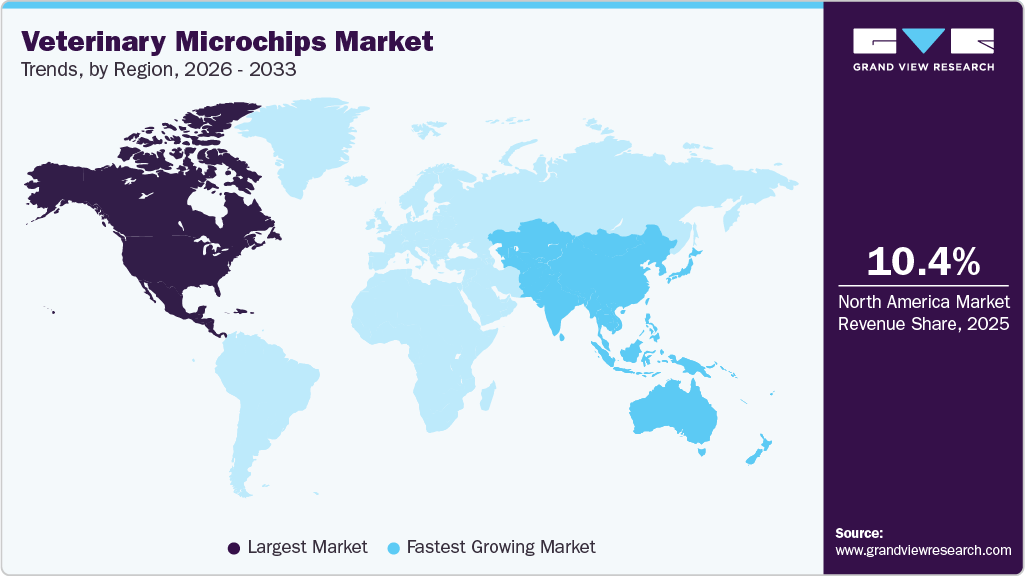
North America dominated the global veterinary microchips marketwith the largest revenue share of 34% in 2025.The market is driven by a mature companion animal microchipping infrastructure, high veterinary expenditure per capita, and multi-species mandate activity spanning companion animals, equines, and livestock. The region benefits from well-established mandatory microchipping legislation across companion animal categories, organized shelter and adoption networks requiring chip implantation as standard protocol, and advanced veterinary distribution infrastructure enabling consistent procurement throughput. Active equine sport federation identification requirements and the further consolidation of livestock traceability frameworks further consolidate the region's addressable market depth across species categories.
U.S. Veterinary Microchips Market Trends
The veterinary microchips market in the U.S. accounted for the largest market revenue share in North America in 2025, driven by a large, organized companion animal population maintained within structured veterinary care cycles and institutionalized through municipal mandatory microchipping ordinances and shelter implantation protocols. Active equine demand catalysts, including the United States Equestrian Federation’s (USEF) January 2026 chip-based Horse Identification Number mandate and Jockey Club scanner distribution, are expanding the addressable market into organized sport and thoroughbred registry segments. Database fragmentation risks, as demonstrated by the "Save This Life" registry collapse, remain a structural constraint on the full realization of chip utility.
The Mexico veterinary microchips market is expected to grow significantly over the forecast period, primarily anchored in its livestock sector. SENASICA and the National Confederation of Livestock Organizations are actively collaborating to strengthen cattle traceability, mobilization certification, and herd health systems, creating institutional demand for electronic identification infrastructure. Cattle from the Mexican states of Chihuahua and Sonora are increasingly crossing into the US with RFID identification in place, USDA, with export compliance requirements to the US market serving as the primary adoption catalyst for livestock EID across Mexico's significant cattle-producing states.
Europe Veterinary Microchips Market Trends
The veterinary microchips market in Europe is fueled by a maturing yet actively expanding mandatory identification legislative framework that spans companion animals and livestock. The EU's advancing Regulation on the welfare of dogs and cats requires all animals held by breeders, sellers, and shelters, including those offered online, to be microchipped and registered in an interoperable national database, with implantation restricted to veterinary professionals. Furthermore, Northern Ireland's active consultation on mandatory cattle EID further extends the addressable adoption into the livestock segment, broadening regional demand beyond companion animal categories across the forecast period.
The UK veterinary microchips market is growing steadily, driven by cross-species mandatory identification legislation covering both dogs and cats, enforced through Defra-compliant database registration requirements carrying fines for non-compliance. The UK currently operates 25 Defra-compliant microchip databases, with providers including Animal Tracker, Petlog, and Identibase offering tiered subscription models alongside one-off registration services, indicating a commercially active and expanding registry ecosystem sustaining recurring revenue beyond chip implantation volumes.
The veterinary microchips market in Spain is expected to grow at the fastest CAGR over the forecast period, driven by the Animal Welfare Law mandating microchipping for all dogs, cats, and ferrets across all autonomous communities. The Spanish government's launch of a unified national pet registry consolidating microchip data, ownership records, and full medical history accessible to veterinary professionals nationwide converts a historically fragmented, under-registered companion animal population into a structured, compliance-driven procurement base, generating sustained demand across veterinary clinic and database registration channels throughout the forecast period.
Asia Pacific Veterinary Microchips Market Trends
The veterinary microchips market in the Asia Pacific is expected to grow at the fastest CAGR over the forecast period. The market is growing quickly, fueled by the convergence of expanding mandatory microchipping legislation across companion animal, equine, and livestock species, rising pet ownership rates across urban centers, and strengthening cross-border animal movement regulations requiring ISO-compliant identification. The region presents the largest untapped addressable population globally, with mandatory compliance frameworks at early-to-mid implementation stages across multiple high-density markets, thereby preserving substantial incremental volume-generation potential throughout the forecast period.
The China veterinary microchips market is fueled by a rapidly expanding urban pet population, municipal-level mandatory microchipping mandates, and tightening cross-border animal entry requirements. Shenzhen has implemented compulsory ISO-compliant RFID microchipping for all registered dogs, with 100 partnering pet hospitals providing government-subsidized implantation services. China's strict pet import regulations, requiring ISO 11784/11785-compliant chip verification at customs, with non-readable chips resulting in mandatory quarantine, institutionalize demand across both domestic and international pet movement channels, sustaining consistent chip and scanner procurement volumes.
The veterinary microchips market in India is growing at a significant rate, fastest in the market, driven by an accelerating multi-species mandatory identification framework spanning companion animals, working horses, and livestock across multiple states. Municipal and state-level regulatory bodies are actively issuing binding microchipping mandates with enforceable fine structures for non-compliance, converting India's substantial unregistered animal population, one of the largest globally across both companion and livestock categories, into an active addressable market. Policy replication beyond Tamil Nadu into other major urban centers signals a structural shift from voluntary to compliance-driven adoption, generating sustained procurement demand across veterinary clinic and government-administered identification program channels throughout the forecast period.
Latin America Veterinary Microchips Market Trends
The veterinary microchips market in Latin America is driven by expanding companion animal ownership across urban centers, growing livestock traceability requirements linked to international beef export certification standards, and gradually strengthening animal welfare legislative frameworks. Brazil and Argentina, as major global livestock exporters, face increasing pressure to adopt electronic identification systems that meet ISO compliance standards. Regulatory development remains at nascent-to-developing stages across most countries, with institutional veterinary infrastructure investment serving as the primary prerequisite for accelerated market conversion.
The Brazil veterinary microchips market is driven by the local government's enactment of Law 15.046/2024, establishing a National Register of Domestic Animals accessible through the Gov.br platform, consolidating owner identity, vaccination records, disease history, and microchip data in a centralized, publicly accessible registry. While microchipping remains recommended rather than compulsory under the current framework, government-funded microchipping campaigns and municipal-level registration programs are actively converting voluntary adoption into structured identification activity, generating sustained procedural demand across veterinary clinic channels.
Middle East & Africa Veterinary Microchips Market Trends
The veterinary microchips market in the Middle East & Africa is experiencing steady growth, largely driven by mandatory ISO-compliant microchip requirements for pet importation across Gulf Cooperation Council member states, including the UAE, Saudi Arabia, Bahrain, Kuwait, and Qatar, institutionalizing chip demand at cross-border animal entry points. Rising companion animal ownership among expatriate populations in urban Gulf centers generates consistent veterinary clinic-driven implantation volumes. Africa's growth is anchored in the development of livestock traceability programs linked to food safety certification and export compliance requirements, though nascent veterinary infrastructure and low regulatory enforcement capacity across sub-Saharan markets continue to constrain the conversion of addressable volume.
The South Africa veterinary microchips market held the largest revenue share in the Middle East & Africa in 2025, owing to a comparatively mature companion animal veterinary infrastructure, organized animal welfare networks, and active community-level microchipping programs. NGO- and rescue-organization-led initiatives, offering low-cost implantation at accessible price points, sustain broad-based adoption beyond formal veterinary clinic channels. A well-established pet ownership culture, combined with functioning identification and lost-pet reunification ecosystems, positions South Africa as the region's most developed veterinary microchip market, with demand volumes significantly exceeding those of neighboring African markets.
The veterinary microchip market in Saudi Arabia is growing rapidly, driven by government-mandated programs such as camel identification. With a national camel population of over ~ 2.2 million heads across approximately ~ 80,000 owners, Saudi Arabia's Ministry of Environment, Water, and Agriculture, in February 2026, launched a mandatory Camel Passport system, requiring subcutaneous microchip implantation as the core identification mechanism, linked to the centralized Naama digital platform for ownership verification, health records, and vaccination documentation. Mandatory microchip requirements for pet importation across the country further drive demand in the companion animal segment, complementing the country's large-scale livestock identification infrastructure.
Key Veterinary Microchips Company Insights
The global veterinary microchip industry operates under a moderately fragmented competitive structure, with no single player commanding dominant share across all species, geographies, and product categories. Merck & Co., Virbac, Datamars, Elanco, and Avid Identification Systems collectively account for a significant portion of global revenue, with competitive positioning determined primarily by distribution network depth, ISO/ICAR compliance, and veterinary channel penetration.
Mid-tier specialists including Trovan Ltd., Wuxi Fofia Technology, and Microchip Identification Systems compete on product-specific and geography-specific portfolios, while emerging platform-oriented players, Peeva Inc., Pethealth Inc., and Pet Pulse, target registry integration and database-linked identification services.
Key Veterinary Microchips Companies:
The following key companies have been profiled for this study on the veterinary microchips market.
- Merck & Co., Inc.,
- Peeva Inc
- Virbac
- ID Tech
- Dipole RFID
- Trovan Ltd.
- Wuxi Fofia Technology Co., Ltd
- Avid Identification Systems, Inc
- Datamars
- Pethealth Inc
- Elanco
- Microchip Identification Systems
- Pet Pulse
Recent Developments
-
In March 2026, AVID Identification Systems launched a new microchip scanner, MiniTracker 4, targeting enhanced cross-protocol readability, expanding its scanner portfolio to address interoperability gaps across multiple RFID frequency standards within veterinary clinic and shelter environments.
-
In February 2026, Virbac launched BackHome Eco-Pack in the UK, introducing sustainability-oriented packaging to its companion animal microchip product line, reflecting growing commercial emphasis on environmentally conscious product positioning within the veterinary identification segment.
-
In January 2026, Delhi's Municipal Corporation has earmarked INR 35 crore (~USD 4 million) in its 2026-27 budget specifically for microchipping and vaccination of community dogs, targeting at least 25,000 animals; with INR 20 crore (~ USD 2 million) deployed directly and the remainder channeled through NGO partnerships; representing one of India's largest institutionally funded urban stray dog identification programs to date.
Veterinary Microchips Market Report Scope
Report Attribute
Details
Market size value in 2025
USD 0.87 billion
Revenue forecast in 2033
USD 1.74 billion
Growth rate
CAGR of 10.4% from 2026 to 2033
Base year for estimation
2025
Historical data
2021 - 2024
Forecast period
2025 - 2033
Quantitative units
Revenue in USD million/billion, and CAGR from 2026 to 2033
Report coverage
Revenue forecast, company ranking, competitive landscape, growth factors, and trends
Segments covered
Veterinary, product, frequency, application, distribution channel, region
Regional scope
North America; Europe; Asia Pacific; Latin America; MEA
Country scope
U.S.; Canada; Mexico; UK; Germany; France; Italy; Spain; Denmark; Sweden; Norway; Japan; China; India; Thailand; South Korea; Australia; Brazil; Argentina; South Africa; UAE; Saudi Arabia; Kuwait; Qatar; Oman
Key companies profiled
Merck & Co., Inc.; Peeva Inc; Virbac; ID Tech; Dipole RFID; Trovan Ltd.; Wuxi Fofia Technology Co., Ltd; Avid Identification Systems, Inc; Datamars; Pethealth Inc; Elanco; Microchip Identification Systems; Pet Pulse
Customization scope
Free report customization (equivalent up to 8 analysts working days) with purchase. Addition or alteration to country, regional & segment scope.
Pricing and purchase options
Avail customized purchase options to meet your exact research needs. Explore purchase options
Global Veterinary Microchips Market Report Segmentation
This report forecasts revenue growth at global, regional, and country levels and provides an analysis of the latest industry trends in each of the sub-segments from 2021 to 2033. For this study, Grand View Research has segmented the global veterinary microchips market report based on animal, product, frequency, application, distribution channel and region:
-
Animal Outlook (Revenue, USD Million, 2021 - 2033)
-
Dogs
-
Cats
-
Horses
-
Others
-
-
Product Outlook (Revenue, USD Million, 2021 - 2033)
-
Microchips
-
Scanner
-
Handheld Scanners
-
Stationary Scanners
-
-
-
Frequency Outlook (Revenue, USD Million, 2021 - 2033)
-
134.2 KHz
-
125 KHz
-
128 KHz
-
Universal/Multifrequency Devices
-
-
Application Outlook (Revenue, USD Million, 2021 - 2033)
-
Veterinary Identification
-
Disease Tracking & Vaccination Management
-
Theft Prevention
-
Others
-
-
Distribution Channel Outlook (Revenue, USD Million, 2021 - 2033)
-
Veterinary Hospitals/Clinics
-
Veterinary Stores/Retails
-
E-Commerce
-
Others
-
-
Region Outlook (Revenue, USD Million, 2021 - 2033)
-
North America
-
U.S.
-
Canada
-
Mexico
-
-
Europe
-
UK
-
Germany
-
France
-
Italy
-
Spain
-
Denmark
-
Sweden
-
Norway
-
-
Asia Pacific
-
Japan
-
China
-
India
-
Australia
-
Thailand
-
South Korea
-
-
Latin America
-
Brazil
-
Argentina
-
-
Middle East & Africa
-
South Africa
-
UAE
-
Saudi Arabia
-
Kuwait
-
Qatar
-
Oman
-
-
Frequently Asked Questions About This Report
b. The global veterinary microchips market size was estimated at USD 726.7 million in 2024 and is expected to reach USD 794.8 million in 2025.
b. The global veterinary microchips market is expected to grow at a compound annual growth rate of 10.44% from 2025 to 2030 to reach USD 1.31 billion by 2030.
b. North America dominated the veterinary microchips market with a share of over 33% in 2024. This is attributable to the presence of established players and increasing demand for microchips. Moreover, the market is growing because of rising veterinary healthcare expenditures and per capita income.
b. Some key players operating in the veterinary microchips market include Merck & Co., Inc., Peeva Inc, Virbac, ID Tech (Eruditus Executive Education), Dipole RFID, Trovan Ltd., Wuxi Fofia Technology Co., Ltd, Avid Identification Systems, Inc, Datamars, Pethealth Inc
b. Key factors that are driving the market growth include the increasing adoption of companion animals, technological advancement in animal microchips, growing animal health expenditure, and increasing adoption of microchips


Share this report with your colleague or friend.
Need a Tailored Report?
Customize this report to your needs — add regions, segments, or data points, with 20% free customization.


ISO 9001:2015 & 27001:2022 Certified
We are GDPR and CCPA compliant! Your transaction & personal information is safe and secure. For more details, please read our privacy policy.
Trusted market insights - try a free sample
See how our reports are structured and why industry leaders rely on Grand View Research. Get a free sample or ask us to tailor this report to your needs.