- Home
- »
- Processed & Frozen Foods
- »
-
U.S. Frozen Bakery Products Market, Industry Report, 2033GVR Report cover
![U.S. Frozen Bakery Products Market Size, Share & Trends Report]()
U.S. Frozen Bakery Products Market (2026 - 2033) Size, Share & Trends Analysis Report By Product (Breads, Cakes & Pastries, Cookies & Biscuits), By Distribution Channel (Hypermarkets & Supermarkets, Club Stores, Online, Bakery Stores), By Region, And Segment Forecasts
- Report ID: GVR-4-68040-868-0
- Number of Report Pages: 109
- Format: PDF
- Historical Range: 2021 - 2024
- Forecast Period: 2026 - 2033
- Industry: Consumer Goods
- Report Summary
- Table of Contents
- Segmentation
- Methodology
- Download FREE Sample
-
 Download Sample Report
U.S. Frozen Bakery Products Market Summary
The U.S. frozen bakery products market size was estimated at USD 2,417.1 billion in 2025 and is projected to reach USD 3,796.3 million by 2033, growing at a CAGR of 5.8% from 2026 to 2033. The market’s growth is primarily driven by evolving consumer lifestyles and a strong preference for convenience-oriented food solutions.
Key Market Trends & Insights
- Northeast dominated the U.S. frozen bakery products market with the largest revenue share of 16.14% in 2025.
- By product, the breads segment led the market with the largest revenue share of 41.77% in 2025.
- By distribution channel, the hypermarkets & supermarket segment led the market with the largest revenue share of 27.61% in 2025.
Market Size & Forecast
- 2025 Market Size: USD 2,417.1 Million
- 2033 Projected Market Size: USD 3,796.3 Million
- CAGR (2026-2033): 5.8%
Busy schedules, increasing participation in the workforce, and a rising inclination toward ready-to-bake and ready-to-eat products are encouraging consumers to opt for frozen bakery items that offer both time efficiency and consistent quality. In addition, advancements in freezing technologies have significantly improved product shelf life, taste, and texture, further enhancing consumer acceptance.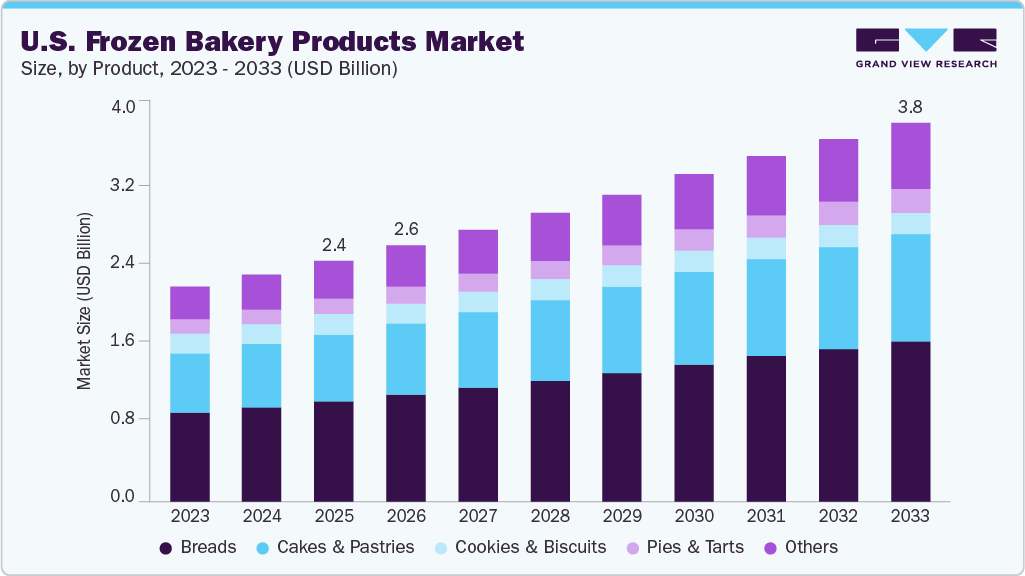
The market is also benefiting from growing demand for premium and artisanal-style bakery products, including clean-label, organic, gluten-free, and high-protein variants. Retail expansion, particularly across supermarkets, club stores, and online grocery platforms, has improved product accessibility and visibility.
As more households juggle busy work schedules, school routines, and hybrid work patterns, demand for ready-to-bake or heat-and-serve bakery items has increased significantly. Frozen bakery products eliminate the time-consuming shopping for and preparation of ingredients, and this convenience factor has become a decisive purchase trigger. 61% of Americans stated that convenience significantly impacts their food purchase decisions, highlighting that time savings is a core driver for continuing adoption of frozen bakery products.
In February 2026, Krispy Kreme launched a seasonal Valentine’s Day frozen doughnut collection, featuring themed items like heart-shaped doughnuts with chocolate and berry fillings. These holiday special releases support limited-time engagement and elevate category visibility.
Another important driver is changing dietary preferences and inclusivity. As health concerns and dietary preferences (such as plant-based, gluten-free, and reduced-sugar regimens) grow, manufacturers are expanding their frozen bakery portfolios to include products that meet these needs. For example, gluten-free frozen bread lines introduced by major U.S. brands demonstrate how product innovation addresses dietary demand while expanding the consumer base.
T. Marzetti Company introduced a first-ever gluten-free line of New York Bakery frozen bread, including gluten-free versions of Garlic Texas Toast and Five Cheese Texas Toast produced in a dedicated gluten-free facility. These products are designed to retain the texture and volume of traditional versions while addressing growing demand for gluten-free options.
A dominant trend is the expansion of online grocery and e-commerce channels, which has transformed access to frozen bakery products. During and after the pandemic, online grocery sales surged, and a significant proportion of shoppers now include frozen items in their online grocery carts. 86% of U.S. online grocery shoppers purchased frozen foods in 2023, up from around 47% three years earlier, showing the strength of digital channels in enabling market growth.
Parallel to e-commerce growth, foodservice channels such as quick-service restaurants (QSRs), cafés, and institutional food services are increasingly integrating frozen bakery items into their menus. This uptake is fueled by labor cost pressures and the need for consistent quality at scale. Chefs and operators can use pre-baked frozen doughs and ready bakery bases to reduce preparation time and meet high-volume demand without specialized staff, extending reach beyond traditional retail use.
In addition, regional consumption patterns reveal how frozen bakery appeal is broadening. For instance, the Midwest U.S. has emerged as a strong market due to robust bakery culture and extensive bakery manufacturing infrastructure, while in the West, demand is increasingly tied to specialty health-oriented products like gluten-free or whole-grain frozen goods.
Philadelphia Cream Cheese expanded into the frozen desserts category with Frozen Cheesecakes available in Original and Strawberry Swirl flavors. These ready-to-serve cheesecakes feature real cream cheese and a graham cracker crust and are targeted at consumers seeking holiday and convenience dessert solutions that require no baking.
Consumers are willing to pay a premium for higher-quality frozen bakery items that replicate artisan characteristics traditionally found only in fresh-baked goods. Brands that emphasize texture, flavor complexity, and ingredient quality can differentiate their products and command higher price points. Moreover, there’s a growing opportunity in expanding frozen bakery products tailored to plant-based, vegan, and allergen-friendly diets. Increased interest in dairy-free and gluten-free formats, particularly among Millennials and Gen Z, positions these variants as growth segments.
Consumer Insights for the U.S. Frozen Bakery Products Market:
In the U.S. frozen bakery products industry, consumer behavior has been increasingly shaped by convenience-led consumption, evolving household structures, and rising quality expectations. Frozen bakery products have been widely adopted by working professionals, families with children, and foodservice-dependent consumers due to their extended shelf life, reduced preparation effort, and consistent availability. Demand has been particularly driven by breakfast and snacking occasions, with products such as frozen breads, pastries, waffles, muffins, and donuts being preferred for quick, heat-and-serve usage.
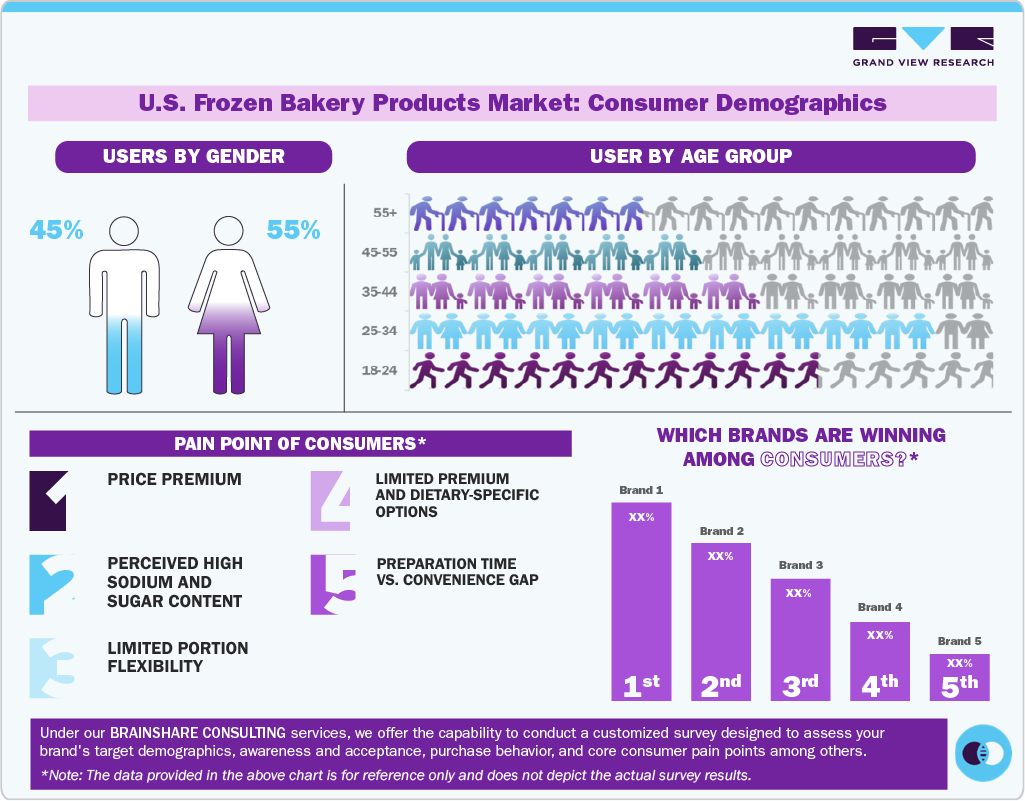
At the same time, consumers have demonstrated heightened sensitivity toward product quality parity with fresh bakery items, placing emphasis on texture, aroma, and freshness after baking. Label transparency has also become a decisive factor, as a growing segment of consumers actively evaluates ingredient lists, sugar and sodium levels, and clean-label claims, especially among younger age cohorts. In addition, purchasing decisions have been influenced by portion flexibility and packaging formats, reflecting the growth of single-person households and the desire to minimize food waste.
Product Insights
The breads segment led the market with the largest revenue share of 41.77% in 2025, driven by everyday utility, channel expansion, and cost-efficiency advantages over fresh counterparts. Core meal occasions, such as breakfast and lunch, generate consistent demand for bread formats, including sandwich loaves, rolls, buns, and bakery-style artisan breads. Younger, time-pressed households and dual-income families increasingly prioritize ready-to-bake or par-baked bread over fresh options, as frozen formats offer both extended shelf life and superior consistency, key attributes that align with a growth in at-home meal preparation post-pandemic.
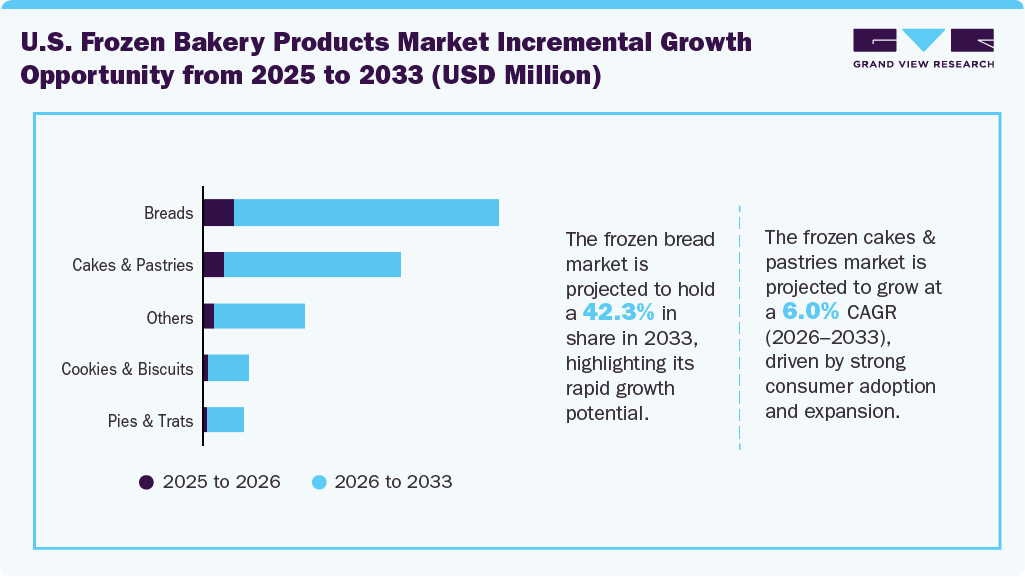
The cakes & pastries segment is projected to grow at the fastest CAGR of 6.0% from 2026 to 2033, as consumer preferences evolve toward premium indulgence, experiential eating, and convenient celebration solutions. Cakes and pastries are often associated with special occasions and elevated snacking moments, and frozen formats have gained traction as consumers seek quality products without the complexity of traditional baking. This trend is reflected in the expansion of premium frozen cake offerings, including layered celebration cakes, crèmes, éclairs, dessert tarts, and even mini-pastry assortments positioned for celebrations or social gatherings.
Distribution Channel Insights
The hypermarkets & supermarket segment led the market with the largest revenue share of 27.61% in 2025, because they remain the primary purchase destination for frozen bakery products across the U.S. Their dominance is rooted in consumer shopping habits that favor one-stop, full-basket purchases, where frozen bakery items are bought alongside core groceries. These large-format stores leverage wide product assortments, including national brands, private-label options, and niche frozen-bakery SKUs, to attract consumers seeking both value and variety. For frozen breads, rolls, and pastries, supermarkets often provide multiple price points, enabling budget-conscious shoppers and premium buyers alike to find products that suit their needs.
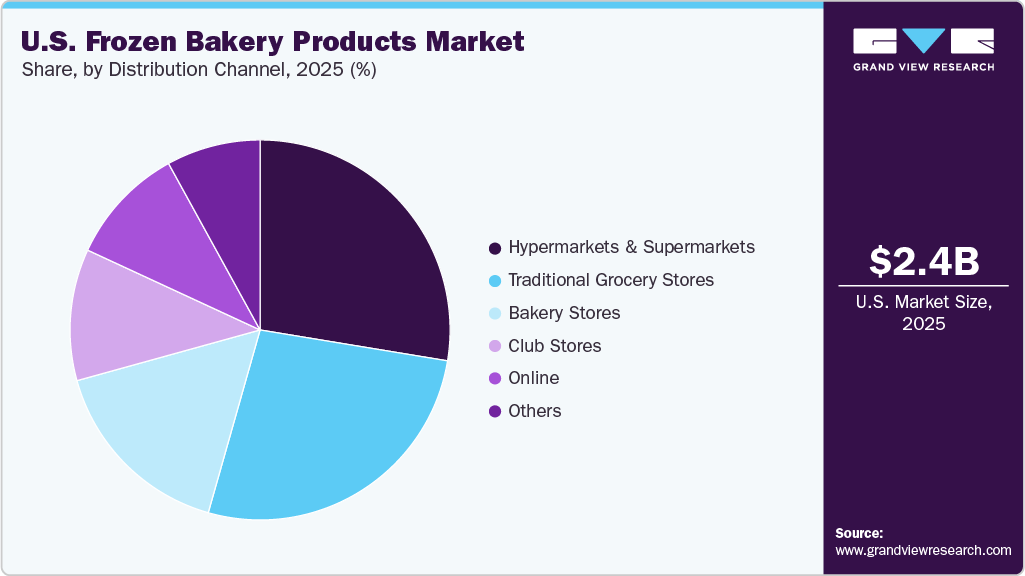
The online segment is expected to grow at the fastest CAGR of 9.9% over the forecast period. This reflects a broader transformation in how U.S. consumers shop for frozen bakery products. This surge is driven by growing adoption of e-commerce grocery platforms, improved cold-chain logistics, and changing consumer expectations around convenience and delivery. Post-pandemic consumer behavior has accelerated online grocery penetration, with an increasing share of frozen foods, including breads, pastries, muffins, and specialty desserts, being purchased through retailer websites, apps, and third-party delivery services. Shoppers are attracted to the online channel’s ease of comparison, availability of detailed product information, and subscription or recurring order features, which streamline repeat purchases.
Regional Insights
Northeast U.S. Frozen Bakery Products Market Trends
Northeast dominated the U.S. frozen bakery products market with the largest revenue share of 16.14% in 2025. The Northeast U.S., comprising major metropolitan hubs such as New York, Boston, Philadelphia, and Washington, D.C., represents a highly urbanized, culturally diverse consumer base that has historically driven strong demand for frozen bakery products. One key driver is the density of on-the-go lifestyles and commuting patterns; with a large percentage of the workforce engaged in long commute hours and hybrid work models, the need for quick, portable breakfast and snack solutions, such as frozen muffins, waffles, and par-baked breads, is particularly pronounced. This region also exhibits a high penetration of specialty food retailers and premium grocers, which often curate expanded frozen bakery assortments, including ethnic and artisanal formats that appeal to local taste profiles.
South Central U.S. Frozen Bakery Products Market Trends
The frozen bakery products market in the South Central region of the U.S. is projected to grow at the fastest CAGR of 8.4% from 2026 to 2033. In the South Central U.S., including Texas, Oklahoma, Louisiana, and Arkansas, the frozen bakery segment is poised for above-average growth driven by shifting demographics and evolving retail ecosystems. A primary driver is the region’s rapid population growth, especially in suburbs and secondary cities, which fuels increased grocery consumption overall and more occasions for at-home meal preparation. Rising multi-generational household purchasing, where larger households seek value and convenience, has bolstered demand for frozen breads and pastries that can serve both daily meals and social gatherings with minimal prep effort.
Key U.S. Frozen Bakery Products Company Insights
The U.S. frozen bakery products industry is characterized by the presence of a few well-established players. Some of the key players in the U.S. market are General Mills, Inc., Conagra Brands, Inc., and Europastry, S.A.
-
General Mills, Inc.: A leading U.S. food company with a strong frozen bakery presence through brands such as Pillsbury (including frozen dough and ready-to-bake products). General Mills leverages broad distribution networks in supermarkets and club stores and focuses on product innovation and health-oriented formats to strengthen engagement with convenience-seeking consumers.
-
Conagra Brands, Inc.: Conagra’s presence in frozen bakery stems from its strong foothold in the broader frozen food portfolio. The company emphasizes supply chain optimization, portfolio expansion through acquisitions, and consistent product development to serve both retail and foodservice channels.
-
Europastry, S.A.: A Spanish bakery group with international operations, Europastry is active in frozen bakery through a varied product mix including artisan breads, pastries, and viennoiserie formats, appealing to both retail and foodservice.
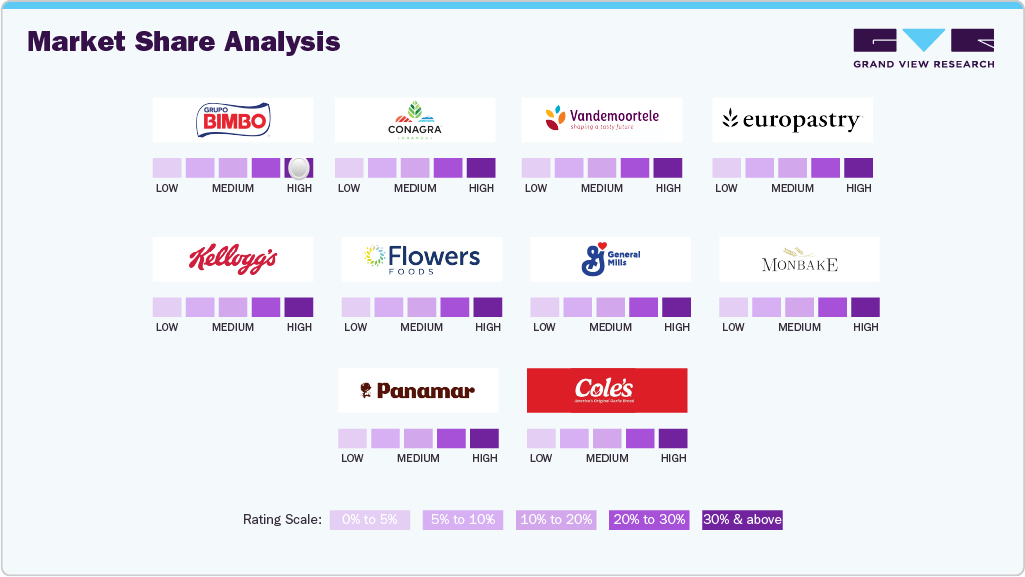
Key U.S. Frozen Bakery Products Companies:
- Grupo Bimbo
- Conagra Brands, Inc.
- Vandemoortele NV
- Europastry
- Kellogg Company
- Flowers Foods
- General Mills Inc.
- Monbake
- Panamar Bakery Group
- Cole’s Quality Foods, Inc.
Recent Developments
-
In February 2026, Krispy Kreme launched a seasonal Valentine’s Day frozen doughnut collection, featuring themed items like heart-shaped doughnuts with chocolate and berry fillings. These holiday special releases support limited-time engagement and elevate category visibility.
-
In October 2025, Lifestyle brand Magnolia Table rolled out a new nationwide frozen baked goods range with items like buttermilk biscuits, cinnamon rolls, banana bread, chocolate chip cookies, and sugar cookies. These products are designed for at-home baking simplicity and are available at Target stores and online.
U.S. Frozen Bakery Products Market Report Scope
Report Attribute
Details
Market value size in 2026
USD 2,564.9 million
Revenue Forecast in 2033
USD 3,796.3 million
Growth rate
CAGR of 5.8% from 2026 to 2033
Base year for estimation
2025
Historical data
2021 - 2024
Forecast period
2026 - 2033
Quantitative units
Revenue in USD million/billion and CAGR from 2026 to 2033
Report coverage
Revenue forecast, company ranking, competitive landscape, growth factors, and trends
Segments covered
Product, distribution channel, region
Country scope
U.S.
Regional Scope
Southeast; Northeast; Great Lakes; Mid-South; South Central; West; California; Plains
Key companies profiled
Grupo Bimbo; Conagra Brands, Inc.; Vandemoortele NV; Europastry; Kellogg Company; Flowers Foods; General Mills Inc.; Monbake; Panamar Bakery Group; Cole’s Quality Foods, Inc.
Customization scope
Free report customization (equivalent up to 8 analysts’ working days) with purchase. Addition or alteration to country, regional & segment scope.
Pricing and purchase options
Avail customized purchase options to meet your exact research needs. Explore purchase options
U.S. Frozen Bakery Products Market Report Segmentation
This report forecasts revenue growth at the regional and country levels and provides an analysis of the latest industry trends and opportunities in each of the sub-segments from 2021 to 2033. For this study, Grand View Research has segmented the U.S. frozen bakery products market report based on the product, distribution channel, and region:
-
Product Outlook (Revenue, USD Million, 2021 - 2033)
-
Breads
-
Cakes & Pastries
-
Cookies & Biscuits
-
Pies & Tarts
-
Others (Muffins/Cupcakes, Donuts, Waffles, Pancakes)
-
-
Distribution Channel Outlook (Revenue, USD Million, 2021 - 2033)
-
Traditional Grocery Stores
-
Hypermarkets & Supermarkets
-
Club Stores
-
Bakery Stores
-
Online
-
Others
-
-
Regional Outlook (Revenue, USD Million, 2021 - 2033)
-
Southeast
-
Northeast
-
Great Lakes
-
Mid-South
-
South Central
-
West
-
California
-
Plains
-
Frequently Asked Questions About This Report
b. The U.S. frozen bakery products market was valued at USD 2,417.1 million in 2025 and is expected to reach USD 2,564.9 million by 2026.
b. The U.S. frozen bakery products market is expected to reach USD 3,796.3 million by 2033 and is expected to grow at a compound annual growth rate (CAGR) of 5.8% from 2026 to 2033.
b. Frozen breads accounted for a share of 41.77% of the U.S. revenue in 2025 due to a combination of everyday utility, channel expansion, and cost efficiency advantages over fresh counterparts.
b. Grupo Bimbo; Conagra Brands, Inc.; Vandemoortele NV; Europastry; Kellogg Company; Flowers Foods; General Mills Inc.; Monbake; Panamar Bakery Group; Cole’s Quality Foods, Inc.
b. The primary engine of market growth continues to be convenience and lifestyle change among U.S. consumers. As more households juggle busy work schedules, school routines, and hybrid work patterns, demand for ready-to-bake or heat-and-serve bakery items has increased significantly.


Share this report with your colleague or friend.
Need a Tailored Report?
Customize this report to your needs — add regions, segments, or data points, with 20% free customization.


ISO 9001:2015 & 27001:2022 Certified
We are GDPR and CCPA compliant! Your transaction & personal information is safe and secure. For more details, please read our privacy policy.
Trusted market insights - try a free sample
See how our reports are structured and why industry leaders rely on Grand View Research. Get a free sample or ask us to tailor this report to your needs.