
- Home
- »
- Automotive & Transportation
- »
-
Truck Refrigeration Unit Market Size, Industry Report, 2033GVR Report cover
![Truck Refrigeration Unit Market Size, Share & Trends Report]()
Truck Refrigeration Unit Market (2026 - 2033) Size, Share & Trends Analysis Report By System Type (Diesel-engine TRUs, Electric TRUs (eTRUs), Hybrid TRU), By Sales Channel, By Vehicle Type, By Mount Location, By End Use Industry, By Region, And Segment Forecasts
- Report ID: GVR-4-68040-873-4
- Number of Report Pages: 120
- Format: PDF
- Historical Range: 2021 - 2024
- Forecast Period: 2026 - 2033
- Industry: Technology
- Report Summary
- Table of Contents
- Segmentation
- Methodology
- Download FREE Sample
-
 Download Sample Report
Truck Refrigeration Unit Market Summary
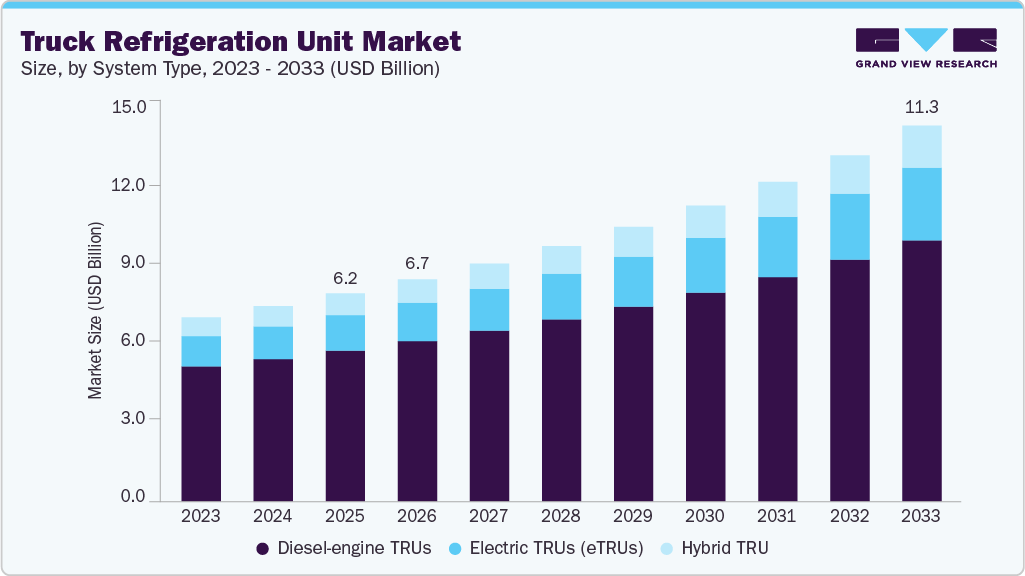
The global truck refrigeration unit market size was estimated at USD 6.23 billion in 2025 and is projected to reach USD 11.26 billion by 2033, growing at a CAGR of 7.8% from 2026 to 2033. The expansion of global cold-chain logistics and the rising demand for temperature-controlled transportation are major drivers of the truck refrigeration unit market.
Key Market Trends & Insights
- North America dominated the truck refrigeration unit industry and accounted for a share of 36.6% in 2025
- The diesel-engine TRUs segment dominated the market in 2025 and accounted for the largest share of 72.6%
- The factory-fit segment held the largest market share in 2025 and is expected to grow at the fastest CAGR over the forecast period
- The HCV segment dominated the market in 2025
- The food & beverage logistics segment dominated the market in 2025
Market Size & Forecast
- 2025 Market Size: USD 6.23 Billion
- 2033 Projected Market Size: USD 11.26 Billion
- CAGR (2026-2033): 7.8%
- North America: Largest market in 2025
- Asia Pacific: Fastest growing market
Increased consumption of perishable food products, such as dairy, meat, seafood, and frozen foods, has been observed across both developed and emerging economies. The growing demand for temperature-sensitive pharmaceutical products has also led to the expansion of distribution networks that require strict temperature compliance. As a result, greater deployment of refrigerated transportation systems has been witnessed across global supply chains. Furthermore, the rapid expansion of organized retail and cross-border food trade has been supporting the demand for reliable refrigerated trucking solutions across long-haul and regional logistics networks.The increasing transition toward electric refrigeration systems is further propelling the growth of the market. Growing concerns regarding emissions from diesel-powered TRUs have led to the development and adoption of electric and hybrid refrigeration technologies. These systems are being integrated with battery-powered and electric commercial vehicles to reduce fuel consumption and operational emissions. With sustainability initiatives being prioritized across logistics operations, electric TRUs are increasingly being deployed, particularly in urban delivery fleets and low-emission zones.
The integration of telematics and IoT-based monitoring solutions has been gaining significant traction within the TRU market. Advanced sensors and connected systems are being incorporated into refrigeration units to enable real-time temperature monitoring, performance tracking, and predictive maintenance. Through digital monitoring platforms, logistics operators gain improved visibility across the cold chain network. This trend has supported compliance with strict temperature-control requirements while enhancing operational efficiency and minimizing the risk of product spoilage during transit.
The global expansion of cold-chain logistics infrastructure is contributing to the demand for truck refrigeration units. Increasing investments in refrigerated warehouses, temperature-controlled transportation fleets, and integrated logistics networks have been observed across both developed and emerging markets. Rapid growth in e-commerce grocery delivery, pharmaceutical distribution, and international food trade has been driving the need for reliable refrigerated transportation solutions. As a result, the deployment of advanced TRUs across regional and long-haul logistics fleets has been steadily increasing.
Factors such as the high initial capital investment required for refrigerated trucks and advanced refrigeration systems could hinder market growth. Operational challenges related to energy consumption and maintenance costs are also expected to limit market expansion. Fluctuations in fuel prices further contribute to operational uncertainties for fleet operators. In addition, infrastructure limitations in developing regions, including insufficient cold-chain networks and limited availability of specialized service facilities, have been constraining the widespread adoption of advanced refrigeration units.
System Type Insights
The diesel-engine TRUs segment dominated the market in 2025, accounting for 72.6% of the market share. Demand for diesel-engine truck refrigeration units has been driven by their strong cooling capacity and ability to operate independently from the vehicle’s primary powertrain. These systems have been widely deployed in long-haul transportation and heavy commercial vehicles where consistent temperature control is required over extended distances. The availability of established diesel fueling infrastructure and the reliability of diesel-powered systems have further supported their adoption across global cold-chain logistics networks. In addition, the large installed base of diesel-powered refrigerated trucks has continued to sustain demand for diesel TRUs in both new vehicle installations and replacement applications.
The electric trUs (eTRUs) segment is expected to grow at the fastest CAGR over the forecast period. The adoption of electric truck refrigeration units has been driven by the increasing emphasis on sustainable transportation and emission reduction across logistics operations. Rising regulatory pressure to limit emissions from diesel-powered refrigeration systems has encouraged the deployment of electric alternatives in refrigerated fleets. Electric TRUs are increasingly used in urban distribution and last-mile delivery operations, where noise reduction and zero-emission operation are prioritized. In addition, improvements in battery technology and the growing availability of electric commercial vehicles have supported the gradual expansion of electric refrigeration solutions in the cold-chain transportation sector.
Sales Channel Insights
The factory-fit segment accounted for the largest market share in 2025 and is expected to grow at the fastest CAGR over the forecast period. The growth of the segment is driven by the increasing preference for fully integrated refrigeration systems installed during vehicle manufacturing. These systems are designed and optimized by original equipment manufacturers to ensure seamless compatibility with vehicle architecture and improved operational efficiency. Higher reliability, standardized installation, and reduced installation time have been key factors supporting the adoption of factory-installed refrigeration units. In addition, the growing production of refrigerated trucks for organized cold-chain logistics networks has been contributing to the expansion of the factory-fit segment.
The retrofits segment is expected to grow at a moderate CAGR during the forecast period. Growth in the retrofit segment has been supported by the large existing fleet of commercial trucks that require refrigeration capabilities. Many fleet operators have been upgrading conventional trucks with refrigeration units to extend vehicle utilization and support expanding cold-chain logistics operations. Retrofitting solutions have been widely adopted due to their cost-effectiveness compared to purchasing new refrigerated vehicles. In addition, increasing demand for flexible refrigeration solutions among small- and medium-sized logistics operators has been driving the installation of retrofit refrigeration systems.
Vehicle Type Insights
The HCV segment dominated the market in 2025. The demand for truck refrigeration units in heavy commercial vehicles has been driven by the increasing need for long-distance transportation of temperature-sensitive goods. These vehicles are widely utilized in large-scale food distribution networks, pharmaceutical logistics, and cross-border trade operations where consistent temperature control is required over extended transit distances. The expansion of global cold-chain logistics infrastructure has further supported the deployment of refrigeration systems in heavy-duty trucks. In addition, the rising volume of frozen and processed food transportation across regional and international routes has contributed to the continued growth of TRU installations in HCV fleets.
The LCV segment is expected to grow at the fastest CAGR during the forecast period. The growth of the segment is supported by the rapid expansion of urban distribution and last-mile delivery services. These vehicles are increasingly being utilized for short-distance transportation of perishable goods, including fresh food, dairy products, and pharmaceutical supplies. The growth of online grocery platforms and quick-commerce delivery networks has further accelerated the demand for refrigerated LCV fleets in urban areas. In addition, the flexibility, lower operational costs, and suitability of LCVs for dense city logistics have been encouraging the installation of refrigeration units in this vehicle category.
Mount Location Insights
The roof-mount segment dominated the market in 2025. Roof-mounted truck refrigeration units have gained significant adoption due to their efficient airflow distribution and ability to optimize space within refrigerated truck bodies. These systems are widely utilized in light and medium commercial vehicles where compact design and effective cooling performance are required. Installation on the roof allows greater cargo space within the vehicle while enabling uniform temperature control throughout the storage compartment. The increasing demand for refrigerated transport in urban distribution and food delivery operations has further driven the adoption of roof-mounted refrigeration systems.
The under-mount segment is expected to witness the fastest CAGR over the forecast period. Under-mount truck refrigeration units are widely utilized due to their suitability for heavy-duty transportation and large-capacity refrigerated trucks. These systems are typically installed beneath the truck chassis, allowing higher cooling capacity and improved weight distribution for long-haul transportation applications. Under-mount refrigeration units are widely preferred in large logistics fleets where durability and continuous operation are critical. The expansion of long-distance cold-chain transportation for frozen food, pharmaceuticals, and agricultural exports has contributed to the growing deployment of under-mounted refrigeration systems.
End Use Industry Insights
The food & beverage logistics segment dominated the market in 2025. The segment’s growth can be attributed to the increasing demand for temperature-controlled transportation of perishable products. Large volumes of dairy products, frozen foods, meat, seafood, and fresh produce require consistent refrigeration during storage and transit. Expansion of organized retail chains, supermarkets, and international food trade has further increased the need for reliable cold-chain transportation networks. In addition, the rapid growth of online grocery platforms and food distribution services has been supporting the deployment of refrigerated trucks across regional and urban logistics operations.
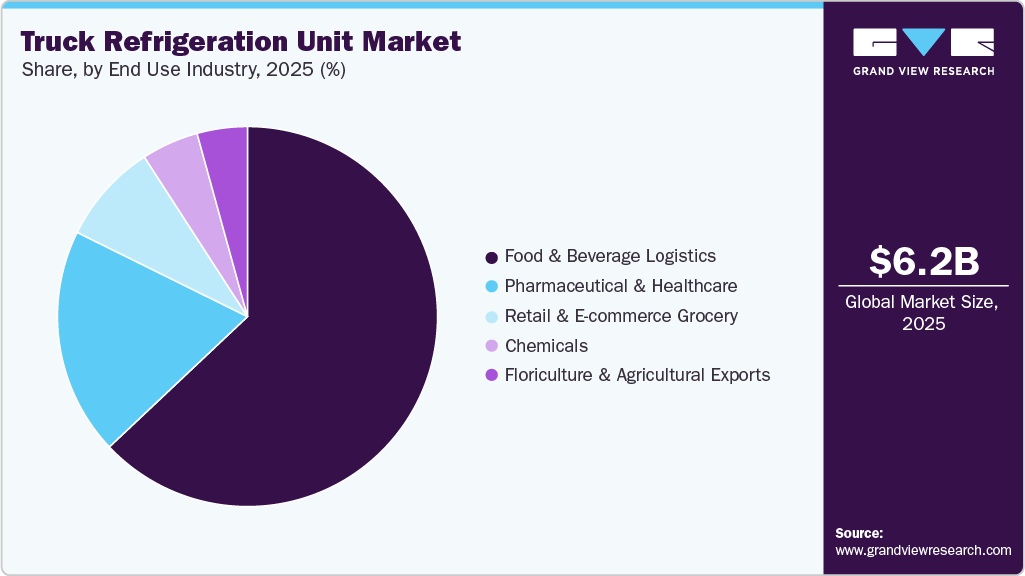
The pharmaceutical & healthcare segment is expected to witness the fastest CAGR over the forecast period. The pharmaceutical and healthcare sector has been significantly contributing to the demand for truck refrigeration units due to strict temperature control requirements for medical products. Many pharmaceuticals, vaccines, biologics, and specialty medicines must be transported within specific temperature ranges to maintain product efficacy and safety. Increasing global distribution of vaccines and temperature-sensitive drugs has led to the expansion of specialized pharmaceutical cold-chain logistics networks. Furthermore, stringent regulatory standards governing pharmaceutical transportation have been encouraging the use of advanced refrigerated transport solutions across healthcare supply chains.
Regional Insights
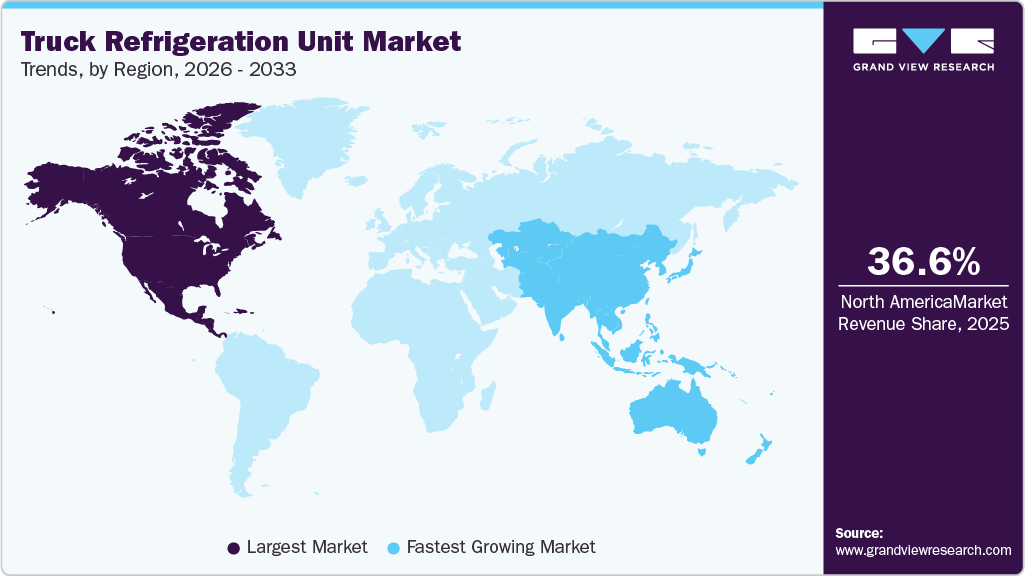
North America dominated the truck refrigeration unit industry and accounted for a share of 36.6% in 2025. North America is a mature, well-established market for truck refrigeration units, supported by a highly developed cold-chain logistics network. The transportation of large volumes of frozen, dairy, and processed foods has driven consistent demand for refrigerated trucking solutions.
U.S. Truck Refrigeration Unit Market Trends
The U.S. truck refrigeration unit market held a dominant position in the region in 2025, due to its extensive refrigerated transportation infrastructure and strong food distribution networks. Large-scale transportation of perishable food products over long distances has sustained demand for refrigerated trucks.
Europe Truck Refrigeration Unit Market Trends
Europe truck refrigeration unit market is expected to register a moderate CAGR from 2026 to 2033. The TRU market in Europe has been supported by well-established logistics infrastructure and strict regulatory standards governing the transportation of food and pharmaceuticals. The increasing demand for temperature-controlled transportation of fresh produce, dairy products, and frozen foods has contributed to market growth.
The UK truck refrigeration unit market is expected to grow at the significant growth rate during the forecast period. The country’s market growth is driven by the expansion of food retail chains and the increasing demand for temperature-controlled food distribution. Growth in online grocery delivery services has created additional demand for refrigerated transportation across urban and regional logistics networks.
The Germany truck refrigeration unit market held a substantial market share in 2025, due to its strong logistics industry and advanced transportation infrastructure. High demand for refrigerated transportation has been observed in the distribution of dairy products, meat, frozen foods, and pharmaceutical products. The presence of large food processing industries and export-oriented agricultural supply chains has further supported the deployment of refrigerated truck fleets.
Asia Pacific Truck Refrigeration Unit Market Trends
The Asia Pacific truck refrigeration unit market is expected to grow at the fastest CAGR during the forecast period. Rising consumption of perishable food products and the growth of organized retail networks have been contributing significantly to the demand for refrigerated transportation.
The India truck refrigeration unit market is expected to grow at the fastest growth rate during the forecast period. Growth in pharmaceutical manufacturing and vaccine distribution has contributed to the adoption of refrigerated trucks across healthcare supply chains. Furthermore, government programs promoting agricultural exports and food preservation have been encouraging investments in refrigerated transport solutions.
The China truck refrigeration unit market held a significant market share in 2025. Increasing urbanization and rising demand for fresh food delivery services are driving the growth of refrigerated truck fleets across major cities. The expansion of the pharmaceutical industry and the strict temperature-control requirements for drug distribution have also contributed to market growth.
Key Truck Refrigeration Unit Companies Insights
Some of the key companies in the truck refrigeration unit industry include Carrier Global Corporation, Daikin Industries, and Thermo King, among others. These companies focus on developing energy-efficient, hybrid, and electric refrigeration technologies to comply with evolving environmental regulations and sustainability goals.
-
Carrier Global Corporation is one of the major providers of truck refrigeration units through its transportation refrigeration brand Carrier Transicold. The company offers a wide portfolio of refrigeration systems designed for trucks, trailers, and vans used in cold-chain logistics. Its solutions are widely adopted across food distribution, pharmaceutical transportation, and refrigerated logistics fleets due to their reliability and advanced temperature control capabilities.
-
Thermo King is another prominent manufacturer of transport refrigeration systems for trucks, trailers, and intermodal containers. The company has established a strong global presence by offering a broad range of diesel, hybrid, and electric refrigeration solutions for temperature-controlled transportation. Its refrigeration systems are widely utilized by logistics providers, food distributors, and pharmaceutical supply chains requiring precise temperature management.
Key Truck Refrigeration Unit Companies:
The following key companies have been profiled for this study on the truck refrigeration unit market.
- Carrier Global Corporation
- Subros Limited
- Daikin Industries
- Thermo King
- Guchen
- Mitsubishi Heavy Industries, Ltd.
- Webasto Group
- TKT HVAC Co., Ltd.
- Glen Refrigeration
Recent Developments
- In July 2025, Carrier Transicold expanded its Supra High Efficiency (HE) range of truck-mounted refrigeration units with the introduction of the Supra HE 13 Multi-Temperature (MT) and HE 11 MT models. These high-performance systems are designed with a compact structure while delivering improved fuel efficiency and reliable cooling performance. The new units have been engineered to support a wide variety of truck configurations used in temperature-controlled transportation. In addition, they are compatible with one of the most extensive ranges of evaporators available in the market.
Truck Refrigeration Unit Market Report Scope
Report Attribute
Details
Market size value in 2026
USD 6.66 billion
Revenue forecast in 2033
USD 11.26 billion
Growth rate
CAGR of 7.8% from 2026 to 2033
Base year for estimation
2025
Historical data
2021 - 2024
Forecast period
2026 - 2033
Quantitative units
Revenue in USD million and CAGR from 2026 to 2033
Report coverage
Revenue forecast, company ranking, competitive landscape, growth factors, and trends
Segments covered
System type, sales channel, vehicle type, mount location, end use industry, region
Regional scope
North America; Europe; Asia Pacific; Latin America; MEA
Country scope
U.S.; Canada; Mexico; Germany; UK; France; China; Japan; India; South Korea; Australia; Brazil; KSA; UAE; South Africa
Key companies profiled
Carrier Global Corporation; Subros Limited; Daikin Industries; Thermo King; Guchen; Mitsubishi Heavy Industries, Ltd.; Webasto Group; TKT HVAC Co., Ltd.; Glen Refrigeration
Customization scope
Free report customization (equivalent up to 8 analysts working days) with purchase. Addition or alteration to country, regional & segment scope.
Pricing and purchase options
Avail customized purchase options to meet your exact research needs. Explore purchase options
Global Truck Refrigeration Unit Market Report Segmentation
This report forecasts revenue growth at global, regional, and country levels and provides an analysis of the latest industry trends in each of the sub-segments from 2021 to 2033. For this study, Grand View Research has segmented the global truck refrigeration unit market report based on system type, sales channel, vehicle type, mount location, end use industry, and region.
-
System Type Outlook (Revenue, USD Million, 2021 - 2033)
-
Diesel-engine TRUs
-
Electric TRUs (eTRUs)
-
Hybrid TRU
-
-
Sales Channel Outlook (Revenue, USD Million, 2021 - 2033)
-
Factory-fit
-
Retrofits
-
-
Vehicle Type Outlook (Revenue, USD Million, 2021 - 2033)
-
LCV
-
MCV
-
HCV
-
-
Mount Location Outlook (Revenue, USD Million, 2021 - 2033)
-
Front-mount
-
Roof-mount
-
Under-mount
-
-
End Use Industry Outlook (Revenue, USD Million, 2021 - 2033)
-
Food & Beverage Logistics
-
Pharmaceutical & Healthcare
-
Retail & E-commerce Grocery
-
Chemicals
-
Floriculture & Agricultural Exports
-
-
Regional Outlook (Revenue, USD Million, 2021 - 2033)
-
North America
-
U.S.
-
Canada
-
Mexico
-
-
Europe
-
Germany
-
UK
-
France
-
-
Asia Pacific
-
China
-
Japan
-
India
-
South Korea
-
Australia
-
-
Latin America
-
Brazil
-
-
Middle East and Africa (MEA)
-
KSA
-
UAE
-
South Africa
-
-
Frequently Asked Questions About This Report
b. The global truck refrigeration unit market size was estimated at USD 6.23 billion in 2025 and is expected to reach USD 6.66 billion in 2026.
b. The global truck refrigeration unit market is expected to grow at a compound annual growth rate of 7.8% from 2026 to 2033 to reach USD 11.26 billion by 2033.
b. The diesel-engine TRUs segment dominated the market in 2025 and accounted for the largest share of 72.6%. Demand for diesel-engine truck refrigeration units has been driven by their strong cooling capacity and ability to operate independently from the vehicle’s primary powertrain.
b. Some key players operating in the truck refrigeration unit market include Carrier Global Corporation, Subros Limited, Daikin Industries, Thermo King, Guchen, Mitsubishi Heavy Industries, Ltd., Webasto Group, TKT HVAC Co., Ltd., and Glen Refrigeration
b. The expansion of global cold-chain logistics and the rising demand for temperature-controlled transportation are major drivers of the truck refrigeration unit market.


Share this report with your colleague or friend.
Need a Tailored Report?
Customize this report to your needs — add regions, segments, or data points, with 20% free customization.


ISO 9001:2015 & 27001:2022 Certified
We are GDPR and CCPA compliant! Your transaction & personal information is safe and secure. For more details, please read our privacy policy.
Trusted market insights - try a free sample
See how our reports are structured and why industry leaders rely on Grand View Research. Get a free sample or ask us to tailor this report to your needs.