Sewing Machine Market Summary
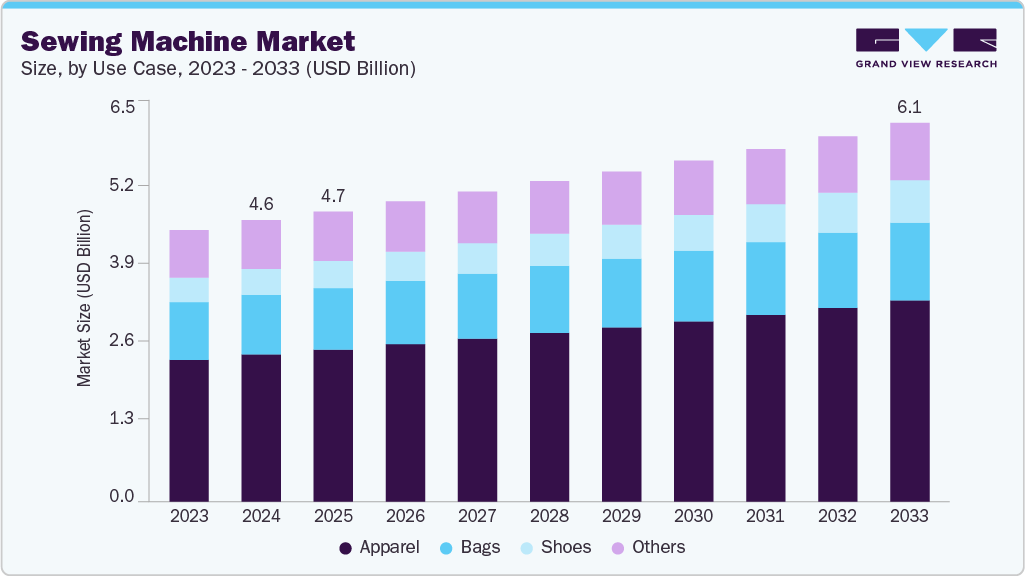
The global sewing machine market size was estimated at USD 4.71 billion in 2025 and is projected to reach USD 6.14 billion by 2033, growing at a CAGR of 3.4% from 2026 to 2033. This can be attributed to the growing demand for personalized fashion and the trend of apparel personalization, which are the major drivers promoting the sales of sewing machines.
Key Market Trends & Insights
- By type, electric sewing machine led the market with a share of 44.42% in 2025.
- By use case, apparel sewing machine held a market share of 52.39% in 2025.
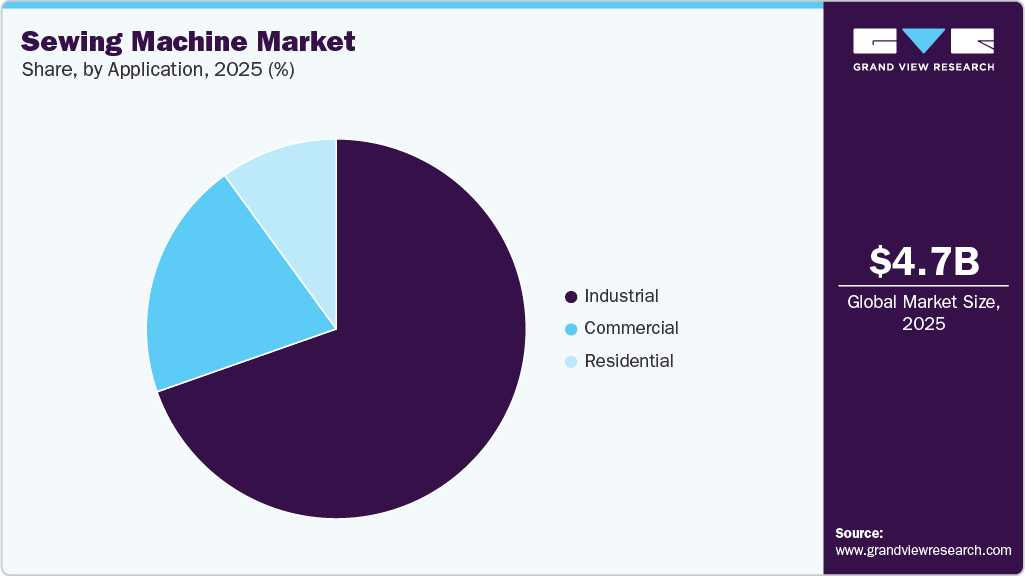
- By application, industrial sewing machine accounted for a revenue share of 69.63% in 2025.
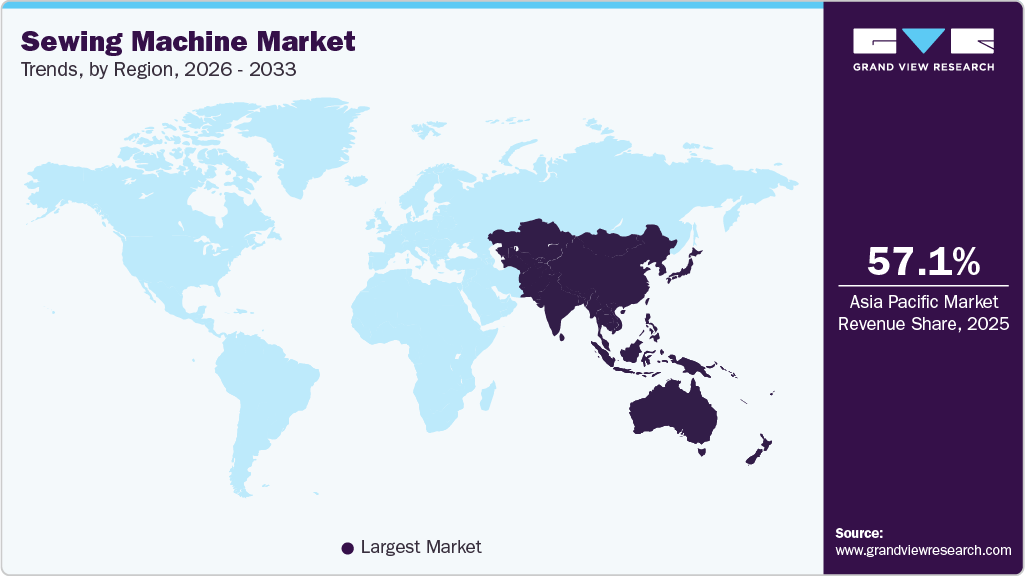
- By region, Asia Pacific held a market share of 57.08% in 2025.
Market Size & Forecast
- 2025 Market Size: USD 4.71 Billion
- 2033 Projected Market Size: USD 6.14 Billion
- CAGR (2026-2033): 3.4%
- Asia Pacific: Largest market in 2025
Rapid technological advancements in modern sewing machines are helping novice users operate them efficiently. Computerized sewing machines are also helping industries boost their production and improve output quality. This is encouraging more consumers to procure advanced sewing machines, thus helping the market grow.
The sewing machine industry has experienced steady growth, driven by an increasing demand for DIY crafts, home-based tailoring, and small businesses offering custom clothing services. With technological advancements, sewing machines have evolved from manual to highly automated models, appealing to hobbyists and professionals. The market has expanded beyond traditional domestic use to include commercial sectors, especially garment manufacturing and alteration services.
Consumers are also increasingly drawn to the sustainable fashion movement, where upcycling and personalization are significant factors. In addition, sewing machines with smart features, such as app connectivity and embroidery options, are gaining popularity.
Several key factors are driving the growth of the sewing machine industry. Rising disposable incomes and the growing DIY fashion, crafts, and home décor trend have led to increased consumer interest, particularly among younger, tech-savvy buyers. The rising popularity of sustainable living and eco-conscious practices has encouraged consumers to opt for sewing machines to repair, customize, or redesign existing garments to reduce waste.
Furthermore, the global expansion of the textile and garment industry demands more efficient and advanced machines for mass production. Technological innovation, including machine automation and integration of digital interfaces, is also expected to attract more professional users and enthusiasts and promote market growth. .
In January 2024, Singer India launched M3330. The machine features 97 stitch applications, a 70W motor capable of 800 stitches per minute, and comes in an iconic blue color. The package includes complimentary online sewing classes valued at Rs. 2,500, a 2-year warranty, and a free home demonstration.
Consumer Insights
-
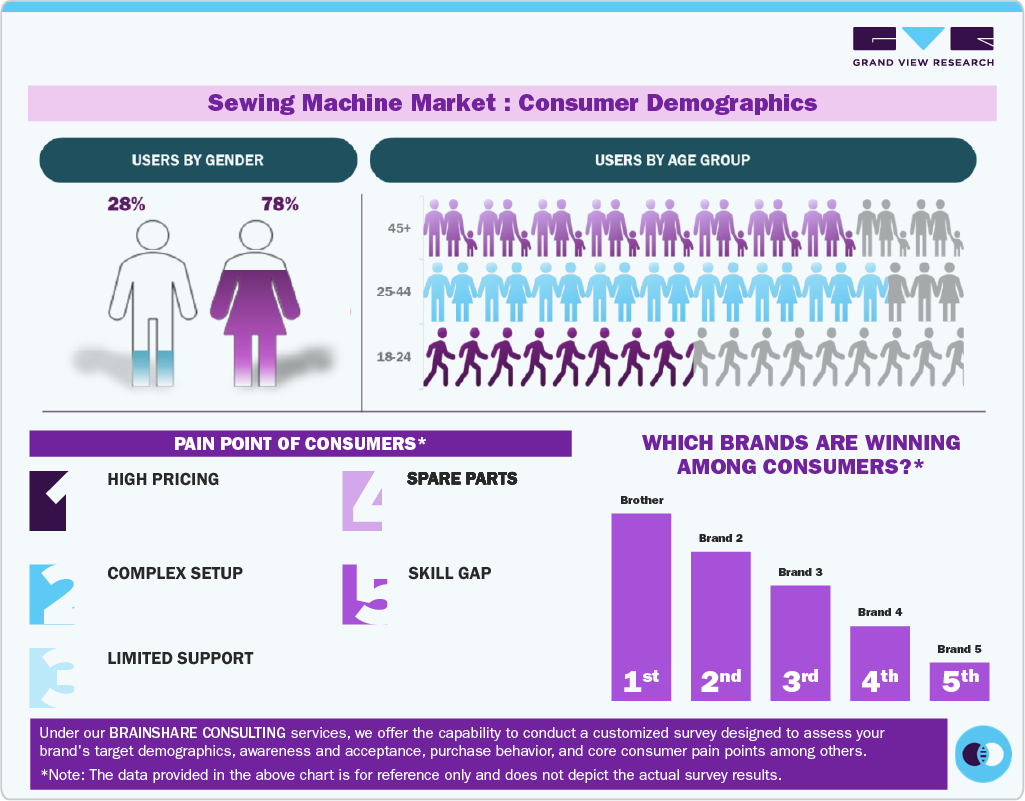
Gender mix: Women dominate global sewing machine usage due to strong involvement in home sewing, fashion, and crafts, while men have a growing presence in industrial, footwear, and commercial tailoring applications.
-
Age profile: The 25-44 age group forms the largest user base, driven by DIY culture, small businesses, and online customization, followed by users aged 45+ who support demand through quilting, alterations, and long-term sewing habits.
-
Key pain points: High equipment cost, complex machine operation, limited service availability, and difficulty in sourcing spare parts continue to influence buying decisions and brand loyalty.
-
Winning brands: Brother, Singer, Janome, Bernina, and JUKI lead consumer preference globally due to their strong reliability, wide product portfolios, and well-established distribution and support networks.
Type Insights
Electric sewing machine held a market share of 44.42% in 2025. The increasing inclination toward automation among key textile manufacturers, the growing focus on capacity expansions and cost reduction among apparel industry participants, rising awareness regarding energy efficiency, and operational excellence strategy adoption among multiple end use industries, including footwear, accessories, fashion, and others, are among the key factors contributing to the dominance of this segment.
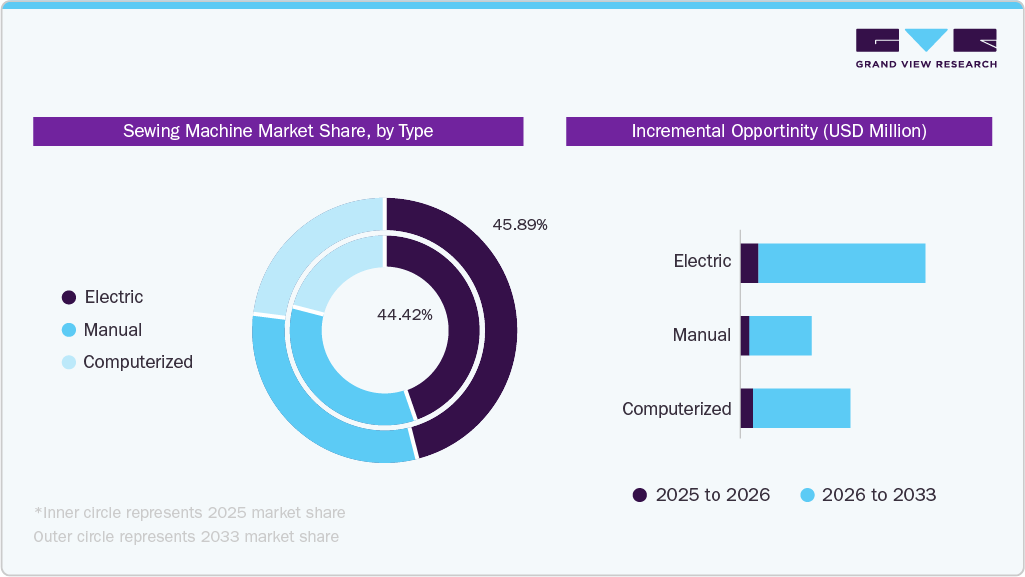
The computerized sewing machine segment is expected to grow at a CAGR of 4.6% from 2026 to 2033. Increasing demand for customized apparel and bags, growing availability of artificial intelligence technology integrated solutions, and evolving fashion industry are among the key growth drivers of this market.
Use Case Insights
The apparel sewing machine segment accounted for a share of 52.39% of the global revenue in 2025. The growth of this segment is driven by increasing demand for electric and computer-assisted sewing machines from large enterprises and SMEs, the trend toward process automation in apparel manufacturing, the rapid expansion of the apparel industry driven by e-commerce, and overall growth in personal disposable incomes.
The shoe sewing machine segment is projected to grow at a CAGR of 5.6% from 2026 to 2033. Growing awareness of sustainable manufacturing processes and increasing focus of manufacturers on reducing environmental impact while reducing costs by adopting technology solutions are primarily driving the growth of this segment.
For instance, in February 2024, Deccan Chronicle reported that Reebok founder Joseph William Foster and Syntilay CEO Ben Weiss collaborated to produce the world's first AI-designed shoe. This innovative footwear featured a shape generated via artificial intelligence, drawing inspiration from a yacht and a spaceship, with patterns also created through AI. The entire shoe was 3D printed, fully recyclable, and uniquely fitted using a phone scan to ensure a perfect fit, eliminating traditional sizing by printing each shoe to match the exact dimensions of the wearer's feet.
Application Insights
The industrial segment dominated the market with the largest revenue share of 69.63% in 2025, due to its large-scale application in manufacturing and production. High-speed and automated sewing machines are essential for efficiently handling bulk orders. Industries such as apparel, automotive, furniture, and medical textiles rely on advanced sewing machines to meet quality standards. The demand for high-precision, durable stitching solutions has led to increased adoption of computerized, AI-integrated machines.
For instance, in September 2022, Mexico Business News reported that JUKI AMERICA relocated its base from Mexico City to Leon to support the automation needs of the local leather manufacturing industry. Expanding global textile production facilities have further boosted the dominance of the industrial segment.
Regional Insights
Asia Pacific sewing machine market dominated the global industry, with a revenue share of 57.08% in 2025. The region has a vast number of consumers and an established textile and apparel industry. Consumers in the region are more inclined toward wearing tailored clothing than buying readymade branded clothes. Tailoring is a key profession in the region that helps several families to earn a stable income. This has helped the region to register the highest revenue share in the global sewing machines industry.
North America Sewing Machine Market Trends
The North America home sewing machine industry is anticipated to witness a CAGR of 2.1% from 2026 to 2033. The moderate growth is driven by rising interest in DIY crafts, quilting, and home décor projects, along with the popularity of personalized and sustainable fashion. For example, hobbyists increasingly purchase computerized machines from brands like Brother and Singer for embroidery and custom stitching at home.
U.S. Sewing Machine Market Trends
The sewing machine industry in the U.S. is expected to see a CAGR of 1.8 % from 2025 to 2033.Global growth is steadier due to market saturation in developed regions and slower industrial expansion in certain areas. However, demand continues from small garment manufacturers and emerging economies. For instance, Chinese industrial brands like Jack and ZOJE are expanding in Asia and Africa, supporting gradual market growth.
Key Sewing Machine Company Insights
-
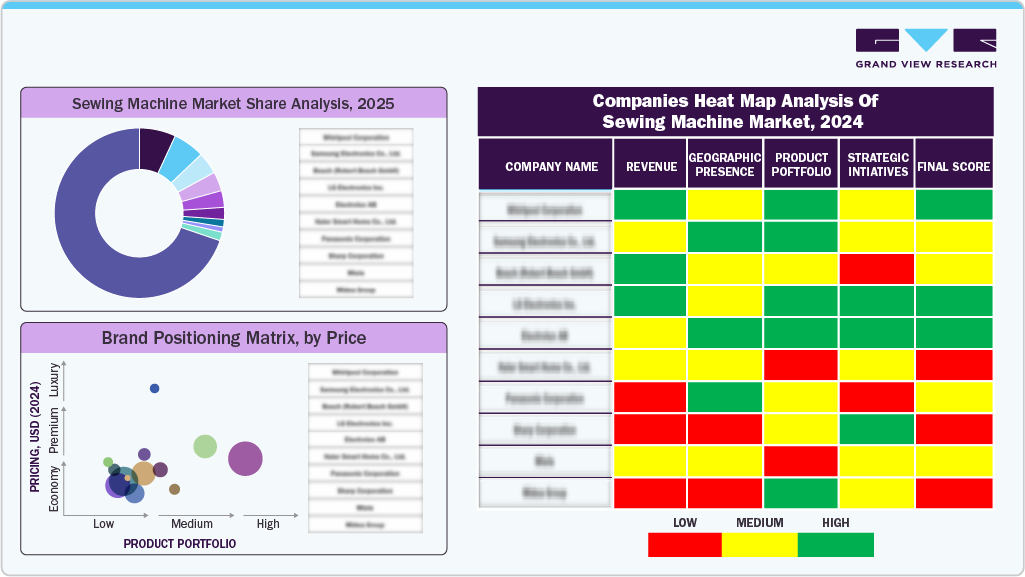
Global brand share is led by well-established players such as Brother Industries, JUKI, and SVP Worldwide (Singer, Pfaff, Husqvarna Viking), which benefit from strong brand equity, broad product portfolios, and extensive retail and dealer networks across both household and industrial segments.
-
Japanese and European brands dominate the premium and professional categories, driven by demand for reliability, precision, and advanced computerized features, particularly in North America, Europe, and developed Asian markets.
-
Chinese manufacturers such as Jack, ZOJE, and Feiyue are steadily gaining share in the industrial segment by offering cost-competitive, high-output machines that are widely adopted by garment and footwear factories in Asia, Africa, and Latin America.
Key Sewing Machine Companies:
The following key companies have been profiled for this study on the sewing machine market.
- Brita
- AISIN CORPORATION
- AMF Reece - Cars s.r.o.
- BERNINA International AG
- Brother
- Dürkopp Adler GmbH
- JUKI CORPORATION
- Jack Sewing Machines
- JANOME Corporation
- SEIKO SEWING MACHINE CO., LTD.
- PEGASUS CO., LTD.
Recent Developments
-
In November 2024, Singer expanded its presence in the Indian market by introducing two premium global sewing brands - PFAFF and Husqvarna Viking, targeting a market. Husqvarna Viking features an interactive color touch screen with design positioning capabilities and internet-enabled updates, while PFAFF offers 100 stitches in a space-efficient design.
-
In May 2024, Coloreel and Juki America announced a partnership to integrate Coloreel's on-demand thread dyeing technology, enabling access to millions of precise colors in real time. This collaboration marks Coloreel's expansion from embroidery into the broader sewing market, with Juki's distributors gaining exclusive rights to market and sell Coloreel's technology in North and South America.
-
In January 2024, Singer India launched M3330. The machine features 97 stitch applications, a 70W motor capable of 800 stitches per minute, and comes in an iconic blue color. The package includes complimentary online sewing classes valued at Rs. 2,500, a 2-year warranty, and a free home demonstration.
Global Sewing Machine Market Report Scope
|
Report Attribute
|
Details
|
|
Market size value in 2026
|
USD 4.87 billion
|
|
Revenue forecast in 2033
|
USD 6.14 billion
|
|
Growth rate (Revenue)
|
CAGR of 3.4% from 2026 to 2033
|
|
Actuals
|
2021 - 2025
|
|
Forecast period
|
2026 - 2033
|
|
Quantitative units
|
Revenue in USD million/billion, Volume in Thousand Units and CAGR from 2026 to 2033
|
|
Report coverage
|
Revenue forecast, company ranking, competitive landscape, growth factors, and trends
|
|
Segments covered
|
Type, use case, application, region
|
|
Regional scope
|
North America; Europe; Asia Pacific; Central & South America; Middle East & Africa
|
|
Country scope
|
U.S.; Canada; Mexico; UK; Germany; France; Italy; Spain; China; India; Japan; Australia ; South Korea; Brazil; South Africa
|
|
Key companies profiled
|
Brita; AISIN CORPORATION; AMF Reece - Cars s.r.o.; BERNINA International AG; Brother; Dürkopp Adler GmbH; JUKI CORPORATION; Jack Sewing Machines; JANOME Corporation; SEIKO SEWING MACHINE CO., LTD.; PEGASUS CO., LTD.
|
|
Customization scope
|
Free report customization (equivalent up to 8 analysts working days) with purchase. Addition or alteration to country, regional & segment scope.
|
|
Pricing and purchase options
|
Avail customized purchase options to meet your exact research needs. Explore purchase options
|
Global Sewing Machine Market Report Segmentation
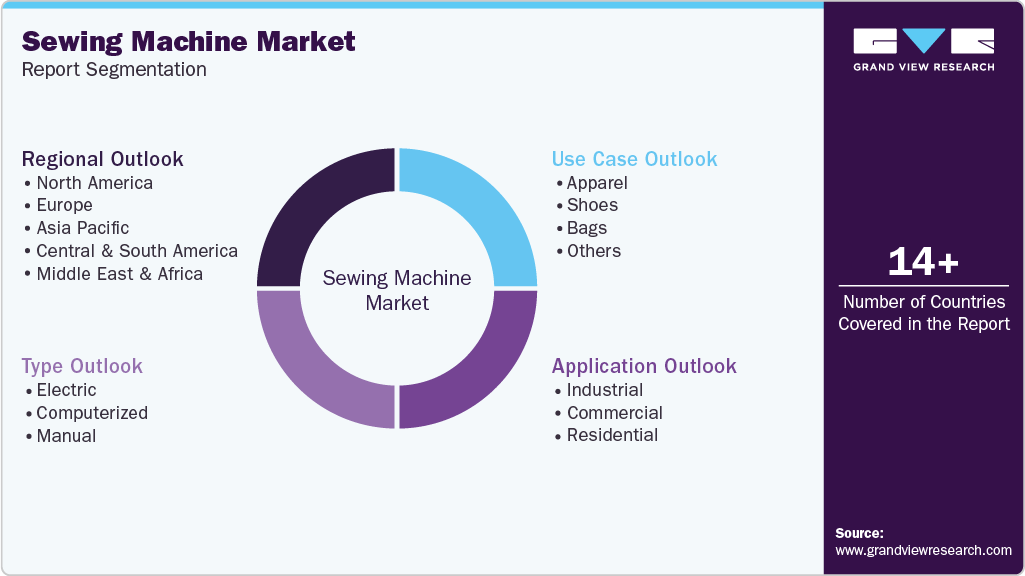
This report forecasts revenue growth at the global, regional, and country levels and provides an analysis of the latest industry trends and opportunities in each of the sub-segments from 2021 to 2033. For the purpose of this study, Grand View Research has segmented the global sewing machine market report based on type, use case, application, and region.
-
Type Outlook (Revenue, USD Million; 2021 - 2033)
-
Electric
-
Computerized
-
Manual
-
Use Case Outlook (Revenue, USD Million; 2021 - 2033)
-
Apparel
-
Shoes
-
Bags
-
Others
-
Application Outlook (Revenue, USD Million; 2021 - 2033)
-
Industrial
-
Commercial
-
Residential
-
Regional Outlook (Revenue, USD Million; 2021 - 2033)
-
North America
-
Europe
-
UK
-
Germany
-
France
-
Italy
-
Spain
-
Asia Pacific
-
China
-
Japan
-
India
-
Australia
-
South Korea
-
Central & South America
-
Middle East & Africa
Frequently Asked Questions About This Report
b. The global sewing machine market size was estimated at USD 4.71 billion in 2025 and is expected to reach USD 4.87 billion in 2026.
b. Some key players operating in the sewing machine market include Aisin Seiki Co., Ltd., AMF Reece CR, s.r.o., BERNINA International AG, Brother International Corporation, Dürkopp Adler AG, Elna International Corp. SA, JACK SEWING MACHINE CO. LTD., JANOME SEWING MACHINE CO., LTD., SEIKO SEWING MACHINE CO., LTD., and PEGASUS SEWING MACHINE MFG. CO., LTD.
b. Key factors that are driving the sewing machine market growth include changing fashion trends, rising population, and availability of electrical and computerized machines.
b. The global sewing machine market is expected to grow at a compound annual growth rate of 3.4% from 2026 to 2033 to reach USD 6.14 billion by 2033.
b. The Asia Pacific dominated the sewing machine market with a share of 57.08% in 2025. The region has a vast number of consumers and an established textile and apparel industry. Consumers in the region are more inclined toward wearing tailored clothing than buying readymade branded clothes. Tailoring is a key profession in the region that helps several families to earn a stable income. This has helped the region to register the highest revenue share in the global sewing machines market.

 Download Sample Report