- Home
- »
- Plastics, Polymers & Resins
- »
-
Rubber Market Size, Share & Growth, Industry Report, 2033GVR Report cover
![Rubber Market Size, Share & Trends Report]()
Rubber Market (2026 - 2033) Size, Share & Trends Analysis Report By Type (Natural, Synthetic), By End Use (Automotive, Construction, Industrial, Healthcare, Consumer goods, Packaging), By Region (North America, Europe, Asia Pacific, CSA, MEA), And Segment Forecasts
- Report ID: GVR-4-68040-158-3
- Number of Report Pages: 120
- Format: PDF
- Historical Range: 2021 - 2024
- Forecast Period: 2026 - 2033
- Industry: Bulk Chemicals
- Report Summary
- Table of Contents
- Segmentation
- Methodology
- Download FREE Sample
-
 Download Sample Report
Rubber Market Summary
The global rubber market size was estimated at USD 50.8 billion in 2025 and is projected to reach USD 79.8 billion by 2033, growing at a CAGR of 6.0% from 2026 to 2033. Rubber consumption is increasing in construction, industrial machinery, and infrastructure projects due to its durability, flexibility, and sealing performance.
Key Market Trends & Insights
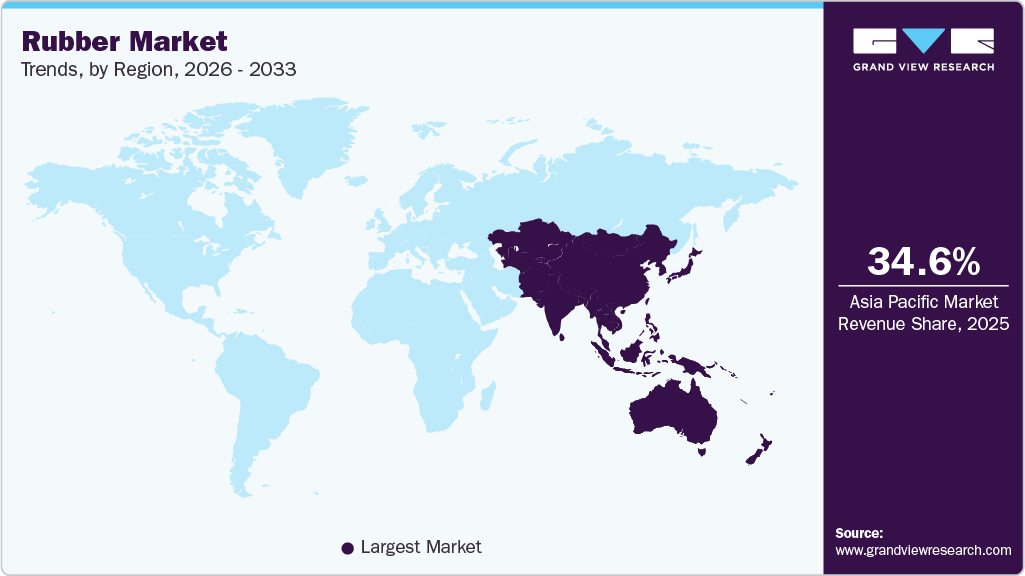
- Asia Pacific dominated the global rubber industry with the largest revenue share of 34.6% in 2025.
- The rubber industry in the UK is expected to grow at a CAGR of 6.9% from 2026 to 2033.
- By type, the synthetic segment dominated the market, accounting for 58.0% revenue share in 2025.
- By end use, the automotive segment is expected to grow at a CAGR of 6.3% from 2026 to 2033 in terms of revenue.
Market Size & Forecast
- 2025 Market Size: USD 50.8 Billion
- 2033 Projected Market Size: USD 79.8 Billion
- CAGR (2026-2033): 6.0%
- Asia Pacific: Largest Market in 2025
Growing investments in infrastructure and manufacturing are driving demand for rubber components, including gaskets, hoses, insulation materials, and vibration-control products. The rubber industry is shifting toward specialty and high-performance compounds for demanding applications like electric vehicles, electronics, and industrial equipment. Manufacturers are investing in advanced elastomers such as solution styrene-butadiene rubber, EPDM, and nitrile rubber to improve heat resistance, durability, and chemical stability. Demand for specialty rubber grades is growing due to increasing needs in electrical insulation, medical components, and engineered industrial products. These materials help enhance product performance and lifecycle efficiency, supporting innovation across automotive, industrial, and healthcare sectors.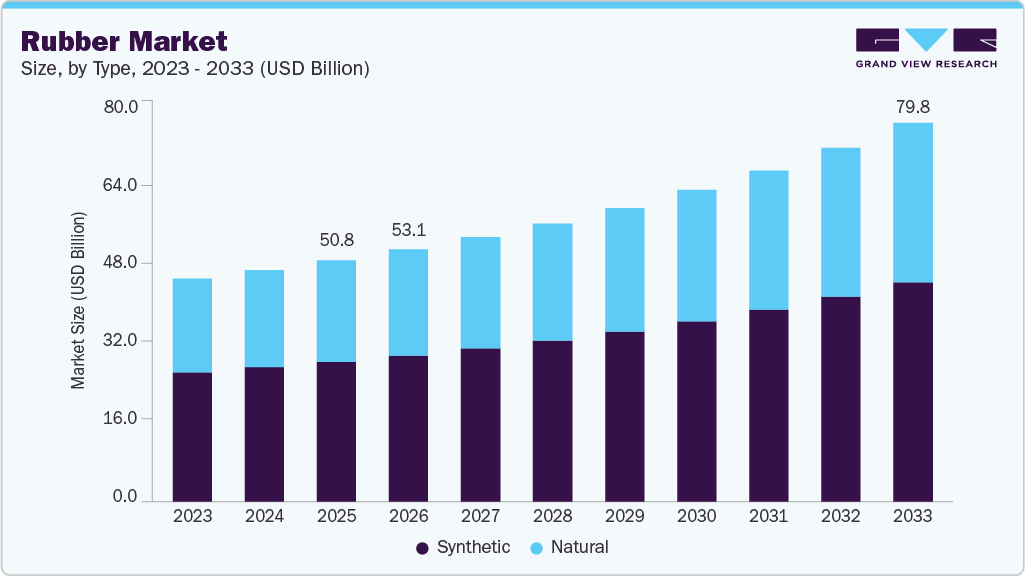
Drivers, Opportunities & Restraints
The automotive sector remains the leading global driver of rubber demand. Tire manufacturing alone accounts for a large share of rubber use, as vehicles need rubber for tires, seals, belts, hoses, and vibration-control parts. With global tire production surpassing 1 billion units per year, demand for both natural and synthetic rubber remains strong. Additionally, increasing vehicle ownership and expanding replacement tire markets further boost consumption. The automotive industry plays a key role in the global market, highlighting its importance.
The rapid growth in electric vehicle production offers a substantial opportunity for rubber manufacturers. EVs need specialized rubber materials that can handle higher torque, heavier battery loads, and improved thermal conditions. Advanced tire compounds, vibration-damping materials, and sealing systems are increasingly necessary to ensure safety and efficiency in electric mobility platforms. Global EV sales have surged in recent years, boosting demand for high-performance synthetic rubber formulas. As electrification accelerates, rubber suppliers are investing in R&D to develop durable, lightweight elastomer solutions for next-generation mobility systems.
Price fluctuations in key feedstocks pose a major challenge for the market. Natural rubber production relies heavily on plantation yields in Southeast Asia, which are susceptible to climate conditions, disease outbreaks, and labor shortages. Synthetic rubber production is also affected by volatility in petrochemical feedstocks like butadiene and styrene, derived from crude oil. These fluctuations can lead to inconsistent production costs and put pressure on manufacturers' margins. Supply disruptions and price swings that exceed typical annual ranges create uncertainty throughout the rubber supply chain.
Market Concentration & Characteristics
The market growth stage is medium, and the pace is accelerating. The industry exhibits fragmentation, with key players dominating the industry landscape. Major companies such as Sinopec, DuPont, The Dow Chemical Company, Exxon Mobil Corporation, Kumho Petrochemical Company Ltd., The Goodyear Tire and Rubber Company, JSR Corporation, Denka Company Ltd., Vietnam Rubber Group, Southland Holding Lonza, Asahi Kasei Corporation, and others play a significant role in shaping the market dynamics. These leading players often drive innovation in the market by introducing new products, technologies, and materials to meet the industry's evolving demands.
Innovation in the industry is steady but emphasizes performance improvement and sustainability. Manufacturers are investing in advanced elastomer formulations, including bio-based rubber, high-durability tire compounds, and recyclable materials. Recent advancements include improved electric-vehicle tire formulations that boost wear resistance and efficiency, along with growing research into devulcanization and rubber recycling technologies. Patent activity and product launches related to circular rubber materials are rising, signaling a gradual shift toward sustainable material engineering and performance-focused rubber solutions.
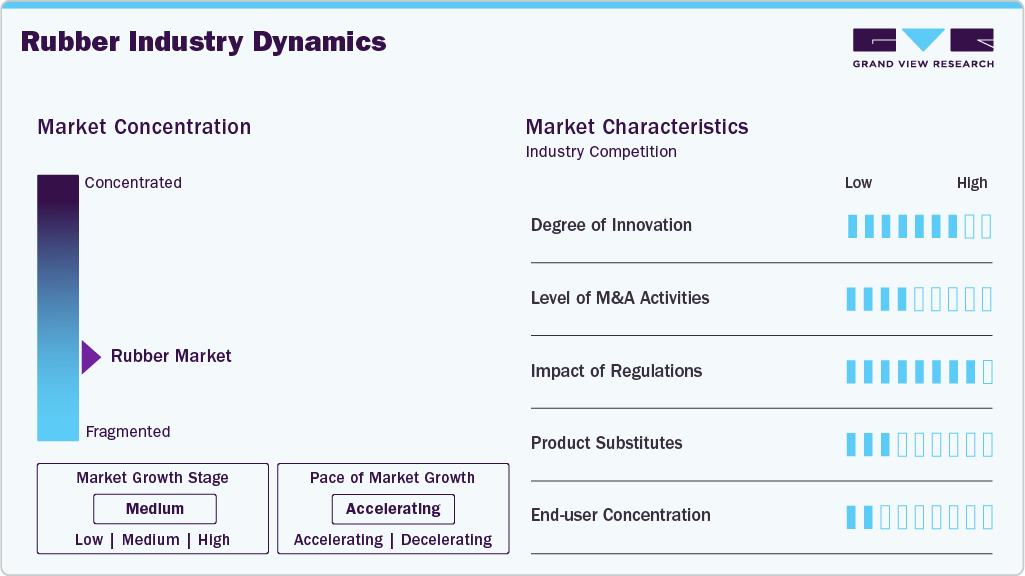
Several alternative materials exert substitution pressure on conventional rubber in specific applications. Thermoplastic elastomers, polyurethane elastomers, and silicone materials are increasingly used in automotive seals, footwear, and industrial components due to easier processing and recyclability. Plastics and composite materials also replace rubber in certain lightweight components where flexibility requirements are moderate. In construction and infrastructure, polymer membranes and plastic sealing systems are gradually substituting rubber products. These alternatives offer design flexibility and cost advantages, creating competitive pressure for traditional rubber materials in selected applications.
Type Insights
The synthetic segment dominated the market across type segmentation in terms of revenue, accounting for a 58.0% share in 2025, and is forecast to grow at a 6.0% CAGR from 2026 to 2033. The growing demand for high-performance materials in automotive, industrial machinery, and electronics is a major driver of synthetic rubber demand. Synthetic elastomers such as styrene-butadiene rubber and EPDM offer superior heat resistance, chemical stability, and abrasion performance compared with natural rubber. Global synthetic rubber consumption is growing, supported by increasing industrial output and automotive production across Asia and Europe.
The natural segment is expected to expand at a 6.0% CAGR over the forecast period. Natural rubber continues to gain demand due to its unmatched elasticity, tensile strength, and fatigue resistance in tire compounds. Tire manufacturers rely on natural rubber to improve grip, rolling efficiency, and durability in heavy-duty and high-load applications. A large amount of natural rubber production is used in tire manufacturing, reflecting its structural importance in radial and truck tires.
End Use Insights
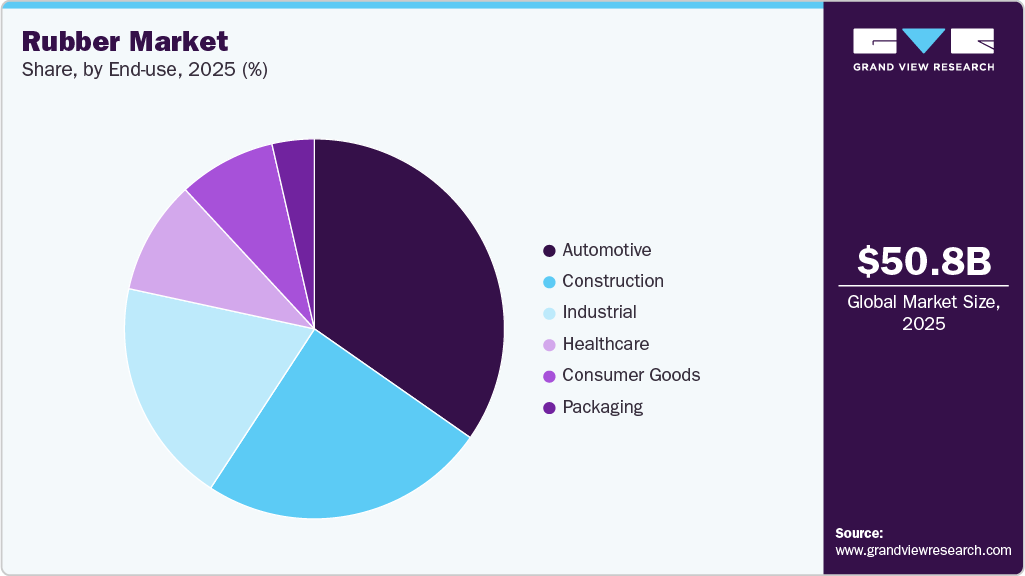
The automotive segment dominated the market, accounting for 34.7% of revenue in 2025, and is forecast to grow at a 6.3% CAGR from 2026 to 2033, driven by high material requirements for tires and vehicle components. Tires alone represent the largest rubber application globally, while additional demand comes from hoses, seals, belts, gaskets, and vibration-dampening parts. Rising vehicle ownership and expanding replacement tire markets continue to strengthen consumption. Automotive applications account for a substantial share of global rubber usage, reflecting the sector’s structural importance in sustaining long-term material demand.
The construction segment is expected to expand at a 6.1% CAGR over the forecast period. Growth in infrastructure development and urban construction is driving demand for rubber-based materials used in sealing, waterproofing, and vibration isolation systems. Rubber components, such as expansion joint seals, roofing membranes, insulation layers, and pipe gaskets, enhance structural durability and environmental resistance. Modern construction projects increasingly rely on elastomeric materials to manage thermal expansion and prevent water infiltration. As global infrastructure investment expands, rubber use in building systems continues to grow steadily across both commercial and residential construction segments.
Regional Insights
The Asia Pacific rubber industry held the largest revenue share of 34.6% in 2025. The regional market is expected to grow at a CAGR of 6.3% over the forecast period. Asia Pacific remains the primary growth engine of the global market, driven by its combined leadership in natural rubber production and manufacturing demand. The region accounts for more than half of global rubber consumption and produces the majority of the natural rubber supply. Countries such as Thailand, Indonesia, and Vietnam supply large volumes to global tire manufacturers. Rapid industrialization, urbanization, and rising automobile production across China, India, and Southeast Asia continue to accelerate regional rubber consumption in tires, industrial goods, and consumer products.
China U.S. Rubber Market Trends
The rubber industry in China is driven by its massive automotive and tire manufacturing sector. The country consumes a substantial portion of global natural rubber and has significantly expanded synthetic rubber production capacity to support domestic tire and industrial goods manufacturing. China also produces a large share of global synthetic rubber, reinforcing its role as a key processing hub for elastomer materials. Strong exports of tires and automotive components continue to sustain large-scale rubber demand across the country’s manufacturing ecosystem.
North America Rubber Market Trends
The rubber market in North America is strongly driven by the region’s large vehicle fleet and replacement tire demand. Tires account for a large amount of share of rubber consumption in the region, supported by high vehicle ownership and extensive road transportation networks. The region also has a mature industrial base that requires rubber for belts, seals, and hoses used in heavy machinery and energy infrastructure. The increasing adoption of electric vehicles and high-performance automotive components is further driving demand for advanced synthetic rubber compounds across the U.S. and Canada.
The rubber market in the U.S. is influenced by circular-economy initiatives and large-scale tire-recycling programs. This recycling ecosystem supports domestic rubber utilization while reducing landfill waste. Growing demand for sustainable infrastructure materials and rubber-modified asphalt in road construction is strengthening long-term consumption of recycled rubber products across the U.S. market.
Europe Rubber Market Trends
The rubber market in Europe is driven by its advanced automotive and engineering industries, particularly in Germany, France, and Italy. Automotive manufacturing hubs require large volumes of rubber for tires, sealing systems, and vibration control components. The region also emphasizes fuel efficiency and emission reduction, which encourages the use of high-performance elastomers in tires and vehicle components. Europe accounts for a significant share of global rubber consumption, with growing demand for specialty rubber grades used in energy equipment, industrial machinery, and healthcare products.
Key Rubber Company Insights
The rubber industry is highly competitive, with several key players dominating the landscape. Major companies in this sector are investing heavily in research and development to enhance the performance, cost-effectiveness, and sustainability of their products.
Key Rubber Companies:
The following key companies have been profiled for this study on the rubber market.
- Sinopec
- DuPont
- The Dow Chemical Company
- Exxon Mobil Corporation
- Kumho Petrochemical Company Ltd.
- The Goodyear Tire and Rubber Company
- JSR Corporation
- Denka Company Ltd.
- Vietnam Rubber Group
- Southland Holding Lonza
- Asahi Kasei Corporation
Recent Developments
-
In May 2025, Arlanxeo and TSRC Corporation inaugurated a new joint-venture NBR plant, expanding nitrile butadiene rubber capacity to serve automotive and industrial supply chains.
-
In January 2025, Sumitomo Rubber Industries, Ltd., and Mitsubishi Chemical Corporation launched a joint project to recycle carbon black for tire applications, aiming to reduce raw material dependence and lower lifecycle emissions in tire manufacturing.
Rubber Market Report Scope
Report Attribute
Details
Market size value in 2026
USD 53.1 billion
Revenue forecast in 2033
USD 79.8 billion
Growth rate
CAGR of 6.0% from 2026 to 2033
Historical data
2021 - 2024
Forecast period
2026 - 2033
Quantitative units
Volume in kilotons; revenue in USD million/billion, and CAGR from 2026 to 2033
Report coverage
Volume & revenue forecast, competitive landscape, growth factors, and trends
Report segmentation
Type, end use, region
Regional scope
North America; Europe; Asia Pacific; Central & South America; Middle East & Africa
Country scope
U.S.; Canada; Mexico; Germany; UK; France; Italy; Spain; Netherlands; China; India; Japan; Australia; South Korea; Malaysia; Singapore; Thailand; Vietnam; Brazil; Argentina; Saudi Arabia; UAE; South Africa
Key companies profiled
Sinopec; DuPont; The Dow Chemical Company; Exxon Mobil Corporation; Kumho Petrochemical Company Ltd.; The Goodyear Tire and Rubber Company; JSR Corporation; Denka Company Ltd.; Vietnam Rubber Group; Southland Holding Lonza; Asahi Kasei Corporation
Customization scope
Free report customization (equivalent to up to 8 analyst working days) with purchase. Addition or alteration to country, regional & segment scope
Pricing and purchase options
Avail customized purchase options to meet your exact research needs. Explore purchase options
Global Rubber Market Report Segmentation
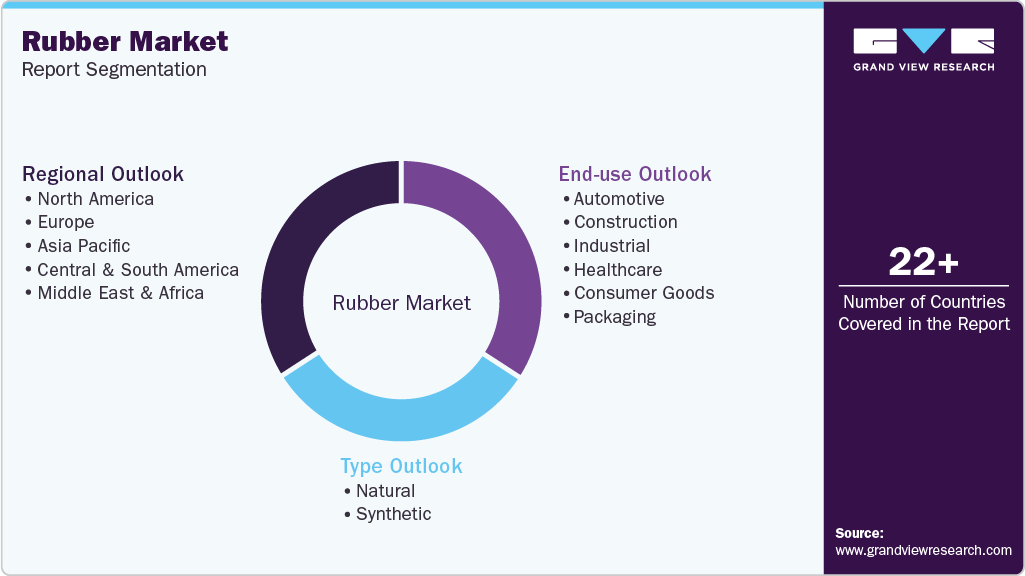
This report forecasts volume & revenue growth at the global, regional, and country levels and provides an analysis of the latest industry trends across sub-segments from 2021 to 2033. For this study, Grand View Research has segmented the global rubber market report based on type, end use, and region:
-
Type Outlook (Volume, Kilotons; Revenue, USD Million, 2021 - 2033)
-
Natural
-
Ribbed Smoked Sheet Type
-
Solid Block Rubber Type
-
Concentrated Latex Type
-
Others
-
-
Synthetic
-
Styrene Butadiene Rubber
-
Nitrile Rubber
-
Polybutadiene Rubber
-
Butyl Rubber
-
Others
-
-
-
End Use Outlook (Volume, Kilotons; Revenue, USD Million, 2021 - 2033)
-
Automotive
-
Construction
-
Industrial
-
Healthcare
-
Consumer goods
-
Packaging
-
-
Regional Outlook (Volume, Kilotons; Revenue, USD Million, 2021 - 2033)
-
North America
-
U.S.
-
Canada
-
Mexico
-
-
Europe
-
Germany
-
UK
-
France
-
Italy
-
Spain
-
The Netherlands
-
-
Asia Pacific
-
China
-
India
-
Japan
-
South Korea
-
Australia
-
Malaysia
-
Singapore
-
Thailand
-
Vietnam
-
-
Central & South America
-
Brazil
-
Argentina
-
-
Middle East & Africa
-
Saudi Arabia
-
UAE
-
South Africa
-
-
Frequently Asked Questions About This Report
b. The global rubber market size was estimated at USD 50.8 billion in 2025 and is expected to reach USD 53.1 billion in 2026.
b. The global rubber market is expected to grow at a compound annual growth rate of 6.0% from 2026 to 2033 to reach USD 79.8 billion by 2033.
b. The automotive segment dominated the market by end use, accounting for 34.7% of revenue in 2025, and is forecast to grow at a 6.3% CAGR from 2026 to 2033, driven by high material requirements for tires and vehicle components.
b. Some key players operating in the rubber market include Sinopec, DuPont, The Dow Chemical Company, Exxon Mobil Corporation, Kumho Petrochemical Company Ltd., The Goodyear Tire and Rubber Company, JSR Corporation, Denka Company Ltd., Vietnam Rubber Group, Southland Holding Lonza, and Asahi Kasei Corporation.
b. Rubber consumption is increasing in construction, industrial machinery, and infrastructure projects due to its durability, flexibility, and sealing performance. Growing investments in infrastructure and manufacturing are driving demand for rubber components, including gaskets, hoses, insulation materials, and vibration-control products.


Share this report with your colleague or friend.
Need a Tailored Report?
Customize this report to your needs — add regions, segments, or data points, with 20% free customization.


ISO 9001:2015 & 27001:2022 Certified
We are GDPR and CCPA compliant! Your transaction & personal information is safe and secure. For more details, please read our privacy policy.
Trusted market insights - try a free sample
See how our reports are structured and why industry leaders rely on Grand View Research. Get a free sample or ask us to tailor this report to your needs.