- Home
- »
- Plastics, Polymers & Resins
- »
-
Post-Consumer Recycled Plastics Market Size Report, 2033GVR Report cover
![Post-Consumer Recycled Plastics Market Size, Share & Trends Report]()
Post-Consumer Recycled Plastics Market (2026 - 2033) Size, Share & Trends Analysis Report By Source (Bottles, Non-bottle Rigid), By Type (PP, PS, PE, PVC, PET), By Region (North America, Europe, Asia Pacific, Middle East & Africa), And Segment Forecasts
- Report ID: GVR-4-68038-806-0
- Number of Report Pages: 120
- Format: PDF
- Historical Range: 2021 - 2024
- Forecast Period: 2026 - 2033
- Industry: Bulk Chemicals
- Report Summary
- Table of Contents
- Segmentation
- Methodology
- Download FREE Sample
-
 Download Sample Report
Post-Consumer Recycled Plastics Market Summary
The global post-consumer recycled plastics market size was estimated at USD 13.2 billion in 2025 and is projected to reach USD 30.0 billion by 2033, growing at a CAGR of 10.6% from 2026 to 2033. The market's growth can be attributed to the surging adoption of sustainability measures by food & beverage and packaging companies to use recycled plastic materials.
Key Market Trends & Insights
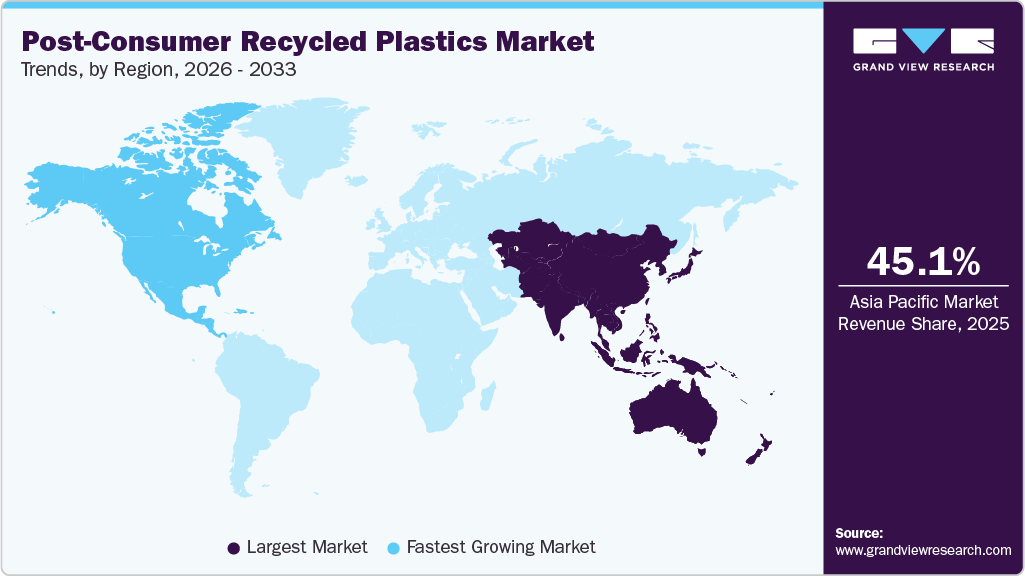
- Asia Pacific dominated the global post-consumer recycled plastics market with the largest revenue share of 45.1%in 2025.
- The post-consumer recycled plastics industry in Indiais expected to grow at the fastest CAGR of 11.2% from 2026 to 2033.
- By source, the bottles segment is expected to grow at the fastest CAGR of 10.7% from 2026 to 2033.
- By type, the polystyrene segment is expected to grow at the fastest CAGR of 10.5% from 2026 to 2033.
Market Size & Forecast
- 2025 Market Size: USD 13.2 Billion
- 2033 Projected Market Size: USD 30.0 Billion
- CAGR (2026-2033): 10.6%
- Asia Pacific: Largest market in 2025
- North America: Fastest growing market
Growing efforts by end users to advance a circular economy, along with the increasing adoption of recycled plastics in packaging, textiles, and other end-use industries, are anticipated to drive global demand for post-consumer recycled plastics during the forecast period.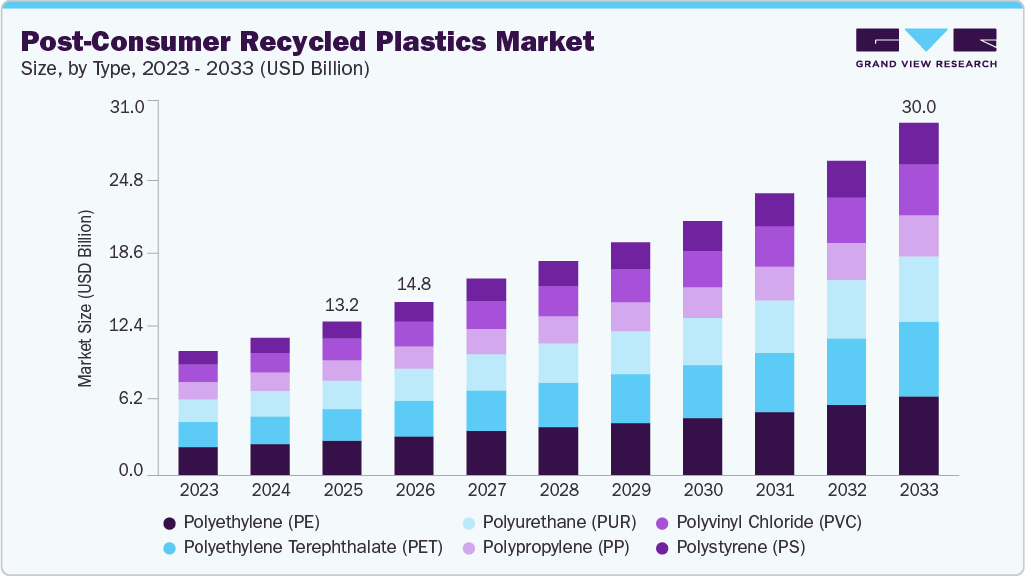
Technological advancements in recycling to produce highly effective, advanced post-recycled plastics have been a major market driver. For instance, in October 2023, Repsol S.A. and Signode Industrial Group LLC launched a ready-to-use strap produced from a polypropylene (PP) composition containing 30% recycled content for utilization in high-tenacity applications.
Drivers, Opportunities & Restraints
Rising regulatory demands to minimize plastic waste are accelerating the use of post-consumer recycled (PCR) plastics. Governments in key economies are enacting policies such as recycled-content mandates, prohibitions on single-use plastics, and extended producer responsibility (EPR) initiatives, prompting manufacturers to use recycled materials in their packaging and consumer goods.
Improved technologies in sorting, mechanical recycling, and chemical recycling are creating growth opportunities for the PCR plastics sector. These innovations improve the quality and effectiveness of recycled plastics, enabling them to be used in more valuable applications such as food packaging, automotive parts, and electronic devices.
However, the PCR plastics industry faces challenges due to variable material quality and limited supply of clean, recyclable feedstock. Contamination in post-consumer waste streams, along with insufficient collection and sorting systems, can impair the performance of recycled plastics, hindering their application in high-performance settings.
Market Concentration & Characteristics
The post-consumer recycled plastics industry is moderately fragmented, with key participants involved in R&D and technological innovations. Notable companies include BASF SE, SABIC, Evonik Industries AG, Sumitomo Chemical Co., Ltd, Arkema, Celanese Corporation, and Eastman Chemical Company, among others. Several players are developing frameworks to improve their market share.
The growing number of stringent government regulations to manage and dispose of plastic waste is driving the global post-consumer recycled plastics industry. Various countries around the world have banned single-use plastics, while others have introduced extended producer responsibility (EPR) programs that hold manufacturers responsible for the end-of-life management of their products.
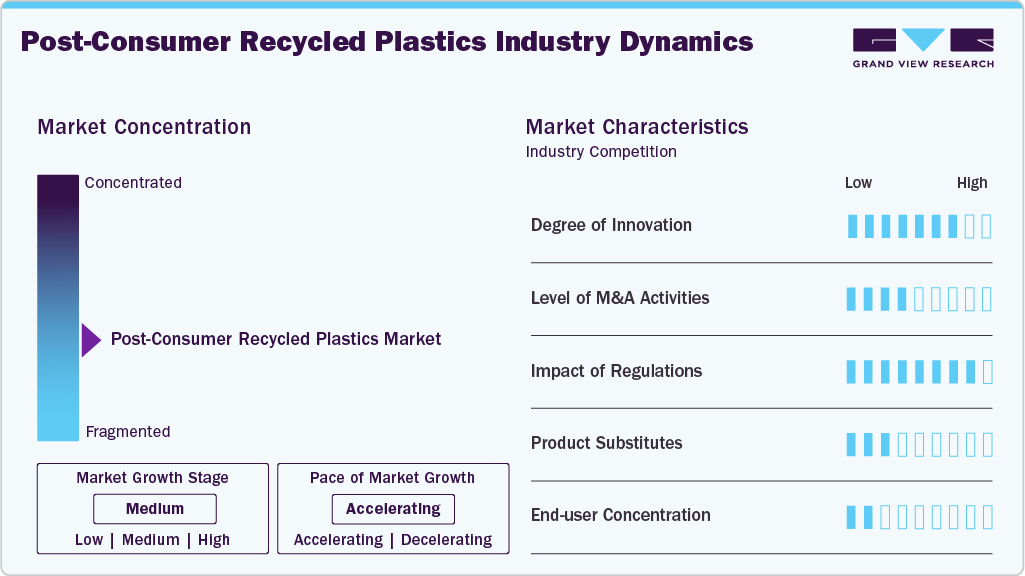
Regulations in the plastic industry have a significant impact, driving industry players to invest in advanced recycling technologies and quality assurance measures to produce sustainable, recyclable plastic materials. Compliance with regulatory frameworks ensures patient safety, fosters innovation, and builds customer trust.
Companies are pursuing regional expansion strategies by entering new geographic markets, forming partnerships with local distributors, and customizing products to align with the rising demand for recycled materials, including plastic, in each region.
Type Insights
The polyethylene segment led the market with the largest revenue share of 20.0% in 2025. Post-consumer recycled polyethylene (PCR PE) is a type of recycled plastic obtained from various plastic products such as films, sheets, and pellets. Post-consumer polyethylene offers barrier performance along with enhanced protection, making it suitable for several food & beverage packaging applications.
In the coming years, demand for polypropylene is likely to grow rapidly. Post-consumer recycled polypropylene (PCR PP) resin offers superior chemical and mechanical properties, which make it suitable for use in various industries, including packaging, automotive, and household appliances. This recycled resin is used to manufacture several household appliances owing to its flexibility, durability, and higher thermal resistance.
Moreover, consumer awareness regarding environmental issues and the need for sustainable practices is likely to expand the production of recycled materials, especially recycled polypropylene, in the packaging and automotive industries.
Source Insights
The bottles segment led the market with the largest revenue share of 75.5% in 2025. Plastic bottles are a major source of post-consumer recycling. Plastic bottles are commonly used to package beverages, cleaning supplies, cosmetics, and other products. The large number of plastic bottles customers produce as waste is a significant source of recycled material. Moreover, increased awareness of the need for sustainable practices, as well as government policies and regulations promoting plastic recycling worldwide, are significant drivers of plastic bottle recycling adoption. This is expected to boost the production of post-consumer recycled plastics from plastic bottles.
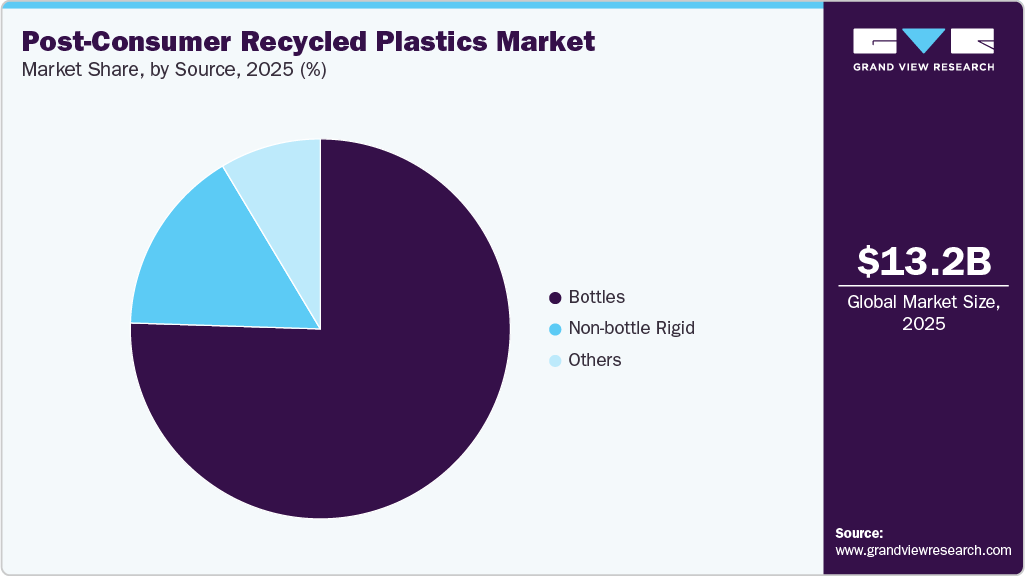
The non-bottle rigid segment is expected to grow at the fastest CAGR of 10.4% during the forecast period. Non-bottle rigid plastics include several durable and non-durable products such as pallets, crates, carts, 5-gallon buckets, electronic housings, dairy and deli tubs, lids, yogurt cups, jars, and similar food containers.Non-bottle rigid plastics include several durable and non-durable products such as pallets, crates, carts, 5-gallon buckets, electronic housings, dairy and deli tubs, lids, yogurt cups, jars, and similar food containers.
Regional Insights
The post-consumer recycled plastics market in North American is expected to grow at the fastest CAGR over the forecast period. The post-consumer recycled plastics industry in North America is characterized by several players, including Eastman Chemical Company. Increased concerns over landfills and the presence of a regulatory framework in the region, along with the surging focus on reducing carbon footprint and increasing inclination of consumers toward sustainable packaging products, building & construction materials, and electrical & electronics products, are expected to fuel the demand for various post-consumer recycled plastics such as PE, PP, and PET in North America in the coming years.
U.S. Post-Consumer Recycled Plastics Market Trends
The post-consumer recycled plastics market in the U.S. accounted for the largest market revenue share in North America in 2025, driven by consumer-generated plastic waste and increased recyclability. Post-consumer recycled plastics are widely used in electronic appliances, including wearables, manufactured in the U.S. The presence of several consumer electronics companies, such as Dell Inc., HP Development Company, L.P., and Apple Inc., in the U.S. is significantly driving demand for post-consumer recycled plastics.
Asia Pacific Post-Consumer Recycled Plastics Market Trends
Asia Pacific dominated the global post-consumer recycled plastics market with the largest revenue share of 45.1%, in 2025. The region is projected to maintain its dominance in the global market over the forecast period. The growth of the post-consumer recycled plastics industry in the region is primarily driven by the increasing demand for these plastics in the automotive and construction applications.
The post-consumer recycled plastics market in China has developed rapidly and is growing faster than the rest of the world. The growth of the food & beverage industry and digitalization in the country have led to the popularity of food delivery services alone. This has created high demand for several plastic packaging materials, including polyethylene, polyethylene terephthalate, and polypropylene. The rise in recycling activities of these plastics is expected to boost the production of post-consumer recycled plastics.
Europe Post-Consumer Recycled Plastics Market Trends
The post-consumer recycled plastics market in Europe is expected to grow at a significant CAGR during the forecast period, driven by the region's adoption of a circular economy to reduce plastic waste. The European Union plans to mandate the use of post-consumer recycled plastics in packaging applications.
The Germany post-consumer recycled plastics market held a significant share in Europe in 2025. Advancements in waste management, along with the rise in post-consumer recycling across the country, are expected to drive demand for post-consumer recycled plastics in Germany.
Central & South America Post-Consumer Recycled Plastics Market Trends
The post-consumer recycled plastics market in the Central & South America is anticipated to grow at a substantial CAGR during the forecast period. Countries such as Brazil, Argentina, Chile, Colombia, and Costa Rica are seeking to reduce land-based waste streams, including plastics, reaching the marine environment. The increasing demand for food and non-food bottles across several application industries, coupled with growing environmental concerns, is driving demand for post-consumer recycled plastics in the packaging industry in Central & South America.
Middle East & Africa Post-Consumer Recycled Plastics Market Trends
The post-consumer recycled plastics market in the Middle East & Africa is anticipated to grow steadily over the forecast period. Rising environmental concerns, driving demand for sustainable plastic products, are expected to fuel demand for post-consumer recycled plastics in the region over the forecast period.
Key Post-Consumer Recycled Plastics Company Insights
Key companies of post-consumer recycled plastics industry are adopting a range of organic and inorganic growth strategies, such as new product development, mergers & acquisitions, and joint ventures, to maintain and expand their market share.
Key Post-Consumer Recycled Plastics Companies:
The following key companies have been profiled for this study on the post-consumer recycled plastics market.
- BASF SE
- SABIC
- Evonik Industries AG
- Sumitomo Chemical Co., Ltd
- Arkema
- Celanese Corporation
- Eastman Chemical Company
- Chevron Phillips Chemical Company
- Exxon Mobil Corporation
- Covestro AG
Recent Developments
-
In November 2023, LyondellBasell Industries Holdings B.V. announced the establishment of an industrial-scale catalytic advanced plastic recycling demonstration plant at the Wesseling location of the company in the country. It will be the first single-train recycling plant for LyondellBasell Industries Holdings B.V., expected to convert post-consumer plastic waste into feedstocks for the production of new plastic.
-
In July 2025, Dow Inc. launched INNATE TF 220 Precision Packaging Resin, specifically created for BOPE flexible packaging structures that enhance recyclability and facilitate the incorporation of post-consumer recycled (PCR) plastic materials. This resin improves the durability and processing efficiency of packaging while promoting circular packaging solutions for consumer goods and detergent packaging uses.
-
In March 2025, SABIC unveiled new extensions to its LNP SLX copolymer resin lineup at the PIAE 2025. The recently launched grades feature significant amounts of post-consumer recycled (PCR) content, with certain formulations incorporating up to 45% PCR. These materials aim to support sustainability efforts in the automotive and mobility sectors while ensuring excellent performance across key attributes, including weather resistance, durability, and color consistency.
Post-Consumer Recycled Plastics Market Report Scope
Report Attribute
Details
Market size value in 2026
USD 14.8 billion
Revenue forecast in 2033
USD 30.0 billion
Growth rate
CAGR of 10.6% from 2026 to 2033
Base year for estimation
2025
Historical data
2021 - 2024
Forecast period
2026 - 2033
Quantitative units
Volume in Kilotons, Revenue in USD million/billion, and CAGR from 2026 to 2033
Report coverage
Volume forecast, Revenue forecast, competitive landscape, growth factors, and trends
Segments covered
Source, type, region
Regional scope
North America; Europe; Asia Pacific; Central & South America; Middle East & Africa
Country scope
U.S.; Canada; Mexico; Germany; UK; France; Italy; China; India; Japan; Malaysia; Brazil; Saudi Arabia
Key companies profiled
BASF SE; SABIC; Evonik Industries AG; Sumitomo Chemical Co., Ltd; Arkema; Celanese Corporation; Eastman Chemical Company; Chevron Phillips Chemical Company; Exxon Mobil Corporation; Covestro AG
Customization scope
Free report customization (equivalent up to 8 analysts working days) with purchase. Addition or alteration to country, regional & segment scope.
Pricing and purchase options
Avail customized purchase options to meet your exact research needs. Explore purchase options
Global Post-Consumer Recycled Plastics Market Report Segmentation
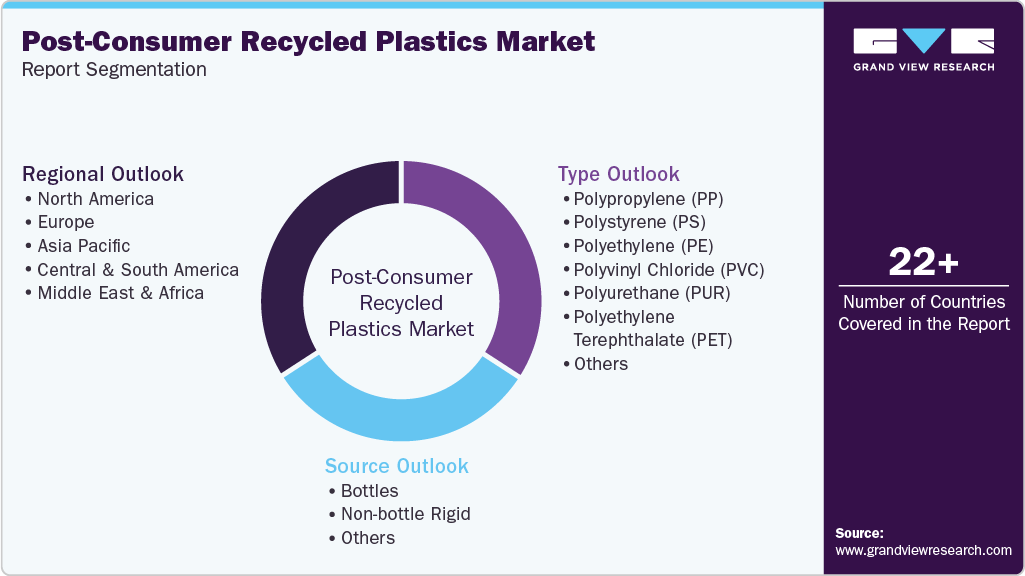
This report forecasts revenue growth at the global, regional, and country levels and provides an analysis of the latest industry trends and opportunities across sub-segments from 2021 to 2033. For this study, Grand View Research has segmented the global post-consumer recycled plastics market report based on source, type, and region:
-
Source Outlook (Volume, Kilotons; Revenue, USD Million, 2021 - 2033)
-
Bottles
-
Non-bottle Rigid
-
Others
-
-
Type Outlook (Volume, Kilotons; Revenue, USD Million, 2021 - 2033)
-
Polypropylene (PP)
-
Polystyrene (PS)
-
Polyethylene (PE)
-
Polyvinyl Chloride (PVC)
-
Polyurethane (PUR)
-
Polyethylene Terephthalate (PET)
-
Others
-
-
Regional Outlook (Volume, Kilotons; Revenue, USD Million, 2021 - 2033)
-
North America
-
U.S.
-
Canada
-
Mexico
-
-
Europe
-
Germany
-
France
-
UK
-
Italy
-
-
Asia Pacific
-
China
-
Japan
-
India
-
Malaysia
-
-
Central & South America
-
Brazil
-
-
Middle East & Africa
-
Saudi Arabia
-
-
Frequently Asked Questions About This Report
b. Some of the key players operating in the post-consumer recycled plastics market include REMONDIS SE & Co. KG; Biffa; Stericycle; Republic Services, Inc.; WM Intellectual Property Holdings, L.L.C.; Veolia; Shell International B.V.; Waste Connections; CLEAN HARBORS, INC.; and Covestro AG.
b. Key factors driving the post-consumer recycled plastics market growth include laws & regulations enforced by governments, increasing awareness regarding sustainable plastic waste management, and reduction in environmental impact from plastic recycling.
b. The global post-consumer recycled plastics market size was estimated at USD 13.18 billion in 2025 and is expected to reach USD 14.80 billion in 2026.
b. Asia Pacific dominated the post-consumer recycled plastics market, accounting for 45.01% in 2025. This is attributable to advanced technology in the waste management industry, laws governing the plastic waste disposal system, and recycling.
b. The global post-consumer recycled plastics market is expected to grow at a compound annual growth rate of 10.6% from 2026 to 2033 to reach USD 30.0 billion by 2033.


Share this report with your colleague or friend.
Need a Tailored Report?
Customize this report to your needs — add regions, segments, or data points, with 20% free customization.


ISO 9001:2015 & 27001:2022 Certified
We are GDPR and CCPA compliant! Your transaction & personal information is safe and secure. For more details, please read our privacy policy.
Trusted market insights - try a free sample
See how our reports are structured and why industry leaders rely on Grand View Research. Get a free sample or ask us to tailor this report to your needs.