- Home
- »
- Plastics, Polymers & Resins
- »
-
Polyethylene Market Size And Share, Industry Report, 2033GVR Report cover
![Polyethylene Market Size, Share & Trends Report]()
Polyethylene Market (2026 - 2033) Size, Share & Trends Analysis Report By Product (LDPE, HDPE, LLDPE), By Application (Bottles & Containers, Films & Sheets, Bags & Sacks, Pipes & Fittings), By End Use, By Region, And Segment Forecasts
- Report ID: GVR-4-68040-259-2
- Number of Report Pages: 120
- Format: PDF
- Historical Range: 2021 - 2025
- Forecast Period: 2026 - 2033
- Industry: Bulk Chemicals
- Report Summary
- Table of Contents
- Interactive Charts
- Methodology
- Download FREE Sample
-
 Download Sample Report
Polyethylene Market Summary
The global polyethylene market size was estimated at USD 166.51 billion in 2025 and is projected to reach USD 229.68 billion by 2033, growing at a CAGR of 4.1% from 2026 to 2033. Growing investments in water distribution, gas pipelines, and irrigation systems are increasing demand for high-density polyethylene pipes.
Key Market Trends & Insights
- Asia Pacific dominated the global polyethylene industry with the largest revenue share of 50.7% in 2025.
- The polyethylene industry in Australia is expected to grow at a CAGR of 5.6% from 2026 to 2033.
- By product, the linear low-density polyethylene (LLDPE) segment is expected to grow at a 4.2% CAGR in revenue from 2026 to 2033.
- By application, the films & sheets segment is expected to grow at a CAGR of 4.8% from 2026 to 2033 in terms of revenue.
- By end use, the construction segment is expected to grow at the fastest CAGR of 4.6% from 2026 to 2033.
Market Size & Forecast
- 2025 Market Size: USD 166.51 billion
- 2033 Projected Market Size: USD 229.68 billion
- CAGR (2026 - 2033): 4.1%
- Asia Pacific: Largest market in 2025
Polyethylene offers corrosion resistance, durability, and long service life, making it a preferred material for modern infrastructure networks. A major trend in the polyethylene market is the rapid integration of circular economy practices, particularly through recycled and bio-based polyethylene grades. Producers are investing in mechanical and chemical recycling technologies to improve waste recovery and produce high-quality recycled polyethylene suitable for packaging and industrial applications.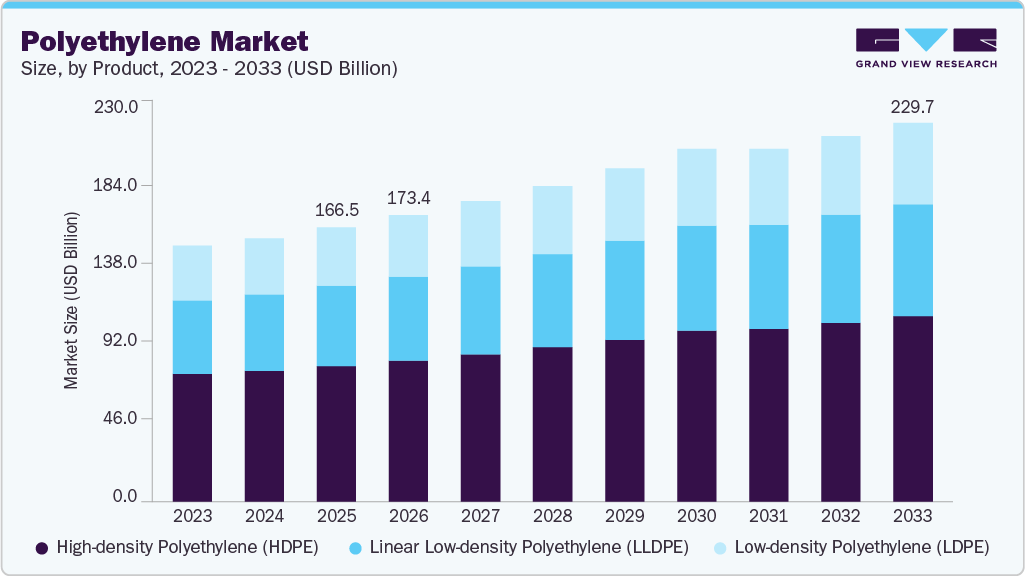
Industry estimates indicate that more than 40% of polyethylene producers are investing in recycled-polymer technologies to meet sustainability targets and regulatory requirements. Brand owners in consumer goods and food packaging are also redesigning products to incorporate recyclable polyethylene materials.
Drivers, Opportunities & Restraints
The global packaging industry remains the main driver of polyethylene demand because of its lightweight, moisture resistance, and cost-effectiveness. Flexible packaging films, rigid containers, and protective packaging solutions depend heavily on polyethylene types such as LDPE, LLDPE, and HDPE. Packaging makes up over 40% of worldwide polyethylene use, boosted by the growth of e-commerce, urbanization, and rising demand for packaged foods in emerging economies. Fast industrial growth in the Asia-Pacific region further increases the need for polyethylene-based packaging options.
The move toward sustainable materials offers a significant opportunity for the polyethylene industry. Governments and multinational consumer brands are increasingly requiring recycled content in plastic packaging, which encourages investment in recycled polyethylene supply chains. Bio-based polyethylene made from renewable feedstocks such as sugarcane is also gaining popularity as companies aim to lower carbon footprints without sacrificing material performance. Growing global bioplastic production capacity and more investment in recycling infrastructure are expected to create new revenue streams for polyethylene producers and compounders.
One of the main constraints on the polyethylene market is the tightening regulatory environment for plastic waste management. Governments across Europe, North America, and Asia are imposing restrictions on single-use plastics and enforcing extended producer responsibility frameworks. These policies raise compliance costs for polyethylene manufacturers and require investments in recycling infrastructure and sustainable material innovation. Moreover, public concerns about plastic pollution continue to influence brand owners to reduce virgin plastic use, thereby moderating demand growth in certain packaging applications.
Market Concentration & Characteristics
The market growth stage is medium, and growth is accelerating. The market exhibits fragmentation, with key players dominating the industry landscape. Major companies such as BASF SE, Borealis AG, Braskem, Dow, Exxon Mobil Corp., Formosa Plastics, INEOS Group, LG Chem, LyondellBasell Industries Holdings B.V., Mitsubishi Chemical Corp., MOL Group, SABIC, China Petrochemical Corp. (Sinopec), and others play a significant role in shaping the market dynamics. These leading players often drive innovation in the market by introducing new products, technologies, and materials to meet the industry's evolving demands.
The polyethylene market shows a moderate to high level of innovation, primarily driven by sustainability needs and performance enhancements in packaging and industrial uses. Producers are investing in advanced catalysts, bio-based feedstocks, and circular polymer technologies to lower carbon emissions and improve recyclability. Several companies have launched bio-based polyethylene grades with better mechanical strength and broader uses in packaging and automotive parts. R&D activity is increasing steadily, with new patents and product launches aimed at lightweight packaging, mono-material films, and improved recyclability.
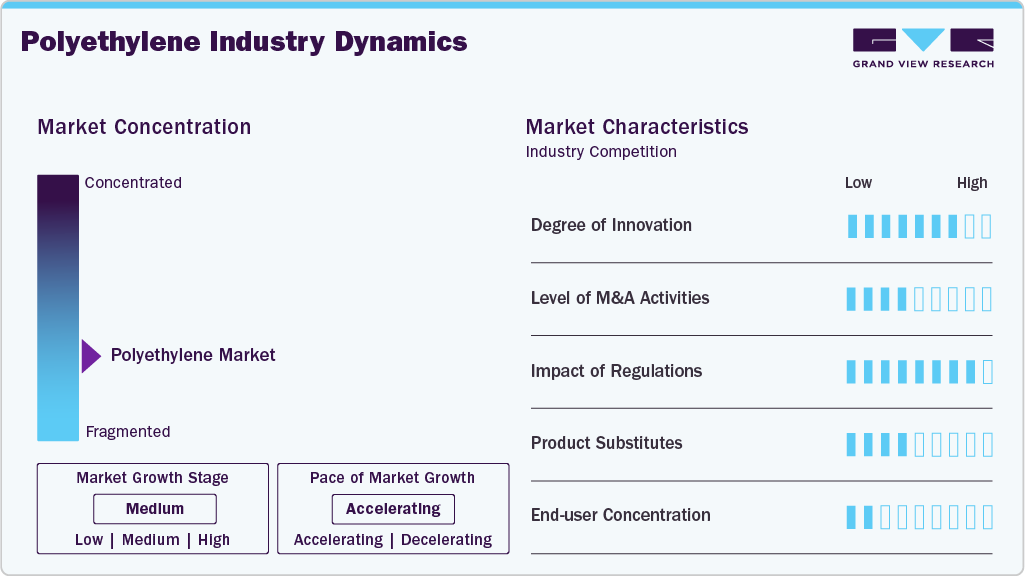
Polyethylene faces pressure to be replaced by alternative materials that offer better sustainability or performance benefits in certain applications. Polypropylene, paper-based packaging, and emerging bioplastics are increasingly used in consumer packaging and food service sectors. Governments and brand owners are encouraging recyclable paper structures and compostable materials to cut down on plastic waste. Bioplastics made from renewable feedstocks are also gaining attention for their lower environmental impact in packaging. However, cost competitiveness and reliability of performance still help polyethylene maintain its dominant market position.
Product Insights
The high-density polyethylene (HDPE) segment led the market with a share of 49.5% in 2025, and is projected to grow at a 4.0% CAGR from 2026 to 2033. Rapid infrastructure expansion and utility pipeline development are fueling this segment. Governments and municipal authorities are increasingly replacing aging metal and concrete pipelines with HDPE due to its corrosion resistance, flexibility, and long service life exceeding 50-100 years. HDPE pipes are extensively used in water distribution, sewage systems, gas networks, and irrigation infrastructure. Over 60 percent of municipal water pipeline installations worldwide currently utilize HDPE, reflecting a strong preference for durable polymer-based infrastructure solutions.
The linear low-density polyethylene (LLDPE) segment is expected to grow at a 4.2% CAGR over the forecast period. The demand for LLDPE is strongly driven by its role in high-performance flexible films used across packaging and agriculture. LLDPE offers superior puncture resistance, stretchability, and seal strength compared with conventional polyethylene grades, enabling converters to reduce film thickness while maintaining performance. This process, known as downgauging, lowers material consumption and packaging costs. Films account for more than half of LLDPE consumption, particularly in stretch wraps, food packaging films, and industrial liners that require strong yet lightweight materials.
Application Insights
The bottles & containers segment dominated the market, accounting for 39.4% market share in 2025, and is forecast to grow at a 3.9% CAGR from 2026 to 2033. Growth in the bottles and containers segment is supported by rising global consumption of packaged household chemicals, personal care products, and food ingredients. HDPE containers offer chemical resistance, impact strength, and cost efficiency, making them suitable for detergents, dairy packaging, edible oil bottles, and industrial containers. Expanding FMCG distribution networks continue to strengthen demand for polyethylene-based rigid packaging.
The films & sheets segment is expected to expand at a 4.8% CAGR over the forecast period. The segment benefits from sustained demand for flexible packaging solutions across food, retail, and industrial supply chains. Polyethylene films are widely used in protective packaging, pallet wraps, agricultural films, and industrial liners due to their moisture-barrier performance and processing efficiency. The expansion of automated packaging and global trade continues to support polyethylene film consumption.
End Use Insights
The packaging segment led the market, accounting for 52.7% of revenue share in 2025, and is expected to grow at a 4.3% CAGR from 2026 to 2033, due to its versatility across rigid and flexible formats. Polyethylene is widely used in bags, pouches, containers, shrink films, and protective packaging. The material offers excellent processability, chemical resistance, and low production costs. Packaging applications account for more than half of global polyethylene consumption, driven by growth in packaged food, e-commerce distribution, and consumer goods manufacturing. The increasing demand for lightweight, recyclable packaging solutions continues to strengthen polyethylene adoption across global supply chains.
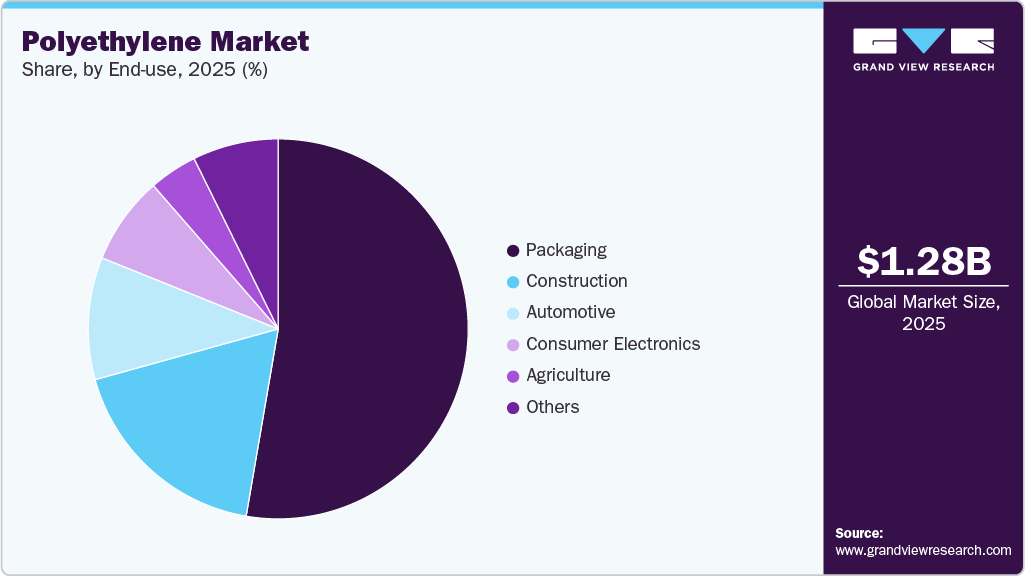
The construction segment is projected to expand at a 4.6% CAGR over the forecast period. Polyethylene demand in the construction sector is supported by its expanding use in piping systems, geomembranes, insulation materials, and vapor barriers. HDPE pipes have gained widespread adoption due to their resistance to corrosion, chemical exposure, and environmental stress cracking. Construction applications account for nearly 9% of global polyethylene consumption, with demand rising due to urban infrastructure development and water management projects. Rapid infrastructure expansion in emerging economies and replacement of aging pipelines in developed regions continue to drive polymer usage in construction materials.
Regional Insights
The Asia Pacific polyethylene industry held the largest revenue share of 50.7% in 2025 and region is expected to grow at a CAGR of 4.5% over the forecast period. Rapid industrialization and expanding consumer markets continue to drive polyethylene consumption across the Asia Pacific. The region accounts for more than half of global polyethylene demand, driven by strong growth in packaging, electronics manufacturing, and construction. Rising urban populations and expanding middle-class consumption have increased demand for packaged foods, consumer goods, and household products that rely heavily on polyethylene materials. Several countries are also expanding polymer processing capacity and petrochemical production, strengthening the region’s role as both a major producer and consumer of polyethylene.
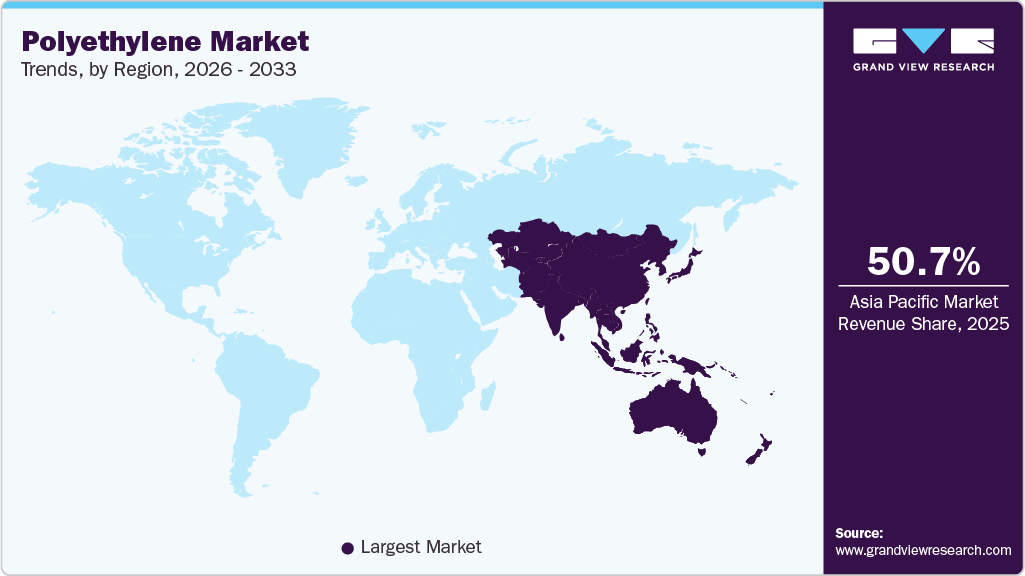
Polyethylene market in China represents the largest single market in the region due to the scale of its manufacturing and packaging industries. The China PE market is driven by strong demand for e-commerce packaging, industrial films, and construction materials. The rapid expansion of domestic petrochemical complexes and polymer processing facilities has strengthened local supply chains. Government-supported infrastructure projects and large-scale consumer goods manufacturing further stimulate demand for polyethylene in pipes, packaging films, and molded plastic products.
North America Polyethylene Market Trends
Abundant shale gas resources in North America provide a structural cost advantage for polyethylene production. Ethane derived from shale gas is widely used as feedstock for ethylene crackers, lowering raw material costs and strengthening regional competitiveness. This has encouraged large-scale capacity expansions along the U.S. Gulf Coast and supported strong export activity to Latin America, Europe, and Asia.
U.S. Polyethylene Market Trends
In the U.S., the polyethylene market is strongly driven by the expansion of domestic petrochemical manufacturing integrated with shale-based feedstocks. The country accounts for nearly 80% of North American polyethylene demand and hosts one of the world’s largest resin production hubs along the Gulf Coast. Competitive feedstock pricing has encouraged investments in new polyethylene plants and export terminals. As a result, the U.S. has become a major global supplier of HDPE and LLDPE resins used in packaging, infrastructure pipes, and industrial films.
Europe Polyethylene Market Trends
Demand for polyethylene in Europe is increasingly influenced by circular economy policies and sustainable packaging initiatives. Governments and industry associations are promoting recyclable plastic solutions and higher recycled-content packaging materials. This regulatory framework has accelerated investments in recycled polyethylene processing and advanced recycling technologies. Strong demand also comes from industrial packaging, construction materials, and automotive lightweight components across major economies such as Germany, France, and Italy.
Key Polyethylene Company Insights
The polyethylene industry is highly competitive, with several key players dominating the landscape. Major companies include BASF SE, Borealis AG, Braskem, Dow, Exxon Mobil Corp., Formosa Plastics, INEOS Group, LG Chem, LyondellBasell Industries Holdings B.V., Mitsubishi Chemical Corp., MOL Group, SABIC, and China Petrochemical Corp. (Sinopec). The polyethylene industry is characterized by a competitive landscape with several key players driving innovation and market growth. Major companies in this sector are investing heavily in research and development to enhance the performance, cost-effectiveness, and sustainability of their products.
Key Polyethylene Companies:
The following key companies have been profiled for this study on the polyethylene market.
- BASF SE
- Borealis AG
- Braskem
- Dow
- Exxon Mobil Corporation
- Formosa Plastics
- INEOS Group
- LG Chem
- LyondellBasell Industries Holdings B.V.
- Mitsubishi Chemical Corporation
- MOL Group
- SABIC
- China Petrochemical Corporation (Sinopec)
Recent Developments
-
In June 2025, Dow Inc. announced the launch of a new LLDPE/HDPE production unit online at Freeport, lifting Gulf Coast resin output and export volumes. The startup supports packaging and film supply chains and improves regional competitiveness for US resin exports.
-
In February 2025, ExxonMobil began test runs at its Huizhou petrochemical complex, commissioning a 1.6 million tons per annum cracker and downstream LLDPE trains with a combined capacity of about 1.2 million tons per annum. The facility materially increased Asian LLDPE and flexible-film resin capacity.
Polyethylene Market Report Scope
Report Attribute
Details
Market size value in 2026
USD 173.74 billion
Revenue forecast in 2033
USD 229.68 billion
Growth rate
CAGR of 4.1% from 2026 to 2033
Actual data
2021 - 2025
Forecast period
2026 - 2033
Quantitative units
Revenue in USD million/billion, Volume in Kilotons, and CAGR from 2026 to 2033
Report coverage
Revenue forecast, competitive landscape, growth factors, and trends
Segments covered
Product, application, end use, region
Regional scope
North America; Europe; Asia Pacific; Central & South America; Middle East & Africa
Country Scope
U.S.; Canada; Mexico; Germany; UK; France; Italy; Spain; China; India; Japan; Australia; South Korea; Brazil; Argentina; Saudi Arabia; UAE; South Africa
Key companies profiled
BASF SE; Borealis AG; Braskem; Dow; Exxon Mobil Corp.; Formosa Plastics; INEOS Group; LG Chem; LyondellBasell Industries Holdings B.V.; Mitsubishi Chemical Corp.; MOL Group; SABIC; China Petrochemical Corp. (Sinopec)
Customization scope
Free report customization (equivalent to up to 8 analyst working days) with purchase. Addition or alteration to country, regional & segment scope
Pricing and purchase options
Avail customized purchase options to meet your exact research needs. Explore purchase options
Global Polyethylene Market Report Segmentation
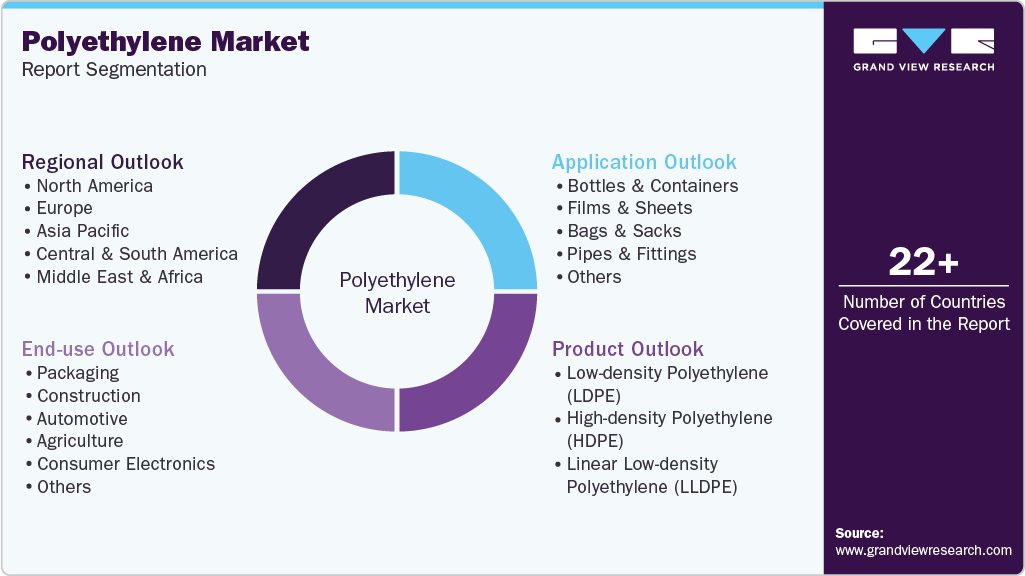
This report forecasts revenue growth at the global, regional, and country levels and provides an analysis of the latest industry trends across sub-segments from 2021 to 2033. For this study, Grand View Research has segmented the polyethylene market report based on product, application, end use, and region:
-
Product Outlook (Volume, Kilotons; Revenue, USD Million, 2021 - 2033)
-
Low-density Polyethylene (LDPE)
-
High-density Polyethylene (HDPE)
-
Linear Low-density Polyethylene (LLDPE)
-
-
Application Outlook (Volume, Kilotons; Revenue, USD Million, 2021 - 2033)
-
Bottles & Containers
-
Films & Sheets
-
Bags & Sacks
-
Pipes & Fittings
-
Others
-
-
End Use Outlook (Volume, Kilotons; Revenue, USD Million, 2021 - 2033)
-
Packaging
-
Construction
-
Automotive
-
Agriculture
-
Consumer Electronics
-
Others
-
-
Regional Outlook (Volume, Kilotons; Revenue, USD Million, 2021 - 2033)
-
North America
-
U.S.
-
Canada
-
Mexico
-
-
Europe
-
Germany
-
UK
-
France
-
Italy
-
Spain
-
-
Asia Pacific
-
China
-
India
-
Japan
-
South Korea
-
Australia
-
-
Central & South America
-
Brazil
-
Argentina
-
-
Middle East & Africa
-
Saudi Arabia
-
UAE
-
South Africa
-
-
Frequently Asked Questions About This Report
b. The global polyethylene market size was estimated at USD 166.5 billion in 2025 and is expected to reach USD 173.7 billion in 2026.
b. The global polyethylene market is expected to grow at a compound annual growth rate of 4.1% from 2026 to 2033 to reach USD 229.7 billion by 2033.
b. Some key players operating in the polyethylene market include BASF SE, Borealis AG, Braskem, Dow, Exxon Mobil Corp., Formosa Plastics, INEOS Group, LG Chem, LyondellBasell Industries Holdings B.V., Mitsubishi Chemical Corp., MOL Group, SABIC, and China Petrochemical Corp. (Sinopec).
b. The high-density polyethylene (HDPE) segment dominated the market across product segmentation in terms of revenue, accounting for 49.5% market share in 2025, and is forecast to grow at a 4.0% CAGR from 2026 to 2033.
b. Growing investments in water distribution, gas pipelines, and irrigation systems are increasing demand for high-density polyethylene pipes. Polyethylene offers corrosion resistance, durability, and long service life, making it a preferred material for modern infrastructure networks.


Share this report with your colleague or friend.
Need a Tailored Report?
Customize this report to your needs — add regions, segments, or data points, with 20% free customization.


ISO 9001:2015 & 27001:2022 Certified
We are GDPR and CCPA compliant! Your transaction & personal information is safe and secure. For more details, please read our privacy policy.
Trusted market insights - try a free sample
See how our reports are structured and why industry leaders rely on Grand View Research. Get a free sample or ask us to tailor this report to your needs.