- Home
- »
- Personal Care & Cosmetics
- »
-
Personal Care Contract Manufacturing Market Report, 2033GVR Report cover
![Personal Care Contract Manufacturing Market Size, Share & Trends Report]()
Personal Care Contract Manufacturing Market (2026 - 2033) Size, Share & Trends Analysis Report By Services (Manufacturing, Custom Formulation & RD, Packaging), By Product (Skin Care, Hair Care, Make-up & Color Cosmetics, Fragrances & Deodorants), By Region, And Segment Forecasts
- Report ID: GVR-1-68038-572-4
- Number of Report Pages: 100
- Format: PDF
- Historical Range: 2021 - 2024
- Forecast Period: 2026 - 2033
- Industry: Bulk Chemicals
- Report Summary
- Table of Contents
- Interactive Charts
- Methodology
- Download FREE Sample
-
 Download Sample Report
Personal Care Contract Manufacturing Market Summary
The global personal care contract manufacturing market size was valued at USD 24.18 billion in 2025 and is projected to reach USD 45.44 billion by 2033, growing at a CAGR of 8.4% from 2026 to 2033. The industry is driven by brands shifting toward asset-light business models to reduce capital investment and operational risk.
Key Market Trends & Insights
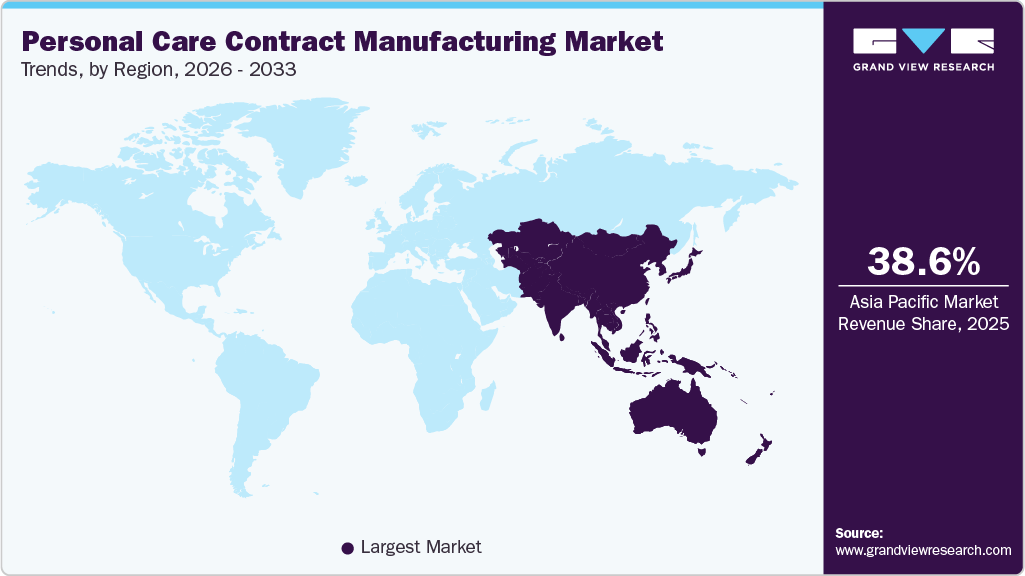
- Asia Pacific dominated the personal care contract manufacturing market with the largest revenue share of 38.6% in 2025.
- The personal care contract manufacturing market in the U.S. is expected to grow at a substantial CAGR of 7.3% from 2026 to 2033.
- By services, the manufacturing segment is expected to grow at a considerable CAGR of 8.5% from 2026 to 2033 in terms of revenue.
- By product, the skin care segment is expected to grow at a considerable CAGR of 8.9% from 2026 to 2033 in terms of revenue.
Market Size & Forecast
- 2025 Market Size: USD 24.18 Billion
- 2033 Projected Market Size: USD 45.44 Billion
- CAGR (2026-2033): 8.4%
- Asia Pacific: Largest market in 2025
Outsourcing manufacturing allows companies to focus on branding, marketing, and distribution while relying on specialized partners for production. Increasing regulatory complexity around safety, quality, and compliance further encourages brands to work with experienced contract manufacturers.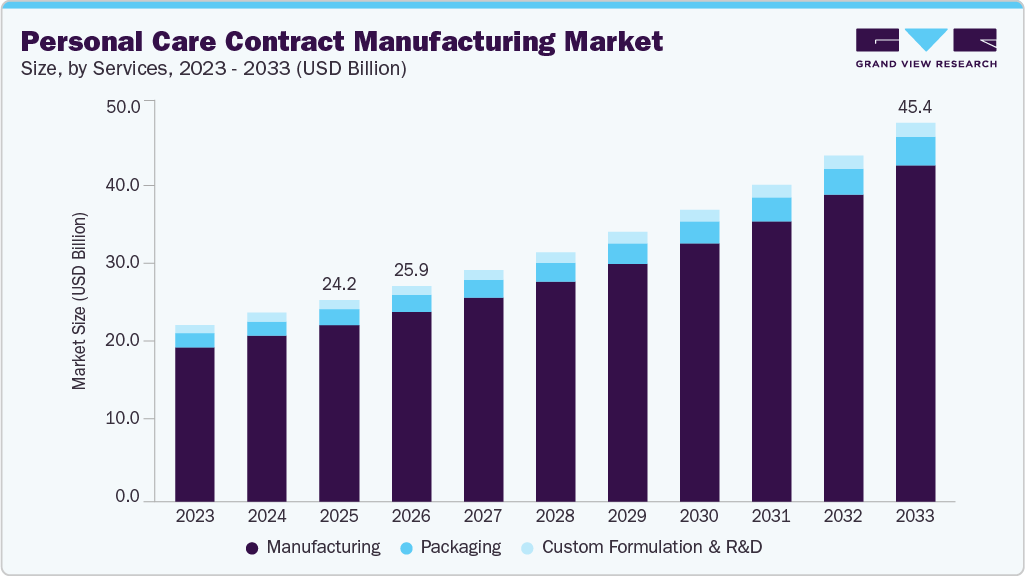
Another key driver is rising demand for innovation, customization, and rapid product launches across skin care, hair care, and color cosmetics. Contract manufacturers with strong R&D capabilities help brands develop differentiated formulations, clean-label products, and premium offerings. Growing consumer preference for sustainable, natural, and personalized products is accelerating the outsourcing of formulation and packaging expertise. Additionally, the scalability offered by contract manufacturers supports brands in managing fluctuating demand and global expansion efficiently.
Market Concentration & Characteristics
The market is moderately fragmented, with a mix of large multinational CDMOs and numerous small to mid-sized regional players. Leading companies hold strong positions due to their global manufacturing networks, regulatory expertise, and ability to serve large brand portfolios. However, no single player dominates the market, as brands often diversify suppliers to reduce risk and improve flexibility. Continuous entry of niche formulators and specialty manufacturers keeps competitive intensity high across regions.
Innovation is a defining characteristic of the personal care contract manufacturing industry, driven by frequent product launches and evolving consumer preferences. Contract manufacturers invest heavily in formulation science, active ingredients, and multifunctional products to support brand differentiation. Demand for clean-label, vegan, and science-backed formulations has accelerated innovation cycles. Advanced testing, rapid prototyping, and flexible production lines further strengthen innovation intensity across the industry.
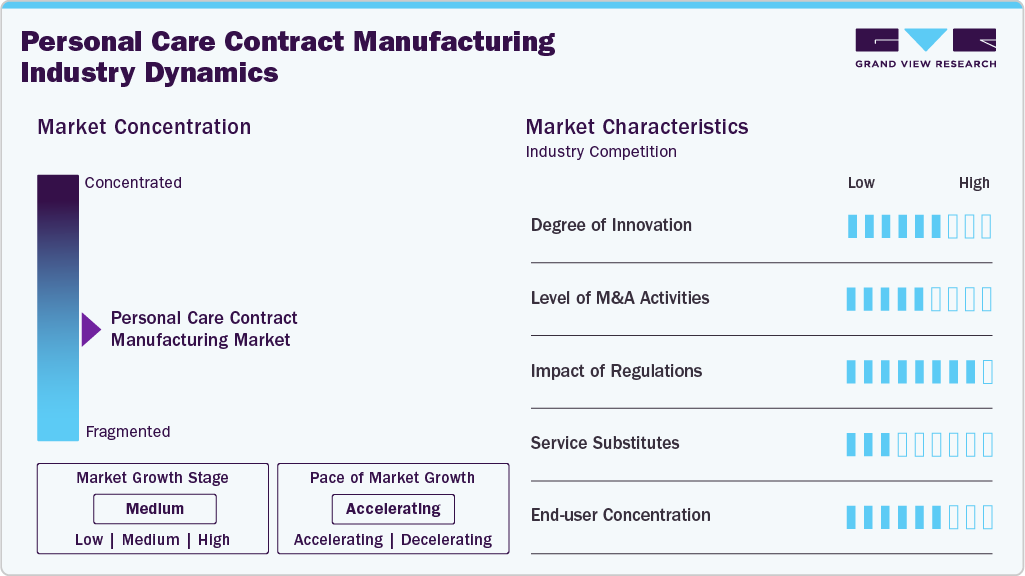
Regulatory requirements significantly influence operations, covering ingredient safety, labeling, and manufacturing practices across regions. Contract manufacturers must comply with strict standards such as GMP, REACH, and cosmetic safety regulations, increasing the value of experienced partners. Compliance costs and frequent regulatory updates raise entry barriers for smaller players. As a result, brands increasingly rely on compliant manufacturers to minimize regulatory risk and delays.
End-user concentration in this market is moderate, with demand coming from a broad mix of global brands, private-label companies, and emerging indie players. Large multinational brands account for higher volumes, but smaller brands contribute significantly through frequent, small-batch orders. This diversified customer base reduces dependency on any single client. At the same time, rising private-label penetration is reshaping order patterns and production planning.
Drivers, Opportunities & Restraints
The personal care contract manufacturing industry is driven by brands adopting outsourcing to reduce capital costs and improve operational flexibility. Growing demand for fast product launches across skin care, hair care, and cosmetics supports reliance on experienced manufacturers. The rising complexity of formulations and compliance requirements further pushes brands toward specialized partners. Expansion of indie and private-label brands is steadily increasing outsourced production volumes.
Strong opportunities are emerging from demand for clean, natural, and sustainable personal care products. Contract manufacturers that offer advanced R&D, eco-friendly packaging, and customization can capture higher-value projects. Growth of direct-to-consumer and niche beauty brands creates steady demand for small-batch and flexible manufacturing. Expansion into emerging markets also opens long-term opportunities for capacity and Services diversification.
The market faces restraints from rising raw material prices and supply-chain volatility, which pressure margins for contract manufacturers. High regulatory compliance costs can limit participation by smaller players and slow capacity expansion. Intense price competition among manufacturers reduces profitability, especially in commoditized product categories. Dependence on brand owners for volume commitments also exposes manufacturers to demand fluctuations.
Services Insights
Manufacturing dominated the market and accounted for 87.8% share in 2025, due to high outsourcing of large-scale production by both global and emerging brands. Brands prefer contract manufacturers to avoid heavy capital investment in plants, equipment, and quality systems. High-volume categories such as skin care and hair care rely on established manufacturers with GMP-certified facilities. Consistent demand, repeat orders, and long-term supply agreements keep manufacturing as the core revenue-generating service.
The packaging segment is expected to grow at a significant CAGR of 7.5% from 2026 to 2033 in terms of revenue. Packaging services are growing significantly as brands place a stronger emphasis on product aesthetics, sustainability, and differentiation. Demand for eco-friendly materials, innovative dispensers, and premium secondary packaging is increasing the outsourcing of packaging capabilities. Contract manufacturers offering integrated filling, labeling, and assembly gain a competitive edge. Regulatory labeling requirements and customization trends further accelerate the growth of packaging-focused Services.
Product Insights
Skin care dominated the personal care contract manufacturing market and accounting for 36.2% share in 2025, due to high consumer spending on daily-use and premium products. The segment involves complex formulations with active ingredients, making outsourcing to experienced manufacturers essential. Frequent product launches in anti-aging, sun care, and dermatological solutions sustain strong production volumes. Higher margins and strong brand differentiation keep skin care as the leading product category.
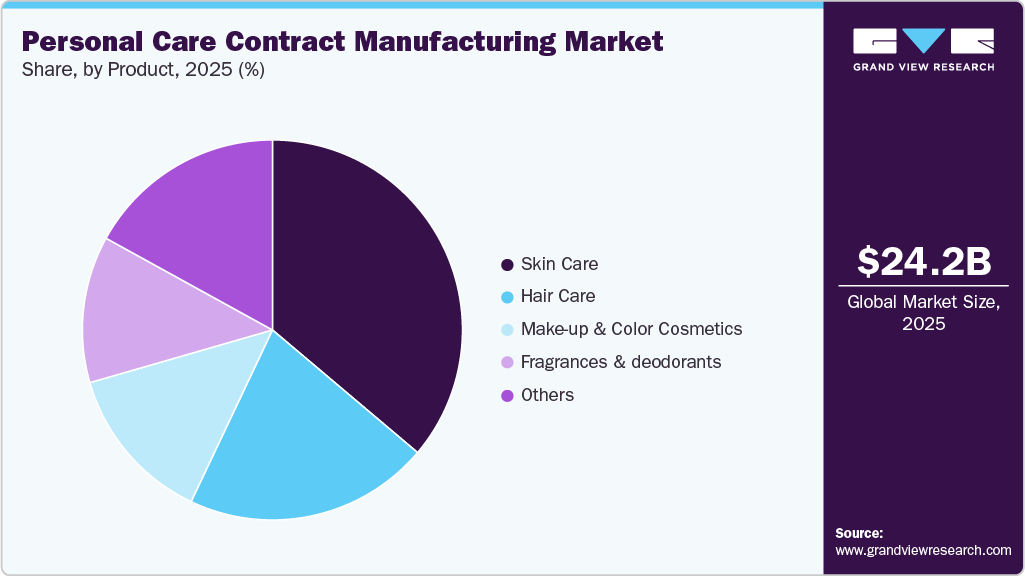
The Hair Care segment is expected to grow at a considerable CAGR of 8.8% from 2026 to 2033 in terms of revenue. Hair care is growing significantly as consumers increasingly focus on scalp health, damage repair, and specialized treatments. Rising demand for sulfate-free, natural, and customized formulations supports greater reliance on contract manufacturers. Product innovation in serums, masks, and treatment-based offerings is expanding outsourced production. Emerging brands and private labels are accelerating growth through frequent launches and flexible manufacturing needs.
Regional Insights
North America personal care contract manufacturing market is growing steadily as brands increasingly outsource manufacturing to improve speed-to-market and manage regulatory complexity. Strong demand for clean-label, premium, and dermatology-backed products supports higher-value contract manufacturing. Indie and direct-to-consumer brands are major growth contributors, relying on small-batch and customized Services. Advanced R&D capabilities and strict quality standards continue to attract outsourcing demand.
U.S. Personal Care Contract Manufacturing Market Trends
The personal care contract manufacturing market in the U.S. dominated the North American region due to its advanced manufacturing infrastructure and strong presence of global and indie beauty brands. High demand for premium, clean-label, and dermatology-backed products drove extensive outsourcing to specialized manufacturers. Strict regulatory and quality standards encouraged brands to rely on experienced domestic partners. Strong R&D capabilities and rapid innovation cycles reinforced the country’s market leadership.
Canada personal care contract manufacturing market is growing steadily as demand rises for natural, sustainable, and ethically produced personal care products. Canadian contract manufacturers benefit from a strong regulatory framework and increasing export-oriented production for U.S. brands. Growth of private-label and niche brands is supporting outsourced manufacturing volumes. Investments in clean beauty and environmentally friendly packaging are accelerating market expansion in the country.
Europe Personal Care Contract Manufacturing Market Trends
The personal care contract manufacturing market in Europe shows consistent growth driven by demand for sustainable, natural, and compliant personal care products. Strict cosmetic regulations encourage brands to partner with experienced contract manufacturers that offer regulatory assurance. Innovation in skin care active ingredients and eco-friendly packaging supports outsourcing trends. Western Europe remains a hub for premium and specialty product manufacturing.
Germany personal care contract manufacturing market dominated the European region due to its strong industrial base and high manufacturing quality standards. The country was home to advanced facilities specializing in skin care, hair care, and dermo-cosmetic products. A strong focus on R&D, formulation science, and process automation supported large-scale outsourcing activities. Strict regulatory compliance and operational reliability made Germany a preferred manufacturing hub for European brands.
The personal care contract manufacturing market in the UK is growing steadily as demand increases for premium, natural, and innovative personal care products. The rising number of indie and private-label brands is driving outsourcing to flexible contract manufacturers. Strong capabilities in formulation development and small-batch production support rapid product launches. Focus on sustainable packaging and clean-label formulations is further boosting market growth.
Asia Pacific Personal Care Contract Manufacturing Market Trends
The personal care contract manufacturing market in Asia Pacific accounted for the largest share of 38.6% in 2025, supported by its cost-efficient production base and large consumer demand. Countries across the region hosted a dense network of contract manufacturers with scalable and technologically advanced facilities. Strong consumption of skin care and hair care products, combined with frequent brand launches, drove high outsourcing volumes. Ready availability of raw materials and flexible manufacturing capacity reinforced the region’s leadership position.
China personal care contract manufacturing market dominated the Asia Pacific due to its large-scale production capacity and cost-efficient manufacturing ecosystem. The country offered end-to-end services, from formulation to mass production, attracting both domestic and global brands. Strong supply-chain integration and ready access to raw materials supported high-volume output. Rapid innovation capabilities and short turnaround times reinforced China’s leading position.
The personal care contract manufacturing market in India is growing significantly as brands increasingly outsource manufacturing to leverage competitive costs and expand technical capabilities. Rising demand for herbal, ayurvedic, and clean-label products supports strong growth in contract manufacturing. The country’s improving regulatory framework and GMP-compliant facilities attract international clients. Expansion of local beauty brands and export-oriented production continues to drive market momentum.
Latin America Personal Care Contract Manufacturing Market Trends
The personal care contract manufacturing market in Latin America is emerging as a growing market due to expanding middle-class populations and rising personal care consumption. Local and international brands increasingly outsource production to meet regional demand efficiently. Cost-competitive manufacturing and improving regulatory frameworks support market growth. Brazil and Mexico act as key production and consumption hubs within the region.
Brazil personal care contract manufacturing market is growing steadily, supported by strong domestic consumption and a well-established beauty culture. Local and international brands are increasingly outsourcing production to serve the large regional market efficiently. Availability of raw materials and improving manufacturing capabilities support localized production. Expansion of private-label and mass-market personal care products continues to drive growth.
Middle East & Africa Personal Care Contract Manufacturing Market Trends
The personal care contract manufacturing market in the Middle East and Africa is growing gradually, supported by rising urbanization and increasing awareness of personal grooming products. Brands outsource manufacturing to serve local markets while managing import costs and lead times. Demand for skin care, hair care, and fragrance products is expanding, especially in Gulf countries. Improving industrial infrastructure is encouraging contract manufacturing investments across the region.
Saudi Arabia is emerging as a growing market for personal care contract manufacturing, supported by rising consumer spending on grooming and wellness products. Government initiatives to strengthen local manufacturing under economic diversification programs are encouraging outsourcing partnerships. Increasing demand for skin care, fragrances, and personal hygiene products is driving production activity. Investments in industrial zones and regulatory modernization are further supporting market growth.
Key Personal Care Contract Manufacturing Companies Insights
Key players operating in the personal care contract manufacturing market are undertaking various initiatives to strengthen their presence and increase the reach of their products and services. Strategies such as expansion activities and partnerships are key in propelling the market growth. Some of the key players operating in the market include Albea, Accupac and Knowlton Development Corporation.
-
Albéa is a major contract partner focused on cosmetic packaging solutions, with strong capabilities in tubes, rigid packaging, and dispensing systems. The company supports personal care brands through integrated Services that combine design, material engineering, and industrial-scale production. Albéa has a strong emphasis on sustainable packaging, including recyclable and bio-based materials. Its global manufacturing footprint enables consistent quality and supply for multinational beauty brands.
-
Accupac specializes in contract manufacturing and filling Services for personal care products, with expertise across liquids, creams, gels, and wipes. The company is known for flexible batch sizes, making it a preferred partner for both large brands and emerging players. Accupac offers vertically integrated capabilities, including formulation support, filling, labeling, and secondary packaging. Strong regulatory compliance and operational reliability support long-term customer relationships.
Key Personal Care Contract Manufacturing Companies:
The following are the leading companies in the personal care contract manufacturing market. These companies collectively hold the largest market share and dictate industry trends.
- Albea
- Accupac
- Knowlton Development Corporation
- Vi-Jon
- MAESA
- HatchBeauty Brands, LLC
- Fareva
- Colep
- Intercos S.p.A
- Oxygen Development
- Voyant Beauty
- Mansfield-King
- NuWorld
- Biogenesis
- Bright International
- Eco Lips
Recent Developments
-
In October 2025, kdc/one strengthened its European presence by acquiring the business and operations of Barony Universal. The acquisition expands kdc/one’s capabilities in aerosol-based personal care products and adds UK manufacturing capacity. It also broadens access to international customers across multiple categories. The move supports kdc/one’s strategy to scale globally through targeted acquisitions.
-
In February 2025, Albéa introduced the Metamorphosis paper-based tube to support brands seeking lower-plastic packaging solutions. The tube combines a high share of certified paper with a lightweight dispensing system to reduce overall material usage. It is designed to maintain functional performance while improving recyclability compared to conventional tubes. The launch aligns with rising demand from beauty brands for sustainable packaging without compromising shelf appeal or usability.
Personal Care Contract Manufacturing Market Report Scope
Report Attribute
Details
Market size value in 2026
USD 25.88 billion
Revenue forecast in 2033
USD 45.44 billion
Growth rate
CAGR of 8.4% from 2026 to 2033
Base year for estimation
2025
Historical data
2021 - 2024
Forecast period
2026 - 2033
Quantitative units
Revenue in USD million/billion, and CAGR from 2026 to 2033
Report coverage
Revenue forecast, company ranking, competitive landscape, growth factors, and trends
Segments covered
Services, product, region
Regional scope
North America; Europe; Asia Pacific; Latin America; Middle East & Africa
Country scope
U.S.; Canada; Mexico; Germany; France; Italy; Spain; UK; China; Japan; India; South Korea; Australia; Argentina; Brazil; Saudi Arabia; UAE
Key companies profiled
Albea; Accupac; Knowlton Development Corporation; Vi-Jon; MAESA; HatchBeauty Brands, LLC; Fareva; Colep; Intercos S.p.A; Oxygen Development; Voyant Beauty; Mansfield-King; NuWorld; Biogenesis; Bright International; Eco Lips
Customization scope
Free report customization (equivalent up to 8 analysts working days) with purchase. Addition or alteration to country, regional & segment scope.
Pricing and purchase options
Avail customized purchase options to meet your exact research needs. Explore purchase options
Global Personal Care Contract Manufacturing Market Report Segmentation
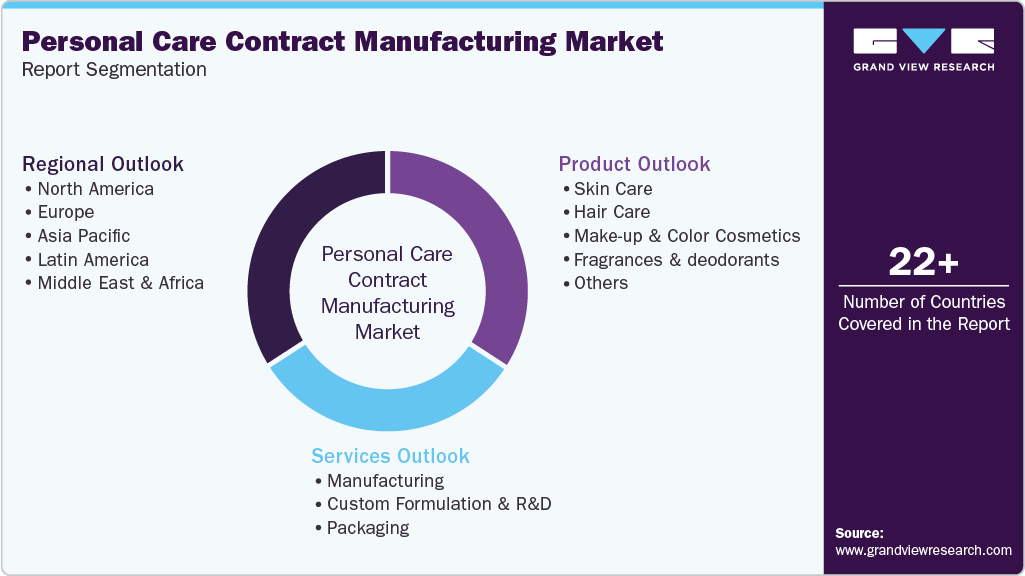
This report forecasts revenue growth at global, regional, and country levels and provides an analysis of the latest industry trends in each of the sub-segments from 2021 to 2033. For this study, Grand View Research has segmented the global personal care contract manufacturing market report based on services, product, and region.
-
Services Outlook (Revenue, USD Billion, 2021 - 2033)
-
Manufacturing
-
Skin Care
-
Hair Care
-
Make-up & Color Cosmetics
-
Fragrances & deodorants
-
Others
-
-
Custom Formulation and R&D
-
Skin Care
-
Hair Care
-
Make-up & Color Cosmetics
-
Fragrances & deodorants
-
Others
-
-
Packaging
-
Skin Care
-
Hair Care
-
Make-up & Color Cosmetics
-
Fragrances & deodorants
-
Others
-
-
-
Product Outlook (Revenue, USD Billion, 2021 - 2033)
-
Skin Care
-
Hair Care
-
Make-up & Color Cosmetics
-
Fragrances & deodorants
-
Others
-
-
Region Outlook (Revenue, USD Billion, 2021 - 2033)
-
North America
-
U.S.
-
Canada
-
Mexico
-
-
Europe
-
Germany
-
UK
-
France
-
Italy
-
Spain
-
-
Asia Pacific
-
China
-
India
-
Japan
-
Australia
-
South Korea
-
-
Latin America
-
Brazil
-
Argentina
-
-
Middle East & Africa
-
UAE
-
Saudi Arabia
-
-
Frequently Asked Questions About This Report
b. Personal care contract manufacturing market size was estimated at USD 24.18 billion in 2025 and is expected to be USD 25.88 billion in 2026.
b. The personal care contract manufacturing market, in terms of revenue, is expected to grow at a compound annual growth rate of 8.4% from 2026 to 2033 to reach USD 45.44 billion by 2033.
b. Asia Pacific region dominated the market in 2025 by accounting for a share of 38.6% of the market. The Asia Pacific region is driven by the heightened demand for products such as deodorants, shaving creams, among younger population in emerging markets including India and China is expected to have major impact on market growth.
b. Some of the key players operating in the personal care contract manufacturing market include Albea, Accupac, Knowlton Development Corporation, Vi-Jon, MAESA, HatchBeauty Brands, LLC, Fareva, Colep, Intercos S.p.A, Oxygen Development, Voyant Beauty, Mansfield-King, NuWorld, Biogenesis, Bright International, and Eco Lips.
b. The shifting focus of significant companies producing personal care products from in-house production to R&D and other promotional activities is projected to boost the contract manufacturing of these products.


Share this report with your colleague or friend.
Need a Tailored Report?
Customize this report to your needs — add regions, segments, or data points, with 20% free customization.


ISO 9001:2015 & 27001:2022 Certified
We are GDPR and CCPA compliant! Your transaction & personal information is safe and secure. For more details, please read our privacy policy.
Trusted market insights - try a free sample
See how our reports are structured and why industry leaders rely on Grand View Research. Get a free sample or ask us to tailor this report to your needs.