- Home
- »
- Network Security
- »
-
Network Detection And Response Market Size Report, 2033GVR Report cover
![Network Detection And Response Market Size, Share & Trends Report]()
Network Detection And Response Market (2026 - 2033) Size, Share & Trends Analysis Report By Component (Solution, Services), By Network Environment (Data Center Networks, Cloud Networks), By Deployment (Cloud-based, Hybrid), By Enterprise Size, By End-use , By Region, And Segment Forecasts
- Report ID: GVR-4-68040-853-0
- Number of Report Pages: 120
- Format: PDF
- Historical Range: 2021 - 2025
- Forecast Period: 2026 - 2033
- Industry: Technology
- Report Summary
- Table of Contents
- Segmentation
- Methodology
- Download FREE Sample
-
 Download Sample Report
Network Detection And Response Market Summary
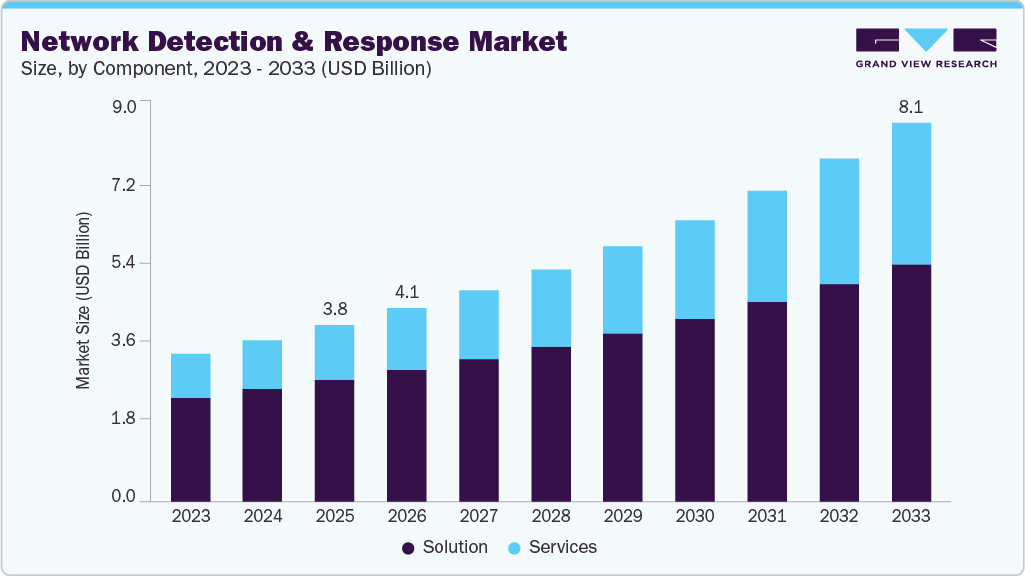
The global network detection and response market size was estimated at USD 3.77 billion in 2025 and is projected to reach USD 8.08 billion by 2033, growing at a CAGR of 10.1% from 2026 to 2033. The market focuses on tools that monitor traffic across company networks to detect and respond to security threats in real time.
Key Market Trends & Insights
- The North America network detection and response (NDR) market held the major revenue share of over 41.0% in 2025.
- The network detection and response (NDR) industry in the U.S. is expected to grow significantly from 2026 to 2033.
- By component, the solution segment accounted for the largest revenue share of 69.1% in 2025.
- By network environment, the enterprise IT network segment accounted for the largest revenue share in 2025.
- By deployment, the on-premises segment dominated the network detection and response (NDR) market in 2025.
Market Size & Forecast
- 2025 Market Size: USD 3.77 Billion
- 2033 Projected Market Size: USD 8.08 Billion
- CAGR (2026-2033): 10.1%
- North America: Largest market in 2025
- Asia Pacific: Fastest growing market
These systems use advanced analytics to identify unusual patterns, such as unauthorized access or data leaks, without relying solely on known signatures. In today's digital landscape, where cyberattacks are becoming increasingly sophisticated, NDR helps businesses stay ahead by providing visibility into hidden risks that traditional firewalls might miss. This approach shifts security from reactive fixes to proactive defense, making it essential for organizations operating in remote work and cloud environments.Growth in the NDR sector stems from rising cyber incidents and stricter regulations such as GDPR and CCPA, which push companies to invest in better threat detection. Many firms now see NDR as a core part of their security stack, integrating it with endpoint protection and SIEM systems for a fuller picture. The market appeals to industries such as finance, healthcare, and manufacturing, where downtime from breaches can cost millions. Vendors compete by offering AI-driven features that automate responses, reducing the need for large security teams and speeding up incident handling.
For instance, in April 2025, Darktrace enhanced its Network Detection and Response (NDR) solution with AI-driven threat detection, autonomous response, and proactive risk management for distributed networks and remote workforces. By leveraging Self-Learning AI, it identifies known and unknown threats faster, improving enterprise security. These innovations strengthen NDR capabilities across hybrid and cloud environments, driving higher adoption of AI-powered solutions. The enhanced visibility and autonomous response are expected to accelerate market growth and reshape competitive dynamics in the NDR segment.
Moreover, the network detection and response (NDR) industry is expected to expand as more businesses adopt zero-trust models, emphasizing continuous monitoring over perimeter defenses. Challenges remain, such as integrating with legacy systems or avoiding false positives that overwhelm teams. Still, with ongoing innovations in behavioral analysis, NDR is poised to play a larger role in safeguarding networks against evolving threats, such as AI-powered attacks.
Component Insights
The solution segment dominated the network detection and response (NDR) market, accounting for a 69.1% revenue share in 2025, capturing the largest portion of industry revenue according to multiple analyst assessments. Organizations continued to prioritize comprehensive, ready-to-deploy platforms that integrate advanced behavioral analytics, machine learning-driven anomaly detection, and automated response capabilities to tackle increasingly sophisticated threats across hybrid and cloud environments. This preference stems from the urgent need for real-time visibility into east-west traffic and encrypted communications, where traditional perimeter defenses fall short. Vendors responded by refining their offerings, with leading providers emphasizing seamless integration into existing security operations workflows and a stronger focus on operational efficiency. Market players also accelerated innovation through frequent platform updates and feature expansions to address evolving enterprise security requirements. For instance, in October 2025, Stamus launched Clear NDR Enterprise Update 42.0, strengthening its position in the network detection and response market through enhanced AI connectivity, advanced behavioral analytics, improved threat intelligence integration, and major performance upgrades that enable faster, lower-noise threat detection and response.
The services segment is expected to grow at the fastest CAGR from 2026 to 2033, fueled by companies' ongoing shift toward outsourcing specialized expertise rather than building everything in-house. Businesses today face mounting pressure to adopt cloud platforms, strengthen cybersecurity defenses, and integrate AI tools quickly, yet many lack the internal resources or skills to handle these changes smoothly. This creates strong demand for managed services, consulting, system integration, and ongoing support, particularly in IT service management and related fields, where providers deliver tailored, scalable solutions that reduce operational risks and speed up digital initiatives. Recent industry assessments highlight that enterprises, including smaller firms, increasingly rely on external services to stay competitive amid rapid technological evolution and tighter budgets, positioning the segment for sustained momentum over the forecast period.
Network Environment Insights
The enterprise IT networks segment accounted for the largest revenue share of the network detection and response (NDR) industry in 2025, reflecting the ongoing priority that large organizations place on secure, scalable, and high-performance connectivity infrastructure. Companies across sectors continued to invest heavily in upgrading their internal backbone systems to support hybrid work models, rising data volumes, and stricter compliance requirements. This segment’s dominance stems largely from the fact that established corporations view reliable network performance as a non-negotiable foundation rather than an optional enhancement. Smaller firms and consumer-focused markets, while growing quickly, still represent far smaller spending pools. Budgets remained firmly focused on solutions that offer long-term stability, vendor interoperability, and robust cybersecurity.
The data center networks segment is expected to grow at a significant CAGR from 2026 to 2033, driven by unrelenting demand for higher bandwidth, lower latency, and greater reliability across cloud, AI, and edge computing environments. Enterprises and hyperscalers continue to rapidly scale infrastructure, placing sustained pressure on network equipment suppliers to deliver more advanced switching, routing, and interconnect solutions. Rising adoption of high-performance workloads has shifted priorities toward fabrics that support seamless east-west traffic flows and efficient scale-out architectures. At the same time, sustainability goals and power constraints are encouraging investment in energy-efficient networking technologies. In parallel with infrastructure expansion, securing high-performance data center networks has become a critical priority, driving increased adoption of AI-driven network security and detection technologies. For instance, in December 2024, Vectra AI partnered with Lumifi to integrate AI-driven Network Detection and Response (NDR) into managed security services for data center and hybrid networks. Using advanced AI detection and behavioral analytics, the solution improves visibility, reduces alert fatigue, and enables faster response to network-based threats across enterprise environments. This partnership strengthens the adoption of AI-powered NDR within managed services and data center networks.
Deployment Insights
The on-premises segment dominated the network detection and response (NDR) market in 2025, reflecting strong preference among enterprises for keeping sensitive security workloads within their own data centers. Many large organizations, especially in regulated industries such as finance, healthcare, and government, still favor on-premises deployments because they offer greater control over data privacy, compliance requirements, and network visibility. Despite steady growth in cloud-based NDR solutions, concerns around latency, vendor lock-in, and internet dependency have kept on-premises platforms as the preferred choice for mission-critical environments. Established vendors with mature on-premises offerings maintained a solid customer base by delivering reliable performance and deep packet inspection capabilities. This leadership position highlights that, for now, trust and customization remain more important than pure scalability for a significant portion of the market.
The cloud-based segment is expected to grow at the fastest CAGR from 2026 to 2033, outpacing other deployment models. Several practical factors are fueling this acceleration: enterprises continue to favor lower upfront capital costs, greater deployment flexibility, and easier access to regular software updates without heavy in-house IT involvement. At the same time, rapid improvements in data security standards, faster internet connectivity in emerging markets, and the widespread adoption of hybrid working arrangements have steadily removed earlier concerns about placing critical operations in the cloud. Industry players who have invested early in scalable, multi-tenant architectures are now capturing larger contract values and enjoying stronger customer retention.
Enterprise Size Insights
The large enterprise segment held the largest revenue share in 2025, driven by sustained investment in digital transformation and mission-critical technology upgrades. These organizations continue to prioritize scalability, data security, and operational resilience, prompting accelerated adoption of advanced solutions that smaller firms often find difficult to implement quickly. Rising complexity in global supply chains and increasing regulatory pressures further encourage larger players to allocate substantial budgets to modern infrastructure and specialized services. Industry observers note that competitive advantage now hinges heavily on technology leadership, which large enterprises are better positioned to pursue. Customer expectations for seamless, personalized experiences also push these companies to deepen their technology spending.
The SMEs segment is expected to grow at the fastest CAGR over the forecast period. Several practical factors are driving this momentum. SMEs are showing greater flexibility in adopting new technologies and in quickly adapting to changing customer needs than larger organizations. Rising digital infrastructure, easier access to cloud-based tools, and various government support programs have significantly lowered entry barriers. Many SMEs are now reaching new markets and improving operational efficiency without massive capital investment. This combination of agility, affordability, and policy encouragement positions the segment for notably stronger expansion in the coming years.
End-use Insights
The BFSI segment accounted for the largest revenue share of the NDR market in 2025, driven by their ongoing push toward digital transformation and regulatory compliance requirements. The segment’s heavy reliance on secure, scalable, and real-time solutions gave it a clear edge over other verticals. Decision-makers in this space remained willing to invest meaningfully in technologies that either strengthened customer trust or improved operational efficiency. As a result, BFSI consistently outperformed other industries in adoption pace and budget allocation throughout the year. This leadership position appears sustainable in the near term, supported by persistent needs around data security, faster transaction processing, and personalized customer offerings.
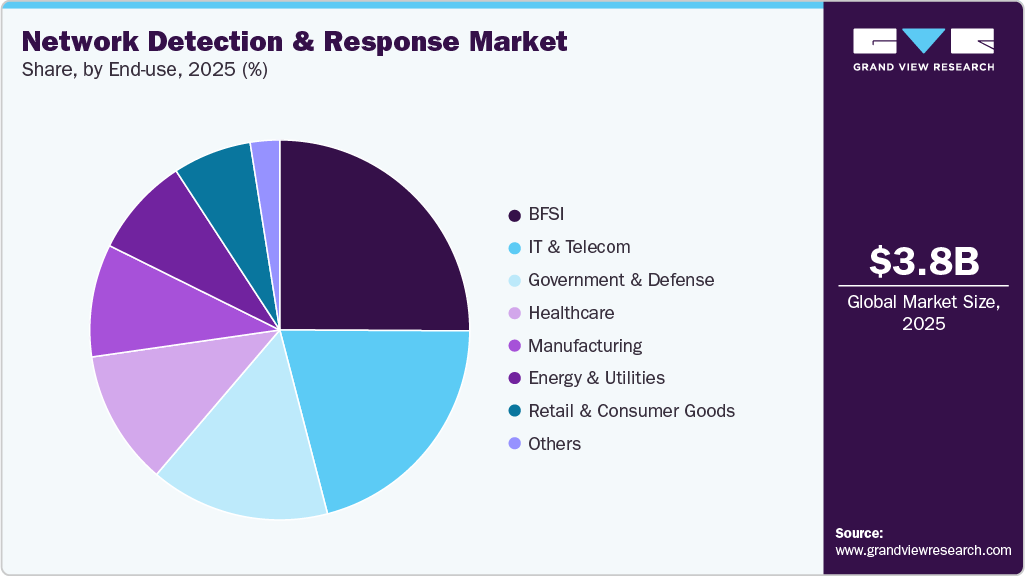
The healthcare segment is expected to grow at the fastest CAGR during the forecast period. This momentum stems from the sector's heavy reliance on connected medical devices, electronic health records, and cloud-based systems, which expand the attack surface considerably. Rising ransomware incidents targeting hospitals and clinics have heightened awareness of network vulnerabilities that can disrupt patient care and compromise sensitive data. Strict regulations such as HIPAA demand continuous monitoring and swift threat response, pushing organizations toward advanced NDR tools for better visibility into east-west traffic and anomaly detection. As healthcare digitization accelerates, providers increasingly view these solutions as essential to safeguard operations and maintain trust. Unlike more mature sectors such as banking, healthcare faces unique challenges from IoT integration and legacy equipment, fueling faster adoption rates.
Regional Insights
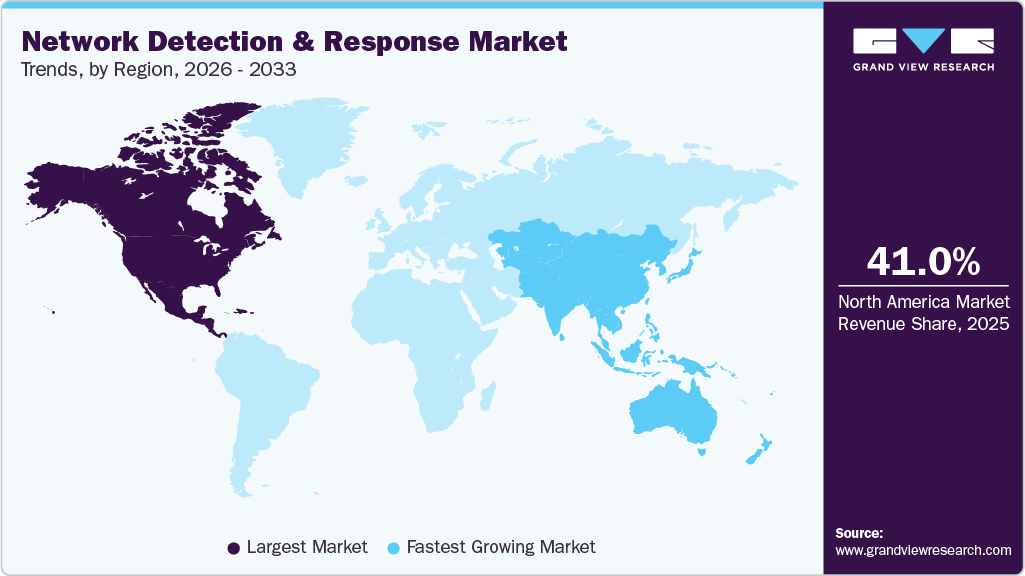
The North America network detection and response (NDR) industry held the largest revenue share of over 41.0% in 2025. The region hosts a large concentration of enterprise headquarters, especially in technology, finance, and healthcare, all of which face intense cyber threats and maintain substantial security budgets. Early and widespread adoption of advanced threat detection tools has created strong market maturity and valuable reference customers. Regulatory requirements such as SEC disclosure rules and data privacy obligations further encourage investment in sophisticated NDR solutions. For instance, in March 2025, Verizon and Accenture formed a strategic partnership to deliver AI-driven Network Detection and Response (NDR) and managed security services across North America. The collaboration integrates AI-based detection, analytics, and response with Verizon’s network solutions to improve threat visibility, enable faster responses, and enhance cyber resilience for enterprises of all sizes. This partnership is expected to accelerate the adoption of AI-powered NDR solutions in North America. It will strengthen competition and drive innovation across the regional NDR market.
U.S. Network Detection And Response Market Trends
The U.S. network detection and response (NDR) industry is expected to grow significantly from 2026 to 2033. Businesses face a steady rise in sophisticated cyber threats that slip past conventional defenses, prompting greater reliance on tools that provide real-time network visibility and rapid threat containment. Regulatory pressures, along with the ongoing shift toward cloud and hybrid environments, continue to compel organizations to strengthen their internal monitoring capabilities. Leading vendors are sharpening their focus on AI-enhanced analytics and automated response features to shorten detection times and limit potential damage. Adoption remains particularly robust among large enterprises in the finance, healthcare, and government sectors, where the cost of breaches is especially high. Meanwhile, even mid-sized firms are beginning to view NDR as a practical necessity rather than an optional layer.
Asia Pacific Network Detection And Response Market Trends
The Asia Pacific NDR market is expected to grow at the fastest CAGR during the forecast period. Rapid digital transformation across industries, widespread adoption of cloud services, and the swift expansion of 5G infrastructure are driving strong demand for advanced threat detection tools. At the same time, rising volumes of cyberattacks targeting enterprises, governments, and critical infrastructure have made robust network visibility and rapid response capabilities essential. Many organizations in the region are moving away from traditional perimeter-based security toward more proactive, behavior-based approaches, which directly favor NDR solutions. Supportive government regulations on data protection and cybersecurity in countries such as India, Japan, South Korea, and Australia further encourage investment in these technologies. The presence of both global vendors and strong local players creates a competitive yet innovative environment that accelerates market growth.
China's network detection and response (NDR) market held a significant revenue share in 2025, driven by strict national cybersecurity regulations and the rapid expansion of digital infrastructure across industries. Organizations in the country have prioritized advanced threat visibility tools. Local vendors, alongside select international players, have gained solid traction by addressing unique requirements such as data sovereignty and integration with existing systems. Rising incidents targeting critical sectors such as finance, manufacturing, and government have further encouraged investment in proactive monitoring solutions. This focus has helped China stand out as a key contributor to the overall NDR space, even as global adoption continues to accelerate.
The network detection and response market in Japan held a significant share in 2025. Enterprises across manufacturing, finance, and critical infrastructure sectors increasingly recognize the limitations of traditional perimeter-based security, driving steady demand for more advanced, behavior-focused detection capabilities. Local organizations showed particular interest in solutions that could handle encrypted traffic and lateral movement without disrupting daily operations. Several prominent Japanese conglomerates publicly expanded their security budgets to include NDR platforms, reflecting greater board-level awareness of persistent threats. Regulatory pressure from both domestic guidelines and international supply-chain requirements further encouraged adoption. Channel partners and system integrators reported healthy project pipelines, especially among mid-to-large enterprises seeking to strengthen visibility inside hybrid cloud environments.
The India network detection and response market is expanding rapidly. Rapid expansion of cloud adoption, widespread digitization across sectors, and stricter compliance requirements from bodies such as CERT-In are pushing enterprises to move beyond traditional security tools toward more proactive, network-focused solutions. Financial institutions, government entities, and growing IT/OT environments particularly feel the pressure to gain deeper visibility into east-west traffic and encrypted flows where many attacks now hide. Local and global vendors alike are responding by tailoring offerings that blend AI-driven analytics with practical deployment options suited to hybrid setups common in the Indian context.
Europe Network Detection And Response Market Trends
The Europe network detection and response (NDR) industry is growing at a significant CAGR from 2026 to 2033. Heightened cyber threats, together with increasingly sophisticated attacks targeting critical infrastructure and enterprise networks, have pushed organisations to prioritise real-time visibility and rapid threat containment. Stringent regulatory requirements, including GDPR and the NIS2 Directive, compel businesses across finance, energy, healthcare, and government sectors to invest more heavily in advanced monitoring tools. Many companies are also shifting toward hybrid and cloud-based environments, where traditional perimeter defences fall short against lateral movement by adversaries. Vendors now focus on behavioural analytics, machine learning-driven anomaly detection, and seamless integration with broader security operations. This combination of external pressures and internal capability needs has created sustained demand for effective NDR platforms.
The network detection and response market in the UK is expected to grow rapidly in the coming years. Rising ransomware incidents, sophisticated supply-chain attacks, and increasing regulatory pressure have pushed companies to move beyond traditional perimeter defences. NDR solutions are now viewed as a practical and essential layer for identifying unusual behaviour that endpoint tools often miss. Demand is particularly noticeable among mid-to-large enterprises in finance, critical infrastructure, and professional services, where dwell time must be kept to a minimum. Vendors offering strong behavioural analytics, streamlined deployment, and clear incident prioritisation are finding it easier to gain traction.
The Germany network detection and response market held a significant revenue share in 2025. Growing awareness of sophisticated cyber threats among enterprises and critical infrastructure operators has driven steady demand for advanced network visibility solutions. Organizations are increasingly prioritizing real-time threat detection over traditional perimeter-based defences. Regulatory pressure from both national and EU-level directives continues to push adoption forward. Several established vendors and innovative local players are expanding their footprint through tailored offerings. Budgets for network security tools are rising, particularly in manufacturing, finance, and energy sectors. The shift toward hybrid and cloud environments has further highlighted the need for comprehensive traffic analysis capabilities. Market participants expect sustained double-digit growth in the near term.
Key Network Detection And Response Company Insights
Some of the key companies operating in the market include Arista Networks; Cisco Systems; Corelight; CrowdStrike; Darktrace Holdings Limited; ExtraHop Networks, Inc.; and Fortinet, Inc.
-
In November 2025, ExtraHop expanded its strategic partnership with Ignition Technology to strengthen its Network Detection and Response (NDR) presence in the Nordics and Benelux. The AI-driven NDR platform delivers advanced AI-based detection, real-time visibility, and rapid response to sophisticated network threats across large enterprise environments.
-
In March 2025, LinkShadow showcased its intelligent Network Detection and Response (NDR) solution at GISEC 2024, highlighting AI-driven detection, machine learning analytics, and automated response capabilities. The platform enhances real-time visibility, threat detection, and incident response for enterprises operating complex network environments through advanced AI-based security intelligence.
-
In October 2024, NTT DATA expanded its partnership with Palo Alto Networks to deliver AI-driven Network Detection and Response (NDR) through its managed XDR service. Leveraging AI and machine learning, the solution enhances network, cloud, and edge visibility, enabling faster detection, automated response, and improved cyber resilience for global enterprises.
Key Network Detection And Response Companies:
The following key companies have been profiled for this study on the network detection and response market.
- Arista Networks
- Cisco Systems
- Corelight
- CrowdStrike
- Darktrace Holdings Limited
- ExtraHop Networks, Inc.
- Fortinet, Inc.
- Gatewatcher
- Nokia
- Palo Alto Networks
- Progress Solution Corporation
- SANGFOR TECHNOLOGIES
- Stellar Cyber
- Trend Micro
- Vectra AI, Inc.
Network Detection And Response Market Report Scope
Report Attribute
Details
Market size value in 2026
USD 4.12 billion
Revenue forecast in 2033
USD 8.08 billion
Growth rate
CAGR of 10.1% from 2026 to 2033
Actual data
2021 - 2025
Forecast period
2026 - 2033
Quantitative units
Revenue in USD billion and CAGR from 2026 to 2033
Report coverage
Revenue forecast, company share, competitive landscape, growth factors, and trends
Segments covered
Component, network environment, deployment, enterprise size, end-use, region
Regional scope
North America; Europe; Asia Pacific; Latin America; MEA
Country scope
U.S.; Canada; Mexico; UK; Germany; France; China; India; Japan; Australia; South Korea; Brazil; UAE; Saudi Arabia; South Africa
Key companies profiled
Arista Networks; Cisco Systems; Corelight; CrowdStrike; Darktrace Holdings Limited; ExtraHop Networks, Inc.; Fortinet, Inc.; Gatewatcher; Nokia; Palo Alto Networks; Progress Solution Corporation; SANGFOR TECHNOLOGIES; Stellar Cyber; Trend Micro; Vectra AI, Inc.
Customization scope
Free report customization (equivalent to 8 analysts working days) with purchase. Addition or alteration to country, regional & segment scope.
Pricing and purchase options
Avail customized purchase options to meet your exact research needs. Explore purchase options
Global Network Detection And Response Market Report Segmentation
This report forecasts revenue growth at the global, regional, and country levels and provides an analysis of the latest industry trends in each of the sub-segments from 2021 to 2033. For this study, Grand View Research has segmented the network detection and response (NDR) market report based on component, network environment, deployment, enterprise size, end-use, and region:
-
Component Outlook (Revenue, USD Billion, 2021 - 2033)
-
Solution
-
Services
-
Managed Services
-
Professional Services
-
-
-
Network Environment Outlook (Revenue, USD Billion, 2021 - 2033)
-
Enterprise IT Networks
-
Data Center Networks
-
Cloud Networks
-
Industrial/ OT Networks
-
-
Deployment Outlook (Revenue, USD Billion, 2021 - 2033)
-
On-premises
-
Cloud-based
-
Hybrid
-
-
Enterprise Size Outlook (Revenue, USD Billion, 2021 - 2033)
-
Large Enterprise
-
SME
-
-
End-use Outlook (Revenue, USD Billion, 2021 - 2033)
-
BFSI
-
Healthcare
-
IT & Telecom
-
Government & Defense
-
Retail & Consumer Goods
-
Manufacturing
-
Energy & Utilities
-
Others
-
-
Regional Outlook (Revenue, USD Billion, 2021 - 2033)
-
North America
-
U.S.
-
Canada
-
Mexico
-
-
Europe
-
Germany
-
UK
-
France
-
-
Asia Pacific
-
China
-
India
-
Japan
-
South Korea
-
Australia
-
-
Latin America
-
Brazil
-
-
Middle East & Africa
-
UAE
-
Saudi Arabia
-
South Africa
-
-
Frequently Asked Questions About This Report
b. The solution segment dominated the network detection and response (NDR) market in 2025 driven by rising cyber threats, increasing adoption of advanced threat detection technologies, and growing demand for real-time network visibility and automated incident response across enterprises.
b. The solution segment dominated the network detection and response (NDR) market in 2025 driven by rising cyber threats, increasing adoption of advanced threat detection technologies, and growing demand for real-time network visibility and automated incident response across enterprises.
b. Factors such as rising sophistication of cyber threats, growth in ransomware and targeted attacks, expansion of remote & hybrid work and increasing adoption of ai & machine learning play a key role in accelerating the network detection and response (NDR) market.
b. The global network detection and response market size was estimated at USD 3.77 billion in 2025 and is expected to reach USD 4.12 billion in 2026.
b. The global network detection and response market is expected to grow at a compound annual growth rate of 10.1% from 2026 to 2033 to reach USD 8.08 billion by 2033.


Share this report with your colleague or friend.
Need a Tailored Report?
Customize this report to your needs — add regions, segments, or data points, with 20% free customization.


ISO 9001:2015 & 27001:2022 Certified
We are GDPR and CCPA compliant! Your transaction & personal information is safe and secure. For more details, please read our privacy policy.
Trusted market insights - try a free sample
See how our reports are structured and why industry leaders rely on Grand View Research. Get a free sample or ask us to tailor this report to your needs.