- Home
- »
- Nanoparticles
- »
-
Nanosilica Market Size & Share, Industry Report, 2033GVR Report cover
![Nanosilica Market Size, Share & Trends Report]()
Nanosilica Market (2026 - 2033) Size, Share & Trends Analysis Report By Product (P Type, S Type, Type III), By End Use (Rubber, Food & Healthcare, Coatings, Plastics, Abrasives & Refractories), By Region, And Segment Forecasts
- Report ID: GVR-1-68038-808-4
- Number of Report Pages: 100
- Format: PDF
- Historical Range: 2021 - 2024
- Forecast Period: 2026 - 2033
- Industry: Advanced Materials
- Report Summary
- Table of Contents
- Segmentation
- Methodology
- Download FREE Sample
-
 Download Sample Report
Nanosilica Market Summary
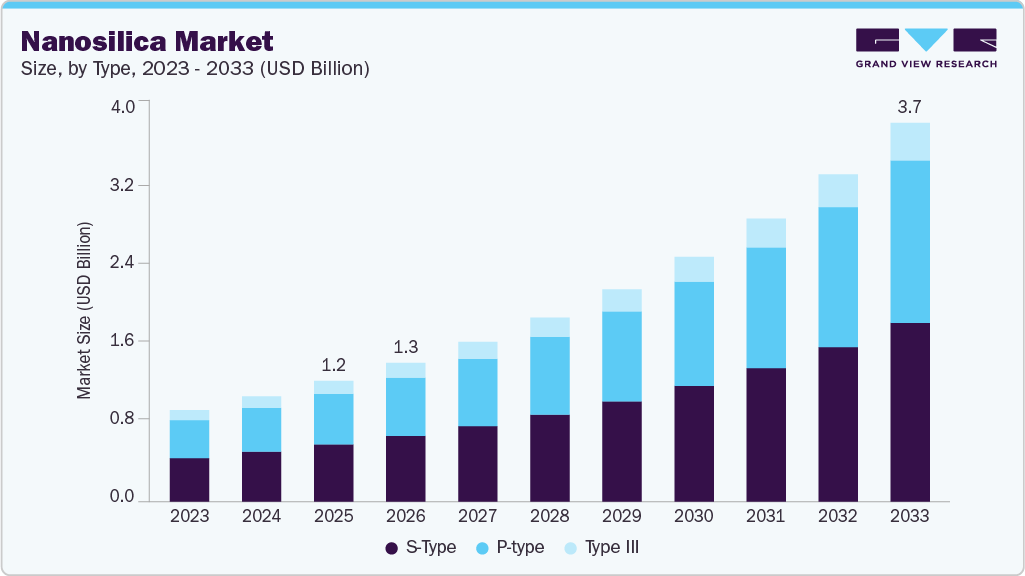
The global nanosilica market size was estimated at USD 1.2 billion in 2025 and is expected to reach USD 3.7 billion by 2033, growing at a CAGR of 15.4% from 2026 to 2033. The growth is attributed to the rise in the demand for nanocoating across aviation, automobile, and medical industries.
Key Market Trends & Insights
- The Asia Pacific nanosilica industry registered a largest market share of 33.8% in 2025.
- The nanosilica industry in the U.S. was propelled by the growing demand for nanocoating across aviation, automobile, and medical industries.
- By product, the P-type variant products segment have registered a dominant market share of 41.8% in 2025.
- By end use, the rubber segment has secured a dominant market share of 33.9% in 2025.
Market Size & Forecast
- 2025 Market Size: USD 1.2 Billion
- 2033 Projected Market Size: USD 3.7 Billion
- CAGR (2026-2033): 15.4%
- Asia Pacific: Largest market in 2025
Manufacturers have increasingly used nanosilica to enhance moisture and bacteria resistance, UV damage, and abrasion in nanocoatings. Aerospace equipment benefits from metal nanocoatings that shield it from temperature fluctuations, minor scratches, and water damage with their ability to protect against corrosion and oxidation. The robust expansion of electronics and healthcare industries which increasingly applied nanosilica is a key market driver. The material’s tiny particle size and large surface area are valued for enhancing the performance of electronics in terms of conductivity, durability, and thermal stability. In healthcare settings, nanosilica is applied in drug delivery systems, wound healing, and diagnostic tools.Furthermore, the market was fueled by material science advancements. Companies including PPG Industries and NanoPore Incorporated have increasingly recognized the potential of nanosilica in influencing the future of materials science. This has led market players to invest in R&D efforts related to nanotechnology and material science and introduce innovative manufacturing processes.
In addition, concerns about environmental impact have resulted in a shift toward eco-friendly formulations. Nanosilica offers an alternative to green technology owing to its unique properties such as tiny particle size and large surface area. The market has witnessed businesses increasingly segmenting the advanced material’s properties to assess its potential across various industries and enhance products and applications.
Market Concentration & Characteristics
The nanosilica industry is moderately consolidated, with players such as Evonik Industries, Cabot Corporation, and Wacker Chemie AG. These companies maintain strong control over technology, product quality, and supply chains, while smaller regional manufacturers cater to cost-sensitive applications. Strategic partnerships and capacity expansions are common as producers aim to strengthen their foothold in emerging markets.
Environmental and occupational safety regulations significantly influence nanosilica production and application. Strict policies by agencies such as the EPA and ECHA require compliance with nanomaterial handling, labeling, and exposure standards. These regulations encourage manufacturers to invest in safer synthesis routes and eco-friendly product formulations. While compliance increases production costs, it also drives product standardization and credibility across key end use sectors.
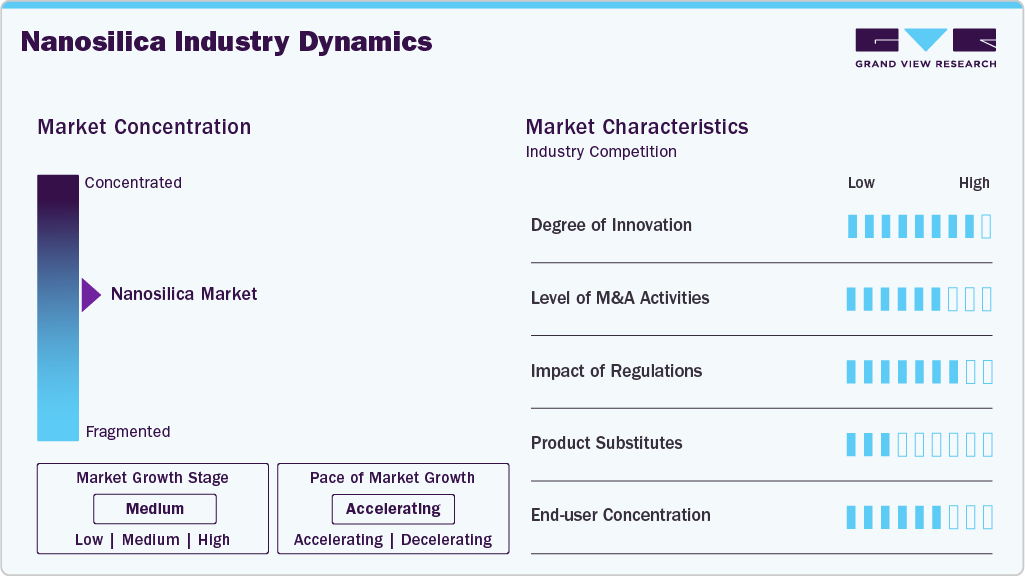
Furthermore, nanosilica can be partially substituted by materials such as carbon black, titanium dioxide, and aluminum oxide in applications such as rubber reinforcement, coatings, and additives. However, its superior surface area, chemical stability, and mechanical strength often provide performance advantages. Substitutes are generally selected in cost-sensitive or less performance-critical uses, keeping nanosilica well-positioned in high-value industrial and construction segments.
Product Insights
The S-type variant products have registered the dominant market share of 47.4% in 2025 owing to their superior dispersion stability, high purity, and excellent surface area characteristics. These properties make them highly suitable for applications in rubber reinforcement, coatings, adhesives, and construction materials. The segment’s dominance is also attributed to its widespread use in high-performance concrete and cement formulations, where nanosilica enhances strength, durability, and resistance to chemical corrosion. Additionally, industries such as electronics and paints & coatings prefer S-type nanosilica for its ability to improve mechanical properties, surface hardness, and thermal stability. Continuous growth in infrastructure development and advanced material manufacturing further supports the strong demand for S-type variants.
P-type variants are expected to emerge as the fastest-growing segment during the forecast period, due to their enhanced porosity and improved reactivity in specialized applications. These variants are increasingly being adopted in catalysts, battery materials, and advanced polymer composites, where higher pore volume and controlled particle structure are advantageous. The expanding use of nanosilica in energy storage technologies and high-performance coatings is further accelerating the demand for P-type products. In addition, increasing R&D activities focused on nanomaterial innovation and the development of functional materials in electronics, automotive, and environmental applications are supporting segment growth. As industries move toward advanced material engineering and lightweight composites, P-type nanosilica is expected to gain significant traction in the coming years.
End Use Insights
The rubber industry has secured the dominant market share in 2025, owing to nanosilica’s role in enhancing material properties. Its small particle size and large surface area improved rubber reinforcement, durability, and resistance to wear and tear. The automotive sector significantly contributed to the demand for rubber products. Nanosilica-enhanced rubber compounds were widely used in tires, seals, and gaskets to improve tire performance, reduce rolling resistance, and enhance fuel efficiency, all key benefits. Furthermore, the construction industry has relied on rubber materials for nanosilica-modified rubber sealants, adhesives, and coatings. These provide better weather resistance, flexibility, and durability. These properties were essential for construction joints, roofing, and other structural elements.
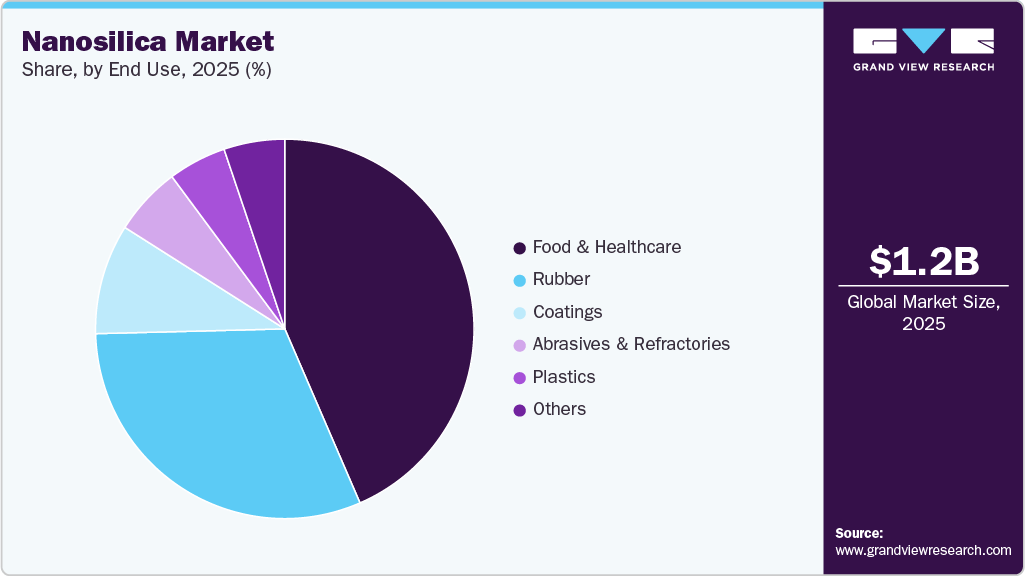
Coatings are anticipated to grow substantially at a CAGR of 16.5% over the forecast period owing to the increasing demand for nanocoating across aviation, automobile, and medical industries. The material’s ability to enhance resistance to moisture, UV damage, and abrasion made it an ideal ingredient in various coating compositions. For instance, coatings used in medical devices, wound healing, and diagnostic tools benefited from nanosilica’s biocompatibility and ability to improve material properties with wear resistance and durability.
Regional Trends
The nanosilica industry in Asia Pacific region accounted for a largest market share of 33.8% owing to its rising demand in countries including China, Japan, and India. The increasing number of buildings and construction activity in the region fueled the demand for nanosilica. Construction materials benefited from nanosilica’s properties, such as improved durability, wear resistance, and environmental sustainability. In addition, nanosilica-modified coatings gained prominence in the paint and coatings industry. These coatings provided better weather resistance, flexibility, and durability, contributing to market expansion.
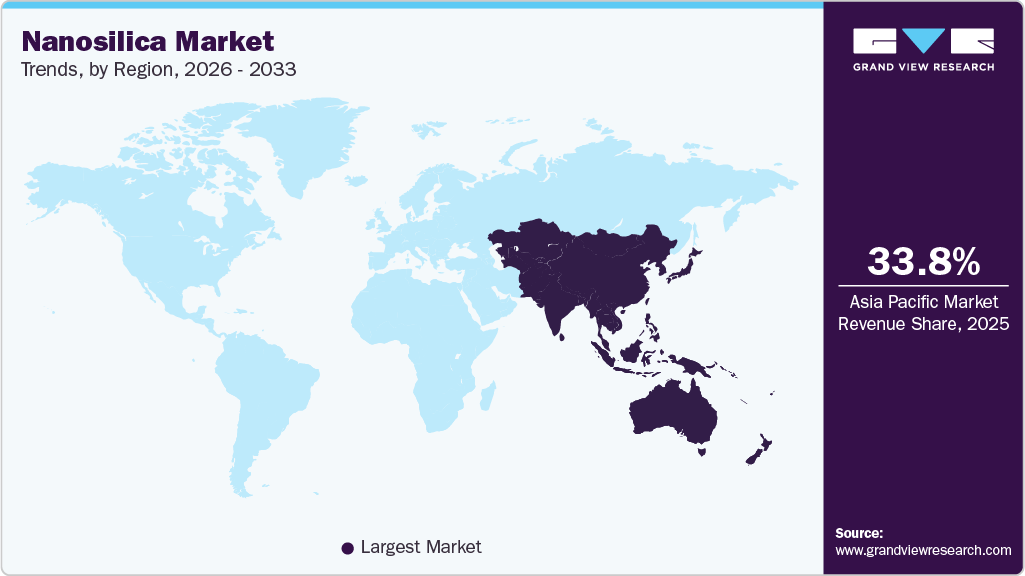
China nanosilica industry dominated the Asia Pacific market owing to its strong industrial base and rapid infrastructure development. The country’s large-scale production of paints, coatings, rubber, and construction materials drives significant domestic consumption. Continuous investments in high-performance concrete and tire reinforcement applications also support market expansion. Furthermore, government support for nanotechnology and material innovation strengthens China’s position as a global manufacturing hub for nanosilica.
North America Nanosilica Market Trends
The North America nanosilica industry registered a market share of 32.8% in 2025 due to the growing adoption of next-generation technologies across various sectors. This trend fueled demand for nanosilica, especially in applications related to rubber and plastic additives, automotive components, and construction materials. Nanosilica-enhanced rubber compounds are applied in tires, seals, gaskets, and other automotive components for durability, improved tire performance, reduced rolling resistance, and enhanced fuel efficiency.
U.S. Nanosilica Market Trends
The nanosilica industry in the U.S. was propelled by the growing demand for nanocoating across aviation, automobile, and medical industries. The market has witnessed several companies heavily investing in research and development efforts to advance nanotechnology and material science to innovate novel applications for nanosilica.
Europe Nanosilica Market Trends
The Europe nanosilica industry held a 24.8% of the revenue share in 2025. The demand was primarily driven by concerns about environmental impact, leading to a shift into eco-friendly formulations. Nanosilica gained considerable traction with its potential for green technology. Furthermore, ongoing research and development focused on innovative manufacturing techniques for nanosilica to improve production efficiency, quality, and cost-effectiveness.
Germany nanosilica industry represents one of the most advanced markets in Europe, supported by its robust automotive, construction, and chemical sectors. The country emphasizes the use of nanosilica in lightweight composites, coatings, and green building materials. Stringent EU regulations promoting energy efficiency and sustainability further encourage the adoption of advanced nanomaterials. Continuous R&D initiatives from local chemical manufacturers contribute to steady growth in the German nanosilica industry.
Central & South America Nanosilica Market Trends
The nanosilica industry in Central & South America is gradually expanding, primarily driven by Brazil and Mexico. Rising infrastructure investments and growing demand for durable building materials support nanosilica adoption in cement and coatings applications. However, limited domestic production and dependence on imports restrain large-scale commercialization. Increasing awareness of performance additives is expected to stimulate market growth over the coming years.
Middle East & Africa Nanosilica Market Trends
The nanosilica industry in the Middle East & Africa is gaining traction due to increasing construction and infrastructure projects, particularly in the Gulf Cooperation Council (GCC) countries. The material’s use in high-strength concrete and coatings aligns with regional initiatives for sustainable and durable building practices. Industrial diversification beyond oil and gas also creates opportunities in polymer and coatings manufacturing. Nevertheless, market penetration remains moderate due to limited local production capabilities.
Key Nanosilica Company Insights
Key players such as AkzoNobel N.V., Cabot Corporation, Evonik Industries, and others are capitalizing on their robust resources and market influence to drive technological advancements and expand their product offerings
-
AkzoNobel N.V. is a Dutch multinational company that specializes in creating paints and performance coatings for both industry and consumers worldwide. The company’s portfolio of brands includes Dulux, International, Sikkens, and Interpon.
-
Cabot Corporation is a global specialty chemicals & performance materials company that delivers innovative solutions to customers across various industries, including transportation, infrastructure, environment, and consumer goods. The company offers reinforcing carbons, battery materials, engineered elastomer composites, specialty carbons, fumed metal oxides, masterbatches, conductive compounds, inkjet colorants, and aerogel.
Key Nanosilica Companies:
The following key companies have been profiled for this study on the nanosilica market.
- Evonik Industries
- AkzoNobel N.V.
- E. I. du Pont de Nemours and Company
- Cabot Corporation
- NanoComposix
- Nanostructured & Amorphous Materials, Inc. (NanoAmor)
- Fuso Chemical Co. Ltd.
- Wacker Chemie AG
- Dow Corning Corporation
- Bee Chems
Recent Development
-
In November 2023, AzkoNobel launched the initial two products from its new Accelstyle range for its packing coating business. These products are specifically designed for the outer surface of traditional two-piece aluminum beverage cans and are formulated without bisphenols, styrene, and PFAS (per- and polyfluoroalkyl substances)
Nanosilica Market Report Scope
Report Attribute
Details
Market size value in 2026
USD 1.3 billion
Revenue forecast in 2033
USD 3.7 billion
Growth rate
CAGR of 15.4% from 2026 to 2033
Base year for estimation
2025
Historical data
2021 - 2024
Forecast period
2026 - 2033
Quantitative units
Volume in kilotons, revenue in USD million/billion, and CAGR from 2026 to 2033
Report coverage
Revenue forecast, company ranking, competitive landscape, growth factors, and trends
Segments covered
Product, end use, region
Regional scope
North America; Europe; Asia Pacific; Latin America; MEA
Country scope
U.S.; Canada; Mexico; Germany; UK; France; Italy; Spain; China; India; Vietnam; Thailand; South Korea; Brazil; Argentina; South Africa; Saudi Arabia
Key companies profiled
Evonik Industries; AkzoNobel N.V.; E. I. du Pont de Nemours and Company; Cabot Corporation; NanoPore Incorporated; Nanostructured & Amorphous Materials, Inc. (NanoAmor); Fuso Chemical Co. Ltd.; Wacker Chemie AG; Dow Corning Corporation; Bee Chems
Customization scope
Free report customization (equivalent up to 8 analysts working days) with purchase. Addition or alteration to country, regional & segment scope.
Pricing and purchase options
Avail customized purchase options to meet your exact research needs. Explore purchase options
Global Nanosilica Market Report Segmentation
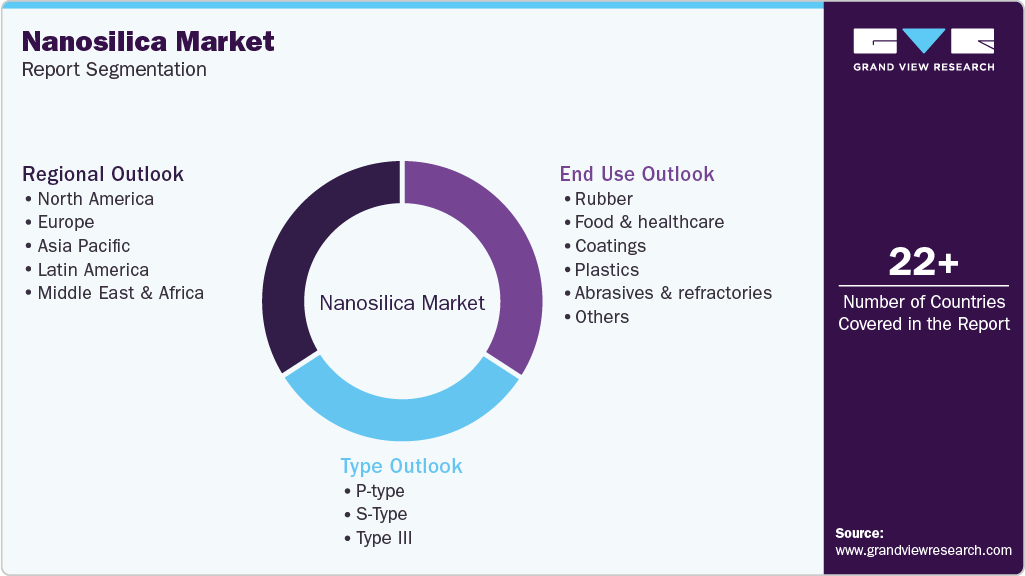
This report forecasts revenue growth at global, regional, and country levels and provides an analysis of the latest industry trends in each of the sub-segments from 2021 to 2033. For this study, Grand View Research has segmented the global nanosilica market report based on product, end use, and region.
-
Product Outlook (Volume, Kilotons; Revenue, USD Million, 2021 - 2033)
-
P-type
-
S-Type
-
Type III
-
-
End Use Outlook (Volume, Kilotons; Revenue, USD Million, 2021 - 2033)
-
Rubber
-
Food & healthcare
-
Coatings
-
Plastics
-
Abrasives & refractories
-
Others
-
-
Regional Outlook (Volume, Kilotons; Revenue, USD Million, 2021 - 2033)
-
North America
-
U.S.
-
Canada
-
Mexico
-
-
Europe
-
Germany
-
UK
-
France
-
Italy
-
Spain
-
-
Asia Pacific
-
China
-
India
-
Vietnam
-
Thailand
-
South Korea
-
-
Latin America
-
Brazil
-
Argentina
-
-
Middle East and Africa (MEA)
-
Saudi Arabia
-
-
Frequently Asked Questions About This Report
b. Key factors that are driving the market growth include growing use of nanosilica as an additive in various application segments such as concrete, rubber and others.
b. The global nanosilica market size was estimated at USD 1.2 billion in 2025 and is expected to reach USD 1.3 billion in 2026.
b. Rubber dominated the nano silica market with a share of 33.9% in 2025. This is attributable to use as an additive in various types of rubbers which includes natural rubber, ethylene propylene diene monomer (EPDM), styrene-butadiene rubber (SBR), ethylene acrylic rubber (AEM), nitrile rubber (NBR) and silicone rubber.
b. Some key players operating in the nano silica market include TAkzoNobel N.V., Evonik Industries, E. I. du Pont de Nemours and Company, NanoPore Incorporated, Fuso Chemical Co. Ltd., NanoPore Incorporated, Wacker Chemie AG, Dow Corning Corporation, Bee Chems, and Cabot Corporation.
b. The global nanosilica market is expected to grow at a compound annual growth rate of 15.4% from 2026 to 2033 to reach USD 3.7 billion by 2033.


Share this report with your colleague or friend.
Need a Tailored Report?
Customize this report to your needs — add regions, segments, or data points, with 20% free customization.


ISO 9001:2015 & 27001:2022 Certified
We are GDPR and CCPA compliant! Your transaction & personal information is safe and secure. For more details, please read our privacy policy.
Trusted market insights - try a free sample
See how our reports are structured and why industry leaders rely on Grand View Research. Get a free sample or ask us to tailor this report to your needs.