MHETase Market Summary
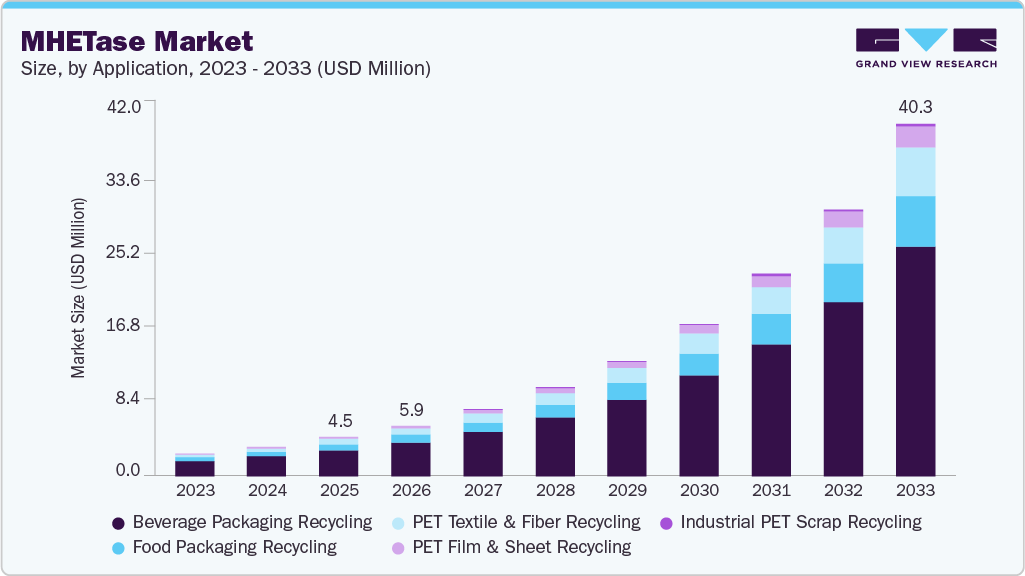
The global MHETase market size was estimated at USD 4.5 million in 2025 and is projected to reach USD 40.3 million by 2033, growing at a CAGR of 31.7% from 2026 to 2033. The market is growing because enzymatic PET recycling can recover high-quality PET monomers without damaging the material, unlike traditional mechanical recycling.
Key Market Trends & Insights
- Europe held the largest market share of 44.4% in 2025.
- Asia Pacific is projected to grow at the fastest CAGR of 33.3% from 2026 to 2033.
- By application, the beverage packaging recycling segment dominated the market in 2025, accounting for 66.7% of total revenue.
- By application, the PET textile & fiber recycling segment is projected to record the fastest CAGR of 33.1% from 2026 to 2033.
Market Size & Forecast
- 2025 Market Size: USD 4.5 Million
- 2033 Projected Market Size: USD 40.3 Million
- CAGR (2026-2033): 31.7%
- Europe: Largest Market in 2025
Companies and regulators increasingly require recycled PET that is safe for food and beverage packaging, and MHETase plays a crucial role in efficiently and reliably breaking down PET intermediates into reusable components. MHETase plays a specific functional role in depolymerizing PET by converting MHET intermediates into terephthalic acid and ethylene glycol that can be reused without downcycling. This functional specificity makes MHETase commercially relevant only where enzymatic recycling systems are deployed. As pilot and early commercial plants move toward continuous operation, enzyme consumption shifts from laboratory scale to recurring industrial procurement, establishing a defined market rather than experimental demand.
The MHETase industry growth is concentrated in regions with strict recycled content mandates, brand-level sustainability commitments, and tolerance for higher input costs during early adoption. Europe and North America lead because closed-loop bottle-to-bottle and textile-to-fiber recycling require monomer purity that enzymatic systems can deliver. MHETase demand rises alongside integrated enzyme systems rather than as a standalone commodity, tying market expansion directly to plant commissioning schedules and licensing of enzymatic recycling processes.
Future expansion depends on cost reduction through strain optimization, fermentation scale-up, and enzyme reuse efficiency rather than PET waste availability. As enzymatic recycling capacity increases, enzyme pricing gradually declines while total volume rises, shifting revenue growth from premium pricing toward higher throughput. Over time, MHETase adoption expands from packaging-focused use into textiles and films, strengthening its role as an enabling input for circular PET value chains rather than a niche biochemical product.
Market Concentration & Characteristics
The MHETase market is highly concentrated because commercial demand exists only where enzymatic PET recycling technologies are deployed at pilot or early industrial scale. A small number of technology developers and enzyme specialists control intellectual property, strain engineering, and process know-how, which limits broad participation. Most activity remains closely tied to proprietary recycling systems rather than open commodity enzyme sales, keeping supplier diversity low and customer relationships highly technical.
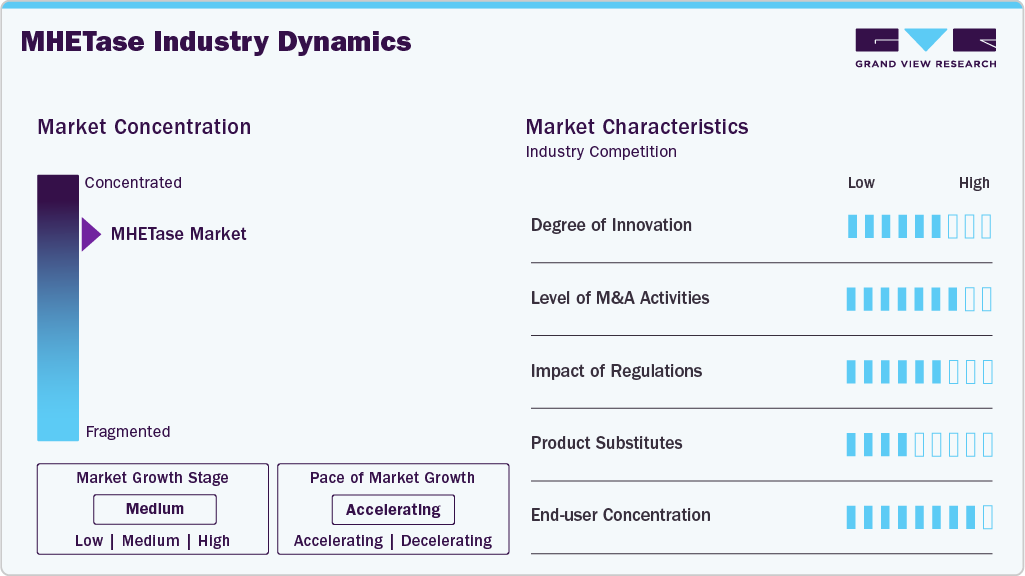
Market characteristics reflect an early-stage specialty-input market rather than a mature enzyme segment. Purchasing decisions are driven by performance reliability, integration with existing depolymerization processes, and long-term supply consistency instead of price competition. Production is typically customized to specific process conditions, and demand growth follows plant commissioning timelines. As capacity expands, the market gradually shifts toward higher recurring volumes, but it remains innovation-led, collaboration-driven, and closely linked to regulatory and brand-driven circularity commitments.
Application Insights
The beverage packaging recycling segment dominated the MHETase market in 2025, accounting for 66.7% of total revenue, driven by the high volume of PET bottles collected and the stringent regulatory requirements for recycled content in food and beverage containers. Brands increasingly demand food‑grade recycled PET, which can only be reliably produced through enzymatic recycling using MHETase. The combination of high feedstock availability, predictable supply chains, and the ability of enzymatic processes to produce high‑purity monomers makes beverage packaging the largest revenue contributor within the market.
The PET textile & fiber recycling segment is projected to record the fastest CAGR of 33.1% from 2026 to 2033, due to the rising demand for sustainable polyester garments and home textiles. Mechanical recycling cannot maintain fiber quality, whereas enzymatic recycling using MHETase enables depolymerization and regeneration of high-quality polyester fibers. With fashion brands and manufacturers committing to circular materials and the increasing availability of post-consumer textile waste, the segment is poised for accelerated growth, capturing new revenue opportunities within the enzymatic PET recycling ecosystem.
Regional Insights
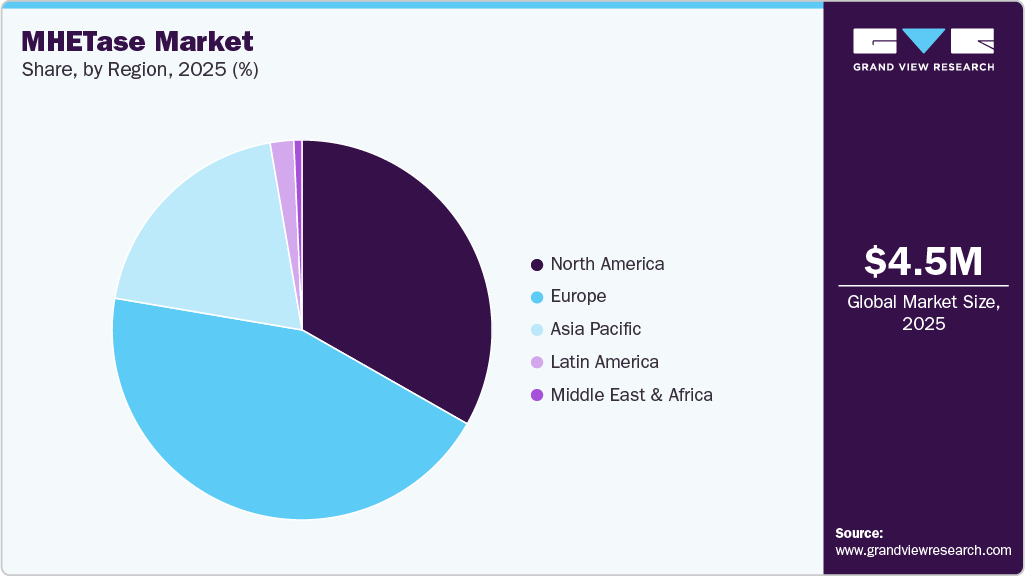
The Europe MHETase industry held the largest revenue share of 44.4% of revenue, due to well-established recycling infrastructure, strict regulatory mandates on recycled content, and strong consumer and corporate sustainability commitments. Governments and brands actively support enzymatic PET recycling to ensure high-quality, food-grade recycled PET. The combination of advanced collection systems, early adoption of industrial enzymatic plants, and regulatory pressure creates consistent demand for MHETase, making Europe the primary revenue-generating region in the global market.
Germany MHETase market holds a leading position in Europe’s market because of its advanced waste management systems and strict recycled content mandates for packaging. The country’s strong regulatory framework for PET recycling encourages industrial adoption of enzymatic depolymerization. German manufacturers and recycling companies prioritize high-quality monomer recovery, making MHETase critical for producing food-grade rPET and meeting the nation’s sustainability objectives.
Asia Pacific MHETase Market Trends
Asia Pacific is projected to grow at the fastest CAGR of 33.3% from 2026 to 2033. Asia Pacific is experiencing rapid growth as governments and manufacturers invest in advanced recycling technologies to manage increasing PET waste volumes. Countries such as China, Japan, and South Korea are launching pilot and commercial enzymatic recycling plants, driving enzyme consumption. Rising awareness of sustainability, growing post-consumer PET streams, and the willingness of brands to adopt circular solutions position the region for accelerated the demand and the fastest market expansion globally.
China MHETase market is driving Asia Pacific growth due to its large PET consumption and increasing government support for advanced recycling technologies. Pilot and commercial enzymatic recycling projects are emerging in major industrial hubs. Environmental policies targeting plastic waste reduction, along with growing brand demand for circular packaging solutions, stimulate enzyme adoption. China’s scale of PET waste makes it a high-potential market for MHETase deployment.
North America MHETase Market Trends
North America accounted for a significant portion of the global MHETase industry due to early adoption of enzymatic PET recycling technologies and strong corporate commitments to recycled content. The presence of pilot and commercial recycling plants, particularly in the U.S., drives recurring demand for enzymes. Investments in circular supply chains, combined with regulatory guidance encouraging sustainable packaging, ensure that the region maintains steady demand for high-purity PET recycling solutions using MHETase.
U.S. MHETase Market Trends
U.S. MHETase industry dominates the demand in North America because it hosts most of the continent’s enzymatic recycling infrastructure. Beverage and food brands actively seek food-grade recycled PET to meet sustainability goals. High research and development capabilities allow for enzyme integration at an industrial scale, and collaborations between technology providers and major manufacturers ensure consistent deployment of MHETase in pilot and commercial recycling plants.
Latin America MHETase Market Trends
Latin America’s MHETase industry is emerging slowly due to limited enzymatic recycling infrastructure and reliance on mechanical recycling. Brazil and Mexico are starting to explore pilot enzymatic plants to meet growing sustainability expectations. Increased awareness among beverage and textile companies about recycled content, along with the gradual development of regulatory guidelines for PET recycling, is expected to drive enzyme adoption in the medium term.
Middle East & Africa MHETase Market Trends
The Middle East and Africa currently represent a small portion of the demand due to minimal enzymatic recycling operations and a predominance of virgin PET production. Pilot projects in the UAE and South Africa are testing enzymatic recycling, and interest from multinational brands in sustainable packaging is creating nascent demand. Market growth is expected to depend on infrastructure development and regulatory encouragement for high-quality PET recycling in the coming years.
Key MHETase Company Insights
Creative Enzymes specializes in producing high-purity, research and industrial-grade enzymes, including MHETase, for advanced polymer depolymerization. The company focuses on customizing enzymes to meet specific process conditions, supporting innovations in circular PET recycling and enabling the production of high-quality monomers for reuse in textiles, packaging, and other PET applications.
Key MHETase Companies:
The following key companies have been profiled for this study on the MHETase market.
- Creative Enzymes
- Carbios
- GenScript
Recent Developments
- In December 2025, CARBIOS and Wankai New Materials signed a strategic partnership to deploy CARBIOS’s PET biorecycling technology in Asia, establishing a joint venture in China to build a 50,000-ton PET waste plant, licensed and majority-owned by Wankai.
MHETase Market Report Scope
|
Report Attribute
|
Details
|
|
Market size value in 2026
|
USD 5.9 million
|
|
Revenue forecast in 2033
|
USD 40.3 million
|
|
Growth rate
|
CAGR of 31.7% from 2026 to 2033
|
|
Base year for estimation
|
2025
|
|
Historical data
|
2018 - 2024
|
|
Forecast period
|
2025 - 2033
|
|
Quantitative units
|
Revenue in USD million, volume in kilotons, and CAGR from 2026 to 2033
|
|
Report coverage
|
Revenue forecast, volume forecast, company ranking, competitive landscape, growth factors, and trends
|
|
Segments covered
|
Application, region
|
|
Regional scope
|
North America; Europe; Asia Pacific; Latin America; Middle East & Africa
|
|
Country scope
|
U.S.; Canada; Mexico; Germany; UK; Italy; Spain; France; China; Japan; South Korea; Brazil; Argentina; Saudi Arabia; South Africa
|
|
Key companies profiled
|
Creative Enzymes; Carbios; GenScript
|
|
Customization scope
|
Free report customization (equivalent to up to 8 analysts’ working days) with purchase. Addition or alteration to country, regional & segment scope.
|
|
Pricing and purchase options
|
Avail customized purchase options to meet your exact research needs. Explore purchase options
|
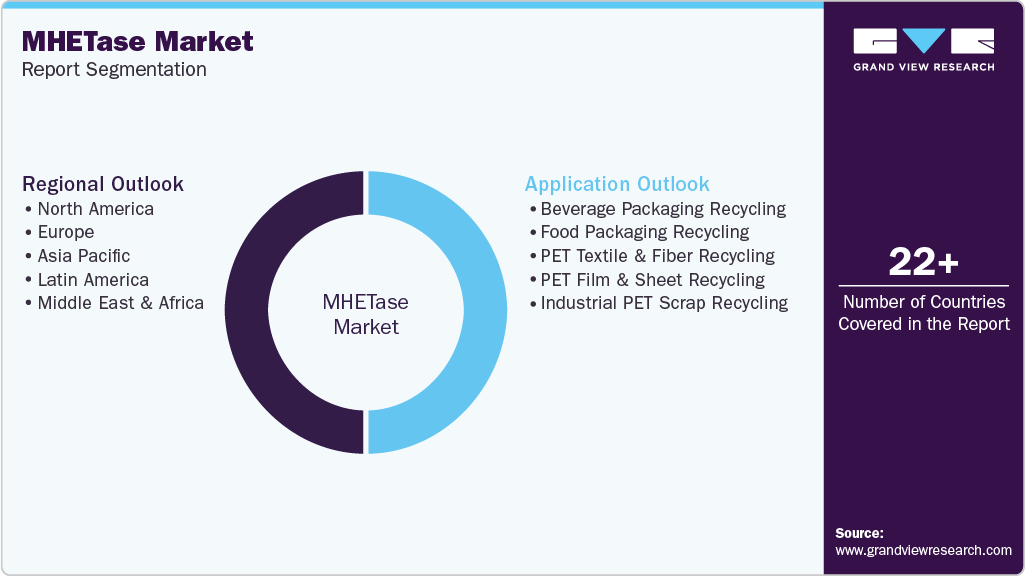
Global MHETase Market Report Segmentation
This report forecasts volume & revenue growth at the global, regional, and country levels and provides an analysis of the latest industry trends in each of the sub-segments from 2018 to 2033. For this study, Grand View Research has segmented the global MHETase market report based on application and region:
-
Application Outlook (Volume, Kilotons; Revenue, USD Million, 2018 - 2033)
-
Beverage Packaging Recycling
-
Food Packaging Recycling
-
PET Textile & Fiber Recycling
-
PET Film & Sheet Recycling
-
Industrial PET Scrap Recycling
-
Regional Outlook (Volume, Kilotons; Revenue, USD Million, 2018 - 2033)
-
North America
-
Europe
-
Germany
-
UK
-
Italy
-
Spain
-
France
-
Asia Pacific
-
Latin America
-
Middle East & Africa
-
Saudi Arabia
-
South Africa
Frequently Asked Questions About This Report
b. The global MHETase market size was estimated at USD 4.5 million in 2025 and is expected to reach USD 5.9 million in 2026.
b. Beverage Packaging Recycling segment dominated the market in 2025, accounting for 66.7% of total revenue, driven by the high volume of PET bottles collected and the stringent regulatory requirements for recycled content in food and beverage containers. Brands increasingly demand food‑grade recycled PET, which can only be reliably produced through enzymatic recycling using MHETase.
b. Some of the key players operating in the MHETase market include Creative Enzymes, Carbios, GenScript and a few others.
b. The MHETase market is emerging because enzymatic PET recycling solves quality loss and contamination limits seen in mechanical recycling while avoiding high energy costs of chemical routes. Demand is forming where regulators and global brands require true circularity for PET, especially for food grade and textile applications.
b. The global MHETase market is expected to grow at a compound annual growth rate of 31.7% from 2026 to 2033, reaching USD 40.3 million by 2033.

 Download Sample Report