- Home
- »
- Beauty & Personal Care
- »
-
Men’s Grooming Products Market Size, Industry Report, 2033GVR Report cover
![Men’s Grooming Products Market Size, Share & Trends Report]()
Men’s Grooming Products Market (2026 - 2033) Size, Share & Trends Analysis Report By Product (Skin Care, Hair Styling, Shave/Beard Care, Accessories), By Distribution Channel (Hypermarkets & Supermarkets, Specialty Stores), By Region, And Segment Forecasts
- Report ID: GVR-2-68038-887-9
- Number of Report Pages: 80
- Format: PDF
- Historical Range: 2021 - 2024
- Forecast Period: 2026 - 2033
- Industry: Consumer Goods
- Report Summary
- Table of Contents
- Segmentation
- Methodology
- Download FREE Sample
-
 Download Sample Report
Men’s Grooming Products Market Summary
The global men’s grooming products market size was estimated at USD 298.94 billion in 2025 and is projected to reach USD 506.73 billion by 2033, growing at a CAGR of 6.7% from 2026 to 2033. The global men’s grooming products market is expanding steadily as personal grooming, skincare, and wellness increasingly become part of everyday consumer lifestyles.
Key Market Trends & Insights
- The Asia Pacific men’s grooming products industry accounted for the largest share of 34.3% in 2025.
- The men’s grooming products industry in China accounted for a revenue share of around 21.3% on the Asia Pacific market in 2025.
- By product, skincare accounted for a market share of 34.1% in 2025.
- By distribution channel, sales through hypermarkets & supermarkets accounted for a market share of 36.9% in 2025.
Market Size & Forecast
- 2025 Market Size: USD 298.94 Billion
- 2033 Projected Market Size: USD 506.73 Billion
- CAGR (2026-2033): 6.7%
Men are allocating a larger share of their spending to products that support skin health, hair care, hygiene, and aesthetic enhancement. Skincare, haircare, shaving products, fragrances, and beard care remain the core categories driving demand across the men's grooming market as male consumers move beyond basic grooming habits toward more structured personal care routines within the broader male beauty industry.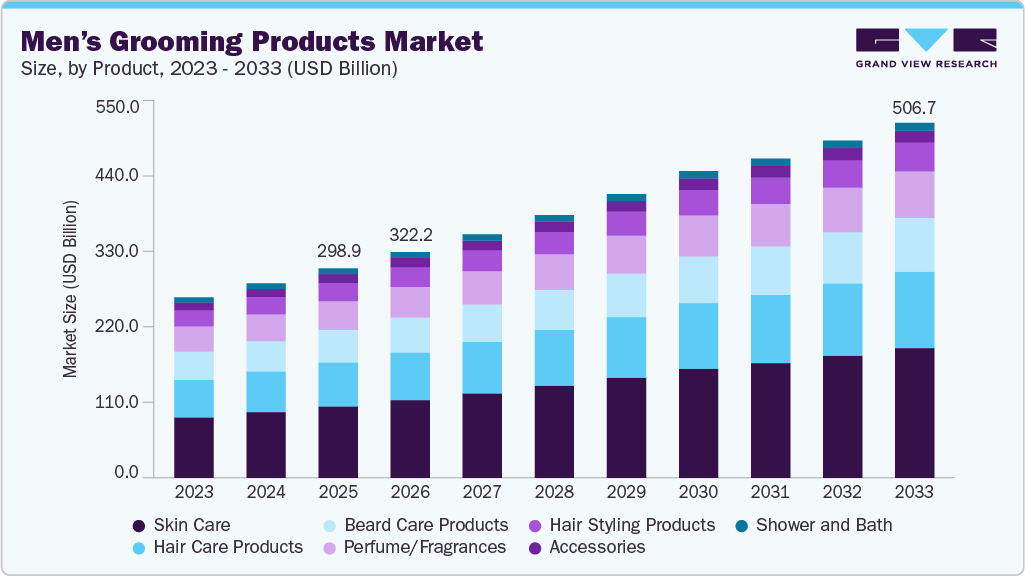
According to an article published by Glossy in November 2025, younger consumers are playing a major role in accelerating this shift, with 42% of Gen Z men reporting that they spend a larger share of their income on grooming products compared with 29% of millennials. This generational shift highlights how grooming is increasingly viewed as part of lifestyle and self-expression rather than a basic hygiene activity. As a result, brands are expanding male-focused product lines and marketing strategies designed to appeal to younger consumers who are more willing to experiment with skincare, fragrance, and grooming routines, further strengthening demand across the global men's grooming market.
Skincare is emerging as one of the most dynamic segments within the men's skincare market, supported by rising awareness of skin health and preventive care routines. Men are increasingly adopting targeted skincare solutions such as cleansers, moisturizers, exfoliators, and sunscreens designed to address specific concerns, including oil control, acne, irritation, and early signs of aging. Ingredient transparency and dermatologically tested formulations are also becoming important factors influencing purchasing decisions. According to the same article published by Glossy in November 2025, consumer search behavior reflects this growing interest, with searches for male facial treatments increasing by around 230%, highlighting the strong curiosity among men exploring skincare solutions tailored to their needs. In response, manufacturers are launching skincare products formulated specifically for male skin physiology, including oil-balancing treatments, post-shave repair creams, and barrier-protection moisturizers that support skin resilience and strengthen growth across both the men's skincare market and the wider male beauty industry.
Hair care trends within the men's grooming market are also evolving as consumers become more aware of scalp health, hair thinning, and styling preferences. Demand is rising for sulfate-free shampoos, anti-dandruff treatments, scalp serums, and strengthening conditioners that support both hair health and styling performance. At the same time, beard grooming products such as beard oils, beard balms, and trimming accessories are gaining popularity as facial hair styling becomes an important part of male grooming culture. Manufacturers are increasingly introducing products enriched with botanical oils, proteins, and conditioning agents that improve hair texture while maintaining scalp balance. According to an industry analysis published by Cosmetics Business in October 2023, key product categories dominating male grooming routines include deodorants, shaving products, fragrances, hair styling products, and skincare, demonstrating how grooming habits now span multiple product categories rather than relying on a limited set of essentials across the expanding male beauty industry.
Another major shift influencing the market is the transition from simple grooming routines toward more comprehensive, multi-step personal care regimens. Men are gradually moving away from basic all-in-one products and toward specialized grooming products that deliver targeted benefits across skincare, haircare, and beard maintenance. According to an article published by Personal Care Insights in February 2026, the average man now follows around seven steps in his daily grooming routine, highlighting the growing complexity of male personal care habits. The research also indicates that 68% of men say they care more about their appearance today than they did five years ago, reflecting the increasing importance of grooming in everyday lifestyles. In addition, nearly 60% of men report concerns about visible signs of aging, while around 70% say they are willing to take external measures such as skincare or grooming products to reduce age-related changes in their appearance, demonstrating the rising adoption of targeted grooming and skincare solutions across the global men's grooming market.
E-commerce platforms are also playing a critical role in expanding product accessibility and accelerating growth in the men's grooming market, particularly across developed regions such as the North America men's grooming products market and the Australia men's grooming products market. Online retail channels allow consumers to easily discover grooming products, compare ingredient formulations, and access niche grooming brands that may not be widely available in traditional retail outlets. Digital platforms also enable grooming brands to provide educational content such as skincare guides, grooming tutorials, and ingredient explanations that help consumers make informed purchasing decisions. According to industry insights from Storyboard18 in January 2025, major online retail platforms such as Amazon and Flipkart have recorded up to 80% year-on-year growth in men’s grooming product sales, underscoring the strong influence of digital commerce on consumer purchasing behavior.
In addition, fragrance and deodorant products continue to remain foundational categories within the men's grooming market as consumers increasingly experiment with scent preferences and personal identity through grooming products across the broader male beauty industry. Instead of relying on a single signature fragrance, many consumers are purchasing multiple scent variants suited to different occasions, such as work, travel, and social events. Manufacturers are responding by introducing niche fragrances, alcohol-free perfume oils, travel-size fragrance formats, and refillable packaging designed for convenience and sustainability. Discovery kits and smaller format fragrance collections are also gaining popularity, allowing consumers to experiment with different scent profiles before committing to full-size products, further supporting product diversification across the North America men's grooming products market and the Australia men's grooming products market.
Brand Market Share Insights
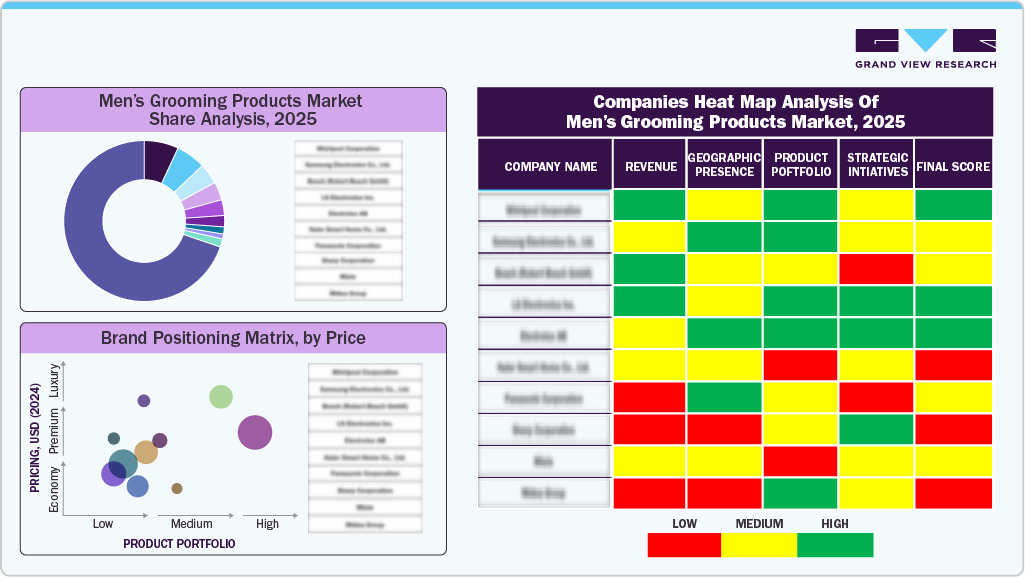
The global men’s grooming products market is characterized by a competitive landscape supported by the presence of multinational consumer goods companies, regional grooming brands, and a growing number of digitally native men’s care labels. Leading manufacturers maintain strong positions through extensive product portfolios, global distribution networks, and continuous product innovation across categories such as skincare, shaving products, hair care, deodorants, and fragrances. Major companies, including L'Oréal, Procter & Gamble, Unilever, Estée Lauder Companies, and Shiseido, leverage strong brand recognition and large-scale retail presence across supermarkets, pharmacies, specialty grooming stores, and online platforms. At the same time, emerging grooming brands are gaining traction by offering natural formulations, vegan ingredients, and sustainable packaging, while the rapid expansion of e-commerce and direct-to-consumer channels is intensifying competition and enabling new brands to reach global consumers more efficiently.
Consumer Insights
Consumer purchasing behavior in the global men’s grooming products market is increasingly shaped by evolving attitudes toward personal care, self-presentation, and long-term skin health. Men are gradually integrating skincare and grooming products into their daily routines as awareness of appearance and wellness continues to grow. Many consumers now view grooming products such as cleansers, moisturizers, shaving products, and fragrances as essential parts of everyday self-care rather than occasional purchases. Product effectiveness, ingredient transparency, and brand credibility play a key role in purchasing decisions, with consumers increasingly preferring dermatologically tested formulations and products designed specifically for male skin concerns such as oil control, irritation, and shaving-related sensitivity.
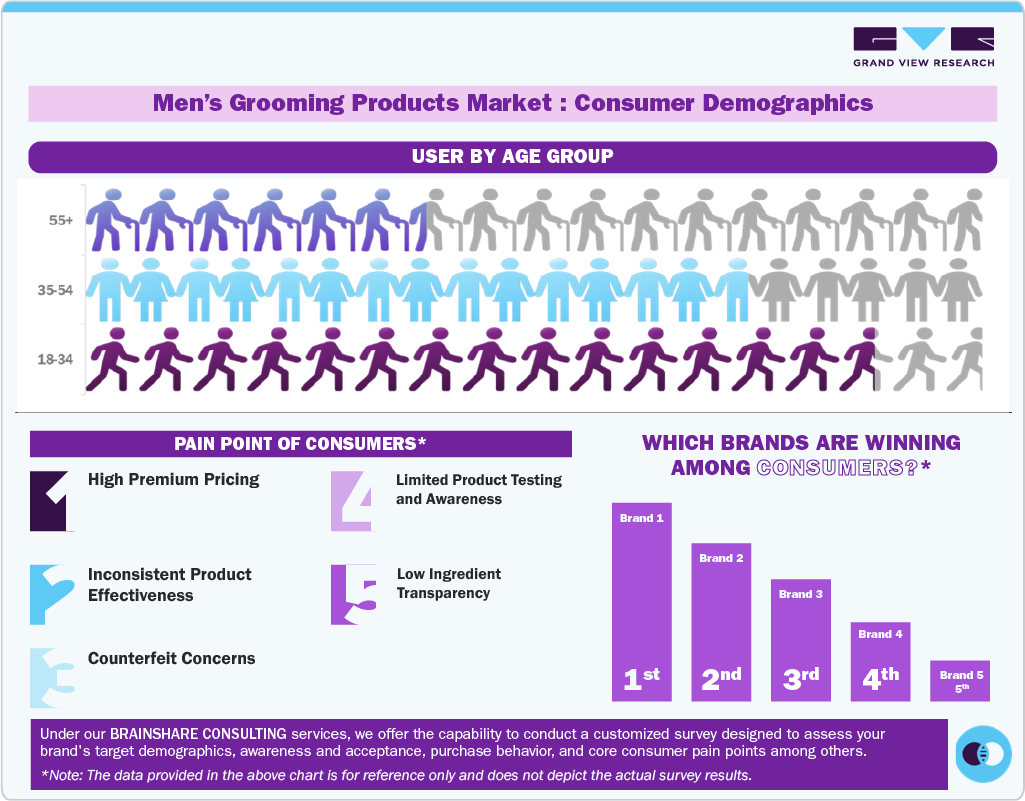
Younger consumers are particularly influencing the expansion of the men’s grooming market, as they show a stronger willingness to experiment with skincare and grooming routines than previous generations. According to a June 2024 YouGov article, around 46% of young men in Britain report using facial skincare products, demonstrating the growing adoption of skincare in male grooming habits. The study also highlights that younger male consumers are more open to exploring specialized products, such as moisturizers, cleansers, and targeted treatments, rather than relying solely on basic grooming items like deodorants or shaving creams. This shift reflects the increasing normalization of skincare within male grooming routines.
Digital platforms and online content are also influencing purchasing behavior within the men’s grooming products market. Many consumers research product ingredients, skincare routines, and grooming techniques on social media, through online tutorials, and in digital grooming communities before making purchasing decisions. Younger male consumers, in particular, rely on digital content to learn about skincare routines, evaluate product performance, and compare grooming brands. As a result, brands are increasingly investing in digital marketing strategies, influencer partnerships, and educational content to build trust and engage male consumers. The growing accessibility of grooming products through online retail platforms, specialty grooming stores, and direct-to-consumer channels is further supporting product discovery and encouraging repeat purchases across the global men’s grooming products market.
Product Insights
The skincare segment accounted for 34.1% of the men’s grooming products market in 2025, supported by the growing adoption of dedicated facial care routines among male consumers. Demand for products such as facial cleansers, moisturizers, serums, and sunscreens has increased as men become more aware of skin health and preventive skincare practices. Concerns about pollution exposure, UV damage, acne, and skin sensitivity are prompting consumers to incorporate protective and treatment-based skincare products into their daily grooming routines. In addition, the availability of specialized formulations designed for male skin, such as oil-control moisturizers, anti-aging treatments, and post-shave repair products, has expanded the category’s appeal across different age groups. Continuous product innovation, along with the introduction of dermatologist-tested formulations and ingredient-focused skincare solutions, is further supporting the strong growth of the skincare segment within the global men’s grooming products market.
Hair care products are expected to grow at a CAGR of 7.0% from 2026 to 2033, supported by increasing consumer focus on scalp health, hair styling, and hair loss management. Demand is rising for products such as shampoos, conditioners, hair styling gels, pomades, and anti-hair fall treatments as men pay greater attention to maintaining healthy hair and well-groomed appearances. Growing concerns about hair thinning, dandruff, and scalp irritation are also driving the use of specialized hair care formulations designed to strengthen hair and improve scalp balance. In addition, manufacturers are introducing products enriched with botanical extracts, proteins, and scalp-care ingredients that provide nourishment and styling benefits. The increasing influence of grooming tutorials, celebrity hairstyles, and professional salon trends is further encouraging men to adopt dedicated hair care routines, supporting the continued expansion of the hair care segment during the forecast period.
Distribution Channel Insights
The sale of men’s grooming products through hypermarkets & supermarkets accounted for 36.9% in 2025. These retail formats attract large numbers of customers thanks to their extensive shelf space and well-organized product displays featuring a wide range of grooming products, including skincare, hair care, shaving items, deodorants, and fragrances. Consumers often prefer purchasing grooming products from these outlets as they can easily compare different brands, product formats, and price ranges in one location. High in-store foot traffic, frequent promotional offers, bundled product deals, and loyalty programs also encourage impulse purchases. In addition, the continuous expansion of large retail chains across urban and suburban regions has improved product accessibility, further strengthening the role of hypermarkets and supermarkets in the distribution of men’s grooming products.
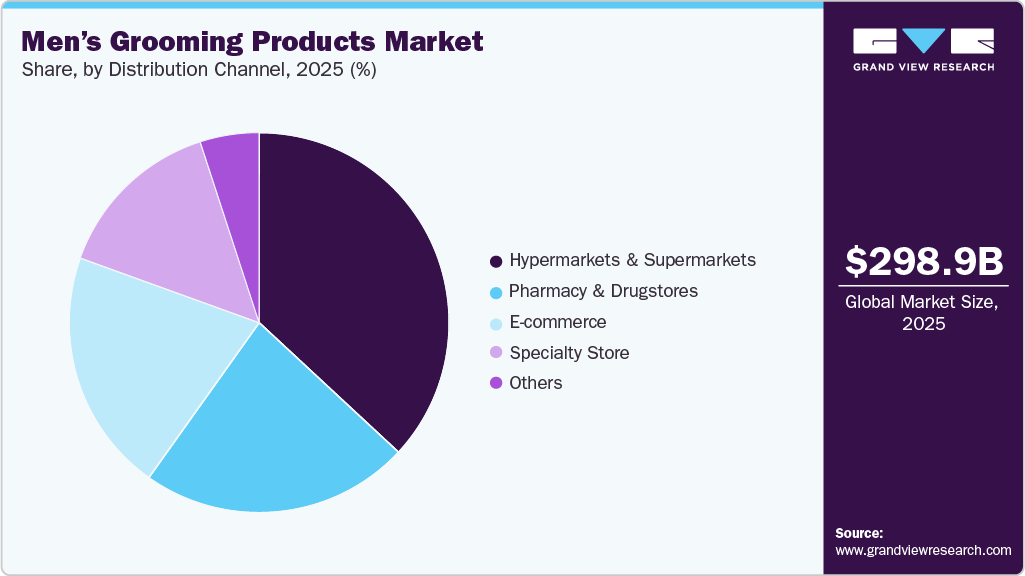
The sale of men’s grooming products through online/e-commerce channels is expected to grow at a CAGR of 8.8% from 2026 to 2033. Online platforms allow consumers to access a broad range of grooming products, including niche and premium brands that may not be widely available in traditional retail stores. The availability of exclusive online discounts, bundled product offers, and limited-edition product launches is also encouraging consumers to purchase grooming products through digital channels. In addition, the growing popularity of mobile shopping applications and secure digital payment systems has made online purchasing more convenient, further strengthening the adoption of e-commerce platforms for men’s grooming products.
Regional Insights
The North American men’s grooming products market accounted for the market share of 24.57% in 2025, driven by strong consumer spending and a well-established personal care industry across the region. The U.S. leads regional demand, supported by the presence of major multinational beauty companies, contract manufacturers, and advanced product development facilities that consistently introduce new formulations across skincare, haircare, beard care, and grooming categories. Consumers in the region show high responsiveness to product innovation, including premium formulations, multifunctional products, and targeted solutions such as anti-aging skincare and scalp treatments. Frequent product launches, limited-edition collections, and collaborations between grooming brands and lifestyle influencers further stimulate repeat purchases and brand engagement.
U.S. Men’s Grooming Products Market Trends
The men’s grooming products industry in the U.S. accounted for around 87.7% of the North America market revenue in 2025. The North America men’s grooming products industry is driven by the growing influence of lifestyle trends and increasing consumer focus on personal appearance and professional image. Many male consumers are adopting advanced grooming routines that include skincare treatments, beard-care products, hair styling products, and premium fragrances as part of their daily personal care. The market is also benefiting from the rapid expansion of men-focused grooming brands and product lines that address specific concerns such as acne, oil control, hair thinning, and beard maintenance. In addition, the strong presence of barbershop chains, grooming salons, and men’s personal care services across the country is encouraging product awareness and promoting the use of specialized grooming products, further supporting the growth of the men’s grooming products market in the U.S.
The Canada men’s grooming products industry is expected to grow at a CAGR of 7.0% from 2026 to 2033. The Canada men’s grooming products market is driven by the increasing adoption of daily grooming routines among male consumers. Many men are incorporating products such as facial cleansers, moisturizers, beard grooming products, hair styling solutions, and deodorants into their regular personal care practices. The market is also benefiting from growing awareness of skin health and hygiene, encouraging the use of specialized skincare and shaving products. In addition, the expansion of retail distribution through supermarkets, pharmacies, specialty grooming stores, and e-commerce platforms is improving product availability and allowing consumers to explore a wider range of men’s grooming brands and formulations across Canada.
Europe Men’s Grooming Products Market Trends
Europe men’s grooming products market accounted for a revenue share of 25.3% in 2025. The Europe men’s grooming products market is driven by the increasing demand for natural and organic grooming products among male consumers. Many consumers across the region are becoming more conscious about ingredient safety and environmental sustainability, encouraging the adoption of grooming products formulated with plant-based ingredients and free from harsh chemicals. The market is also benefiting from the growing popularity of multifunctional grooming products that combine skincare, hair care, and moisturizing benefits within a single formulation, appealing to consumers seeking convenient grooming routines. In addition, the expansion of private-label grooming products introduced by major supermarket and pharmacy chains across Europe is improving product affordability and accessibility, further supporting the growth of the men’s grooming products market across the region.
The men’s grooming products industry in the UK accounted for a revenue share of around 14.7% on the Europe market in 2025. The UK men’s grooming products market is driven by the strong adoption of personal grooming and skincare routines among male consumers. Many men in the UK are increasingly incorporating products such as facial cleansers, moisturizers, beard grooming products, hair styling solutions, and fragrances into their daily routines. The market is also influenced by evolving grooming trends and the growing popularity of premium men’s care brands that offer specialized skincare and hair care formulations. In addition, retailers and grooming brands are continuously expanding their product portfolios and introducing innovative grooming solutions to attract consumers seeking high-performance and lifestyle-oriented grooming products.
The France men’s grooming products industry is expected to grow at a CAGR of 7.7% from 2026 to 2033. The France men’s grooming products market is driven by the country’s strong culture of personal grooming and increasing consumer interest in premium skincare and fragrance products. Male consumers in France are increasingly adopting daily grooming routines that include facial cleansers, moisturizers, shaving products, hair styling products, and fragrances. The market also benefits from the presence of well-established beauty and personal care brands that continuously introduce innovative grooming products tailored to male consumers.
Asia Pacific Men’s Grooming Products Market Trends
The Asia Pacific men’s grooming products industry accounted for the largest share of 34.3% in 2025 and is expected to grow at a CAGR of 8.6% from 2026 to 2033. The Asia Pacific men’s grooming products market is driven by the growing young male population and increasing influence of grooming culture across the region. Younger consumers are becoming more conscious about personal appearance and are increasingly adopting products such as facial cleansers, moisturizers, beard care products, hair styling gels, and fragrances as part of their daily routines. The market is also benefiting from the rapid expansion of barbershop chains, grooming salons, and male-focused beauty services that promote the use of specialized grooming products. In addition, increasing investments by global and regional personal care brands in marketing campaigns, product launches, and localized product development are strengthening product awareness and encouraging wider adoption of men’s grooming products across the Asia Pacific.
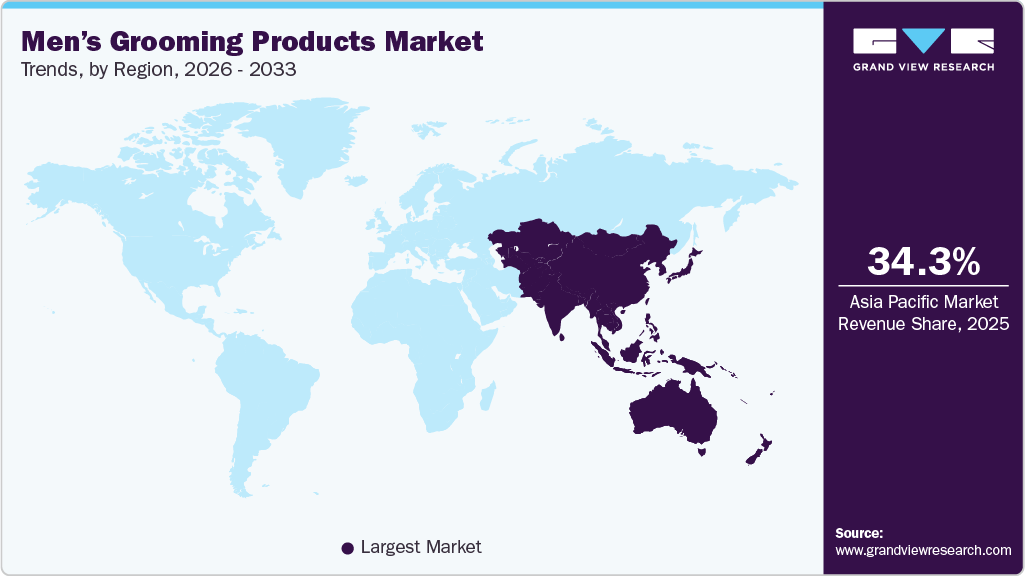
The men’s grooming products industry in China accounted for a revenue share of around 21.3% on the Asia Pacific market in 2025. The China men’s grooming products market is driven by the strong influence of digital media and evolving beauty standards among younger consumers. Social media platforms, livestream shopping, and influencer-led product promotions are encouraging male consumers to explore skincare, hair styling, and grooming products more actively. The market is also benefiting from the growing popularity of premium and specialized grooming products such as anti-aging skincare, oil-control treatments, and scalp-care solutions designed specifically for male consumers.
The India men’s grooming products industry is expected to grow at a CAGR of 8.7% from 2026 to 2033. The India men’s grooming products market is driven by the rising penetration of digital commerce and the increasing accessibility of grooming products across the country. Online marketplaces and quick-commerce platforms are enabling consumers to easily purchase a wide range of grooming products, including skincare, beard care, hair styling products, and fragrances. The market is also benefiting from the growing popularity of beard grooming and hairstyling trends among young male consumers, which is increasing demand for products such as beard oils, styling waxes, and hair serums. In addition, expanding retail distribution through supermarkets, pharmacies, and convenience stores across tier-2 and tier-3 cities is improving product availability and encouraging wider adoption of men’s grooming products across India.
Central & South America Men’s Grooming Products Market Trends
The Central & South America men’s grooming products industry is expected to grow at a CAGR of 5.5% from 2026 to 2033. The Central & South America men’s grooming products market is driven by the increasing influence of urban lifestyles and the rising popularity of modern grooming habits among male consumers. As more men in major cities adopt professional and style-conscious lifestyles, demand is rising for products such as hair styling gels, beard grooming oils, shaving creams, and facial skincare treatments. The market is also benefiting from the strong cultural emphasis on personal appearance and grooming in several countries across the region. In addition, the rapid expansion of e-commerce platforms and digital retail channels is improving product availability and enabling consumers to access a wider variety of grooming brands and specialized products, further supporting the growth of the men’s grooming products market across Central and South America.
Middle East & Africa Men’s Grooming Products Market Trends
The Middle East & Africa men’s grooming products industry is expected to grow at a CAGR of 6.6% from 2026 to 2033. The Middle East & Africa men’s grooming products market is driven by the rising awareness of personal grooming and increasing demand for skincare, hair care, and fragrance products among male consumers. In several countries across the region, grooming and personal appearance are strongly associated with social presentation and professional image, encouraging consistent use of products such as deodorants, shaving products, facial cleansers, and hair styling solutions. The market is also supported by a growing young population and increasing urbanization, which are influencing lifestyle trends and grooming habits. In addition, the expansion of international personal care brands and the increasing availability of grooming products through supermarkets, specialty retail stores, and online platforms are further supporting the growth of the men’s grooming products market across the Middle East and Africa.
Key Men’s Grooming Products Companies:
The following key companies have been profiled for this study on the men’s grooming products market
- Beiersdorf AG
- Procter & Gamble Co.
- L'Oréal SA
- Shiseido Co., Ltd.
- Vi-john Group
- Colgate-Palmolive Company
- Kao Corporation
- Estee Lauder Companies, Inc.
- Reckitt Benckiser
- Coty, Inc.
Recent Developments
-
In March 2026, Creative Labs introduced a new men’s haircare brand, BLVD & CO, with its initial launch through Walmart stores and online platforms. The product line includes shampoos, conditioners, and styling products designed to provide affordable, salon-inspired grooming solutions for men. The rollout across thousands of Walmart locations aims to expand access to quality men’s haircare products while strengthening the brand’s presence in the growing male grooming market.
-
In February 2026, BIC introduced BIC Flex 5 Trim & Shave, a manual grooming device that combines shaving and trimming in one product. The tool features interchangeable heads, including a five-blade razor and a precision trimmer with adjustable lengths, allowing users to switch easily between shaving and beard maintenance. The launch expands BIC’s men’s grooming portfolio and offers a convenient, battery-free solution for everyday grooming.
-
In February 2026, Unilever introduced a new formula for its men’s shampoo brand Clear Men, launching Clear Men Ultra with improved scalp care benefits. The launch is supported by a collaboration connected to the FIFA World Cup 2026, aimed at engaging sports fans and promoting the product to active male consumers. Through this initiative, the company seeks to strengthen the brand’s presence in the men’s grooming market while linking it with football-inspired marketing campaigns.
-
In November 2025, Garnier Men launched Garnier Men AcnoFight Gentle Cleanser, a new product designed for acne-prone and sensitive skin. The cleanser includes ingredients such as salicylic acid and soothing components to help cleanse pores while remaining gentle on the skin. The brand has also appointed Abhishek Sharma as its ambassador to connect with younger male consumers and strengthen its presence in India’s growing men’s grooming market.
-
In September 2025, BOSS Fragrances launched BOSS Bottled Beyond, expanding its well-known BOSS Bottled collection. The new scent blends spicy ginger with rich leather and woody notes, creating a modern, long-lasting fragrance profile. Developed by a team of perfumers, the launch is supported by a global marketing campaign featuring ambassadors such as Bradley Cooper, Maluma, and Vinícius Júnior to promote the fragrance’s bold and contemporary identity.
Men’s Grooming Products Market Report Scope
Report Attribute
Details
Market size value in 2026
USD 322.24 billion
Revenue forecast in 2033
USD 506.73 billion
Growth rate
CAGR of 6.7% from 2026 to 2033
Base year for estimation
2025
Historical data
2021 - 2024
Forecast period
2026 - 2033
Quantitative units
Revenue in USD billion and CAGR from 2026 to 2033
Report coverage
Revenue forecast, company ranking, competitive landscape, growth factors, and trends
Segments covered
Product; distribution channel, region
Regional scope
North America; Europe; Asia Pacific; Central & South America; Middle East & Africa
Country scope
U.S.; Canada; Mexico; Germany; UK; France; Italy; Spain; China; India; Japan; Australia & New Zealand; South Korea; Brazil; South Africa
Key companies profiled
Beiersdorf AG; Procter & Gamble Co.; L'Oréal SA; Shiseido Co., Ltd.; Vi-john Group; Colgate-Palmolive Company; Kao Corporation; Estee Lauder Companies, Inc.; Reckitt Benckiser; Coty, Inc.
Customization scope
Free report customization (equivalent up to 8 analysts working days) with purchase. Addition or alteration to country, regional & segment scope.
Pricing and purchase options
Avail customized purchase options to meet your exact research needs. Explore purchase options
Global Men’s Grooming Products Market Report Segmentation
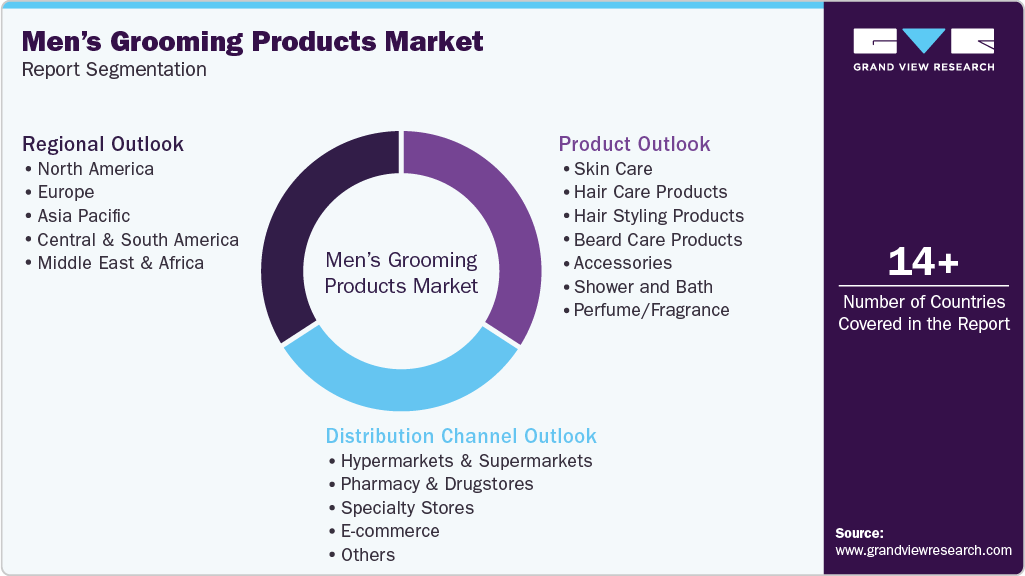
This report forecasts revenue growth at global, regional & country levels and provides an analysis on the latest trends and opportunities in each of the sub-segment from 2021 to 2033. For the purpose of this study, Grand View Research has segmented the global men’s grooming products market on the basis of product, distribution channel, and region:
-
Product Outlook (Revenue, USD Billion, 2021 - 2033)
-
Skin Care
-
Face Skin Care
-
Lotions, Face Creams, & Moisturizers
-
Cleansers & Face Wash
-
Facial Oils & Serums
-
Sunscreen/Sun Care
-
Sheet Face Masks
-
Others (Scrub, etc.)
-
-
Body Skin Care
-
Hair Removal Products
-
Lotions, Creams, & Moisturizers
-
Body Sunscreen/Sun Care
-
Body Scrub
-
Others (Serum, Oils, etc.)
-
-
-
Hair Care Products
-
Shampoo
-
Conditioner
-
Oils
-
Serums
-
Others (Hair Masks, Peels, Etc.)
-
-
Hair Styling Products
-
Hair Gel
-
Hair Wax
-
Hair Mousse
-
Hair Spray
-
Pomade
-
Others (Hair Creams & Lotions, etc.)
-
-
Beard Care Products
-
Oil/Serum
-
Shampoo and Conditioner
-
Cream and Wax
-
Others (Balm, etc.)
-
-
Accessories
-
Shaving & Beard Care Accessories
-
Hair Styling Accessories
-
Nail Care Accessories
-
Bathing & Body Care Accessories
-
Others (Travel & Storage Accessories, etc.)
-
-
Shower and Bath
-
Bar Soap
-
Body Scrubs & Exfoliators
-
Body Wash & Shower Gel
-
Others (Bath Additives, Medicated Bath Products, etc.)
-
-
Perfume/Fragrances
-
Body Mists & Body Sprays
-
Deodorants
-
Fine Fragrances (EDP, EDT, EDC)
-
Others (Minis, Discovery Sets, Solid Perfumes, etc.)
-
-
-
Distribution Channel Outlook (Revenue, USD Billion, 2021 - 2033)
-
Hypermarkets & Supermarkets
-
Pharmacy & Drugstores
-
Specialty Stores
-
E-commerce
-
Others
-
-
Regional Outlook (Revenue, USD Billion, 2021 - 2033)
-
North America
-
U.S.
-
Canada
-
Mexico
-
-
Europe
-
Germany
-
UK
-
France
-
Italy
-
Spain
-
-
Asia Pacific
-
China
-
India
-
Japan
-
Australia & New Zealand
-
South Korea
-
-
Central & South America
-
Brazil
-
-
Middle East & Africa
-
South Africa
-
-
Frequently Asked Questions About This Report
b. Some key players operating in the men’s grooming products market Beiersdorf AG; Procter & Gamble Co.; L'Oréal Groupe; Shiseido Co., Ltd.; Vi-john Group; Colgate-Palmolive Company; Kao Corporation; Estee Lauder Companies, Inc.; Reckitt Benckiser; Coty, Inc.
b. Key factors such as the increase in the number of men’s salons and increased spending on grooming products are expected to drive the market growth over the forecast period.
b. The global men’s grooming products market size was valued at USD 298.94 billion in 2025 and is expected to reach USD 322.24 billion in 2026.
b. The global men’s grooming products market is expected to witness a compound annual growth rate of 6.7% from 2026 to 2033 to reach USD 506.73 billion by 2033.
b. The skin care segment led the market and accounted for a share of around 34.11% in 2025. Increasing awareness among males regarding personal hygiene and grooming globally has been driving the demand for men’s skincare products over the years.


Share this report with your colleague or friend.
Need a Tailored Report?
Customize this report to your needs — add regions, segments, or data points, with 20% free customization.


ISO 9001:2015 & 27001:2022 Certified
We are GDPR and CCPA compliant! Your transaction & personal information is safe and secure. For more details, please read our privacy policy.
Trusted market insights - try a free sample
See how our reports are structured and why industry leaders rely on Grand View Research. Get a free sample or ask us to tailor this report to your needs.