- Home
- »
- Food Additives & Nutricosmetics
- »
-
L-carnitine Market Size And Share, Industry Report, 2033GVR Report cover
![L-carnitine Market Size, Share & Trends Report]()
L-carnitine Market (2026 - 2033) Size, Share & Trends Analysis Report By Process (Bioprocess, Chemical Synthesis), By Product (Food & Pharma Grade, Feed Grade), By Application (Animal Feed, Healthcare Products, Functional Food & Beverage), By Region, And Segment Forecasts
- Report ID: GVR-3-68038-800-8
- Number of Report Pages: 151
- Format: PDF
- Historical Range: 2018 - 2024
- Forecast Period: 2026 - 2033
- Industry: Specialty & Chemicals
- Report Summary
- Table of Contents
- Segmentation
- Methodology
- Download FREE Sample
-
 Download Sample Report
L-carnitine Market Summary
The global L-carnitine market size was estimated at USD 235.6 million in 2025 and is projected to reach USD 385.8 million by 2033, growing at a CAGR of 6.5% from 2026 to 2033. The market is primarily driven by rising consumer awareness regarding preventive healthcare, weight management, and metabolic wellness, alongside increasing incidence of cardiovascular diseases, obesity, and diabetes.
Key Market Trends & Insights
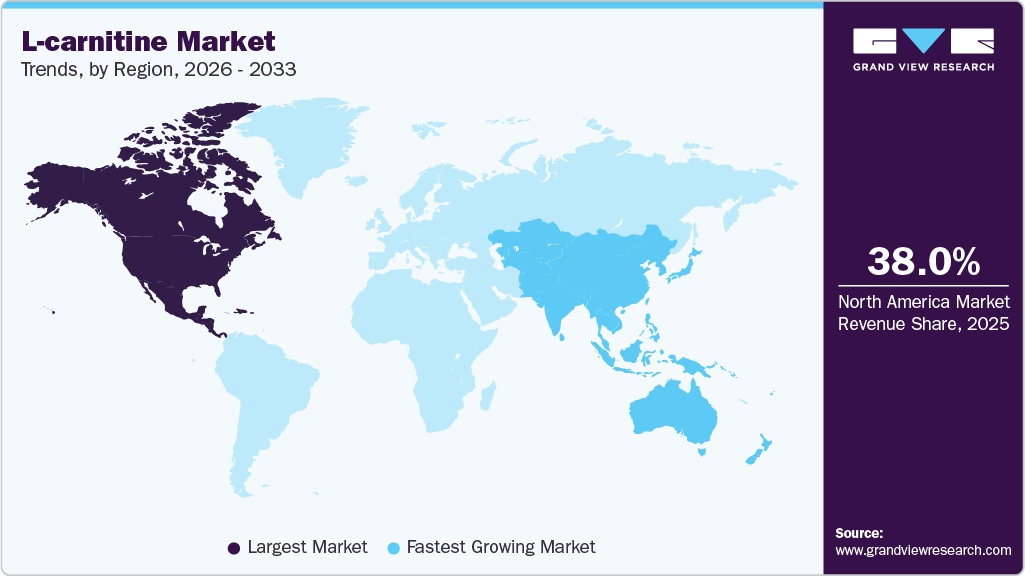
- North America dominated the L-Carnitine industry with the largest revenue share of 38.0% in 2025.
- The U.S. L-carnitine industry represented 81.5% of the North American market in 2025.
- By process, the bioprocess segment dominated the market with a 76.7% revenue share in 2025.
- By product, the food & pharma grade segment held the largest revenue share of 79.4% in 2025.
- By application, the healthcare products segment held the largest revenue share of 34.7% in 2025 in terms of value.
Market Size & Forecast
- 2025 Market Size: USD 235.6 Million
- 2033 Projected Market Size: USD 385.8 Million
- CAGR (2026-2033): 6.5%
- North America: Largest market in 2025
- Asia Pacific: Fastest growing market
The rapid expansion of the global dietary supplements and sports nutrition industry, particularly in North America and Europe, continues to stimulate demand for food and pharma-grade L-carnitine. The growth in industrial livestock production across Asia Pacific and Latin America is supporting steady uptake in feed-grade applications, as producers focus on improving feed conversion ratios and animal productivity. Technological advancements in bioprocess manufacturing are further enhancing yield efficiency and purity levels, strengthening supply reliability and regulatory compliance in developed markets.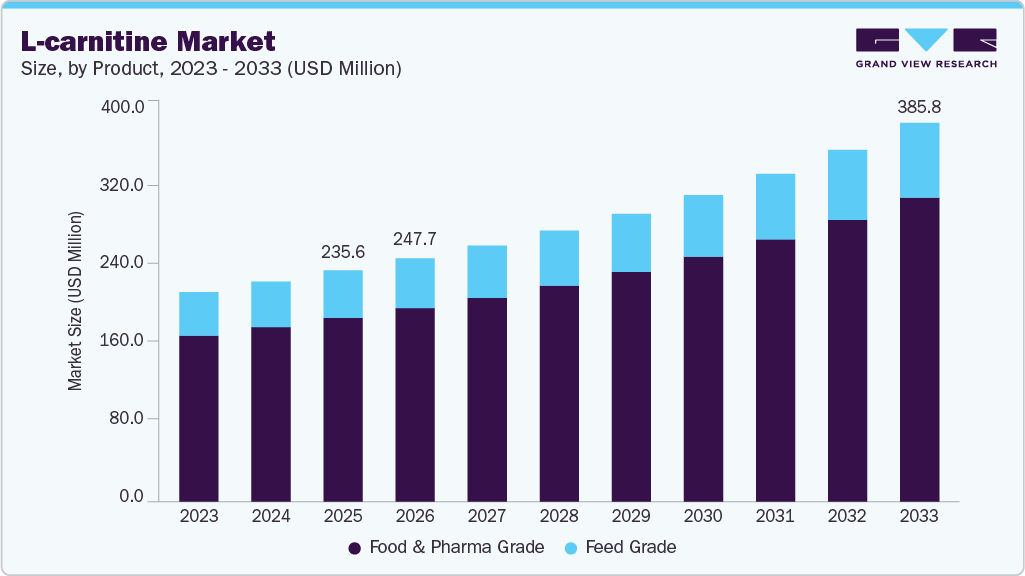
Significant growth opportunities exist in the expansion of functional foods and fortified beverages, where L-carnitine is increasingly positioned as an energy metabolism enhancer. The structural shift toward fermentation-based (bioprocess) production presents opportunities for manufacturers to differentiate through sustainability, cost optimization, and high-purity output. Emerging markets in Southeast Asia, India, Brazil, and the Middle East offer untapped potential due to rising disposable incomes and growing health-conscious consumer bases. Furthermore, innovation in personalized nutrition, clinical nutrition formulations, and combination supplements (e.g., L-carnitine with CoQ10 or omega-3) is expected to create premium product avenues and margin expansion opportunities.
The market faces challenges including raw material price volatility, particularly for trimethylamine derivatives used in chemical synthesis routes, which directly impacts production economics. Increasing regulatory scrutiny in developed regions regarding supplement labeling, purity standards, and health claims may constrain market penetration and extend product approval timelines. Competitive pressure from alternative fat-metabolism enhancers and other amino acid-based supplements also limits pricing power, particularly in the mass-market segment. In addition, feed-grade demand remains cyclical and sensitive to fluctuations in livestock production and agricultural commodity prices, creating periodic volume instability for manufacturers.
Market Concentration & Characteristics
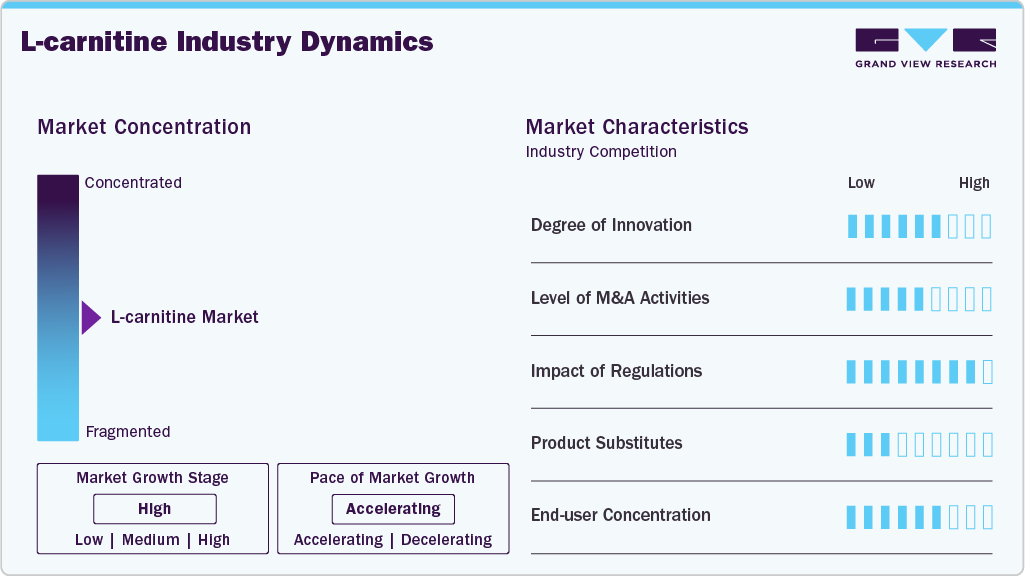
The global L-carnitine industry is moderately consolidated, characterized by competition between multinational life sciences companies and cost-competitive Asian manufacturers. Established players such as Lonza Group and Merck KGaA lead the high-purity food and pharmaceutical-grade segments, leveraging advanced bioprocess capabilities, strong regulatory compliance, and global distribution networks. Companies including Northeast Pharmaceutical Group Co., Ltd. (NEPG), Biosint S.p.A., Tokyo Chemical Industry Co., Ltd., and Cayman Chemical maintain competitive positioning through diversified portfolios and specialized product offerings across research, nutraceutical, and industrial applications.
Meanwhile, Chinese manufacturers such as Kaiyuan Hengtai Nutrition Co., Ltd., ChengDa Pharmaceuticals Co., Ltd., Huanggang Huayang Pharmaceuticals Co. Ltd., HuBei Yuancheng Saichuang Technology Co., Ltd., and Ceva compete primarily on scale and cost efficiency, particularly in feed-grade and bulk supply markets. Competitive dynamics are increasingly influenced by bioprocess innovation, sustainability compliance, and quality differentiation, with players investing in fermentation technologies and certifications to strengthen global market access and margin resilience.
Product Insights
The food & pharma grade segment held the largest revenue share of 79.4% in 2025 owing to its premium pricing structure, stringent purity standards, and strong demand across dietary supplements, clinical nutrition, and pharmaceutical formulations. High-purity L-carnitine compliant with pharmacopeial standards commands significantly higher margins compared to feed-grade variants, thereby contributing disproportionately to total market revenue. Rising global awareness around preventive healthcare, metabolic health management, and sports nutrition supplementation has further strengthened demand in North America, Europe, and developed Asia markets. The growing aging population and increasing incidence of cardiovascular and metabolic disorders continue to drive sustained uptake in prescription and over-the-counter healthcare products, reinforcing segment dominance through 2033.
The feed grade segment represents a volume-driven but comparatively lower-margin market, primarily supported by demand from poultry, swine, and aquaculture industries. While livestock productivity enhancement and feed conversion optimization underpin steady consumption, pricing sensitivity and cyclical agricultural dynamics constrain revenue expansion. Asia Pacific remains the primary demand hub due to large-scale commercial farming operations. Although the segment is expected to witness stable growth over the forecast period, its overall revenue contribution will remain secondary to the high-value Food & Pharma Grade segment.
Application Insights
The healthcare products segment captured the largest revenue share of 34.7% in 2025 driven by strong demand for L-carnitine in dietary supplements, sports nutrition, and preventive health formulations. Increasing consumer focus on weight management, energy metabolism, cardiovascular health, and active lifestyles has significantly accelerated product penetration across North America, Europe, and parts of Asia Pacific. Premium pricing of supplement-grade formulations, coupled with expanding e-commerce distribution channels and rising disposable incomes, has further strengthened revenue contribution. The growing awareness around metabolic disorders and aging-related health concerns continues to support sustained demand growth in this segment through 2033.
Animal feed remains a high-volume application supported by livestock productivity optimization and improved feed conversion ratios, particularly in poultry, swine, and aquaculture industries across Asia Pacific and Latin America. Functional Food & Beverage represents an emerging growth avenue, benefiting from rising consumer preference for fortified energy drinks, dairy products, and nutrition bars positioned around metabolic enhancement. Meanwhile, the Medicines segment maintains steady demand driven by prescription use in primary carnitine deficiency, cardiovascular conditions, and renal disorders, though growth remains regulated and comparatively moderate due to stringent approval frameworks. Collectively, these applications provide a diversified demand base supporting long-term market stability.
Process Insights
The bioprocess segment dominated the market with a 76.7% revenue share in 2025 due to its superior optical purity, regulatory compliance advantages, and alignment with sustainability standards. Fermentation-based production ensures high L-isomer specificity, improved yield efficiency, and reduced environmental impact, making it the preferred route for food and pharmaceutical-grade applications. Ongoing advancements in microbial strain optimization and large-scale fermentation capacity, particularly in Asia and Europe, have enhanced cost competitiveness, reinforcing its leadership position. With growing demand for premium-grade L-carnitine in dietary supplements, clinical nutrition, and functional beverages, the bioprocess segment is expected to sustain its revenue dominance through 2033.
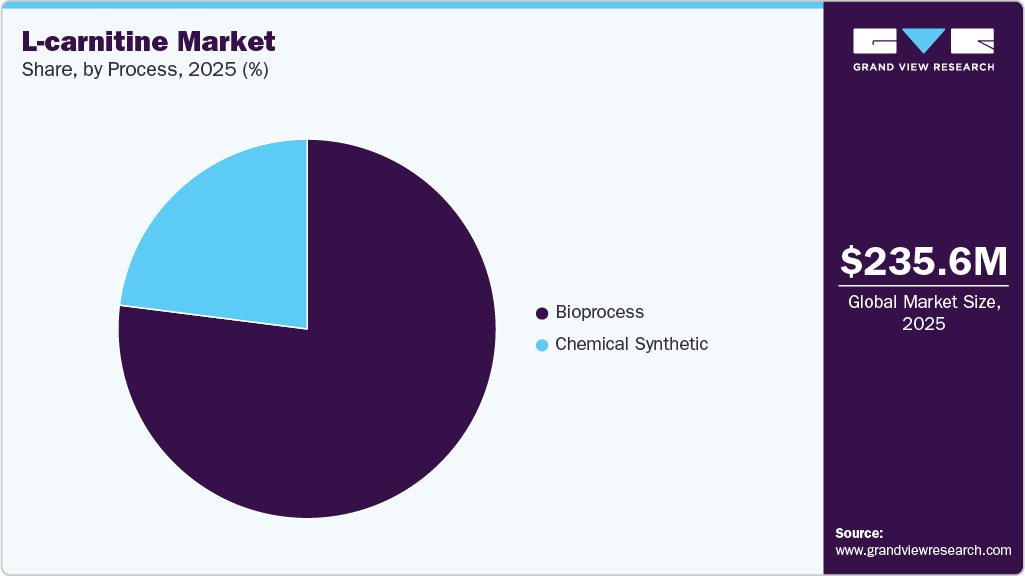
In comparison, chemical synthesis remains relevant in cost-sensitive and feed-grade applications, supported by established manufacturing infrastructure and lower initial capital intensity. However, the process involves complex purification and chiral resolution steps, leading to higher compliance and environmental management costs. As regulatory scrutiny intensifies and sustainability considerations gain prominence, chemical synthesis is projected to witness comparatively moderate growth, maintaining a stable but secondary share within the global L-carnitine industry.
Regional Insights
North America L-carnitine industry accounted for 38.0% of the global market revenue in 2025, driven by high dietary supplement penetration, strong sports nutrition consumption, and advanced pharmaceutical infrastructure. Robust consumer spending on preventive healthcare, coupled with increasing prevalence of obesity and cardiovascular disorders, continues to support sustained demand for food and pharma-grade L-carnitine. The region benefits from established regulatory frameworks and premium product positioning, enabling higher average selling prices compared to other regions.
U.S. L-Carnitine Market Trends
The U.S. L-carnitine industry represented 81.5% of the North American market in 2025, underpinned by a mature nutraceutical industry, strong retail and e-commerce supplement distribution networks, and widespread consumer awareness of metabolic health products. High healthcare expenditure and strong demand for sports nutrition and weight management supplements significantly contribute to revenue concentration. The innovation in functional beverages and personalized nutrition continues to create incremental growth opportunities.
Europe L-Carnitine Market Trends
Europe L-carnitine market held 28.0% of the global market revenue in 2025, supported by stringent quality standards, high pharmaceutical-grade consumption, and increasing demand for clean-label nutraceutical products. The region’s aging population and growing preventive healthcare focus drive steady uptake in clinical and dietary supplement applications. Regulatory compliance and preference for high-purity, fermentation-derived L-carnitine further sustain premium pricing dynamics across key European markets.
Germany L-carnitine market represents one of Europe’s leading markets, driven by a well-established pharmaceutical sector, strong health supplement consumption, and high consumer awareness regarding metabolic wellness. The country’s advanced regulatory oversight and preference for scientifically validated formulations support demand for pharma-grade L-carnitine. In addition, Germany’s strong distribution infrastructure and export-oriented nutraceutical industry contribute to stable regional growth.
Asia Pacific L-Carnitine Market Trends
Asia Pacific L-carnitine market accounted for 24.8% of global revenue in 2025, supported by expanding middle-class populations, increasing health awareness, and strong livestock production activity. The region plays a dual role as both a major production hub, particularly for bioprocess manufacturing, and a high-volume consumer of feed-grade L-carnitine. Rapid urbanization, rising disposable income, and growing demand for dietary supplements in China, Japan, South Korea, and India continue to accelerate market expansion.
ChinaL-carnitine market represents as both the largest production base and a significant consumption market within Asia Pacific, benefiting from cost-efficient fermentation infrastructure and large-scale manufacturing capabilities. Strong domestic livestock production supports feed-grade demand, while rising consumer awareness of sports nutrition and preventive healthcare fuels growth in food-grade applications. Export competitiveness and vertical integration strategies further enhance China’s strategic position in the global supply chain.
Central & South America L-Carnitine Market Trends
TheL-carnitine industry in Central & South America represents an emerging growth region, primarily driven by expanding livestock industries in Brazil and Argentina and gradually increasing adoption of dietary supplements. While overall revenue contribution remains comparatively modest, improving economic stability, urbanization, and rising health awareness are expected to support moderate growth through 2033. However, pricing sensitivity and currency volatility may influence short-term demand dynamics.
Middle East & Africa L-Carnitine Market Trends
Middle East & Africa L-carnitine industry exhibits gradual growth supported by rising healthcare investments, increasing lifestyle-related disorders, and expanding animal nutrition sectors in select Gulf and African countries. Although the market remains at a nascent stage relative to developed regions, growing urban populations and improving distribution infrastructure present long-term expansion potential. Demand is largely concentrated in healthcare supplements and poultry feed applications, with future growth contingent on regulatory development and consumer education.
Key L-carnitine Company Insights
Key players, such as Lonza, Cayman Chemical, Merck, and Ceva are dominating the market:
-
Lonza is a leading global life sciences company with a strong presence in the market, primarily serving high-value pharmaceutical and nutraceutical segments. The company leverages advanced bioprocessing capabilities, stringent quality compliance, and vertically integrated manufacturing infrastructure to produce high-purity L-carnitine tailored for food, clinical, and pharmaceutical applications. Lonza’s competitive advantage lies in its robust R&D capabilities, regulatory expertise, and long-standing relationships with global supplement and healthcare brands, enabling premium product positioning and stable margins. Through continuous innovation, sustainability-focused production practices, and strategic capacity optimization, the company maintains a strong foothold in developed markets, particularly North America and Europe.
Key L-carnitine Companies:
The following key companies have been profiled for this study on the L-carnitine market.
- Lonza
- Northeast Medicines Group Co., Ltd. (NEPG)
- Biosint S.p.A.
- Cayman Chemical
- Merck KGaA
- Tokyo Chemical Industry Co., Ltd.
- Ceva
- Kaiyuan Hengtai Nutrition Co., Ltd.
- ChengDa PharmaCeuticals Co., Ltd.
- Huanggang Huayang PharmaCeuticals Co., Ltd.
- HuBei Yuancheng Saichuang Technology Co. Ltd.
L-carnitine Market Report Scope
Report Attribute
Details
Market size value in 2026
USD 247.68 million
Revenue forecast in 2033
USD 385.28 million
Base year for estimation
2025
Growth Rate
CAGR of 6.5% from 2026 to 2033
Historical data
2018 - 2024
Forecast period
2026 - 2033
Market representation
Volume in kilotons, revenue in USD million & CAGR from 2026 to 2033
Segment scope
Process, product, application, region
Regional scope
North America; Europe; Asia Pacific; Central & South America; Middle East & Africa
Country scope
U.S.; Canada; Mexico; Germany; UK; France; Italy; China; India; Japan; South Korea; Brazil; Argentina; South Africa; Saudi Arabia
Key companies Listed
Lonza; Northeast Medicines Group Co., Ltd. (NEPG); Biosint S.p.A.; Cayman Chemical; Merck KGaA; Tokyo Chemical Industry Co., Ltd.; Ceva; Kaiyuan Hengtai Nutrition Co., Ltd.; ChengDa Pharmaceutical Co., Ltd.; Huanggang Huayang Pharmaceutical Co. Ltd.; HuBei Yuancheng Saichuang Technology Co. Ltd.
Report coverage
Revenue forecast, competitive landscape, growth factors, and trends
15% free customization scope (equivalent to 5 analyst working days)
If you need specific in Productation, which is not currently within the scope of the report, we will provide it to you as a part of the customization
Global L-carnitine Market Report Segmentation
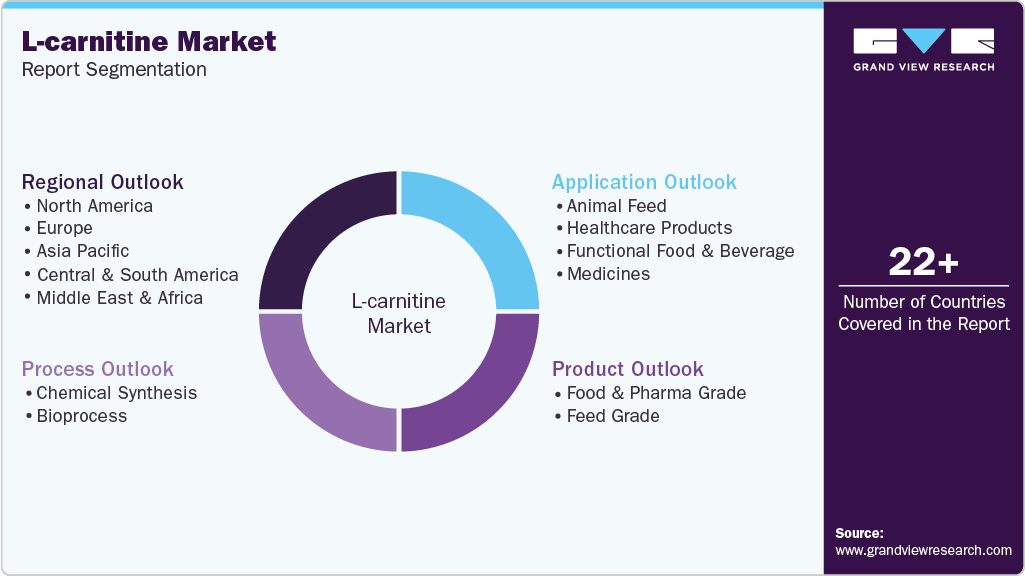
This report forecasts revenue and volume growth at global, regional and country levels and provides an analysis of the latest industry trends in each of the sub-segments from 2018 to 2033. For this study, Grand View Research has segmented the global L-carnitine market report based on process, product, application, and region:
-
Process Outlook (Volume, Kilotons; Revenue, USD Million, 2018 - 2033)
-
Chemical Synthesis
-
Bioprocess
-
-
Product Outlook (Volume, Kilotons; Revenue, USD Million, 2018 - 2033)
-
Food & Pharma Grade
-
Feed Grade
-
-
Application Outlook (Volume, Kilotons; Revenue, USD Million, 2018 - 2033)
-
Animal Feed
-
Healthcare Products
-
Functional Food & Beverage
-
Medicines
-
-
Regional Outlook (Volume, Kilotons; Revenue, USD Million, 2018 - 2033)
-
North America
-
U.S.
-
Canada
-
Mexico
-
-
Europe
-
Germany
-
UK
-
France
-
Italy
-
-
Asia Pacific
-
China
-
India
-
Japan
-
South Korea
-
-
Central & South America
-
Brazil
-
Argentina
-
-
Middle East & Africa
-
South Africa
-
Saudi Arabia
-
-
Frequently Asked Questions About This Report
b. The global L-carnitine market size was estimated at USD 235.6 million in 2025 and is expected to reach 247.7 million in 2026.
b. The bioprocess segment dominated the L-carnitine market with a 76.7% revenue share in 2025 due to its ability to deliver high optical purity, superior regulatory compliance, and alignment with sustainability standards required for food and pharmaceutical-grade applications. Advancements in fermentation efficiency and large-scale production capacity have further enhanced cost competitiveness, reinforcing its leadership over conventional chemical synthesis.
b. The L-carnitine market is expected to grow at a compound annual growth rate of 6.5% from 2026 to 2033 to reach USD 385.8 million by 2033.
b. Some of the key players operating in the L-carnitine market Lonza, Northeast Medicines Group Co., Ltd. (NEPG), Biosint S.p.A., Cayman Chemical, Merck KGaA, Tokyo Chemical Industry Co., Ltd., Ceva, Kaiyuan Hengtai Nutrition Co., Ltd., ChengDa Mediciness Co., Ltd., Huanggang Huayang Medicines Co. Ltd., and HuBeiYuancheng Saichuang Technology Co., Ltd.
b. The L-carnitine market is primarily driven by rising consumer demand for dietary supplements and sports nutrition products, supported by increasing awareness of metabolic health, weight management, and preventive healthcare. The expanding livestock production and the need to improve feed efficiency in animal nutrition continue to generate steady demand for feed-grade applications.


Share this report with your colleague or friend.
Need a Tailored Report?
Customize this report to your needs — add regions, segments, or data points, with 20% free customization.


ISO 9001:2015 & 27001:2022 Certified
We are GDPR and CCPA compliant! Your transaction & personal information is safe and secure. For more details, please read our privacy policy.
Trusted market insights - try a free sample
See how our reports are structured and why industry leaders rely on Grand View Research. Get a free sample or ask us to tailor this report to your needs.