- Home
- »
- Beauty & Personal Care
- »
-
K-Beauty Products Market Size, Share, Industry Report 2033GVR Report cover
![K-Beauty Products Market Size, Share & Trends Report]()
K-Beauty Products Market (2026 - 2033) Size, Share & Trends Analysis Report By Product (Skin care, Haircare, Color Cosmetics), By End User (Men, Women), By Distribution Channel (Hypermarkets & Supermarkets, Specialty Beauty Stores), By Region, And Segment Forecasts
- Report ID: GVR-4-68040-092-4
- Number of Report Pages: 110
- Format: PDF
- Historical Range: 2021 - 2025
- Forecast Period: 2026 - 2033
- Industry: Consumer Goods
- Report Summary
- Table of Contents
- Interactive Charts
- Methodology
- Download FREE Sample
-
 Download Sample Report
K-beauty Products Market Summary
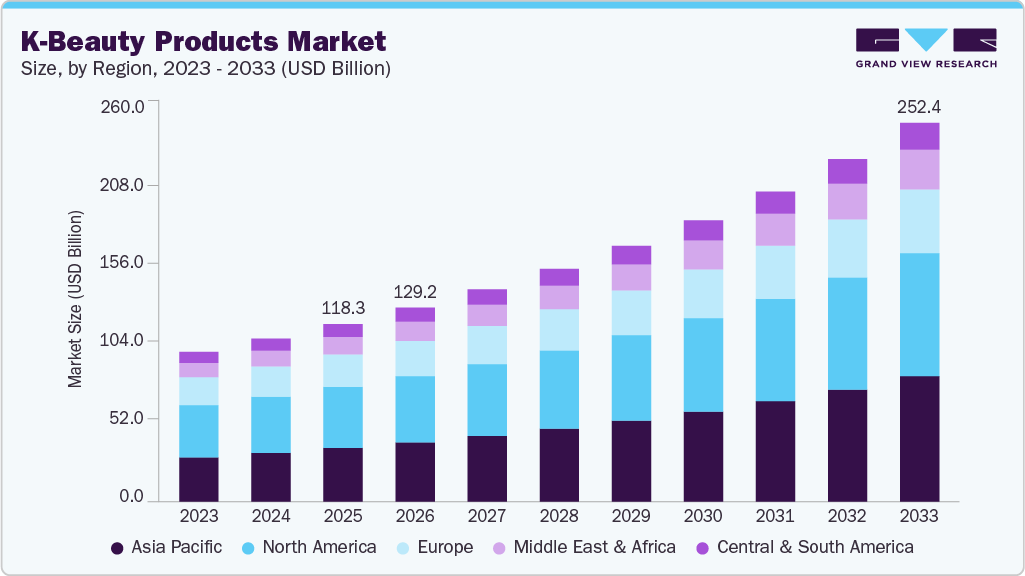
The global K-beauty products market size was estimated at USD 118.28 billion in 2025 and is expected to reach USD 252.41 billion by 2033, growing at a CAGR of 10.0% from 2026 to 2033. The global rise of Korean pop culture, including K-pop and K-dramas, has played a significant role in expanding K-beauty worldwide, as consumers increasingly adopt skin care and makeup trends inspired by Korean celebrities and influencers.
Key Market Trends & Insights
- By product, skin care led the K-beauty products market and accounted for a share of 56.78% in 2025.
- By end user, women led the K-beauty products market and accounted for a share of 61.81% in 2025.
- By distribution channel, specialty stores led the K-beauty products market and accounted for a share of 44.96% in 2025.
- By region, North America led the K-beauty products market and accounted for a share of 34.38% in 2025.
Market Size & Forecast
- 2025 Market Size: USD 118.28 Billion
- 2033 Projected Market Size: USD 252.41 Billion
- CAGR (2026-2033): 10.0%
- North America: Largest market in 2025
At the same time, rising demand for natural and skin-friendly ingredients is driving market growth, with consumers favoring gentle, clean formulations focused on hydration, skin health, and preventive skin care.The skin-first beauty approach, popularized by K-beauty, emphasizes achieving naturally healthy, radiant skin rather than relying on heavy makeup coverage. The “glass skin” trend reflects consumer preference for clear, smooth, deeply hydrated skin, driving demand for multi-step skin care routines and moisture-rich products such as essences, serums, and hydrating creams that prioritize long-term skin health and luminosity.
Korean manufacturers and brands are increasingly working with major e-commerce platforms, distributors, and beauty retailers to expand market access, localize offerings, and increase consumer reach. For instance, partnerships such as Kolmar Korea’s collaboration with Amazon and distribution alliances with European retailers highlight how joint initiatives are helping Korean brands scale globally while strengthening supply chains and retail presence in new regions.
For instance, in September 2025, Nykaa expanded its Korean beauty portfolio by launching Mise En Scène and RYO haircare brands in India, strengthening its long-standing partnership with South Korean beauty giant Amorepacific. The launch, marking nearly a decade of collaboration, reflects the growing popularity of K-beauty beyond skin care into haircare, with Mise En Scène focusing on “glass hair” shine and repair solutions. At the same time, RYO emphasizes scalp health using traditional Korean herbal science.
Innovation-led product development remains a core driver of the K-beauty skin care market, as brands continuously introduce advanced formulations, unique ingredients, and rapid product innovation cycles to meet evolving consumer expectations. Rising demand for science-backed K-beauty skin care solutions that deliver visible results has encouraged companies to launch multifunctional products featuring innovative textures, dermatology-inspired technologies, and active ingredients such as fermented extracts, peptides, and probiotics, strengthening K-beauty’s global leadership in skin care innovation.
For instance, in November 2025, Actress Shay Mitchell launched Rini, a Korean-made skincare brand developed specifically for children, highlighting a new niche expansion within the K-beauty market. The brand introduced dermatologist-tested hydrogel and sheet masks formulated with up to 95% natural-origin ingredients, including aloe vera, vitamin B12, and white tremella mushroom extract, focusing on gentle, safe, and transparent skin care for young users. Manufactured in South Korea, the launch demonstrates how K-beauty innovation is expanding beyond traditional adult skin care into emerging segments such as Gen Alpha and kids’ skin care, supported by rising parental demand for safe, age-appropriate self-care products.
Consumer Insights
Consumer behavior insights highlight that skin care routines play a central role in beauty habits, with individuals using an average of nearly six skin care products simultaneously. Many consumers follow layered routines that go beyond basic toner and cream, incorporating products such as essences, serums, mists, and emulsions to achieve targeted skin benefits. This reflects the strong influence of K-beauty’s multi-step skin care philosophy, which prioritizes consistent care, hydration, and skin maintenance over quick cosmetic fixes, demonstrating growing awareness of long-term skin health.
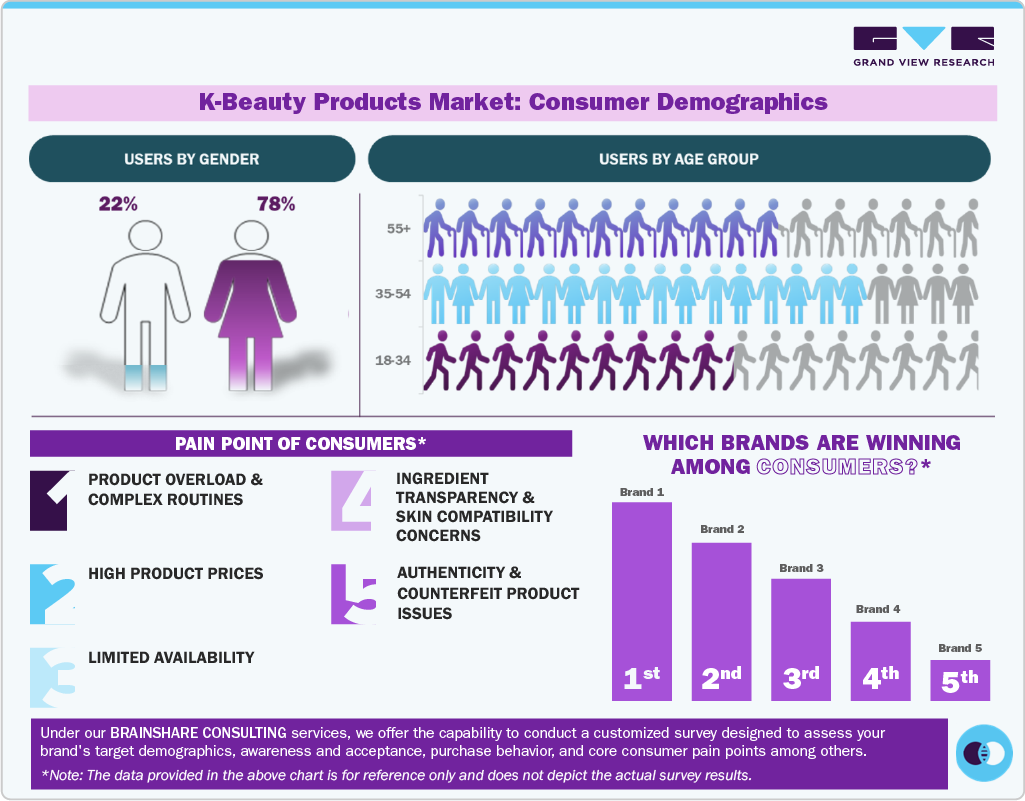
Similarly, makeup usage shows diversity, with consumers using an average of 5.9 products, ranging from simple cushion foundation and lipstick combinations to more comprehensive base routines. When selecting products, consumers primarily focus on effectiveness and texture, followed by value for money and positive online reviews, highlighting the growing influence of digital influencers on purchase decisions.
Product Insights
Skin care products held the largest revenue share of the K-beauty industry in 2025, accounting for a 56.78%. Korean beauty culture strongly emphasizes skin health over makeup, encouraging consumers to invest in preventive and long-term skin care routines. The popularity of multi-step regimens involving cleansers, toners, essences, serums, and moisturizers drives higher product consumption compared to color cosmetics. In addition, K-beauty brands are known for innovative formulations, gentle skin-friendly ingredients, and hydration-focused solutions that appeal to a wide range of consumers seeking effective yet affordable skin care.
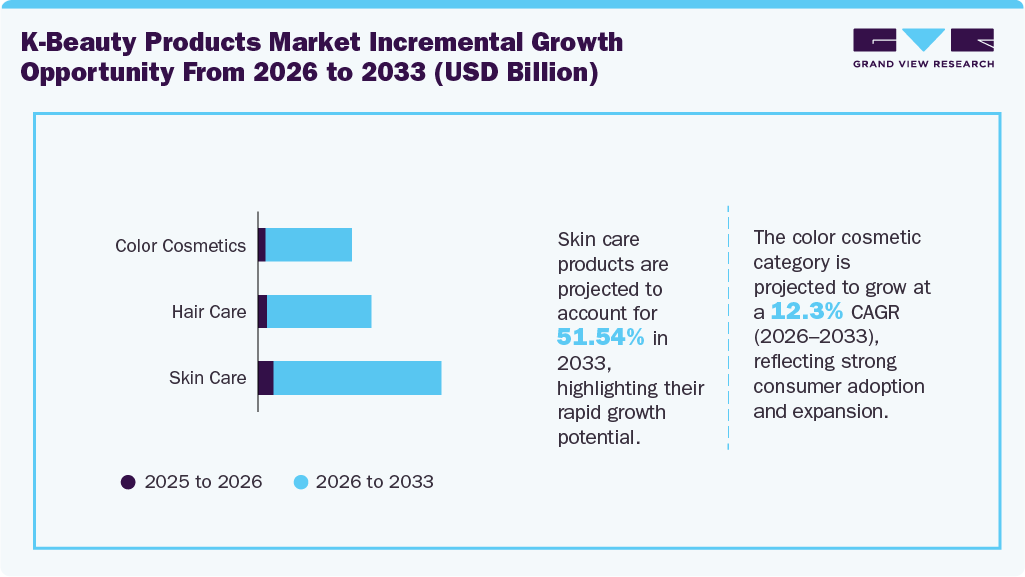
The color cosmetic category is anticipated to witness a CAGR of 12.3% from 2026 to 2033. Consumers increasingly prefer lightweight products such as cushion foundations, lip tints, and cream blushes that enhance rather than conceal the skin, aligning with the broader skin-first beauty trend. Continuous product innovation, hybrid skin care-makeup formulations, and affordable pricing make K-beauty cosmetics accessible to a broad consumer base.
End User Insights
Women held the largest revenue share of the K-beauty industry in 2025, accounting for 61.81%. Women have higher engagement in skin care and beauty routines, stronger awareness of skin health, and greater spending on personal care products. K-beauty’s multi-step skin care philosophy, wide product variety, and targeted solutions for concerns such as hydration, aging, acne, and brightening strongly resonate with female consumers who prioritize preventive skin care and appearance enhancement. In addition, marketing strategies, influencer promotions, and beauty trends primarily target women.
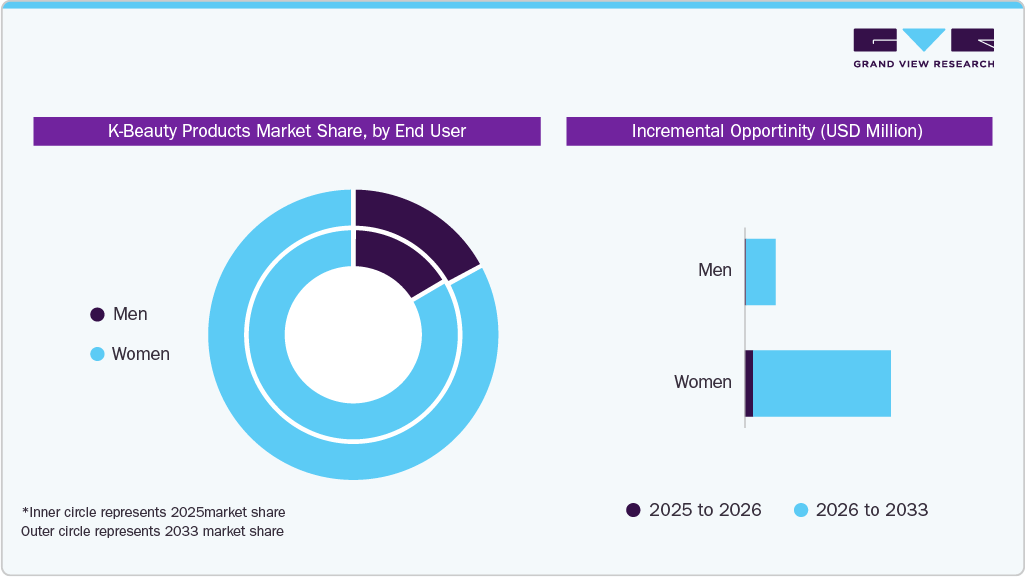
The demand for K-beauty products among men is anticipated to witness a CAGR of 10.9% from 2026 to 2033. Growing awareness about skin health, acne care, sun protection, and anti-aging has encouraged men to adopt simple skin care routines inspired by Korean beauty culture. The influence of K-pop idols, Korean actors, and social media trends has normalized male grooming and appearance consciousness globally. In addition, brands are launching gender-inclusive products and easy-to-use multifunctional skin care solutions tailored for men.
Distribution Channel Insights
Hypermarkets & supermarkets held the largest revenue share of the K-beauty industry in 2025, accounting for a share of 44.96%. These retail formats allow customers to physically examine textures, shades, and packaging before purchase, which is especially important for skin care and cosmetics. Competitive pricing, promotional discounts, and strong distribution partnerships with global retailers further attract mass-market buyers.
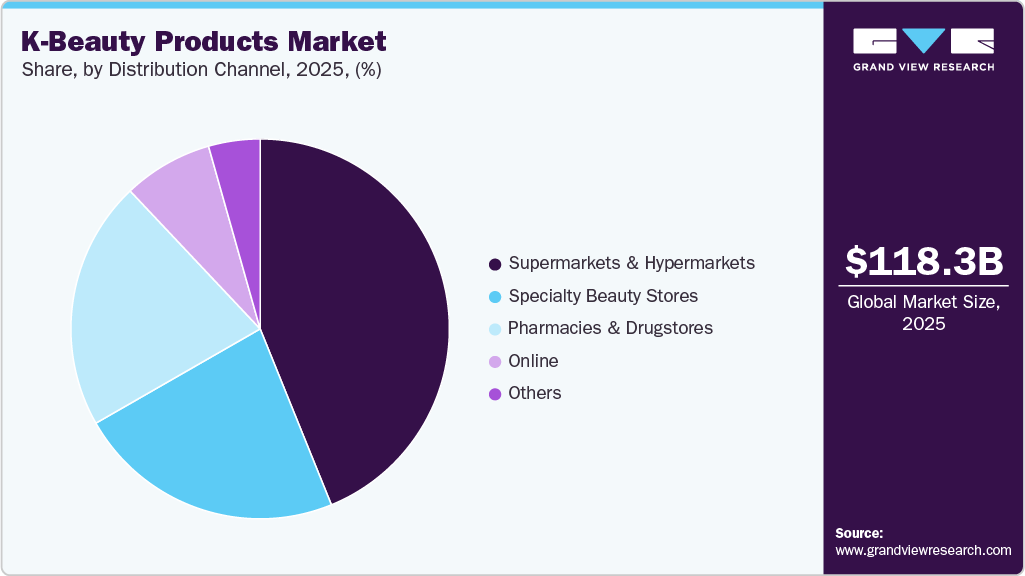
Online sales are expected to witness a CAGR of 11.8% from 2026 to 2033. Online platforms allow consumers to easily compare products, read reviews, access a broader range of international brands, and take advantage of discounts and personalized recommendations. The rise of influencer marketing, live commerce, and viral beauty trends on platforms such as Instagram and TikTok has further accelerated online purchases, especially among younger consumers. Brands are also collaborating to expand their reach. For instance, in October 2025, Kolmar Korea announced its partnership with Amazon Beauty at Amazon Beauty Seoul 2025, reflecting a strategic collaboration to accelerate the globalization of K-beauty brands. As the exclusive manufacturing sponsor, Kolmar Korea will work closely with Amazon to provide brands with product development expertise, manufacturing capabilities, and global distribution support, helping Korean beauty companies scale internationally.
Regional Insights
North America K-Beauty Products Market Trends
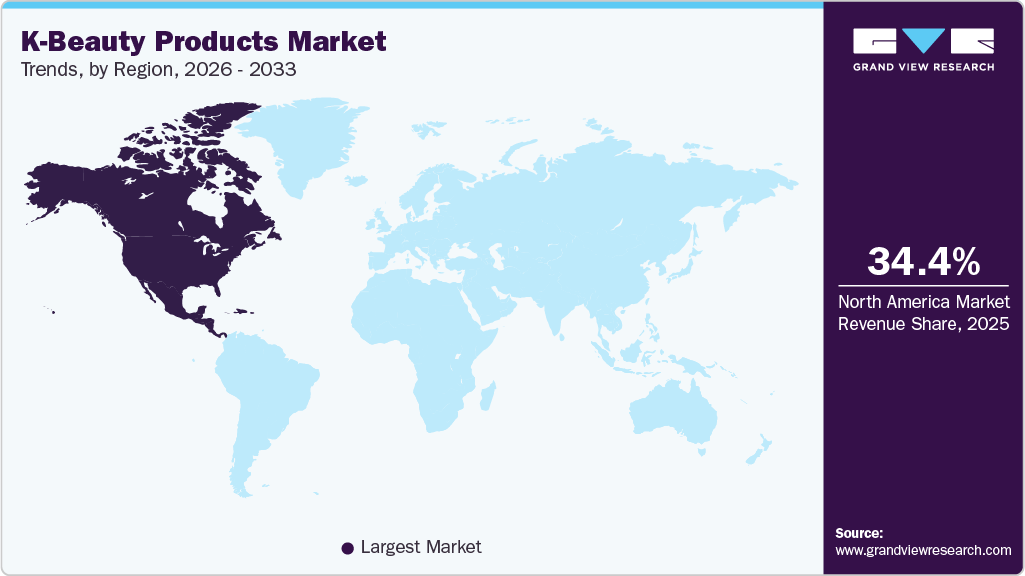
The K-beauty products market in North America held the largest revenue share of 34.38% of the global K-beauty products industry in 2025. Korean brands emphasize preventive skin care, multi-step routines, and advanced formulations featuring ingredients such as hyaluronic acid, snail mucin, centella asiatica, and fermented extracts. Consumers in the region increasingly prefer hydration, skin-barrier repair, and “glass skin” results over heavy makeup, driving higher demand for serums, essences, sheet masks, and gentle treatment products. Continuous product innovation, fast trend adaptation, and science-backed skin care solutions position K-beauty as a high-performance alternative to traditional Western beauty products.
U.S. K-Beauty Products Market Trends
The K-beauty products market in the U.S. held the revenue share of 67.96% in the North American K-beauty industry in 2025. K-beauty products in the U.S. are rapidly expanding beyond niche online platforms into major mainstream retailers such as Sephora, Ulta Beauty, Target, and department stores. This wider retail presence improves product accessibility, increases brand visibility, and enhances consumer trust by allowing shoppers to experience products in physical stores.
The K-beauty products market in Canada is anticipated to witness a CAGR of 8.6% from 2026 to 2033. In Canada, the K-beauty skin care market is gaining momentum as consumers increasingly prioritize clean, safe, and high-quality beauty products. Shoppers prefer ingredient transparency, dermatologically gentle formulations, and products free of harsh chemicals, aligning closely with K-beauty’s focus on botanical extracts, skin-barrier protection, and long-term skin health. This quality-driven purchasing behavior is encouraging Canadian consumers to adopt K-beauty skin care solutions that combine innovation, efficacy, and clean beauty standards.
Asia Pacific K-Beauty Products Market Trends
The K-beauty products market in Asia Pacific is anticipated to witness a CAGR of 11.3% from 2026 to 2033. Consumers increasingly prefer products formulated with natural extracts, fermented ingredients, and mild active compounds that promote skin health while minimizing irritation. K-beauty brands are responding by emphasizing transparency, sustainable sourcing, and dermatologically tested formulations, positioning clean beauty innovation as a key driver of the regional K-beauty product market's expansion.
The K-beauty products market in China held the revenue share of 34.59% in the Asia Pacific K-beauty industry in 2025. The popularity of Korean pop culture, including K-pop, K-dramas, and Korean celebrities, shapes beauty standards and consumer preferences. Exposure to Korean skin care routines and the “glass skin” aesthetic through social media and entertainment platforms increases brand awareness. It drives demand for K-beauty skin care products among younger Chinese consumers.
The K-beauty products market in Australia is anticipated to witness a growth rate of 12.2% from 2026 to 2033, supported by rising consumer interest in ingredient-focused skin care and multi-step beauty routines. Australian consumers are increasingly drawn to Korean formulations that emphasize hydration, skin barrier repair, and gentle actives, aligning with the broader shift toward preventative and wellness-oriented skin care.
In addition, the strong presence of cross-border e-commerce platforms, specialty beauty retailers, and social media-driven discovery is accelerating product accessibility and brand awareness across the country. Influencer-led education, growing demand for clean and cruelty-free formulations, and the popularity of hybrid makeup-skin care products are further strengthening market penetration and supporting the sustained growth of K-beauty brands in Australia.
Europe K-Beauty Products Market Trends
The K-beauty products market in Europe held a revenue share of 18.28% of the global K-beauty products industry in 2025. The rapid growth of e-commerce platforms and online beauty communities enhances product discovery and consumer education. Social media influencers, online reviews, and digital skin care content are increasing awareness of Korean beauty routines, encouraging online purchases and accelerating the adoption of K-beauty skin care products across European markets.
The K-beauty products market in the UK held the revenue share of 42.59% in the European K-beauty products industry. The rising demand for skin care-focused beauty routines as consumers increasingly prioritize skin health, hydration, and natural radiance over heavy makeup. K-beauty skin care products emphasizing preventive care, gentle formulations, and long-term skin benefits are gaining popularity among UK consumers seeking practical and minimalist beauty solutions.
The K-beauty products market in France is anticipated to witness a CAGR of 10.1% from 2026 to 2033. Consumers increasingly embrace innovative skin care solutions that complement the country’s established dermocosmetic culture. Rising interest in gentle formulations, hydration-focused skin care, and clean beauty ingredients is encouraging French consumers to adopt K-beauty skin care products, while expanding online retail channels and social media influence continue to enhance product awareness and market penetration.
Central & South America K-Beauty Products Market Trends
The K-beauty products market in Central & South America is anticipated to witness a CAGR of 9.7% from 2026 to 2033. The Central & South America K-beauty products market is growing as consumers become more beauty-conscious and increasingly adopt skin care-focused routines. Rising awareness of skin health, hydration, and preventive skin care is driving demand for K-beauty products known for innovative formulations, visible results, and premium, affordable positioning across the region.
Middle East & Africa K-Beauty Products Market Trends
The K-beauty products in the Middle East & Africa held a revenue share of 9.85% of the global K-beauty products industry in 2025. The Middle East & Africa (MEA) K-beauty market is emerging as a promising growth region, driven by rising beauty awareness, increasing disposable incomes, and strong demand for premium skin care solutions. Expanding urban populations, digital retail growth, and growing interest in global beauty trends are accelerating the adoption of K-beauty skin care products across countries such as the UAE, Saudi Arabia, South Africa, and Egypt.
Key K-Beauty Products Company Insights
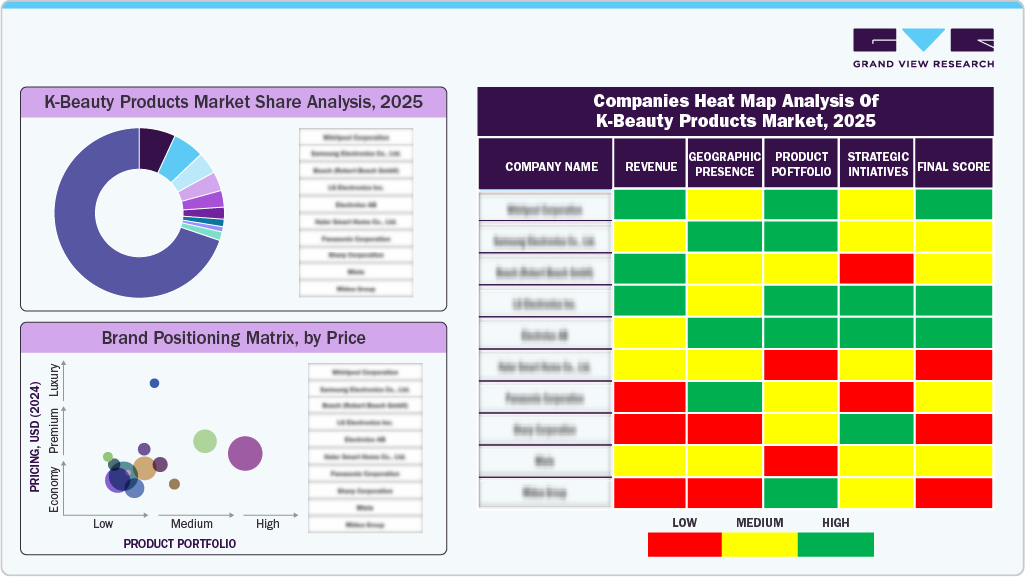
Leading players in the baby bassinet market include BANILLA CO, AMOREPACIFIC, and The Crème Shop, among others. The global K-beauty products market is highly competitive, characterized by established Korean cosmetics conglomerates, emerging indie K-beauty brands, dermatology-driven skin care companies, and digitally native direct-to-consumer players expanding into specialty beauty stores, supermarkets, department stores, and online marketplaces. Companies are increasingly focusing on rapid product innovation, advanced skin care formulations, unique ingredients, and trend-driven product development to meet evolving consumer demand for effective, skin-first, and technology-inspired beauty solutions. Strong emphasis on research and development, global collaborations, and social media-led marketing strategies continues to strengthen brand differentiation and accelerate international expansion within the K-beauty products market.
Key K-Beauty Products Companies:
The following key companies have been profiled for this study on the K-beauty products market.
- BANILLA CO
- AMOREPACIFIC
- The Crème Shop
- Clio
- CARVER KOREA CO. (Unilever)
- Able C&C
- The Face Shop, Inc.
- Nature Republic
- TolyMoly
- LG HOUSEHOLD & HEALTH CARE LTD.
Recent Developments
-
In November 2025, Actress and entrepreneur Shay Mitchell launched Rini, a Korean-made skin care brand designed specifically for children, developed alongside Esther Song and Matte Babel, and formulated with pediatric chemists in South Korea. The brand debuted with a five-product lineup, including what is promoted as the world’s first hydrogel face mask tailored for kids, focusing on gentle, safe formulations and playful designs to encourage early self-care routines.
-
In May 2025, Amorepacific’s Korean skin care brand Hanyul expanded its international presence through an exclusive launch at Sephora in the United States, marking a strategic step in accelerating global growth for heritage-driven K-beauty brands. The launch introduced Hanyul’s skin care range both online and across more than 300 Sephora stores, positioning the brand as a premium yet accessible offering rooted in traditional Korean botanical ingredients combined with science-backed formulations.
K-Beauty Products Market Report Scope
Report Attribute
Details
Market size in 2026
USD 129.20 billion
Revenue forecast in 2033
USD 252.41 billion
Growth rate (Revenue)
CAGR of 10.0% from 2026 to 2033
Actuals
2021 - 2025
Forecast period
2026 - 2033
Quantitative units
Revenue in USD million/billion, and CAGR from 2026 to 2033
Report coverage
Revenue forecast, company ranking, competitive landscape, growth factors, and trends
Segments covered
Product, end user, distribution channel, region
Region Covered
North America; Europe; Asia Pacific; Central & South America; Middle East & Africa
Country Covered
U.S.; Canada; UK; Germany; France; China; Singapore; Japan; Australia; Brazil; UAE; South Africa; Mexico; Italy; Spain; India
Key companies profiled
BANILLA CO; AMOREPACIFIC; The Crème Shop; Clio; CARVER KOREA CO. (Unilever); Able C&C; The Face Shop, Inc.; Nature Republic; TolyMoly; LG HOUSEHOLD & HEALTH CARE LTD.
Customization scope
Free report customization (equivalent to up to 8 analysts’ working days) with purchase. Addition or alteration to country, regional & segment scope.
Pricing and purchase options
Avail customized purchase options to meet your exact research needs. Explore purchase options
Global K-Beauty Products Market Report Segmentation
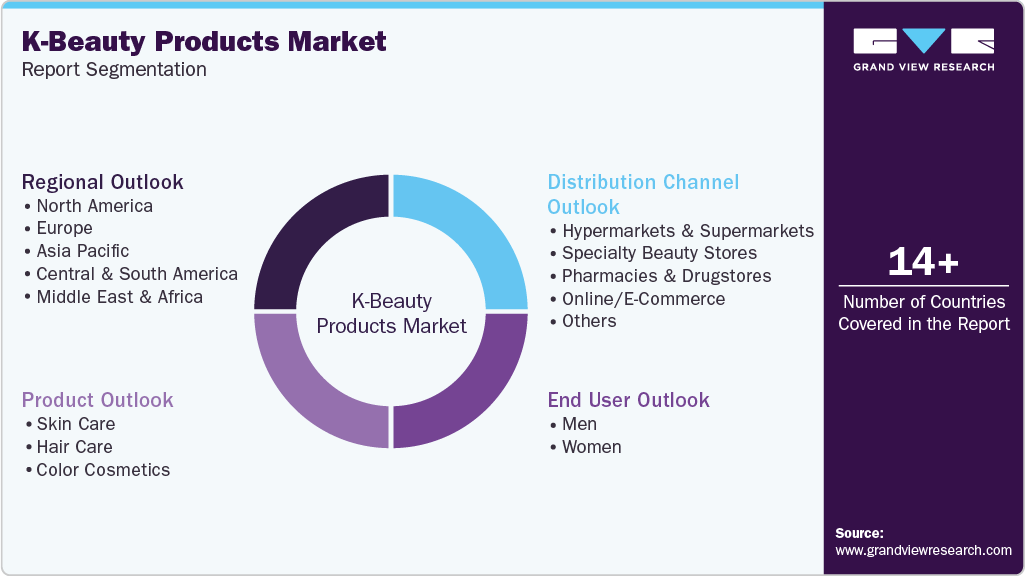
This report forecasts revenue growth at global, regional & country levels and provides an analysis of the latest trends and opportunities in each of the sub-segments from 2021 to 2033. For this study, Grand View Research has segmented the K-beauty products market on the basis of product, end user, distribution channel, and region.
-
Product Outlook (Revenue, USD Billion, 2021 - 2033)
-
Skin Care
-
Face Skin Care
-
Lotions, Face Creams, & Moisturizers
-
Cleansers & Face Wash
-
Facial Serums
-
Facial Masks
-
Sunscreen/Sun Care
-
Others (Scrub, etc.)
-
-
Body Skin Care
-
Lotions, Creams, & Moisturizers
-
Body Sunscreen/Sun Care
-
Body Scrub
-
Others (Serum, Oils, etc.)
-
-
-
Hair Care
-
Shampoo
-
Conditioner
-
Oils
-
Serums
-
Others (Hair Masks, Peels, Etc.)
-
-
Color Cosmetics
-
Face Color Cosmetics
-
Lip Color Cosmetics
-
Eye Color Cosmetics
-
Nail Color Cosmetics
-
-
-
End User Outlook (Revenue, USD Billion, 2021 - 2033)
-
Men
-
Women
-
-
Distribution Channel Outlook (Revenue, USD Billion, 2021-2033)
-
Hypermarkets & Supermarkets
-
Specialty Beauty Stores
-
Pharmacies & Drugstores
-
Online/E-Commerce
-
Others
-
-
Regional Outlook (Revenue, USD Billion, 2021 - 2033)
-
North America
-
U.S.
-
Canada
-
Mexico
-
-
Europe
-
Germany
-
UK
-
France
-
Italy
-
Spain
-
-
Asia Pacific
-
China
-
India
-
Japan
-
Australia
-
-
Central & South America
-
Brazil
-
-
Middle East and Africa
-
UAE
-
South Africa
-
-
Frequently Asked Questions About This Report
b. Some of the key players operating in the K-beauty products market include BANILLA CO, AMOREPACIFIC, The Crème Shop, Clio, CARVER KOREA CO. (Unilever), Able C&C, The Face Shop, Inc., Nature Republic, TolyMoly, and LG HOUSEHOLD & HEALTH CARE LTD.Coty Inc.
b. Key factors that are driving the K-beauty products market growth include the rising awareness of chemical-free beauty products and the rising popularity of personalized skincare products.
b. The K-beauty products market was estimated at USD 118.28 billion in 2025 and is expected to reach USD 129.20 billion in 2026.
b. The K-beauty products market is expected to grow at a compound annual growth rate of 10.0% from 2026 to 2033 to reach USD 252.41 billion by 2033.
b. North America dominated the K-beauty products market with a share of around 34.4% in 2025. This is owing to the people are moving toward a healthy lifestyle and are thinking of a sustainable environment, thus preferring beauty products made from organic and plant-based ingredients.


Share this report with your colleague or friend.
Need a Tailored Report?
Customize this report to your needs — add regions, segments, or data points, with 20% free customization.


ISO 9001:2015 & 27001:2022 Certified
We are GDPR and CCPA compliant! Your transaction & personal information is safe and secure. For more details, please read our privacy policy.
Trusted market insights - try a free sample
See how our reports are structured and why industry leaders rely on Grand View Research. Get a free sample or ask us to tailor this report to your needs.