- Home
- »
- Beauty & Personal Care
- »
-
India Yoga Market Size And Share, Industry Report, 2033GVR Report cover
![India Yoga Market Size, Share & Trends Report]()
India Yoga Market (2026 - 2033) Size, Share & Trends Analysis Report By Delivery Mode (Online, Offline, Yoga Accreditation Training Programs), By End User, By Age Group (Below 18 Years, 18 - 29 Years, 30 - 50 Years, Above 50 Years), And Segment Forecasts
- Report ID: GVR-4-68040-861-6
- Number of Report Pages: 110
- Format: PDF
- Historical Range: 2021 - 2025
- Forecast Period: 2026 - 2033
- Industry: Consumer Goods
- Report Summary
- Table of Contents
- Segmentation
- Methodology
- Download FREE Sample
-
 Download Sample Report
India Yoga Market Summary
The India yoga market size was estimated at USD 5.06 billion in 2025 and is expected to reach USD 11.0 billion by 2033, growing at a CAGR of 10.2% from 2026 to 2033. This growth is driven by rising health consciousness, increasing stress-related lifestyle disorders, and growing awareness of yoga as a holistic approach to physical and mental well-being.
Key Market Trends & Insights
- By delivery mode, the offline yoga courseled the India yoga market, with a share of 73.45% in 2025.
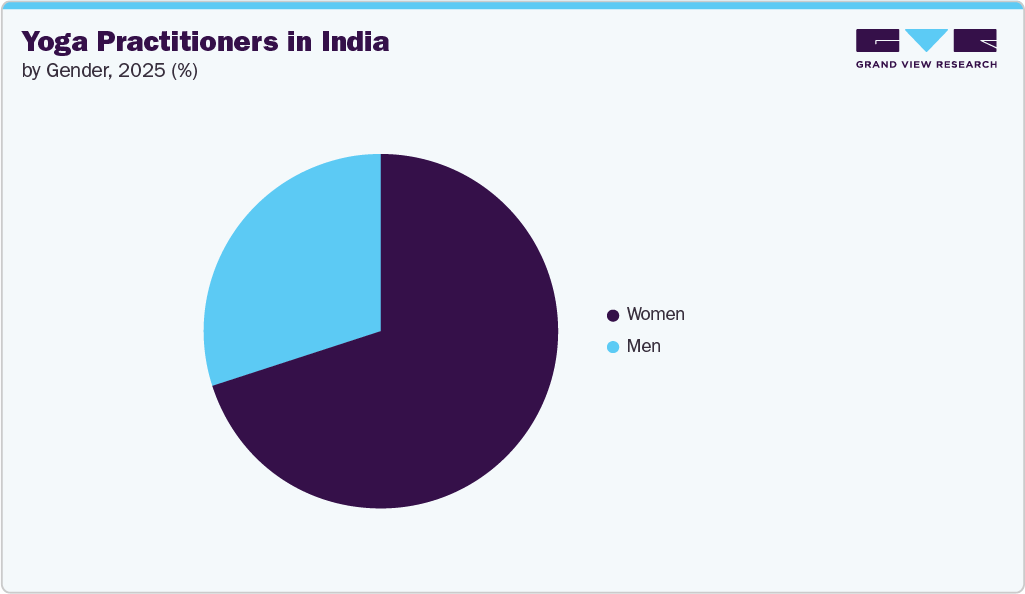
- By end user, the femalesegment led the market with a share of 64.93% in 2025.
- By age group, the 30-50 years segment led the market, with a share of 43.80% in 2025
Market Size & Forecast
- 2025 Market Size: USD 5.06 Billion
- 2033 Projected Market Size: USD 11.0 Billion
- CAGR (2026-2033): 10.2%
Government initiatives such as the promotion of International Yoga Day and the integration of yoga into public health programs continue to support market expansion. The increasing adoption of yoga among urban populations, corporate wellness programs, and younger demographics is further accelerating demand.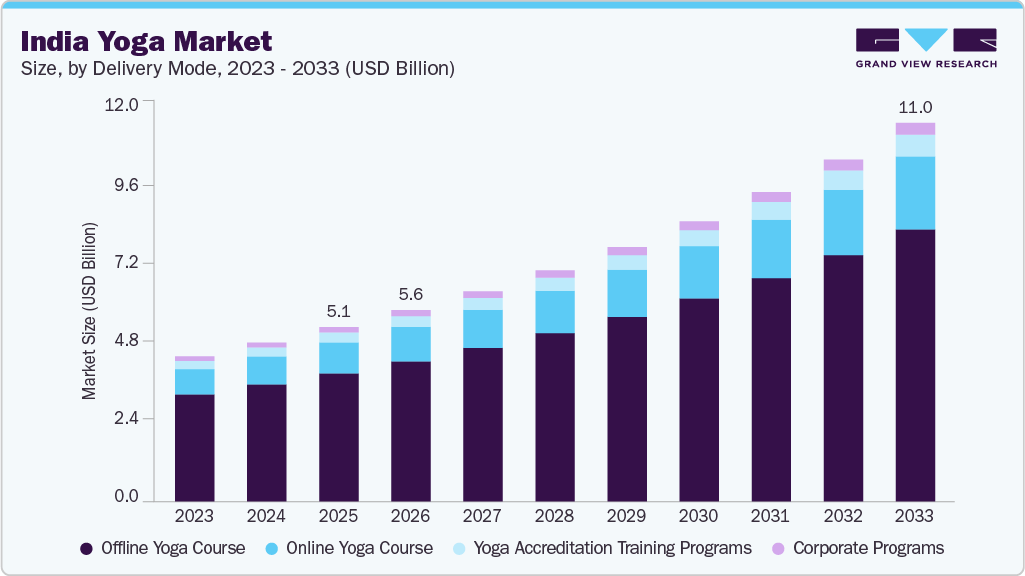
According to the data published in May 2025, Delhi Government Schools are introducing courses that include yoga and self-help alongside other subjects for students up to Class 10, signaling the formal incorporation of yoga into school learning modules. Rising smartphone penetration and affordable internet are expanding access to online classes and apps. Moreover, as health-conscious urban populations grow, they are investing in yoga equipment, wearables, and personalized training programs.
Additionally, the Indian yoga market is influenced by government initiatives and campaigns promoting yoga for public health and international recognition. According to the Nationwide Impact Assessment Survey on the International Day of Yoga (IDY) 2025, approximately 231.4 million people participated in yoga events on IDY 2023.
Moreover, rising disposable incomes allow consumers to spend on premium classes, retreats, and specialized equipment. The influx of wellness startups offering innovative solutions, from apps to on-demand sessions, is expanding consumer choice. Furthermore, community-driven events and social media challenges are motivating more individuals to adopt yoga as part of their lifestyle consistently.
This visibility sustains yoga’s cultural relevance and supports related markets, including training programs, retreats, and equipment purchases. According to the Yog4Lyf data, the yoga studio examined the behavior of approximately 55,000 online yoga users and found that in India, 83.8% of online consumption was dedicated to yoga classes. At the same time, pranayama sessions accounted for the remaining 16.2%.
This expanding user base spans millennials, Gen X, and diverse urban demographics, creating a broad and resilient participation ecosystem. As yoga becomes increasingly integrated into daily life in India, participation is growing across both online and offline sessions. Users are not just taking one-time classes; they are increasingly opting for recurring sessions and program upgrades. Preferences for guided instruction, flexible timings, and holistic practices are fueling sustained growth in India’s yoga market. According to the data published in June 2025, about 74% of millennials in India practice yoga regularly, followed by Gen X at 70%.
Consumer Insights
Men tend to practice yoga to enhance physical strength, endurance, and posture. Stress reduction and recovery from sports-related strains are significant motivators. Online platforms appeal by offering time-efficient routines and guided sessions suited for fitness goals. Additionally, curiosity about mindfulness and mental focus drives adoption among male users.
Women are primarily drawn to yoga for stress relief, mental wellness, and flexibility improvement. Many also cite weight management and holistic health as key motivators. According to the data published in December 2025, women over the age of 40 prefer yoga-first programs. The convenience of online sessions allows them to balance fitness with work and family commitments. Social and community engagement through virtual classes further encourages consistent practice.
Delivery Mode Insights
Offline yoga courses led the India yoga industry, accounting for the largest revenue share of 73.45%. Offline yoga courses in India are increasingly structured around specific practice needs and outcome-driven goals, rather than broad, generalized wellness offerings. Physical studios and training centers design focused modules such as Hatha yoga, Ashtanga, prenatal yoga, therapeutic yoga, and meditation-led programs, each addressing distinct physical or mental objectives. For instance, in January 2026, a new meditation center was inaugurated in Tirupati by the Yogoda Satsanga Society, reinforcing the role of physical, in-person spaces in promoting inner well-being and spiritual growth.
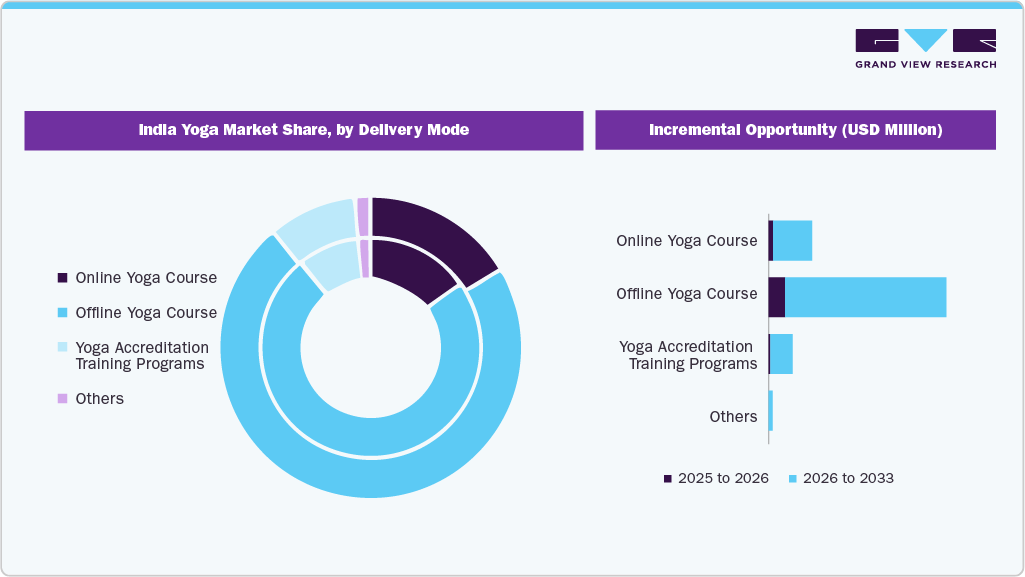
The online yoga course segment is anticipated to grow at a CAGR of 11.4% from 2026 to 2033. Factors such as demanding work schedules, academic pressures, urban congestion, and limited time for commuting to physical studios have pushed many consumers toward online yoga courses as a convenient, accessible alternative. Rather than being viewed as clinical or corrective interventions, these courses are increasingly perceived as lifestyle enablers that help individuals maintain physical activity, manage stress, and improve mental focus within the constraints of modern living. For instance, in June 2025, Habuild, a digital wellness initiative, brought together an unprecedented number of participants for an online yoga session, setting a new global milestone for virtual engagement. On International Yoga Day, the platform connected over 7.5 lakh people from around the world in a single live online yoga class, surpassing previous participation records and highlighting the potential of digital formats to unify large global audiences around shared wellness practices.
End User Insights
The female segment led the India yoga market, accounting for the largest revenue share of 64.93% in 2025. Female consumers in India are increasingly adopting yoga as a functional, outcome-oriented practice rather than a purely recreational activity. Yoga is widely used for posture correction, stress regulation, and mobility maintenance, particularly in response to prolonged sitting, extended screen exposure, and mounting work-life pressure. The emphasis on breathing techniques, flexibility, and core stability aligns strongly with women seeking sustainable fitness outcomes without excessive physical strain. Structured class schedules and instructor-led formats further support consistency, allowing yoga to be integrated into daily or weekly routines with minimal disruption.
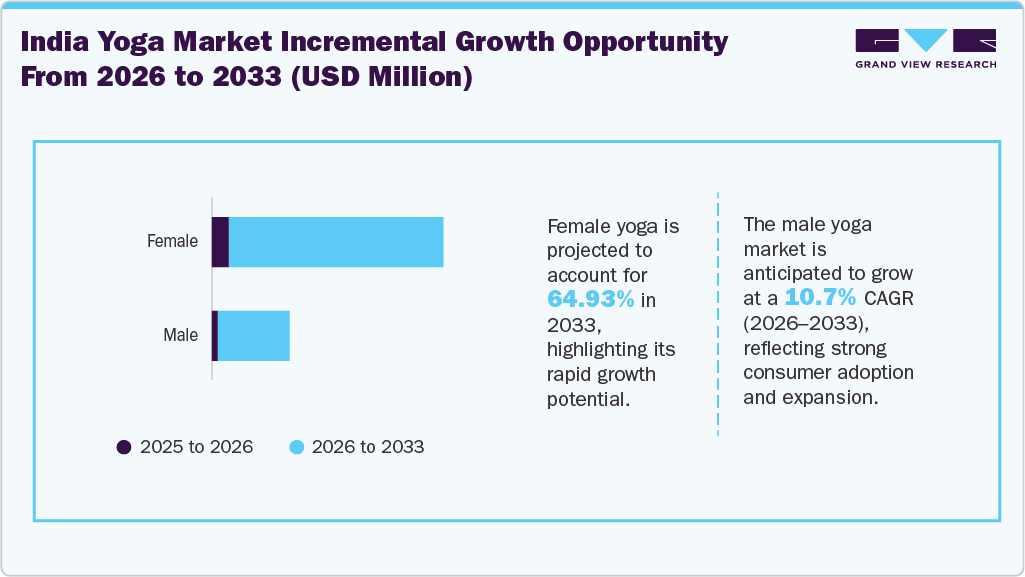
The male yoga market segment is anticipated to witness a CAGR of 10.7% from 2026 to 2033. Men increasingly favor yoga as it complements demanding work schedules and physically or mentally strenuous lifestyles. High levels of occupational stress, sedentary desk jobs, long screen hours, and rising awareness around posture-related issues have made yoga a practical solution rather than a purely spiritual or recreational activity. Many male practitioners view yoga as a tool for endurance, mental clarity, and long-term physical resilience, often combining it with gym training, running, or sports. Instructor-led sessions and goal-oriented programs further enhance adoption by offering structure, progression, and measurable outcomes.
Age Group Insights
The 30-50 years age group segment held the largest revenue share of the India yoga industry in 2025, accounting for a share of 43.80%. Participation among individuals aged 30-50 years in India’s yoga market is strongly influenced by trust, structure, and perceived credibility, particularly as yoga is increasingly adopted as a long-term health management tool rather than a casual fitness activity. According to The Economic Times, a large share of India’s millennial and working-age population now practices yoga regularly, reflecting how this age group has moved beyond awareness into habitual adoption. For individuals in this life stage, yoga is increasingly positioned as a preventive health practice that supports long-term physical stability, mental resilience, and work-life balance, rather than as a recreational or trend-led activity.
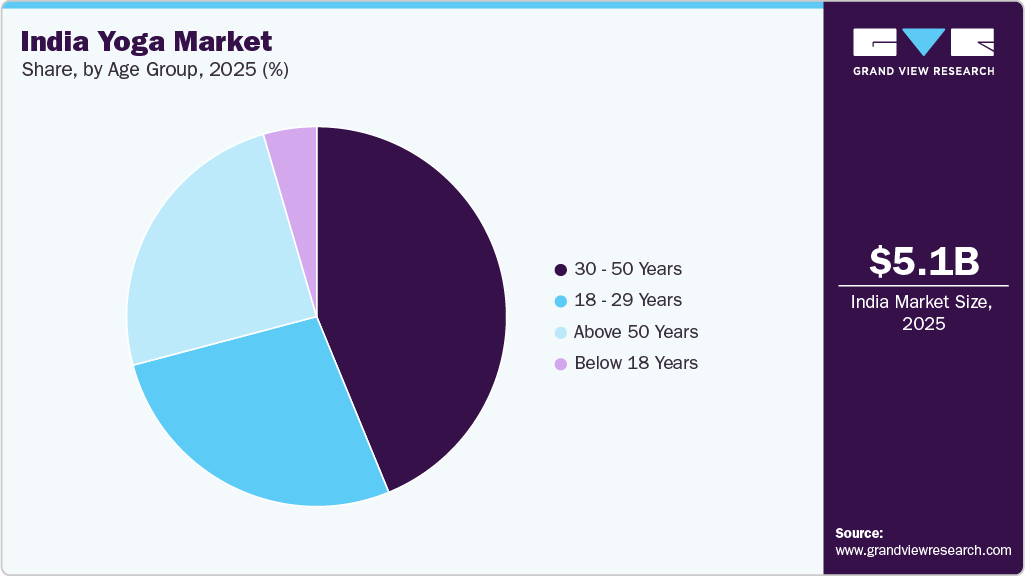
The 18-29 years’ age group is anticipated to witness a CAGR of 11.0% from 2026 to 2033. Participation among individuals aged 18-29 years in India’s yoga market is strongly shaped by credibility, guidance, and structured learning environments, which resonate with this age group’s preference for informed and purposeful wellness choices. According to a report cited by Deccan Herald, millennials are leading the adoption of yoga in India, with 74% practicing it regularly, reflecting high acceptance among young adults seeking both physical fitness and mental balance. For this cohort, yoga is not viewed as an occasional activity but as a disciplined lifestyle practice that supports stress management, focus, and long-term well-being during formative career and life stages.
Key India Yoga Company Insights
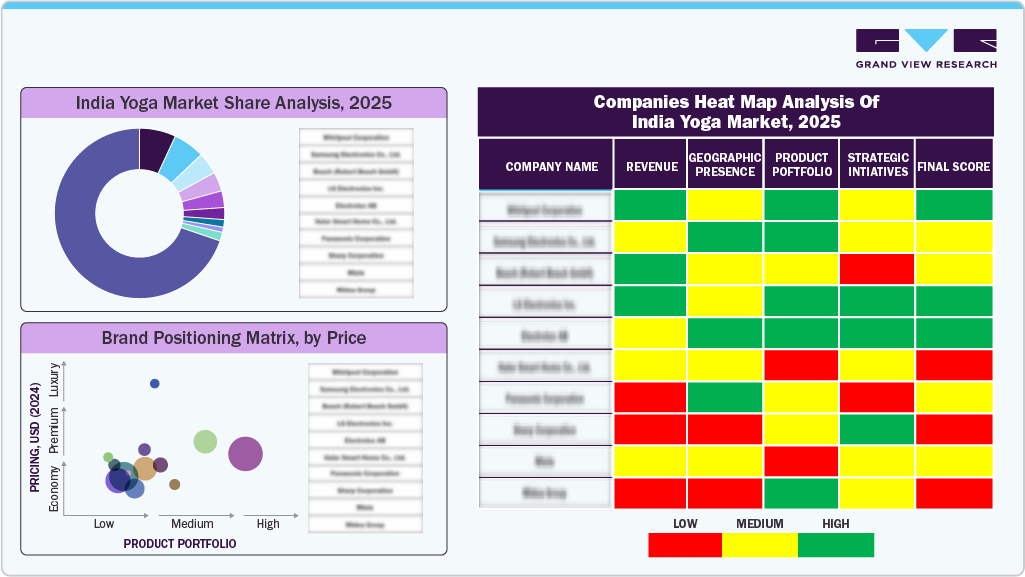
Leading players in the India yoga market include Isha Foundation, The Art of Living, and The Yoga Institute. The Indian yoga market remains highly competitive, with major yoga studios, wellness brands, and independent practitioners expanding their presence across urban fitness centers, corporate offices, educational institutions, healthcare facilities, and fast-growing digital and subscription-based platforms to improve customer reach and retention. Providers are increasingly investing in service innovation, holistic and wellness-focused yoga programs, instructor certification and training, and technology-enabled delivery models such as online classes, mobile apps, and data-driven wellness tracking to meet evolving consumer expectations for physical fitness, mental well-being, personalization, and lifestyle sustainability.
Key India Yoga Companies:
- Isha Foundation
- The Art of Living
- The Yoga Institute
- cult.fit
- HealthifyMe
- Sarva Yoga
- Kaivalyadhama Shriman Madhava Yoga Mandir Samiti.
- Sivananda Yoga
- 136.1 Yoga & Wellness Academy
- Kashish Yoga School India.
Recent Developments
-
In January 2026, the Isha Foundation introduced “In the Grace of Yoga”, a special program designed by Sadhguru to help participants deepen their connection with yoga and prepare for the spiritual significance of Mahashivratri. The initiative aims to harness the natural rise in inner energy associated with the festival by guiding individuals through meditative practices and experiential processes that focus on the five elements of existence. Delivered through immersive practices and guided sessions, the program seeks to enhance receptivity and spiritual engagement as the auspicious night of Mahashivratri approaches, offering participants a transformative experience rooted in yogic tradition.
-
In October 2025, the Kairali Ayurvedic Group announced the upcoming launch of Villa Raag, a luxury yoga and wellness-focused boutique resort at Agonda Beach in South Goa, set to open within a month. Spanning nearly two acres along the coastline, the five-star retreat is designed to blend mindful living, modern luxury, and natural serenity, offering beachfront access, refined technology-enabled villas, personalised hospitality, and curated yoga and wellness experiences. The property will feature dedicated yoga sessions, Ayurvedic-inspired wellness programs, and tranquil outdoor spaces to create an immersive environment for relaxation and rejuvenation, appealing to both domestic and international travellers seeking elevated wellness-led hospitality.
-
In September 2025, Sarovar Hotels & Resorts launched The Shoonyam Retreat, a wellness-oriented hospitality experience developed in collaboration with fitness expert Dr. Mickey Mehta. The retreat is designed to offer guests a holistic health programme that blends physical wellness, mindfulness practices, and personalized lifestyle guidance. With an emphasis on integrated well-being, the initiative includes curated activities, fitness modules, and therapeutic sessions to enhance guests’ physical, mental, and emotional balance, positioning The Shoonyam Retreat as a lifestyle-led addition to the hospitality group’s portfolio.
India Yoga Market Report Scope
Report Attribute
Details
Market size value in 2026
USD 5.56 billion
Revenue forecast in 2033
USD 11.0 billion
Growth rate
CAGR of 10.2% from 2025 to 2033
Actuals
2021 - 2025
Forecast period
2026 - 2033
Quantitative units
Revenue in USD million/billion and CAGR from 2026 to 2033
Report coverage
Revenue forecast, company ranking, competitive landscape, growth factors, and trends
Segments covered
Delivery mode, end user, age group
Key companies profiled
Isha Foundation; The Art of Living; The Yoga Institute; cult.fit; HealthifyMe; Sarva Yoga; Kaivalyadhama Shriman Madhava Yoga Mandir Samiti. ; Sivananda Yoga; 136.1 Yoga & Wellness Academy; and Kashish Yoga School India
Customization scope
Free report customization (equivalent up to 8 analysts’ working days) with purchase. Addition or alteration to country, regional & segment scope.
Pricing and purchase options
Avail customized purchase options to meet your exact research needs. Explore purchase options India Yoga Market Report Segmentation
This report forecasts revenue growth at the country level and provides an analysis of the latest trends and opportunities in each sub-segment from 2021 to 2033. For this study, Grand View Research has segmented the India yoga market report based on delivery mode, end use, and age group:
-
Application Outlook (Revenue, USD Million, 2021 - 2033)
-
Orthodontics
-
Aligner models
-
Retainer models
-
-
Prosthodontics
-
Crowns & bridges (temporary / casting patterns)
-
Denture bases
-
Temporary Tooth
-
Permanent Tooth
-
-
Try-in dentures
-
Wax-ups
-
-
Implantology
-
Surgical Guides
-
Implant Models
-
-
Oral & Maxillofacial Surgery
-
Other Dental Applications
-
Night Guards
-
Splints
-
Custom trays
-
-
-
Technology Outlook (Revenue, USD Million; 2021 - 2033)
-
Vat Photopolymerization
-
Stereolithography
-
Digital Light Processing
-
-
Polyjet Technology
-
Fused Deposition Modelling
-
Selective Laser Sintering
-
Others
-
-
Material Outlook (Revenue, USD Million; 2021 - 2033)
-
Metals
-
Photopolymer
-
Ceramic
-
Others
-
-
End Use Outlook (Revenue, USD Million; 2021 - 2033)
-
Dental Clinics
-
Dental Laboratories
-
Academic and Research Institutes
-
-
Regional Outlook (Revenue, USD Million, 2021 - 2033)
-
North America
-
U.S.
-
Canada
-
Mexico
-
-
Europe
-
Germany
-
UK
-
France
-
Italy
-
Spain
-
Sweden
-
Denmark
-
Norway
-
-
Asia Pacific
-
Japan
-
China
-
India
-
Australia
-
South Korea
-
Thailand
-
-
Latin America
-
Brazil
-
Argentina
-
-
Middle East & Africa
-
South Africa
-
Saudi Arabia
-
UAE
-
Kuwait
-
-
Frequently Asked Questions About This Report
b. Offline yoga course held the largest revenue share of the India yoga industry in 2025, accounting for a share of 73.45%. Offline yoga courses in India are increasingly structured around specific practice needs and outcome-driven goals, rather than broad, generalized wellness offerings
b. The India yoga market was estimated at USD 5.06 billion in 2025 and is expected to reach USD 5.56 billion in 2026.
b. Some of the key players operating in the India yoga market include Isha Foundation; The Art of Living; The Yoga Institute; cult.fit; HealthifyMe; Sarva Yoga; Kaivalyadhama Shriman Madhava Yoga Mandir Samiti. ; Sivananda Yoga; 136.1 Yoga & Wellness Academy; Kashish Yoga School India
b. This growth is driven by rising health consciousness, increasing stress-related lifestyle disorders, and growing awareness of yoga as a holistic approach to physical and mental well-being. Government initiatives such as the promotion of International Yoga Day and the integration of yoga into public health programs continue to support market expansion.
b. The India yoga market is expected to grow at a compound annual growth rate of 10.2% from 2026 to 2033, reaching USD 11.00 billion by 2033.


Share this report with your colleague or friend.
Need a Tailored Report?
Customize this report to your needs — add regions, segments, or data points, with 20% free customization.


ISO 9001:2015 & 27001:2022 Certified
We are GDPR and CCPA compliant! Your transaction & personal information is safe and secure. For more details, please read our privacy policy.
Trusted market insights - try a free sample
See how our reports are structured and why industry leaders rely on Grand View Research. Get a free sample or ask us to tailor this report to your needs.