- Home
- »
- Consumer F&B
- »
-
Food Colors Market Size And Share, Industry Report, 2033GVR Report cover
![Food Colors Market Size, Share & Trends Report]()
Food Colors Market (2026 - 2033) Size, Share & Trends Analysis Report By Type (Natural, Synthetic, Nature-Identical, Caramel), By Form (Powder, Liquid, Gel & Paste), By Source (Plants, Microbes), By Application, By Region, And Segment Forecasts
- Report ID: 978-1-68038-229-7
- Number of Report Pages: 84
- Format: PDF
- Historical Range: 2021 - 2024
- Forecast Period: 2026 - 2033
- Industry: Consumer Goods
- Report Summary
- Table of Contents
- Interactive Charts
- Methodology
- Download FREE Sample
-
 Download Sample Report
Food Colors Market Summary
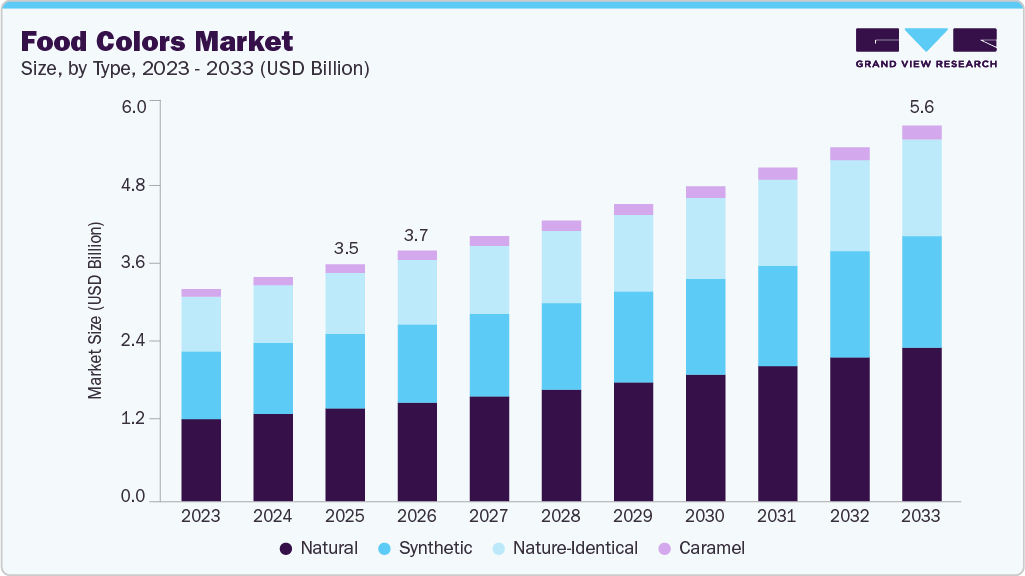
The global food colors market size was estimated at USD 3.5 billion in 2025 and is projected to reach USD 5.6 billion by 2033, growing at a CAGR of 5.9% from 2026 to 2033. Market growth is primarily driven by increasing demand for visually appealing food products across the bakery, confectionery, beverages, and dairy categories.
Key Market Trends & Insights
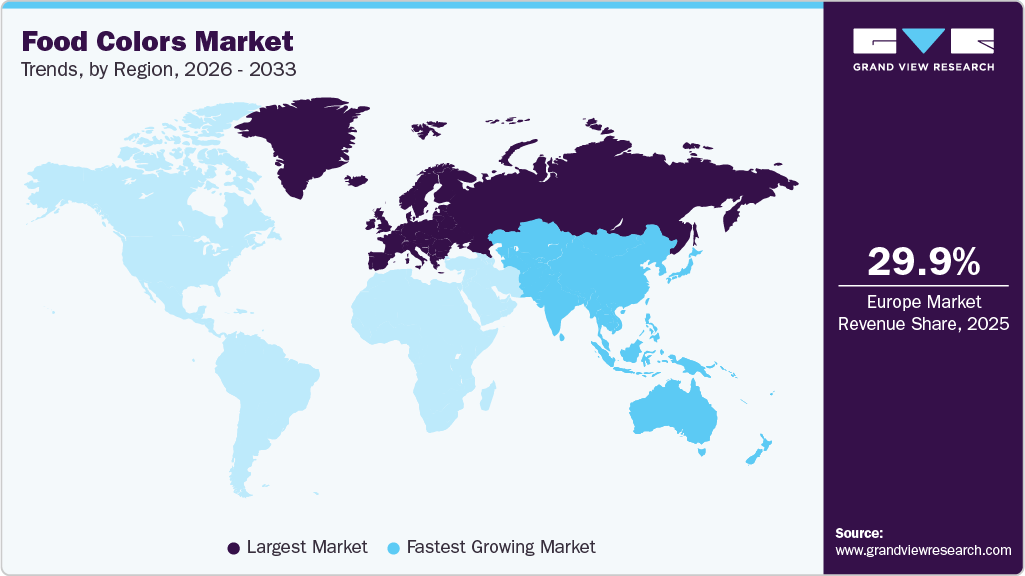
- Europe dominated the global food colors market with the largest revenue share of 29.9% in 2025.
- By type, the natural segment is expected to witness at the fastest CAGR of 6.5% from 2026 to 2033.
- By form, the powder segment led the market with the largest revenue share of 51.8% in 2025.
- By source, the plant segment is expected to grow at the fastest CAGR of 6.4% during the forecast period.
- By application, the beverages segment is expected to grow at the fastest CAGR of 6.6% during the forecast period.
Market Size & Forecast
- 2025 Market Size: USD 3.5 Billion
- 2033 Projected Market Size: USD 5.6 Billion
- CAGR (2026-2033): 5.9%
- Europe: Largest market in 2025
- Asia Pacific: Fastest growing market
Color plays a critical role in shaping consumer perceptions and purchasing decisions, particularly in packaged foods, where visual differentiation is essential. Food manufacturers are therefore incorporating advanced coloring solutions to enhance product appearance and maintain brand consistency.The rising consumer preference for clean-label and natural ingredients. As awareness of health and wellness continues to grow, consumers are increasingly avoiding artificial additives and seeking products formulated with plant-based or naturally derived colors. This trend has encouraged manufacturers to invest in natural pigments such as carotenoids, anthocyanins, and chlorophyll extracted from fruits, vegetables, and botanical sources
The expansion of the global processed food and beverage industry is supporting steady demand for food colors. Rapid urbanization, changing dietary patterns, and increasing consumption of convenience foods are driving product innovation in packaged food categories. Food colors enable manufacturers to maintain product stability and aesthetic appeal during processing, storage, and transportation, further strengthening their role in modern food formulations.
Market Concentration & Characteristics
The global food colors industry is moderately consolidated, with a few multinational ingredient manufacturers dominating global supply, alongside several regional producers specializing in natural pigments. Leading companies maintain strong market positions through extensive product portfolios, proprietary extraction technologies, and well-established distribution networks across the food and beverage industries. Large ingredient suppliers also benefit from long-term partnerships with food manufacturers, enabling consistent demand and product innovation.
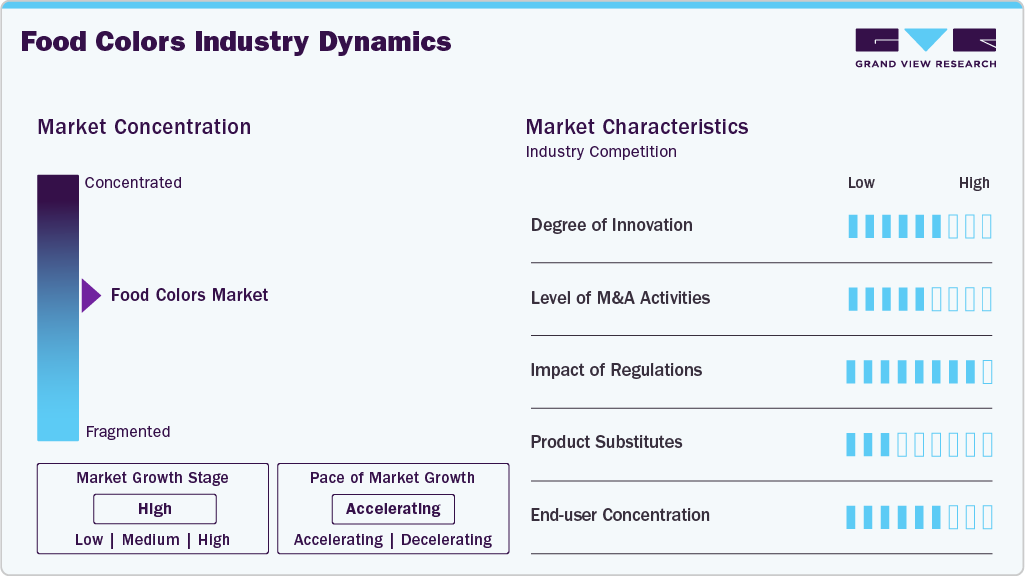
Competitive intensity within the food color industry is driven by increasing investments in research and development, particularly for natural and plant-based coloring solutions. Companies are focusing on developing stable natural color formulations that can withstand heat, pH variations, and light exposure during food processing. Strategic acquisitions, collaborations with food manufacturers, and expansion of production capacities are also common strategies used to strengthen global presence and capture emerging market opportunities
Type Insights
The natural segment led the market with the largest revenue share of 39.2% in 2025 and is projected to grow at the fastest CAGR during the forecast period. This growth is due to the strong shift toward clean-label and plant-derived ingredients. Consumers increasingly prefer natural colors extracted from fruits, vegetables, and botanical sources as alternatives to synthetic additives. Regulatory pressures and labeling transparency requirements in several regions have also encouraged food manufacturers to reformulate products using natural color solutions. As a result, natural systems have gained widespread adoption across beverage, confectionery, and dairy applications.
The caramel segment is expected to grow at a significant CAGR of 6.2% during the forecast period. This is due to its widespread use in beverages, bakery, and savory food applications. Caramel color is valued for its stability, versatility, and cost-effectiveness compared to many natural pigments. It is commonly used in carbonated soft drinks, sauces, confectionery products, and baked goods. The growing demand for dark-colored beverages and processed foods continues to support the expansion of this segment
Form Insights
The powder segment led the market with the largest revenue share of 51.8% in 2025. The growth is primarily driven by its longer shelf life and ease of storage compared to liquid forms. Powdered food colors offer better stability and are widely used in dry food formulations such as bakery premixes, confectionery coatings, and snack seasonings. They are also easier to transport and handle in large-scale manufacturing environments. These advantages have made powder-based formulations the preferred choice for many food processors.
The liquid segment is expected to grow at the fastest CAGR of 6.2% during the forecast period, due to its convenience in beverage and dairy applications. Liquid colors offer superior dispersion and uniform mixing, making them suitable for ready-to-drink beverages, syrups, and liquid food products. They also allow manufacturers to achieve precise color intensity during production. Increasing demand for colored beverages and functional drinks is supporting segment growth.
Source Insights
The plant segment led the market with the largest revenue share of 59.4% in 2025 and is projected to grow at the fastest CAGR during the forecast period, driven by growing consumer demand for natural and plant-derived ingredients. Colors extracted from sources such as beetroot, turmeric, paprika, spirulina, and berries are increasingly used as alternatives to synthetic dyes. Plant-based pigments align with clean-label trends and regulatory preferences for naturally derived food additives. Their compatibility with organic and vegan food products further supports market leadership.
The microbes segment is expected to grow at a significant CAGR of 5.4% during the forecast period, as biotype advances enable the production of stable natural pigments through microbial fermentation. Microbial pigments offer advantages such as controlled production conditions and consistent quality. They also reduce dependence on agricultural raw materials, which are subject to seasonal variability. Increasing research in fermentation-based color production is expected to expand this segment.
Application Insights
The bakery & confectionery segment led the market with the largest revenue share of 29.7% in 2025, due to the extensive use of colors in cakes, pastries, candies, and decorative toppings. Visual appeal is a critical factor influencing consumer purchase decisions in these product categories. Manufacturers use food colors to enhance product aesthetics and differentiate flavors. The popularity of premium confectionery and artisanal bakery products further supports segment demand.
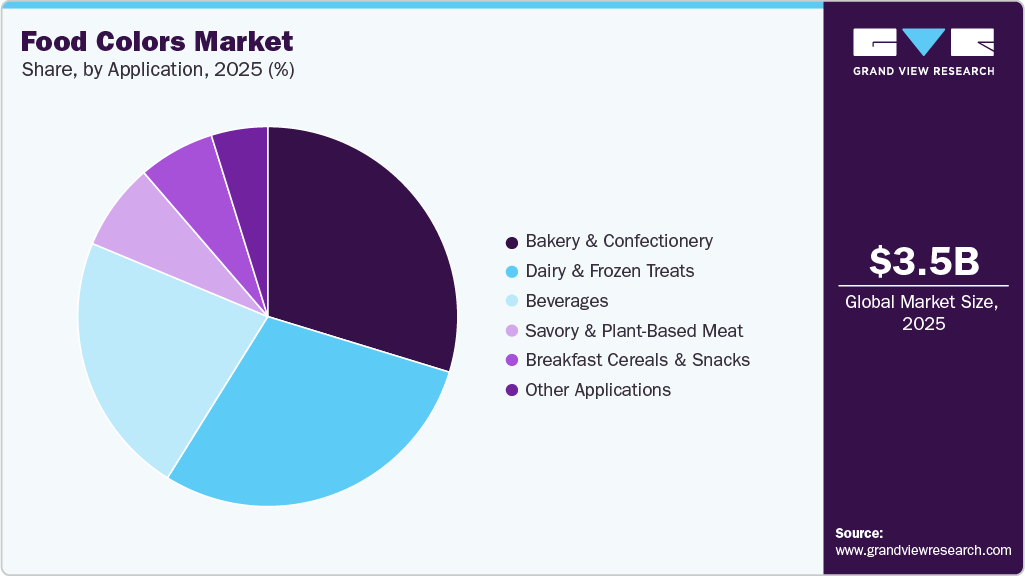
The dairy & frozen treats segment is expected to grow at a significant CAGR of 6.3% during the forecast period. Increasing consumption of flavored yogurts, ice creams, and frozen desserts is driving the demand for natural and vibrant colors. Food manufacturers are incorporating fruit-derived pigments to enhance product appeal while maintaining clean-label positioning. Rising innovation in premium dairy products is further accelerating segment growth.
Regional Insights
The food colors market in North America is driven by high consumption of processed foods and beverages. Food manufacturers in the U.S. and Canada are actively reformulating products to meet clean-label requirements. Rising demand for natural and organic food products is encouraging the use of plant-based food colors. Innovation in functional beverages and premium confectionery also supports market growth.
U.S. Food Colors Market Trends
The food colors market in the U.S. held a significant share in North America in 2025, due to its well-developed food processing industry. Rising consumer demand for natural and organic food ingredients has encouraged manufacturers to shift toward plant-based color solutions. Strong innovation in beverages, snacks, and confectionery continues to drive market growth.
Europe Food Colors Market Trends
Europe dominated the global food colors market with the largest revenue share of 29.9% in 2025. The growth is supported by strict regulations regarding synthetic additives and strong consumer demand for natural ingredients. The region has a well-established food processing industry that increasingly relies on natural color solutions. Growing adoption of plant-based and organic foods further drives demand for natural food colors across European markets.
The food colors market in Germany accounted for the largest market revenue share in Europe in 2025, supported by strong regulatory frameworks and consumer preference for natural ingredients. The country’s well-established food manufacturing sector continues to adopt natural color solutions in bakery, dairy, and beverage products. Innovation in clean-label and organic food products further supports market growth.
Asia Pacific Food Colors Market Trends
The food colors market in the Asia Pacific is expected to grow at the fastest CAGR during the forecast period, due to expanding food processing industries and increasing disposable incomes. Countries such as China, India, and Japan are witnessing rising demand for packaged foods and beverages. The region’s large population and changing dietary habits are driving increased consumption of food color across multiple food categories.
The China food colors market held a significant share in the Asia Pacific in 2025, driven by rapid industrialization and increasing consumption of processed foods. The country’s expanding beverage and confectionery industries are major contributors to food color demand. Government regulations and rising consumer awareness are also driving the use of natural colorants.
Latin America Food Colors Market Trends
The food colors market in Latin America is emerging, with growth supported by expanding bakery and beverage industries. Brazil and Mexico represent key markets due to their strong food manufacturing sectors. Increasing urbanization and growing demand for convenience foods are encouraging the adoption of food coloring ingredients.
Middle East and Africa Food Colors Market Trends
The food colors market in the Middle East & Africa is experiencing gradual growth, driven by rising demand for processed and packaged foods. Expanding retail sectors and increasing consumption of confectionery and beverages support market expansion. In addition, the tourism and hospitality industries drive demand for visually appealing food products.
Key Food Colors Company Insights
Naturex, Roha Dye Chem Pvt. Ltd., Chr. Hansen, Sensient Technologies Ltd., Doehler, and Diana Naturals are the key players in the global food colors market. These companies have a global presence with manufacturing facilities and sales offices spread across the globe. Chr. Hansen and Naturex are the leading manufacturers and are highly active in the natural food colors industry. Naturex exclusively manufactures products derived from natural sources, which include natural ingredients, dietary supplements, and natural colors & flavors.
- BASF SE manufactures and distributes chemicals for a range of applications. The company operates 390 production sites across Europe, Asia, North America, Latin America, Africa, and Australia, producing industrial chemicals through seven business segments that cater to a wide consumer base. These segments include chemicals, performance products, plastics, functional materials & solutions, biotype, oil & gas exploration, and agricultural solutions. It has an employee base of over 100,000, of whom over 53,000 are based in Germany. BASF Polyurethane is a division of the company. It manufactures polyurethane for a variety of applications and offers a comprehensive polyurethane portfolio, including polyols, polyether, TDI, MDI, and specialty elastomers. The company is involved in the production of food colorants, which are supplied to the consumers through direct and third-party distribution networks, thereby making the company one of the notable forces in the food colors industry.
Key Food Colors Companies:
The following key companies have been profiled for this study on the food colors market.
- Cargill, Incorporated
- Oterra
- BASF SE
- Danisco
- DD Williamson
- DSM
- Naturex
- FMC Corporation
- ADM
- Lycored Ltd.
- GNT Group
- SAN-EI GEN F.F.I. Inc.
- Sensient Technologies Corporation
- Roha Dye Chem Pvt. Ltd.
- Symrise
- Synthite Industries Ltd.
Recent Developments
-
In January 2025, ROHA introduced its next-generation natural food colors tailored for cream fillings and compound coatings in the confectionery sector, addressing the surging demand for clean-label and plant-based ingredients. Sourced from fruits, vegetables, flowers, and algae, these colors, offered under the NATRACOL brand, combine vibrancy, stability, and sensory appeal.
-
In February 2025, Oterra inaugurated a new color blending and application center in Kochi, Kerala, India, to serve the growing demand for natural colors in the Indian, Asia Pacific, and Middle East food and beverage markets.
-
In April 2025, DIC CORPORATION's U.S. subsidiary, Earthrise Nutritionals, inaugurated a state-of-the-art edible algae cultivation facility in California to support sustainable smart farming. The new plant, which produces Spirulina-derived LINABLUE, a natural blue colorant, reinforces DIC's expansion into eco-friendly, food-grade colorants using advanced technologies and renewable energy.
-
In June 2025, Oterra, formerly known as Chr. Hansen Natural Colors A/S announced its intention to acquire the natural food coloring division of Diana Food, a move that underscores its rapid growth in the global food colorant market. Diana Food is part of Symrise AG, a leading global supplier of ingredients for food, nutrition, cosmetics, and fragrances.
Food Colors Market Report Scope
Report Attribute
Details
Market size value in 2026
USD 3.7 billion
Revenue forecast in 2033
USD 5.6 billion
Growth rate
CAGR of 5.9% from 2026 to 2033
Base year for estimation
2025
Historical data
2021 - 2024
Forecast period
2026 - 2033
Quantitative units
Revenue in USD million/billion, Volume in Kilotons, and CAGR from 2026 to 2033
Report coverage
Revenue forecast, volume forecast, company ranking, competitive landscape, growth factors, and trends
Segments covered
Type, form, source, application, region
Regional scope
North America; Europe; Asia Pacific; Latin America; Middle East & Africa
Country scope
U.S.; Canada; Mexico; Germany; UK; France; Spain; Italy; China; India; Japan; South Korea; Brazil; Argentina; South Africa; Saudi Arabia.
Key companies profiled
Cargill; Incorporated; Oterra; BASF SE; Danisco; DD Williamson; DSM; Naturex; FMC Corporation; ADM; Lycored Ltd.; GNT Group; SAN-EI GEN F.F.I. Inc.; Sensient Technologies Corporation; Roha Dye Chem Pvt. Ltd.; Symrise; Synthite Industries Ltd.
Customization scope
Free report customization (equivalent up to 8 analysts’ working days) with purchase. Addition or alteration to country, regional & segment scope.
Pricing and purchase options
Avail customized purchase options to meet your exact research needs. Explore purchase options
Global Food Colors Market Report Segmentation
This report forecasts revenue growth at global, regional, and country levels and provides an analysis of the latest industry trends in each of the sub-segments from 2021 to 2033. For this study, Grand View Research has segmented the global food colors market report based on type, product, application, and region.
-
Type Outlook (Volume, Kilotons; Revenue, USD Billion, 2021 - 2033)
-
Natural
-
Carotenoids
-
Anthocyanin
-
Annatto
-
Other Naturals
-
-
Synthetic
-
Tartrazine-E102
-
Sunset Yellow FCF-E110
-
Brilliant Blue FCF
-
Other Synthetic
-
-
Nature-Identical
-
Mixed Carotenes
-
Canthaxanthin
-
Riboflavin
-
Other Nature-Identical
-
-
Caramel
-
-
Form Outlook (Volume, Kilotons; Revenue, USD Billion, 2021 - 2033)
-
Powder
-
Liquid
-
Gel & Paste
-
-
Source Outlook (Volume, Kilotons; Revenue, USD Billion, 2021 - 2033)
-
Plants
-
Microbes
-
Petroleum, Other Minerals & Chemicals
-
-
Application Outlook (Volume, Kilotons; Revenue, USD Billion, 2021 - 2033)
-
Bakery & Confectionery
-
Dairy & Frozen Treats
-
Breakfast Cereals & Snacks
-
Savory & Plant-Based Meat
-
Beverages
-
Other Applications
-
-
Regional Outlook (Volume, Kilotons; Revenue, USD Billion, 2021 - 2033)
-
North America
-
U.S.
-
Canada
-
Mexico
-
-
Europe
-
Germany
-
UK
-
France
-
Spain
-
Italy
-
-
Asia Pacific
-
China
-
India
-
Japan
-
South Korea
-
-
Latin America
-
Brazil
-
Argentina
-
-
Middle East & Africa
-
Saudi Arabia
-
South Africa
-
-
Frequently Asked Questions About This Report
b. Some of the key market players in the food colors market are BASF, Cargill, Oterra, Danisco, DD Williamson, DSM, GNT Group, Lycored Ltd, Naturex.
b. Germany is a key European market supported by strong regulatory frameworks and consumer preference for natural ingredients. The country’s well-established food manufacturing sector continues to adopt natural color solutions in bakery, dairy, and beverage products. Innovation in clean-label and organic food products further supports market growth.
b. The global food colors market size was estimated at USD 3.5 billion in 2025 and is expected to reach USD 2.2 billion in 2026.
b. The global food colors market is expected to grow at a compound annual growth rate of 5.9% from 2026 to 2033 to reach USD 5.6 billion by 2033.
b. Europe dominated the market with a revenue share of 29.9% in 2025. The growth is supported by strict regulations regarding synthetic additives and strong consumer demand for natural ingredients. The region has a well-established food processing industry that increasingly relies on natural color solutions. Growing adoption of plant-based and organic foods further drives demand for natural food colors across European markets.


Share this report with your colleague or friend.
Need a Tailored Report?
Customize this report to your needs — add regions, segments, or data points, with 20% free customization.


ISO 9001:2015 & 27001:2022 Certified
We are GDPR and CCPA compliant! Your transaction & personal information is safe and secure. For more details, please read our privacy policy.
Trusted market insights - try a free sample
See how our reports are structured and why industry leaders rely on Grand View Research. Get a free sample or ask us to tailor this report to your needs.