- Home
- »
- Animal Feed and Feed Additives
- »
-
Aquafeed Market Size And Share, Industry Report, 2033GVR Report cover
![Aquafeed Market Size, Share & Trends Report]()
Aquafeed Market (2026 - 2033) Size, Share & Trends Analysis Report By Form (Dry, Wet), By Additive (Amino Acid, Feed Acidifiers), By Feed (Grower, Finisher), By Application (Tilapia, Carp), By Region, And Segment Forecasts
- Report ID: 978-1-68038-104-7
- Number of Report Pages: 137
- Format: PDF
- Historical Range: 2018 - 2024
- Forecast Period: 2026 - 2033
- Industry: Specialty & Chemicals
- Report Summary
- Table of Contents
- Interactive Charts
- Methodology
- Download FREE Sample
-
 Download Sample Report
Aquafeed Market Summary
The global aquafeed market size was valued at USD 81.93 billion in 2025 and is anticipated to reach USD 118.06 billion by 2033, growing at a CAGR of 4.7% from 2026 to 2033. The market is primarily driven by the rapid expansion of aquaculture production to meet rising global seafood consumption, particularly across Asia Pacific and Latin America.
Key Market Trends & Insights
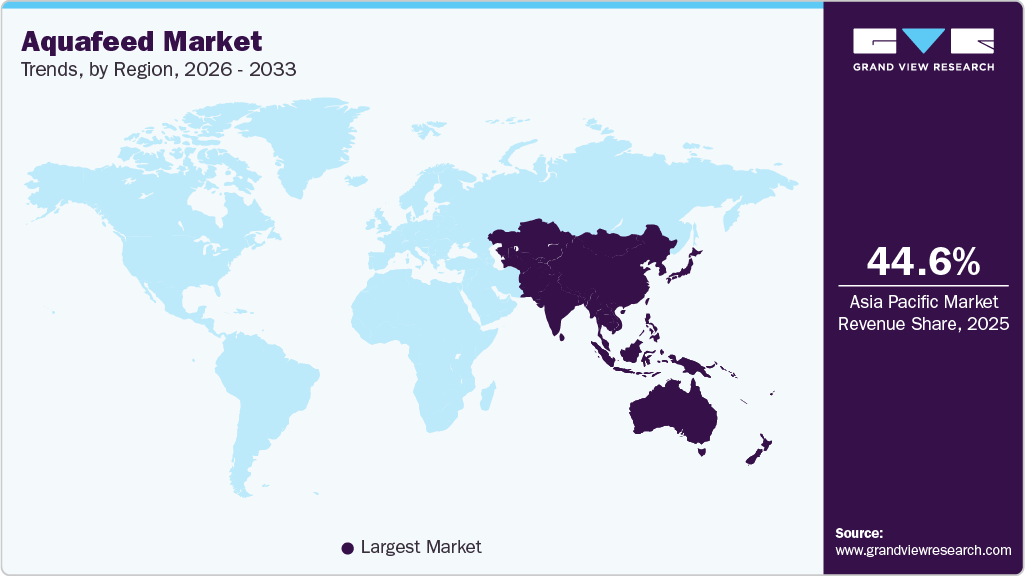
- Asia Pacific dominated the aquafeed market with the largest revenue share of 44.6% in 2025.
- The market in Canada is expected to grow at the fastest CAGR of 5.5% from 2026 to 2033 in terms of revenue.
- By form, the dry segment is expected to grow at the fastest CAGR of 4.9% from 2026 to 2033 in terms of revenue.
- By additives, the amino acids segment held the largest revenue share of 32.6% in 2025 in terms of value.
- By feed, the grower feed segment held the largest revenue share of 34.5% in 2025 in terms of value.
Market Size & Forecast
- 2025 Market Size: USD 81.93 Billion
- 2033 Projected Market Size: USD 118.06 Billion
- CAGR (2026-2033): 4.7%
- Asia Pacific: Largest market in 2025
With capture fisheries plateauing, commercial aquaculture has become the dominant source of fish supply, necessitating high-performance compound feed to improve feed conversion ratios (FCR) and optimize biomass yield. Increasing intensification of farming systems for high-value species such as salmon and shrimp is further accelerating demand for nutritionally balanced, functional, and species-specific feed formulations. The growing adoption of organized aquaculture practices and technological advancements in extrusion, precision feeding, and water-quality management are supporting sustained growth in feed demand.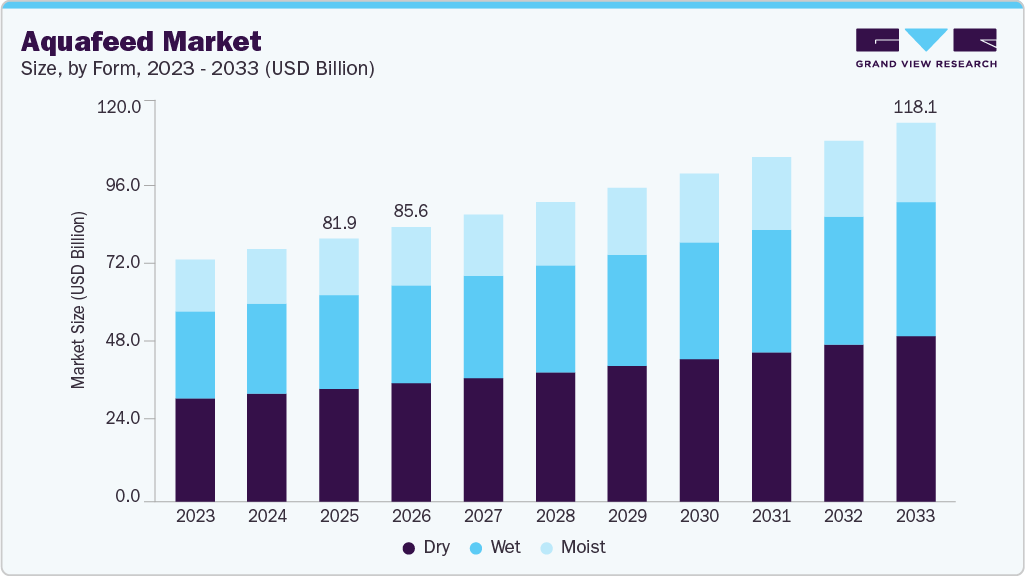
Significant growth opportunities lie in the development of sustainable and functional aquafeed solutions. The industry is witnessing a structural shift toward alternative protein sources, including insect meal, algae-based omega-3, and microbial proteins, to reduce reliance on fishmeal and fish oil. Increasing regulatory restrictions on antibiotic usage are creating strong demand for probiotics, prebiotics, enzymes, and immune-enhancing additives, enabling premium pricing strategies. Furthermore, the expansion of Recirculating Aquaculture Systems (RAS) in North America and Europe is driving demand for high-digestibility, low-waste feed formulations. Emerging aquaculture markets in Africa and Southeast Asia also present untapped volume potential as production scales toward export-oriented operations.
Despite strong growth fundamentals, the aquafeed market faces structural challenges related to raw material price volatility, particularly fishmeal, soybean meal, and fish oil, which significantly impact margin stability. Disease outbreaks in shrimp and finfish farming continue to pose operational risks, leading to sudden demand fluctuations. Stringent environmental regulations concerning nutrient discharge and sustainability certification requirements are increasing compliance costs for feed manufacturers. The fragmented, small-scale aquaculture operations in developing regions limit the penetration of premium feeds, while geopolitical trade disruptions and supply chain constraints further challenge procurement and global distribution strategies.
Market Concentration & Characteristics
The global aquafeed market is characterized by a moderately consolidated competitive landscape, led by multinational players such as Cargill, Inc., Skretting, BioMar Group, and Charoen Pokphand Foods PCL. These companies maintain strong market positions through vertically integrated operations, global manufacturing footprints, advanced extrusion technologies, and species-specific nutritional expertise. Their competitive advantage is further reinforced by strategic investments in R&D, sustainability initiatives, and long-term partnerships with commercial aquaculture producers to optimize feed efficiency and production outcomes.
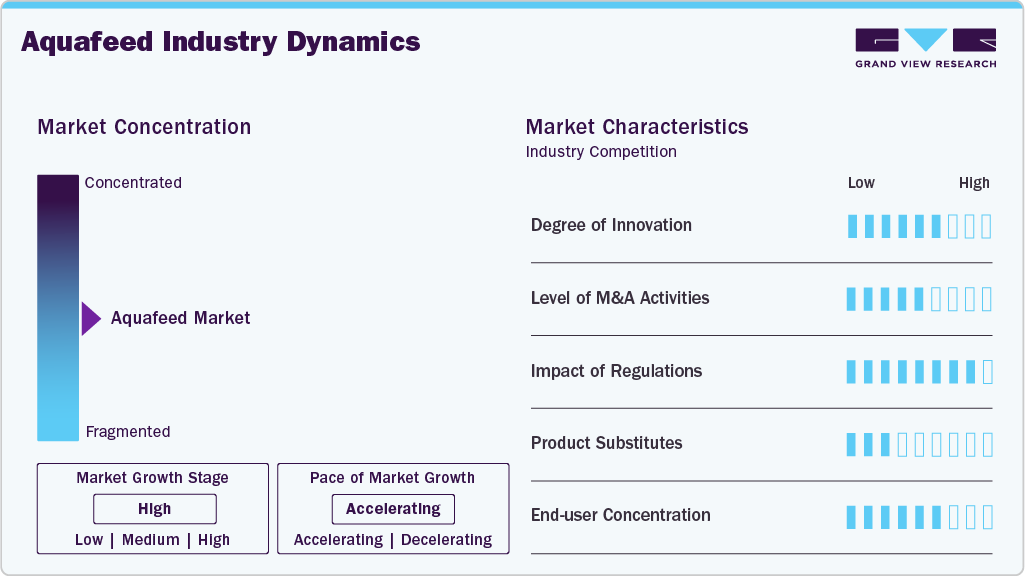
Regional players such as Avanti Feeds Ltd., Ridley Corp. Ltd., Dibaq Aquaculture, and The Waterbase Ltd. compete through localized production, cost competitiveness, and species-focused offerings. Meanwhile, ingredient specialists, including Alltech, BENEO, and Aker Biomarine, support innovation in functional and sustainable feed formulations. Overall, competition is increasingly shaped by raw material security, sustainability compliance, and performance-driven product differentiation.
Form Insights
The dry aquafeed segment dominated the global market, accounting for the largest revenue share of 43.0% in 2025, primarily due to its superior storage stability, cost efficiency, and compatibility with automated feeding systems in intensive aquaculture operations. Dry feed, particularly extruded pellets, offers enhanced water stability, optimized nutrient retention, and improved feed conversion ratios (FCR), making it the preferred choice for high-value species such as salmon and shrimp. Large commercial producers favor dry formulations due to their longer shelf life, lower per-ton transportation costs, and scalability across recirculating aquaculture systems (RAS) and offshore farming operations. Furthermore, technological advancements in extrusion processing have enabled manufacturers to customize pellet density, buoyancy, and digestibility, strengthening adoption across both freshwater and marine aquaculture segments.
The moist and wet feed segments, while smaller in overall revenue contribution, continue to serve niche and traditional aquaculture systems. Moist feed is primarily utilized in semi-intensive shrimp and carp farming, where on-site mixing allows partial cost optimization; however, its limited shelf life and higher spoilage risk constrain large-scale commercialization. Wet feed, often comprising trash fish or fresh raw material mixtures, remains prevalent in certain developing regions due to lower upfront costs, but it faces declining adoption in export-oriented markets owing to biosecurity concerns, inconsistent nutritional profiles, and environmental discharge regulations. Over the forecast period to 2030, both moist and wet feed segments are expected to witness gradual substitution by nutritionally balanced dry compound feed, particularly as farming practices modernize and regulatory oversight intensifies globally.
Additive Insights
The amino acids segment held the largest revenue share of 32.6% in 2025, primarily due to their critical role in optimizing protein utilization, improving feed conversion ratios (FCR), and reducing overall feed costs in commercial aquaculture. Essential amino acids such as lysine, methionine, and threonine are increasingly incorporated into formulations to balance plant-based protein diets, particularly as the industry reduces dependence on fishmeal. With rising raw material prices and margin pressures, feed manufacturers are leveraging precision amino acid supplementation to enhance growth performance while minimizing nitrogen waste and environmental discharge. Their widespread use across high-value species, including salmon, shrimp, and tilapia, further supports volume scalability and consistent revenue contribution.
Other additive categories are gaining strategic importance as the industry shifts toward functional and antibiotic-free nutrition. Vitamins & minerals remain foundational for immune support and metabolic health, while enzymes and feed acidifiers are witnessing strong uptake due to their ability to improve digestibility and gut health in plant-protein-rich diets. The probiotics & prebiotics segment is among the fastest-growing, driven by global regulatory restrictions on antibiotic growth promoters and by increasing demand for sustainable aquaculture practices. Meanwhile, antibiotics and anti-parasitic additives face regulatory scrutiny and moderate growth in developed markets, though they remain relevant in disease-prone farming regions. Antioxidants and other specialty additives continue to support feed stability, shelf life, and stress resistance, reinforcing their value in modern intensive aquaculture systems.
Feed Insights
The grower feed segment accounted for the largest revenue share of 34.5% in 2025, primarily because it represents the longest and most feed-intensive phase of the aquaculture production cycle. During the grow-out stage, fish and shrimp experience rapid biomass accumulation, requiring consistent, high-volume feed input to achieve optimal weight gain and commercial size targets. As a result, feed consumption per unit of stock is highest in this phase, directly translating into greater revenue contribution. Commercial farms prioritize nutritionally balanced grower formulations to optimize feed conversion ratios (FCR), enhance survival rates, and reduce production cycle time, particularly for high-value species such as salmon, shrimp, and tilapia. The scalability of grower feed across both freshwater and marine aquaculture further reinforces its dominant market position.
Starter feed plays a critical role in early-stage development by ensuring high digestibility, immune support, and survival during the larval and juvenile phases; although premium-priced, its lower volume usage limits overall revenue share. Finisher feed is designed to enhance flesh quality, pigmentation, and final weight optimization prior to harvest, particularly in export-oriented markets; however, the feeding duration is comparatively shorter than the grower phase. The broodstock (brooder) feed segment serves breeding populations and focuses on reproductive performance, egg quality, and larval vitality, representing a niche but high-margin category. Over the forecast period to 2030, demand across all feed stages is expected to expand in line with global aquaculture production growth, with grower feed continuing to anchor overall market revenue due to its volume intensity.
Application Insights
The carp segment dominated the global aquafeed market, accounting for the largest revenue share of 24.8% in 2025, primarily due to its substantial production volumes across the Asia Pacific, particularly in China and India. Carp farming is characterized by large-scale freshwater pond cultivation, relatively lower production costs, and strong domestic consumption demand, which collectively drive high feed volume requirements. Although carp feed is comparatively lower in price than salmon or shrimp feed, its sheer production scale translates into significant aggregate revenue contribution. The species’ adaptability to diverse farming systems and its importance in food security strategies across emerging economies further reinforce sustained feed demand in this segment.
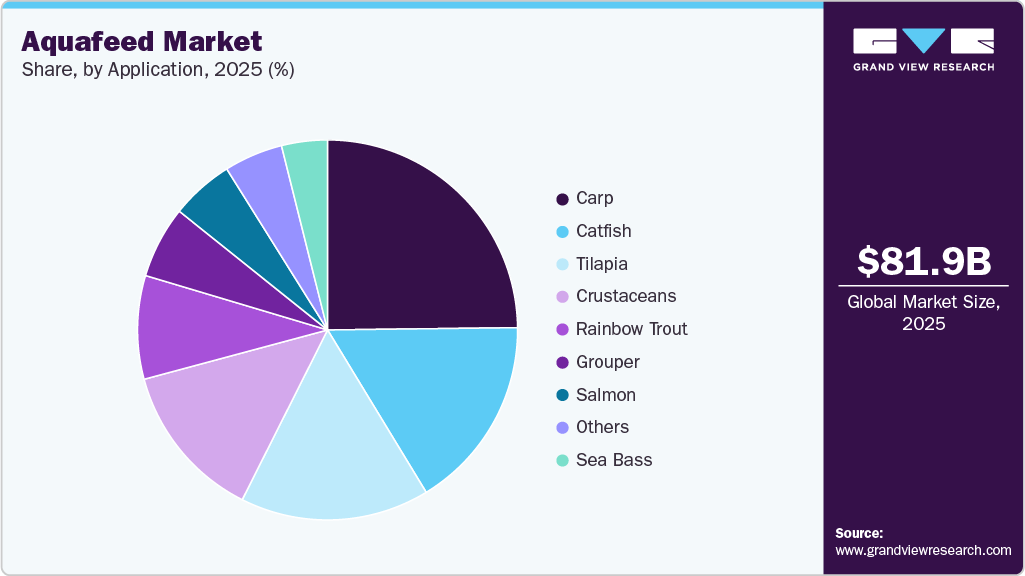
Other high-value segments, such as salmon and crustaceans (shrimp), contribute disproportionately to revenue due to premium feed formulations, higher protein inclusion rates, and intensive farming practices in regions such as Europe, Latin America, and Southeast Asia. Tilapia and catfish represent stable, volume-driven segments supported by growing exports and domestic consumption in Asia, Africa, and North America. Meanwhile, rainbow trout, sea bass, and grouper serve niche but high-margin marine aquaculture markets, particularly in Europe and the Mediterranean region. Over the forecast period to 2030, while carp is expected to retain volume leadership, revenue growth is likely to be increasingly supported by premium species segments that demand specialized, high-performance feed solutions.
Regional Insights
Asia Pacific dominated the global aquafeed market with a 44.6% revenue share in 2025, driven by large-scale aquaculture production, expanding seafood consumption, and strong government support for aquaculture intensification. The region benefits from abundant freshwater resources, cost-effective labor, and high production volumes of carp, tilapia, shrimp, and catfish. Rapid modernization of farming practices, increasing adoption of compound feed, and growing export-oriented shrimp production in India, Vietnam, and Indonesia continue to strengthen regional feed demand.
China Aquafeed Market Trends
China remains the single largest aquaculture producer globally and a key growth engine for aquafeed demand. The country’s dominance in carp farming, coupled with expanding shrimp and marine fish cultivation, drives substantial feed consumption volumes. Ongoing consolidation of small-scale farms, regulatory tightening on environmental discharge, and a gradual shift toward nutritionally balanced compound feed are enhancing feed efficiency and supporting steady market expansion.
Europe Aquafeed Market Trends
Europe accounted for 21.0% of the global aquafeed market in 2025, supported primarily by high-value salmon and trout production in Norway, Scotland, and other Nordic regions. The region is characterized by advanced aquaculture technologies, strict sustainability standards, and strong regulatory oversight on feed composition and antibiotic use. Premium feed formulations, high protein inclusion rates, and sustainability certifications drive higher revenue realization per ton compared to volume-driven markets.
The Germany aquafeed market represents a technologically advanced but relatively niche market within Europe, supported by trout and freshwater fish farming as well as growing Recirculating Aquaculture System (RAS) installations. The country emphasizes sustainable feed ingredients, traceability, and reduced environmental impact, aligning with broader EU aquaculture and green transition policies. Demand is increasingly centered on specialty and functional feed solutions.
North America Aquafeed Market Trends
North America held an 18.2% revenue share in 2025, driven by salmon farming in Canada and the rapid expansion of land-based RAS facilities across the United States. The region exhibits strong demand for high-performance, low-waste feed formulations that optimize FCR and water quality management. Growing consumer preference for sustainably farmed seafood and rising domestic production capacity are reinforcing feed innovation and premium product penetration.
The U.S. aquafeed market is characterized by increasing investments in RAS-based salmon production, tilapia farming, and catfish aquaculture. Regulatory scrutiny regarding antibiotic usage and environmental compliance is accelerating adoption of functional additives such as probiotics and enzymes. Technological integration, including automated feeding systems and digital farm monitoring, is further supporting demand for precision-formulated compound feed.
Central & South America Aquafeed Market Trends
Central & South America represent a high-growth aquafeed market, primarily driven by shrimp farming in Ecuador and salmon production in Chile. Export-oriented aquaculture operations and favorable climatic conditions support strong feed consumption intensity. Increasing investments in disease management, feed efficiency optimization, and sustainable sourcing of raw materials are enhancing regional competitiveness in global seafood trade.
Middle East & Africa Aquafeed Market Trends
Middle East & Africa region is an emerging aquafeed market supported by expanding tilapia and freshwater fish farming, particularly in Egypt and sub-Saharan Africa. Government-led food security initiatives and aquaculture development programs are gradually increasing compound feed penetration. While the market remains relatively fragmented and price-sensitive, modernization of farming practices and rising protein demand present long-term growth potential.
Key Aquafeed Company Insights
Key players, such as Lonza, Cayman Chemical, Merck, Ceva are dominating the market:
Cargill, Inc.
-
Cargill, Inc. is a leading global agribusiness corporation and a key player in the aquafeed market, operating through its animal nutrition division with an extensive global manufacturing and distribution footprint. The company offers species-specific aquafeed solutions for salmon, shrimp, tilapia, and other finfish, leveraging advanced R&D capabilities, precision nutrition technologies, and digital farm advisory services to optimize feed conversion ratios (FCR) and production efficiency. Cargill’s competitive strength lies in its vertically integrated supply chain, strong raw material sourcing network, and strategic focus on sustainability, including the development of alternative protein ingredients and reduced fishmeal formulations. Through continuous investments in innovation, partnerships with aquaculture producers, and expansion in high-growth regions such as Asia Pacific and Latin America, the company maintains a strong market position in the global aquafeed industry.
Key Aquafeed Companies:
The following key companies have been profiled for this study on the aquafeed market.
- Cargill, Inc.
- BioMar Group
- Ridley Corp. Ltd.
- Aller Aqua
- BENEO
- Alltech
- Aker Biomarine
- Charoen Pokphand Foods PCL
- Skretting
- Purina Animal Nutrition LLC
- Dibaq Aquaculture
- INVE Aquaculture
- Avanti Feeds Ltd.
- Biostadt India Ltd.
- The Waterbase Ltd.
Recent Developments
-
Cargill, Inc. has exited the aquafeed market in Vietnam, closing two feed plants and refocusing on higher-growth regions and species segments as part of its global realignment strategy.
Aquafeed Market Report Scope
Report Attribute
Details
Market size value in 2026
USD 85.58 billion
Revenue forecast in 2033
USD 118.06 billion
Growth rate
CAGR of 4.7% from 2026 to 2033
Base year for estimation
2025
Historical data
2018 - 2024
Forecast period
2026 - 2033
Quantitative units
Revenue in USD million/billion, volume in tons, and CAGR from 2026 to 2033
Report coverage
Revenue forecast, company ranking, competitive landscape, growth factors, and trends
Segments covered
Form, additives, feed, application, regions
Regional scope
North America; Europe; Asia Pacific; Central & South America; Middle East & Africa
Country scope
U.S.; Canada; Mexico; Germany; UK; France; Italy; Spain; Denmark; China; India; Japan; Vietnam; Thailand; Indonesia; Australia; Brazil; Argentina; Chile; Ecuador; South Africa; Egypt
Key companies profiled
Cargill, Inc.; BioMar Group; Ridley Corp. Ltd.; Aller Aqua; BENEO; Alltech; Aker Biomarine; Charoen Pokphand Foods PCL; Skretting; Purina Animal Nutrition LLC; Dibaq Aquaculture; INVE Aquaculture; Avanti Feeds Ltd.; Biostadt India Ltd.; The Waterbase Ltd.
Customization scope
Free report customization (equivalent up to 8 analysts working days) with purchase. Addition or alteration to country, regional & segment scope
Pricing and purchase options
Avail customized purchase options to meet your exact research needs. Explore purchase options
Global Aquafeed Market Report Segmentation
This report forecasts revenue growth at global, regional, and country levels and provides an analysis of the latest industry trends in each of the sub-segments from 2018 to 2033. For the purpose of this study, Grand View Research has segmented the global aquafeed market report on the basis of form, additive, feed, application, and regions:
-
Form Outlook (Volume, Tons; Revenue, USD Million, 2018 - 2033)
-
Dry
-
Moist
-
Wet
-
-
Additives Outlook (Volume, Tons; Revenue, USD Million, 2018 - 2033)
-
Amino Acids
-
Antibiotics
-
Vitamins & Minerals
-
Feed Acidifiers
-
Antioxidants
-
Enzymes
-
Anti-parasitic
-
Probiotics & Prebiotics
-
Others
-
-
Feed Outlook (Volume, Tons; Revenue, USD Million, 2018 - 2033)
-
Starter Feed
-
Grower Feed
-
Finisher Feed
-
Brooder Feed
-
-
Application Outlook (Volume, Tons; Revenue, USD Million, 2018 - 2033)
-
Carp
-
Rainbow Trout
-
Salmon
-
Crustaceans
-
Tilapia
-
Catfish
-
Sea Bass
-
Grouper
-
Others Application
-
-
Regional Outlook (Volume, Tons; Revenue, USD Million, 2018 - 2033)
-
North America
-
U.S.
-
Canada
-
Mexico
-
-
Europe
-
Germany
-
UK
-
France
-
Italy
-
Spain
-
Denmark
-
-
Asia Pacific
-
China
-
India
-
Japan
-
Vietnam
-
Thailand
-
Indonesia
-
Australia
-
-
Central & South America
-
Brazil
-
Argentina
-
Chile
-
Ecuador
-
-
Middle East & Africa
-
South Africa
-
Egypt
-
-
Frequently Asked Questions About This Report
b. The global aquafeed market size was estimated at USD 81.93 billion in 2025 and is expected to reach 85.58 billion in 2026.
b. The dry aquafeed segment held the largest revenue share of 43.0% in 2025 due to its superior shelf stability, cost-efficient logistics, and compatibility with automated feeding systems in intensive aquaculture operations. The extruded dry pellets offer improved feed conversion ratios (FCR), enhanced nutrient retention, and reduced water pollution, making them the preferred choice for commercial producers of high-value species such as salmon and shrimp.
b. Some of the key players operating in the aquafeed market are Cargill, Inc., BioMar Group, Ridley Corp. Ltd., Aller Aqua, BENEO, Alltech, Aker Biomarine, Charoen Pokphand Foods PCL, Skretting, Purina Animal Nutrition LLC, Dibaq Aquaculture, INVE Aquaculture, Avanti Feeds Ltd., Biostadt India Ltd., and The Waterbase Ltd.
b. The global aquafeed market is driven by the rapid expansion of aquaculture production to meet rising global seafood consumption amid stagnating capture fisheries. Increasing intensification of farming practices, demand for improved feed conversion efficiency, and growing adoption of nutritionally optimized and functional feed formulations are further accelerating market growth.
b. The global aquafeed market is expected to grow at a compound annual growth rate of 4.7% from 2026 to 2033 to reach USD 118.06 billion by 2033.


Share this report with your colleague or friend.
Need a Tailored Report?
Customize this report to your needs — add regions, segments, or data points, with 20% free customization.


ISO 9001:2015 & 27001:2022 Certified
We are GDPR and CCPA compliant! Your transaction & personal information is safe and secure. For more details, please read our privacy policy.
Trusted market insights - try a free sample
See how our reports are structured and why industry leaders rely on Grand View Research. Get a free sample or ask us to tailor this report to your needs.