Wood Pellets Market Summary
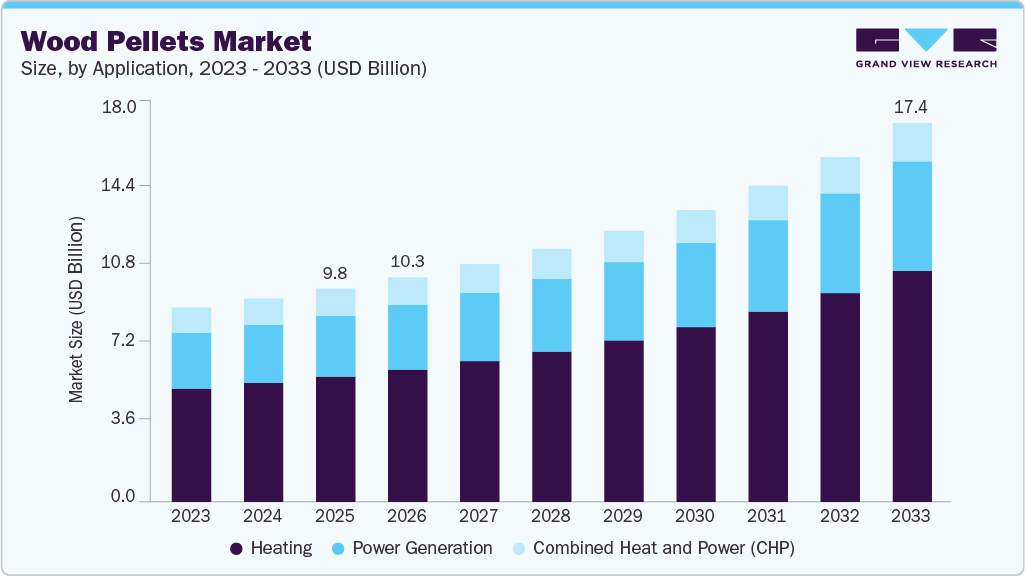
The global wood pellets market size was estimated at USD 9.8 billion in 2025 and is projected to reach USD 17.4 billion by 2033, growing at a CAGR of 7.8% from 2026 to 2033. Rising demand for renewable energy and carbon-neutral fuels is driving the adoption of Wood Pellets in power generation and heating applications worldwide.
Key Market Trends & Insights
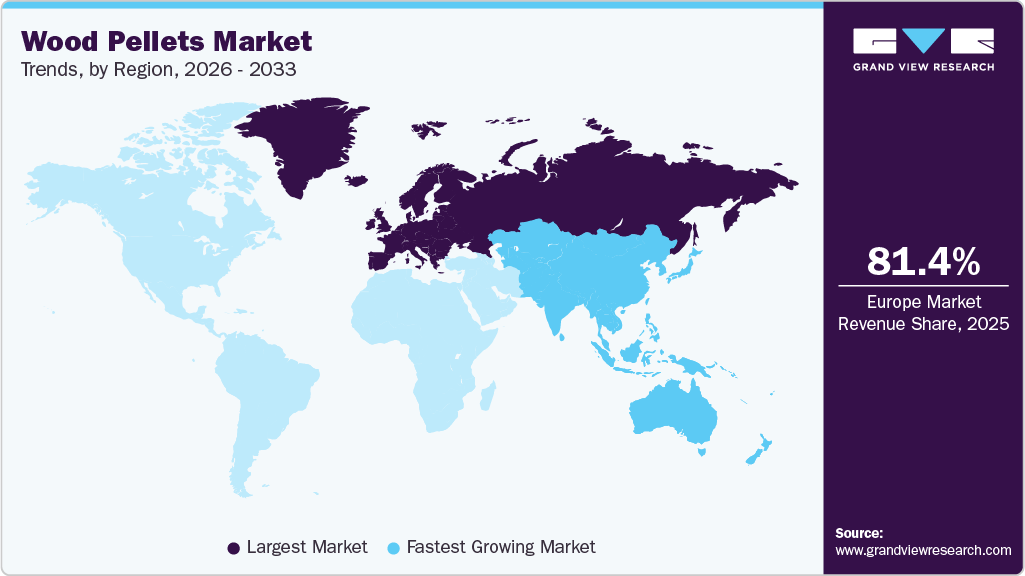
- Europe accounted for the largest share of wood pellet consumption in 2025, representing 81.4% of total market revenue.
- By application, the heating segment dominated the industry in 2025 with a 58.7% revenue share.
- By end use, industrial segment dominated the industry in 2025 with a 45.9% share.
Market Size & Forecast
- 2025 Market Size: USD 9.8 Billion
- 2033 Projected Market Size: USD 17.4 Billion
- CAGR (2026-2033): 7.8%
- Europe: Largest market in 2025
- Asia Pacific: Fastest growing market
Additionally, supportive government policies and climate targets such as the European Green Deal are encouraging utilities and industries to replace coal with biomass-based fuels, accelerating wood pellet consumption. The global wood pellets industry is experiencing strong growth due to the rising transition toward renewable energy sources and the expanding bioenergy infrastructure across developed and emerging economies. An increasing adoption of biomass-based heating systems in residential, commercial, and industrial sectors, is one of the primary drivers for market growth. The growing wood pellet biomass boiler market is particularly significant in Europe and North America, where governments are promoting low-carbon heating solutions through subsidies and carbon-reduction targets. Biomass boilers using wood pellets provide high energy efficiency and lower emissions compared to traditional fossil fuels, making them an attractive alternative for district heating systems, institutional buildings, and industrial facilities.
The European black & wood pellets industry has gained considerable traction as utilities shift from coal-based power generation to co-firing and dedicated biomass plants to meet climate targets. Black pellets, which have improved energy density and hydrophobic properties, are increasingly being adopted for large-scale power generation because they are easier to store and transport compared to conventional white pellets. This transition is particularly evident in countries such as the UK, the Netherlands, and Denmark, where biomass co-firing projects are replacing coal in existing thermal power plants.
Investment inflows and financial market participation are also accelerating the sector’s development. The rising visibility of companies involved in pellet production, biomass energy, and supply chain infrastructure is strengthening the wood pellets stock market landscape. Investors are increasingly viewing biomass energy as part of the broader clean energy transition portfolio alongside wind and solar. Publicly traded bioenergy companies and pellet manufacturers are attracting capital for capacity expansions, logistics networks, and pellet export terminals, particularly in North America and the Baltic region, which serve as major suppliers to Europe and Asia.
Furthermore, technological innovation and diversification of pellet-based fuels are expanding the scope of applications within the industry. Research into torrefaction, densification, and improved pelletization techniques is contributing to the development of the advanced wood pellets industry, where pellets exhibit higher calorific value, better durability, and enhanced combustion efficiency. These advanced products are increasingly being adopted in industrial heating, combined heat and power plants, and sustainable aviation fuel supply chains, reinforcing wood pellets as a critical component of the global bioenergy transition.
Market Concentration & Characteristics
Wood pellets are primarily produced from forestry residues, sawdust, wood chips, and other by-products of the timber industry. This creates a strong dependency on the health and output of the forestry and wood-processing sectors. Regions with abundant forest resources, such as Canada, Germany, and the U.S., are major pellet producers due to stable feedstock availability and well-established forest management practices.
The industry has a highly international trade structure, where production hubs differ significantly from consumption hubs. North America and parts of Eastern Europe act as large exporters, while Western Europe and Asia represent major importing regions. For instance, the European Union imports large volumes of pellets from the U.S. and Canada to fuel biomass power plants and district heating systems.
Moreover, the industry is witnessing advancements in pellet processing technologies such as torrefaction and densification, leading to the development of higher energy-density fuels such as black pellets. These innovations improve storage stability, transportation efficiency, and combustion performance, making wood pellets more competitive with traditional fossil fuels in large-scale energy applications.
Application Insights
The heating segment dominated the industry in 2025 with a 58.7% revenue share due to the widespread adoption of pellet-based heating systems in residential, commercial, and district heating applications, particularly across the European Union. Government incentives promoting low-carbon heating and the rapid expansion of pellet stoves and biomass boilers have significantly increased demand for wood pellets as a cost-efficient and renewable heating fuel. Additionally, rising fossil fuel prices have accelerated the shift toward pellet-based heating solutions.
The power generation segment represents a significant application area in the industry due to the increasing conversion of coal-fired power plants to biomass-based electricity production. Utilities are adopting pellet fuel to reduce greenhouse gas emissions while utilizing existing thermal power infrastructure. In regions such as the European Union and Japan, supportive renewable energy policies and biomass co-firing programs are encouraging power producers to incorporate wood pellets into their energy mix, driving demand from large-scale power utilities.
End Use Insights
The industrial segment dominated the industry in 2025 with a 45.9% share primarily due to the large-scale adoption of wood pellets as a renewable fuel in industrial boilers and combined heat and power (CHP) plants. Many industries are shifting from coal and oil to biomass fuels to reduce carbon emissions and comply with sustainability regulations aligned with global climate goals such as the Paris Agreement. Additionally, wood pellets offer cost-efficient and stable energy for continuous industrial operations, especially in energy-intensive sectors such as pulp & paper, chemicals, and food processing.
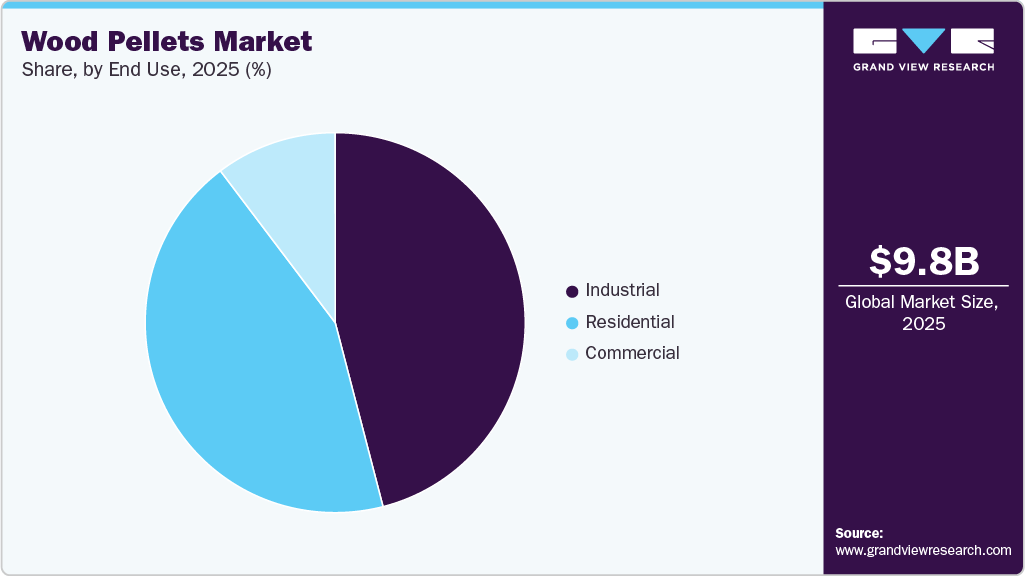
The residential segment holds a significant share in the market due to the growing use of pellet stoves and small-scale biomass boilers for home heating. Households across the European Union, particularly in countries such as Germany and Italy, are increasingly adopting pellet-based heating systems as a cost-efficient and environmentally friendly alternative to fossil-fuel heating. Government subsidies for renewable heating technologies and rising energy costs have further accelerated residential pellet consumption.
Regional Insights
Europe wood pellets market led in 2025 due to strong renewable energy policies and widespread adoption of biomass heating and power generation. The European Union has implemented strict carbon reduction targets and renewable energy directives, encouraging utilities and households to shift toward biomass fuels such as wood pellets. Additionally, countries such as Germany, France, Latvia, Austria, and Sweden are major producers within the region, collectively contributing significant production capacity, with Germany alone producing about 3.7 million metric tons of pellets in 2024, strengthening Europe’s supply base and supporting its leadership in the global market.
North America Wood Pellets Market Trends
The wood pellets market in North America represents a significant region due to its abundant forest resources and strong pellet export infrastructure. The U.S. and Canada are among the world’s largest producers and exporters of wood pellets, supplying substantial volumes to the European Union and Asia for biomass power generation. Well-developed forestry industries, large-scale pellet manufacturing facilities, and efficient port logistics along the U.S. Southeast and British Columbia enable the region to serve as a major global supply hub for industrial wood pellets.
Asia Pacific Wood Pellets Market Trends
The wood pellets market in Asia Pacific is witnessing strong growth due to the increasing demand for renewable energy and biomass-based power generation. Countries such as Japan and South Korea are major importers of wood pellets, driven by government policies promoting biomass co-firing in thermal power plants and renewable energy targets. Additionally, rising industrial energy demand and efforts to reduce coal dependency across the Asia Pacific region are accelerating the adoption of wood pellets as a sustainable fuel source.
Latin America Wood Pellets Market Trends
The wood pellets market in Latin America is emerging as a growing region due to expanding forestry resources and increasing investments in biomass energy projects. Countries such as Brazil and Chile are developing pellet production capacities to utilize abundant wood residues from the forestry and timber industries. Additionally, rising exports to major demand centers such as the European Union and Japan are supporting the region’s role as a potential supplier in the global wood pellets trade.
Key Wood Pellets Companies Insights
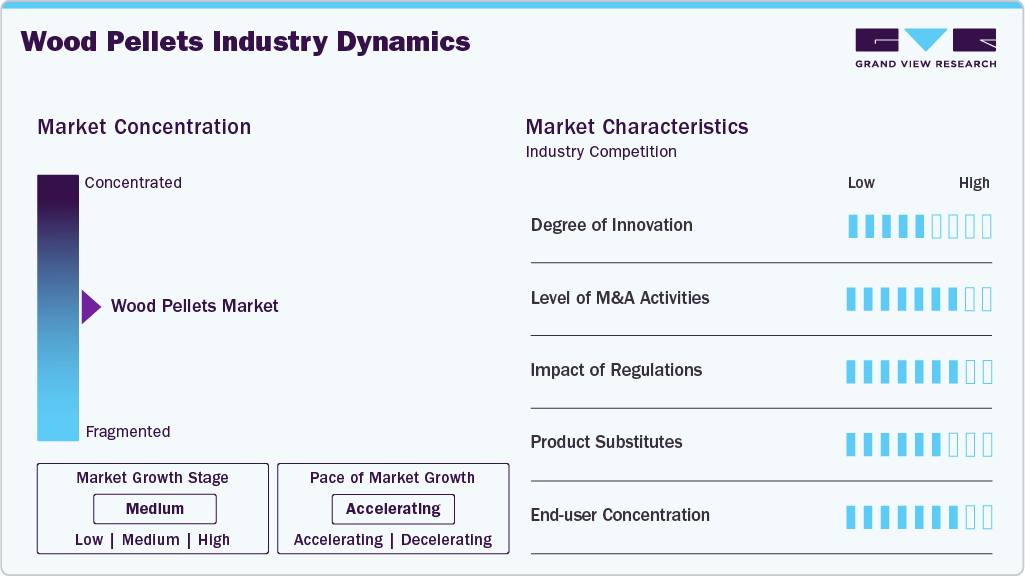
The competitive environment of the wood pellets market is moderately fragmented, with a mix of large biomass energy companies and regional pellet manufacturers competing based on production capacity, feedstock availability, and long-term supply contracts with utilities. Major players such as Enviva Inc., Drax Group, Pinnacle Renewable Energy, and Graanul Invest focus on expanding pellet production facilities and strengthening export logistics to supply large energy markets in the European Union and Asia. Companies are increasingly investing in sustainable forestry sourcing, advanced pellet technologies, and strategic partnerships with power utilities to secure long-term demand and maintain competitiveness in the growing global biomass energy sector.
Key Wood Pellets Companies:
The following key companies have been profiled for this study on the wood pellets market
- Drax
- Enviva
- The Westervelt Company, Inc.
- Graanul Invest
- Energex
- Balcas
- Lignetics
- Fram Fuels
- Highland Pellets, LLC
- Valfei Products Inc.
- Barefoot Pellet Company
- Mallard Creek Inc.
Recent Developments
-
In December 2025, Mackenzie County in Alberta partnered with PowerWood Canada Corp. to develop two advanced wood pellet plants using wildfire-damaged timber as feedstock. The “Peace River” facility (350,000 tons capacity) will begin construction in 2026, followed by the “Hay River” plant in 2027, producing low-carbon black pellets for export to Japan under a 10-year offtake agreement.
-
In January 2025, Drax Group signed a multi-year agreement to supply over 1 million tonnes of sustainable wood pellets annually to Pathway Energy for its proposed SAF plant in Port Arthur, Texas. The USD 2.0 billion facility will convert wood pellets into carbon-negative jet fuel via gasification and is expected to produce 30 million gallons annually starting in 2029, supporting aviation decarbonization.
Wood Pellets Market Report Scope
|
Report Attribute
|
Details
|
|
Market size value in 2026
|
USD 10.3 billion
|
|
Revenue forecast in 2033
|
USD 17.4 billion
|
|
Growth rate
|
CAGR of 7.8% from 2026 to 2033
|
|
Base year for estimation
|
2025
|
|
Historical data
|
2021 - 2024
|
|
Forecast period
|
2026 - 2033
|
|
Quantitative units
|
Volume in kilotons; revenue in USD million/billion, and CAGR from 2026 to 2033
|
|
Report coverage
|
Revenue forecast, volume forecast, company ranking, competitive landscape, growth factors, and trends
|
|
Segments covered
|
Application, end use, region
|
|
Regional scope
|
North America; Europe; Asia Pacific; Latin America; Middle East & Africa
|
|
Country scope
|
U.S.; Canada; Mexico; Germany; UK; France; China; India; Japan; Brazil
|
|
Key companies profiled
|
Drax; Enviva; The Westervelt Company, Inc.; Graanul Invest; Energex; Balcas; Lignetics; Fram Fuels; Highland Pellets, LLC; Valfei Products Inc.; Barefoot Pellet Company; Mallard Creek Inc.
|
|
Customization scope
|
Free report customization (equivalent up to 8 analysts’ working days) with purchase. Addition or alteration to country, regional, and segment scope.
|
|
Pricing and purchase options
|
Avail customized purchase options to meet your exact research needs. Explore purchase options
|
Global Wood Pellets Market Report Segmentation
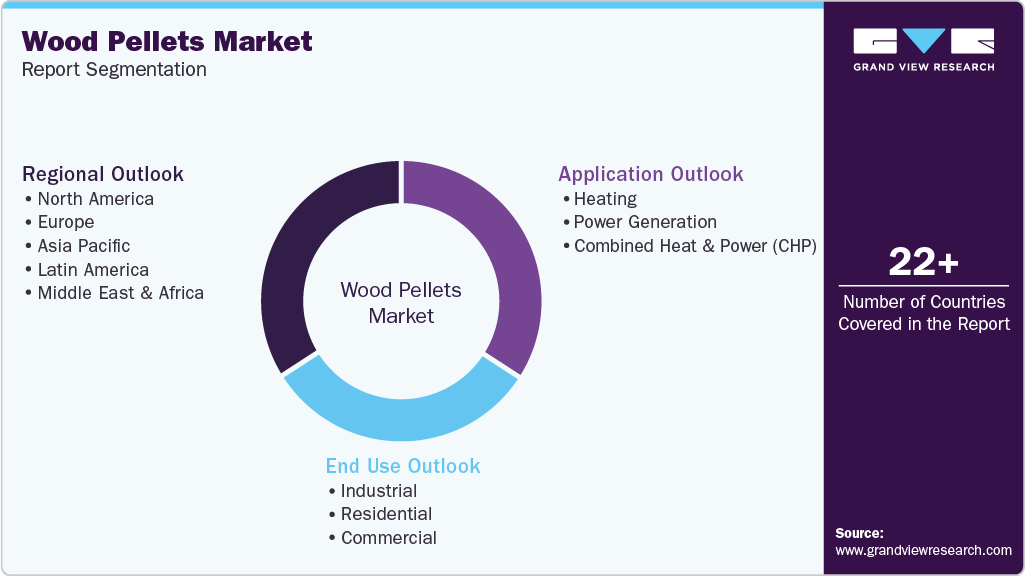
This report forecasts volume & revenue growth at the global, regional, and country levels and provides an analysis of the latest industry trends in each of the sub-segments from 2021 to 2033. For this study, Grand View Research has segmented the global wood pellets market report on the basis of application, end use, and region:
-
Application Outlook (Volume, Kilotons; Revenue, USD Million, 2021 - 2033)
-
End Use Outlook (Volume, Kilotons; Revenue, USD Million, 2021 - 2033)
-
Industrial
-
Residential
-
Commercial
-
Regional Outlook (Volume, Kilotons; Revenue, USD Million, 2021 - 2033)
-
North America
-
Europe
-
Asia Pacific
-
Latin America
-
Middle East & Africa
Frequently Asked Questions About This Report
b. The key players operating in the global wood pellets market include Drax Group Plc, SINGPELLET Pte. Ltd., Enviva LP, Georgia Biomass, LLC, The Westervelt Company, Inc., Pinnacle Renewable Energy Inc., Energex, Wood Pellet Energy (UK) Ltd., United Company, and Groupe Savoie Inc.
b. The wood pellets market is anticipated to be driven by growing residential consumption and encouraging government policies to use renewable source of energy, which will consequently drive the market growth. In addition, rising awareness regarding the environmental degradation by harmful emissions by other fuels is also expected to aid the market growth.
b. The global wood pellets market size was estimated at USD 9.8 billion in 2025 and is expected to reach USD 10.3 billion in 2026.
b. The global wood pellets market is expected to grow at a compound annual growth rate of 7.8% from 2026 to 2033 to reach USD 17.4 billion by 2033.
b. Industrial end use accounted for the largest revenue share of 45.9% in 2025 and is expected to dominate the market over the forecast period, owing to the increasing demand of renewable source of energy across the globe.

 Download Sample Report