- Home
- »
- Pharmaceuticals
- »
-
Women’s Health Market Size & Share, Industry Report, 2033GVR Report cover
![Women’s Health Market Size, Share & Trends Report]()
Women’s Health Market (2026 - 2033) Size, Share & Trends Analysis Report By Application (Postmenopausal Osteoporosis, Infertility, Endometriosis & Uterine Fibroids), By Drug Class (Hormonal Therapies, Bone Health Agents), By Age, By Region, And Segment Forecasts
- Report ID: GVR-1-68038-634-9
- Number of Report Pages: 150
- Format: PDF
- Historical Range: 2021 - 2024
- Forecast Period: 2026 - 2033
- Industry: Healthcare
- Report Summary
- Table of Contents
- Segmentation
- Methodology
- Download FREE Sample
-
 Download Sample Report
Women’s Health Market Summary
The global women’s health market size was estimated at USD 53.48 billion in 2025 and is projected to reach USD 75.42 billion by 2033, growing at a CAGR of 5.1% from 2026 to 2033. Market growth can be attributed to the increase in the geriatric population of women and the introduction of new advanced therapeutic applications for women’s health.
Key Market Trends & Insights
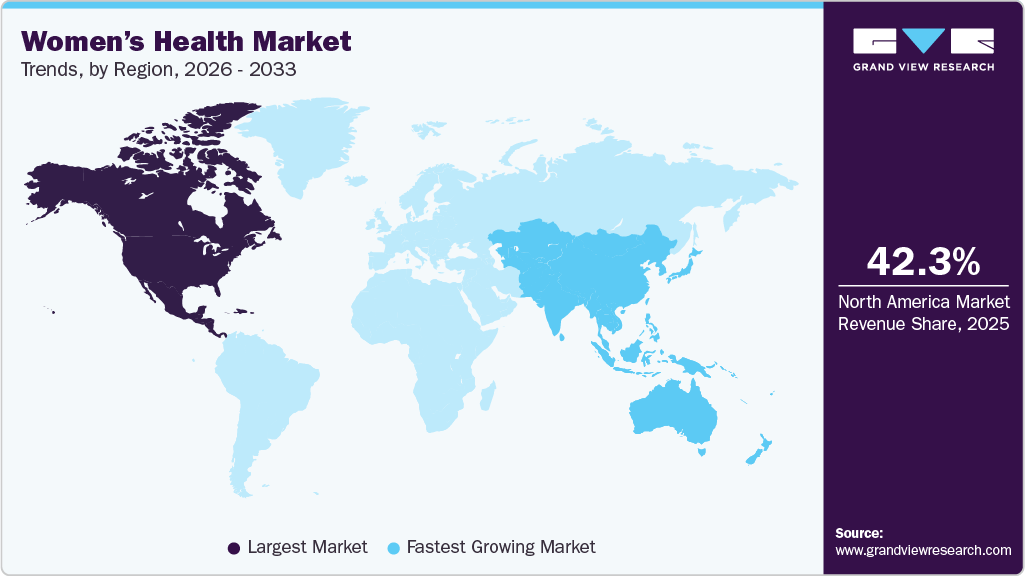
- North America dominated the market with the largest revenue share of 42.94% in 2025.
- Asia Pacific is expected to grow at the fastest CAGR of 7.0% over the forecast period.
- By application, the contraceptives segment accounted for the largest revenue share of 28.17% in 2025.
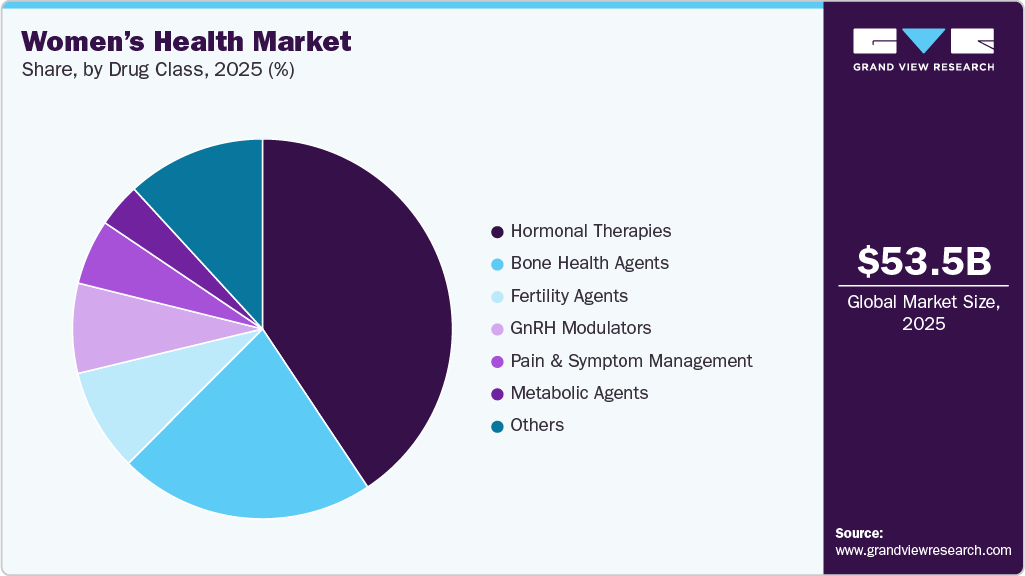
- By drug class, the hormonal therapies segment accounted for the largest revenue share of 40.66% in 2025.
- By age, the 50 years and above segment is expected to grow at the fastest CAGR of 6.7% over the forecast period.
Market Size & Forecast
- 2025 Market Size: USD 53.48 Billion
- 2033 Projected Market Size: USD 75.42 Billion
- CAGR (2026-2033): 5.1%
- North America: Largest market in 2025
- Asia Pacific: Fastest growing market
Furthermore, favorable policies initiated by governments to improve women’s health and raise awareness are likely to drive market growth during the forecast period. The market for women s health is increasingly defined by a lifecycle approach that extends beyond reproductive care to include maternal health, fertility, menopause management, and gender specific diagnostics. Governments and multilateral agencies are reinforcing women’s health as a health system priority, influencing regulation, reimbursement, and funding alignment across regions. World Health Organization continues to emphasize sexual and reproductive health and rights as foundational to health system resilience and equity, shaping policy agendas globally.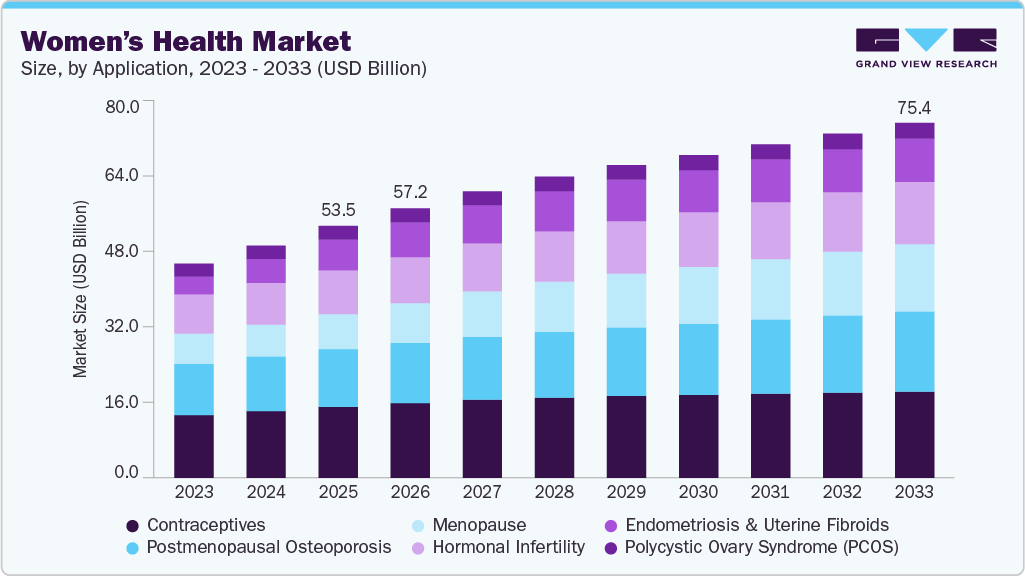
Regulatory scrutiny has intensified around safety, evidence generation, and inclusion of women across life stages in clinical research, particularly in areas such as hormone therapies and menopause care. This has direct implications for application development strategies, labeling pathways, and post market surveillance requirements. In parallel, healthcare companies are positioning women’s health as a strategic growth and responsibility area within annual reports and investor communications, highlighting increased focus on diagnostics, fertility technologies, and chronic condition management.
Overall, the market is shaped by rising policy engagement, evolving regulatory expectations, and strategic corporate investment, with opportunities centered on evidence backed therapies, diagnostics, and scalable care models aligned with public health priorities.
Market Concentration & Characteristics
Innovation in the market is moderate to high, driven primarily by unmet clinical needs and historical underrepresentation of women in medical research. Activity is concentrated in fertility technologies, menopause therapies, non-invasive diagnostics, and digital health platforms addressing menstrual and reproductive health. Innovation is increasingly incremental rather than disruptive, focused on improving safety profiles, delivery mechanisms, and patient adherence. Public sector initiatives encouraging sex specific data generation are reinforcing innovation pipelines. Organizations such as the World Health Organization and national regulators are influencing research priorities by highlighting gaps in women focused evidence and care pathways.
Barriers to entry are moderate but rising. Regulatory approval requirements, long clinical development timelines, and the need for robust safety data across life stages create high upfront investment demands. Market entry is further constrained by fragmented reimbursement policies and variability in coverage for fertility and menopause treatments across countries. Brand trust and physician familiarity also act as soft barriers, favoring established players. In addition, sociopolitical sensitivity around reproductive health in some regions increases policy uncertainty, raising risk for new entrants without diversified portfolios or strong regulatory expertise.
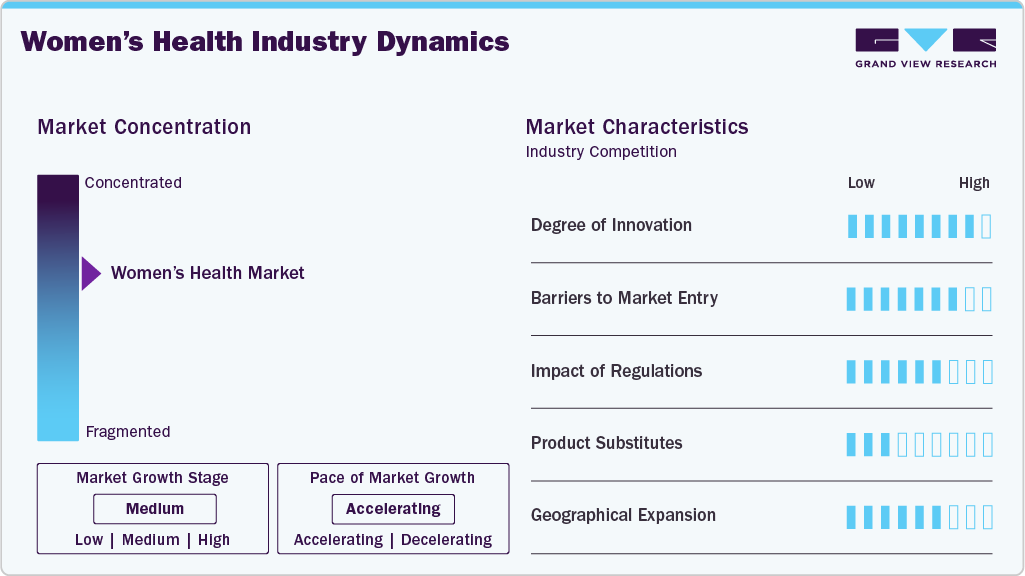
Regulation has a significant and direct impact on the market. Authorities increasingly require sex specific safety and efficacy data, influencing trial design and post market commitments. Regulatory scrutiny is particularly strong for hormone therapies, fertility interventions, and Applications used during pregnancy or menopause. In 2025, the U.S. Food and Drug Administration reinforced regulatory dialogue through expert panels on menopause and hormone replacement therapy, signaling continued oversight and evolving guidance. Compliance costs are high, but clearer frameworks also reduce long term development risk for compliant manufacturers.
Application substitution risk is moderate and varies by segment. In fertility and menopause care, substitutes include lifestyle interventions, supplements, and non-prescription therapies, many of which lack strong clinical validation. In diagnostics, traditional imaging and laboratory testing can substitute for newer point of care or digital tools, depending on healthcare infrastructure. Cultural preferences for traditional or alternative medicine in certain regions also act as substitutes to pharmaceutical interventions. However, increasing emphasis on evidence-based care and physician guided treatment limits full substitution, particularly for regulated therapies and clinically critical conditions.
Geographical expansion is a key growth lever, particularly into emerging markets with improving healthcare access and rising awareness of women s health issues. Expansion is shaped by government programs targeting maternal health, fertility access, and cancer screening. Regulatory heterogeneity and uneven reimbursement slow uniform rollout, requiring localized market entry strategies. Multinational companies prioritize partnerships, local manufacturing, and public health collaborations to reduce access barriers. Growth potential is strongest in Asia Pacific, Latin America, and parts of Africa, where demographic trends and policy engagement are converging to expand formal women s healthcare delivery.
Application Insights
The contraceptives segment dominated the market with the largest revenue share of 28.17% in 2025. The contraceptives segment dominated the market in 2025 due to its broad population coverage, recurring utilization, and strong integration into public health systems. Contraceptives are embedded in national essential health packages, supported by sustained government procurement and donor funding, which provides predictable demand compared with episodic or specialty women s health therapies. The availability of diverse methods, including long-acting reversible contraceptives, further supports higher per patient value and clinical preference. For instance, in 2025, the World Health Organization updated global family planning indicators used by governments to plan contraceptive procurement and service delivery, directly reinforcing volume driven demand across markets.
The menopause segment is projected to grow at the fastest CAGR of 10.0% over the forecast period as awareness, diagnosis rates, and willingness to seek medical care continue to rise among midlife and older women. Improved clinical education and broader availability of hormone and non-hormone therapies are reducing historical treatment gaps, while employers and health systems increasingly recognize menopause as a long term care need rather than a lifestyle issue. For instance, in 2025, NHS England reinforced menopause care within women s health services through updated clinical pathways and expanded access to specialist menopause clinics, supporting sustained uptake of prescription therapies and structured care models.
Age Insights
The age below 50 years segment dominated the market in 2025 as it encompasses the largest and most actively treated population group, covering contraception, fertility care, pregnancy related services, menstrual disorders, and hormonal regulation. Women in this age range have higher interaction frequency with healthcare systems, leading to recurring prescriptions, preventive screenings, and long duration treatment pathways. Public health programs and employer sponsored insurance also primarily target this cohort, reinforcing utilization intensity. For instance, in 2025, the United Nations Population Fund reiterated that women of reproductive age remain the primary focus of sexual and reproductive health investments globally, sustaining demand concentration in this demographic segment.
The 50 years and above segment is projected to grow at a CAGR of 6.7% over the forecast period, driven by population aging, longer life expectancy, and rising demand for menopause management, osteoporosis prevention, and chronic condition care. Women in this cohort increasingly seek structured, evidence-based therapies and diagnostics, shifting care from episodic symptom relief to long term disease prevention and quality of life management. Health systems are adapting pathways and benefits to address these needs, supporting utilization growth. For instance, in 2025, the Organization for Economic Co-operation and Development highlighted accelerating female population aging and its implications for healthcare planning, reinforcing sustained demand growth among women aged 50 years and above.
Drug Class Insights
The hormonal therapies segment dominated the market with the largest revenue share of 40.66% in 2025 and is expected to register the fastest CAGR over the forecast period, due to its wide therapeutic coverage and chronic use profile across contraception, fertility management, menstrual disorders, and menopause care. These therapies are prescribed over extended durations, driving consistent utilization and higher cumulative treatment value compared with episodic interventions. Strong inclusion in clinical guidelines and reimbursement frameworks further supports adoption across healthcare systems. In addition, portfolio breadth among specialized women’s health companies sustains lifecycle revenues. For instance, in 2025, Organon emphasized hormonal therapies as a foundational component of its women’s health strategy in its annual report, reinforcing the segment’s central commercial and clinical importance.
Regional Insights
North America women’s health industry held the largest share of the global market in 2025, accounting for 42.94% of global revenue, supported by high healthcare spending, strong insurance coverage, and advanced clinical adoption. Demand is broad-based across contraception, fertility, menopause management, and oncology diagnostics. Regulatory clarity, large commercial formularies, and strong physician engagement support early uptake of new therapies. Employer sponsored health benefits increasingly recognize fertility and menopause care, expanding access beyond traditional reimbursement channels. The region also benefits from a dense ecosystem of pharmaceutical innovators, digital health platforms, and specialty clinics, reinforcing sustained utilization and Application lifecycle stability.
U.S. Women’s Health Market Trends
The United States women’s health industry drives regional momentum due to scale, high prescription volumes, and rapid commercialization of women’s health therapies. Utilization is shaped by private insurance coverage, employer benefits, and public programs targeting reproductive and maternal health. Innovation adoption is strong in fertility services, menopause therapies, and diagnostics, while regulatory oversight emphasizes safety and real-world evidence. Policy variability across states introduces access complexity, but overall demand remains resilient due to high healthcare engagement among women and strong presence of specialized providers and pharmaceutical manufacturers.
Europe Women’s Health Market Trends
Europe’s women’s health industry is characterized by centralized regulation, price controls, and broad public reimbursement. Demand is stable across contraception, maternal care, and menopause management, supported by national health systems and preventive care mandates. Uptake of innovation is gradual but sustained, with strong emphasis on safety, clinical guidelines, and cost effectiveness. Aging demographics and structured screening programs support long-term growth, while regional harmonization under the European regulatory framework facilitates cross-border commercialization despite country-level reimbursement differences.
The women’s health industry in the UK is shaped by publicly funded healthcare delivery and standardized clinical pathways. Women’s health demand is concentrated in contraception, menopause care, and cancer screening, with increasing policy attention on reducing treatment gaps. Uptake of therapies is influenced by clinical guidance and budget impact assessments rather than rapid commercialization. Expansion of specialized clinics and primary care training supports gradual growth, particularly in menopause management and preventive services, reinforcing steady utilization rather than high price driven expansion.
Germany women’s health industry represents one of Europe’s largest markets due to comprehensive insurance coverage and strong outpatient care. High physician density and early adoption of approved therapies support consistent utilization across hormonal treatments, fertility services, and gynecological diagnostics. Pricing and access are regulated, but broad reimbursement ensures volume stability. Demographic aging and structured preventive programs are strengthening demand for menopause and chronic condition management, while domestic manufacturing capabilities support supply reliability.
France’s women’s health industry benefits from universal healthcare access and strong emphasis on preventive and maternal care. Utilization is driven by standardized treatment pathways, widespread contraception access, and public health screening programs. Regulatory oversight prioritizes safety and population health outcomes, moderating rapid Application uptake but ensuring long term stability. Growth is supported by increasing focus on menopause care and chronic disease prevention in aging women, aligned with national health priorities.
Asia-Pacific Women’s Health Market Trends
Asia Pacific women’s health industry is anticipated to be the fastest growing regional market over the forecast period, driven by population scale, rising healthcare access, and increasing awareness of women’s health needs. Demand expansion is strongest in contraception, fertility treatment, and maternal care, supported by urbanization and income growth. Governments are investing in reproductive health infrastructure, while private providers and multinational companies expand presence through partnerships and localized manufacturing. Regulatory heterogeneity requires country specific strategies, but long-term demand fundamentals remain strong.
The women’s health industry in Japan is shaped by rapid population aging and high healthcare utilization. Demand is increasingly concentrated in menopause management, osteoporosis prevention, and chronic condition care. Universal insurance supports access, while cultural shifts are improving diagnosis and treatment seeking behavior. Innovation adoption is measured but consistent, supported by strong regulatory standards and physician trust. Declining birth rates moderate fertility volumes but aging driven demand offsets this trend.
China women’s health industry represents a large, evolving market driven by healthcare reform, rising awareness, and expanding insurance coverage. Demand spans contraception, fertility services, maternal care, and gynecologic oncology diagnostics. Policy initiatives aimed at improving reproductive health access and addressing demographic challenges support long term utilization. Domestic manufacturing and digital health platforms are expanding reach, while regulatory reforms are improving approval timelines and market access for women focused therapies.
Latin America Women’s Health Market Trends
Latin America women’s health industry shows steady growth supported by improving public healthcare coverage and expanding private sector participation. Demand is centered on contraception, maternal health, and hormonal therapies, with gradual uptake of fertility and menopause care. Access varies widely by country, influenced by public funding levels and infrastructure. Multinational companies rely on partnerships and tender participation, while governments emphasize preventive programs to reduce long term healthcare costs.
Brazil women’s health industry leads Latin America market due to its population size and mixed public private healthcare system. Women’s health demand is driven by public reproductive health programs and a growing private insurance segment. Utilization is strong in contraception and maternal care, with emerging demand for fertility and menopause treatments in urban centers. Regulatory oversight is robust, supporting Application quality while moderating pricing flexibility.
Middle East & Africa Women’s Health Market Trends
The Middle East & Africa women’s health industry is heterogeneous, with growth driven by improving healthcare infrastructure and government investment in women’s health outcomes. Demand is focused on maternal health, contraception, and basic gynecological care, with gradual expansion into chronic and menopause related treatments. Access gaps persist in lower income regions, while private healthcare growth supports premium services in urban markets.
Saudi Arabia women’s health industry is a key growth market within the region, supported by healthcare system modernization and national transformation initiatives. Investment in women’s health services, expanded insurance coverage, and increased female workforce participation are driving utilization. Demand is rising across reproductive health, hormonal therapies, and preventive care, supported by expanding hospital capacity and specialist services aligned with long term healthcare diversification goals.
Key Women’s Health Company Insights
Key companies in the market emphasize portfolio breadth, lifecycle management, and regulatory engagement to sustain stable demand across contraception, hormonal therapies, fertility, and menopause care. Innovation is largely incremental, improving safety, delivery, and adherence, while selective partnerships and acquisitions expand niche capabilities. Geographic expansion into emerging markets and participation in public health programs support volume growth. Overall, leading players position women’s health as a resilient, long-term strategic segment aligned with public policy and payer priorities.
Key Women’s Health Companies:
The following key companies have been profiled for this study on the women’s health market
- AbbVie, Inc.
- Bayer AG
- Organon & Co.
- Pfizer, Inc.
- Theramex
- Agile Therapeutics
- Amgen, Inc.
- Apothecus Pharmaceutical Corp.
- Blairex Laboratories, Inc.
- Ferring
Recent Developments
-
In November 2025, Roche highlighted expansion of women-focused diagnostics, particularly in gynecologic oncology, within its healthcare strategy updates, reinforcing diagnostics as a key pillar of women’s health beyond therapeutics.
-
In October 2025, Midi Health raised Series C funding to scale virtual menopause and perimenopause care, signaling strong private capital interest and validation of menopause management as a high-growth segment within women’s health.
-
In May 2025, Bayer emphasized lifecycle management and access expansion of its women’s health Applications in its investor presentation, reflecting sustained corporate investment in hormonal therapies and reproductive health despite broader pharmaceutical portfolio reshaping.
-
In March 2025, Organon reaffirmed women’s health as its core business priority in its annual report, highlighting continued focus on contraception, fertility, and menopause portfolios, underscoring long-term strategic commitment rather than diversification into unrelated therapeutic areas.
-
In September 2024, Organon announced acquisition of Dermavant, a subsidiary of Roivant focused on developing and commercializing novel treatments in immuno-dermatology.
-
In March 2024, Insud Pharma announced the successful acquisition of Viatris' Women’s Healthcare division, which focuses on oral and injectable contraceptives. This strategic move strengthens Insud Pharma's industrial footprint in India by adding two manufacturing facilities located in Sarigam and Ahmedabad.
-
In March 2024, the U.S. FDA granted approval to ELAHERE, developed by AbbVie Inc., for the treatment of adult patients with folate receptor alpha (FRα)-positive, platinum-resistant epithelial ovarian, fallopian tube, or primary peritoneal cancer, who have previously undergone up to three lines of therapy.
Women’s Health Market Report Scope
Report Attribute
Details
Market size value in 2026
USD 57.20 billion
Revenue forecast in 2033
USD 75.42 billion
Growth rate
CAGR 5.1% from 2026 to 2033
Base year for estimation
2025
Historical data
2021 - 2024
Forecast period
2026 - 2033
Quantitative units
Revenue in USD million/billion and CAGR from 2026 to 2033
Report coverage
Revenue forecast, company ranking, competitive landscape, growth factors, trends
Segments covered
Application, drug class, age, region
Regional scope
North America; Europe; Asia Pacific; Latin America; Middle East & Africa
Country scope
U.S.; Canada; Mexico; UK; Germany; France; Italy; Spain; Denmark; Sweden; Norway; China; Japan; India; Australia; South Korea; Thailand; Brazil; Argentina; Saudi Arabia; South Africa; UAE; Kuwait
Key company profiled
AbbVie, Inc.; Bayer AG; Organon & Co.; Pfizer, Inc.; Theramex; Agile Therapeutics; Amgen, Inc.; Apothecus Pharmaceutical Corp.; Blairex Laboratories, Inc.; Ferring
Customization scope
Free report customization (equivalent up to 8 analysts working days) with purchase. Addition or alteration to country, regional & segment scope.
Pricing and purchase options
Avail customized purchase options to meet your exact research needs. Explore purchase options
Global Women’s Health Market Report Segmentation
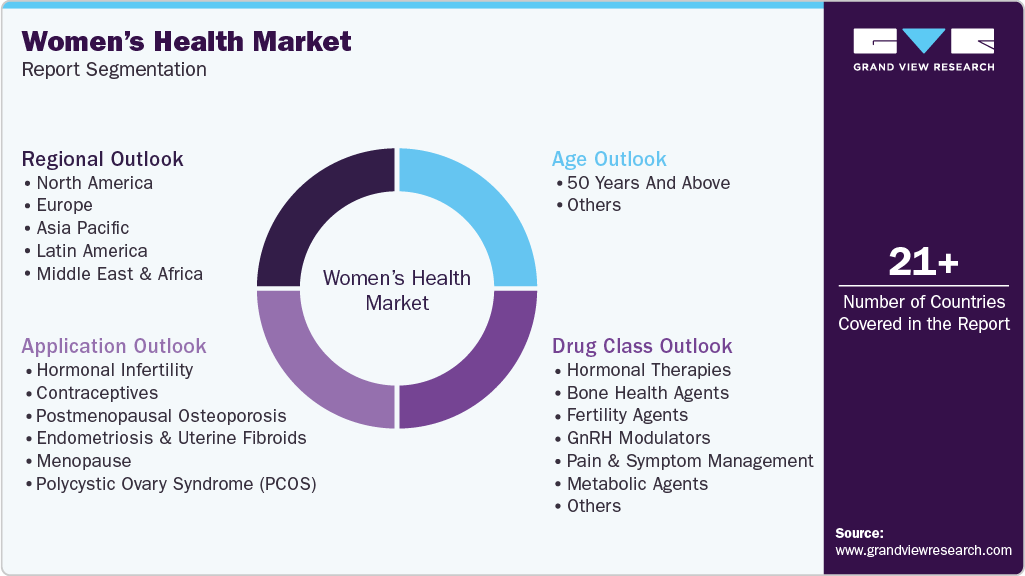
This report forecasts revenue growth at global, regional, and country levels and provides an analysis of the latest industry trends in each of the sub-segments from 2021 to 2033. For this study, Grand View Research has segmented the global women’s health market report based on application, drug class, age, and region:
-
Application Outlook (Revenue, USD Million, 2021 - 2033)
-
Hormonal Infertility
-
Contraceptives
-
Postmenopausal Osteoporosis
-
Endometriosis & Uterine Fibroids
-
Menopause
-
Polycystic Ovary Syndrome (PCOS)
-
-
Drug Class Outlook (Revenue, USD Million, 2021 - 2033)
-
Hormonal Therapies
-
Bone Health Agents
-
Fertility Agents
-
GnRH Modulators
-
Pain and Symptom Management
-
Metabolic Agents
-
Others
-
-
Age Outlook (Revenue, USD Million, 2021 - 2033)
-
50 years and above
-
Postmenopausal Osteoporosis
-
Endometriosis & Uterine Fibroids
-
Menopause
-
Others
-
-
Others
-
-
Regional Outlook (Revenue, USD Million, 2021 - 2033)
-
North America
-
U.S.
-
Canada
-
Mexico
-
-
Europe
-
UK
-
Germany
-
France
-
Italy
-
Spain
-
Denmark
-
Sweden
-
Norway
-
-
Asia Pacific
-
Japan
-
China
-
India
-
Australia
-
South Korea
-
-
Thailand
-
Latin America
-
Brazil
-
Argentina
-
-
Middle East & Africa
-
South Africa
-
Saudi Arabia
-
UAE
-
Kuwait
-
-
Frequently Asked Questions About This Report
b. Some of the key players operating in the women’s health market are AbbVie, Inc., Bayer AG, Organon & Co., Pfizer, Inc., Theramex, Agile Therapeutics, Amgen, Inc., Apothecus Pharmaceutical Corp., Blairex Laboratories, Inc., and Ferring.
b. An increase in the population of women aged over 60, a rise in unhealthy lifestyle habits, the introduction of novel medicines for women's health, and the impending approval of pipeline products are some of the factors that drive market growth.
b. The global women's health market size was estimated at USD 53.48 billion in 2025 and is expected to reach USD 57.20 billion in 2026.
b. The global women's health market is expected to grow at a compound annual growth rate of 5.1% from 2026 to 2033 to reach USD 75.42 billion by 2033.
b. The contraceptives segment dominated the market with the largest revenue share of 28.17% in 2025. The contraceptives segment dominated the women s health market in 2025 due to its broad population coverage, recurring utilization, and strong integration into public health systems.


Share this report with your colleague or friend.
Need a Tailored Report?
Customize this report to your needs — add regions, segments, or data points, with 20% free customization.


ISO 9001:2015 & 27001:2022 Certified
We are GDPR and CCPA compliant! Your transaction & personal information is safe and secure. For more details, please read our privacy policy.
Trusted market insights - try a free sample
See how our reports are structured and why industry leaders rely on Grand View Research. Get a free sample or ask us to tailor this report to your needs.