- Home
- »
- Advanced Interior Materials
- »
-
Wireless Gas Detection System Market Size Report, 2033GVR Report cover
![Wireless Gas Detection System Market Size, Share & Trends Report]()
Wireless Gas Detection System Market (2026 - 2033) Size, Share & Trends Analysis Report By Type (Portable, Fixed), By Technology (Infrared Technology, Electrochemical Technology, Semiconductor Technology, Catalytic Technology), By End Use, By Region, And Segment Forecasts
- Report ID: GVR-4-68040-882-0
- Number of Report Pages: 152
- Format: PDF
- Historical Range: 2021 - 2024
- Forecast Period: 2026 - 2033
- Industry: Advanced Materials
- Report Summary
- Table of Contents
- Segmentation
- Methodology
- Download FREE Sample
-
 Download Sample Report
Wireless Gas Detection System Market Summary
The global wireless gas detection system market size was estimated at USD 2,194.3 million in 2025 and is projected to reach USD 3,532.4 million by 2033, growing at a CAGR of 6.2% from 2026 to 2033. The market is expected to grow significantly due to increasing focus on industrial safety and real-time monitoring across sectors such as oil and gas, chemicals, mining, and manufacturing.
Key Market Trends & Insights
- North America dominated the wireless gas detection system market with the largest revenue share of 39.5% in 2025.
- By type, the portable wireless gas detection system segment is projected to grow at 6.7% CAGR during the forecast period.
- The electrochemical technology segment is projected to expand at a CAGR of 6.7% from 2026 to 2033 in terms of revenue.
- Based on end use, the oil & gas segment dominated the market in 2025, accounting for 40.2% market share.
Market Size & Forecast
- 2025 Market Size: USD 2,194.3 Million
- 2033 Projected Market Size: USD 3,532.4 Million
- CAGR (2026-2033): 6.2%
- North America: Largest market in 2025
- Asia Pacific: Fastest growing market
These systems offer flexibility, easy installation, and remote accessibility compared to wired solutions. Rising gas-leak incidents and stringent safety regulations are driving adoption. Integration with IoT and cloud-based platforms enables continuous monitoring, data analytics, and predictive maintenance, improving operational efficiency. Growing investments in industrial automation and smart infrastructure further support demand. In addition, the expansion of hazardous work environments and the need for worker safety are pushing companies worldwide to adopt advanced wireless gas detection solutions.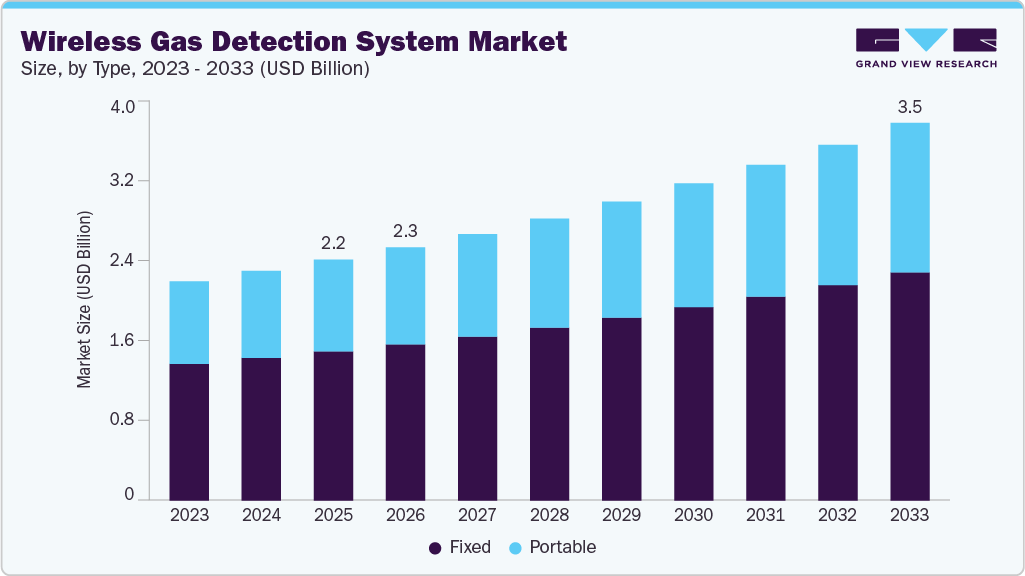
Market Concentration & Characteristics
The wireless gas detection system market is moderately fragmented, with a mix of global safety equipment manufacturers, technology providers, and regional players. Large companies offer advanced, integrated solutions, while smaller firms focus on niche applications and cost-effective products. Continuous technological advancements and the entry of new players intensify competition. Diverse industry requirements and varying regulatory standards across regions further contribute to market fragmentation, preventing high concentration.
The degree of innovation in the market is high, driven by advancements in IoT, sensor technology, and real-time data analytics. Companies are developing compact, low-power wireless sensors with improved accuracy and faster response times. Integration with cloud platforms, mobile applications, and predictive maintenance tools enhances monitoring capabilities, safety, and operational efficiency across industrial environments.
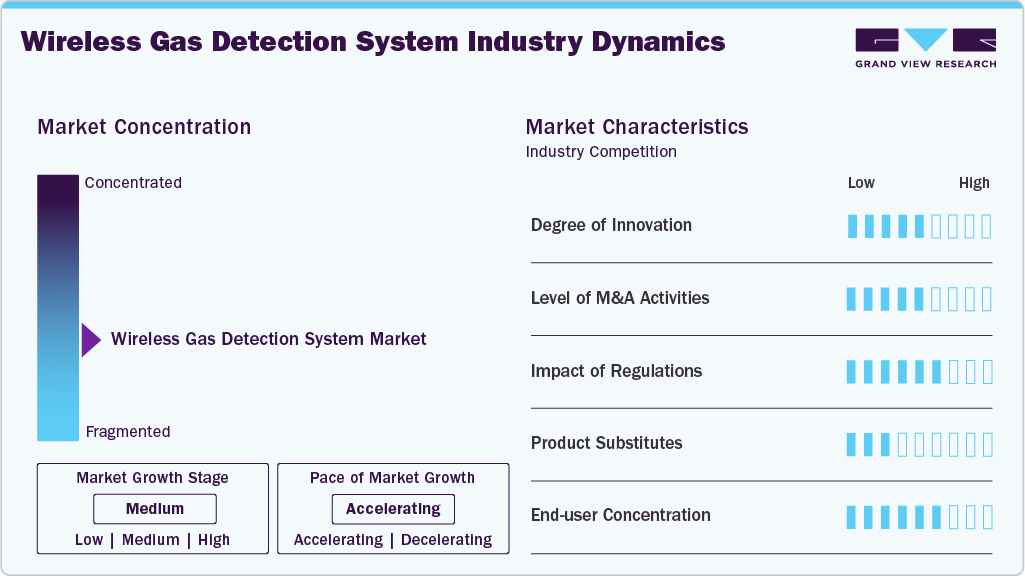
Merger and acquisition activity is increasing as companies aim to strengthen technological capabilities and expand geographic reach. Established safety equipment providers are acquiring sensor technology firms and software companies to enhance product portfolios. Strategic partnerships are also common, enabling integration of advanced analytics and connectivity solutions, helping companies stay competitive in a rapidly evolving market.
Regulations are significantly shaping the wireless gas detection system industry by enforcing strict industrial safety and environmental standards. Governments and regulatory bodies require continuous monitoring of hazardous gases in workplaces, driving the adoption of advanced detection systems. Compliance with safety norms and emission standards encourages companies to invest in reliable technologies. While regulations increase operational costs, they also promote innovation and ensure worker safety.
Drivers, Opportunities & Restraints
Increasing focus on worker safety and industrial risk management is driving the market. Industries such as oil and gas, chemicals, and mining require continuous monitoring of hazardous gases to prevent accidents. Rising incidents of gas leaks and strict safety regulations are encouraging companies to adopt wireless systems for real-time monitoring and faster response.
A major opportunity in the market lies in the integration of IoT, cloud computing, and advanced analytics. These technologies enable remote monitoring, predictive maintenance, and data-driven decision-making. Expansion of smart industrial facilities and automation across emerging economies is creating new demand. Increasing adoption in non-traditional sectors, such as utilities and infrastructure, further broadens the market's potential.
High initial investment and maintenance costs associated with advanced systems are being challenged in the market. Small and medium-sized enterprises may find it difficult to adopt these technologies. Additionally, concerns related to network reliability, data security, and system integration can hinder adoption. Harsh industrial environments may also impact sensor performance and long-term reliability.
Type Insights
The fixed segment led the market and accounted for 61.5% of the global revenue share in 2025, due to its ability to provide continuous, real-time monitoring in industrial facilities. These systems are widely used in oil & gas, chemical plants, and manufacturing units for permanent installation. Increasing safety regulations and the need for constant surveillance of hazardous environments are driving adoption, along with the integration of wireless connectivity and centralized monitoring systems.
The portable segment is expected to grow rapidly in the wireless gas detection system market, driven by increasing demand for mobility and worker safety. Portable devices allow on-the-go monitoring in confined or remote locations, making them essential for field workers. Ease of use, flexibility, and real-time alerts enhance safety. Rising awareness of occupational hazards and adoption across multiple industries are supporting strong segment growth.
Technology Insights
The infrared technology segment dominated the market in 2025, accounting for 37.4% of the market share, due to its high accuracy and reliability in detecting hydrocarbon gases. It performs well in harsh industrial environments and offers long operational life with low maintenance requirements. Increasing use in oil and gas and chemical industries, along with integration into wireless monitoring systems, is supporting adoption and long-term growth.
The electrochemical technology segment is expected to grow significantly in the wireless gas detection system market due to its sensitivity in detecting toxic gases such as carbon monoxide and hydrogen sulfide. These sensors are widely used for personal safety and portable devices. Their compact size, cost-effectiveness, and compatibility with wireless systems are driving adoption, especially in industries focused on worker safety and regulatory compliance.
End Use Insights
The oil & gas segment led the market in 2025 due to high safety risks and the need for continuous monitoring of hazardous gases. Exploration, production, and refining activities require reliable detection systems to prevent leaks and accidents. Increasing regulatory requirements and the adoption of advanced wireless technologies for real-time monitoring are driving demand across upstream and downstream operations.
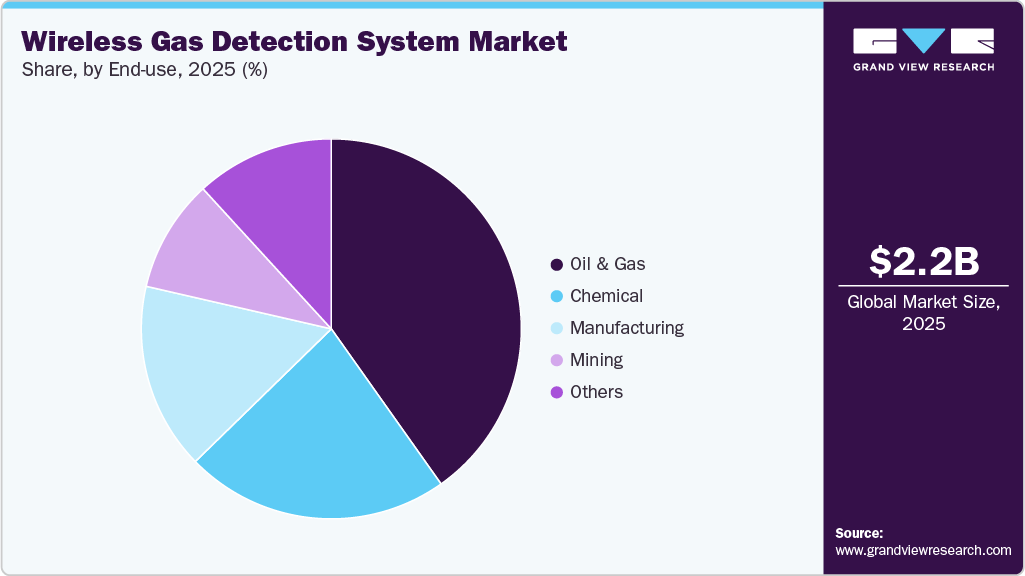
The chemical segment is expected to grow at 6.4% CAGR during the forecast period, driven by the need to monitor toxic and flammable gases in manufacturing processes. Chemical plants require accurate and continuous detection systems to ensure worker safety and regulatory compliance. Adoption of wireless solutions enables flexible deployment and real-time alerts. Increasing focus on process safety and risk management is supporting growth in this segment.
Regional Insights
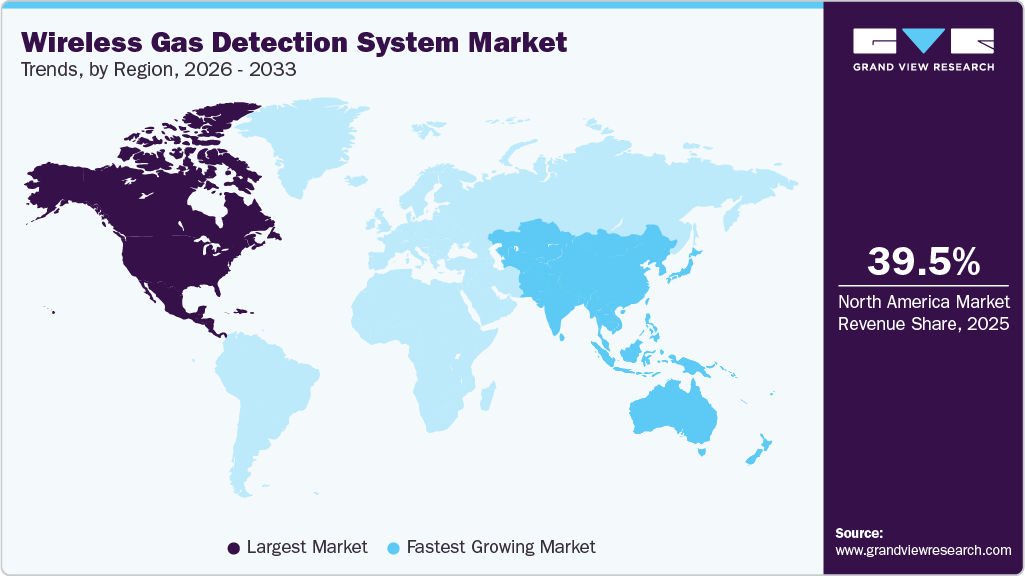
North America dominated the wireless gas detection system market with the largest revenue share of 39.5% in 2025. The wireless gas detection system industry in North America led the market in 2025 due to strong industrial safety regulations and advanced infrastructure. High adoption across oil & gas, chemicals, and manufacturing sectors drives demand. Increasing focus on worker safety, along with integration of IoT and cloud-based monitoring systems, supports growth. The presence of key market players and continuous technological advancements further strengthen market expansion.
U.S. Wireless Gas Detection System Market Trends
The U.S. wireless gas detection system industry is expanding significantly, driven by strict occupational safety standards and high adoption of advanced monitoring technologies. Industries such as oil & gas and chemicals rely heavily on wireless gas detection systems for real-time safety. Increasing investments in industrial automation and smart facilities are boosting demand. Technological innovation and strong regulatory compliance requirements continue to support steady growth.
The wireless gas detection system industry in Mexico is growing gradually, supported by expanding industrial activities and improving safety standards. The oil & gas and manufacturing sectors are key contributors to demand. Increasing awareness of workplace safety and regulatory compliance is encouraging adoption. However, cost sensitivity and limited technological penetration may slow growth, though urban industrial areas are witnessing steady implementation of wireless solutions.
Asia Pacific Wireless Gas Detection System Market Trends
The wireless gas detection system industry in the Asia Pacific is expected to witness the fastest growth of 6.7% CAGR during the forecast period, driven by rapid industrialization and expanding manufacturing sectors. Increasing investments in infrastructure and energy projects are boosting demand. Growing awareness of workplace safety and regulatory improvements supports adoption. Countries across the region are adopting IoT-enabled monitoring systems, making it a key growth hub for wireless gas detection technologies.
The China wireless gas detection system industry is growing rapidly due to large-scale industrial activity and increased focus on workplace safety. The chemical, mining, and manufacturing sectors drive demand for wireless gas detection systems. Government regulations on industrial safety and environmental protection are encouraging adoption. Technological advancements and the integration of smart monitoring solutions are further supporting market expansion across industrial facilities.
The wireless gas detection system industry in India is expanding steadily, supported by industrial growth and increasing awareness of safety standards. Sectors such as oil & gas, chemicals, and manufacturing are driving demand. Government initiatives to improve workplace safety and environmental compliance are encouraging adoption. The growing use of IoT-enabled systems and the expansion of industrial infrastructure are further contributing to market growth.
Europe Wireless Gas Detection System Market Trends
The wireless gas detection system industry in Europe is expected to grow at 6.0% CAGR during the forecast period due to strict environmental and workplace safety regulations. Industries are increasingly adopting advanced monitoring systems to comply with emission and safety standards. Growing focus on industrial automation and sustainability is supporting demand. Technological advancements and the integration of IoT-based solutions are further enhancing system efficiency and driving market expansion across the region.
The Germany wireless gas detection system industry is growing due to its strong industrial base and emphasis on workplace safety. The country’s chemical and manufacturing industries are key users of wireless gas detection systems. Strict regulatory standards and increasing adoption of Industry 4.0 technologies are driving demand. Integration of smart monitoring systems and continuous investments in industrial automation are further supporting market growth.
The wireless gas detection system industry in the UK is expanding steadily, driven by strict safety regulations and increasing adoption of advanced monitoring technologies. Industries such as oil & gas, utilities, and manufacturing are key contributors. Growing focus on worker safety and environmental compliance supports demand. Integration of wireless and IoT-based systems for real-time monitoring and predictive maintenance is further boosting market growth.
Middle East & Africa Wireless Gas Detection System Market Trends
The wireless gas detection system industry in the Middle East and Africa is witnessing steady growth due to strong demand from the oil & gas sector. The high risk of gas leaks and strict safety requirements are driving the adoption of wireless detection systems. Increasing investments in industrial infrastructure and energy projects support growth. Rising awareness of worker safety and the gradual adoption of advanced monitoring technologies are further contributing to market expansion.
The Saudi Arabia wireless gas detection system industry is growing significantly due to its dominant oil & gas industry and focus on industrial safety. Wireless gas detection systems are widely used to monitor hazardous environments. Government initiatives to enhance safety standards and investments in energy and infrastructure projects are driving demand. Adoption of advanced monitoring technologies and smart systems is further supporting market growth.
Latin America Wireless Gas Detection System Market Trends
The wireless gas detection system industry in Latin America is experiencing gradual growth, driven by expanding industrial sectors and rising safety awareness. Oil & gas and mining industries are key contributors. Increasing regulatory focus on workplace safety is encouraging adoption. However, economic constraints and limited technological adoption may slow growth, though demand is rising in major industrial regions.
The Brazil wireless gas detection system industry is growing due to increasing industrial activities and demand from the oil & gas and mining sectors. Rising awareness of worker safety and regulatory compliance is driving the adoption of wireless gas detection systems. Investments in industrial infrastructure and energy projects support growth. Although cost concerns remain, growing adoption of advanced monitoring technologies is contributing to market expansion.
Key Wireless Gas Detection System Company Insights
Some of the key players operating in the market include Agilent Technologies and Honeywell International, among others.
-
Agilent Technologies develops analytical instruments, sensors, and monitoring solutions used in industrial and environmental applications, including gas detection. The company focuses on precision measurement, data analysis, and laboratory technologies. Its offerings support the detection of hazardous gases and ensure compliance with safety standards. Agilent operates globally, serving industries such as chemicals, energy, and environmental monitoring through continuous investment in research and development.
-
Honeywell International Inc. provides a wide range of industrial safety solutions, including wireless gas detection systems. Its products are used to monitor hazardous gases in sectors such as oil & gas, chemicals, and manufacturing. The company integrates sensing technologies with software and connectivity features for real-time monitoring. Honeywell operates through a global network, offering solutions that support workplace safety and regulatory compliance.
Key Wireless Gas Detection System Companies:
The following key companies have been profiled for this study on the wireless gas detection system market.
- Agilent Technologies
- Danaher Corporation
- Honeywell International
- TE Connectivity
- Siemens
- Raytheon Company
- BAE Systems
- Thales Group
- Lockheed Martin Corporation
- Environmental Sensors
- Yokogawa
- Henan Hwsensor
- Beijing SDL Technology
- RIKEN KEIKI
- Suzhou Create
Recent Developments
-
In January 2026, Safe Monitoring Group (SMG) acquired Gastronics, expanding its presence in wireless gas detection systems. Gastronics brings expertise in advanced monitoring technologies. Strengthening its portfolio and enhancing its capabilities in industrial safety and monitoring solutions.
-
In October 2024, onsemi announced the CEM102, a miniaturized analog front-end designed for highly accurate electrochemical sensing at low currents. Its compact size and low power consumption enable the development of efficient gas detection solutions.
Wireless Gas Detection System Market Report Scope
Report Attribute
Details
Market size in 2026
USD 2,322.7 million
Revenue forecast in 2033
USD 3,532.4 million
Growth rate
CAGR of 6.2% from 2026 to 2033
Base year for estimation
2025
Historical data
2021 - 2024
Forecast period
2026 - 2033
Quantitative units
Revenue in USD million and CAGR from 2026 to 2033
Report coverage
Revenue forecast, company market position analysis, competitive landscape, growth factors, and trends
Segments covered
Type, technology, end use, region
Regional scope
North America; Europe; Asia Pacific; Latin America; Middle East & Africa
Country Scope
U.S.; Canada; Mexico; Germany; UK; Italy; Spain; France; China; Japan; India; Australia; South Korea; Brazil; Argentina; Saudi Arabia; UAE; South Africa
Key companies profiled
Agilent Technologies; Danaher Corporation; Honeywell International; TE Connectivity; Siemens; Raytheon Company; BAE Systems; Thales Group; Lockheed Martin Corporation; Environmental Sensors; Yokogawa; Henan Hwsensor; Beijing SDL Technology; RIKEN KEIKI; Suzhou Create
Customization scope
Free report customization (equivalent up to 8 analysts working days) with purchase. Addition or alteration to country, regional & segment scope.
Pricing and purchase options
Avail customized purchase options to meet your exact research needs. Explore purchase options
Global Wireless Gas Detection System Market Report Segmentation
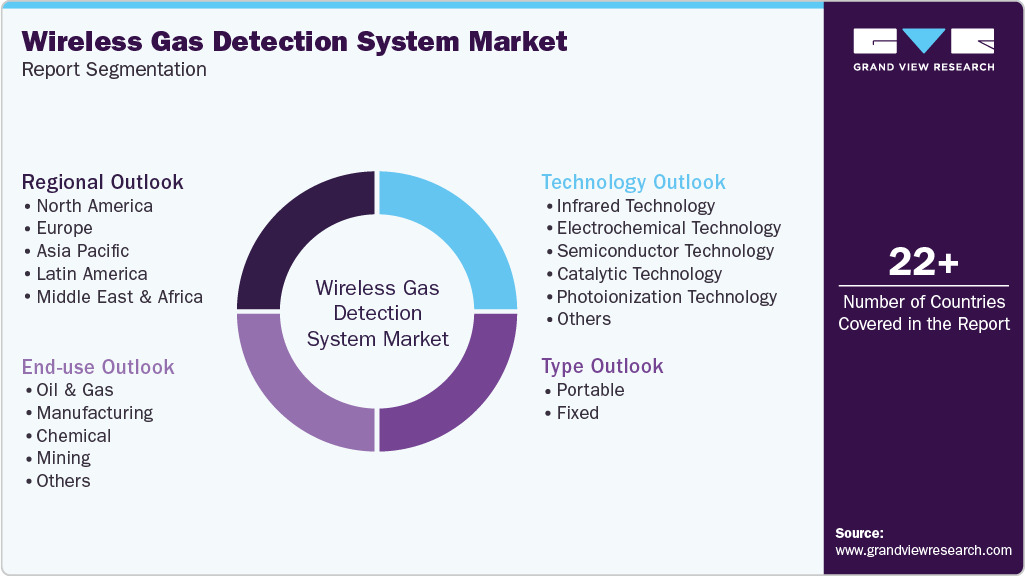
This report forecasts revenue growth at global, regional & country levels and provides an analysis on the industry trends in each of the sub-segments from 2021 to 2033. For this study, Grand View Research has segmented the global wireless gas detection system market report on the basis of type, technology, end use, and region:
-
Type Outlook (Revenue, USD Million, 2021 - 2033)
-
Portable
-
Fixed
-
-
Technology Outlook (Revenue, USD Million, 2021 - 2033)
-
Infrared Technology
-
Electrochemical Technology
-
Semiconductor Technology
-
Catalytic Technology
-
Photoionization Technology
-
Others
-
-
End Use Outlook (Revenue, USD Million, 2021 - 2033)
-
Oil & Gas
-
Manufacturing
-
Chemical
-
Mining
-
Others
-
-
Regional Outlook (Revenue, USD Million, 2021 - 2033)
-
North America
-
U.S.
-
Canada
-
Mexico
-
-
Europe
-
Germany
-
France
-
UK
-
Spain
-
Italy
-
-
Asia Pacific
-
China
-
India
-
Japan
-
South Korea
-
Australia
-
-
Latin America
-
Brazil
-
Argentina
-
-
Middle East & Africa
-
Saudi Arabia
-
UAE
-
South Africa
-
-
Frequently Asked Questions About This Report
b. The global wireless gas detection system market size was estimated at USD 2,194.3 million in 2025 and is expected to reach USD 2,322.7 million in 2026.
b. The oil & gas segment led the market and accounted for 40.2% of the global market revenue share in 2025 due to high safety risks and the need for continuous monitoring of hazardous gases. Exploration, production, and refining activities require reliable detection systems to prevent leaks and accidents.
b. Some of the key players operating in the wireless gas detection system include Agilent Technologies, Danaher Corporation, Honeywell International, TE Connectivity, Siemens, Raytheon Company, BAE Systems, Thales Group, Lockheed Martin Corporation, Environmental Sensors, Yokogawa, Henan Hwsensor, Beijing SDL Technology, Heibei Saihero, Suzhou Create.
b. Key factors driving the wireless gas detection system market include increasing focus on industrial safety, rising incidents of gas leaks, and strict regulatory standards. Growing adoption of IoT-enabled monitoring, need for real-time detection, and expansion of hazardous industrial environments further support market growth.
b. The global wireless gas detection system market, in terms of revenue, is expected to grow at a compound annual growth rate of 6.2% from 2026 to 2033 to reach USD 3,532.4 million by 2033.


Share this report with your colleague or friend.
Need a Tailored Report?
Customize this report to your needs — add regions, segments, or data points, with 20% free customization.


ISO 9001:2015 & 27001:2022 Certified
We are GDPR and CCPA compliant! Your transaction & personal information is safe and secure. For more details, please read our privacy policy.
Trusted market insights - try a free sample
See how our reports are structured and why industry leaders rely on Grand View Research. Get a free sample or ask us to tailor this report to your needs.