- Home
- »
- Organic Chemicals
- »
-
Water Treatment Chemicals Market, Industry Report, 2033GVR Report cover
![Water Treatment Chemicals Market Size, Share & Trends Report]()
Water Treatment Chemicals Market (2026 - 2033) Size, Share & Trends Analysis Report Product (Coagulants & Flocculants, Biocide & Disinfectant, Defoamer & Defoaming Agent), By End Use (Power, Oil & Gas, Chemical Manufacturing), By Region, And Segment Forecasts
- Report ID: GVR-4-68038-584-7
- Number of Report Pages: 80
- Format: PDF
- Historical Range: 2021 - 2024
- Forecast Period: 2026 - 2033
- Industry: Bulk Chemicals
- Report Summary
- Table of Contents
- Segmentation
- Methodology
- Download FREE Sample
-
 Download Sample Report
Water Treatment Chemicals Market Summary
The global water treatment chemicals market size was estimated at USD 35.8 billion in 2025 and is projected to reach USD 49.5 billion by 2033, growing at a CAGR of 4.2% from 2026 to 2033. The market is primarily driven by rising freshwater scarcity, rapid urbanization, and increasingly stringent environmental regulations governing industrial and municipal wastewater discharge.
Key Market Trends & Insights
- North America dominated the water treatment chemicals market with the largest revenue share of 28.2% in 2025.
- The market in the U.S. is expected to grow at a CAGR of 3.3% from 2026 to 2033 in terms of revenue.
- By product, the Scale & Corrosion Inhibitor segment is expected to grow at the fastest CAGR of 4.8% from 2026 to 2033 in terms of revenue.
- The raw water treatment segment held the largest revenue share of 48.0% in 2025 in terms of value.
- In 2025, the municipal segment held the largest revenue share of 43.1%.
Market Size & Forecast
- 2025 Market Size: USD 35.8 Billion
- 2033 Projected Market Size: USD 49.5 Billion
- CAGR (2026-2033): 4.2%
- Asia Pacific: Largest market in 2025
Growing demand from municipal water treatment, power generation, oil & gas, mining, and chemical manufacturing sectors is accelerating the adoption of coagulants, flocculants, biocides, and corrosion inhibitors to ensure regulatory compliance and operational efficiency. In addition, expanding industrial cooling and boiler applications, coupled with the need to extend asset life and reduce unplanned downtime, continue to support sustained chemical consumption across both developed and emerging economies.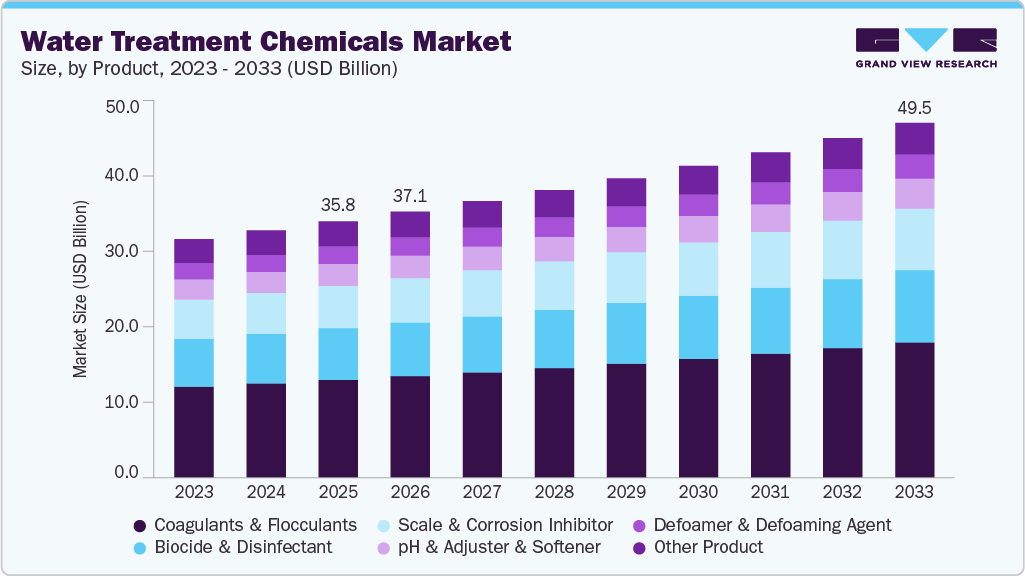
Significant growth opportunities are emerging from the increasing focus on water reuse, zero liquid discharge (ZLD), and desalination projects, particularly in water-stressed regions across the Asia Pacific, the Middle East, and parts of Africa. The shift toward eco-friendly, bio-based, and low-toxicity formulations, driven by sustainability goals and regulatory pressures, is creating avenues for product innovation and portfolio differentiation. Furthermore, the integration of digital water management platforms and AI-enabled dosing optimization presents opportunities for chemical suppliers to move up the value chain by offering performance-based and service-oriented solutions rather than standalone products.
Despite steady demand, the market faces challenges related to volatile raw material prices, high dependency on petrochemical feedstock, and margin pressure from commoditization in mature product categories such as coagulants and flocculants. Compliance with evolving environmental and chemical safety regulations, including restrictions on certain biocides and phosphorus-based formulations, increases R&D and reformulation costs for manufacturers. The availability of alternative physical and membrane-based treatment technologies, along with cost sensitivity in emerging markets, can limit pricing flexibility and slow the adoption of premium chemical solutions.
Market Concentration & Characteristics
The competitive landscape of the global water treatment chemicals market is characterized by the presence of large diversified chemical players, specialty chemical specialists, and technologically advanced service-oriented providers. Key incumbents such as BASF SE, Ecolab, Kemira, Nouryon, and SNF leverage extensive product portfolios, strong global distribution networks, and significant R&D investments to maintain broad coverage across municipal and industrial end-uses. These players emphasize product innovation, regulatory compliance, and sustainability credentials to differentiate offerings in core segments, including coagulants & flocculants, biocides, corrosion inhibitors, and pH adjusters. Strategic alliances, acquisitions, and capacity expansions remain central to defending market share and expanding into high-growth regions such as the Asia Pacific and Middle East.
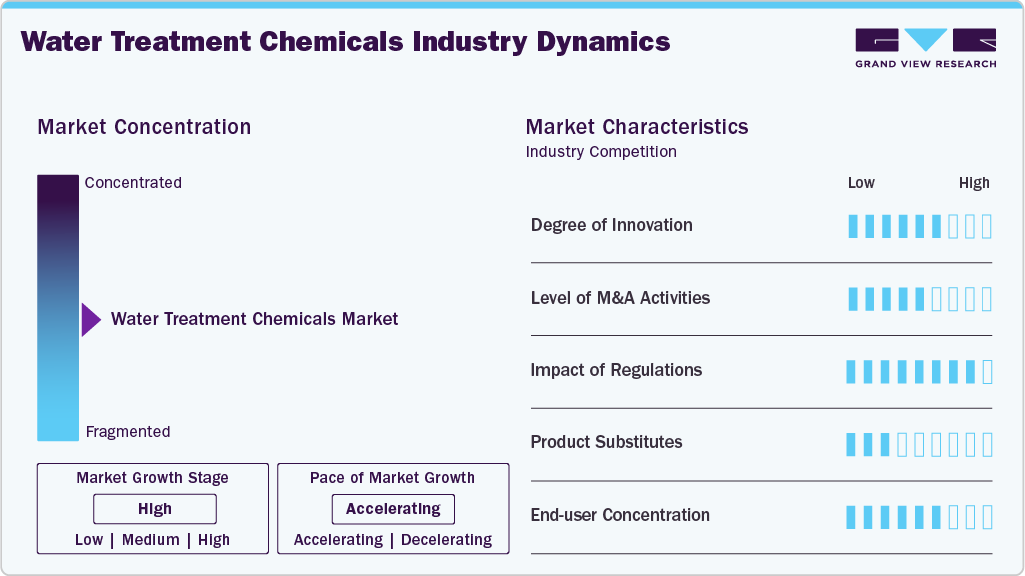
Competition also reflects a divergence in value propositions, with traditional chemical suppliers increasingly bundling digital water management and services to improve dosing efficiency and reduce total cost of ownership for customers. Companies such as Ecolab and SUEZ integrate advanced analytics, real-time monitoring platforms, and performance-based service contracts, challenging peers to move beyond commodity chemistry toward outcome-driven solutions. At the same time, smaller and niche players, including Cortec Corporation, focus on specialized corrosion control and environmentally friendly formulations, targeting specific industrial verticals. The market remains moderately concentrated at the top but competitive in product innovation and services, with differentiation increasingly driven by sustainability, data-enabled solutions, and customized application support.
Product Insights
The coagulants & flocculants segment dominated the global water treatment chemicals market with the largest revenue share of 38.2% in 2025, driven by their indispensable role in primary water and wastewater treatment across municipal and industrial applications. These chemicals are foundational to solid-liquid separation processes, enabling the efficient removal of suspended solids, organic matter, and contaminants in raw water treatment, effluent treatment, and sludge dewatering. Their widespread adoption across municipal water utilities, mining & mineral processing, pulp & paper, oil & gas, and power generation, combined with high-volume consumption and recurring demand, continues to underpin their revenue leadership. The increasing investments in wastewater infrastructure, water reuse, and compliance with tightening discharge norms have reinforced sustained demand for both inorganic coagulants and high-performance polymer-based flocculants.
Other product segments, including biocides & disinfectants, scale & corrosion inhibitors, pH adjusters & softeners, and defoamers, play a critical supporting role in ensuring water system integrity, operational efficiency, and asset protection. Biocides and disinfectants are essential in controlling microbial growth in cooling, boiler, and municipal water systems, while scale and corrosion inhibitors are increasingly adopted to extend equipment life and optimize heat transfer efficiency in industrial operations. pH adjusters and softeners are widely used to maintain process stability and downstream chemical effectiveness, particularly in desalination and boiler applications. Defoamers address operational challenges in industrial effluent and process water systems, whereas other products, including specialty chelants and conditioning agents, cater to niche and application-specific requirements.
Application Insights
The raw water treatment segment held the largest revenue share of 48.0% in 2025, driven by the critical need to treat surface and groundwater sources to meet potable and industrial intake standards. This segment accounts for high and consistent consumption of coagulants, flocculants, pH adjusters, and disinfectants, particularly within municipal water utilities and large industrial facilities. Rapid urbanization, population growth, and tightening drinking water quality regulations have significantly increased investments in raw water treatment infrastructure, especially in emerging economies. Moreover, the deterioration of natural water sources due to industrial discharge and agricultural runoff has intensified the need for robust pretreatment processes, reinforcing raw water treatment as the largest and most stable revenue-generating application within the market.
Other application segments, including effluent water treatment, cooling, boiler, and desalination, continue to exhibit steady growth supported by industrial expansion and water efficiency initiatives. Effluent water treatment remains a key demand driver as industries increasingly adopt wastewater recycling and zero liquid discharge (ZLD) practices to comply with stringent discharge norms. Cooling and boiler applications generate recurring demand for scale inhibitors, corrosion inhibitors, and biocides to ensure system efficiency and asset longevity in power generation, oil & gas, and manufacturing facilities. Meanwhile, water desalination, although smaller in revenue share, is gaining strategic importance in water-scarce regions, driving demand for antiscalants and specialty conditioning chemicals. Other applications, including process water treatment and reuse systems, further contribute to market diversification and long-term growth.
End Use Insights
The municipal segment accounted for the largest revenue share of 43.1% in 2025, reflecting the essential role of water treatment chemicals in providing safe drinking water and managing municipal wastewater across urban and semi-urban regions. Municipal utilities represent a high-volume, recurring demand base for coagulants, flocculants, disinfectants, and pH-control chemicals, driven by population growth, urbanization, and increasingly stringent public health and environmental regulations. Ongoing investments in water supply infrastructure, aging pipeline rehabilitation, and wastewater treatment capacity expansion, particularly in emerging economies, have further strengthened chemical consumption in this segment, making municipal applications the most stable and predictable contributor to market revenues.
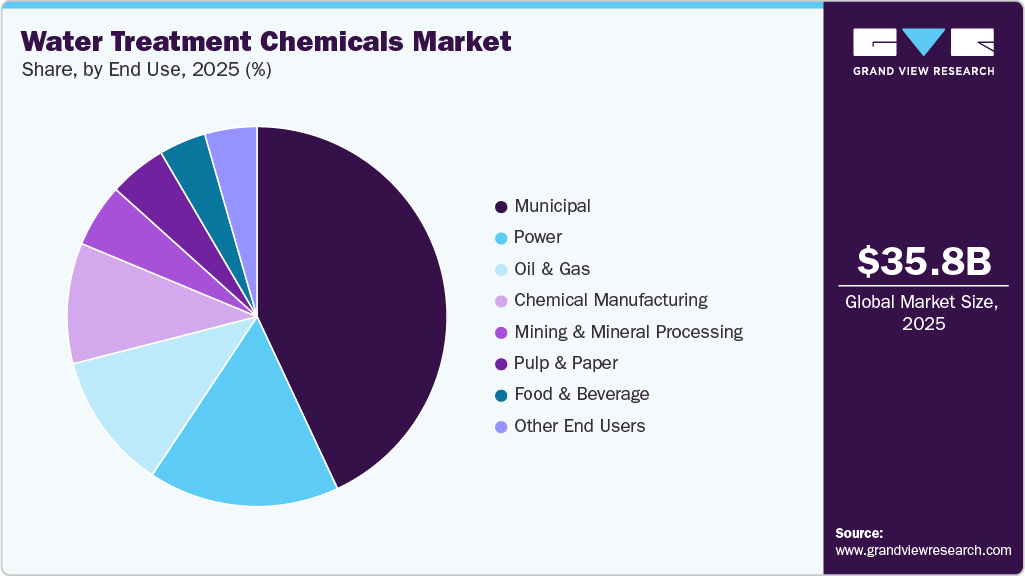
Other end-use industries, including power generation, oil & gas, chemical manufacturing, mining & mineral processing, food & beverage, and pulp & paper, collectively account for a significant share of market demand, supported by process water requirements and stringent effluent norms. Power and oil & gas facilities rely heavily on scale and corrosion inhibitors, biocides, and boiler chemicals to maintain operational efficiency and asset integrity. Chemical manufacturing and mining sectors drive demand for high-performance coagulants, flocculants, and specialty treatment chemicals due to complex effluent characteristics. Meanwhile, the food & beverage and pulp & paper industries increasingly adopt advanced water treatment programs to meet quality standards, reduce water consumption, and support sustainability goals, while other end uses, including pharmaceuticals and textiles, contribute to incremental growth through niche and application-specific requirements.
Regional Insights
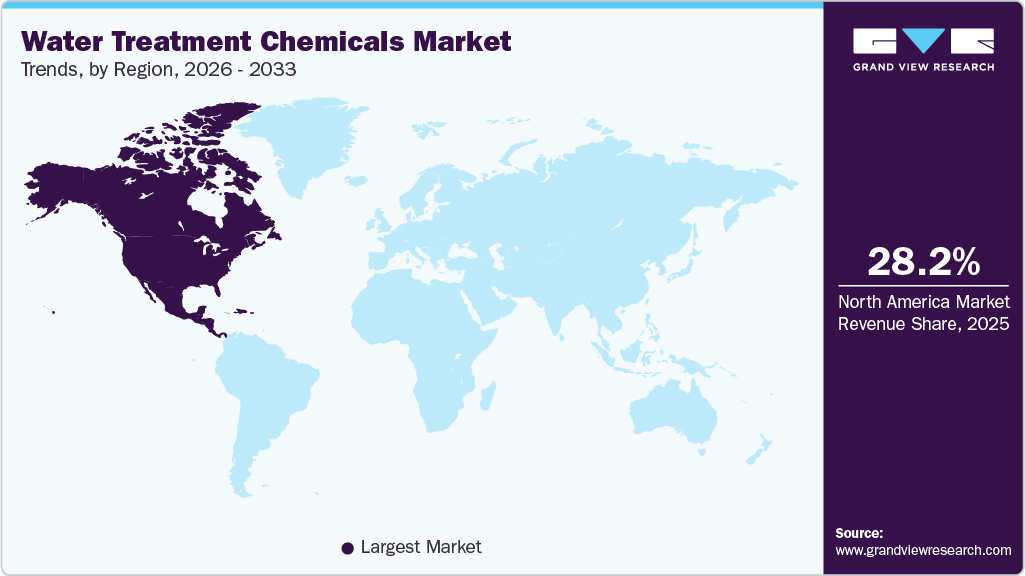
North America accounted for 28.2% of the global water treatment chemicals market in 2025, supported by a mature municipal water infrastructure, strict environmental regulations, and strong industrial demand. The region benefits from high adoption of advanced water treatment programs across power generation, oil & gas, food & beverage, and chemical manufacturing, driving consistent consumption of coagulants, disinfectants, and corrosion inhibitors. The increasing focus on water reuse, aging infrastructure upgrades, and the adoption of digital water management solutions continue to sustain market leadership in value terms.
U.S. Water Treatment Chemicals Market Trends
The U.S. dominated the North American market, driven by large-scale municipal water systems, stringent EPA regulations, and a diversified industrial base. High chemical usage across wastewater treatment plants, cooling and boiler systems, and industrial effluent treatment supports steady demand. Moreover, early adoption of performance-based chemical programs, digital dosing technologies, and sustainability-driven reformulations positions the U.S. as a high-value and innovation-led market.
Asia Pacific Water Treatment Chemicals Market Trends
Asia Pacific captured 27.0% of the global market in 2025, driven by rapid urbanization, industrialization, and expanding water infrastructure investments across emerging economies. Rising population density, deteriorating water quality, and increasing enforcement of wastewater discharge regulations are accelerating chemical demand across municipal, power, mining, and manufacturing sectors. The region represents the fastest-growing market globally, with strong demand for cost-effective coagulants and flocculants alongside increasing adoption of specialty chemicals in advanced treatment applications.
The China water treatment chemicals market is the largest contributor within Asia Pacific, underpinned by massive municipal wastewater treatment capacity, stringent environmental reforms, and continued industrial expansion. Government-led investments in water pollution control, industrial effluent treatment, and water reuse have significantly increased consumption of coagulants, flocculants, and pH control chemicals. While price sensitivity remains high, growing emphasis on regulatory compliance and sustainable water management is driving gradual uptake of higher-performance treatment chemistries.
Europe Water Treatment Chemicals Market Trends
Europe accounted for 22.0% of the global water treatment chemicals market in 2025, supported by strict environmental legislation, high water quality standards, and widespread adoption of sustainable treatment practices. Demand is driven by municipal utilities and industrial sectors such as food & beverage, chemicals, and pulp & paper. The region places strong emphasis on low-toxicity, bio-based, and REACH-compliant formulations, positioning Europe as a technology- and sustainability-driven market.
The Germany water treatment chemicals market is a key market within Europe, characterized by advanced water infrastructure, strong industrial demand, and stringent regulatory oversight. The country’s robust chemical manufacturing, automotive, and power sectors drive sustained demand for scale inhibitors, corrosion inhibitors, and process water treatment chemicals. In addition, Germany’s leadership in environmental sustainability and circular water use supports ongoing innovation and adoption of advanced and environmentally friendly water treatment solutions.
Middle East & Africa Water Treatment Chemicals Market Trends
The Middle East & Africa water treatment chemicals market is driven primarily by acute water scarcity, large-scale desalination projects, and growing municipal water demand, particularly in the Gulf Cooperation Council (GCC) countries. High reliance on desalinated water supports demand for antiscalants, biocides, and specialty conditioning chemicals, while industrial growth in oil & gas and power generation further contributes to chemical consumption. In Africa, investments in basic water treatment infrastructure and urban wastewater management are gradually expanding the market base.
Latin America Water Treatment Chemicals Market Trends
Latin America represented a developing but steadily growing market, supported by expanding municipal water treatment capacity and industrial activity in countries such as Brazil, Mexico, and Chile. Increasing regulatory enforcement on wastewater discharge, particularly in mining, food & beverage, and pulp & paper industries, is driving demand for coagulants, flocculants, and effluent treatment chemicals. However, budget constraints and price sensitivity continue to influence purchasing decisions, favoring cost-effective and high-volume chemical solutions over premium formulations.
Key Water Treatment Chemicals Company Insights
Key players, such as SUEZ, BASF SE, HollyFrontier Corporation, Solenis, Nouryon, and Kemira are dominating the market. SUEZ is a leading global water treatment chemicals manufacturer headquartered in Norway, specializing in decorative paints, protective water treatment chemicals, and marine water treatment chemicals across industrial, construction, and marine sectors. The company has a strong presence in Europe, Asia Pacific, and the Middle East, leveraging a diversified product portfolio that includes waterborne, solvent-borne, powder, and specialty water treatment chemicals. SUEZ emphasizes sustainability, high-performance formulations, and innovative coating technologies, with a focus on corrosion protection, durability, and environmentally compliant solutions. Through strategic regional expansions, R&D investment, and targeted partnerships, SUEZ has established itself as a trusted supplier for industrial, decorative, and marine applications worldwide, consistently maintaining a robust competitive position in the global water treatment chemicals market.
Key Water Treatment Chemicals Companies:
The following key companies have been profiled for this study on the water treatment chemicals market.
- SUEZ
- BASF SE
- HollyFrontier Corporation
- Solenis
- Nouryon
- Kemira
- Baker Hughes Company
- Dow
- SNF
- Cortec Corporation
- Ecolab
Recent Developments
-
In December 2025, Ecolab closed a major acquisition of Ovivo’s Electronics Ultra-Pure Water business in late 2025, a deal valued at approximately USD 1.8 billion. This move brings leading ultra-pure water technologies into Ecolab’s portfolio, specifically targeting the growing demands for advanced water management in semiconductor manufacturing and high-tech industries, a segment with significant water reuse and circularity potential.
-
In May 2025, In November 2025, Solenis completed its acquisition of NCH Corporation, significantly expanding its global footprint and mid-market water treatment and industrial solutions capabilities. The transaction enhances Solenis’s product and service portfolio while creating cross-selling opportunities across sustainable and digital solutions worldwide, reinforcing its position as a global leader for water and hygiene solutions.
Water Treatment Chemicals Market Report Scope
Report Attribute
Details
Market size value in 2026
USD 37.1 billion
Revenue forecast in 2033
USD 49.5 billion
Growth rate
CAGR of 4.2% from 2026 to 2033
Base year for estimation
2025
Historical data
2021 - 2024
Forecast period
2026 - 2033
Quantitative units
Revenue in USD million and CAGR from 2026 to 2033
Report coverage
Revenue forecast, company ranking, competitive landscape, growth factors, and trends
Segments covered
Product, application, end use, region
Regional scope
North America; Europe; Asia Pacific; Middle East & Africa; Latin America
Country scope
U.S.; Canada; Mexico; Germany; UK; France; Italy; Spain; China; India; Japan; South Korea; Brazil; Argentina; South Africa; Saudi Arabia
Key companies profiled
SUEZ; BASF SE; HollyFrontier Corporation; Solenis; Nouryon; Kemira; Baker Hughes Company; Dow; SNF; Cortec Corporation; Ecolab
Customization scope
Free report customization (equivalent up to 8 analysts’ working days) with purchase. Addition or alteration to country, regional & segment scope.
Pricing and purchase options
Avail customized purchase options to meet your exact research needs. Explore purchase options
Global Water Treatment Chemicals Market Report Segmentation
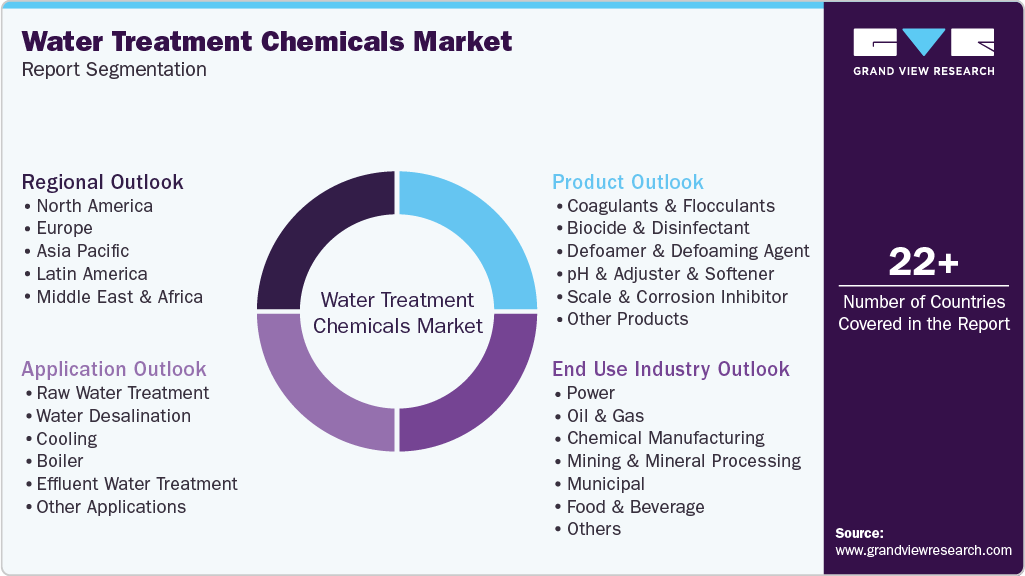
This report forecasts revenue growth at global, regional, and country levels and provides an analysis of the latest industry trends in each of the sub-segments from 2021 to 2033. For this study, Grand View Research has segmented the global water treatment chemicals market report based on product, application, end use, and region:
-
Product Outlook (Revenue, USD Million, 2021 - 2033)
-
Coagulants & Flocculants
-
Biocide & Disinfectant
-
Defoamer & Defoaming Agent
-
pH & Adjuster & Softener
-
Scale & Corrosion Inhibitor
-
Other Products
-
-
Application Outlook (Revenue, USD Million, 2021 - 2033)
-
Raw Water Treatment
-
Water Desalination
-
Cooling
-
Boiler
-
Effluent Water Treatment
-
Other Applications
-
-
End Use Industry Outlook (Revenue, USD Million, 2021 - 2033)
-
Power
-
Oil & Gas
-
Chemical Manufacturing
-
Mining & Mineral Processing
-
Municipal
-
Food & Beverage
-
Pulp & Paper
-
Other End Uses
-
-
Regional Outlook (Revenue, USD Million, 2021 - 2033)
-
North America
-
U.S.
-
Canada
-
Mexico
-
-
Europe
-
Germany
-
UK
-
France
-
Italy
-
Spain
-
-
Asia Pacific
-
China
-
India
-
Japan
-
South Korea
-
-
Middle East & Africa
-
Saudi Arabia
-
South Africa
-
-
Latin America
-
Brazil
-
Argentina
-
-
Frequently Asked Questions About This Report
b. The coagulants & flocculants segment dominated the market with a 38.2% revenue share in 2025 due to their essential role in primary and secondary water treatment processes, where they are consumed in high volumes across municipal and industrial applications. Their widespread use in raw water treatment, wastewater treatment, and sludge dewatering, combined with recurring demand and limited substitution, continues to underpin their revenue leadership
b. Some of the key players operating in the water treatment chemicals market include SUEZ, BASF SE, HollyFrontier Corporation, Solenis, Nouryon, Kemira, Baker Hughes Company, Dow, SNF, Cortec Corporation, BASF SE, Dow, Honeywell International Inc., Royal Dutch Shell P.L.C, and Mitsui Chemicals, Inc.
b. The global water treatment chemicals market is driven by rising freshwater scarcity, rapid urbanization, and increasingly stringent regulations governing drinking water quality and wastewater discharge across municipal and industrial sectors. Growing demand for efficient water reuse, industrial process optimization, and asset protection in power, oil & gas, and manufacturing further supports sustained chemical consumption.
b. The global water treatment chemicals market size was estimated at USD 35.8 billion in 2025 and is expected to reach USD 37.1 billion in 2026.
b. The global water treatment chemicals market is expected to grow at a compound annual growth rate of 4.2% from 2026 to 2033 to reach USD 49.5 billion by 2033.


Share this report with your colleague or friend.
Need a Tailored Report?
Customize this report to your needs — add regions, segments, or data points, with 20% free customization.


ISO 9001:2015 & 27001:2022 Certified
We are GDPR and CCPA compliant! Your transaction & personal information is safe and secure. For more details, please read our privacy policy.
Trusted market insights - try a free sample
See how our reports are structured and why industry leaders rely on Grand View Research. Get a free sample or ask us to tailor this report to your needs.