- Home
- »
- Water & Sludge Treatment
- »
-
Water Desalination Equipment Market, Industry Report, 2033GVR Report cover
![Water Desalination Equipment Market Size, Share & Trends Report]()
Water Desalination Equipment Market (2026 - 2033) Size, Share & Trends Analysis Report By Technology (Reverse Osmosis, Multi-stage Flash Distillation, Multi-effect Distillation), By Source (Sea Water, Brackish Water, River Water), By Application, By Region, And Segment Forecasts
- Report ID: GVR-1-68038-489-5
- Number of Report Pages: 152
- Format: PDF
- Historical Range: 2021 - 2024
- Forecast Period: 2026 - 2033
- Industry: Bulk Chemicals
- Report Summary
- Table of Contents
- Interactive Charts
- Methodology
- Download FREE Sample
-
 Download Sample Report
Water Desalination Equipment Market Summary
The global water desalination equipment size was estimated at USD 20,015.0 million in 2025 and is expected to reach USD 42,658.4 million by 2033, growing at a CAGR of 10.0% from 2026 to 2033. The scarcity of freshwater reserves, coupled with the rising demand for water in various arid regions, as these areas lack sources of surface water such as lakes and rivers, has resulted in increased demand for water desalination equipment globally.
Key Market Trends & Insights
- Middle East & Africa dominated the water desalination equipment market with the largest revenue share of 49.4% in 2025.
- By source, seawater segment is expected to grow at a considerable CAGR of 10.3% from 2026 to 2033 in terms of revenue.
- By technology, Multi-stage flash (MSF) distillation segment is expected to grow at a considerable CAGR of 10.0% from 2026 to 2033 in terms of revenue.
- By application, industrial segment is expected to grow at a considerable CAGR of 10.2% from 2026 to 2033 in terms of revenue.
Market Size & Forecast
- 2025 Market Size: USD 20,015.0 Million
- 2033 Projected Market Size: USD 42,658.4 Million
- CAGR (2026-2033): 10.0%
- Middle East & Africa: Largest market in 2025
According to the World Economic Forum, global freshwater demand is projected to exceed supply by 40% by 2030, leaving an estimated 1.6 billion people without access to safely managed drinking water. Currently, approximately 4 billion people live in water-scarce regions, and one in four cities faces water insecurity.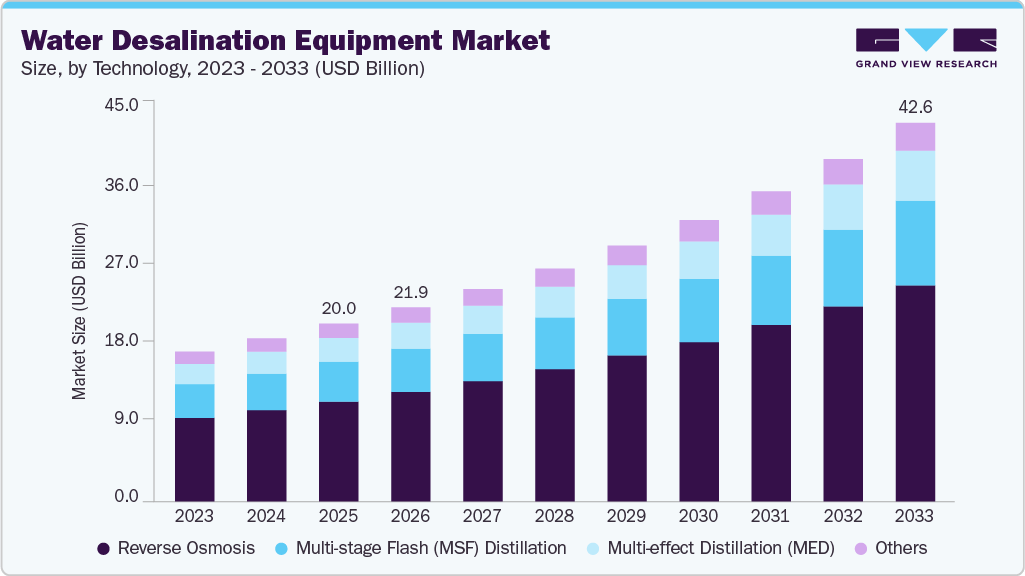
As water scarcity intensifies, the demand for desalination equipment is growing to bridge the widening gap between supply and demand. Water is a fundamental resource for daily life and plays a critical role in industrial and construction activities. According to the U.S. Geological Survey (USGS), approximately 71% of the Earth’s surface is covered by water, with 96.5% found in oceans, seas, and bays as saline water. Only 3.5% of the world’s water is freshwater, sourced from groundwater, rivers, streams, and lakes, making its availability and sustainable management crucial for human and industrial needs.
Market Concentration & Characteristics
The market growth stage is high, and the pace of growth is accelerating. The market is characterized by a high degree of innovation owing to rapid technological advancements. Key trends include intelligent and automated systems, which use IoT-enabled sensors and devices to monitor and control various aspects of the desalination process, such as water quality, energy consumption, and equipment performance. This real-time data collection and analysis enables predictive maintenance, allowing operators to identify and address potential issues before they lead to breakdowns or disruptions. By minimizing downtime and optimizing operations of water desalination equipment, these systems contribute to increased plant efficiency and cost-effectiveness.
Regulations significantly impact the global water desalination equipment market by shaping operational practices and market dynamics. Governments and regulatory bodies around the world enforce stringent standards to safeguard environmental and public health, and these regulations play a critical role in influencing the design, operation, and expansion of desalination facilities.
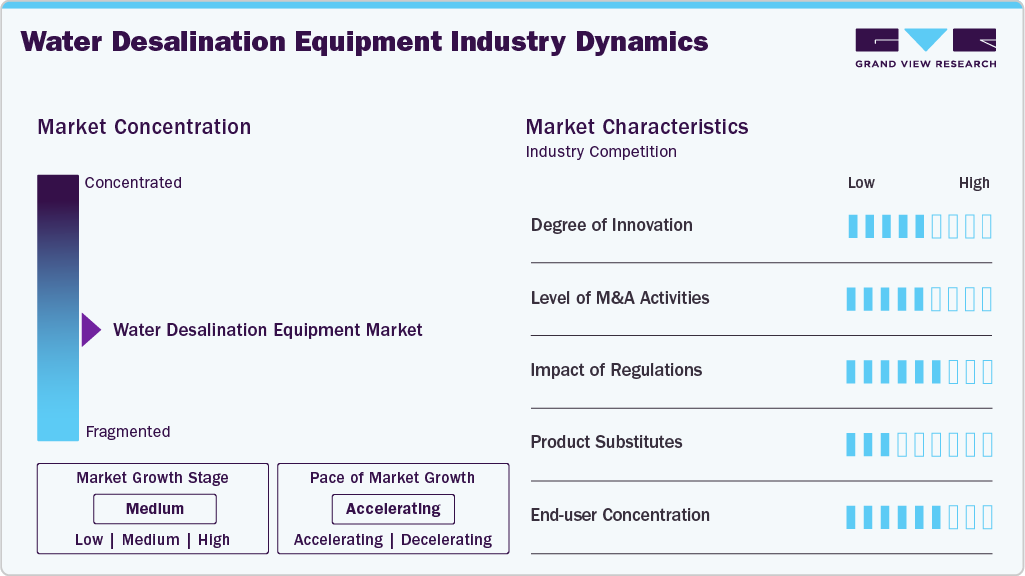
Regulations regarding the prevention of contaminants, such as brine, can drive up operational costs as companies invest in advanced treatment technologies and systems to comply with these requirements. In regions with rigorous environmental regulations, the increased costs of compliance can slow down the pace of new desalination projects and impact market growth.
Drivers, Opportunities & Restraints
The rising population in urban areas worldwide is straining the existing natural water sources. Deteriorating environmental conditions such as altered weather patterns, increased pollution, and deforestation have resulted in water shortages and drought-like scenarios globally. The governments of various countries are investing in the development of desalination plants to counter this challenge, which, in turn, is projected to drive the water desalination equipment market.
The initial cost of desalination equipment, such as reverse osmosis membranes and multi-stage flash (MSF) systems, can be high. Ongoing maintenance and replacement of components like membranes also add to long-term costs, limiting widespread adoption.
Governments and private entities are focusing on sustainable water solutions, leading to increased investments in desalination infrastructure and equipment. This trend is particularly prominent in regions like the Middle East, Australia, and parts of Europe and Asia.
Source Insights
The brackish water segment is expected to grow at a significant CAGR of 9.9% from 2026 to 2033 in terms of revenue. Seawater segment led the market and accounted for 60.4% of the global revenue share in 2025, driven by the abundance and widespread availability of seawater. As coastal regions face increasing scarcity of freshwater, seawater offers a reliable and consistent source for desalination. The ability to tap into the vast oceanic resources ensures a steady supply of potable water, especially in regions prone to droughts, population growth, and limited access to natural freshwater sources. This makes seawater a preferred choice for desalination, driving its adoption globally.
Brackish water segment is estimated to witness growth at a CAGR of 9.9% over the forecast period. One of the major advantages of desalinating brackish groundwater, compared to seawater, is its recovery rate. Seawater desalination yields around 50% of its volume in freshwater, whereas brackish water yields about 90% freshwater.
Technology Insights
The multi-stage flash (MSF) distillation segment is expected to grow at a CAGR of 10.0% from 2026 to 2033 in terms of revenue. The reverse osmosis segment dominated the market in 2024 accounting for 56.1% of the market share. Reverse osmosis is widely adopted due to its energy efficiency, lower operational costs, and the ability to produce high-quality freshwater. Technological advancements in membrane materials and system design have made RO increasingly cost-effective, making it popular for both large-scale and smaller desalination projects.
The adoption of MSF distillation is driven by its ability to handle high salinity levels in seawater, making it ideal for large-scale desalination. Its proven reliability and capacity to operate in various environmental conditions also make it a preferred choice in regions with limited freshwater resources.
Application Insights
The industrial segment is expected to grow at a CAGR of 10.2% from 2026 to 2033 in terms of revenue. The municipal application segment led the market and accounted for 52.3% of the global revenue share in 2025. The municipal sector is responsible for providing potable water to the urban population around the world. Moreover, the growing urban population coupled with expanding megacities globally is anticipated to limit the capacity of municipal sectors to provide water. Thus, this sector is expected to emerge as a key segment that will aid the Water Desalination Equipment growth over the forecast period.
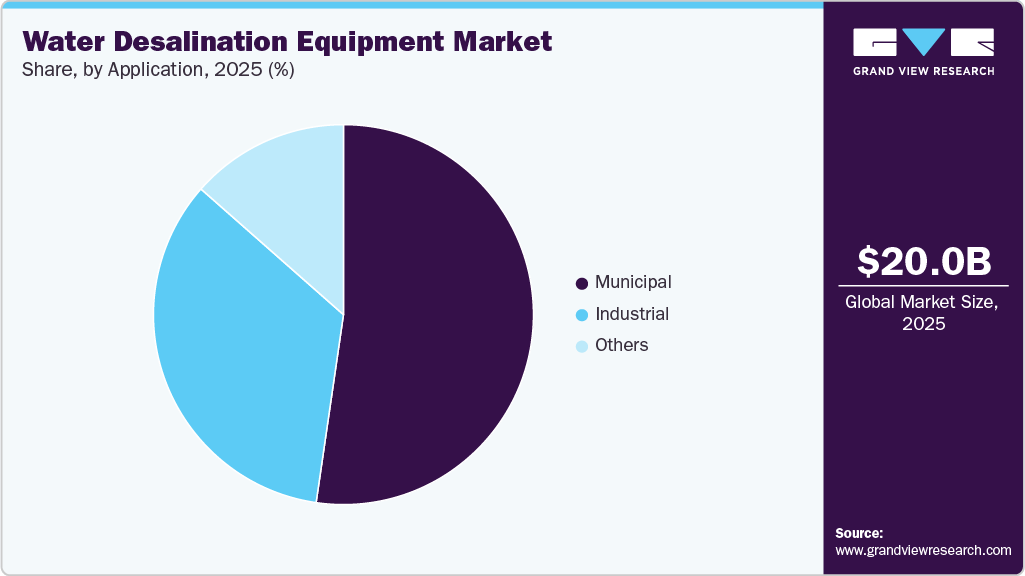
The water desalination equipment market is witnessing significant growth, driven by increasing demand across various industrial applications. Industries such as power generation, oil & gas, mining, food & beverage, and pharmaceuticals require large volumes of water for operations, making desalination a vital solution in water-scarce regions. In power plants, desalinated water is essential for cooling systems and steam generation, while in the oil & gas sector, it is used for enhanced oil recovery and process water needs.
Regional Insights
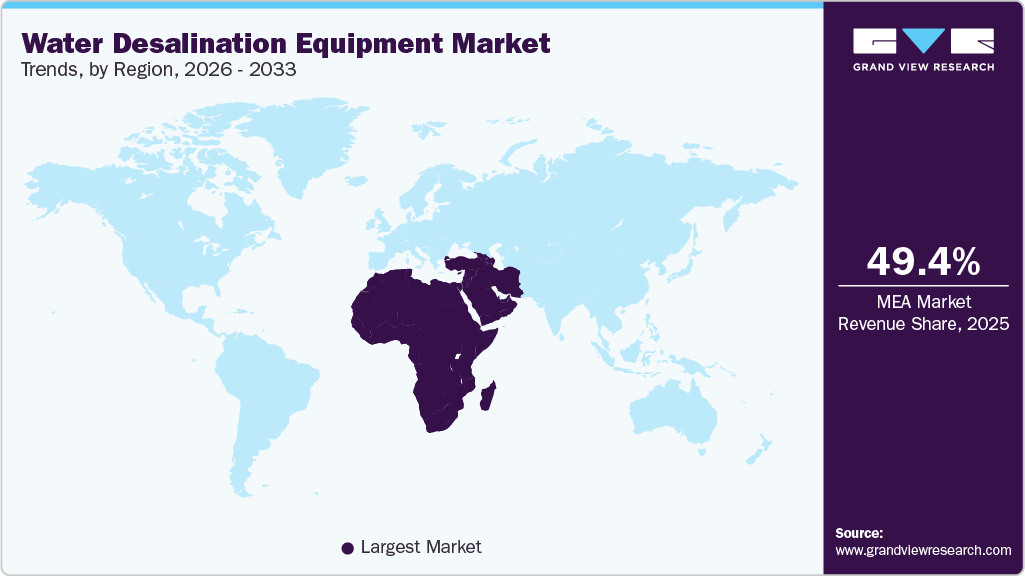
Middle East & Africa led the market and accounted for 49.4% of the global revenue share in 2025. The Middle East & Africa (MEA) water desalination equipment market is witnessing significant growth, driven by extreme water scarcity, rapid urbanization, and expanding industrial activities. The Middle East, home to some of the most water-stressed nations, relies heavily on desalination to meet municipal and industrial water demands. Countries such as Saudi Arabia, the UAE, and Qatar have made substantial investments in large-scale desalination projects, utilizing technologies like reverse osmosis (RO) and multi-stage flash (MSF) distillation.
Saudi Arabia Water Desalination Equipment Market Trends
Saudi Arabia is expected to witness strong growth in the water desalination equipment market due to severe freshwater scarcity, rapid population growth, and rising industrial demand. The country relies heavily on desalination to meet municipal and industrial water needs. Large-scale government investments under Vision 2030, expansion of mega-projects such as NEOM, and modernization of existing desalination plants are driving demand for advanced desalination equipment, including reverse osmosis systems, energy-efficient technologies, and smart monitoring solutions.
North America Water Desalination Equipment Market Trends
The North America water desalination equipment market is experiencing steady growth, driven by increasing water scarcity, rising industrial demand, and stringent environmental regulations. The region faces growing pressure on freshwater resources due to climate change, population growth, and industrial expansion, particularly in water-stressed areas such as California, Texas, and parts of Mexico. With advancements in energy-efficient desalination systems and growing demand for brackish and seawater treatment solutions, North America is expected to remain a key market for desalination equipment in the coming years.
The U.S. water desalination equipment market held a majority regional market share of 74.9% in 2025. The country’s market is expanding considerably, due to increasing concerns about water scarcity and the urgent need for reliable, sustainable water sources.
Europe Water Desalination Equipment Market Trends
In Europe, the water desalination equipment market is experiencing steady growth, driven by increasing concerns over water scarcity, especially in southern regions. Countries like Spain, Italy, and Cyprus are adopting advanced desalination technologies such as MSF and reverse osmosis to ensure water security for agriculture, urban areas, and industries. This growth is also fueled by the region's focus on sustainability and innovative water management solutions to cope with climate change and population pressures.
Spain is a key player in Europe’s market, with a growing reliance on both MSF and reverse osmosis technologies to tackle water scarcity, particularly in its arid southeastern regions. The country has been at the forefront of desalination adoption, using these solutions to support agriculture, tourism, and domestic water supply, while also focusing on integrating renewable energy to reduce environmental impact and operational costs.
The industry in Greeceis likely to grow at a CAGR 10.8% over the forecast period driven by the increasing demand for freshwater, particularly in its island regions facing water scarcity. With a growing focus on sustainable water solutions, Greece is investing in both MSF and reverse osmosis technologies to meet its water needs while ensuring reliable, year-round water supply for agriculture, tourism, and local populations.
Asia Pacific Water Desalination Equipment Market Trends
The water desalination equipment market in Asia Pacific is experiencing robust growth, largely propelled by the growing population, rapid urbanization, extensive agriculture development, and intensified industrialization that have strained the region's existing water resources. A substantial proportion of the region’s population faces water scarcity, and government initiatives to address the condition are expected to foster market growth.
The market in Australia is projected to expand at a CAGR of 11.9% over the forecast period. In Australia, the desalination market is expanding rapidly due to the country's recurring droughts and increasing water scarcity, particularly in coastal urban areas. With a focus on ensuring a reliable water supply for cities such as Perth, Melbourne, and Sydney, Australia is investing in both MSF and reverse osmosis technologies. .
The China water desalination equipment market held a 41.0% share of the Asia Pacific market. In China, the desalination market is rapidly growing as the country faces increasing water stress in coastal and arid regions. With a focus on addressing water shortages and supporting industrial and agricultural demands,
Latin America Water Desalination Equipment Market Trends
In Latin America, the industry is expanding as countries in the region, particularly coastal areas, face challenges with water scarcity and pollution. As demand for freshwater rises due to population growth, agriculture, and tourism, nations such as Chile and Argentina are increasingly turning to MSF and reverse osmosis technologies to secure reliable water sources. These solutions are becoming integral in ensuring water sustainability and supporting economic growth in the face of climate change and resource limitations.
Brazil’s water desalination equipment market is expected to grow steadily, driven by increasing water stress in arid and semi-arid regions, particularly in the Northeast. Climate variability, prolonged droughts, and rising demand from agriculture, industry, and urban populations are encouraging investments in alternative water sources. Government initiatives to improve water security, along with growing adoption of small- and medium-scale desalination systems for remote communities and industrial applications, are supporting market expansion in Brazil.
Key Water Desalination Equipment Company Insights
Some of the key players operating in the market include Xylem, Inc. Veolia, among others.
-
Xylem, Inc is a global water technology company engaged in the manufacturing, designing, and servicing of products that primarily cater to the water sector as well as the electric and gas sectors. The company owns numerous brands such as Aanderaa, AC Fire, Bell & Gossett, Bellingham + Stanley, CentriPro, ebro, Godwin,0 Flygt, Flojet, and Goulds Water Technology.
-
Veolia is a multinational company engaged in the designing and distribution of water, waste, and energy management solutions. It operates through three business segments, namely water management, waste management, and energy management.
Key Water Desalination Equipment Companies:
The following key companies have been profiled for this study on the water desalination equipment market.
- Acciona S.A.
- Doosan Heavy Industries & Construction
- Veolia
- SUEZ
- IDE Technologies
- Xylem, Inc.
- Aquatech International LLC
- Biwater Holdings Limited
- Genesis Water Technologies
- Guangzhou KangYang Seawater Desalination Equipment Co., Ltd. (KYSEARO)
Recent Developments
-
In January 2026, Veolia Water Technologies and SBM Offshore signed an MoU to jointly develop floating desalination units. The initiative aims to provide flexible, offshore freshwater production using advanced desalination technologies, targeting coastal and water-stressed regions while reducing reliance on land-based infrastructure and enabling rapid deployment of sustainable water supply solutions.
-
In May 2025, SUEZ, in partnership with local stakeholders, launched a €508 million seawater desalination project in Taiwan to strengthen long-term water security. Using advanced reverse osmosis technology, the plant supports Taiwan’s strategy to diversify water resources, reduce dependence on rainfall, and ensure a reliable freshwater supply amid climate variability and growing industrial and urban water demand.
Water Desalination Equipment Market Report Scope
Report Attribute
Details
Market size in 2026
USD 21,862.4 million
Revenue forecast in 2033
USD 42,658.4 million
Growth rate
CAGR of 10.0% from 2026 to 2033
Base year for estimation
2025
Historical data
2021 - 2024
Forecast period
2026 - 2033
Quantitative units
Revenue in USD million/billion and CAGR from 2026 to 2033
Report coverage
Revenue forecast, company market position analysis, competitive landscape, growth factors, and trends
Segments covered
Source, technology, application, and region
Regional scope
North America; Europe; Asia Pacific; Latin America; Middle East & Africa
Country Scope
U.S.; Canada; Mexico; Germany; Greece; Italy; Spain; China; Japan; India; Australia; Brazil; Argentina; Saudi Arabia; UAE
Key companies profiled
Acciona S.A.; Doosan Heavy Industries & Construction; Veolia; SUEZ; IDE Technologies; Xylem; Aquatech International LLC; Biwater Holdings Limited; Genesis Water Technologies; Guangzhou KangYang Seawater Desalination Equipment Co., Ltd. (KYSEARO)
Customization scope
Free report customization (equivalent up to 8 analysts working days) with purchase. Addition or alteration to country, regional & segment scope.
Pricing and purchase options
Avail customized purchase options to meet your exact research needs. Explore purchase options
Global Water Desalination Equipment Market Report Segmentation
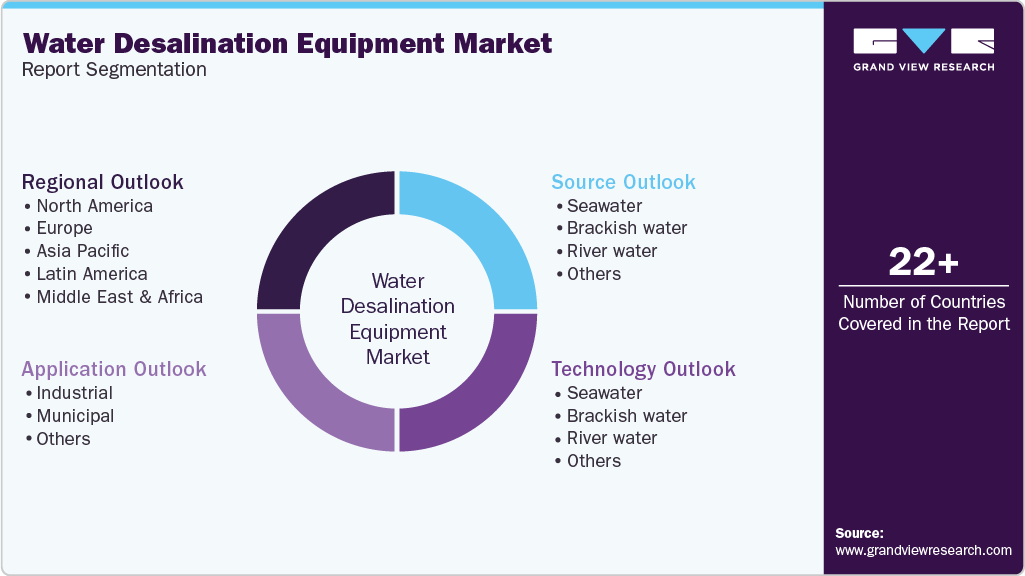
This report forecasts revenue growth at global, regional & country levels and provides an analysis on the industry trends in each of the sub-segments from 2021 to 2033. For this study, Grand View Research has segmented the water desalination equipment market on the basis of source, technology, application, and region:
-
Source Outlook (Revenue, USD Million, 2021 - 2033)
-
Seawater
-
Brackish water
-
River water
-
Others
-
-
Technology Outlook (Revenue, USD Million, 2021 - 2033)
-
Seawater
-
Brackish water
-
River water
-
Others
-
-
Application Outlook (Revenue, USD Million, 2021 - 2033)
-
Industrial
-
Municipal
-
Others
-
-
Regional Outlook (Revenue, USD Million, 2021 - 2033)
-
North America
-
U.S.
-
Canada
-
Mexico
-
-
Europe
-
Spain
-
Greece
-
Italy
-
Germany
-
-
Asia Pacific
-
China
-
India
-
Australia
-
Japan
-
-
Latin America
-
Brazil
-
Argentina
-
-
Middle East & Africa
-
Saudi Arabia
-
UAE
-
-
Frequently Asked Questions About This Report
b. Some of the key players operating in the Water Desalination Equipment include Xylem, Inc., Veolia, Aquatech, DuPont, TOYOBO CO., LTD., Pure Aqua, Inc., Doosan Corporation, APPLIED MEMBRANES, INC., Ovivo, Guangzhou KangYang Seawater Desalination Equipment Co., Ltd. (KYSEARO), Genesis Water Technologies, Biwater Holdings Limited, IDE.
b. The water desalination equipment market is driven by the scarcity of freshwater reserves, rising demand for water in various arid regions, as these areas lack sources of surface water such as lakes and rivers, has resulted in augmenting the number of desalination plants globally thereby fostering the demand for water desalination equipment.
b. The global water desalination equipment market size was estimated at USD 20,015.0 million in 2025 and is expected to reach USD 21,862.4 million in 2026.
b. The global water desalination equipment market, in terms of revenue, is expected to grow at a compound annual growth rate of 10.0% from 2026 to 2033 to reach USD 42,658.4 million by 2033.
b. The seawater source segment led the market and accounted for 60.4% of the global market revenue share in 2025. The growing scarcity of water for domestic and industrial usage is projected to act as the key driver for the rising demand for seawater desalination.


Share this report with your colleague or friend.
Need a Tailored Report?
Customize this report to your needs — add regions, segments, or data points, with 20% free customization.


ISO 9001:2015 & 27001:2022 Certified
We are GDPR and CCPA compliant! Your transaction & personal information is safe and secure. For more details, please read our privacy policy.
Trusted market insights - try a free sample
See how our reports are structured and why industry leaders rely on Grand View Research. Get a free sample or ask us to tailor this report to your needs.