- Home
- »
- Water & Sludge Treatment
- »
-
Water And Wastewater Treatment Equipment Market Report, 2033GVR Report cover
![Water And Wastewater Treatment Equipment Market Size, Share & Trends Report]()
Water And Wastewater Treatment Equipment Market (2026 - 2033) Size, Share & Trends Analysis Report By Application (Municipal, Industrial), By Process By Equipment (Primary Treatment, Tertiary Treatment, Tertiary Treatment), By Region, And Segment Forecasts
- Report ID: GVR-1-68038-317-1
- Number of Report Pages: 90
- Format: PDF
- Historical Range: 2021 - 2024
- Forecast Period: 2026 - 2033
- Industry: Bulk Chemicals
- Report Summary
- Table of Contents
- Interactive Charts
- Methodology
- Download FREE Sample
-
 Download Sample Report
Water And Wastewater Treatment Equipment Market Summary
The global water and wastewater treatment equipment market size was estimated at USD 71.01 billion in 2025 and is projected to reach USD 106.39 billion by 2033, growing at a CAGR of 5.3% from 2026 to 2033. The market growth is driven by factors such as population growth, urbanization, industrialization, and stricter environmental regulations.
Key Market Trends & Insights
- Asia Pacific dominated the water and wastewater treatment equipment market with the largest revenue share of 36% in 2025.
- By application, the industrial segment is expected to grow at a considerable CAGR of 5.6% from 2026 to 2033 in terms of revenue.
- Based on process by equipment, the tertiary treatment segment is expected to grow at a considerable CAGR of 5.6% from 2026 to 2033 in terms of revenue.
Market Size & Forecast
- 2025 Market Size: USD 71.01 Billion
- 2033 Projected Market Size: USD 106.39 Billion
- CAGR (2026-2033): 5.3%
- Asia Pacific: Largest market in 2025
Rising awareness of environmental pollution, stringent management regulations, and a growing demand for sustainable and efficient wastewater treatment solutions are expected to contribute to the expansion of the industry. The market is further set to grow due to increasing industrialization, population growth, and stricter government regulations on wastewater discharge. Companies in the water and wastewater treatment equipment industry are forming partnerships with end-users to promote the adoption of new technologies. Increased investment in research and development to improve technology efficiency is also expected to drive market growth. Small and medium-sized businesses are adopting new water and wastewater treatment technologies, creating opportunities for growth.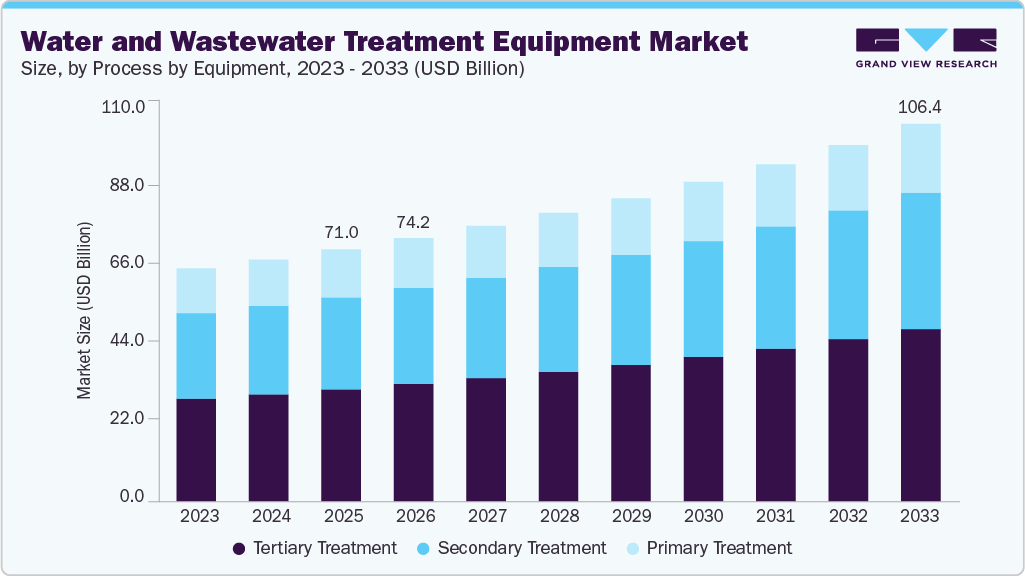
Many opportunities have become prevalent in the industry due to technological advancements and the introduction of innovative treatment solutions, providing huge potential for market players to implement such solutions to gain a competitive advantage. The market is witnessing growth in the adoption of membrane filtration and ultraviolet disinfection technologies because of their high efficacy in treating water and wastewater.
Market Concentration & Characteristics
The water and wastewater treatment equipment industry is characterized by moderate industry concentration, with a mix of established players and emerging companies. Leading global players typically dominate the market, offering a wide range of products and solutions to address different needs across industrial, municipal, and commercial sectors. These key companies possess strong research and development capabilities, enabling them to innovate and deliver advanced, efficient treatment technologies. Despite the market dominance of these major players, there is still room for smaller players and regional companies to grow, particularly in developing regions where demand for water treatment solutions is increasing.
A notable characteristic of this industry is its reliance on technological advancements. The increasing demand for more sustainable and efficient treatment processes has spurred the development of cutting-edge technologies such as membrane bioreactors, UV disinfection, and advanced filtration systems. These innovations are being driven by the need to improve water quality, reduce the environmental impact of wastewater disposal, and meet regulatory requirements. As a result, companies in the market are continuously investing in research and development to stay competitive and meet the evolving needs of the market.
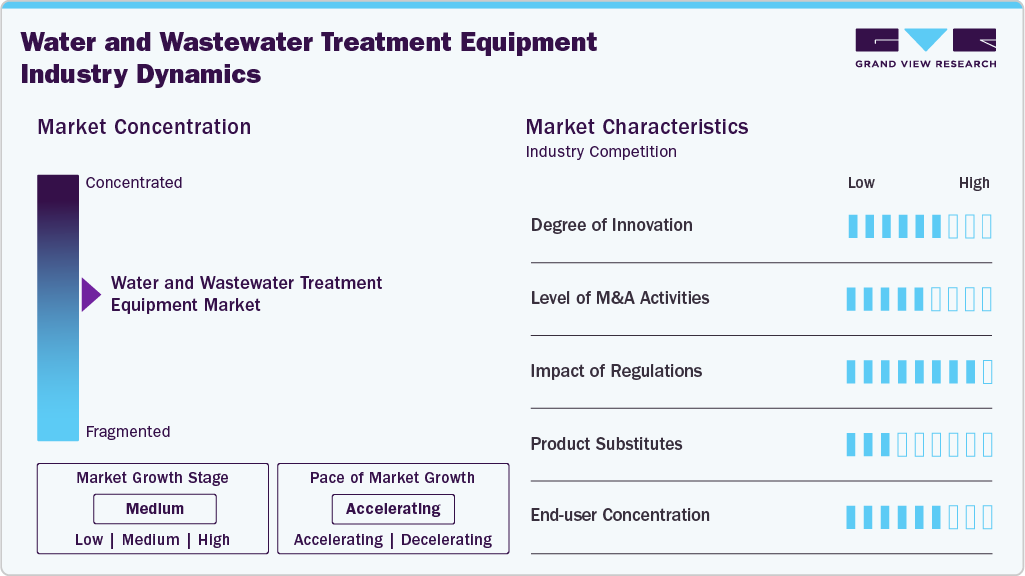
The market is heavily influenced by government regulations and environmental policies. Stringent regulations regarding wastewater discharge and water quality standards drive the demand for advanced treatment technologies. Governments across the globe are implementing regulations that encourage the adoption of eco-friendly and efficient solutions, further driving market growth. As urbanization and industrialization continue to increase, the demand for effective water and wastewater treatment solutions is expected to rise, making this sector essential for sustainable development and environmental protection.
Mergers and acquisitions in the global market are rising as companies seek to expand their technology portfolios, strengthen regional presence, and address growing infrastructure demands. Recent deals have included acquisitions focused on advanced filtration, modular treatment systems, and PFAS removal technologies. Larger players are buying specialized firms to enhance system integration, improve service capabilities, and meet stricter environmental regulations. This consolidation helps companies achieve scale, accelerate innovation, and offer more comprehensive water treatment solutions to municipalities and industries.
Drivers, Opportunities & Restraints
The water and wastewater treatment equipment market is primarily driven by increasing industrialization, population growth, and stringent environmental regulations. As urbanization accelerates, the demand for clean water and efficient wastewater management solutions intensifies, particularly in rapidly growing cities. Governments are imposing stricter regulations on wastewater discharge and water quality, which is pushing industries and municipalities to adopt advanced treatment technologies. Additionally, growing environmental awareness and the need for sustainable water use further fuel the market's expansion.
A key restraint is the high initial investment and operational costs associated with advanced treatment technologies. Many small and medium-sized enterprises (SMEs), as well as municipalities in developing regions, face challenges in affording the installation and maintenance of sophisticated equipment. In addition, the complexity of these systems can necessitate specialized labor for operation and maintenance, thereby increasing overall costs. These financial barriers may limit widespread adoption, particularly in cost-sensitive markets.
There are significant opportunities in the market driven by technological advancements and the rising demand for sustainable water solutions. Emerging technologies such as membrane filtration, nanotechnology, and AI-based water treatment systems offer potential for improving efficiency and reducing costs. The growing trend of water reuse and recycling also opens new market avenues, particularly in water-scarce regions where demand for innovative wastewater treatment solutions is high. Furthermore, the global push for sustainability and stricter environmental policies presents a long-term opportunity for companies offering eco-friendly and energy-efficient water treatment solutions.
Process By Equipment Insights
The tertiary treatment segment dominated the market with a revenue share of 44.5 % in 2025. Tertiary treatment is the final stage in water and wastewater treatment, designed to refine the treated water to meet stringent quality standards before discharge or reuse. This stage often involves advanced filtration, chemical treatment, or disinfection methods, such as UV treatment or membrane filtration, to remove remaining contaminants, including pathogens, heavy metals, and nutrients, that were not removed during earlier stages. Tertiary treatment is becoming increasingly important as regulations on water quality become more stringent, and the demand for water reuse, particularly in the industrial and municipal sectors, continues to rise. It helps ensure that water is safe for various purposes, including irrigation, industrial processes, or even potable reuse.
Secondary treatment is the biological phase of water and wastewater treatment, where the focus is on removing dissolved organic matter and suspended solids through microbial action. In this stage, activated sludge processes or trickling filters are commonly used, where microorganisms break down organic pollutants in the wastewater. Secondary treatment is a crucial step in reducing biochemical oxygen demand (BOD) and suspended solids, thereby ensuring that the water meets basic quality standards for discharge into natural bodies of water. This treatment stage is crucial for municipal and industrial wastewater management, as it plays a significant role in mitigating the environmental impact of wastewater before it undergoes further refinement in tertiary treatment.
Application Insights
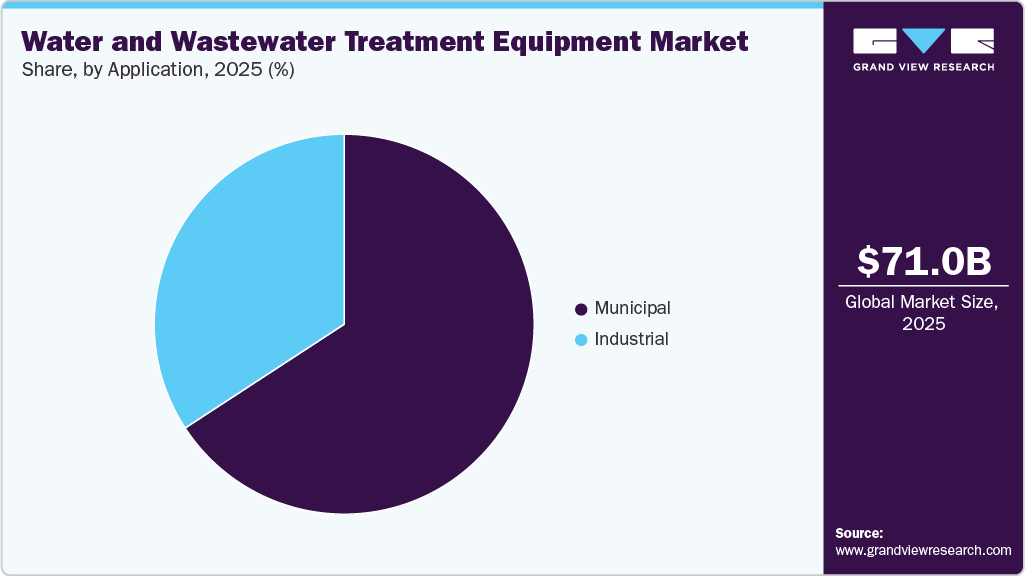
The municipal application segment accounted for a revenue share of 65.8% in 2025. In the municipal sector, water and wastewater treatment equipment plays a crucial role in providing clean drinking water and ensuring proper wastewater management for urban populations. Municipalities rely on these systems to meet regulatory standards for water quality and wastewater discharge, safeguarding public health and the environment. With increasing urbanization and population growth, municipalities are adopting advanced treatment technologies such as membrane filtration, UV disinfection, and biological treatment to address water scarcity, reduce pollution, and promote water reuse. Additionally, aging infrastructure in many cities presents opportunities for upgrading and modernizing municipal treatment systems to enhance efficiency and sustainability.
In industrial applications, water and wastewater treatment equipment is essential for managing the large volumes of water used in various processes such as manufacturing, cooling, and cleaning. Industries such as pharmaceuticals, food and beverage, textiles, and chemicals require tailored treatment systems to ensure that their wastewater meets environmental standards before being discharged or reused. Advanced treatment technologies, including reverse osmosis, ion exchange, and chemical precipitation, help remove contaminants from industrial wastewater, reducing environmental impact and ensuring compliance with regulations. With industries facing increasing pressure to reduce their water footprint and adopt more sustainable practices, the demand for efficient and cost-effective treatment solutions continues to grow.
Regional Insights
The Asia Pacific water and wastewater treatment equipment industry dominated the market, accounting for 36% of the global market share in 2025. The rapid growth is driven by industrialization, urbanization, and population expansion. Countries such as China, India, and Japan are heavily investing in water treatment infrastructure to meet the growing demand for clean water and address the challenges posed by water pollution. Stricter government regulations and heightened awareness of water scarcity and environmental impact are driving the adoption of advanced treatment technologies, including membrane filtration, reverse osmosis, and biological treatment.
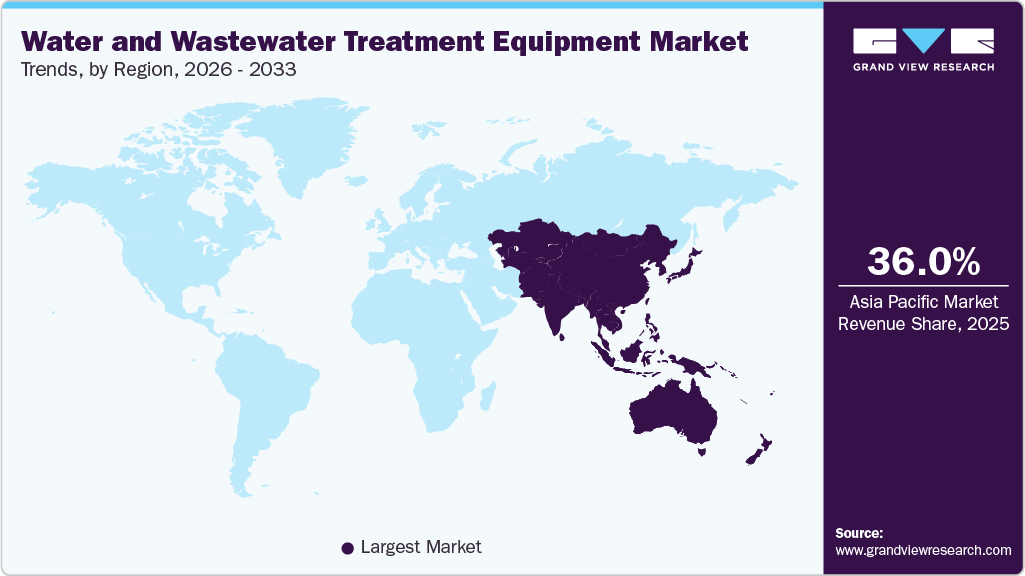
The China water and wastewater treatment equipment industry dominated the regional market in 2025. The market is expanding rapidly as the country deals with severe water pollution, population growth, and increasing industrial demands. The Chinese government has implemented stringent regulations to improve water quality and manage wastewater effectively, which is driving the demand for advanced treatment technologies.
The water and wastewater treatment equipment industry in India is expected to grow at a CAGR of 6.3% from 2026 to 2033. The emerging economy is experiencing significant growth due to urbanization, industrialization, and increasing concerns about water pollution and water scarcity.
North America Water And Wastewater Treatment Equipment Market Trends
The water and wastewater treatment equipment industry in North America is experiencing significant growth, driven by increasing emphasis on sustainability, regulatory compliance, and the need to address aging infrastructure. The U.S. and Canada are investing heavily in upgrading and replacing outdated water treatment systems to meet stringent water quality standards and improve resilience against climate change.
U.S. Water And Wastewater Treatment Equipment Market Trends
The U.S. water and wastewater treatment equipment industry is expected to grow at a CAGR of 3.6% from 2026 to 2033. The growth outlook is attributed to rising concerns about water quality, pollution, and infrastructure challenges. The country is focusing on modernizing aging water systems, especially in urban areas. The adoption of technologies such as membrane filtration, reverse osmosis, and UV disinfection is on the rise to ensure the safe supply of drinking water and to treat wastewater efficiently.
The water and wastewater treatment equipment industry in the Canada is expected to grow at a CAGR of 4.1% from 2026 to 2033. The market is expanding as the country faces increasing pressure to manage its water resources sustainably. With its vast natural resources, Canada is focusing on ensuring the protection of freshwater ecosystems while addressing wastewater treatment needs in both urban and remote communities.
Europe Water And Wastewater Treatment Equipment Market Trends
The Europe water and wastewater treatment equipment industry is being driven by stringent environmental regulations, the push for sustainability, and the growing need for efficient water management solutions. The EU’s commitment to reducing water pollution and improving water quality has led to increased investments in wastewater treatment infrastructure and the adoption of advanced technologies.
The Germany water and wastewater treatment equipment industry is driven by the country’s strong regulatory framework and commitment to sustainability. The German market is focusing on improving water quality and wastewater treatment processes, particularly in industrial applications and municipalities. Germany's emphasis on reducing pollutants and advancing technologies, such as membrane filtration and energy-efficient treatment systems, is boosting the adoption of innovative water treatment solutions.
The water and wastewater treatment equipment industry in France is expanding, fueled by stringent environmental regulations, particularly those related to nutrient removal and the treatment of wastewater from agriculture and industry, which are encouraging the adoption of advanced treatment technologies. The market is also being influenced by the country’s commitment to achieving net-zero carbon emissions, leading to an increased demand for energy-efficient water treatment solutions.
Middle East & Africa Water And Wastewater Treatment Equipment Market Trends
The water and wastewater treatment equipment industry in the Middle East and Africa region is experiencing growth due to water scarcity, rapid urbanization, and industrialization. Countries such as Saudi Arabia, the UAE, and South Africa are investing heavily in water treatment technologies to address the lack of freshwater resources and improve wastewater management. In the Middle East, desalination technologies are particularly important, with Saudi Arabia and the UAE leading the way in large-scale desalination plants.
The Saudi Arabia water and wastewater treatment equipment industry is growing rapidly due to the country’s limited natural freshwater resources and a strong focus on desalination and wastewater recycling. The government is investing heavily in infrastructure projects to expand water treatment capacity, particularly in urban areas and industrial zones. Desalination is a key focus, with Saudi Arabia being one of the world leaders in this technology.
Latin America Water And Wastewater Treatment Equipment Market Trends
The water and wastewater treatment equipment industry in Latin America is expanding as the region faces challenges related to water pollution, scarcity, and rapid urban growth. Countries such as Brazil, Mexico, and Argentina are investing in infrastructure improvements to ensure better water quality and wastewater management. In Brazil, the demand for treatment equipment is particularly high due to the need for sustainable solutions in both urban and rural areas. Government initiatives, such as the National Sanitation Plan in Brazil, are driving investments in water treatment infrastructure, while the growing focus on water reuse and wastewater recycling is contributing to market growth across the region.
The Brazil water and wastewater treatment equipment industry is growing as the country faces significant water management challenges, including pollution and regional disparities in water availability. The Brazilian government is investing in the modernization and expansion of water treatment infrastructure to ensure universal access to clean water and enhance wastewater management. The growing emphasis on environmental protection, particularly in the Amazon rainforest, is driving the demand for eco-friendly and efficient treatment solutions.
Key Water And Wastewater Treatment Equipment Company Insights
Some of the key players operating in the market include Xylem Inc., Pentair plc, and Ecolab Inc.,among others.
-
Xylem, Inc. was established in 2011 and is headquartered in Washington, U.S. Xylem, Inc. is a leading global water technology company, engaged in the manufacture, designing, and service of products that primarily cater to the water sector as well as the electric and gas sector. The water infrastructure business segment focuses on applications related to the transport and treatment of water. The primary customers of this segment belong to utility and industrial end-use markets. Major products in this segment include disinfection, filtration, and mobile dewatering equipment, biological treatment equipment, and water & wastewater pumps. Primary brands in the water infrastructure segment including Flygt, Goodwin, Wedeco, Leopold and Sanitair.
-
Pentair plc. operates through three business segments, namely Aquatic Systems, Filtration solutions, and Flow Technologies. The aquatic systems business segment focuses on manufacturing residential and commercial pool equipment and accessories, including filters, pumps, heaters, lights, automatic cleaners, and automatic controls. Pentair, Sta-Rite, and Kreepy Krauly are the key brands under this segment.
Key Water And Wastewater Treatment Equipment Companies:
The following are the leading companies in the water and wastewater treatment equipment market. These companies collectively hold the largest market share and dictate industry trends.
- Xylem, Inc.
- Pentair plc.
- Aquatech International LLC
- Ecolab Inc.
- DuPont
- Calgon Carbon Corporation
- Toshiba Water Solutions Private Limited (TOSHIBA CORPORATION)
- Veolia Group
- Ecologix Environmental Systems, LLC
- Evonik Industries AG
- Parkson Corporation
- Lenntech B.V.
- Samco Technologies, Inc.
- Koch Membrane Systems, Inc
- General Electric
Recent Developments
-
In March 2025, DuPont Water Solutions launched WAVE PRO, an advanced online modeling tool designed to optimize ultrafiltration water treatment systems. It helps engineers and operators simulate performance, select appropriate UF modules, and design more efficient treatment processes. The tool enhances accuracy, reduces design time, and facilitates better decision-making for a wide range of water and wastewater applications.
-
In April 2024, Thermax launched a state-of-the-art manufacturing facility in Pune, focused on producing advanced water and wastewater treatment solutions. This milestone highlights Thermax’s dedication to resource conservation and long-term sustainability. Spanning two acres, the facility embodies the company’s commitment to engineering excellence, driven by innovation, quality, and a customer-centric approach. Additionally, the facility will showcase Thermax’s latest technologies, such as softeners and filter vessels, tubular membrane modules, and capacitive deionization solutions.
-
In May 2023, Xylem Inc. acquired Evoqua to address critical water challenges for customers and communities. Evoqua offers water treatment solutions for diverse end-use industries, including food and beverage, power generation, life sciences, and microelectronics. With this initiative, the company will expand its presence in the European and North American markets.
Water And Wastewater Treatment Equipment Market Report Scope
Report Attribute
Details
Market size value in 2026
USD 74.21 billion
Revenue forecast in 2033
USD 106.39 billion
Growth Rate
CAGR of 5.3% from 2026 to 2033
Base year for estimation
2025
Historical data
2021 - 2024
Forecast period
2026 - 2033
Quantitative units
Revenue in USD million/billion and CAGR from 2026 to 2033
Report coverage
Revenue forecast, company market position analysis, competitive landscape, growth factors, and trends
Segments covered
Application, process by equipment, region
Regional scope
North America; Europe; Asia Pacific; Central & South America; Middle East & Africa
Country Scope
U.S.; Canada; Mexico; Germany; France; UK; Italy; Norway; Finland; China; India; Japan; Australia; Brazil; Argentina; Venezuela; Saudi Arabia; UAE; Egypt
Key companies profiled
Xylem, Inc.; Pentair plc.; Aquatech International LLC; Ecolab Inc.; DuPont; Calgon Carbon Corporation; Toshiba Water Solutions Private Limited (TOSHIBA CORPORATION); Veolia Group; Ecologix Environmental Systems, LLC; Evonik Industries AG; Parkson Corporation; Lenntech B.V.; Samco Technologies, Inc.; Koch Membrane Systems, Inc.; General Electric
Customization scope
Free report customization (equivalent up to 8 analysts working days) with purchase. Addition or alteration to country, regional & segment scope.
Pricing and purchase options
Avail customized purchase options to meet your exact research needs. Explore purchase options
Global Water And Wastewater Treatment Equipment Market Report Segmentation
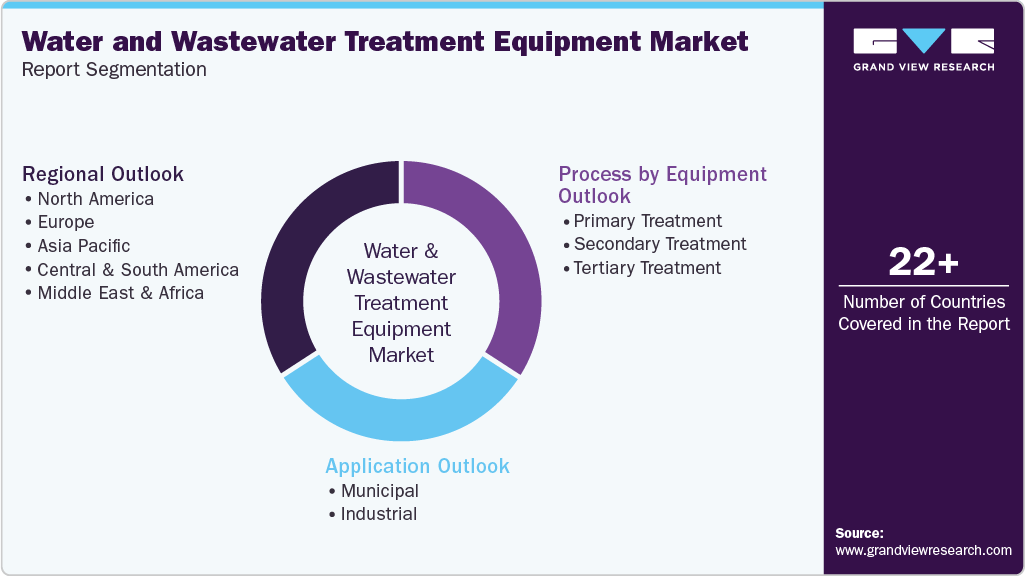
This report forecasts revenue growth at global, regional & country levels and provides an analysis on the industry trends in each of the sub-segments from 2021 to 2033. For this study, Grand View Research has segmented the water and wastewater treatment equipment market report on the basis of application, process by equipment, and region:
-
Application Outlook (Revenue, USD Billion, 2021 - 2033)
-
Municipal
-
Industrial
-
-
Process by Equipment Outlook (Revenue, USD Billion, 2021 - 2033)
-
Primary treatment
-
Primary Clarifier
-
Sludge Removal
-
Grit Removal
-
Pre-Treatment
-
Others
-
-
Secondary treatment
-
Activated Sludge
-
Sludge Treatment
-
Others
-
-
Tertiary treatment
-
Tertiary Clarifier
-
Filters
-
Chlorination Systems
-
Others
-
-
-
Regional Outlook (Revenue, USD Billion, 2021 - 2033)
-
North America
-
U.S.
-
Canada
-
Mexico
-
-
Europe
-
Germany
-
UK
-
France
-
Italy
-
Norway
-
Finland
-
-
Asia Pacific
-
China
-
India
-
Japan
-
Australia
-
-
Central & South America
-
Brazil
-
Argentina
-
Venezuela
-
-
Middle East & Africa
-
Saudi Arabia
-
UAE
-
Egypt
-
-
Frequently Asked Questions About This Report
b. The global water and wastewater treatment equipment market size was estimated at USD 71.01 billion in 2025 and is expected to reach USD 74.21 billion in 2026.
b. The global water and wastewater treatment equipment market, in terms of revenue, is expected to grow at a compound annual growth rate of 5.3% from 2026 to 2033 and reach USD 106.39 billion by 2033.
b. The municipal application segment accounted for a revenue share of 65.8% in 2025. In the municipal sector, water and wastewater treatment equipment plays a crucial role in providing clean drinking water and ensuring proper wastewater management for urban populations.
b. Some of the key players operating in the water and wastewater treatment equipment market include Xylem, Inc., Pentair plc., Aquatech International LLC, Ecolab Inc., DuPont, Calgon Carbon Corporation, Toshiba Water Solutions Private Limited (TOSHIBA CORPORATION), Veolia Group, Ecologix Environmental Systems, LLC, Evonik Industries AG, Parkson Corporation, Lenntech B.V., Samco Technologies, Inc., Koch Membrane Systems, Inc., General Electric.
b. The key factors that are driving the water and wastewater treatment equipment market include the growing population, increasing water scarcity, rising industrialization, and government regulations.


Share this report with your colleague or friend.
Need a Tailored Report?
Customize this report to your needs — add regions, segments, or data points, with 20% free customization.


ISO 9001:2015 & 27001:2022 Certified
We are GDPR and CCPA compliant! Your transaction & personal information is safe and secure. For more details, please read our privacy policy.
Trusted market insights - try a free sample
See how our reports are structured and why industry leaders rely on Grand View Research. Get a free sample or ask us to tailor this report to your needs.