- Home
- »
- Next Generation Technologies
- »
-
Vertical AI Market Size And Share, Industry Report, 2033GVR Report cover
![Vertical AI Market Size, Share & Trends Report]()
Vertical AI Market (2026 - 2033) Size, Share & Trends Analysis Report By Offering (Hardware, Software, Services), By Technology (Machine Learning (ML, Natural Language Processing (NLP), Computer Vision, Deep Learning), By Deployment Mode, By End Use, By Organization Size, By Region, And Segment Forecasts
- Report ID: GVR-4-68040-878-5
- Number of Report Pages: 120
- Format: PDF
- Historical Range: 2021 - 2025
- Forecast Period: 2026 - 2026
- Industry: Technology
- Report Summary
- Table of Contents
- Segmentation
- Methodology
- Download FREE Sample
-
 Download Sample Report
Vertical AI Market Summary
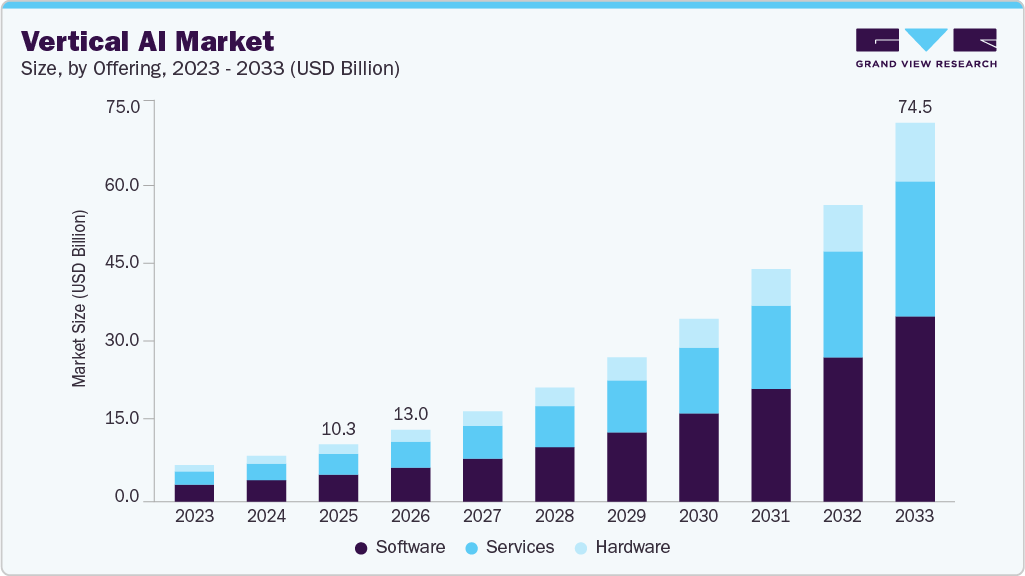
The global vertical AI market size was estimated USD 10,321.5 million in 2025 and is projected to reach USD 74,507.9 million by 2033, growing at a CAGR of 28.3% from 2026 to 2033. The market is growing rapidly as organizations increasingly prioritize high-resolution visual content to enhance customer engagement, brand perception, and user experience across digital platforms.
Key Market Trends & Insights
- North America is expected to hold a significant share of the global vertical AI market, with a revenue share of 36.8% by 2025.
- The vertical AI market in U.S. led the North America market and held the largest revenue share in 2025.
- By Offering, Software segment led the Market and held the largest revenue share of 47.1% in 2025.
- By Technology, Machine Learning (ML) segment led the market and held the largest revenue share of 36.4% in 2025.
- By End use, IT & Telecommunications segment is expected to grow at the fastest CAGR of 30.8% from 2026 to 2033.
Market Size & Forecast
- 2025 Market Size: USD 10,321.5 Million
- 2033 Projected Market Size: USD 74,507.9 Million
- CAGR (2026-2033): 28.3%
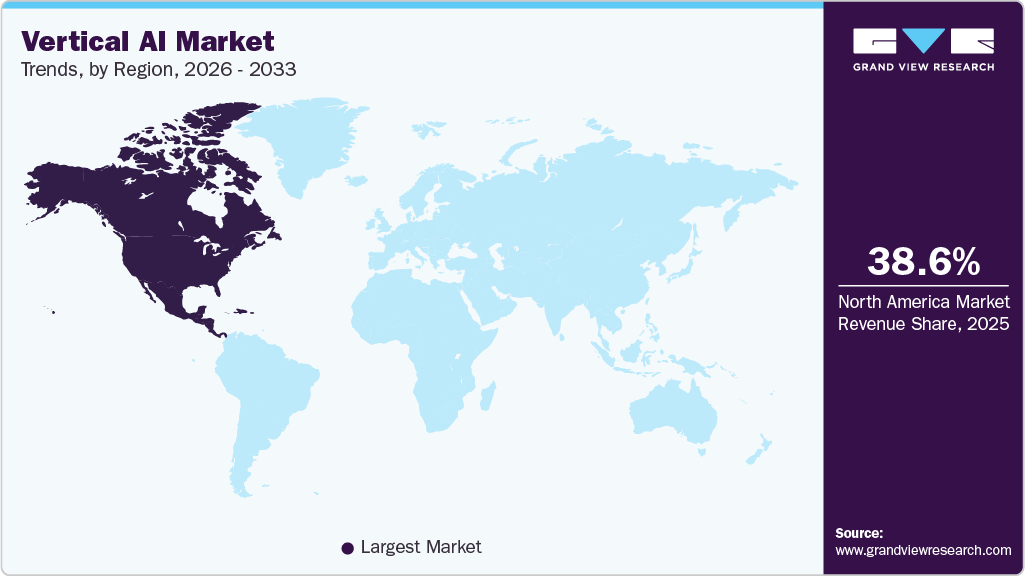
- North America: Largest market in 2025
The expansion of OTT streaming services, social media platforms, gaming, and e-commerce has significantly increased demand for AI-powered super-resolution, denoising, and image enhancement solutions to deliver superior visual quality without increasing production costs.The vertical AI market is being strongly driven by the growing demand for industry-specific artificial intelligence solutions that can address unique operational challenges and deliver measurable business outcomes across sectors. As enterprises move beyond generic AI tools toward specialized AI models tailored for industries such as healthcare, BFSI, retail, manufacturing, and telecommunications, the need for domain-trained algorithms, scalable data pipelines, and seamless enterprise integration frameworks is increasing significantly.. Furthermore, the emergence of autonomous AI agents capable of executing multi-step tasks, managing workflows, and interacting with enterprise systems is transforming how businesses operate and scale their processes. The increasing deployment of collaborative AI agents across functions such as customer service, operations, and decision support is further enhancing productivity, reducing human intervention, and driving next-generation intelligent automation.
The vertical AI market is experiencing strong growth due to the increasing demand for industry-specific artificial intelligence solutions that can address complex operational challenges and improve decision-making across enterprise environments. As organizations across sectors such as healthcare, BFSI, retail, manufacturing, and telecommunications compete to enhance efficiency and gain data-driven insights, AI models tailored to specific industry workflows are becoming essential. Businesses are increasingly adopting vertical AI platforms to automate processes, analyze large volumes of domain-specific data, and optimize customer experience without significantly increasing operational costs. This combination of improved operational efficiency, higher accuracy, and scalable deployment capabilities is significantly accelerating the adoption of vertical AI solutions across multiple industries.
Another key growth driver is the rapid advancement of machine learning, natural language processing, and computer vision technologies, which have significantly enhanced the performance, scalability, and real-time capabilities of AI systems. Vertical AI platforms are now capable of processing vast amounts of structured and unstructured industry data to generate predictive insights, automate complex workflows, and support intelligent decision-making at scale. In addition, the growing availability of cloud-based AI infrastructure, pre-trained models, and industry-specific AI platforms is enabling organizations of all sizes to deploy AI solutions more efficiently. As enterprises continue to invest in digital transformation initiatives, the integration of vertical AI into enterprise software, analytics platforms, and operational systems is expanding rapidly, further driving market growth.
Offering Insights
The Software segment dominated the Vertical AI Market with a share of 47.1% in 2025, driven by the increasing demand for industry-specific AI platforms, machine learning applications, and cloud-based AI solutions that enable organizations to automate workflows, analyze large volumes of data, and integrate AI capabilities across enterprise operations. The software segment is dominating the Vertical AI market due to the rising demand for AI-driven platforms, analytics tools, and industry-specific applications, including AI agents, that enable organizations to embed intelligence directly into their core business processes. Enterprises across sectors such as healthcare, BFSI, retail, manufacturing, and telecommunications are increasingly adopting AI software solutions and AI agents to automate workflows, process large volumes of structured and unstructured data, and enhance real-time decision-making efficiency. Unlike hardware, which primarily supports computational infrastructure, AI software delivers the core intelligence through machine learning models, predictive analytics engines, and intelligent automation tools, making it a critical component for deploying vertical AI solutions. Additionally, the growing availability of AI development frameworks, low-code AI platforms, and industry-tailored AI applications is making it easier for organizations to implement scalable AI solutions across business operations.
The services segment is growing significantly in the Vertical AI market due to the increasing demand for customized AI deployment, integration, and consulting across industry-specific applications. Organizations adopting vertical AI solutions often require specialized expertise to integrate AI models with existing enterprise systems, ensure data readiness, and align solutions with regulatory and operational requirements. As industries such as healthcare, BFSI, manufacturing, and retail implement AI for domain-specific use cases, the need for implementation, training, and ongoing support services is rising.
Technology Insights
The Machine Learning (ML) segment dominated the Vertical AI Market with a share of 36.4% in 2025, driven by its extensive use in predictive analytics, recommendation systems, fraud detection, and intelligent automation across industries such as healthcare, BFSI, retail, and telecommunications. Machine learning algorithms enable organizations to analyze large volumes of structured and unstructured data, identify patterns, and generate actionable insights that support data-driven decision-making and operational optimization. Additionally, the increasing availability of cloud-based ML platforms, pre-trained models, and advanced analytics tools is enabling enterprises to deploy scalable AI solutions more efficiently, further strengthening the dominance of the machine learning segment in the Vertical AI market.
Natural Language Processing (NLP) is growing at a significant CAGR due to the rising adoption of AI-driven communication technologies across enterprises. Organizations are increasingly leveraging NLP for applications such as chatbots, virtual assistants, sentiment analysis, and automated customer support to enhance operational efficiency and customer engagement. The rapid growth of unstructured data from social media, emails, and digital platforms is further driving demand for advanced text analytics solutions. Moreover, advancements in machine learning, deep learning, and cloud computing are enabling more accurate language understanding and real-time analytics, accelerating the adoption of NLP solutions across industries such as healthcare, BFSI, retail, and telecommunications.
Deployment Mode Insights
The Cloud deployment segment dominated the Vertical AI Market with a share of over 64.6% in 2025, driven by the increasing demand for scalable, flexible, and cost-efficient AI infrastructure across industries. Organizations are rapidly adopting cloud-based AI platforms to process and analyze large volumes of enterprise data without investing heavily in on-premises infrastructure. Cloud deployment enables seamless integration of machine learning models, real-time analytics, and automated decision-making capabilities, making it particularly attractive for sectors such as healthcare, BFSI, retail, and telecommunications that require scalable AI-powered solutions.
The on-premise segment is expected to grow at a significant CAGR in the market due to increasing concerns around data privacy, security, and regulatory compliance. Many organizations, particularly in highly regulated industries such as BFSI, healthcare, and government, prefer deploying NLP solutions within their internal IT infrastructure to maintain full control over sensitive data and prevent external access. On-premise deployment also allows companies to customize NLP models according to specific business requirements and integrate them with existing legacy systems. Additionally, enterprises handling large volumes of confidential customer or financial data often choose on-premise solutions to ensure strict data governance, low latency processing, and compliance with regional data protection regulations.
Organization size Insights
The Large Enterprise segment dominated the Vertical AI Market with a share of 54.6% in 2025, driven by the strong financial capacity, advanced IT infrastructure, and large-scale data availability within these organizations. Large enterprises across industries such as healthcare, BFSI, telecommunications, and manufacturing are increasingly adopting vertical AI solutions to automate complex workflows, enhance predictive analytics, and improve operational efficiency. These organizations generate massive volumes of structured and unstructured data, making AI-driven platforms essential for extracting actionable insights, optimizing decision-making, and maintaining a competitive advantage. Additionally, large enterprises have greater resources to invest in AI research, deployment, and integration with existing enterprise systems, which further accelerates the adoption of vertical AI solutions.
Small enterprises are expected to grow at an exponential CAGR over the forecast period, due to the increasing availability of affordable, industry-specific AI solutions. Vertical AI platforms provide pre-trained models tailored for specific sectors such as healthcare, retail, finance, and manufacturing, enabling small businesses to adopt AI without requiring extensive technical expertise or large IT budgets. The rise of cloud-based AI services, low-code/no-code platforms, and AI-as-a-service offerings is further lowering the barrier to adoption. Additionally, small enterprises are increasingly leveraging vertical AI tools to automate operations, enhance customer experience, and gain data-driven insights, helping them compete more effectively with larger organizations.
End Use Insights
The IT & Telecommunications segment dominated the Vertical AI Market with a share of 25.3% in 2025, driven by the increasing adoption of AI technologies to optimize network performance, enhance cybersecurity, and automate customer service operations. Telecom operators and IT service providers are leveraging vertical AI solutions to analyze large volumes of network data, predict system failures, and improve service reliability. AI-powered analytics, intelligent network management, and automated troubleshooting systems enable organizations to reduce operational costs while improving network efficiency and user experience.
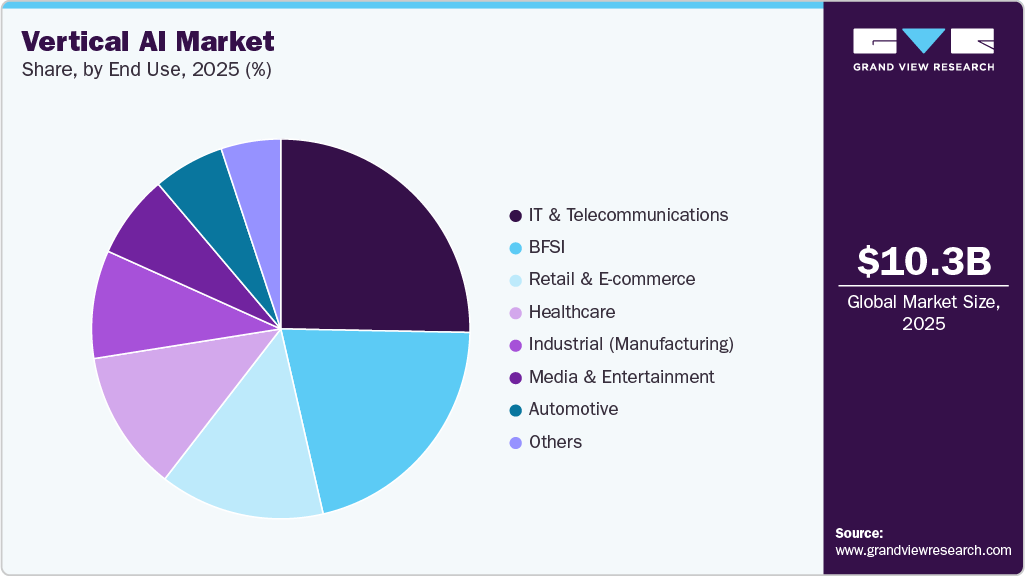
The BFSI segment is witnessing a substantial growth over the forecast period, due to the increasing adoption of AI-driven solutions for fraud detection, risk management, and customer service automation. Financial institutions are leveraging vertical AI platforms to analyze large volumes of financial data, improve decision-making, and enhance operational efficiency. The growing demand for personalized banking services, AI-powered chatbots, and predictive analytics is further accelerating adoption. Additionally, stricter regulatory compliance requirements and the need for advanced security systems are encouraging banks and financial institutions to integrate industry-specific AI technologies into their operations.
Regional Insights
The North America vertical AI market dominated with a share of 38.6% in 2025, driven by the strong presence of leading artificial intelligence technology providers, advanced digital infrastructure, and high adoption of AI solutions across industries such as healthcare, BFSI, retail, and telecommunications. Organizations in the region are actively investing in industry-specific AI platforms to enhance operational efficiency, automate business processes, and improve data-driven decision-making. Additionally, the availability of large-scale enterprise data, significant investments in AI research and development, and the rapid integration of AI into enterprise software and cloud platforms are further accelerating the adoption of vertical AI solutions across North America.
U.S. Vertical AI Market Trends
The U.S. dominated the North America Vertical AI market, driven by the strong presence of leading artificial intelligence companies, advanced cloud infrastructure, and significant investments in AI research and development, including innovations in AI agents. The country is home to numerous technology providers, AI startups, and research institutions actively developing industry-specific AI solutions and AI agents for sectors such as healthcare, BFSI, retail, manufacturing, and telecommunications.
Additionally, enterprises in the U.S. are early adopters of advanced technologies and are heavily investing in digital transformation initiatives that leverage AI agents to enhance operational efficiency and enable data-driven decision-making. The widespread availability of large datasets, robust venture capital funding for AI innovation, and the rapid adoption of cloud-based AI platforms and AI agents are further accelerating the deployment of vertical AI solutions across industries in the U.S.
Europe Vertical AI Market Trends
The Europe Vertical AI Market is witnessing significant growth, driven by the increasing adoption of artificial intelligence across industries such as manufacturing, automotive, healthcare, and financial services. Organizations across the region are investing heavily in AI-driven automation, predictive analytics, and intelligent decision-making systems to improve operational efficiency and competitiveness. Additionally, strong government initiatives and funding programs supporting AI research, innovation, and digital transformation are accelerating the deployment of industry-specific AI solutions. The presence of advanced industrial infrastructure, growing adoption of Industry 4.0 technologies, and increasing demand for data-driven business strategies are further contributing to the expansion of the Vertical AI market across Europe.
Asia-Pacific Vertical AI Market Trends
The Asia-Pacific Vertical AI Market is experiencing rapid growth, driven by the increasing adoption of artificial intelligence across industries such as manufacturing, retail, healthcare, and telecommunications. Countries including China, Japan, South Korea, and India are investing heavily in AI technologies to enhance industrial automation, improve operational efficiency, and support large-scale digital transformation initiatives. Additionally, the rapid expansion of cloud computing infrastructure, growing internet penetration, and the increasing availability of large volumes of enterprise and consumer data are accelerating the deployment of industry-specific AI solutions across the region. The presence of a large technology ecosystem, strong government support for AI innovation, and rising investments from both public and private sectors are further contributing to the growth of the Vertical AI market in Asia-Pacific.
Key Vertical AI Company Insights
The Vertical AI Market features several key players that significantly shape its global landscape through advanced industry-specific AI platforms, machine learning frameworks, and scalable enterprise deployment solutions. Microsoft Corporation is a leading provider of AI-powered cloud and enterprise solutions, widely recognized for its Azure AI platform, Azure Machine Learning, and Copilot technologies, which enable organizations to develop and deploy vertical AI applications across industries such as healthcare, finance, manufacturing, and retail. The company’s strong cloud infrastructure and extensive AI ecosystem allow enterprises to build domain-specific AI models, automate workflows, and generate real-time insights at scale.
Accenture plays a major role in the market by providing AI consulting, integration, and industry-specific AI deployment services through its AI-powered analytics platforms and generative AI capabilities. The company supports organizations in implementing vertical AI solutions tailored to sectors such as banking, healthcare, telecommunications, and energy. By combining deep industry expertise with advanced AI technologies and cloud partnerships, Accenture enables enterprises to accelerate digital transformation, optimize operational processes, and deploy scalable AI-driven solutions across complex business environments.
-
Microsoft Corporation is a global technology leader delivering advanced industry-specific artificial intelligence solutions through its powerful cloud infrastructure and AI development platforms. The company supports a wide range of industries including healthcare, BFSI, retail, manufacturing, and telecommunications by enabling intelligent automation, predictive analytics, and data-driven decision-making through its Azure AI and Azure Machine Learning platforms. Microsoft’s scalable cloud ecosystem, AI frameworks, and enterprise software integration capabilities facilitate the development and deployment of vertical AI applications across complex business environments.
-
Accenture is a global professional services company delivering advanced industry-specific artificial intelligence solutions through its AI consulting, analytics, and digital transformation capabilities. The company supports a broad range of industries including banking, healthcare, telecommunications, energy, and manufacturing by enabling intelligent automation, predictive analytics, and AI-driven business optimization. Their continuous investments in generative AI, cloud-based AI platforms, and industry-focused digital innovation initiatives position Accenture as a key player driving enterprise AI adoption and technological transformation within the global Vertical AI Market.
Key Vertical AI Companies:
The following key companies have been profiled for this study on the vertical AI market.
- C3.ai
- Palantir Technologies
- Tempus AI
- Siemens Healthineers AG
- Procore Technologies
- nCino
- H2O.ai
- Insitro
- PathAI
- IBM Corporation
- Microsoft Corporation
- Matellio Inc.
- Salesforce, Inc.
- Accenture
Recent Development
-
In February 2025, Salesforce, Inc. collaborated with Accenture and major cloud technology providers to expand generative AI capabilities for enterprise CRM platforms. The initiative integrates advanced AI models and automation tools to enable organizations deploy AI-driven customer engagement, analytics, and workflow automation solutions across industries such as retail, financial services, and telecommunications. Through this collaboration, enterprises can leverage scalable AI-powered CRM systems that enhance productivity, deliver personalized customer experiences, and enable data-driven decision-making
-
In January 2025, Accenture launched its AI Refinery™ for Industry platform to accelerate the development and deployment of industry-specific AI agents across enterprise environments. The platform includes multiple AI agent solutions designed to address operational challenges across sectors such as telecommunications, financial services, insurance, and manufacturing. Built in collaboration with advanced AI infrastructure partners, the solution enables organizations to transform raw AI technologies into scalable enterprise systems that automate workflows, improve productivity, and generate data-driven insights
-
In December 2025, Microsoft Corporation announced a major investment of approximately USD 17.5 billion to expand its artificial intelligence and cloud infrastructure ecosystem in India. The initiative focuses on strengthening Azure cloud capabilities, advancing AI research, and enabling enterprise adoption of AI-driven solutions across industries such as healthcare, finance, and manufacturing. The investment also includes partnerships with leading technology firms to accelerate the development and deployment of industry-specific AI applications and workforce skilling programs
Vertical AI Market Report Scope
Report Attribute
Details
Market size value in 2026
USD 13,039.0 million
Revenue forecast in 2033
USD 74,507.9 million
Growth rate
CAGR of 28.3% from 2026 to 2033
Actual data
2021 - 2025
Forecast period
2026 - 2033
Quantitative units
Revenue in USD Million/Billion and CAGR from 2026 to 2033
Report coverage
Revenue forecast, company ranking, competitive landscape, growth factors, and trends
Segments covered
Offering, technology, deployment, organization size, end use, region
Regional scope
North America; Europe; Asia Pacific; Latin America; MEA
Country scope
U.S.; Canada; Mexico; Germany; UK; France; China; India; Japan; Australia; South Korea; Brazil; UAE; South Africa; KSA
Key companies profiled
C3.ai; Palantir Technologies; Tempus AI; Siemens Healthineers AG; Procore Technologies; nCino; H2O.ai; Insitro; PathAI; IBM Corporation; Microsoft Corporation; Matellio Inc.; Salesforce, Inc.; Accenture
Customization scope
Free report customization (equivalent up to 8 analysts working days) with purchase. Addition or alteration to country, regional & segment scope.
Pricing and purchase options
Avail customized purchase options to meet your exact research needs. Explore purchase options
Global Vertical AI Market Report Segmentation
This report forecasts revenue growth at global, regional, and country levels and provides an analysis of the latest industry trends in each of the sub-segments from 2021 to 2033. For this study, Grand View Research has segmented the global vertical AI market report based on offering, deployment mode, Technology, organization size, end use, and region.
-
Offering Outlook (Revenue, USD Million, 2021 - 2033)
-
Hardware
-
Software
-
Services
-
-
Technology Outlook (Revenue, USD Million, 2021 - 2033)
-
Machine Learning (ML)
-
Natural Language Processing (NLP)
-
Computer Vision
-
Deep Learning
-
Others
-
-
Deployment Mode Outlook (Revenue, USD Million, 2021 - 2033)
-
Cloud
-
On-Premises
-
-
Organization size Outlook (Revenue, USD Million, 2021 - 2033)
-
Small & Medium Enterprise
-
Large Enterprise
-
-
End Use Outlook (Revenue, USD Million, 2021 - 2033)
-
IT & Telecommunications
-
BFSI
-
Retail & E-commerce
-
Healthcare
-
Industrial (Manufacturing)
-
Media & Entertainment
-
Automotive
-
Others
-
-
Regional Outlook (Revenue, USD Million, 2021 - 2033)
-
North America
-
U.S.
-
Canada
-
Mexico
-
-
Europe
-
UK
-
Germany
-
France
-
-
Asia Pacific
-
China
-
Japan
-
India
-
Australia
-
South Korea
-
-
Latin America
-
Brazil
-
-
Middle East and Africa (MEA)
-
KSA
-
UAE
-
South Africa
-
-
Frequently Asked Questions About This Report
b. The global vertical AI market size was estimated at USD 10,321.5 million in 2025 and is expected to reach USD 13,039.0 million in 2026
b. The global vertical AI market is expected to grow at a compound annual growth rate of 28.3% from 2026 to 2033 to reach USD 74,507.9 million by 2033
b. North America dominated the vertical AI market with a share of 38.6% in 2025. This is attributable to the strong presence of leading AI providers, early adoption across key industries, and high investment in advanced digital infrastructure, coupled with increasing integration of AI into enterprise workflows and continuous innovation through research and development initiatives.
b. Some key players operating in the vertical AI market include IBM; Microsoft Corporation; Google LLC; Amazon Web Services, Inc.; NVIDIA Corporation; Intel Corporation; Salesforce, Inc.; SAP SE; Oracle Corporation; C3.ai, Inc.; DataRobot, Inc.; H2O.ai, Inc.; Palantir Technologies Inc.; OpenAI; and SenseTime Group Limited.
b. Key factors that are driving the market growth include increasing adoption of industry-specific AI solutions, rising integration of AI into enterprise workflows, and continuous technological advancements in data analytics and automation across industries.


Share this report with your colleague or friend.
Need a Tailored Report?
Customize this report to your needs — add regions, segments, or data points, with 20% free customization.


ISO 9001:2015 & 27001:2022 Certified
We are GDPR and CCPA compliant! Your transaction & personal information is safe and secure. For more details, please read our privacy policy.
Trusted market insights - try a free sample
See how our reports are structured and why industry leaders rely on Grand View Research. Get a free sample or ask us to tailor this report to your needs.