- Home
- »
- Consumer F&B
- »
-
U.S. Packaged Salad Market Size, Industry Report, 2033GVR Report cover
![U.S. Packaged Salad Market Size, Share & Trends Report]()
U.S. Packaged Salad Market (2026 - 2033) Size, Share & Trends Analysis Report By Product (Vegetarian, Non-vegetarian), By Processing (Organic, Conventional), By Type (Packaged Greens, Packaged Kits), By Category, By Distribution Channel, By States, And Segment Forecasts
- Report ID: GVR-4-68040-055-2
- Number of Report Pages: 109
- Format: PDF
- Historical Range: 2021 - 2024
- Forecast Period: 2026 - 2033
- Industry: Consumer Goods
- Report Summary
- Table of Contents
- Segmentation
- Methodology
- Download FREE Sample
-
 Download Sample Report
U.S. Packaged Salad Market Summary
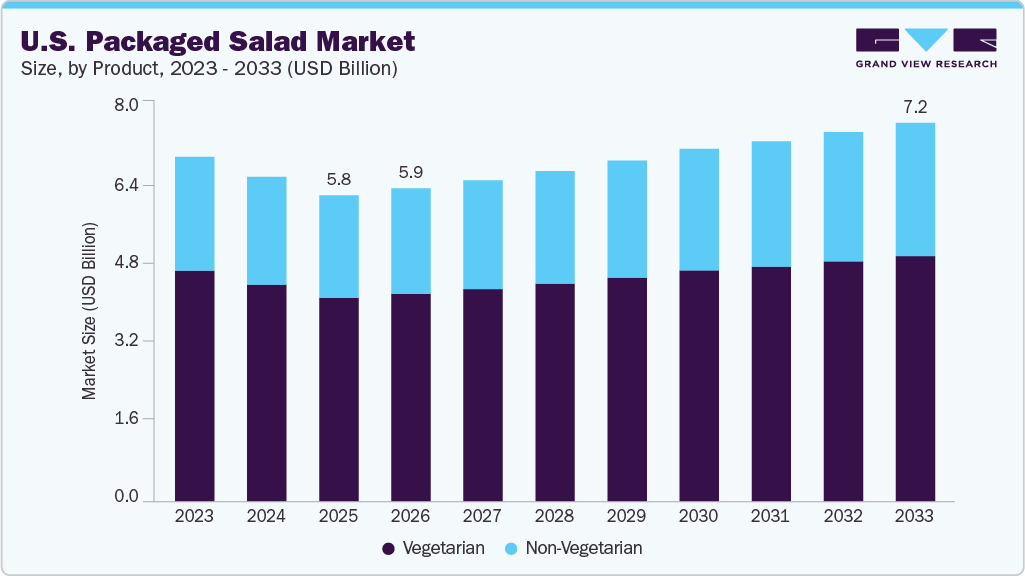
The U.S. packaged salad market size was estimated at USD 5,795.3 million in 2025 and is projected to reach USD 7,174.3 million by 2033, growing at a CAGR of 2.8% from 2026 to 2033. The growth of the U.S. packaged salad industry can be attributed to the rising popularity of salads and the ease of consumption provided by packaged salad products.
Key Market Trends & Insights
- By product, the vegetarian segment led the market with the largest revenue share of 66.54% in 2025.
- By processing, the organic segment is anticipated to grow at the fastest CAGR of 3.7% during the forecast period.
- By type, the packaged kits segment is anticipated to grow at the fastest CAGR of 3.6% during the forecast period.
- By category, the branded packaged salad segment led the market with the largest revenue share of 76.43% in 2025.
- By distribution channel, the offline segment led the market with the largest revenue share of 79.29% in 2025.
Market Size & Forecast
- 2025 Market Size: USD 5,795.3 Million
- 2033 Projected Market Size: USD 7,174.3 Million
- CAGR (2026-2033): 2.8%
The availability of packaged salads in a combination of various kinds of vegetables and fruits, dressed in various condiments and dressings, and accompanied by different meats and seafood has driven their popularity across the globe. Purchasing the ingredients for the salad, cleaning and chopping the fruits, vegetables, and meats, and preparing them with all the necessary dressings can be a tedious, time-consuming task. Hence, the demand for packaged and ready-to-eat salads is increasing among consumers, driving the growth of the U.S. packaged salad industry.Over the past few years, consumers’ food preferences have been gradually shifting toward healthy plant-based foods, driving the growth of the U.S. packaged salad industry. These salads, rich in leafy vegetables, are high in nutrients and an excellent source of fiber, minerals, vitamins, and protein. Moreover, these salads are also rich in antioxidants, vitamins A, K, C, & E, iron, calcium, and potassium. Apart from the high nutritional content, packaged salads are more easily digestible and help improve the digestion system when compared to any processed or fortified food.
The growing prevalence of social media has created mass momentum toward achieving a fit body. A majority of consumers consider healthy eating habits a major contributor to physical wellness. The demand for a fiber-rich diet with low-fat, protein-enriched content has made salads among the most popular dishes for achieving this goal. Thus, the demand for packaged salad is expected to witness consistent growth, driving the growth of the U.S. packaged salad industry.
The growing trend toward a healthy lifestyle is one of the key factors driving the U.S. packaged salad industry over the forecast period. In recent years, the trend of home cooking has been significantly growing among health-conscious people, working professionals, and the younger generations. However, their busy schedules leave less time for cooking and various other kitchen chores, which drives the demand for ready-to-eat healthy foods such as packaged salads. Hence, the demand for packaged salad and vegetables is on a continuous rise across the globe.
The demand for vegetarian salads is significantly growing owing to the rising vegan population around the world. Growing awareness regarding the high carbon footprint of the meat industry is compelling an increasing number of consumers to opt for vegetarian packaged salads instead. Moreover, growing awareness about animal health and cruelty in the food industry has encouraged people to shift from animal-based to plant-based food products, including packaged salads.
Schouten Europe launched a new plant-based tuna product in 2025 that offers enhanced taste and texture for salads, sandwiches, and other dishes. The formulation aims to better mimic conventional tuna while addressing sustainability concerns related to overfishing. Moreover, in 2025, Squeaky Bean introduced marinated Salmon Style Flakes in a popular sweet chilli flavour in UK supermarkets. These flaked plant-based fish alternatives are versatile and ready-to-eat, ideal for salads, wraps, or grain bowls.
Consumer Insights for the U.S. Packaged Salad Market
Over the years, the rising demand has compelled food companies to reformulate products to meet organic standards. Increasing government support for organic agriculture and the rising popularity of organic foods among commercial buyers have driven the demand for organically processed packaged salads. This heightened demand is expected to create new trends in processing techniques and product labeling in the organic packaged food space.
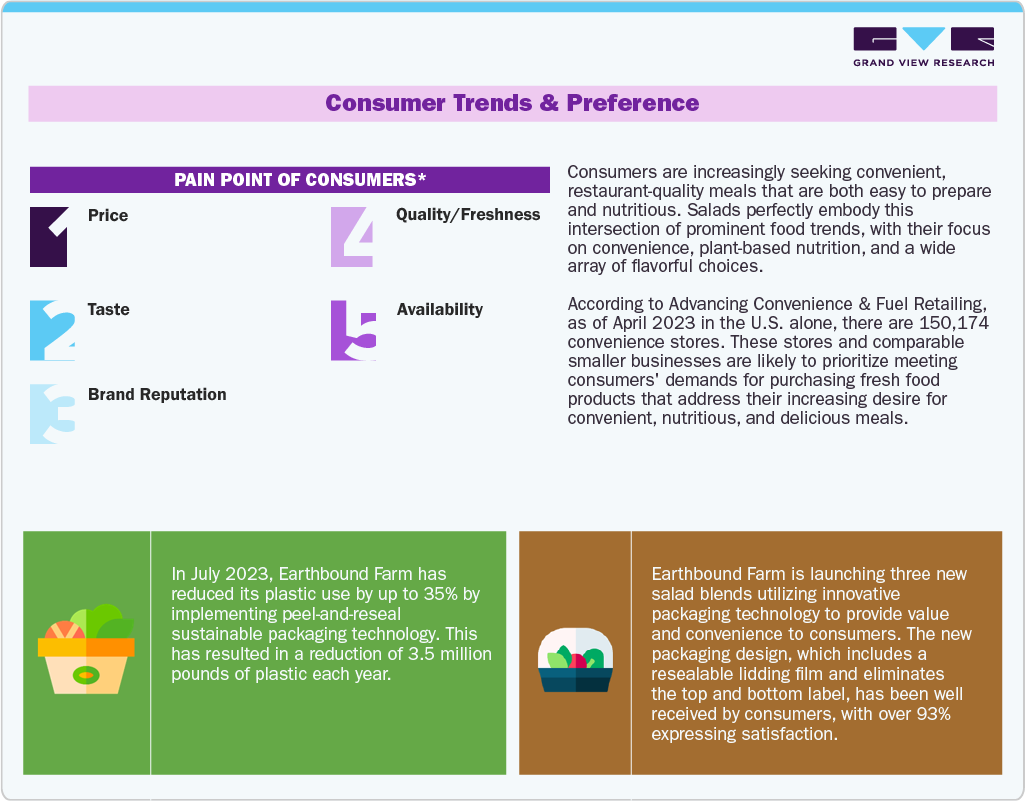
Consumers are increasingly seeking convenient, restaurant-quality meals that are both easy to prepare and nutritious. Salads perfectly embody this intersection of prominent food trends, with their focus on convenience, plant-based nutrition, and a wide array of flavorful choices.
At Expo West 2025, Beleaf showcased a range of plant-based seafood alternatives, including breaded shrimp, salmon, and tuna analogues, expanding beyond traditional meat substitutes to include seafood-style options for flexitarian and vegan consumers. Moreover, Steakholder Foods began commercial sales of plant-based white fish kebabs and salmon patties at vegan retailers in Israel. These products were developed using proprietary mixes and represent one of the company’s first finished seafood alternatives on the U.S. packaged salad industry.
Product Insights
The vegetarian segment led the market with the largest revenue share of 66.54% in 2025. In the U.S., a labor shortage in the foodservice industry is pushing restaurants and other food establishments to seek ways to reduce their reliance on manual labor. As a result, there is a growing preference for value-added products like pre-cut and pre-packaged vegetables, which are essential components of vegetarian salads. These products help foodservice operators streamline their processes and reduce the need for extensive preparation, making it easier to offer vegetarian salad options on their menus.
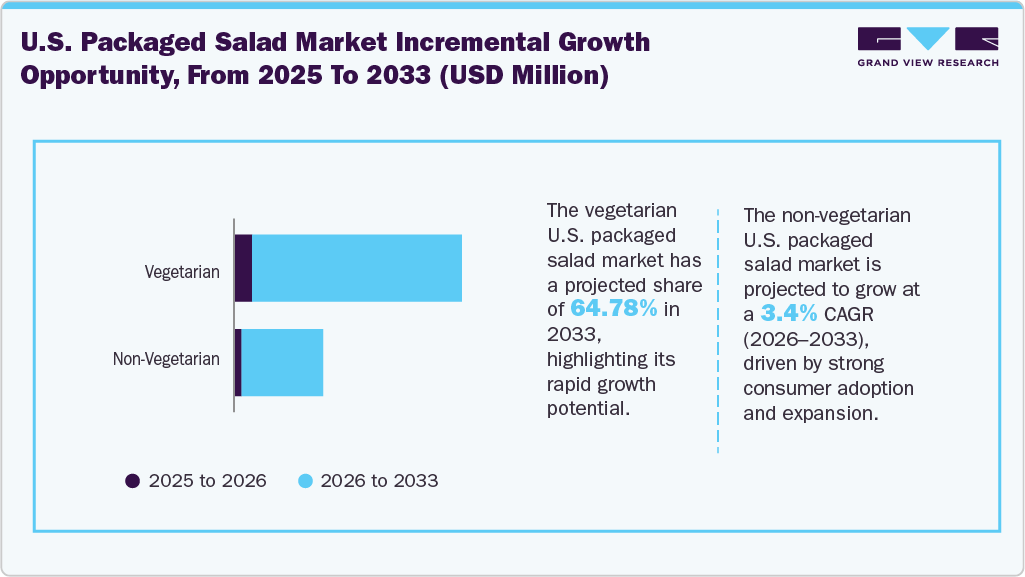
The non-vegetarian segment is projected to grow at the fastest CAGR of 3.4% from 2026 to 2033. Several companies have made significant developments in the non-vegetarian packaged salad space. In 2025, Church Brothers Farms entered the retail salad kit category with its Little Gems Salad Kits, offering convenient, ready-to-eat salads for quick meals. These kits aim to appeal to consumers seeking fresh, portable salad options from the produce aisle.
In November 2025, Factor, a chef-prepared meal delivery brand, partnered with Sakara to launch a new line of fresh, high-protein, and high-fiber ready-to-eat salads. While available primarily through Factor subscription service rather than grocery produce aisles, these salads deliver up to ~37 g of protein per serving and combine balanced nutrition, convenience, and flavorful ingredients, similar in convenience appeal to prepared salad kits.
Processing Insights
The conventional segment led the market with the largest revenue share of 76.0% in 2025. Packaged salads processed through conventional farming methods differ from organic salads. The National Organic Program, a federal regulatory framework in the U.S., places limitations on the use of genetically modified organisms (GMOs), while conventionally processed packaged salads may include GMOs. Generally, conventionally produced salads are more affordable than their organic counterparts because conventional farming tends to be less costly.
The organic segment is projected to grow at the fastest CAGR of 3.7% from 2026 to 2033. If a packaged salad features the USDA Organic label, it indicates that the contents inside the package have been processed or produced in compliance with USDA organic regulations. Packaged salads that are completely organic are labeled 100% organic. Brands operating in the organic space display the USDA seal on their packages to help consumers understand that their products are made with ingredients from organic farms.
Type Insights
The packaged salad greens segment led the market with the largest revenue share of 62.89% in 2025. Packaged greens have been gaining popularity owing to their raw taste without the addition of any type of seasonings, dressings, or condiments. Growing consumer preference for raw packaged salads has encouraged key players and new entrants to launch a number of products in the U.S. packaged salad industry. All the key players in the U.S. packaged salad industry, such as BrightFarms, Inc., Dole Food Company, Inc., Earthbound Farm, Misionero, Fresh Express, Incorporated, and Gotham Greens, have a wide range of packaged greens in their product portfolios.
The packaged salad kits segment is projected to grow at the fastest CAGR of 3.6% from 2026 to 2033. Traditional cooking methods are often too time-consuming and labor-intensive for individuals preparing meals for themselves, including fresh salads. The most time-consuming aspect of salad preparation involves washing, chopping, and mixing ingredients with the appropriate dressings or condiments to enhance flavor. Furthermore, consumers would need to go grocery shopping at least once or twice a week, in addition to spending 20 to 25 minutes more on meal preparation. This demanding process creates a new market opportunity for salad manufacturers in the U.S. packaged salad industry.
Category Insights
The branded packaged salad segment led the market with the largest revenue share of 76.43% in 2025. Well-known national and international brands have entrenched reputations for quality, consistency, and food safety. These attributes increase consumer willingness to choose branded salads, especially for perishable, ready-to-eat products. Growing health consciousness is a major driver of the segment. Many consumers perceive branded salad products as healthy, nutritious meal options, aligning with lifestyle trends that emphasize fresh vegetables, high protein, and clean labels.
The in-store/private-label packaged salad segment is projected to grow at the fastest CAGR of 4.6% from 2026 to 2033. Retailers are improving the quality, transparency, and branding of their in-store salad offerings, which is increasing consumer confidence in private-label products as reliable, cost-effective alternatives to national brands. Economic pressures and value consciousness, particularly among budget-conscious shoppers, drive a preference for private-label packaged salads, which often offer similar freshness and convenience at lower prices.
Distribution Channel Insights
The offline segment led the market with the largest revenue share of 79.29% in 2025. Supermarkets and hypermarkets are prominent distribution channels for packaged salads worldwide. Target and Walmart continue to dominate this space. Unlike grocery stores, orders placed through supermarkets and hypermarkets are typically larger. While grocery stores help packaged salad brands stay customer-focused, supermarkets and hypermarkets allow brands to increase sales by providing access to a considerably larger customer base. Furthermore, supermarkets and hypermarkets often have dedicated aisles for packaged foods, making it easy for customers to find specific brands' products.
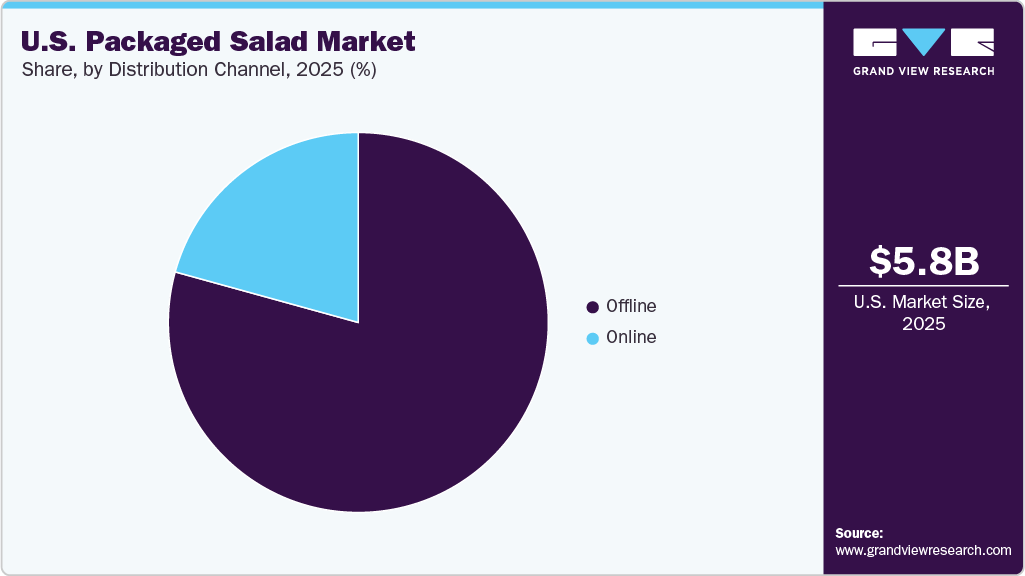
The online segment is projected to grow at the fastest CAGR of 5.8% from 2026 to 2033. The packaged salad market has yet to widely adopt e-commerce, unlike other sectors such as household products and consumer electronics. The perishable nature of packaged salads, with unique logistics and storage requirements, is a key factor slowing down the distribution through online/e-commerce channels. However, recent consumption patterns and shifting shopper sentiments indicate that the online category is poised for robust growth.
States Insights
Florida Packaged Salad Market Trends
The Florida dominated the U.S. packaged salad market with the largest revenue share of 6.28% in 2025. In Florida, the packaged salad industry is driven by the state’s warm year-round climate and a strong emphasis on active, health-oriented lifestyles, which sustain continuous demand for light, refreshing, ready-to-eat salads that fit into daily routines. Urban and suburban consumers often prioritize convenience and nutritious meal options, which encourages supermarkets and grocery chains to expand in-store salad offerings and private-label salad kits to capture health-focused purchases. Moreover, the warm climate supports local production and availability of fresh produce that complements packaged salad assortments, helping reinforce retail penetration across traditional grocery aisles and e-commerce channels.
New York Packaged Salad Market Trends
The packaged salad market in the New York is expected to grow at the fastest CAGR of 4.4% during the forecast period, propelled by dense urban populations, fast-paced lifestyles, and trend-forward consumption behavior, making convenience and novelty highly valued. Consumers in New York frequently seek ready-to-eat, chef-inspired, and premium salad kits that align with busy work schedules and evolving culinary preferences, including organic, plant-based, or globally-inspired blends. The extensive retail infrastructure, from large supermarkets to specialty grocers, combined with robust cold-chain logistics and higher health awareness among urban dwellers, further supports the proliferation of packaged salads. These factors, together, enhance product variety and availability, reinforcing salad consumption as an accessible and desirable meal option across diverse New York demographics.
Key U.S. Packaged Salads Company Insights
The U.S. packaged salad industry is characterized by the presence of a few well-established and several small- and medium-sized players. Some of the key players in the market are BrightFarms, Dole Food Company Inc., Earthbound Farm, Eat Smart, Fresh Express, Incorporated, Misionero, Gotham Greens, Mann Packing Co., Inc., Bonduelle, and organicgirl.
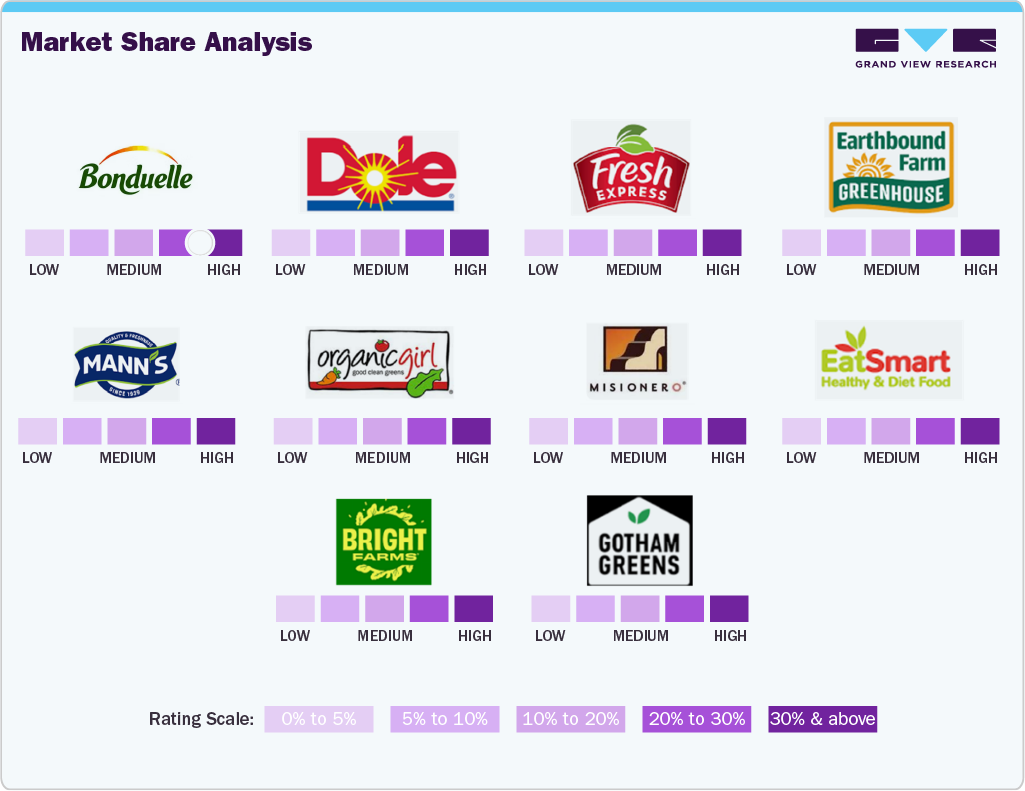
The market players face intense competition, especially from the top companies in the packaged salad market, as they have a large consumer base, strong brand recognition, and vast distribution networks. Companies have been implementing various expansion strategies, such as mergers & acquisitions, new product launches, and production capacity expansion, to gain a competitive advantage.
Key U.S. Packaged Salad Companies:
- Bonduelle
- Dolle Food Company Inc.
- Fresh Express, Incorporated
- Earthbound Farm
- Mann Packing Co., Inc.
- Organicgirl
- Misionero
- Eat Smart
- BrightFarms, Inc.
- Gotham Greens
Recent Developments
-
In January 2025, Fresh Del Monte Produce, through its Mann Packing division, launched the Newman's Own Salad Kits featuring four culinary-inspired flavours, each crafted with high-quality lettuce.
-
In March 2024, Fresh Express, the brand leader in value-added salads, launched an Asian Apple Salad Kit and a Twisted Caesar Creamy Truffle Caesar Chopped Salad Kit.
U.S. Packaged Salad Market Report Scope
Report Attribute
Details
Market value size in 2026
USD 5,927.9 million
Revenue Forecast in 2033
USD 7,174.3 million
Growth rate
CAGR of 2.8% from 2026 to 2033
Base year for estimation
2025
Historical data
2021 - 2024
Forecast period
2026 - 2033
Quantitative units
Revenue in USD million/billion, and CAGR from 2026 to 2033
Report coverage
Revenue forecast, company ranking, competitive landscape, growth factors, and trends
Segments covered
Product, processing, category, type, distribution channel, states
Country scope
U.S.
States scope
Florida; New York; Pennsylvania; Illinois; Ohio; Georgia
Key companies profiled
Bonduelle; Dolle Food Company Inc.; Fresh Express, Incorporated; Earthbound Farm; Mann Packing Co., Inc.; organicgirl; Misionero; Eat Smart; BrightFarms, Inc.; Gotham Greens
Customization scope
Free report customization (equivalent up to 8 analysts’ working days) with purchase. Addition or alteration to country, regional & segment scope.
Pricing and purchase options
Avail customized purchase options to meet your exact research needs. Explore purchase options
U.S. Packaged Salad Market Report Segmentation
This report forecasts revenue growth at the regional and country levels and provides an analysis of the latest industry trends and opportunities in each of the sub-segments from 2021 to 2033. For this study, Grand View Research has segmented the U.S. packaged salad market report based on the product, processing, type, category, distribution channel, and states:
-
Product Outlook (Revenue, USD Million, 2021 - 2033)
-
Vegetarian
-
Non-vegetarian
-
-
Processing Outlook (Revenue, USD Million, 2021 - 2033)
-
Organic
-
Conventional
-
-
Type Outlook (Revenue, USD Million, 2021 - 2033)
-
Packaged Greens
-
Packaged Kits
-
-
Category Outlook (Revenue, USD Million, 2021 - 2033)
-
Branded
-
In-store/ Private Label
-
-
Distribution Channel Outlook (Revenue, USD Million, 2021 - 2033)
-
Offline
-
Online
-
-
State Outlook (Revenue, USD Million, 2021 - 2033)
-
Florida
-
New York
-
Pennsylvania
-
Illinois
-
Ohio
-
Georgia
-
Frequently Asked Questions About This Report
b. Vegetarian packaged salad market accounted for a share of over 66% of the U.S. revenues in 2025. According to an article published by Cook Unity, in 2023, 5-8% of the U.S. population identified themselves as vegetarian, signifying a substantial market for vegetarian products, including packaged salads. This demographic actively seeks convenient and readily available food options that align with their dietary choices. The vegetarian packaged salad market, therefore, has a significant consumer base looking for appealing and nutritious salad options free from animal products.
b. Some key players operating in the U.S. packaged salads market are BrightFarms, Inc., Dole Food Company, Inc., Earthbound Farm, Eat Smart (Curation Foods), Missionero, Gotham Greens Holdings, PBC, Mann Packaging Co., Inc., Bonduelle, Fresh Express, Inc., VegPro Intenational, Inc., ORGANICGIRL, LLC
b. The availability of packaged food in combinations of different vegetables and fruits, accompanied by various condiments and dressings, as well as an assortment of meats and seafood, has driven their popularity across the region.
b. The U.S. packaged salad market size was estimated at USD 5,795.3 million in 2025 and is expected to reach USD 5,927.9 million in 2026.
b. The U.S. packaged salads market is expected to grow at a compounded growth rate of 2.8% from 2026 to 2033 to reach USD 7,174.3 million by 2033.


Share this report with your colleague or friend.
Need a Tailored Report?
Customize this report to your needs — add regions, segments, or data points, with 20% free customization.


ISO 9001:2015 & 27001:2022 Certified
We are GDPR and CCPA compliant! Your transaction & personal information is safe and secure. For more details, please read our privacy policy.
Trusted market insights - try a free sample
See how our reports are structured and why industry leaders rely on Grand View Research. Get a free sample or ask us to tailor this report to your needs.