U.S. Office Furniture Market Summary
The U.S. office furniture market size was valued at USD 17.43 billion in 2025 and is projected to reach USD 25.82 billion by 2033, growing at a CAGR of 5.1% from 2026 to 2033. The U.S. office furniture market is experiencing renewed growth as companies reinvest in workplace infrastructure and redesign offices to support hybrid work models.
Key Market Trends & Insights
- By product, seating office furniture accounted for a market share of 27.68% in 2025.
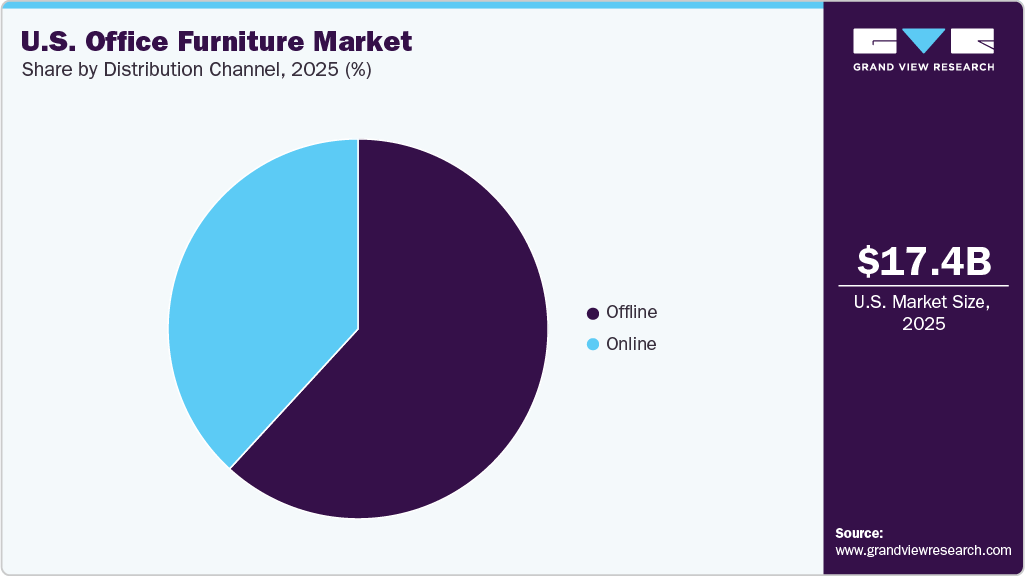
- By distribution channel, sales through offline channels accounted for a market share of 61.82% in 2025.
Market Size & Forecast
- 2025 Market Size: USD 17.43 Billion
- 2033 Projected Market Size: USD 25.82 Billion
- CAGR (2026-2033): 5.1%
Many organizations are renovating existing office spaces to attract employees back to the workplace and improve productivity. This trend is increasing demand for ergonomic chairs, modular desks, acoustic panels, and collaborative workstations. Corporate employers are also redesigning workplaces with flexible layouts that allow employees to alternate between focused work areas and collaborative meeting zones. The expansion of technology companies, consulting firms, and financial services offices continues to support demand for modern workplace furniture across major business districts and emerging suburban office hubs.
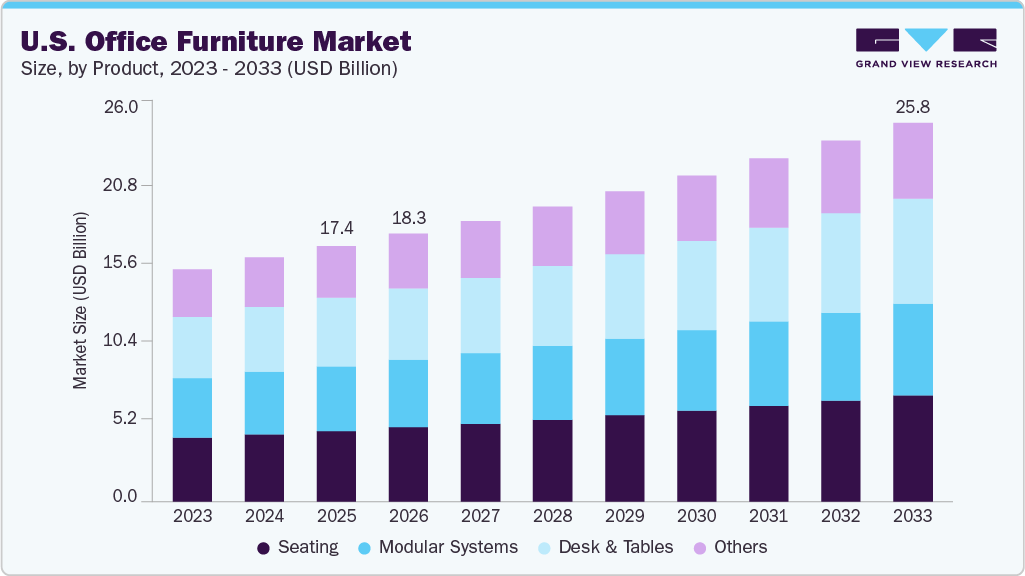
Hybrid work arrangements have also reshaped purchasing patterns in the U.S. office furniture market. While employees are gradually returning to corporate offices, many organizations now maintain flexible work policies that require adaptable office layouts. As a result, companies are investing in modular furniture systems that can be reconfigured quickly for different team sizes and working styles. Height-adjustable desks, ergonomic seating, and compact meeting pods are increasingly adopted to support employee comfort and productivity. Employers are prioritizing furniture that improves posture, reduces fatigue, and supports long working hours, reflecting growing awareness of workplace wellness and occupational health.
Another major trend shaping the market is the integration of technology within office furniture. Manufacturers are launching desks, conference tables, and seating solutions equipped with built-in charging ports, wireless connectivity, and cable management systems to support modern digital workplaces. Smart furniture solutions that integrate sensors to monitor workspace utilization, air quality, and energy consumption are gaining traction among large enterprises seeking to optimize office efficiency. These innovations are particularly relevant for technology firms and corporate campuses that require digitally enabled environments capable of supporting high levels of collaboration and connectivity.
Sustainability has become an important purchasing consideration in the U.S. office furniture market. Many corporate buyers now prioritize furniture manufactured from recycled materials, responsibly sourced wood, and low-emission components. Manufacturers are responding by introducing environmentally certified furniture that complies with sustainability standards such as indoor air quality certifications and responsible material sourcing. For instance, in September 2025, URBANICA Furniture introduced a new line of sustainable office furniture that includes ergonomic chairs and height-adjustable desks designed for modern workplaces and home offices. The collection focuses on improving comfort and posture while supporting flexible sit-stand working styles. The products are developed with durable materials and environmentally conscious practices, reflecting the growing demand for ergonomic and sustainable workspace solutions. Companies are also investing in furniture designs that can be easily repaired, refurbished, or recycled to extend product life cycles and reduce waste. This shift aligns with broader corporate sustainability goals and environmental reporting requirements adopted by many U.S. organizations.
Brand Market Share Insights
The U.S. office furniture market is characterized by a highly competitive landscape supported by the presence of established manufacturers as well as emerging furniture design companies. Leading players maintain strong market positions through extensive distribution networks, large-scale manufacturing capabilities, and long-standing relationships with corporate and institutional clients. Companies such as Herman Miller, Steelcase, Haworth, and HNI Corporation dominate significant segments of the market by offering ergonomic seating, modular workstations, and flexible office solutions designed for modern workplaces.
These companies continuously invest in product innovation, workplace research, and sustainable manufacturing practices to address evolving corporate requirements such as hybrid office layouts, employee wellness, and environmentally responsible furniture materials. In addition to established manufacturers, the market is also witnessing the emergence of design-oriented brands and digitally driven furniture retailers that target startups, small businesses, and home-office consumers through online platforms, further intensifying competition across the U.S. office furniture market.
Product Insights
Seating office furniture in the U.S. accounted for the largest share, over 27.68% in 2025, driven by the increasing adoption of ergonomic workplace solutions designed to improve employee comfort and productivity during long working hours. Organizations are increasingly investing in adjustable office chairs with lumbar support, headrests, and flexible armrests to reduce posture-related health issues and workplace fatigue. Demand is also supported by the growing trend of hybrid work models, which has encouraged both companies and individual consumers to purchase ergonomic seating for home offices. In addition, businesses are focusing on modern office layouts and visually appealing workplace interiors, which is encouraging the purchase of premium seating furniture made with durable materials and contemporary designs.
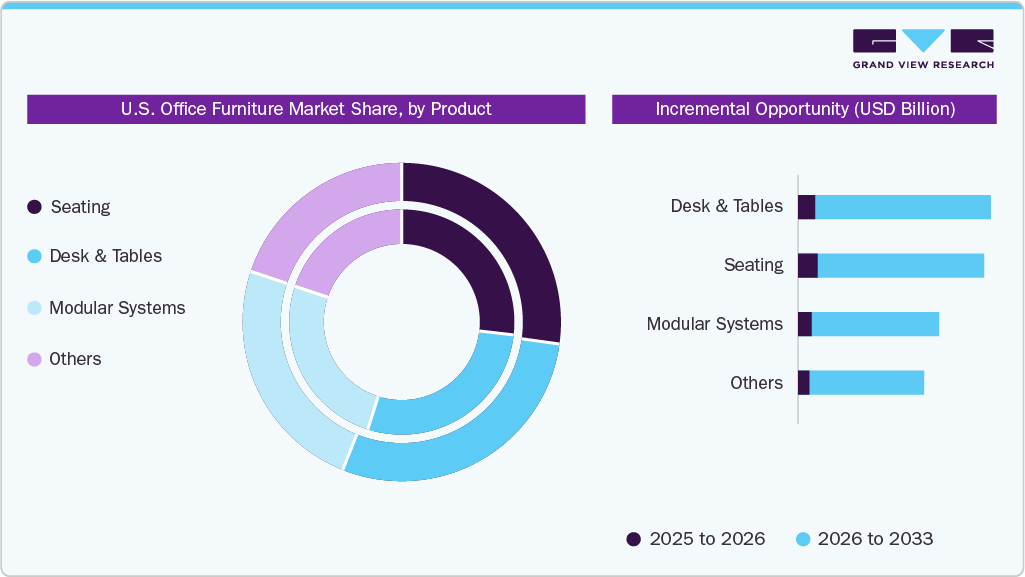
Demand for office modular systems is expected to rise at a CAGR of 5.6% from 2026 to 2033. Modular office furniture systems allow organizations to easily rearrange workstations, partitions, and storage units to accommodate changing team sizes and evolving workspace requirements. Companies increasingly prefer modular setups because they enable quick reconfiguration without requiring major renovations or additional infrastructure investment. These systems also support collaborative work environments by allowing offices to create open work areas, meeting zones, or private workstations as needed. In addition, the growing adoption of hybrid and agile workplace models is prompting businesses to invest in modular office furniture that can adapt to a dynamic office environment.
Distribution Channel Insights
The sale of office furniture through offline channels accounted for about 61.82% of the U.S. office furniture market in 2025. Offline retail continues to play a significant role as many businesses prefer to evaluate furniture quality, material durability, and ergonomic features in person before making large purchases. Physical showrooms allow buyers to test seating comfort, workstation configurations, and storage systems, while also providing access to professional consultation, installation services, and bulk procurement support.
The growth of new specialty furniture showrooms and office furnishing stores across major U.S. cities has further strengthened offline sales channels. Companies such as Williams‑Sonoma and Crate and Barrel offer office furniture through extensive retail store networks and digital platforms, enabling customers to explore eco-friendly and premium furniture collections in-store. The continued expansion of branded showrooms and franchise furniture outlets is therefore supporting the strong presence of offline distribution in the U.S. office furniture market. For instance, in February 2026, West Elm, part of Williams-Sonoma, launched West Elm Office, a new furniture line designed for both professional workplaces and home offices. The range includes desks, chairs, shelving, and storage solutions made with contract-grade materials to ensure durability and flexibility. Through this launch, the company aims to expand its presence in the growing workspace and hybrid-work furniture market.
Demand for office furniture in the U.S. through online channels is expected to grow at a CAGR of 8.9% from 2026 to 2033. The growth of e-commerce platforms has significantly transformed the way businesses and individual consumers purchase office furniture. Online marketplaces and brand-owned websites allow buyers to explore a wide range of office chairs, desks, modular workstations, and storage units while comparing prices, specifications, and customer reviews. Many companies prefer online procurement as it simplifies bulk purchasing, reduces procurement time, and provides access to a broader supplier network. In addition, digital platforms increasingly offer features such as virtual showroom tours, 3D product visualization, and workspace planning tools, which help buyers evaluate furniture suitability before making purchasing decisions.
Key U.S. Office Furniture Companies:
- Herman Miller Inc.
- HNI Corporation
- Steelcase Inc.
- Haworth Inc.
- 9to5 Seating LLC
- Ashley Furniture Industries, LLC
- Global Furniture Group
- Teknion
- OKAMURA CORPORATION
- Interior Systems, Inc.
Recent Developments
-
In March 2026, Wayfair is set to open a new large-format retail store in Atlanta, Georgia, at The District at Howell Mill, replacing a former Walmart location. The 150,000-square-foot store will feature a wide range of products, including furniture, décor, appliances, and home improvement items, allowing customers to experience the brand in a physical retail setting.
-
In February 2026, West Elm launched West Elm Office, a new contract-grade furniture collection designed for both home offices and professional workplaces. The range includes desks, chairs, shelving, and storage solutions built for durability and long-term use. With modular designs that allow flexible workspace layouts, the collection reflects growing demand for adaptable office furniture in hybrid work environments.
-
In February 2026, AndaSeat launched the Xtreme Series standing desk, expanding its portfolio of ergonomic furniture for gaming setups and home or office workspaces. The desk includes an electric height-adjustment system that allows users to shift between sitting and standing positions, helping support healthier working habits. It also features a sturdy steel frame, built-in cable management, and programmable height settings for greater convenience and workspace organization.
U.S. Office Furniture Market Report Scope
|
Report Attribute
|
Details
|
|
Market size value in 2026
|
USD 18.25 billion
|
|
Revenue forecast in 2033
|
USD 25.82 billion
|
|
Growth rate
|
CAGR of 5.1% from 2026 to 2033
|
|
Actual data
|
2021 - 2025
|
|
Forecast period
|
2026 - 2033
|
|
Quantitative units
|
Revenue in USD Billion, and CAGR from 2026 to 2033
|
|
Report coverage
|
Revenue forecast, company ranking, competitive landscape, growth factors, and trends
|
|
Segments covered
|
Product and Distribution Channel
|
|
Country scope
|
U.S.
|
|
Key companies profiled
|
Herman Miller Inc.; HNI Corporation; Steelcase Inc.; Haworth Inc.; 9to5 Seating LLC; Ashley Furniture Industries, LLC; Global Furniture Group; Teknion; OKAMURA CORPORATION; and Interior Systems, Inc.
|
|
Customization
|
Free report customization (equivalent up to 8 analysts working days) with purchase. Addition or alteration to country, regional & segment scope.
|
|
Pricing and purchase options
|
Avail customized purchase options to meet your exact research needs. Explore purchase options
|
U.S. Office Furniture Market Report Segmentation
This report forecasts revenue growth at the country level and provides an analysis of the latest industry trends and opportunities in each of the sub-segments from 2021 to 2033. For this study, Grand View Research has segmented the U.S. office furniture market report by product and distribution channel.
-
Product Outlook (Revenue, USD Billion, 2021 - 2033)
-
Seating
-
Modular Systems
-
Desks & Tables
-
Others
-
Distribution Channel Outlook (Revenue, USD Billion, 2021 - 2033)
Frequently Asked Questions About This Report
b. The U.S. office furniture market size was estimated at USD 17.43 billion in 2025 and is expected to reach USD 18.25 billion in 2026.
b. Some key players operating in the U.S. office furniture market include Herman Miller Inc.; HNI Corporation; Steelcase Inc.; Haworth Inc.; 9to5 Seating LLC; Ashley Furniture Industries, LLC; Global Furniture Group; Teknion; OKAMURA CORPORATION; Interior Systems, Inc.
b. Key factors that are driving the U.S. office furniture market growth include the growth of the commercial sector and an increase in office improvement activities.
b. The U.S. office furniture market is expected to grow at a compound annual growth rate of 5.1% from 2026 to 2033 to reach USD 25.82 billion by 2033.
b. Seating dominated the U.S. office furniture market with a share of 27.7% in 2025. This is attributable to the growth in commercial and office building construction and remodeling activities.

 Download Sample Report