- Home
- »
- Homecare & Decor
- »
-
U.S. Furniture Market Size & Share, Industry Report, 2033GVR Report cover
![U.S. Furniture Market Size, Share & Trends Report]()
U.S. Furniture Market (2026 - 2033) Size, Share & Trends Analysis Report By Product (Bedroom Furniture, Seating Furniture, Storage Furniture, Desk & Tables), By Material (Metal, Wood, Plastic, Glass), By Application (Residential, Commercial), And Segment Forecasts
- Report ID: GVR-4-68040-646-4
- Number of Report Pages: 90
- Format: PDF
- Historical Range: 2021 - 2025
- Forecast Period: 2026 - 2033
- Industry: Consumer Goods
- Report Summary
- Table of Contents
- Segmentation
- Methodology
- Download FREE Sample
-
 Download Sample Report
U.S. Furniture Market Summary
The U.S. furniture market size was estimated at USD 180.55 billion in 2025 and is projected to reach USD 292.26 billion by 2033, growing at a CAGR of 6.4% from 2026 to 2033. The industry is evolving due to changing market dynamics and consumer preferences.
Key Market Trends & Insights
- By product, the bedroom furniture accounted for a 35.16% share of the U.S. furniture industry in 2025.
- By material, wooden furniture accounted for a market share of 39.26% in 2025.
- By application, residential furniture accounted for a market share of 60.21% in 2025.
Market Size & Forecast
- 2025 Market Size: USD 180.55 Billion
- 2033 Projected Market Size: USD 292.26 Billion
- CAGR (2026-2033): 6.4%
Manufacturers are turning to recycled materials and eco-friendly production methods as sustainability becomes a priority across the U.S. furniture market, including segments such as the U.S. bedroom furniture market, U.S. kids furniture market, and U.S. outdoor furniture and kitchen market. At the same time, demand is growing for multifunctional, modular, and tech-integrated designs that save space and offer affordability, particularly in categories like the U.S. kids storage furniture market and the U.S. pet furniture market.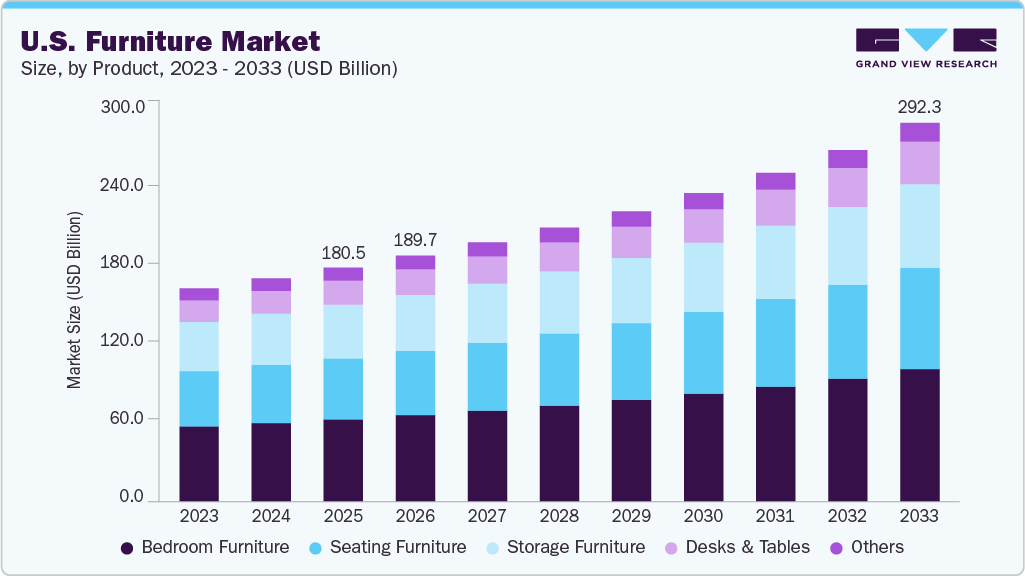
Consumers are increasingly environmentally conscious, prompting manufacturers to use reclaimed wood, recycled metals, and organic fabrics across the U.S. furniture market and adjacent segments such as the U.S. salon furniture market and the U.S. education furniture market. These choices reduce raw material extraction and waste and align with green manufacturing practices such as renewable energy use and waste minimization, helping brands save costs, improve safety, and enhance their reputations. For instance, West Elm is widely recognized for its commitment to eco-friendly production. The company uses reclaimed wood, organic cotton, and recycled materials in many furniture lines. Over 60% of its wood furniture is FSC-certified, ensuring responsible forestry practices.
Local sourcing and manufacturing are gaining importance in the U.S. furniture industry in 2025, including in institutional segments such as the U.S. school furniture market and the U.S. education furniture market. Sourcing furniture locally offers a range of benefits beyond convenience. It supports the local economy by creating jobs and empowering small businesses, contributing to economic growth and community stability. Ethan Allen is a U.S.-based furniture manufacturer with extensive domestic operations. About 75% of its furniture is made in North America, with several manufacturing facilities in the U.S., including plants in Vermont and North Carolina, as well as in Mexico and Honduras.
Smart furniture is rapidly gaining popularity in the U.S. furniture market, emerging as a top trend for 2025 as consumers seek more functionality and convenience in their living spaces, especially within the U.S. bedroom furniture market and U.S. outdoor furniture and kitchen market. Manufacturers are integrating sensors, wireless charging, built-in speakers, and voice-enabled features that connect with Wi-Fi and smart home systems. For instance, the Sobro Smart Coffee Table includes a built-in fridge, Bluetooth speakers, charging ports, and LED lighting, all controlled via a touchscreen.
The growth of the residential construction sector is driving increased demand in the market, particularly boosting categories such as the U.S. bedroom furniture market, the U.S. kids furniture market, and the U.S. kids storage furniture market. As more new homes are built and existing properties undergo renovation, the need for home furnishings rises accordingly. This highlights the strong connection between housing development and the furniture industry.
Furniture rental and subscription services are becoming increasingly popular among younger urban residents in the U.S. furniture industry, with growing relevance in flexible-use categories such as the U.S. pet furniture market and the U.S. kids furniture market. These options allow individuals to access high-quality furniture without long-term commitments, making them ideal for frequent relocators. Additionally, this approach supports sustainability by promoting reuse and reducing waste.
Brand Market Share Insights
The U.S. furniture market is characterized by a highly competitive landscape supported by the presence of large national retailers, established furniture manufacturers, and emerging direct-to-consumer brands across segments such as the U.S. bedroom furniture market, U.S. outdoor furniture and kitchen market, and institutional categories including the U.S. school furniture market and U.S. education furniture market. Leading companies leverage strong brand recognition, extensive retail networks, and continuous product innovation to maintain their competitive positions while adapting to evolving consumer preferences in home décor and interior design. Major players such as Ashley Furniture Industries, Williams-Sonoma, IKEA, Wayfair, and La-Z-Boy offer a broad portfolio of furniture products, including sofas, beds, dining sets, storage units, and modular home furnishings.
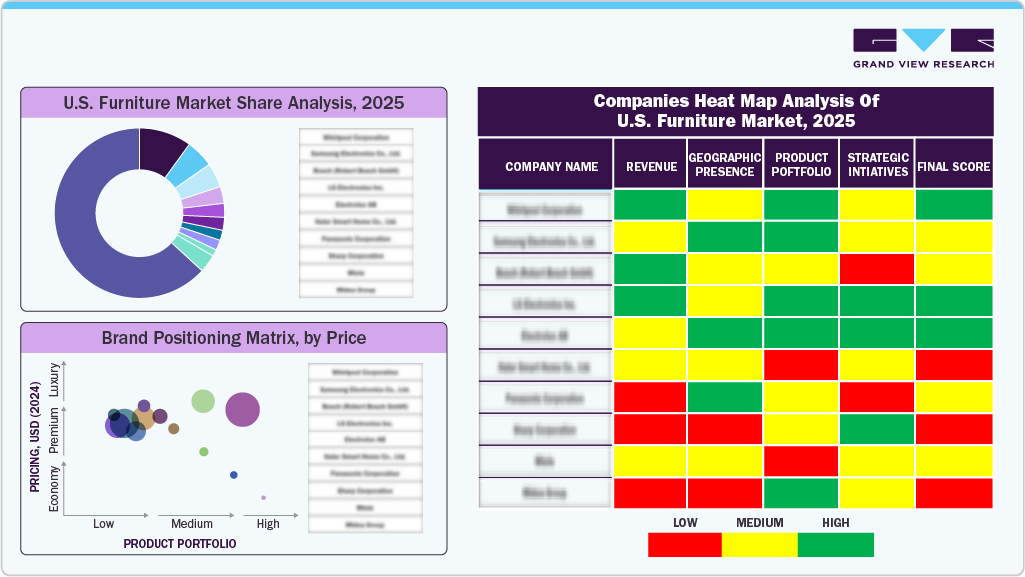
These companies frequently introduce new collections, design collaborations, and space-efficient furniture solutions to align with changing lifestyle trends and housing patterns across both residential and institutional demand segments, including the U.S. bedroom furniture market and U.S. education furniture market. Continuous investments in omnichannel retail strategies, digital visualization tools, and expansion across brand-owned stores, specialty furniture retailers, and e-commerce platforms allow leading brands to strengthen their market presence while attracting consumers seeking both functional and design-driven furniture for modern homes, as well as outdoor living spaces within the U.S. outdoor furniture and kitchen market.
Consumer Insights & Surveys
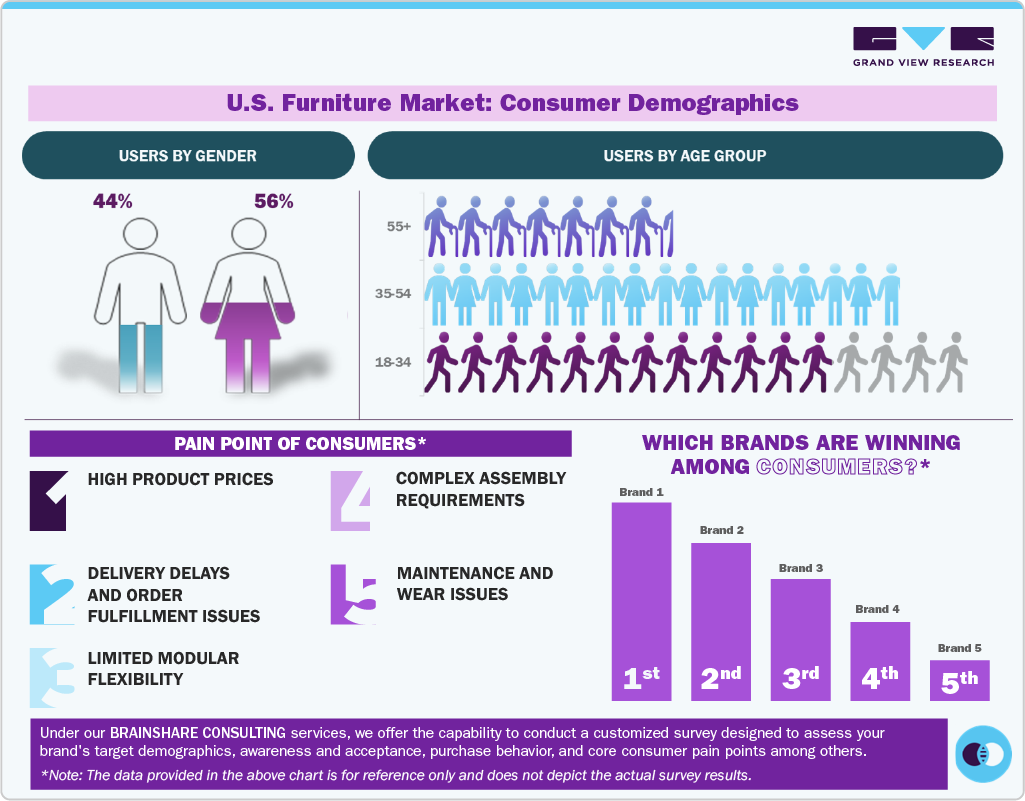
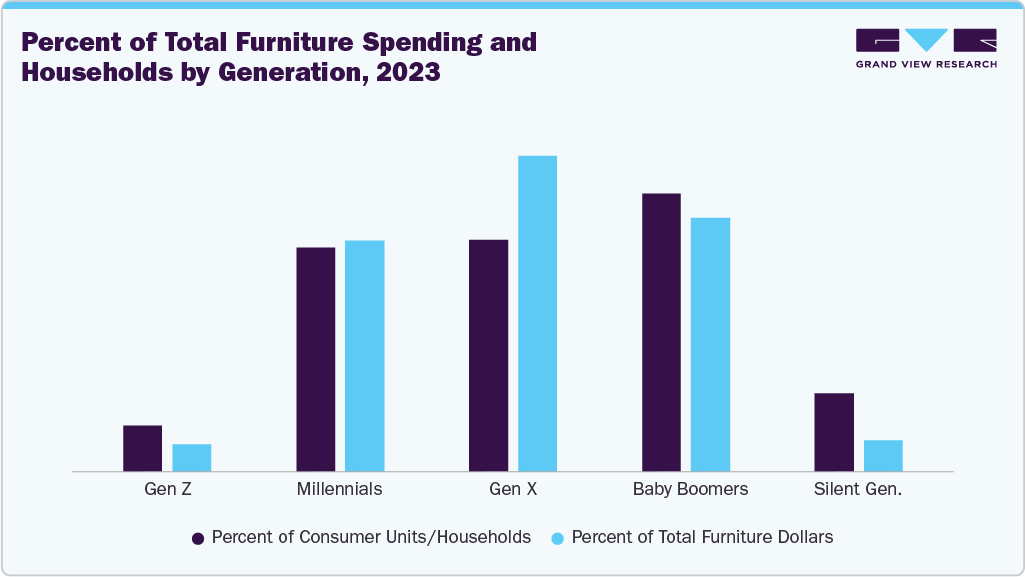
According to the survey conducted by Home Furnishing Business, the percentage of total furniture spending and consumer households by generation in 2023, Gen X contributes a significantly higher share of total furniture dollars than its share of households, indicating higher average spending per household. Millennials also have a strong presence, with their spending closely matching their household share. Though forming many households, Baby Boomers spend slightly less than their share would suggest. Gen Z and the Silent Generation both contribute minimally, reflecting Gen Z’s limited purchasing power and the Silent Generation’s declining consumer activity.
Product Insights
The bedroom furniture accounted for a 35.16% share of the U.S. furniture industry in 2025. The U.S. bedroom furniture market is expected to grow steadily, fueled by increasing consumer demand for quality, functionality, sustainability, and personalized designs. Companies that adapt their products to these shifting preferences will be well-positioned to succeed in this evolving, competitive market.
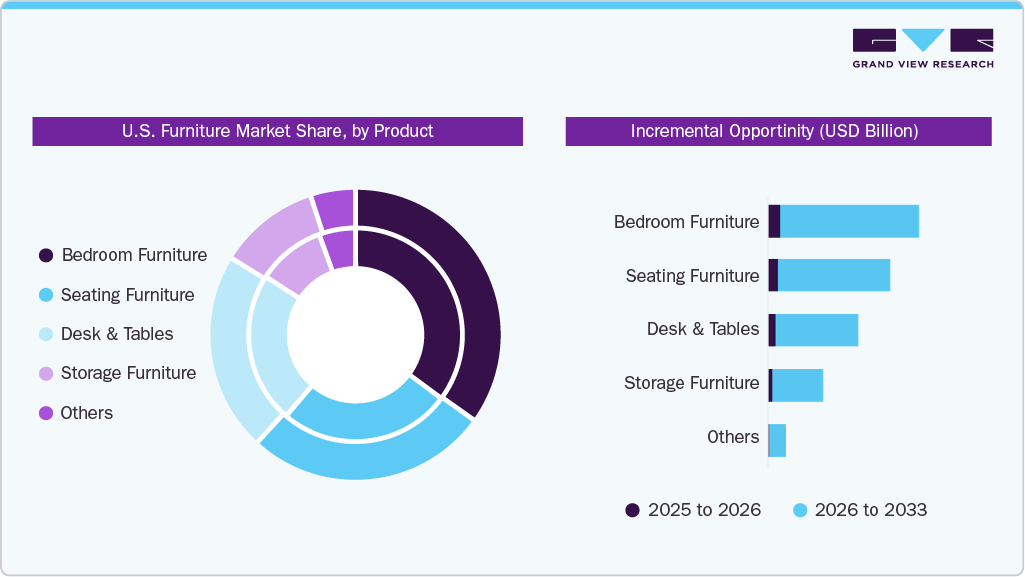
A primary factor contributing to this market expansion is the rise in disposable income among U.S. consumers. With greater financial means, people are more willing to spend on durable, high-quality, and visually appealing bedroom furniture. Additionally, increasing urbanization and shrinking living spaces have boosted the need for versatile, space-efficient furniture. Shoppers are now prioritizing items that fulfill multiple functions while elevating the look of their bedrooms. Manufacturers focus on innovative designs that blend practicality with modern aesthetics. For instance, Burrow is a U.S.-based furniture company known for its modular and space-saving designs tailored to urban lifestyles.
Demand for storage furniture is projected to rise at a CAGR of 7.5% from 2026 to 2033. As living spaces in urban areas become more compact, demand for space-saving, multifunctional, and efficient furniture is rising. Post-pandemic, consumers increasingly invest in home upgrades, and storage furniture provides a cost-effective solution to enhance interior spaces. Moreover, integrating smart technology into entertainment units and shelving, along with a growing focus on sustainability, DIY projects, and eco-friendly choices, significantly influences buying decisions. Ashley Furniture, one of the largest U.S. furniture manufacturers and retailers, offers a variety of storage-centric pieces like beds with drawers, lift-top coffee tables, and TV stands with built-in shelving. Focusing on urban and suburban homes, the brand focuses on stylish, functional, and affordable designs, including compact, space-saving options made with sustainable materials to attract eco-conscious buyers.
Material Insights
The wooden furniture held the share of 39.26% in 2025, due to its timeless aesthetic, durability, and versatility. Consumers value its natural beauty, long-lasting quality, and ability to fit a range of traditional and modern interior styles. With rising eco-consciousness, sustainably sourced wood is also preferred for its lower environmental impact than synthetic materials. Bassett Furniture Industries is a U.S.-based company known for its high-quality, customizable wood furniture. It offers a wide range of durable, American-made pieces using sustainably sourced wood.
The demand for plastic furniture is projected to rise at a CAGR of 7.2% from 2026 to 2033. The U.S. furniture market is experiencing rapid growth due to the rising demand for affordable designer furniture. Additionally, the growing preference for high-performance plastic materials is expected to boost market expansion further in the coming years. Manufacturers are introducing innovative and stylish plastic furniture to capitalize on this trend, driving significant industry growth throughout the forecast period.
Application Insights
The residential segment contributed to the largest revenue share of 60.21% in 2025. The residential segment is expected to witness significant growth during the forecast period, driven by rising demand for living room and bedroom furniture alongside a surge in real estate construction, particularly in urban areas, supported by government initiatives. In 2024, the U.S. reported approximately 1.47 million housing starts, indicating a strong pace of new residential developments and a corresponding increase in the need for home furnishings.
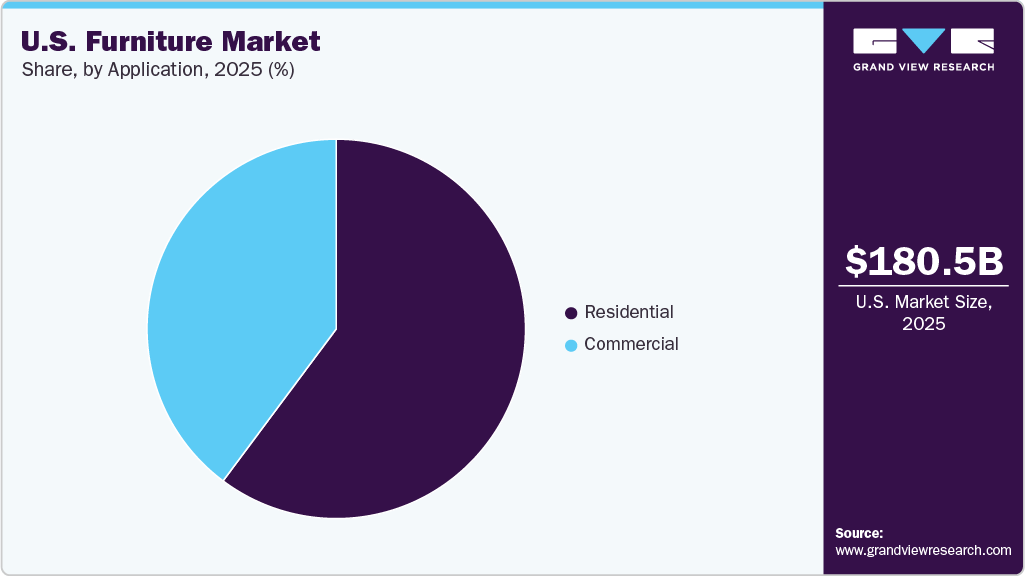
The commercial segment is expected to grow at the fastest CAGR of 6.7% from 2026 to 2033. The rapid rise in commercial-grade furniture reflects a broader shift toward flexible, tech-enhanced, and sustainable work environments. Employers increasingly prioritize employee well-being by integrating height-adjustable desks, sensor-equipped workstations, and smart ergonomic chairs into offices. These investments support both comfort and productivity in a hybrid setting.
Key U.S. Furniture Companies:
- Ashley Furniture Industries
- La‑Z‑Boy
- Bassett Furniture Industries
- Steelcase Inc.
- Haworth Inc.
- MillerKnoll company
- HNI Corporation
- Sauder Woodworking Co.
- Flexsteel Industries
- L. & J.G. Stickley
Recent Developments
-
In December 2025, Rutherford Home Furnishings partnered with KOUCH to introduce furniture with built-in immersive sound technology. The collaboration will allow KOUCH’s audio-integrated sofas and chairs to be distributed through Rutherford’s retail network. The partnership aims to combine home entertainment technology with modern furniture design, offering consumers a more integrated living room experience.
-
In September 2025, Ornate Home expanded its operations with the opening of a new showroom and distribution center in Charlotte, North Carolina. The facility will showcase a variety of furniture products while strengthening the company’s logistics and delivery capabilities across the eastern United States. The expansion is expected to improve product availability and enable faster delivery for customers in the region.
-
In July 2025, Wayfair continued its expansion into physical retail with plans to open a new large-format store in Denver, Colorado, scheduled for late 2026. The approximately 140,000-square-foot location will mark the company’s entry into the Mountain West region and is designed to offer an immersive shopping experience where customers can explore furniture, décor, and home products in person. The store reflects Wayfair’s strategy to complement its strong e-commerce presence with physical retail spaces that let customers experience products firsthand while integrating online ordering and delivery services.
U.S. Furniture Market Report Scope
Report Attribute
Details
Market size value in 2026
USD 189.74 billion
Revenue forecast in 2033
USD 292.26 billion
Growth rate
CAGR of 6.4% from 2026 to 2033
Actuals
2021 - 2025
Forecast period
2026 - 2033
Quantitative units
Revenue in USD billion and CAGR from 2026 to 2033
Report coverage
Revenue forecast, company ranking, competitive landscape, growth factors, and trends
Segments covered
Product, material, application
Country scope
U.S.
Key companies profiled
Ashley Furniture Industries; La‑Z‑Boy; Bassett Furniture Industries; Steelcase Inc.; Haworth Inc.; MillerKnoll company; HNI Corporation; Sauder Woodworking Co.; Flexsteel Industries; L. & J.G. Stickley
Customization
Free report customization (equivalent up to 8 analysts working days) with purchase. Addition or alteration to country, regional & segment scope.
Pricing and purchase options
Avail customized purchase options to meet your exact research needs. Explore purchase options
U.S. Furniture Market Report Segmentation
This report forecasts revenue growth at the country level and provides an analysis of the latest industry trends and opportunities in each of the sub-segments from 2021 to 2033. For this study, Grand View Research has segmented the U.S. furniture market report by product, material, and application:
-
Product Outlook (Revenue, USD Billion, 2021 - 2033)
-
Bedroom Furniture
-
Mattresses
-
Beds
-
Nightstands
-
-
Seating furniture
-
Chairs
-
Sofa & couches
-
Others ( lounges & recliners, etc.)
-
-
Storage furniture
-
Wardrobes & Dressers
-
Cabinets & Shelves
-
TV Stands/Entertainment Units
-
Others (Drawers, Chests, etc.)
-
-
Desk and Tables
-
Others
-
-
Material Outlook (Revenue, USD Billion, 2021 - 2033)
-
Metal
-
Wood
-
Plastic
-
Glass
-
Others
-
-
Application Outlook (Revenue, USD Billion, 2021 - 2033)
-
Residential
-
Commercial
-
Frequently Asked Questions About This Report
b. Some of the key players in the U.S. furniture market is - Ashley Furniture Industries; La‑Z‑Boy; Bassett Furniture Industries; Steelcase Inc.; Haworth Inc.; MillerKnoll company; HNI Corporation; Sauder Woodworking Co.; Flexsteel Industries; L. & J.G. Stickley.
b. The U.S. furniture industry is evolving due to changing market dynamics and consumer preferences. Manufacturers are turning to recycled materials and eco-friendly production methods as sustainability becomes a priority. At the same time, demand is growing for multifunctional, modular, and tech-integrated designs that save space and offer affordability.
b. The U.S. furniture market was estimated at USD 180.55 billion in 2025 and is expected to reach USD 189.74 billion in 2026.
b. The U.S. furniture market is expected to grow at a compound annual growth rate of 6.4% from 2025 to 2033 to reach USD 292.26 billion by 2033.
b. The bedroom furniture accounted for a share of about 35.16% of the U.S. furniture market in 2025. The U.S. bedroom furniture market is expected to grow steadily, fueled by increasing consumer demand for quality, functionality, sustainability, and personalized designs.


Share this report with your colleague or friend.
Need a Tailored Report?
Customize this report to your needs — add regions, segments, or data points, with 20% free customization.


ISO 9001:2015 & 27001:2022 Certified
We are GDPR and CCPA compliant! Your transaction & personal information is safe and secure. For more details, please read our privacy policy.
Trusted market insights - try a free sample
See how our reports are structured and why industry leaders rely on Grand View Research. Get a free sample or ask us to tailor this report to your needs.