- Home
- »
- Drilling & Extraction Equipments
- »
-
U.S. Froth Flotation Chemicals Market, Industry Report, 2033GVR Report cover
![U.S. Froth Flotation Chemicals Market Size, Share & Trends Report]()
U.S. Froth Flotation Chemicals Market (2025 - 2033) Size, Share & Trends Analysis Report By Product (Collectors, Frothers, Modifiers, Other Reagent Types), By End Use (Mining, Pulp & Paper, Other End Uses), And Segment Forecasts
- Report ID: GVR-4-68040-641-0
- Number of Report Pages: 80
- Format: PDF
- Historical Range: 2018 - 2023
- Forecast Period: 2025 - 2033
- Industry: Bulk Chemicals
- Report Summary
- Table of Contents
- Segmentation
- Methodology
- Download FREE Sample
-
 Download Sample Report
U.S. Froth Flotation Chemicals Market Summary
The U.S. froth flotation chemicals market size was valued at USD 286.7 million in 2024 and is projected to reach USD 379.5 million by 2033, growing at a CAGR of 3.1% from 2025 to 2033. The growth is attributed to strong demand from its mining industry, especially for copper, gold, molybdenum, and rare earth elements.
Key Market Trends & Insights
- The U.S. froth flotation chemicals market is projected to grow at a CAGR of 3.1% from 2025 to 2033.
- By product, the frothers product in the froth flotation chemicals market is expected to witness the fastest growth of 3.5% from 2025 to 2033.
- By end use, mining dominated the market with a revenue share of 40.2% in 2024.
Market Size & Forecast
- 2024 Market Size: USD 286.7 Million
- 2033 Projected Market Size: USD 379.5 Million
- CAGR (2025-2033): 3.1%
These ores require efficient beneficiation, with froth flotation being the preferred method due to its selectivity and effectiveness. Common reagents include xanthates and dithiophosphates as collectors, MIBC and PPG-based compounds as frothers, and depressants such as sodium silicate and metabisulfite. Similarly, activators such as copper sulfate are also used to enhance mineral recovery. As the U.S. prioritizes domestic mineral production and clean energy infrastructure, the need for advanced flotation chemicals continues to grow.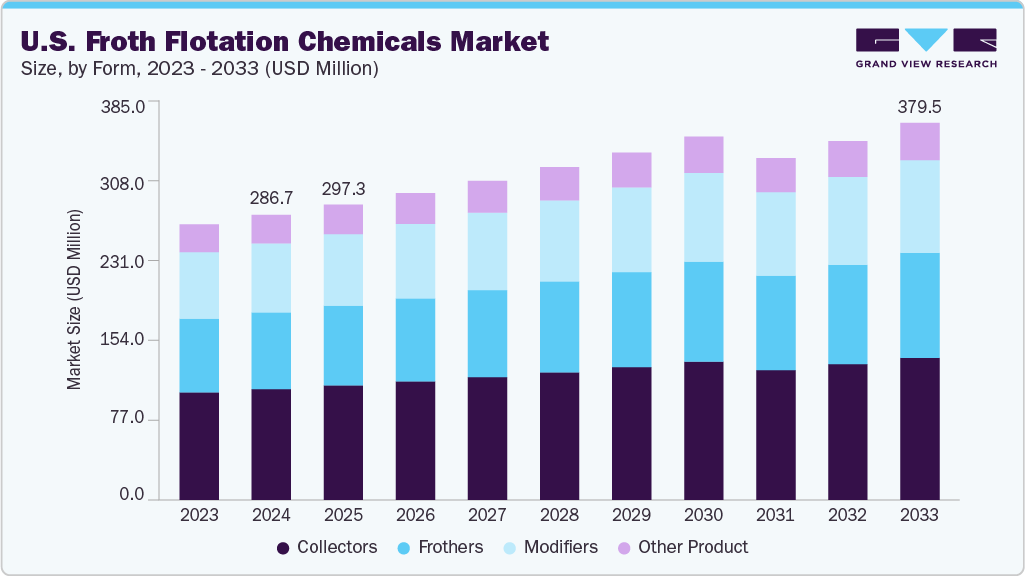
In the U.S. gold mining industry, froth flotation is a widely adopted method, especially in operations where gold is finely disseminated in sulfide ores. Mines utilize flotation circuits to enhance gold recovery from complex ores containing pyrite and arsenopyrite. In such operations, collectors like potassium amyl xanthate (PAX) render gold-bearing sulfide particles hydrophobic, improving their ability to adhere to air bubbles. Frothers such as Methyl Isobutyl Carbinol (MIBC) create a stable froth layer, allowing the gold-loaded bubbles to rise and be skimmed efficiently. These reagents help maximize gold yield even from low-grade ores previously considered uneconomical to process. In these cases, flotation concentrates gold while removing carbonaceous material that would otherwise consume cyanide. The adoption of froth flotation chemicals significantly boosted recovery rates, supporting the U.S. market’s ongoing shift toward higher process efficiency and sustainability in mineral extraction.
The market demand for collectors and depressants based on froth flotation chemicals is growing steadily, as is the demand for rare earth elements (REEs), particularly for deposits in carbonatites and alkaline igneous rocks., due to their use in defense, electronics, and green technologies, flotation chemicals are critical for selectively separating REEs from complex ores. Common reagents include hydroxamic and fatty acids as collectors and sodium silicate or oxalic acid as depressants. The strategic importance of REEs and U.S. supply concerns drive increased investment in flotation-based extraction chemicals.
The paper and metal recycling-based froth flotation chemicals demand is increasing steadily across the U.S. In paper recycling, flotation is crucial for deinking wastepaper to produce high-quality recycled pulp in packaging and printing. The growing demand for eco-friendly paper products, especially amid plastic ban and corporate ESG commitments, is driving the need for flotation chemicals like fatty acids, surfactants, and pH modifiers. Additionally, in metal recycling, froth flotation helps recover valuable non-ferrous metals like copper, zinc, and aluminum from scrap and e-waste. With government initiatives such as the Inflation Reduction Act promoting circular manufacturing, flotation reagents, such as xanthates, MIBC, and copper sulfate, are in high demand. The trend toward sustainable materials and urban mining positions flotation chemicals as critical enablers in the U.S. recycling economy.
However, in the froth flotation chemicals market, issues with the selectivity of chemical interactions make it harder to achieve clean separation of materials. As a result, recovery rates may decline, and recycling or beneficiation operations face higher complexity and operational costs.
Market Concentration & Characteristics
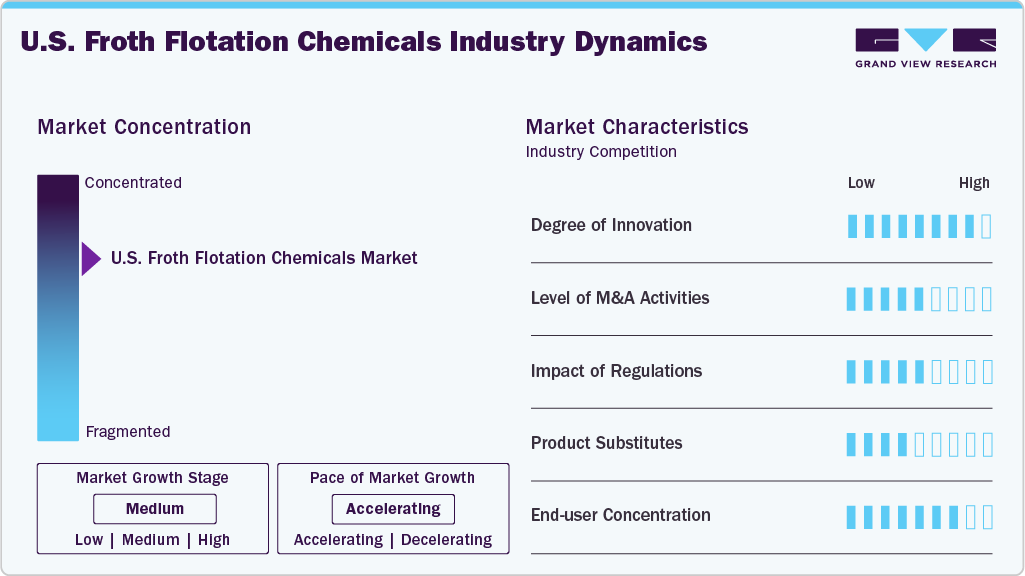
The U.S. froth flotation chemicals market is concentrated, comprising a combination of global corporations and domestic leaders. These players cater primarily to the mining and mineral processing sectors and extend their expertise to growing fields such as paper recycling, wastewater treatment, and industrial waste management. The competition is intensified by increasing customer demand for performance-optimized and application-specific reagents that can operate effectively across diverse ore types and recycling feedstock.
The rapid transition toward eco-friendly, biodegradable, and low-toxicity flotation chemicals is a major trend shaping the U.S. market. This shift is driven by stricter environmental regulations from agencies like the EPA and pressure from mining and industrial clients to reduce ecological impact without sacrificing recovery efficiency. As a result, innovation focuses on developing sustainable reagents that offer improved selectivity and lower environmental footprint, especially for use in sensitive applications like urban mining, e-waste processing, and closed-loop recycling systems. This green innovation trend is becoming a key competitive differentiator among U.S. flotation chemical suppliers.
A significant threat facing the froth flotation chemical market in the U.S. is the escalating demand for environmentally friendly alternatives, driven by stricter regulations and heightened environmental awareness. This trend includes the potential replacement of conventional synthetic surfactants with bio-based or greener flotation chemicals, compelling manufacturers to innovate and adapt to more sustainable formulations.
Product Insights
Collectors-based chemicals dominated the froth flotation chemicals market with a market share of 38.9% in 2024. The growth is attributed to strong demand for custom-formulated flotation collectors tailored to maximize the grade and recovery of industrial minerals, reflecting the need for high selectivity and efficiency in mineral processing. Both simple nonionic and more complex anionic and cationic collectors are sought after, as they enable precise control over mineral surface properties and enhance hydrophobicity, which is crucial for effective froth flotation. There is a particular emphasis on collectors that can be optimized for specific ore bodies and process conditions, supporting the diverse requirements of the industrial minerals sector. The ability to provide collectors that function effectively through chemisorption or physical adsorption and maintain performance under varying operational conditions further drives market demand. As U.S. mining and industrial mineral production grows, the need for advanced, adaptable collector reagents remains a key factor in the froth flotation chemical market.
Frothers-based froth flotation chemicals market products are the fastest growing market with a CAGR of 3.5% for their high demand frother reagents with balanced hydrophilic-lipophilic properties that stabilize froth and optimize bubble dynamics for efficient mineral separation. Effective frothers must provide stable yet easily removable froth, adaptable to diverse ore types and water qualities. Demand favors cost-effective, non-ionizing organic surfactants that enhance flotation kinetics and recovery, with dosage control critical to maintaining froth quality and process efficiency. Customizable frother blends tailored to specific mineral processing conditions are increasingly sought to maximize flotation performance.
End Use Insights
Mining end uses dominated the froth flotation chemicals market with a market share of 40.2% due to Methyl Isobutyl Carbinol (MIBC) frother-based froth flotation chemicals widely preferred for extracting copper, molybdenum sulfide, and coal. It enhances mineral recovery and concentrates grade by improving froth formation and separation efficiency. Research comparing MIBC with other frothers confirmed its superior performance in copper ore flotation. As demand for harder-to-extract ores grows, MIBC's role becomes increasingly critical, with ongoing innovations focused on improving its safety and environmental profile for sustainable mining operations.
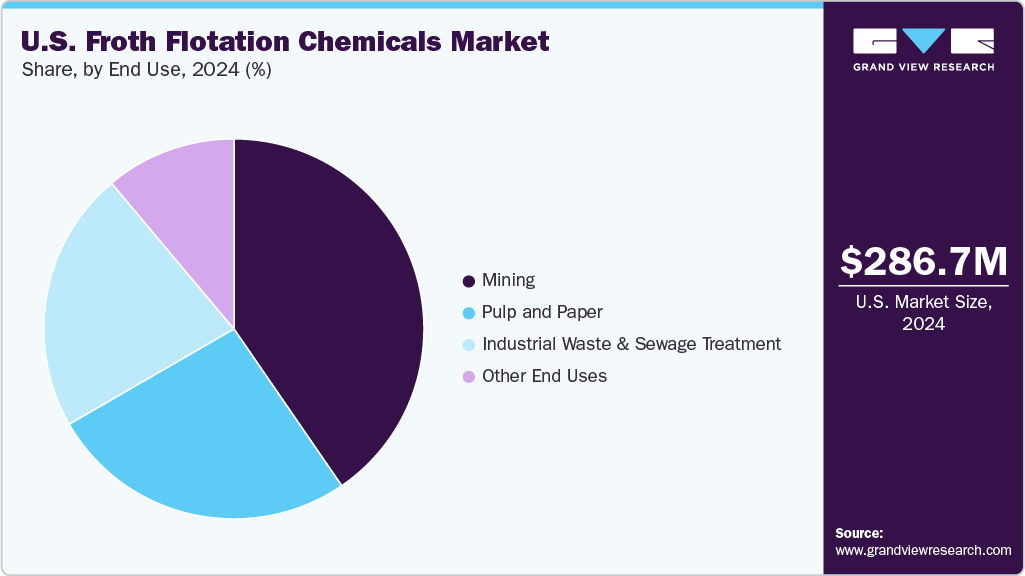
Pulp and paper end uses are the fastest growing segment with a CAGR of 3.4% during the forecast period. The growth is attributed to the growing application in paper making and deinking. In papermaking, white water contains fibers and additives such as rosin size, glue, casein, clay, mineral fillers, and pigments. Discharging this water leads not only to environmental pollution but also to the loss of valuable raw materials. Flotation provides an effective method for recovering these components, reducing waste, and enhancing resource efficiency. Additionally, flotation is widely used for removing ink, ink-coated fibers, and pigments from pulps derived from recycled paper. High-quality waste paper, such as writing and printing grades, typically contains clay, calcium carbonate, and adhesives bonded to a cellulose base. In deinking flotation, the primary objective is to reclaim the cellulose fibers while efficiently removing contaminants.
Key U.S. Froth Flotation Chemicals Company Insights
Some of the key players operating in the froth flotation chemicals market include Dow and BASF
-
Dow, a U.S.-based chemical leader headquartered in Midland, Michigan, is a dominant and mature player in the froth flotation chemicals market. The company offers a robust range of frothers, collectors, and modifiers for mineral beneficiation processes. The company draws on its core surfactant science, process chemistry, and material innovation competencies to deliver flotation reagents that improve metal recovery, energy efficiency, and process stability across diverse ore types. With a R&D infrastructure and strong backward integration in chemical intermediates, Dow ensures reliable supply chains and customized reagent solutions. Its focus on sustainable chemistry and process optimization enables mining operations to reduce water and reagent consumption, align with ESG targets, and enhance productivity. By partnering with mining companies and technology providers, Dow continues to advance digital integration and circular economy initiatives, reinforcing its position as a key enabler of next-generation, environmentally responsible flotation systems worldwide.
Chevron Phillips Chemical Company LLC and Evonik Industries AG are an emerging market participant in the froth flotation chemicals market.
-
Chevron Phillips Chemical Company LLC, U.S.-based and headquartered in The Woodlands, Texas, has emerged as a noteworthy niche player in the froth flotation chemicals market, primarily through its specialty chemicals portfolio tailored for mineral processing applications. Drawing from its olefins, polyolefins, and aromatics strengths, the company produces flotation reagents, particularly collectors, frothers, and modifiers, that enhance recovery efficiency, froth stability, and process selectivity. With a strategic emphasis on quality control and technical support, Chevron Phillips ensures consistent product performance and reliability for processors dealing with variable ore types. The company’s global manufacturing footprint, supported by R&D and technology centers, facilitates robust supply chains and regional customization. Chevron Phillips also displays a growing commitment to sustainability, investing in chemical innovations that reduce environmental impact and align with ESG objectives in the mining industry. Through this approach, it is steadily strengthening its presence, positioning itself as a trusted partner for mining operators seeking efficient, eco-conscious flotation solutions.
Key U.S. Froth Flotation Chemicals Companies:
- Huntsman International LLC.
- Chevron Phillips Chemical Company LLC.
- Dow
- Akzo Nobel N.V.
- Solvay
- Clariant
- BASF
- Evonik Industries AG
- Orica Limited.
- Ecolab
- Solenis
- Arkema
Recent Developments
-
In October 2022, Solvay launched SmartFloat, an industry-first AI-powered reagent optimization system to improve froth flotation performance in the mining sector. Designed to enhance operational efficiency, recovery rates, and sustainability, SmartFloat leverages real-time data to recommend optimal reagent types and dosages based on ore characteristics. This helps operators respond quickly to ore variability, reduce reagent consumption, and improve metal yield. SmartFloat complements existing technologies like the Solvay Cube and builds on the company's Flotation Matrix 100 methodology. It offers a user-friendly interface tailored for rugged mining conditions, facilitating automation and better decision-making. Currently being adopted in copper and copper-gold processing plants, the system reflects a growing trend toward digital transformation and smart process control in froth flotation.
-
In February 2024, Orica's acquisition of U.S.-based Cyanco for USD 640 million significantly strengthened its position in the mining chemicals market, particularly in sodium cyanide, a key reagent in gold extraction and froth flotation processes. This move more than doubled Orica’s production capacity and expanded its presence in North America, enhancing its integrated global supply network. The acquisition reflects rising global demand for flotation chemicals driven by lower ore grades and increased gold mining activity.
U.S. Froth Flotation Chemicals Market Report Scope
Report Attribute
Details
Market size value in 2025
USD 297.3 million
Revenue forecast in 2033
USD 379.5 million
Growth rate
CAGR of 3.1% from 2025 to 2033
Base year for estimation
2024
Historical data
2018 - 2023
Forecast period
2025 - 2033
Quantitative units
Revenue in USD million/billion, Volume in Kilotons, and CAGR from 2025 to 2033
Report coverage
Revenue forecast, company ranking, competitive landscape, growth factors, and trends
Segments covered
Product, end use, region
Key companies profiled
Huntsman International LLC.; Chevron Phillips Chemical Company LLC.; Dow; Akzo Nobel N.V.; Solvay; Clariant; BASF; Evonik Industries AG; Orica Limited.; Ecolab; Solenis; Arkema
Customization scope
Free report customization (equivalent to up to 8 analysts’ working days) with purchase. Addition or alteration to country, regional & segment scope.
Pricing and purchase options
Avail customized purchase options to meet your exact research needs. Explore purchase options
U.S. Froth Flotation Chemicals Market Report Segmentation
This report forecasts revenue growth at U.S., regional, and country levels and provides an analysis of the latest industry trends in each of the sub-segments from 2018 to 2033. For this study, Grand View Research has segmented the U.S. Froth Flotation Chemicals market report based on product, end use, and region:
-
Product Outlook (Revenue, USD Million; Volume, Kilotons, 2018 - 2033)
-
Collectors
-
Frothers
-
Modifiers
-
Other Product
-
-
End Use Outlook (Revenue, USD Million; Volume, Kilotons, 2018 - 2033)
-
Mining
-
Pulp and Paper
-
Industrial Waste and Sewage Treatment
-
Other End Uses
-
Frequently Asked Questions About This Report
b. The U.S. froth flotation chemicals market size was estimated at USD 286.7 million in 2024 and is expected to reach USD 297.3 million in 2025.
b. The U.S. froth flotation chemicals market is expected to grow at a compound annual growth rate of 3.1% from 2025 to 2033 to reach USD 379.5 million by 2033.
b. The mining segment led the market and accounted for the largest revenue share of 40.2% in 2024, driven by froth flotation chemicals widely preferred for extracting copper, molybdenum sulfide, and coal.
b. Some of the key players operating in the froth flotation chemicals market include Huntsman International LLC., Chevron Phillips Chemical Company LLC., Dow, Akzo Nobel N.V., Solvay, Clariant, BASF, Evonik Industries AG, Orica Limited., Ecolab, Solenis, Arkema.
b. The growth is attributed to froth flotation chemicals’s strong demand from its mining industry, especially for copper, gold, molybdenum, and rare earth elements.


Share this report with your colleague or friend.
Need a Tailored Report?
Customize this report to your needs — add regions, segments, or data points, with 20% free customization.


ISO 9001:2015 & 27001:2022 Certified
We are GDPR and CCPA compliant! Your transaction & personal information is safe and secure. For more details, please read our privacy policy.
Trusted market insights - try a free sample
See how our reports are structured and why industry leaders rely on Grand View Research. Get a free sample or ask us to tailor this report to your needs.