- Home
- »
- Beauty & Personal Care
- »
-
U.S. Beauty And Personal Care Products Market Report, 2033GVR Report cover
![U.S. Beauty And Personal Care Products Market Size, Share & Trends Report]()
U.S. Beauty And Personal Care Products Market (2026 - 2033) Size, Share & Trends Analysis Report By Product (Skin Care, Hair Care, Oral Care, Color Cosmetics, Shower & Bath, Perfume/Fragrances), By End Use, By Distribution Channel, And Segment Forecasts
- Report ID: GVR-4-68040-486-2
- Number of Report Pages: 100
- Format: PDF
- Historical Range: 2021 - 2025
- Forecast Period: 2026 - 2033
- Industry: Consumer Goods
- Report Summary
- Table of Contents
- Segmentation
- Methodology
- Download FREE Sample
-
 Download Sample Report
U.S. Beauty And Personal Care Products Market Summary
The U.S. beauty and personal care products market size was estimated at USD 109.56 billion in 2025 and is expected to reach USD 196.33 billion by 2033, growing at a CAGR of 7.7% from 2026 to 2033. An increased emphasis on self-care, wellness, and product quality is driving consumers toward premium beauty and personal care solutions, particularly in the skincare, color cosmetics, and hair care segments, reinforcing growth across the premium beauty and personal care products market.
Key Market Trends & Insights
- By product, skincare accounted for a market share of 32.5% in 2025.
- By end use, women accounted for a market share of 66.1% in 2025.
- By distribution channel, sales through hypermarkets & supermarkets accounted for a market share of 34.1% in 2025.
Market Size & Forecast
- 2025 Market Size: USD 109.56 Billion
- 2033 Projected Market Size: USD 196.33 Billion
- CAGR (2026-2033): 7.7%
There is an increasing demand for clean beauty offerings that are free from harmful chemicals and sourced sustainably, leading to the rise of eco-conscious brands within the natural personal care products market and the organic personal care products market. The rise of digital platforms and social media has played a pivotal role in driving demand, as women are exposed to a wide range of beauty products and trends through influencers, tutorials, and targeted advertising, accelerating brand discovery across the premium beauty and personal care products market.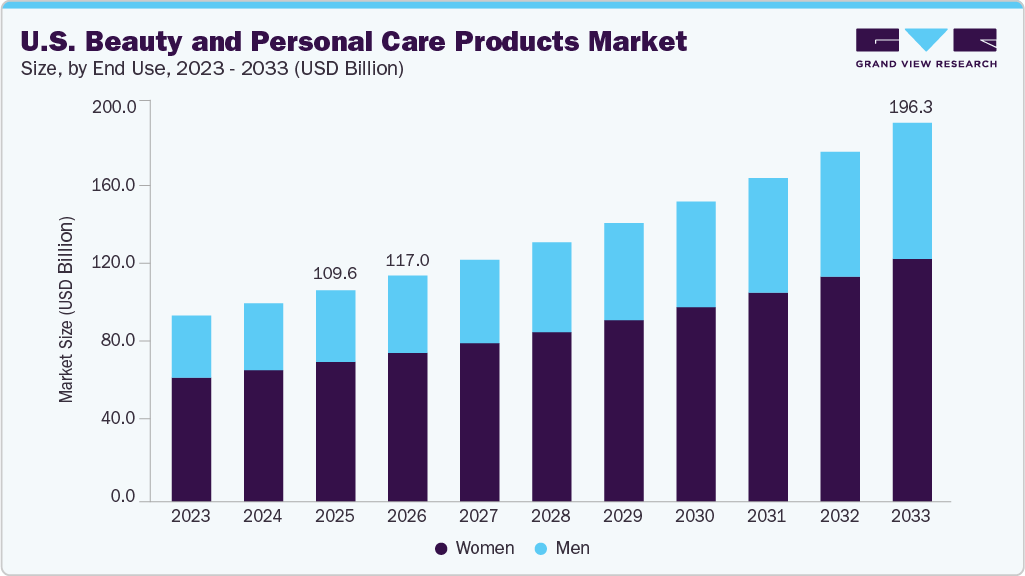
American consumers are increasingly aware of what goes into their products and are actively choosing cosmetics that are natural, organic, vegan, cruelty-free, and dermatologically tested. This shift toward ethical and sustainable beauty is encouraging brands to reformulate products, source responsibly, and highlight transparency in labeling, strengthening momentum in the natural personal care products market and the organic personal care products market. Hybrid beauty, where makeup delivers skincare benefits, is also gaining traction as consumers prefer multifunctional, time-saving solutions.
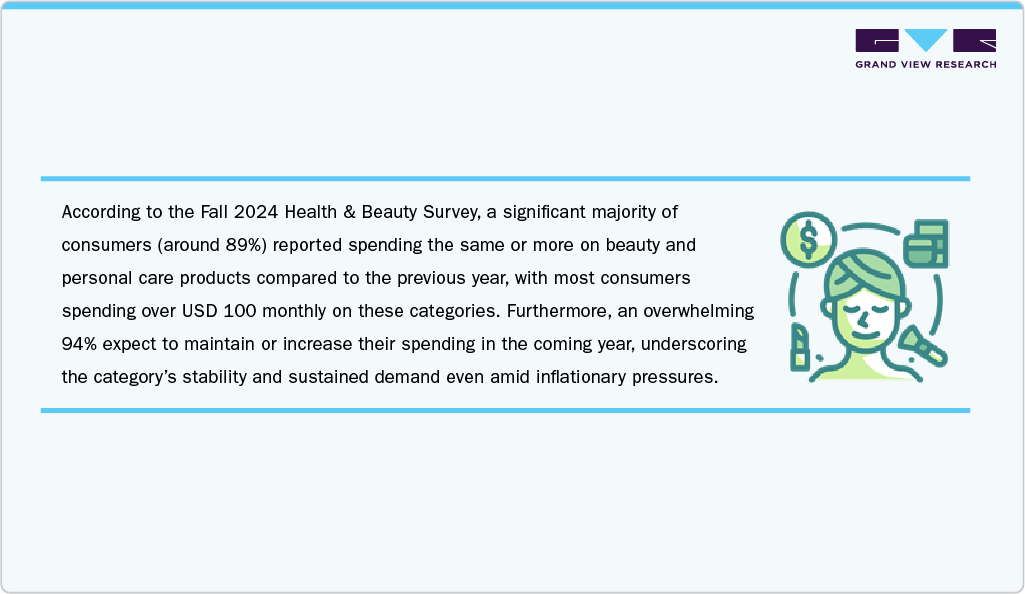
Notably, skincare and hair care represent the largest spending categories, each accounting for approximately 30% of total beauty expenditures. This heightened consumer investment is further underscored by a willingness to prioritize beauty purchases over other expenditures, with 35% of Americans and notably 52% of millennials and 50% of Gen Z indicating they would cut back on other costs to allocate more towards beauty products. This strong spending propensity, especially among younger generations, is expected to drive the continued expansion of the premium beauty and personal care products market, supporting product innovation and the broadening of offerings across skincare, hair care, and other categories.
Additionally, the aging population is significantly influencing demand, with consumers seeking anti-aging, skin-repair, and rejuvenation products that address fine lines, pigmentation, and elasticity loss, further accelerating innovation in targeted skincare and hybrid makeup that combines cosmetic coverage with functional skincare benefits across the natural personal care products market.
The clean beauty and cruelty-free trend has gained significant traction within the U.S. beauty and personal care products market, reflecting a broader consumer shift toward ethical and environmentally responsible practices. This trend is characterized by the formulation of products that prioritize natural, non-toxic ingredients and the avoidance of harmful chemicals, aligning closely with the organic personal care products market. Moreover, the cruelty-free aspect aligns with heightened ethical considerations, as consumers increasingly prefer products that are not tested on animals. Regulatory changes and advocacy for animal rights have catalyzed this shift, leading to an expanding array of brands that eschew animal testing.
Furthermore, the men’s grooming segment is rapidly expanding as male consumers adopt more sophisticated skincare and grooming routines, showing strong interest in beard care, anti-aging, and skin-enhancing products, reinforcing growth in the men’s personal care products market. The influence of Asian beauty philosophies continues to accelerate global trends, with the k-beauty products market emphasizing gentle formulations, layered skincare routines, innovative textures, and science-backed ingredients, shaping product development strategies across Western markets.
The rise of e-commerce has facilitated the growth of direct-to-consumer (D2C) business models, allowing brands to bypass traditional retail intermediaries. This not only enhances profit margins but also enables brands to maintain direct control over customer interactions, brand messaging, and product offerings, thereby fostering stronger brand loyalty across the premium beauty and personal care products market, the men’s personal care products market, and the broader natural personal care products market.
The U.S. beauty market continues to expand robustly across multiple categories, driven by evolving consumer preferences for clean, multifunctional, and ethically formulated products. Within this landscape, the U.S. cleanser and facewash market has seen sustained demand as consumers increasingly prioritize effective yet gentle daily routines that remove impurities while supporting skin health, with products incorporating natural botanicals, niacinamide, and exfoliating acids rising in popularity. At the same time, the U.S. color cosmetics market remains a dynamic and growing segment, with foundations, concealers, and hybrid makeup-skincare formulations (such as tinted moisturizers and multifunctional primers) gaining traction; brands are reformulating classics like Studio Fix foundations to offer broader shade ranges and skincare benefits that align with consumer expectations for inclusivity and performance.
Beyond skin care and makeup, other categories of beauty are also evolving rapidly. The U.S. oral care products market is being influenced by trends toward holistic wellness, with toothpaste systems and whitening formulas infused with natural extracts and probiotic or enamel-strengthening technology appealing to health-conscious buyers. Similarly, the U.S. hair care products market is drawing attention to ingredient-driven innovations, from bond-strengthening complexes and plant-derived actives to sustainable formulations, as exemplified by relaunches and expanded collections that address specific hair concerns, such as damage repair and scalp health. These trends reflect a broader transformation of the U.S. beauty landscape, where ingredient transparency, multifunctionality, and consumer education underpin product launches and brand growth across cleansers and facewashes, color cosmetics, oral care, and hair care categories.
Brand Market Share Insights
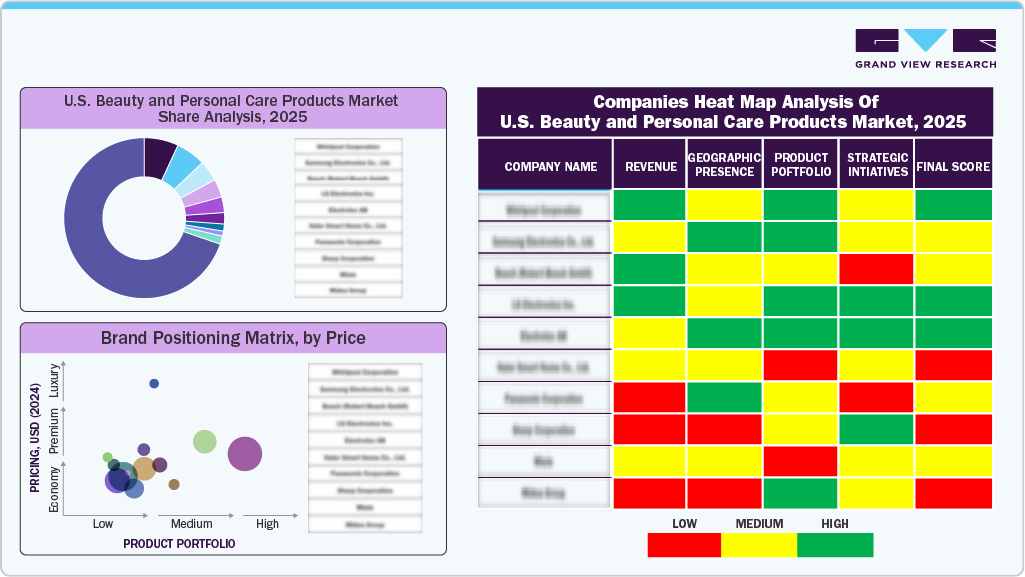
The U.S. beauty and personal care products market is characterized by a dynamic and highly competitive landscape, driven by both established global brands and innovative emerging players. Major brands leverage strong brand equity, extensive distribution networks, and significant marketing budgets to maintain substantial market shares, while continuously adapting to shifting consumer preferences through product innovation and sustainability initiatives. Companies like L’Oréal, Procter & Gamble, and Estée Lauder dominate multiple categories, utilizing advanced R&D capabilities and frequent product launches to address diverse consumer needs, from premium skincare to mass-market cosmetics.
Consumer Insights
According to the 2024 Bread Financial and Ulta Beauty study of nearly 1,850 U.S. adults, 74 % of respondents said they prioritized self-care and wellness within their beauty rituals, with Gen Z and Millennials especially likely to view routines as sources of joy and identity expression. Nearly half (46 %) of consumers reported using beauty products to bring happiness and calm into their lives, while roughly one-third (34 %) see these routines as ways to express personal style. Evening skincare and soothing practices such as face masks or bath soaks are also valued relaxation moments, particularly among younger cohorts. Social elements are shaping habits too: 47 % seek advice from friends on beauty and grooming, and 29 % enjoy shared beauty routines with peers, reflecting a trend where personal care becomes a communal and lifestyle-oriented activity.
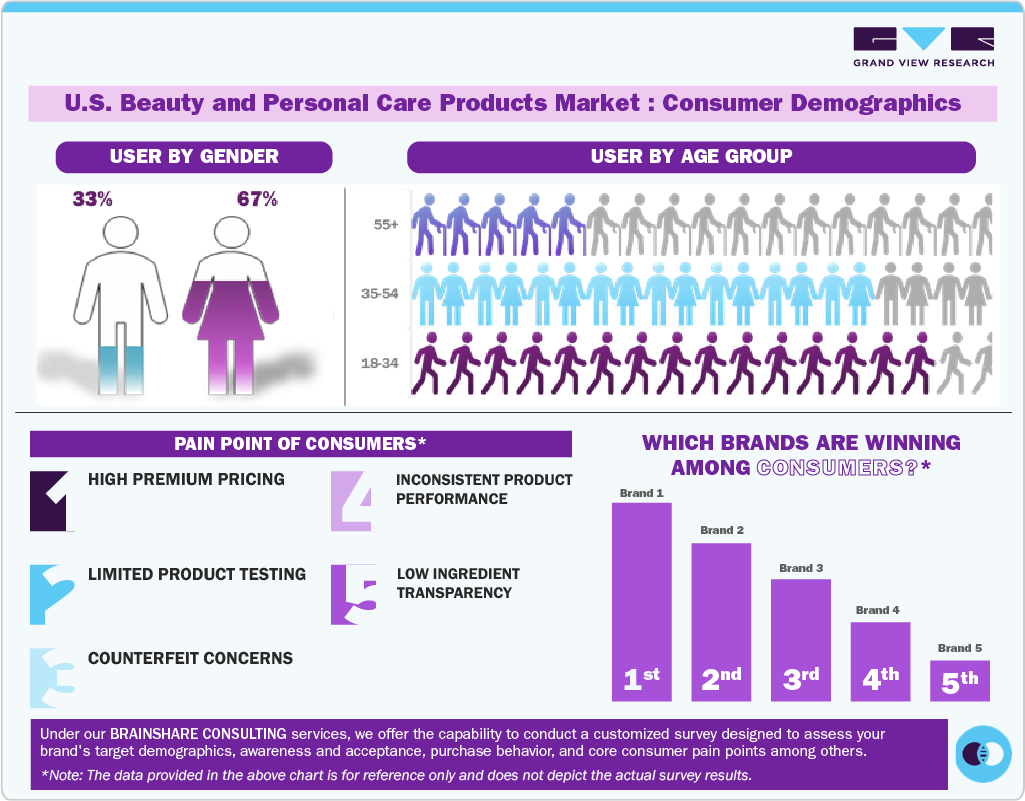
Spending behaviors in the U.S. also show important shifts, with men now outspending women on beauty and grooming products, averaging about USD 90 per month versus women’s ~USD 80, and categories like haircare, skincare, bath & body, and fragrance ranking as top interests. Despite broader economic caution, this resilience underscores consumer willingness to invest in products that deliver both sensory enjoyment and confidence-related benefits. The survey further suggests that consumers remain value-driven, often seeking deals and loyalty-reward incentives to stretch beauty budgets while continuing to explore the category.
Product Insights
The skincare products segment dominated the U.S. beauty and personal care products industry, accounting for a revenue share of 32.5% in 2025. The demand for facial skincare products in the U.S. is on an upward trajectory, propelled by a heightened consumer focus on self-care, wellness, and preventive skincare routines. An increasing awareness of skin health, combined with rising concerns around aging, pollution, and environmental stressors, has led more consumers to invest in targeted facial skincare products that address specific concerns such as hydration, anti-aging, and sun protection. Additionally, the widespread influence of social media, beauty influencers, and dermatological advice readily accessible online has made skincare education more prevalent, further driving demand.
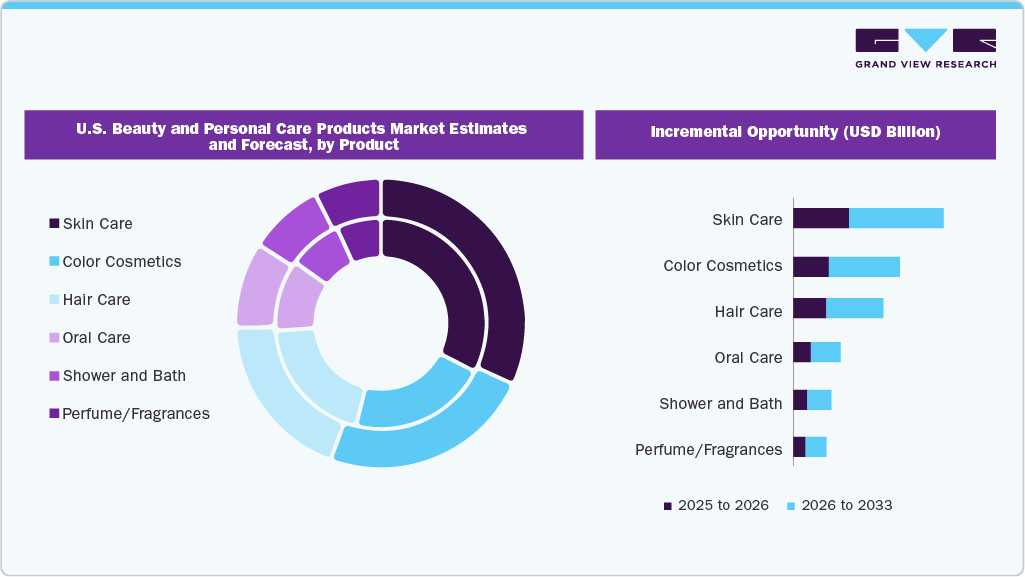
The demand for color cosmetics is anticipated to grow at a CAGR of 9.2% from 2026 to 2033. The shift towards hybrid beauty products, cosmetics that combine skincare benefits with makeup, has further contributed to the rising demand for face color cosmetics. Many consumers now seek multi-functional products that not only offer coverage and color but also provide additional benefits, such as hydration, sun protection, and anti-aging properties.
The growing emphasis on clean beauty and health-conscious products is also contributing to the increased demand for color cosmetics. As consumers become more mindful of the ingredients in their beauty products, they are seeking color formulations that are free from harmful chemicals and toxins. This shift has led to a rise in the popularity of products such as lipsticks and glosses that are made with natural, organic, and cruelty-free ingredients.
End Use Insights
The demand for beauty and personal care products from women led the U.S. beauty and personal care products industry, accounting for a revenue share of 66.1% in 2025. The demand for beauty products among women is undergoing a transformative shift, heavily shaped by influencer and celebrity-led trends. Prominent figures such as Kylie Jenner, Rihanna, and Selena Gomez have successfully established their beauty lines, Kylie Skin, Fenty Beauty, and Rare Beauty, respectively, demonstrating a growing trend in which celebrities capitalize on their influence to develop personal brands that resonate with consumers and significantly impact market dynamics.
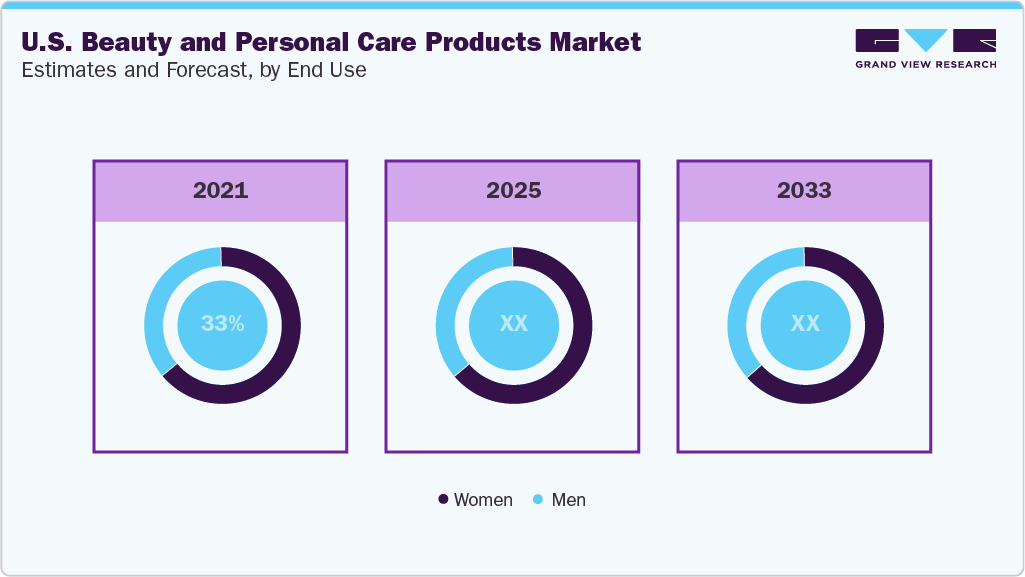
The demand for beauty and personal care products among men is expected to grow at a CAGR of 8.4% from 2026 to 2033. The emergence of male beauty influencers and makeup artists has been instrumental in normalizing and popularizing beauty and personal care products among men. This cultural shift is further propelled by strategic product innovations and robust marketing efforts from leading brands focused on catering to men’s specific skincare and cosmetic needs.
Distribution Channel Insights
The sales of beauty and personal care products through supermarkets and hypermarkets contributed a market share of 34.1% in 2025. The growth in U.S. beauty and personal care product sales through supermarkets and hypermarkets can be attributed to the convenience, variety, and accessibility these stores offer to consumers. With vast shelf space and high foot traffic, these retail formats present a wide range of brands and product types under one roof, simplifying the shopping experience. This approach appeals to consumers seeking efficient, one-stop shopping and aligns with evolving consumer preferences for convenience-driven purchases. Furthermore, supermarkets and hypermarkets have been enhancing their beauty aisles, integrating prominent displays and dedicated sections for high-demand categories like skincare and haircare, thereby elevating in-store visibility and encouraging impulse purchases.
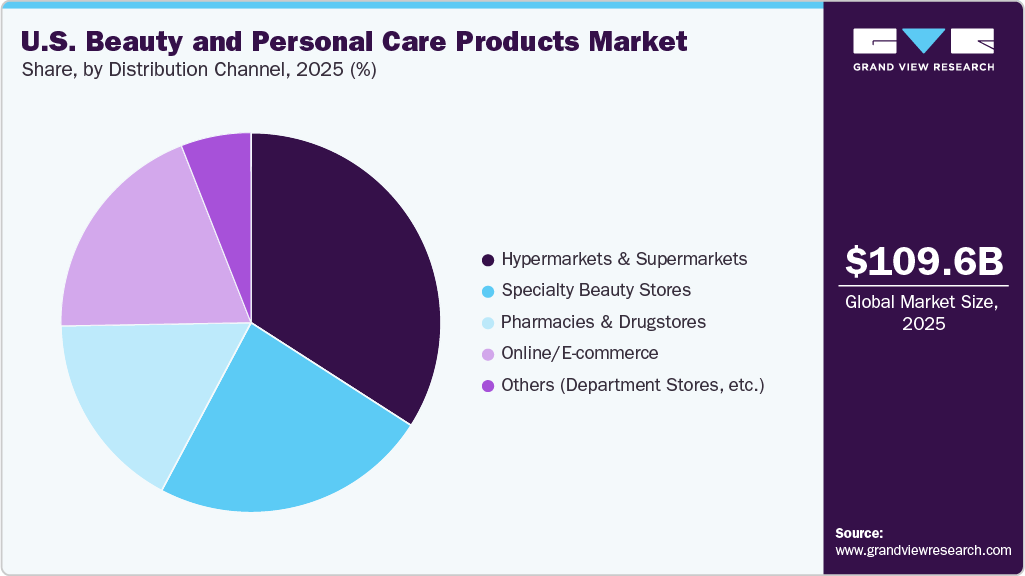
The sales through e-commerce/online platforms channels are expected to grow at a CAGR of 9.3% from 2026 to 2033. The online channel's growth as a preferred platform for beauty and personal care products is primarily driven by its convenience, extensive product selection, and customization options. E-commerce platforms and brand websites offer consumers the flexibility to browse, compare, and purchase products from anywhere, often supported by targeted recommendations and virtual try-on technologies. Enhanced by influencer marketing, online tutorials, and user reviews, online platforms provide a highly engaging shopping experience that appeals especially to younger, tech-savvy consumers. Additionally, many brands have embraced direct-to-consumer models through their websites, offering exclusive online discounts, subscription services, and tailored recommendations, thereby strengthening customer loyalty and increasing online sales.
Key U.S. Beauty And Personal Care Products Companies:
- The Estée Lauder Companies
- L'Oréal S.A.
- Procter & Gamble (P&G) Company
- Unilever plc
- Johnson & Johnson
- Shiseido Co., Ltd.
- Coty Inc.
- Revlon Consumer Products LLC
- Natura&Co
- Kao Corporation
Recent Developments
-
In February 2026, Aurelia Cellular Vitality expanded into the U.S. market with the launch of its ingestible beauty supplement range, bringing its science-led formulations to American consumers for the first time. Backed by H&H Group, the brand introduced multiple products positioned around cellular health and daily beauty support, strengthening its presence in the fast-growing beauty-from-within segment through online retail channels.
-
In January 2026, Sephora announced an exclusive omnichannel partnership with Korean beauty and health retailer CJ Olive Young, starting from fall 2026 in markets like the U.S., Canada, Hong Kong SAR, and parts of Southeast Asia, with more regions to follow in 2027. Olive Young will curate dedicated K-beauty zones in Sephora stores and online, featuring popular and trend-driven Korean brands. At the same time, Sephora contributes its retail footprint, beauty advisors, and digital expertise to scale K-beauty globally and boost its relevance in fast-moving Korean beauty trends.
-
In December 2025, The Estée Lauder Companies announced that Bobbi Brown Cosmetics expanded its online reach by launching on Amazon Premium Beauty in the U.S. The move aimed to strengthen the brand’s digital distribution, improve accessibility to its core makeup assortment, and capture demand from consumers increasingly shopping for prestige beauty products through trusted e-commerce platforms.
-
In September 2025, Gap Inc. announced plans to expand into the beauty category as part of its broader growth strategy, starting with a pilot launch in select Old Navy stores. The initiative introduced a curated range of beauty and personal care products through dedicated in-store spaces, with a phased rollout designed to test consumer response before scaling across additional brands and locations, positioning the company as a more diversified lifestyle retailer.
-
In September 2025, Rhode made its first major retail debut by launching its range of skincare and hybrid makeup products at Sephora stores and online across the U.S. and Canada, moving beyond its earlier direct-to-consumer model. The rollout of the brand’s largest North American launch to date responds to strong consumer interest and sets the stage for further expansion into the U.K. later this year, offering broader access to Rhode’s cult-favorite formulas in brick-and-mortar prestige beauty locations.
-
In June 2024, The Estée Lauder Companies announced the completion of its acquisition of DECIEM Beauty Group Inc. Having secured majority ownership in 2021, Estée Lauder finalized the acquisition of the remaining shares for approximately USD 860 million as of May 31, 2024. Renowned for its flagship brand, The Ordinary, DECIEM significantly enhances The Estée Lauder Companies’ skincare portfolio, reinforcing its position in the prestige skincare segment, particularly in North America and Europe, where DECIEM has achieved notable market leadership.
U.S. Beauty and Personal Care Products MarketReport Scope
Report Attribute
Details
Market size value in 2026
USD 117.05 billion
Revenue forecast in 2033
USD 196.33 billion
Growth rate
CAGR of 7.7% from 2026 to 2033
Actuals
2021 - 2025
Forecast period
2026 - 2033
Quantitative units
Revenue in USD billion and CAGR from 2026 to 2033
Report coverage
Revenue forecast, company ranking, competitive landscape, growth factors, and trends
Segments covered
Product, end use, and distribution channel
Key companies profiled
The Estée Lauder Companies; L'Oréal S.A.; Procter & Gamble (P&G) Company; Unilever plc; Johnson & Johnson; Shiseido Co., Ltd.; Coty Inc.; Revlon Consumer Products LLC; Natura&Co; Kao Corporation
Customization scope
Free report customization (equivalent up to 8 analysts working days) with purchase. Addition or alteration to segment scope.
Pricing and purchase options
Avail customized purchase options to meet your exact research needs. Explore purchase options
U.S. Beauty and Personal Care Products Market Report Segmentation
This report forecasts revenue growth at the country level and provides an analysis of the latest trends and opportunities in each of the sub-segments from 2021 to 2033. For this study, Grand View Research has segmented the U.S. beauty and personal care products market report based on product, end use, and distribution channel:
-
Product Outlook (Revenue, USD Billion, 2021 - 2033)
-
Skin Care
-
Face Skin Care
-
Lotions, Face Creams, & Moisturizers
-
Cleansers & Face Wash
-
Facial Serums
-
Sunscreen/Sun Care
-
Sheet Face Masks
-
Others (Scrub, etc.)
-
-
Body Skin Care
-
Hair Removal Products
-
Lotions, Creams, & Moisturizers
-
Body Sunscreen/Sun Care
-
Body Scrub
-
Others (Serum, Oils, etc.)
-
-
-
Hair Care
-
Shampoo
-
Conditioner
-
Oils
-
Serums
-
Others (Hair Masks, Peels, Etc.)
-
-
Oral Care
-
General Purpose Products
-
Toothpaste
-
Toothbrush
-
Mouthwashes/Rinses
-
Dental Floss
-
Others (Tongue Cleaners, Dental Water Jets, etc.)
-
-
Beauty Oral Care Products
-
Teeth Whitening Products
-
Teeth Glossing Products
-
Breath Freshening Products
-
Tooth Polishing Tools
-
Others (Clear Aligners, etc.)
-
-
-
Color Cosmetics
-
Face Color Cosmetics
-
Foundation
-
Concealer
-
Blush and Bronzer
-
Powder
-
Others (Highlighter, etc.)
-
-
Lip Color Cosmetics
-
Lipstick
-
Lipliner
-
Lip Gloss
-
Lip Tint
-
Others (Lip Powder, Plummer, etc.)
-
-
Eye Color Cosmetics
-
Eye Shadow
-
Eyeliner
-
Mascara
-
Eye Pencil
-
False Eyelashes
-
Others (Eye Primer, etc.)
-
-
Nail Color Cosmetics
-
-
Shower and Bath
-
Perfume/Fragrances
-
-
End Use Outlook (Revenue, USD Billion, 2021 - 2033)
-
Men
-
Women
-
-
Distribution Channel Outlook (Revenue, USD Billion, 2021 - 2033)
-
Hypermarkets & Supermarkets
-
Specialty Beauty Stores
-
Pharmacies & Drugstores
-
Online/E-commerce
-
Others
-
Frequently Asked Questions About This Report
b. Some of the key players operating in the U.S. beauty and personal care products market are The Estée Lauder Companies, L'Oréal S.A., Procter & Gamble (P&G) Company, Unilever plc, Johnson & Johnson, Shiseido Co., Ltd., Coty Inc., Revlon Consumer Products LLC, Natura&Co, and Kao Corporation.
b. The growth of the U.S. beauty and personal care products market is majorly driven by a heightened emphasis on self-care and wellness, increasing demand for clean beauty offerings that are free from harmful chemicals and sourced sustainably, and the rise of direct-to-consumer (D2C) business models.
b. The U.S. beauty and personal care products market was estimated at USD 109.56 billion in 2025 and is expected to reach USD 117.05 billion in 2026.
b. The U.S. beauty and personal care products market is expected to grow at a compound annual growth rate of 7.7% from 2026 to 2033, reaching USD 196.33 billion by 2033.
b. The skincare products accounted for a market share of 32.5% in 2025. The demand for facial skincare products in the U.S. is on an upward trajectory, propelled by a heightened consumer focus on self-care, wellness, and preventive skincare routines.


Share this report with your colleague or friend.
Need a Tailored Report?
Customize this report to your needs — add regions, segments, or data points, with 20% free customization.


ISO 9001:2015 & 27001:2022 Certified
We are GDPR and CCPA compliant! Your transaction & personal information is safe and secure. For more details, please read our privacy policy.
Trusted market insights - try a free sample
See how our reports are structured and why industry leaders rely on Grand View Research. Get a free sample or ask us to tailor this report to your needs.