- Home
- »
- Network Security
- »
-
Threat Hunting Market Size & Share, Industry Report, 2033GVR Report cover
![Threat Hunting Market Size, Share & Trends Report]()
Threat Hunting Market (2026 - 2033) Size, Share & Trends Analysis By Component (Solutions, Services), By Deployment (On-Premise, Cloud-based), By Enterprise Size (Large Enterprises, SMEs), By End Use (BFSI, Energy & Utilities), By Region, and Segment Forecasts
- Report ID: GVR-4-68040-867-3
- Number of Report Pages: 120
- Format: PDF
- Historical Range: 2021 - 2024
- Forecast Period: 2026 - 2033
- Industry: Technology
- Report Summary
- Table of Contents
- Segmentation
- Methodology
- Download FREE Sample
-
 Download Sample Report
Threat Hunting Market Summary
The global threat hunting market size was estimated at USD 4.89 billion in 2025 and is projected to reach USD 16.25 billion by 2033, growing at a CAGR of 16.3% from 2026 to 2033, driven by the rising frequency and sophistication of cyber threats across industries. Organizations are adopting proactive threat detection solutions and managed services to identify, investigate, and mitigate advanced security risks before they cause significant damage.
Key Market Trends & Insights
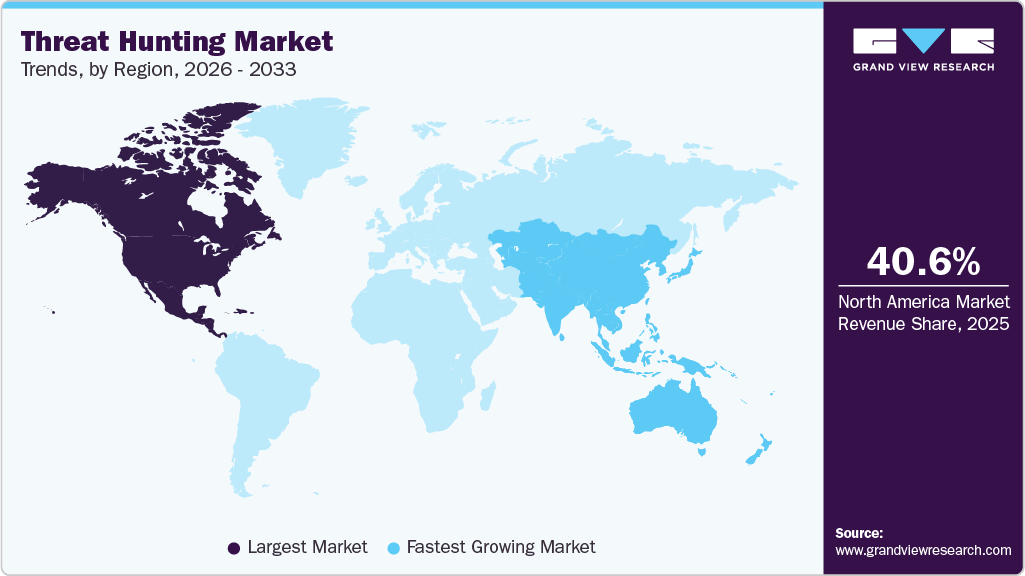
- North America dominated the global threat hunting market with the largest revenue share of 40.6% in 2025.
- In the U.S., the market is driven by increasing cyber threats and rising investment in proactive threat detection and advanced security monitoring solutions.
- By component, the solutions segment led the market with the largest revenue share of 71.4% in 2025.
- By organization size, the large enterprises segment accounted for the largest market revenue share in 2025.
Market Size & Forecast
- 2025 Market Size: USD 4.89 Billion
- 2033 Projected Market Size: USD 16.25 Billion
- CAGR (2026-2033): 16.3%
- North America: Largest market in 2025
- Asia Pacific: Fastest growing market
Growth in the threat hunting industry stems from rising concerns about advanced threats, such as those powered by artificial intelligence, which can slip past traditional security alerts. Companies are investing in AI-driven analytics to spot unusual patterns quickly, blending technology with human skills for better results. This shift helps address staff shortages in security roles, enabling firms to respond more quickly to potential breaches. As regulations tighten around data protection, more organizations see threat hunting as a smart way to stay compliant and maintain client trust.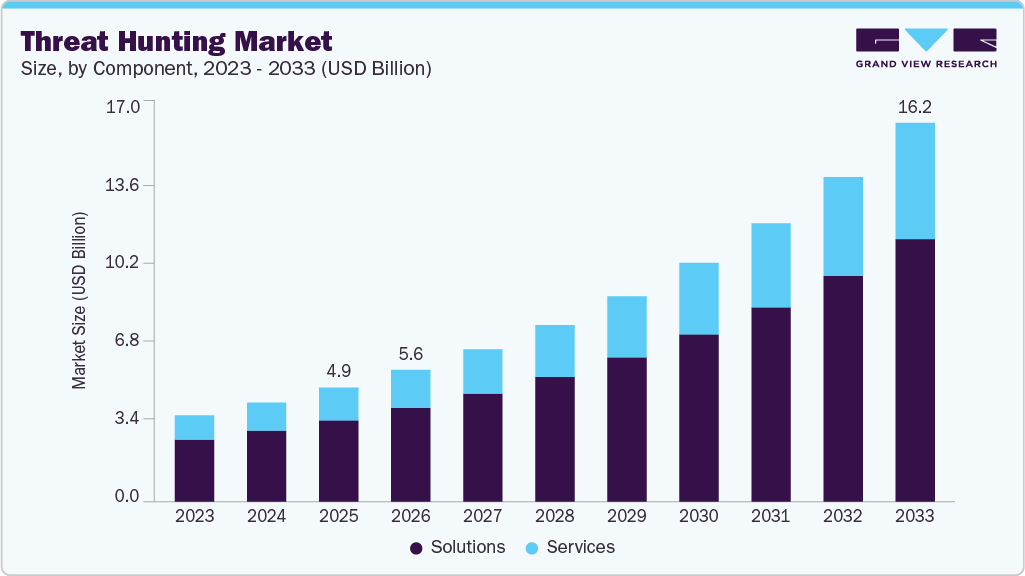
Moreover, the threat hunting industry will likely expand as automation becomes central, enabling real-time monitoring across complex cloud setups. Challenges such as evolving attacker tactics will drive innovation in tools that learn from past incidents. Overall, this market supports a move toward resilient security strategies, where preventing issues upfront saves time and resources in the long run.
For instance, in December 2025, Recorded Future, a cybersecurity company, evaluated its Autonomous Threat Operations solution within its own security operations center. By integrating AI-driven automated threat hunting, the company reduced average detection time by 40% (from 48 hours to 28 hours), improved incident response efficiency by 30%, and identified 25% more threats compared to previous processes, demonstrating measurable operational improvements. Such advancements are expected to accelerate market growth by boosting enterprise confidence in AI-powered threat-hunting solutions and driving broader adoption across industries.
Component Insights
The solutions segment led the market with the largest revenue share of 71.4% in 2025. Companies in this space offer advanced platforms such as endpoint detection and response (EDR) systems, security information and event management (SIEM) software, and threat intelligence feeds, which allow skilled analysts to investigate anomalies in real time. These solutions emphasize automation, machine learning integration, and collaboration features to streamline hunting processes, reduce reliance on reactive defenses, and help businesses stay ahead of sophisticated attacks from cybercriminals and state actors. By prioritizing user-friendly interfaces and scalable deployments, providers aim to make threat hunting accessible even for mid-sized firms with limited resources, ultimately strengthening overall network resilience in an increasingly hostile digital landscape. For instance, in January 2026, CrowdStrike launched its enhanced Falcon Threat Hunting module, which incorporates AI-driven behavioral analytics to identify zero-day exploits more efficiently, as reported in industry updates from sources such as Cybersecurity Dive. This continued innovation in advanced threat hunting platforms is expected to drive higher enterprise spending and further strengthen the growth trajectory of the threat hunting industry.
The services segment is expected to register at the fastest CAGR during the forecast period. These services often blend skilled analysts with advanced tools, such as AI, to spot subtle attacks that standard defenses miss, helping businesses stay ahead in a world of rapidly evolving cyber risks. This area has seen strong growth as firms face more complex threats, leading to higher demand for managed hunting options that provide ongoing monitoring and quick responses without needing large in-house teams. Moreover, organizations are turning to these services to reduce the dwell time of attackers and limit potential damage. Many now prefer flexible subscription-based models that scale with their specific security needs and budget constraints.
Deployment Insights
The on-premises segment led the market with the largest revenue share of 52.77% in 2025. This setup keeps sensitive data fully under internal control, which appeals to firms in strict sectors such as banking or government, where privacy rules are tight. Still, it often calls for hefty upfront costs in gear and expert staff to handle updates and tweaks. Larger organizations value this model for its reliability during complex hunts for hidden cyber threats. Over time, it has proven steady even as cloud options grow, thanks to hands-on management that builds trust. Smaller players might find it tough, but for those with resources, it strengthens defenses against evolving attacks.
The cloud segment is expected to grow at the fastest CAGR during the forecast period, driven by increasing hybrid work models and more sophisticated cyber risks that demand proactive defenses. Companies value cloud-based solutions for their flexibility and ability to scale security efforts without high upfront costs. This approach allows teams to monitor vast networks in real time, spotting hidden threats before they cause damage. However, the rise in cloud adoption also brings unique vulnerabilities, such as misconfigurations that attackers exploit. Firms are turning to advanced tools that integrate AI for smarter threat detection in these environments.
Enterprise Size Insights
The large enterprises segment accounted for the largest market revenue share in 2025. These organizations operate across vast networks and handle high-value data, making them prime targets for persistent threats from nation-states or organized crime groups. By deploying skilled hunters who proactively search for anomalies, companies can uncover hidden malware or insider risks before they cause major damage. This approach not only boosts overall security posture but also helps meet strict compliance rules in sectors such as finance and healthcare. As breaches grow costlier, many firms are investing in advanced tools and expert teams to integrate hunting into their daily operations. The market for these services is expanding, driven by the need for real-time intelligence and customized threat models.
The SME segment is projected to register at the fastest CAGR over the forecast period, as small and medium enterprises (SMEs) increasingly recognize the value of proactive cybersecurity measures to stay ahead of evolving digital risks. With limited in-house expertise and budgets, many SMEs turn to specialized threat hunting services that offer scalable solutions without overwhelming costs. These services help detect hidden threats early, minimizing potential damage from breaches that could cripple operations. However, adoption can be slow due to concerns over integration with existing systems and the need for trusted partners. Despite these hurdles, the market is growing as SMEs prioritize resilience amid rising ransomware attacks and regulatory pressures. Outsourcing threat hunting allows these businesses to focus on core activities while enhancing their security posture.
End Use Insights
The BFSI segment accounted for the largest market revenue share in 2025, where financial data and customer trust are paramount, threat hunting emerges as a vital strategy to combat evolving cyber risks beyond traditional defenses. By proactively scanning networks for hidden anomalies, organizations can identify sophisticated attacks, such as ransomware or insider threats, before they escalate, ensuring regulatory compliance with standards such as PCI DSS and GDPR. This approach not only minimizes potential losses from data breaches but also enhances operational resilience in a landscape marked by increasing digital transactions. Overall, integrating threat hunting fosters a culture of vigilance, allowing BFSI firms to stay ahead of adversaries in an interconnected world. Adopting such measures can transform reactive security postures into proactive shields, ultimately safeguarding assets and reputations. As threats grow more complex, investing in skilled hunters becomes essential for long-term stability.
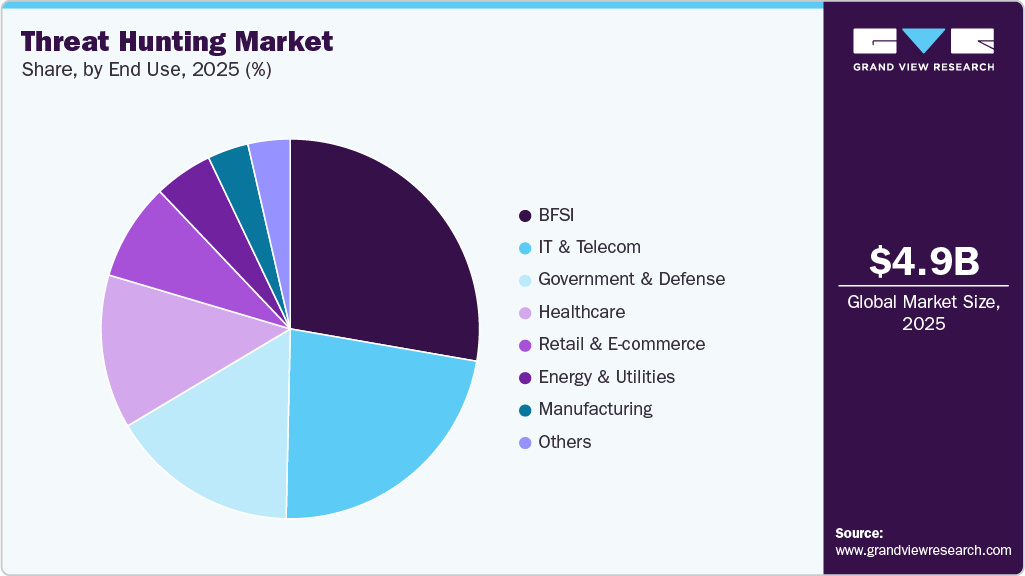
The IT & telecom segment is expected to register at the fastest CAGR during the forecast period. Threat hunting has become essential as networks face rising sophisticated attacks from state actors and cybercriminals, pushing companies to adopt proactive detection strategies beyond traditional defenses. With the rollout of 5G and IoT devices expanding attack surfaces, firms are integrating AI tools to scan for hidden threats in real-time, reducing response times and potential damages. This market segment leads in adoption due to high data volumes and regulatory pressures, fostering a shift toward hybrid human-AI hunting teams. Growth is driven by cloud migrations and supply chain vulnerabilities, where early threat identification prevents costly breaches.
For instance, in September 2024, the FBI and CISA revealed the “Salt Typhoon” campaign, which infiltrated global telecommunications and critical infrastructure networks across more than 80 countries. The operation demonstrated long-term, state-linked access to essential systems, highlighting advanced, persistent cyberintrusion capabilities. Such large-scale incidents are expected to increase demand for proactive threat-hunting solutions, driving growth in the global threat-hunting industry.
Regional Insights
North America dominated the global threat hunting market with the largest revenue share of 40.6% in 2025, driven by the region's heavy exposure to complex cyberattacks and a strong culture of proactive defense. Organizations across finance, healthcare, government, and technology sectors face persistent risks from ransomware, nation-state actors, and insider threats, pushing companies to move beyond traditional detection tools toward active hunting strategies. High cybersecurity awareness, combined with strict compliance rules and major investments from both private firms and public agencies, keeps demand steady and growing.
U.S. Threat Hunting Market Trends
The threat hunting market in the U.S. accounted for the largest market revenue share in North America in 2025, as companies face more sophisticated cyber-attacks that bypass standard defenses. Organizations now recognize that simply reacting to alerts is no longer sufficient, so they invest in proactive teams and tools to search networks for hidden threats before damage occurs. Major providers such as CrowdStrike, Palo Alto Networks, and others drive innovation through AI-enhanced platforms and managed services, helping significantly reduce breach detection time. Demand is particularly strong among large enterprises operating in cloud environments and facing persistent adversaries, while smaller businesses gradually adopt these capabilities through outsourced solutions.
Europe Threat Hunting Market Trends
The threat hunting market in Europe is anticipated to register at a significant CAGR from 2026 to 2033. Strict regulations such as GDPR, combined with rising ransomware and state-sponsored attacks, have pushed companies in finance, government, and critical infrastructure to invest more in dedicated hunting teams and tools. Many businesses now combine automated platforms with skilled analysts to uncover hidden threats that evade standard security controls. Cloud-based adoption across the region has broadened the attack surface, making proactive searching for indicators of compromise a practical necessity rather than an optional extra. While larger enterprises lead adoption, midsize firms are gradually following due to growing outsourcing options and managed services.
The UK threat hunting market is experiencing strong growth, driven by rising sophisticated attacks, including ransomware and advanced persistent threats targeting critical sectors such as finance, government, and energy. Companies increasingly seek specialist services to uncover hidden risks that evade standard security tools. Strict regulations such as GDPR, combined with government initiatives and the National Cyber Security Centre's guidance, push both public and private entities to invest in dedicated hunting capabilities. Many organizations now favor managed detection and response offerings that include continuous proactive searching, often delivered through cloud-based platforms for greater speed and scalability.
The threat hunting market in Germany is experiencing robust growth. Businesses, especially in manufacturing, finance, and critical infrastructure, are moving beyond traditional detection tools toward proactive searching for hidden threats in their networks. Strong data protection laws such as GDPR, combined with recent updates such as NIS2 and the IT Security Act, push organizations to invest in advanced proactive security measures. Many large enterprises now include dedicated threat hunting in their security operations, often supported by managed detection and response services from local and international providers.
The France threat hunting marketis growing significantly from 2026 to 2033. Driven by rising sophisticated attacks on critical sectors such as finance, government, and energy, companies increasingly rely on specialized hunting teams and managed services to detect hidden adversaries before damage occurs. Local players such as Capgemini and Eviden, alongside international providers, are strengthening their presence through tailored solutions that align with strict national regulations and data sovereignty priorities.
Asia Pacific Threat Hunting Market Trends
The threat hunting market intheAsia Pacific is expected to register at the fastest CAGR from 2026 to 2033. Rapid digital transformation, widespread cloud adoption, and the expansion of connected devices have significantly widened the attack surface, pushing companies in countries such as China, India, Japan, and Southeast Asia to move beyond traditional detection methods. Businesses are now investing in proactive hunting approaches to uncover hidden risks before they cause serious damage. Rising regulatory pressures and increasing awareness of advanced persistent threats, ransomware, and insider risks are further encouraging the adoption of specialized tools and managed services.
The India threat hunting market is poised for robust growth from 2026 to 2033, as organizations shift from traditional reactive security measures to more proactive strategies. Many enterprises now recognize that signature-based tools alone fall short against sophisticated threats such as ransomware, APTs, and insider threats, leading them to invest in dedicated threat-hunting teams or managed services. Local cybersecurity providers, alongside global players, are stepping up with tailored solutions that address India-specific challenges, including regulatory pressures from laws such as the DPDPA. While skilled professionals remain scarce, the integration of AI and automation is helping bridge this gap and improve response times.
The threat hunting market in China is witnessing rapid growth as organizations face a rising wave of sophisticated cyber threats, including advanced persistent threats and state-linked intrusions. Businesses and government entities are shifting from traditional reactive defenses toward proactive hunting practices to detect hidden adversaries before damage occurs. Strict national regulations on data security and critical infrastructure protection have pushed companies to invest more in specialized tools, skilled teams, and managed services.
Key Threat Hunting Company Insight
Key players operating in the global threat hunting industry are CrowdStrike, Cynet, Fortinet, Inc., IBM Corporation, and others. Companies are focusing on various strategic initiatives, including new product development, partnerships & collaborations, and agreements to gain a competitive advantage over their rivals.
Key Threat Hunting Companies:
The following key companies have been profiled for this study on the threat hunting market
- AO Kaspersky Lab
- Binary Defense
- Capgemini
- CrowdStrike
- CyCognito
- Cynet
- Eviden SAS
- Fortinet, Inc.
- IBM Corporation
- Palo Alto Networks
- Rapid7
- SANGFOR TECHNOLOGIES
- SolarWinds Worldwide, LLC.
- Sophos Ltd.
- TrendAI
Recent Development
-
In December 2025, NTT DATA launched AI-powered Cyber Defense Centers across India, the UK, and the U.S., integrating autonomous threat detection and localized threat hunting. These centers combine human expertise and AI to reduce alert volumes and accelerate incident response. This expansion is expected to strengthen the adoption of AI-driven threat hunting services and accelerate growth in the global threat hunting industry.
-
In September 2024, Cohesity announced its partnership with CrowdStrike to integrate advanced threat intelligence into backup and recovery environments. The collaboration enhances threat detection, forensic investigation, and threat hunting within protected data, improving visibility and response against evolving cyber threats. This integration is expected to drive greater adoption of data-centric threat-hunting solutions, thereby supporting growth in the global threat-hunting market.
-
In August 2024, Group-IB announced a partnership with SecurityHQ to strengthen managed security services worldwide. Under the agreement, SecurityHQ will integrate Group-IB’s threat intelligence, attack surface management, digital risk protection, and fraud prevention capabilities into its global security operations centers. This collaboration is expected to enhance demand for integrated threat-hunting and intelligence solutions, supporting the expansion of the global threat-hunting industry.
Threat Hunting Market Report Scope
Report Attribute
Details
Market size in 2026
USD 5.65 billion
Revenue forecast in 2033
USD 16.25 billion
Growth rate
CAGR of 16.3% from 2026 to 2033
Base year for estimation
2025
Historical data
2021 - 2024
Forecast period
2026 - 2033
Quantitative units
Revenue in USD million/billion, and CAGR from 2026 to 2033
Report Coverage
Revenue forecast, company share, competitive landscape, growth factors, and trends
Segments covered
Component, deployment, enterprise size, end use, region
Regional scope
North America; Europe; Asia Pacific; Latin America; MEA
Country scope
U.S.; Canada; Mexico; UK; Germany; France; China; India; Japan; Australia; South Korea; Brazil; UAE; Kingdom of Saudi Arabia; South Africa
Key companies profiled
AO Kaspersky Lab; Binary Defense; Capgemini; CrowdStrike; CyCognito; Cynet; Eviden SAS; Fortinet, Inc.; IBM Corporation; Palo Alto Networks; Rapid7; SANGFOR TECHNOLOGIES; SolarWinds Worldwide, LLC.; Sophos Ltd.; TrendAI.
Customization scope
Free report customization (equivalent to 8 analysts working days) with purchase. Addition or alteration to country, regional & segment scope.
Pricing and purchase options
Avail customized purchase options to meet your exact research needs. Explore purchase options
Global Threat Hunting Market Report Segmentation
This report forecasts revenue growth at global, regional, and country levels and provides an analysis of the latest industry trends in each of the sub-segments from 2021 to 2033. For this study, Grand View Research has segmented the global threat hunting market report based on component, deployment, enterprise size, end use, and region.
-
Component Outlook (Revenue, USD Billion, 2021 - 2033)
-
Solutions
-
Services
-
Managed Services
-
Professional Services
-
-
-
Deployment Outlook (Revenue, USD Billion, 2021 - 2033)
-
On-Premise
-
Cloud-based
-
-
Enterprise Size Outlook (Revenue, USD Billion, 2021 - 2033)
-
Large Enterprises
-
SMEs
-
-
End Use Outlook (Revenue, USD Billion, 2021 - 2033)
-
BFSI
-
Energy & Utilities
-
Government & Defense
-
Healthcare
-
Manufacturing
-
Retail & E-commerce
-
IT & Telecom
-
Others
-
-
Regional Outlook (Revenue, USD Billion, 2021 - 2033)
-
North America
-
U.S.
-
Canada
-
Mexico
-
-
Europe
-
UK
-
Germany
-
France
-
-
Asia Pacific
-
China
-
India
-
Japan
-
South Korea
-
Australia
-
-
Latin America
-
Brazil
-
-
Middle East & Africa
-
UAE
-
Saudi Arabia
-
South Africa
-
-
Frequently Asked Questions About This Report
b. The global threat hunting market size was estimated at USD 4.89 billion in 2025 and is expected to reach USD 5.65 billion in 2026.
b. The global threat hunting market is expected to grow at a compound annual growth rate of 16.3% from 2026 to 2033 to reach USD 16.25 billion by 2033.
b. The solution segment dominated the threat hunting market in 2025 driven by increasing cyber threats and rising demand for advanced detection solutions.
b. Some key players operating in the market include AO Kaspersky Lab, Binary Defense, Capgemini, CrowdStrike, CyCognito, Cynet, Eviden SAS, Fortinet, Inc., IBM Corporation, Palo Alto Networks, Rapid7, SANGFOR TECHNOLOGIES, SolarWinds Worldwide, LLC., Sophos Ltd. and TrendAI.
b. Factors such as the shift toward proactive cybersecurity strategies, growing adoption of cloud and hybrid it environments, and integration of AI and advanced analytics play a key role in accelerating the threat hunting market.


Share this report with your colleague or friend.
Need a Tailored Report?
Customize this report to your needs — add regions, segments, or data points, with 20% free customization.


ISO 9001:2015 & 27001:2022 Certified
We are GDPR and CCPA compliant! Your transaction & personal information is safe and secure. For more details, please read our privacy policy.
Trusted market insights - try a free sample
See how our reports are structured and why industry leaders rely on Grand View Research. Get a free sample or ask us to tailor this report to your needs.