- Home
- »
- Communications Infrastructure
- »
-
Structural Health Monitoring Market Size, Share Report, 2033GVR Report cover
![Structural Health Monitoring Market Size, Share & Trends Report]()
Structural Health Monitoring Market (2026 - 2033) Size, Share & Trends Analysis Report By Solution (Hardware, Software & Services), By Technology (Wired SHM, Wireless SHM), By Application (Bridges & Dams, Buildings & Stadiums), By Region, And Segment Forecasts
- Report ID: GVR-2-68038-587-8
- Number of Report Pages: 120
- Format: PDF
- Historical Range: 2021 - 2025
- Forecast Period: 2026 - 2033
- Industry: Technology
- Report Summary
- Table of Contents
- Interactive Charts
- Methodology
- Download FREE Sample
-
 Download Sample Report
Structural Health Monitoring Market Summary
The global structural health monitoring market size was valued at USD 4.35 billion in 2025 and is projected to reach USD 17.77 billion by 2033, growing at a CAGR of 19.4% from 2026 to 2033. The market growth can be attributed to the strict public safety regulations, the subsequent focus on maintaining aging infrastructure, and the aggressive investments in smart infrastructure projects.
Key Market Trends & Insights
- North America held 36.3% revenue share of the structural health monitoring industry.
- The U.S. dominated the structural health monitoring industry in 2025.
- By solution, the hardware segment held the largest revenue share in 2025.
- By technology, the wired SHM segment held the largest revenue share in 2025.
- By application, the bridges & dams segment held the largest revenue share in 2025.
Market Size & Forecast
- 2025 Market Size: USD 4.35 Billion
- 2033 Projected Market Size: USD 17.77 Billion
- CAGR (2026-2033): 19.4%
- North America: Largest Market in 2025
- Asia Pacific: Fastest Growing Market
Government initiatives aimed at standardizing SHM systems as part of the broader efforts to boost overall public safety also bode well for the growth of the market. The continued rollout of smart infrastructure projects is driving the adoption of new, innovative SHM systems based on the latest technologies, thereby propelling the market growth. Rapid urbanization and expanding infrastructure development are major factors driving the growth of the structural health monitoring (SHM) industry. Global goals such as the sustainable development goals and the target of achieving net-zero emissions by 2050 highlight the need for sustainable and resilient infrastructure, which requires large-scale investments. According to the OECD, around USD 6.9 trillion per year is needed for infrastructure development until 2050 to support economic growth and climate resilience. However, there is still a significant gap between required and actual investments, with much of the spending focused on traditional infrastructure, as noted by the Global Infrastructure Hub. As a result, SHM systems are increasingly being adopted to monitor the safety and performance of critical infrastructure such as buildings, bridges, and dams, helping extend asset life and reduce long-term risks.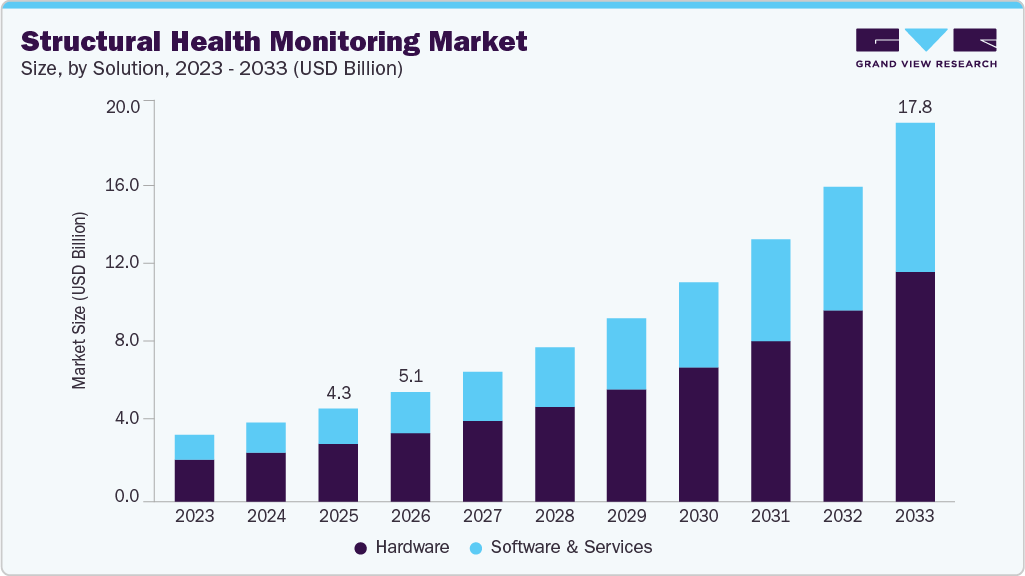
Government regulations and policies for sustainable infrastructure serve as a significant driver for the SHM market, driven by the need to address climate change impacts and enhance resilience in infrastructure networks. According to OECD ENVIRONMENT POLICY PAPER NO. 14, infrastructure networks are highly vulnerable to the physical effects of climate variability and change, with extreme events highlighting the potential exposure and vulnerabilities. For instance, OECD modeling of a major flood in Paris demonstrated that 30%-50% of direct damages would be suffered by the infrastructure sector, emphasizing the need for climate-resilient infrastructure to mitigate losses and reduce disruption costs.
In alignment with these efforts, annual green public infrastructure investments emphasize the commitment toward sustainable infrastructure development. These investments are channeled across various sectors, such as transportation, energy, water, and telecommunications, aiming to foster infrastructure resilience and sustainability. The following chart depicts the annual green public infrastructure investments in different sectors as a percentage of the GDP.
Complex data processing and management pose significant restraints in the market. The challenge primarily stems from the high volume of data generated by large structures, making it cumbersome to handle with conventional solutions. There is a growing need for efficiently managing vast datasets to extract meaningful insights that are crucial for structural health assessment. Moreover, ensuring the robustness and reliability of installed sensors presents an additional challenge, as manual monitoring may be necessary in the event of sensor failures.
Solution Insights
The hardware segment held the largest revenue share in 2025. The structural health monitoring system relies heavily on hardware components such as sensors, data acquisition systems, and communication devices. These components monitor numerous physical parameters of any structure, such as strain, deformation, and tilt, and make structure-specific decisions based on the data obtained from various hardware equipment. Thus, the increasing adoption of structural health monitoring systems for detecting structural damage, ensuring safety and integrity, and estimating performance deterioration of civil infrastructures is a major factor behind the growth of the segment. In addition, increasing urbanization in countries such as India and China is further expected to drive the demand for SHM hardware such as sensors and data acquisition systems.
The software & services segment is expected to grow at the fastest CAGR during the forecast period. The segment is growing at a rapid pace due to its ability to provide real-time access to the information on the structural quality check parameters. Structural health monitoring supports continuous monitoring, data collection, alert of any impending damage, and data acquisition even in adverse conditions. Growing urbanization and industrialization across the globe are expected to drive the demand for SHM software and services. Furthermore, the increasing preference for wireless technology has led to an increased demand for efficient software that offers rapid analysis and data acquisition speed, along with real-time presentation of information on the end-user's portal.
Technology Insights
The wired SHM segment dominated the market in 2025. Many structures, such as bridges, buildings, and dams, already have wired monitoring systems to analyze their basic condition. The wired SHM system refers to the communication technique used to connect sensors, the data acquisition system, and other communication devices via lead wires, coaxial cables, optical fibers, and other wired technologies. SHM systems are frequently installed using wired procedures as they do not encounter any network disruption.
The wireless SHM is expected to grow at the fastest CAGR over the forecast period. Increasing demand for wireless sensors for structural health monitoring applications is driving the segment’s growth. Wireless sensors have the potential to catapult advancements in the field of structural monitoring. The benefits of wireless sensor networks over wired monitoring technologies include rapid deployment, minimal interference with the environment, autonomy, and flexibility. In addition, advancements in wireless sensing technologies have significantly led to developments in the field of SHM, especially when deploying equipment on large and complex structures.
Application Insights
The bridges & dams segment dominated the market in 2025. SHM is used to monitor various conditions of bridges and dams, such as tilting angle, load capacity, and safety factors for material strength, to ensure regular maintenance. Certain defects of such structures cannot be detected by visual inspection. Therefore, sensors are used to detect inconspicuous damage caused by factors such as wind, temperature, vibration, and traffic to alert for timely maintenance.
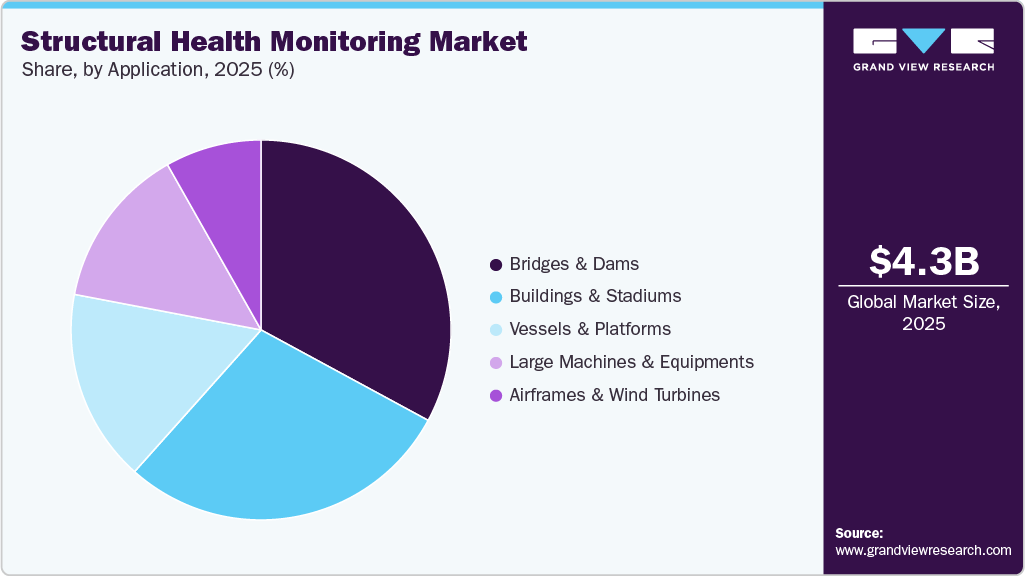
The buildings & stadiums segment is expected to grow at a significant CAGR over the forecast period. High-rise buildings and stadiums are complex structures that require structural health monitoring systems to evaluate and assess their health, strengthen safety, and optimize operational and maintenance activities. They need reliable and accurate data to improve operations, maintenance, and repair of complex structures when they become outdated. Hence, fiber-optic technology and data acquisition systems are preferred to detect performance degradation of these structures to help save lives and prevent critical property damage. Moreover, rapid urbanization and the need for sustainable infrastructure across the globe, coupled with the development of smart cities, are expected to fuel the segment’s growth.
Regional Insights
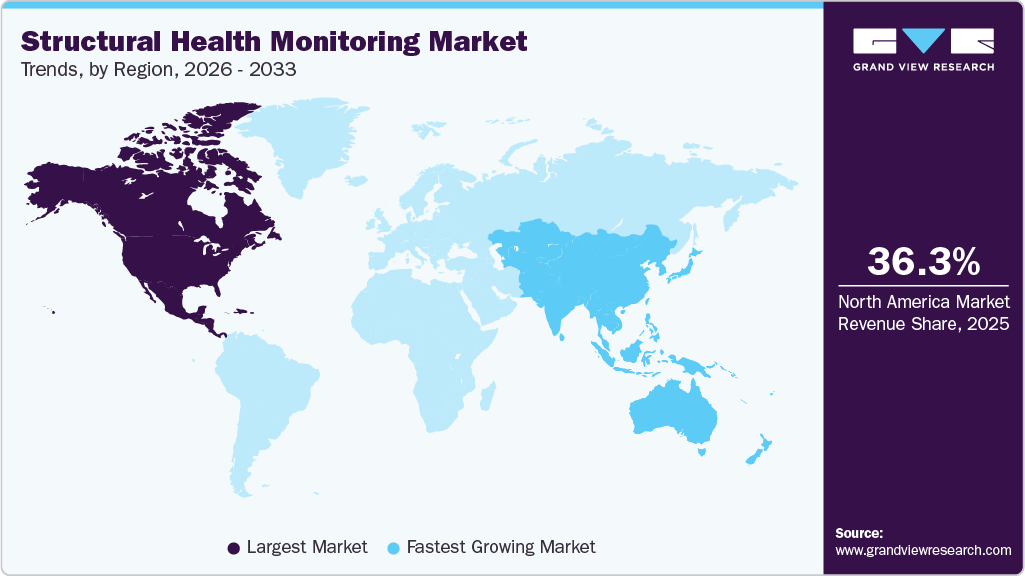
North America structural health monitoring industry dominated the global market with a revenue share of over 36.0% in 2025. The growth of the market in North America can be attributed to the high investments undertaken by countries such as the U.S. and Canada for infrastructure development. Both the government and private sectors support these large-scale infrastructure development activities. In addition, the early adoption of advanced sensing technologies and strict safety regulations for aging infrastructure, such as bridges, highways, and public buildings, has increased the demand for continuous monitoring solutions across the region.
U.S. Structural Health Monitoring Market Trends
The U.S. structural health monitoring industry dominated the North America market in 2025, and it is expected to grow significantly from 2026 to 2033. This growth is mainly due to the aging condition of the country’s infrastructure, including dams, locks, bridges, and navigation systems that are operating beyond their intended lifespan. Government agencies and private operators require accurate, real-time data to monitor the safety and performance of these structures. To address this need, the U.S. Army Corps of Engineers (USACE) has developed sensor-based systems that continuously track structural conditions. Structural health monitoring helps estimate the remaining life and reliability of infrastructure assets and provides early warnings of potential failures. Such government-led initiatives are playing a key role in driving SHM market growth in the U.S.
Asia Pacific Structural Health Monitoring Market Trends
The structural health monitoring industry in Asia Pacific is expected to grow at the fastest CAGR from 2026 to 2033. The Asia Pacific structural health monitoring (SHM) market growth can be attributed to the growing government regulations in countries such as China and South Korea, requiring SHM for critical infrastructures such as bridges and buildings. In addition, increased awareness of the benefits of SHM, such as improved safety, lower maintenance costs, and a longer lifespan of structures, is contributing to the regional market growth.
China structural health monitoring industry’s growth is driven by rapid infrastructure expansion, aging public assets, and a strong government focus on safety and resilience in 2025. Large-scale projects such as high-speed rail networks, long-span bridges, urban metros, and mega dams are increasing the need for continuous, real-time monitoring to ensure structural integrity and public safety. Government policies emphasizing smart infrastructure, disaster prevention, and digital transformation are accelerating the adoption of sensor-based SHM systems integrated with IoT, AI, and big data platforms. In addition, growing concerns over seismic activity, extreme weather events, and long-term maintenance costs are pushing infrastructure operators to deploy SHM solutions to enable early fault detection, extend asset life, and reduce inspection costs, supporting steady market growth across China.
Europe Structural Health Monitoring Market Trends
Europe structural health monitoring industry is growing at a significant CAGR from 2026 to 2033. Countries in Europe are witnessing significant investments to improve their existing infrastructure. For instance, in July 2025, the European Commission announced nearly 2.8 billion euros in funding under the Connecting Europe Facility (CEF) to modernize railways, inland waterways, and transport corridors, reinforcing sustainable and resilient infrastructure, funding that indirectly increases demand for monitoring and safety systems such as SHM for bridges and transport networks. This strong focus on infrastructure improvement, combined with national initiatives aimed at improving public assets and enhancing safety, is driving the adoption of structural health monitoring systems. As rail, road, and urban transport networks are modernized, the need for real-time monitoring and predictive maintenance solutions continues to rise across Europe.
The structural health monitoring industry in Germany is expected to grow significantly during the forecast period. Germany’s structural health monitoring industry is benefiting from major government infrastructure investment programs in 2025, as the federal government adopted a 500 billion euros Special Fund for Infrastructure and Climate Neutrality aimed at modernizing transport networks, bridges, roads, digital infrastructure, and energy systems. Under this plan, record infrastructure funding, including tens of billions for rail and bridge upgrades, is being mobilized to improve the safety, resilience, and performance of key public assets. Such large-scale public spending and modernization efforts are increasing demand for structural health monitoring technologies that help track the condition of aging assets and support predictive maintenance and long-term resilience.
Key Structural Health Monitoring Company Insights
Some of the key companies operating in the market include Acellent Technologies, Inc., Campbell Scientific, Inc., COWI A/S, Digitexx Data Systems, Inc., Geocomp, Inc., GEOKON, GeoSIG Ltd., among others are some of the leading participants in the market.
-
Acellent Technologies, Inc. is a U.S.-based company in Structural Health Monitoring (SHM) systems, with more than two decades of experience in the field. Founded in 1999 and headquartered in Sunnyvale, California, Acellent designs, builds, and supports complete SHM solutions that monitor the condition and integrity of a wide range of metal and composite structures, including aircraft, bridges, pipelines, wind turbines, heavy machinery, and more. The company’s core technology is its patented SMART Layer sensor network, which can be installed on new structures or retrofitted onto existing ones to provide real-time data on structural health. Acellent’s end-to-end offerings include hardware, software, and advanced analytics that help automate inspection, detect damage early, and support predictive maintenance, making infrastructure and equipment safer and more reliable across industries such as aerospace, civil infrastructure, energy, and manufacturing.
-
Campbell Scientific, Inc. is a U.S.-based technology company specializing in data acquisition, monitoring, and measurement solutions for environmental and structural applications. Founded in 1974 and headquartered in Logan, Utah, the company develops rugged, high-performance instruments, sensors, and systems used worldwide to collect and analyze data in real time under harsh field conditions. Campbell Scientific’s offerings include data loggers, communication interfaces, sensors, and software that support applications such as weather and climate monitoring, hydrology, air quality, and structural health monitoring for bridges, buildings, and other critical infrastructure.
Key Structural Health Monitoring Companies:
The following key companies have been profiled for this study on the structural health monitoring market.
- Acellent Technologies, Inc.
- Campbell Scientific, Inc.
- COWI A/S
- Digitexx Data Systems, Inc.
- Geocomp, Inc.
- GEOKON
- GeoSIG Ltd.
- Hottinger Brüel & Kjaer (HBK)
- James Fisher and Sons plc
- Kinemetrics
- National Instruments Corp
- Nova Ventures
- SIXENSE
- Structural Monitoring Systems Plc.
- Xylem, Inc.
Recent Developments
-
In September 2025, Airbus Defence and Space invested in Quebec-based IPR Innovative Products Resources Inc. (IPR) to support the development of advanced sensing technologies, including structural health monitoring (SHM). These technologies help monitor structural stress and detect damage in aircraft, ships, machinery, and critical infrastructure. The investment, supported by Airbus subsidiary Testia, is intended to speed up SHM innovation and expand its use beyond aerospace to areas such as bridges, railways, and power plants, improving safety, reliability, and maintenance planning.
-
In October 2025, MISTRAS Group partnered with Villari to offer advanced wireless crack-detection sensors as part of its structural health monitoring (SHM) solutions. This collaboration combines Villari’s certified passive magnetic flux leakage sensor technology, which can detect fatigue crack growth earlier than traditional inspection methods, with MISTRAS’ expertise in continuous monitoring and data analytics. The integrated solution provides real-time insights into structural conditions for assets such as bridges, wind turbines, cranes, and oil & gas infrastructure, helping operators reduce manual inspections, improve safety, extend asset life, and enhance predictive maintenance strategies.
Structural Health Monitoring Market Report Scope
Report Attribute
Details
Market size value in 2026
USD 5.14 billion
Revenue forecast in 2033
USD 17.77 billion
Growth rate
CAGR of 19.4% from 2026 to 2033
Actual data
2021 - 2025
Forecast period
2026 - 2033
Quantitative units
Revenue in USD million/billion and CAGR from 2026 to 2033
Report coverage
Revenue forecast, company share, competitive landscape, growth factors, and trends
Segments covered
Solution, technology, application, region
Regional scope
North America; Europe; Asia Pacific; Latin America; MEA
Country scope
U.S.; Canada; Mexico; UK; Germany; France; China; India; Japan; Australia; South Korea; Brazil; UAE; Saudi Arabia; South Africa
Key companies profiled
Acellent Technologies, Inc.; Campbell Scientific, Inc.; COWI A/S; Digitexx Data Systems, Inc.; Geocomp, Inc.; GEOKON; GeoSIG Ltd.; Hottinger Brüel & Kjaer (HBK); James Fisher and Sons plc; Kinemetrics; National Instruments Corp; Nova Ventures; SIXENSE; Structural Monitoring Systems Plc.; Xylem, Inc.
Customization scope
Free report customization (equivalent to 8 analysts working days) with purchase. Addition or alteration to country, regional & segment scope.
Pricing and purchase options
Avail customized purchase options to meet your exact research needs. Explore purchase options
Global Structural Health Monitoring Market Report Segmentation
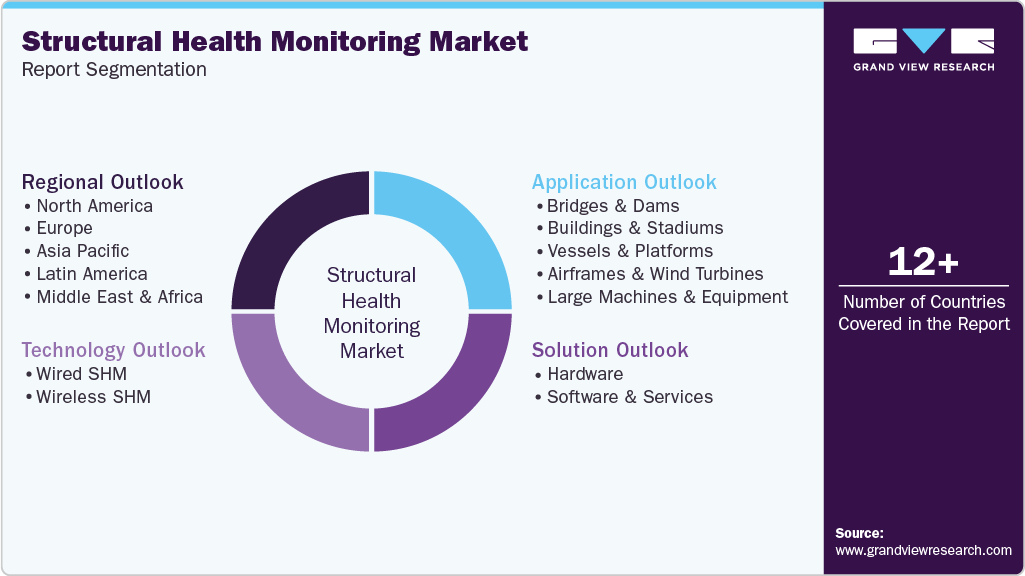
This report forecasts revenue growth at global, regional, and country levels and provides an analysis of the latest industry trends in each of the sub-segments from 2021 to 2033. For this study, Grand View Research has segmented the global structural health monitoring market report based on solution, technology, application, and region.
-
Solution Outlook (Revenue, USD Billion, 2021 - 2033)
-
Hardware
-
Sensors
-
Data Acquisition Systems
-
Others
-
-
Software & Services
-
-
Technology Outlook (Revenue, USD Billion, 2021 - 2033)
-
Wired SHM
-
Wireless SHM
-
-
Application Outlook (Revenue, USD Billion, 2021 - 2033)
-
Bridges & Dams
-
Bridges
-
Rails
-
Dams
-
-
Buildings & Stadiums
-
Vessels & Platforms
-
Airframes & Wind Turbines
-
Airframes
-
Wind Turbines
-
-
Large Machines & Equipment
-
-
Regional Outlook (Revenue, USD Billion, 2021 - 2033)
-
North America
-
U.S.
-
Canada
-
Mexico
-
-
Europe
-
Germany
-
UK
-
France
-
-
Asia Pacific
-
China
-
India
-
Japan
-
South Korea
-
Australia
-
-
Latin America
-
Brazil
-
-
Middle East & Africa
-
UAE
-
Saudi Arabia
-
South Africa
-
-
Frequently Asked Questions About This Report
b. The growth of the market can be attributed to the stringent public safety regulations, the subsequent emphasis on maintaining aging infrastructure, and the aggressive investments in smart infrastructure projects. Government initiatives aimed at standardizing SHM systems as part of the broader efforts to boost overall public safety also bode well for the growth of the market.
b. The global structural health monitoring market size was estimated at USD 4.35 billion in 2025 and is expected to reach USD 5.14 billion in 2026
b. The global structural health monitoring market is expected to grow at a compound annual growth rate of 19.4% from 2026 to 2033 to reach USD 17.77 billion by 2033
b. North America region dominated the structural health monitoring market with a share of over 36.0% in 2025. The growth of the Structural Health Monitoring (SHM) market in North America can be attributed to the high investments undertaken by countries such as the U.S. and Canada for infrastructure development. Both government and private sectors support these large-scale infrastructure development activities.
b. Some key players operating in the structural health monitoring market include Acellent Technologies, Inc.; Campbell Scientific, Inc.; COWI A/S; Digitexx Data Systems, Inc.; Geocomp, Inc.; GEOKON; GeoSIG Ltd.; Hottinger Brüel & Kjaer (HBK); James Fisher and Sons plc; Kinemetrics; National Instruments Corp; Nova Ventures; SIXENSE; Structural Monitoring Systems Plc.; Xylem, Inc.


Share this report with your colleague or friend.
Need a Tailored Report?
Customize this report to your needs — add regions, segments, or data points, with 20% free customization.


ISO 9001:2015 & 27001:2022 Certified
We are GDPR and CCPA compliant! Your transaction & personal information is safe and secure. For more details, please read our privacy policy.
Trusted market insights - try a free sample
See how our reports are structured and why industry leaders rely on Grand View Research. Get a free sample or ask us to tailor this report to your needs.