- Home
- »
- Plastics, Polymers & Resins
- »
-
Solvent-based Plastic Recycling Market Size Report, 2033GVR Report cover
![Solvent-based Plastic Recycling Market Size, Share & Trends Report]()
Solvent-based Plastic Recycling Market (2026 - 2033) Size, Share & Trends Analysis Report By Product (Polyethylene, Polyethylene Terephthalate, Polypropylene, Polyvinyl Chloride, Polypropylene), By Application (Automotive, Textile), By Region, And Segment Forecasts
- Report ID: GVR-4-68039-971-8
- Number of Report Pages: 190
- Format: PDF
- Historical Range: 2021 - 2025
- Forecast Period: 2026 - 2033
- Industry: Bulk Chemicals
- Report Summary
- Table of Contents
- Interactive Charts
- Methodology
- Download FREE Sample
-
 Download Sample Report
Solvent-Based Plastic Recycling Market Summary
The global solvent-based plastic recycling market size was estimated at USD 701.3 million in 2025 and is projected to reach USD 1,222.6 million by 2033, growing at a CAGR of 7.4% from 2026 to 2033. Advances in solvent recovery and process optimization are reducing operating costs and improving yield consistency for solvent-based recycling.
Key Market Trends & Insights
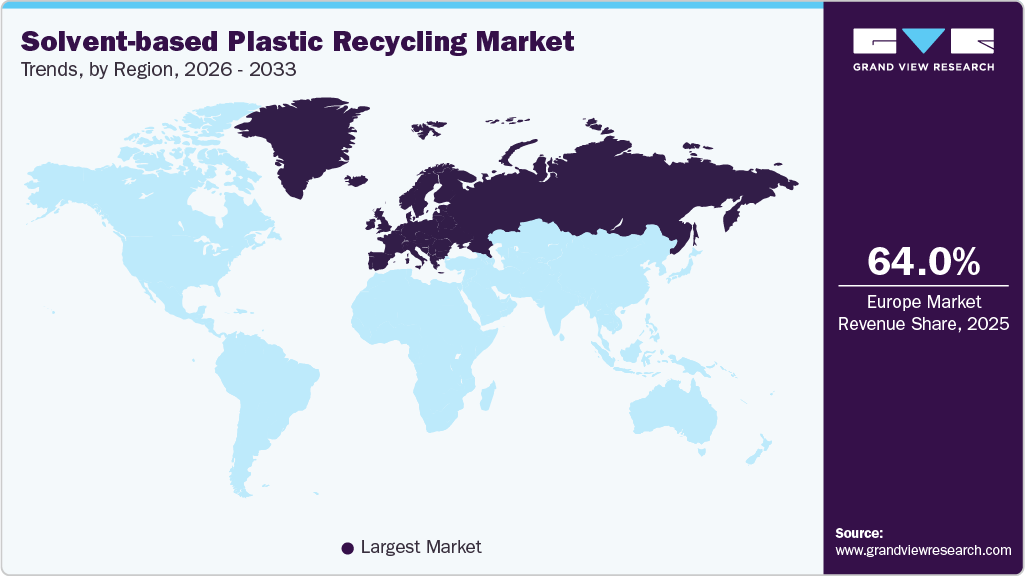
- Europe dominated the global solvent-based plastic recycling industry with the largest revenue share of 64.0%in 2025.
- The solvent-based plastic recycling industry in India is expected to grow at a CAGR of 11.6% from 2026 to 2033.
- By product, the polyethylene segment is expected to grow at a CAGR of 8.6% from 2026 to 2033.
- The building & construction segment is expected to grow at a CAGR of 7.8% from 2026 to 2033 in terms of revenue in the application segment.
Market Size & Forecast
- 2025 Market Size: USD 701.3 Million
- 2033 Projected Market Size: USD 1,222.6 Million
- CAGR (2026-2033): 7.4%
- Europe: Largest market in 2025
This strengthens investor confidence and enables more competitive pricing versus virgin polymers, accelerating commercial adoption. Investment in solvent-based dissolution and purification moved from pilots to commercial scale in recent years. Producers report on-spec output and initial revenue from molecular and dissolution facilities. Large polymer producers and recyclers are integrating solvent-based lines alongside mechanical and thermal routes to capture hard-to-recover streams. This shift reduces reliance on virgin feedstock for high-value applications and signals a transition toward hybrid circular supply chains.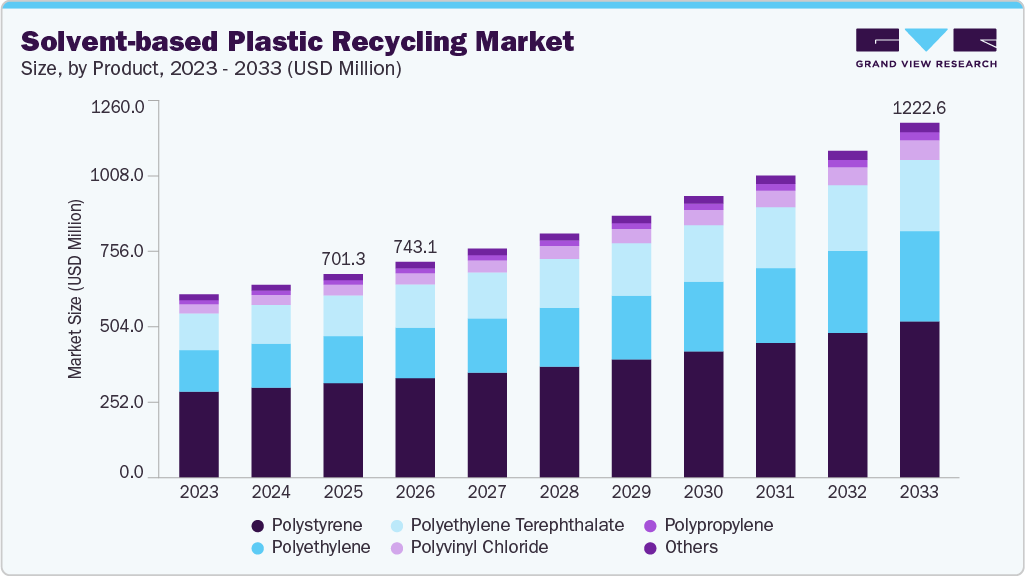
Drivers, Opportunities & Restraints
Tighter recycled-content requirements and circularity roadmaps are driving strong market demand for high-quality recyclate. Regional industry associations and regulators expect solvent-based methods to complement mechanical recycling and help meet strict packaging content targets. Public programs and national strategies focus on diverting waste from landfills and recovering feedstock, which enhances project bankability for solvent-based plants. These policy signals boost offtake discussions with consumer brands and support upstream capital investments.
Solvent-based purification enables the reuse of contaminated, multilayer, and post-industrial streams that mechanical methods cannot reclaim to the same grade. Proprietary dissolution techniques allow the separation of additives and contaminants while maintaining polymer chain integrity. Recyclers and polymer producers can supply near-virgin quality resins for food-contact, medical, and high-barrier packaging applications. This generates profit opportunities through differentiated product specifications, long-term supply agreements with brand owners, and decreased substitution risks for specialty resin buyers.
Solvent-based facilities require high initial investments and complex solvent recovery systems. Variability in feedstock quality increases operational risks due to fluctuating yields and extra pre-treatment costs. Permitting and environmental regulations introduce timeline and cost uncertainties for new plants. Waste management systems in many regions lack the consistent, segregated feedstocks necessary for solvent processes at scale. These combined factors hinder rapid deployment and limit short-term returns unless operators secure reliable feedstock sources and clear regulatory guidance.
Market Concentration & Characteristics
The market is in a moderate growth stage, with acceleration happening. It shows fragmentation, with key players leading the industry. Major companies like Solvay, Sulzer Ltd, Trinseo, Procter & Gamble, APK AG, Fraunhofer, PolystyreneLoop, PureCycle Technologies Inc, Saperatec GmbH, and others play important roles in shaping market trends. These leading companies often drive innovation by introducing new products, technologies, and materials to meet the industry's changing needs.
Solvent-based recycling is a convergent innovation that couples selective polymer dissolution with industrial solvent recovery and contaminant removal. Recent pilots have validated continuous, regulated outputs and modular plant designs. Technology owners are improving solvent loops, energy integration, and contaminant extraction to deliver near-virgin polymer properties for demanding end uses. Strategic scale-ups demonstrate the route is moving from lab to early commercial status, but engineering complexity and integration remain the main innovation challenges.
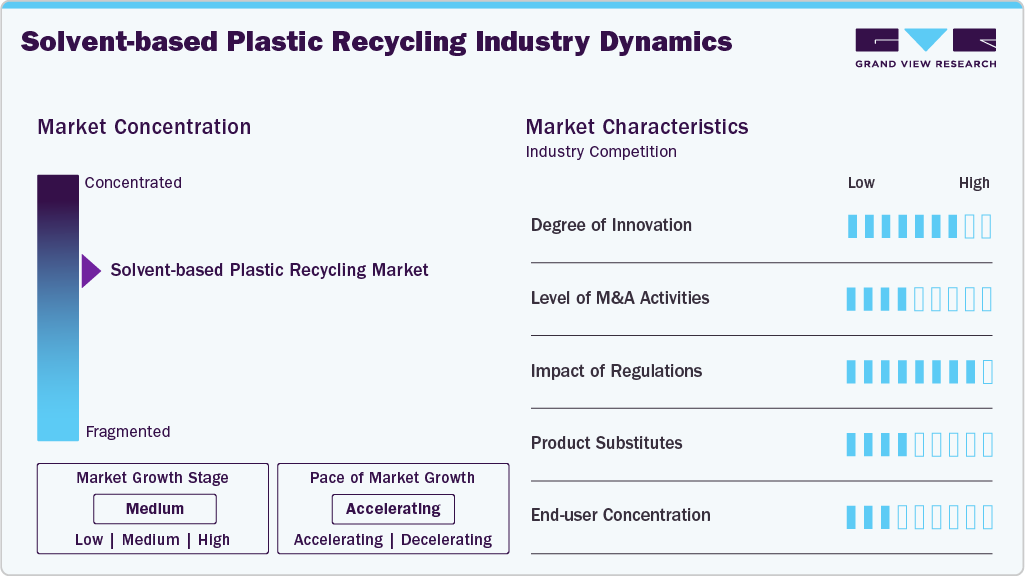
Solvent-based purification competes with mechanical reprocessing, thermal pyrolysis, and chemical depolymerization. Mechanical recycling remains the lowest cost for clean, mono-material streams, though it struggles with multilayer and contaminated waste. Thermal and depolymerization routes recover hydrocarbons or monomers, yet can degrade polymer identity and incur high energy penalties. Solvent processes fill the technical gap by preserving polymer chains and enabling food-grade outputs from complex feedstocks, while remaining more capital-intensive than mechanical options.
Product Insights
The polystyrene segment dominated the market in terms of revenue, accounting for 46.5% market share in 2025, and is forecast to grow at a 6.7% CAGR from 2026 to 2033. Polystyrene (PS) is one of the most important plastics and is widely used in daily life in electronics, building materials, packaging, and food containers. According to Plastics Europe, more than 15 million tons of PS are produced per year globally, but only a small fraction of this is recycled. The rate of recycling is so low since not all recyclable plastics are collected and taken to recycling facilities. Also, existing recycling technologies can only recycle certain types of PS.
The polyethylene segment is expected to expand at a CAGR of 8.6% over the forecast period. It is the most recycled plastic globally. Solvent-based PET recycling has certain advantages over mechanical recycling. For example, Worn Again, a UK-based company, has developed technology to recycle PET packaging, which includes bottles, based on solvent-based recycling. The major advantage of this method over mechanical recycling is the removal of dyes, which affect the quality of recycled material. Dyed textiles and colored plastics are less valuable as secondary feedstock for products compared to uncolored transparent materials. In order to be economically viable, the solvent has to be recycled.
Application Insights
The packaging segment led the market, accounting for 38.9% of revenue in 2025, and is projected to grow at a 7.5% CAGR from 2026 to 2033. Most of the plastic packaging materials manufactured today are composites made of distinct polymer layers, i.e., multilayer films. Annually billions of tons of multilayer films are produced and because of inefficiencies in manufacturing result in huge post-industrial waste streams. There are no commercially practiced technologies to fully deconstruct postindustrial multilayer plastic wastes into virgin, recyclable polymers. The main plastic types found in the packaging are polyethylene terephthalate (PET), high-density polyethylene (HDPE), low-density polyethylene (LDPE), and polypropylene (PP). Together, these plastics constitute eighty-five percent of single-use plastic. The remaining two major resin types, polystyrene (PS) and polyvinyl chloride (PVC) constitute less than ten percent. Solvent-based recycling can be of use in recycling such composite plastic materials.
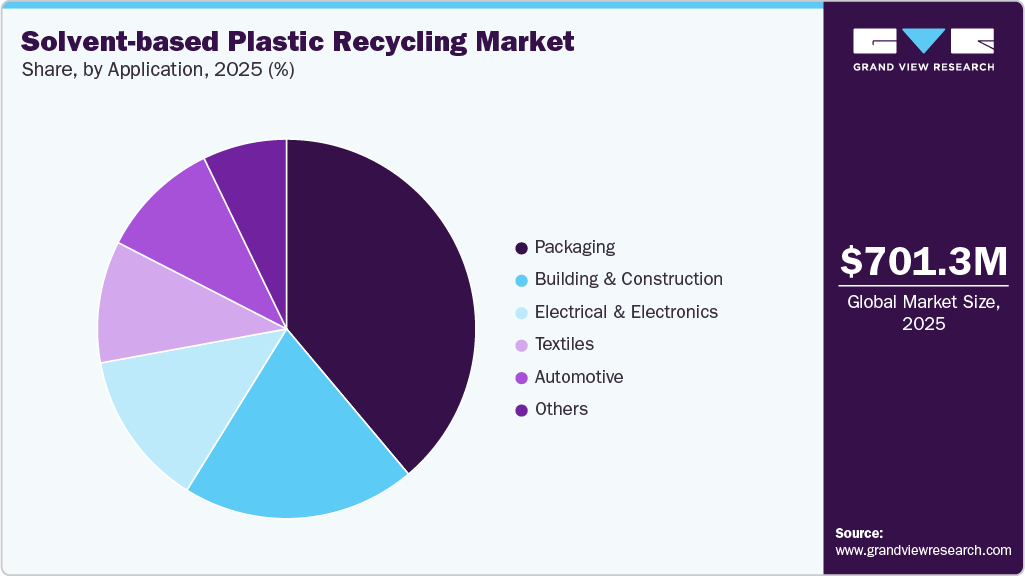
The building & construction segment is expected to grow at the fastest CAGR of 7.8% over the forecast period in the automotive solvent-based plastic recycling glazing market. Construction markets require consistent material performance and low levels of legacy additives for insulation and structural uses. Solvent-based projects have delivered recycled polystyrene from construction waste that meets strict contaminant criteria, enabling direct reuse in building products. CreaSolv project outcomes demonstrate that solvent purification can remove legacy flame retardants and other contaminants to below regulatory thresholds. This capability creates a clear demand pull from specifiers and contractors focused on sustainable material sourcing.
Regional Insights & Trends
The Europe solvent-based plastic recycling industry held the largest revenue share of 64.0% in 2025. The region is expected to grow at a CAGR of 7.4% over the forecast period. Regulatory tightening and coordinated industry advocacy are creating clear commercial pathways for dissolution routes. European associations are publishing guidance and forming task forces to define technical and traceability criteria for solvent-recycled outputs. This alignment reduces uncertainty for brand owners seeking compliant recycled-content suppliers. Consolidation by chemical producers and targeted national funding schemes accelerate capacity deployment and create a predictable demand base for high-grade recyclates in packaging and specialty applications.
Germany Solvent-based Plastic Recycling Market Trends
Germany's solvent-based plastic recycling industry is driven by stringent packaging rules and active industrial consolidation, which are dual catalysts for solvent recycling. Tighter recycled-content obligations increase demand for high-quality recyclate and push brand owners toward verified purification routes. At the same time, strategic acquisitions of solvent technology firms signal incumbents’ intent to integrate advanced recycling into core operations. This combination of regulatory pressure and corporate consolidation makes Germany a priority market for early commercial solvent-based capacity.
North America Solvent-based Plastic Recycling Market Trends
The solvent-based plastic recycling industry in North America is driven by demand-driven scale-up from integrated producers. Large specialty resin makers have announced early commercial molecular and dissolution lines to secure recycled feedstock for automotive and packaging grades. These projects validate technology and lower perceived execution risk for financiers. Strategic partnerships between converters and recyclers are creating guaranteed offtake channels. The result is faster capital deployment for solvent-based plants that target high-value polymer recovery.
Federal policy and infrastructure planning are strengthening the investment case for solvent processes. National recycling objectives and targeted funding for materials recovery improve market certainty for advanced recycling plants. Regulatory focus on improving markets for recyclates encourages collaborations between brands and technology owners to pilot food-contact qualified outputs. This combination of policy signal and public financing is accelerating permitting and bankability for commercial solvent-based facilities.
Asia Pacific Solvent-based Plastic Recycling Market Trends
The solvent-based plastic recycling industry in Asia Pacific is driven by regional policy harmonization and industrial support. Japan’s ministry-level circularity programs and industry subsidies enable pilots and scale-up for high-quality recyclate. South Korean regulatory moves to mandate recycled content in large-volume polymer producers are increasing feedstock demand. China’s standards development for recycled plastics is raising technical expectations and creating larger domestic markets for solvent-purified polymers. Together, these measures produce a policy-led pull for solvent-based solutions.
Key Solvent-based Plastic Recycling Company Insights
The solvent-based plastic recycling industry is highly competitive, with several key players dominating the landscape. Major companies include Solvay, Sulzer Ltd, Trinseo, Procter & Gamble, APK AG, Fraunhofer, PolystyreneLoop, PureCycle Technologies Inc, and Saperatec GmbH. The solvent-based plastic recycling industry is characterized by a competitive landscape with several key players driving innovation and market growth. Major companies in this sector are investing heavily in research and development to enhance the performance, cost-effectiveness, and sustainability of their products.
Key Solvent-based Plastic Recycling Companies:
The following key companies have been profiled for this study on the solvent-based plastic recycling market.
- Solvay
- Sulzer Ltd
- Trinseo
- Procter & Gamble
- APK AG
- Fraunhofer
- PolystyreneLoop
- PureCycle Technologies Inc
- Saperatec GmbH
Recent Developments
-
In September 2025, INEOS formed a partnership with a dissolution-technology firm to scale polystyrene recycling. The collaboration pairs INEOS’s downstream reach with the technology owner’s purification know-how to accelerate collection, processing capacity, and offtake for recycled styrenic resins.
-
In April 2025, Polystyvert announced an expansion of its dissolution platform and a rebrand to UpSolv to process a broader range of thermoplastics. The company signalled readiness to move beyond styrenics with pilot commercial runs and new feedstock partnerships.
Solvent-Based Plastic Recycling Market Report Scope
Report Attribute
Details
Market size value in 2026
USD 743.1 million
Revenue forecast in 2033
USD 1,222.6 million
Growth rate
CAGR of 7.4% from 2026 to 2033
Historical data
2021 - 2025
Forecast period
2026 - 2033
Quantitative units
Volume in kilotons; revenue in USD million/billion, and CAGR from 2026 to 2033
Report coverage
Revenue & volume forecast, competitive landscape, growth factors, and trends
Segments covered
Product, application, region
Regional scope
North America; Europe; Asia Pacific; Central & South America; Middle East & Africa
Country scope
U.S.; Canada; Mexico; Germany; UK; China; India; Japan
Key companies profiled
Solvay; Sulzer Ltd; Trinseo; Procter & Gamble; APK AG; Fraunhofer; PolystyreneLoop; PureCycle Technologies Inc; Saperatec GmbH
Customization scope
Free report customization (equivalent to up to 8 analyst working days) with purchase. Addition or alteration to country, regional & segment scope
Pricing and purchase options
Avail customized purchase options to meet your exact research needs. Explore purchase options
Global Solvent-based Plastic Recycling Market Report Segmentation
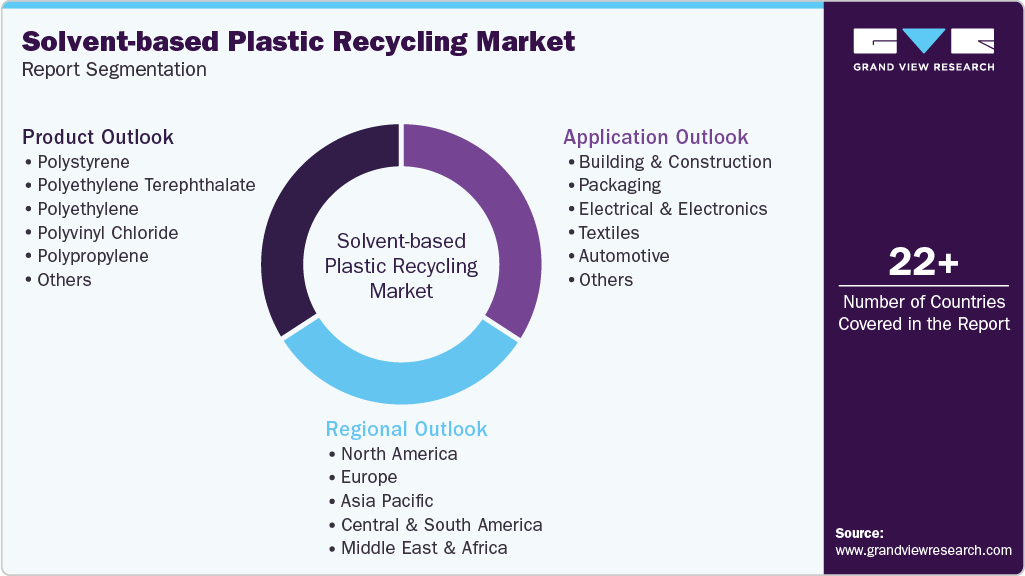
This report forecasts volume & revenue growth at the global, regional, and country levels and provides an analysis of the latest industry trends across sub-segments from 2021 to 2033. For this study, Grand View Research has segmented the global solvent-based plastic recycling market report based on product, application, and region:
-
Product Outlook (Volume, Kilotons; Revenue, USD Million, 2021 - 2033)
-
Polystyrene
-
Polyethylene Terephthalate
-
Polyethylene
-
Polyvinyl Chloride
-
Polypropylene
-
Others
-
-
Application Outlook (Volume, Kilotons; Revenue, USD Million, 2021 - 2033)
-
Building & Construction
-
Packaging
-
Electrical & Electronics
-
Textiles
-
Automotive
-
Others
-
-
Regional Outlook (Volume, Kilotons; Revenue, USD Million, 2021 - 2033)
-
North America
-
U.S.
-
Canada
-
Mexico
-
-
Europe
-
Germany
-
UK
-
-
Asia Pacific
-
China
-
India
-
Japan
-
-
Central & South America
-
Middle East & Africa
-
Frequently Asked Questions About This Report
b. The global solvent-based plastic recycling market size was estimated at USD 701.3 million in 2025 and is expected to reach USD 743.1 million in 2026.
b. The global solvent-based plastic recycling market is expected to grow at a compound annual growth rate of 7.4% from 2026 to 2033 to reach USD 1,222.6 million by 2033.
b. The polystyrene segment dominated the market across product segmentation in terms of revenue, accounting for 46.5% market share in 2025, and is forecast to grow at a 6.7% CAGR from 2026 to 2033.
b. Some key players operating in the solvent-based plastic recycling market include Solvay, Sulzer Ltd, Trinseo, Procter & Gamble, APK AG, Fraunhofer, PolystyreneLoop, PureCycle Technologies Inc, and Saperatec GmbH.
b. Advances in solvent recovery and process optimization are reducing operating costs and improving yield consistency for solvent-based recycling. This strengthens investor confidence and enables more competitive pricing versus virgin polymers, accelerating commercial adoption.


Share this report with your colleague or friend.
Need a Tailored Report?
Customize this report to your needs — add regions, segments, or data points, with 20% free customization.


ISO 9001:2015 & 27001:2022 Certified
We are GDPR and CCPA compliant! Your transaction & personal information is safe and secure. For more details, please read our privacy policy.
Trusted market insights - try a free sample
See how our reports are structured and why industry leaders rely on Grand View Research. Get a free sample or ask us to tailor this report to your needs.