- Home
- »
- Communications Infrastructure
- »
-
Social Commerce Market Size, Share, Industry Report 2033GVR Report cover
![Social Commerce Market Size, Share & Trends Report]()
Social Commerce Market (2026 - 2033) Size, Share & Trends Analysis Report By Business Model (B2B, B2C, C2C), By Product Type (Personal & Beauty Care, Apparel, Accessories, Home Products, Health Supplements), By Platform/ Sales Channel, By Region, And Segment Forecasts
- Report ID: GVR-4-68039-318-0
- Number of Report Pages: 120
- Format: PDF
- Historical Range: 2021 - 2025
- Forecast Period: 2026 - 2033
- Industry: Technology
- Report Summary
- Table of Contents
- Interactive Charts
- Methodology
- Download FREE Sample
-
 Download Sample Report
Social Commerce Market Summary
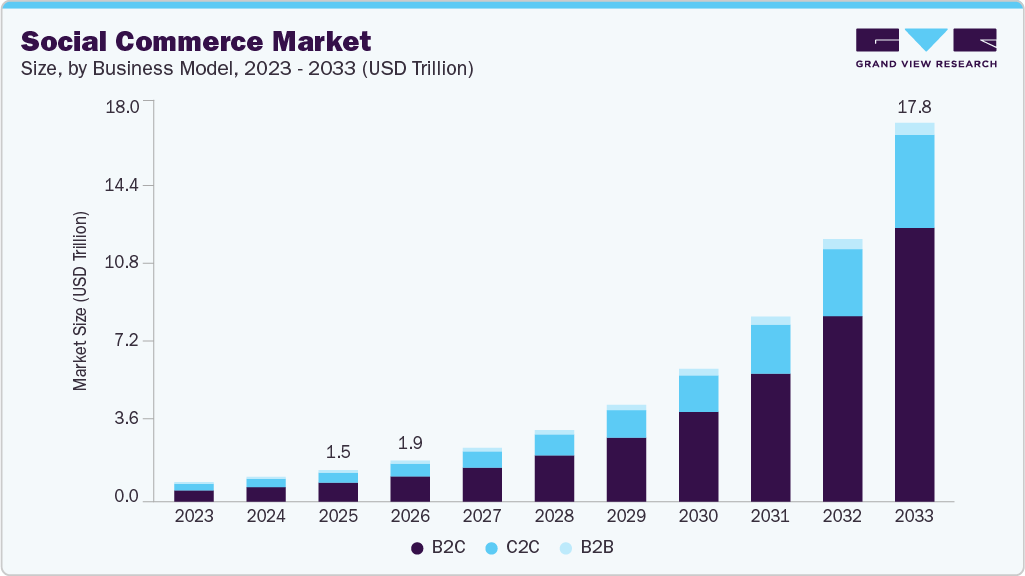
The global social commerce market size was estimated at USD 1,484.46 billion in 2025 and is projected to reach USD 17,828.84 billion by 2033, growing at a CAGR of 37.4% from 2026 to 2033. The growth can be attributed to the integration of social media platforms into everyday consumer behavior and purchasing journeys.
Key Market Trends & Insights
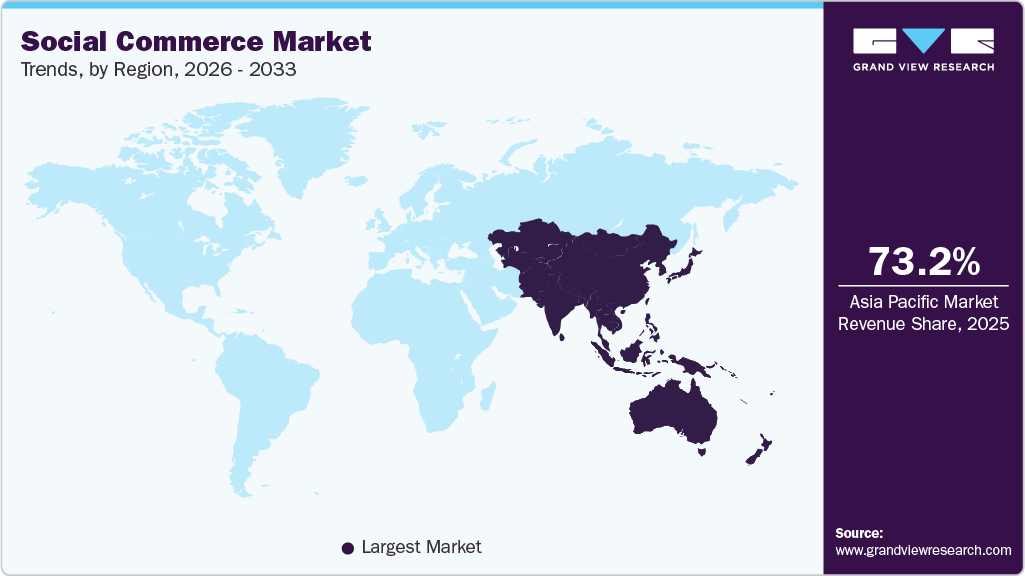
- Asia Pacific social commerce dominated the global market with the largest revenue share of 73.2% in 2025.
- The social commerce industry in U.S. is expected to grow significantly over the forecast period.
- By business model, B2C led the market and held the largest revenue share of 60.3% in 2025.
- By product type, the personal & beauty care segment held the dominant position in the market and accounted for the largest revenue share in 2025.
- By platform/sales channel, the social network-led commerce segment is expected to grow at the fastest CAGR from 2026 to 2033.
Market Size & Forecast
- 2025 Market Size: USD 1,484.46 Billion
- 2033 Projected Market Size: USD 17,828.84 Billion
- CAGR (2026-2033): 37.4%
- Asia Pacific: Largest market in 2025
Social networks such as Instagram, Facebook, TikTok, and Pinterest have evolved from pure engagement platforms into full-fledged shopping ecosystems, enabling product discovery, evaluation, and checkout within a single interface. This convergence significantly reduces purchase friction, shortens the customer decision cycle, and increases impulse buying, particularly among millennials and Gen Z consumers who prefer seamless, mobile-first shopping experiences.The increasing influence of creator-led and influencer-driven commerce contributes to the growth of the social commerce industry. Brands are leveraging trusted content creators, live streamers, and micro-influencers to deliver authentic product recommendations and real-time demonstrations. Live commerce formats combining entertainment, social interaction, and instant purchasing are proving highly effective in boosting conversion rates and customer engagement. The credibility and relatability of influencers overcome trust barriers in online shopping, especially in categories such as fashion, beauty, electronics, and lifestyle products.
The accelerating transition toward mobile-first internet adoption is a key catalyst for the growth of the social commerce industry. In many regions, particularly emerging economies, smartphones have become the primary gateway for online access and shopping activities. The availability of integrated digital payment solutions, including global platforms such as Apple Pay and Google Pay alongside country-specific systems such as India’s UPI and regional e-wallets, has simplified checkout processes while improving transaction security. When paired with mobile-friendly social platforms and intuitive user interfaces, these capabilities are driving higher engagement and purchase conversions, supporting the rapid scaling of social commerce across both developed and developing markets. According to the GSMA Association’s State of Mobile Internet Connectivity 2025 report, approximately 4.7 billion people representing about 58% of the world’s population, now have access to mobile internet through their devices.
Advancements in AI-driven personalization and data analytics are further accelerating social commerce adoption. Platforms use AI to analyze user behavior, preferences, and social interactions to deliver highly targeted product recommendations, personalized feeds, and dynamic pricing or promotions. Features such as shoppable posts, in-app checkout, augmented reality (AR) try-ons, and chat-based commerce enhance user experience and drive higher average order values. These technologies enable brands to optimize marketing spend while improving conversion efficiency.
Business Model Insights
The B2C segment dominated the market and accounted for the revenue share of 60.3% in 2025, driven by the shift toward impulse-led, experience-centric online shopping enabled by social media platforms. Consumers increasingly rely on social feeds, influencer content, peer reviews, and short-form videos for product discovery and validation, making social platforms a natural point of purchase rather than just marketing channels. Integrated features such as shoppable posts, live-stream shopping, in-app checkout, personalized recommendations, and instant customer interaction reduce friction and accelerate purchase decisions.
The C2C segment is anticipated to grow at the fastest CAGR during the forecast period due to the growing trust in peer-to-peer transactions enabled by social platforms and community-driven interactions. Consumers are increasingly comfortable buying and selling directly with other individuals through social networks, resale marketplaces, and group-based commerce due to transparent user profiles, ratings, reviews, and social validation mechanisms.
Product Type Insights
The personal & beauty care segment dominated the market and accounted for the largest revenue share in 2025, driven by the rising consumer emphasis on self-care, wellness, and appearance, supported by increasing exposure to beauty trends through social media and influencer marketing. Platforms such as Instagram, TikTok, and YouTube play a pivotal role in shaping purchasing decisions through tutorials, reviews, and live demonstrations, accelerating product discovery and trial. Growing demand for clean-label, natural, organic, and cruelty-free products.
The apparel segment is expected to grow at a significant CAGR during the forecast period due to the highly visual and trend-driven nature of fashion, which aligns naturally with social media platforms. Short-form videos, influencer styling content, user-generated reviews, and live shopping events enable real-time trend discovery and instant purchasing, significantly accelerating fashion adoption cycles. Features such as shoppable posts, live try-ons, size recommendations powered by AI, and augmented reality fitting tools reduce purchase hesitation and return rates.
Platform/ Sales Channel Insights
The video commerce (live stream + prerecorded) segment dominated the market and accounted for the largest revenue share in 2025 due to its ability to combine visual storytelling, real-time engagement, and instant purchasing within a single commerce journey. Video formats enable brands to demonstrate product features, usage, and value more effectively than static images or text, significantly improving customer trust and conversion rates. Live streaming, in particular, drives urgency through limited-time offers, interactive Q&A, and social proof, while prerecorded videos provide scalable, on-demand content that supports product discovery across platforms.
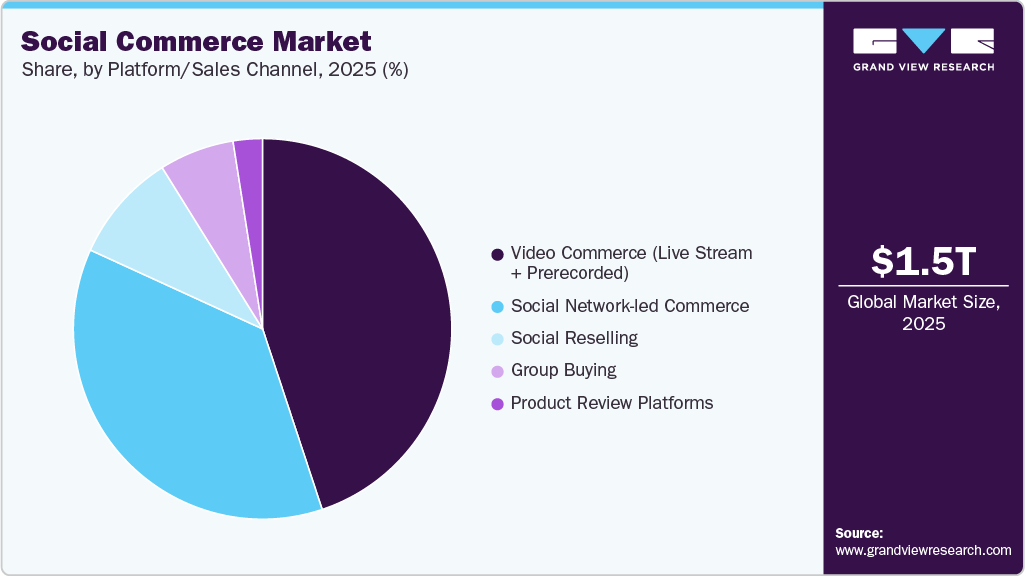
The social network-led commerce segment is expected to grow at a significant CAGR over the forecast period, due to advanced data analytics and AI-powered targeting enable brands to deliver highly personalized commerce experiences at scale, making social networks a preferred channel for both large enterprises and D2C brands seeking efficient customer acquisition and higher return on marketing spend.
Regional Insights
North America social commerce market held a significant share in the global market in 2025 driven bythe widespread adoption of advanced e-commerce infrastructure and high consumer trust in digital transactions. Mature logistics networks, strong data privacy frameworks, and seamless integration of social platforms with established online retail systems enable consumers to complete purchases confidently within social apps.
U.S. Social Commerce Market Trends
The social commerce market in the U.S. is expected to grow significantly at a CAGR of 33.4% from 2026 to 2033, due to the commercialization of creator economies and performance-driven social advertising. Social platforms serve as key customer acquisition channels where brands leverage influencer partnerships, affiliate storefronts, and paid social tools to directly monetize content.
Europe Social Commerce Market Trends
The social commerce market in Europe is anticipated to register considerable growth from 2026 to 2033 due to rising cross-border digital trade and localized social shopping experiences. Brands are increasingly using social platforms to reach consumers across multiple countries with localized content, pricing, and language-specific storefronts. The region’s strong emphasis on sustainability and ethical consumption also supports social commerce, as brands use storytelling and community engagement to communicate transparency, origin, and values directly through social channels.
The UK social commerce market is expected to grow rapidly over the forecast period, owing to the rapid adoption of mobile-first shopping combined with high social media penetration. British consumers are highly engaged with short-form video, live content, and community-driven brand interactions, which translates into higher conversion rates on social platforms. Retailers are using social commerce to complement traditional online retail amid intense competition, leveraging limited-time drops, live product launches, and exclusive social-only offers to drive urgency and engagement.
The Germany social commerce market held a substantial market share in 2025 due to the integration of trusted payment methods and compliance-focused platform design. Consumers in Germany prioritize security, transparency, and regulatory compliance, prompting platforms to embed secure payment options and clear return policies within social shopping features.
Asia Pacific Social Commerce Market Trends
Asia Pacific dominated the global market with the largest revenue share of 72.3% in 2025, due tothe convergence of social media, messaging apps, and digital wallets into super-app ecosystems. Consumers in the region are accustomed to discovering, evaluating, and purchasing products within a single app environment.
Social commerce market in Japan is expected to grow rapidly in the coming years, driven by brand-led community building and high-quality content integration within social platforms. Japanese consumers value product authenticity, detailed information, and brand reputation, encouraging companies to use social commerce for storytelling, limited-edition launches, and fan-based engagement.
The China social commerce market held a substantial market share in 2025, due to large-scale live commerce ecosystems and platform-led monetization models. Social networks and content platforms deeply integrate live streaming, influencer storefronts, group buying, and instant checkout, turning social engagement directly into high-frequency transactions.
Key Social Commerce Company Insights
Key players operating in the social commerce industry are Meta Platforms, Inc. (Facebook), TikTok (Douyin), Taobao, WeChat (Weixin), Pinduoduo Inc., and Pinterest, Inc. The companies are focusing on various strategic initiatives, including new product development, partnerships & collaborations, and agreements to gain a competitive advantage over their rivals. The following are some instances of such initiatives.
Key Social Commerce Companies:
The following key companies have been profiled for this study on the social commerce market.
- Etsy, Inc.
- Fashnear Technologies Private Limited (Meesho)
- Meta Platforms, Inc. (Facebook)
- Pinduoduo Inc.
- Pinterest, Inc.
- Poshmark
- Roposo
- Snap, Inc.
- Taobao
- TikTok (Douyin)
- Trell Shop
- Twitter, Inc.
- WeChat (Weixin)
- Xiaohongshu
- Yunji Sharing Technology Co., Ltd.
Recent Developments
-
In September 2025, Pinterest, Inc. unveiled a suite of new advertising solutions aimed at enhancing visual shopping experiences. The company introduced Top of Search ads and additional tools designed to assist shoppers transition seamlessly from inspiration to purchase, while providing brands with smarter ways to capture consumer intent and drive engagement in a visually-driven commerce environment.
-
In February 2025, Snap Inc. partnered with Later, an influencer marketing and social media management platform, to transform creator collaborations on Snapchat. The partnership introduces two major capabilities: enabling brands to discover creator profiles directly within Later’s platform and automating content scheduling and posting via Snapchat’s APIs. Later becomes the first platform to integrate both Snapchat’s Public Profile API for organic posting and Creator Discovery API, streamlining content management and creator engagement for marketers.
Social Commerce Market Report Scope
Report Attribute
Details
Market size in 2026
USD 1,925.34 billion
Revenue forecast in 2033
USD 17,828.84 billion
Growth rate
CAGR of 37.4% from 2026 to 2033
Actual data
2021 - 2025
Forecast period
2026 - 2033
Quantitative units
Revenue in USD million/billion, and CAGR from 2026 to 2033
Report enterprise size
Revenue forecast, company share, competitive landscape, growth factors, and trends
Segments covered
Business model, product type, platform/sales channel, region
Regional scope
North America; Europe; Asia Pacific; Latin America; MEA
Country scope
U.S.; Canada; Mexico; UK; Germany; France; China; India; Japan; Australia; South Korea; Brazil; UAE; Kingdom of Saudi Arabia; South Africa
Key companies profiled
Etsy, Inc.; Fashnear Technologies Private Limited (Meesho); Meta Platforms, Inc. (Facebook); Pinduoduo Inc.; Pinterest, Inc.; Poshmark; Roposo; Snap, Inc.; Taobao; TikTok (Douyin); Trell Shop; Twitter, Inc.; WeChat (Weixin); Xiaohongshu; Yunji Sharing Technology Co., Ltd.
Customization scope
Free report customization (equivalent to 8 analysts working days) with purchase. Addition or alteration to country, regional & segment scope.
Pricing and purchase options
Avail customized purchase options to meet your exact research needs. Explore purchase options
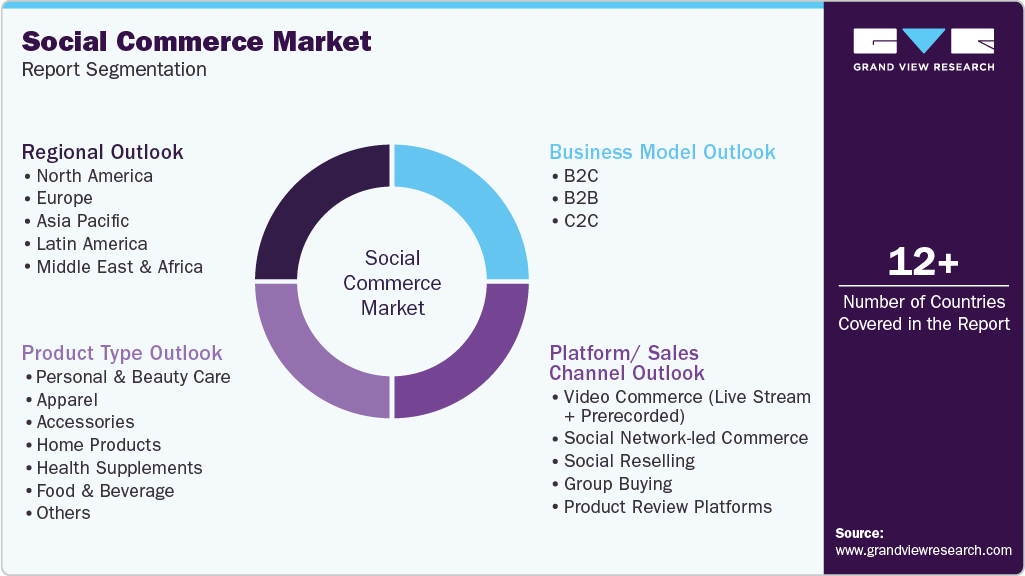
Global Social Commerce Market Report Segmentation
This report forecasts revenue growth at the global, regional, and country levels and provides an analysis of the latest industry trends in each of the sub-segments from 2021 to 2033. For this study, Grand View Research has segmented the global social commerce market report based on business model, product type, platform/sales channel, and region:
-
Business Model Outlook (Revenue, USD Billion, 2021 - 2033)
-
B2C
-
B2B
-
C2C
-
-
Product Type Outlook (Revenue, USD Billion, 2021 - 2033)
-
Personal & Beauty Care
-
Apparel
-
Accessories
-
Home Products
-
Health Supplements
-
Food & Beverage
-
Others
-
-
Platform/Sales Channel Outlook (Revenue, USD Billion, 2021 - 2033)
-
Video Commerce (Live stream + Prerecorded)
-
Social Network-led Commerce
-
Social Reselling
-
Group Buying
-
Product review platforms
-
-
Regional Outlook (Revenue, USD Billion, 2021 - 2033)
-
North America
-
U.S.
-
Canada
-
Mexico
-
-
Europe
-
UK
-
Germany
-
France
-
-
Asia Pacific
-
China
-
India
-
Japan
-
South Korea
-
Australia
-
-
Latin America
-
Brazil
-
-
Middle East & Africa
-
UAE
-
Saudi Arabia
-
South Africa
-
-
Frequently Asked Questions About This Report
b. Some key players operating in the social commerce market include Etsy, Inc., Fashnear Technologies Private Limited (Meesho), Meta Platforms, Inc. (Facebook), Pinduoduo Inc., Pinterest, Inc., Poshmark, Roposo, Snap, Inc., Taobao, TikTok (Douyin), Trell Shop, Twitter, Inc., WeChat (Weixin), Xiaohongshu, Yunji Sharing Technology Co., Ltd.
b. Key factors driving the social commerce market growth include the increasing global penetration of social media platforms. These platforms have evolved from mere networking tools into powerful sales channels with integrated shopping functionalities.
b. The global social commerce market size was estimated at USD 1,484.46 billion in 2025 and is expected to reach USD 17,828.84 billion in 2026.
b. The global social commerce market is expected to grow at a compound annual growth rate of 37.4% from 2026 to 2033 to reach USD 17,828.84 billion by 2033.
b. Asia Pacific region dominated the global social commerce market with a share of 72.3% in 2025. This is attributed to the mobile-first nature of digital consumers, high population density, and deep smartphone penetration. A cultural inclination toward community-based shopping, gamified commerce, and live-stream interactions further enhances platform stickiness and user engagement.


Share this report with your colleague or friend.
Need a Tailored Report?
Customize this report to your needs — add regions, segments, or data points, with 20% free customization.


ISO 9001:2015 & 27001:2022 Certified
We are GDPR and CCPA compliant! Your transaction & personal information is safe and secure. For more details, please read our privacy policy.
Trusted market insights - try a free sample
See how our reports are structured and why industry leaders rely on Grand View Research. Get a free sample or ask us to tailor this report to your needs.