- Home
- »
- Electronic & Electrical
- »
-
Smart Rings Market Size & Share, Industry Report, 2033GVR Report cover
![Smart Rings Market Size, Share & Trends Report]()
Smart Rings Market (2026 - 2033) Size, Share & Trends Analysis Report By Application (Notifications, Security), By Technology (Bluetooth-enabled, NFC-enabled), By Distribution Channel (Offline, Online), By Region, And Segment Forecasts
- Report ID: GVR-4-68040-490-0
- Number of Report Pages: 100
- Format: PDF
- Historical Range: 2021 - 2025
- Forecast Period: 2026 - 2033
- Industry: Consumer Goods
- Report Summary
- Table of Contents
- Segmentation
- Methodology
- Download FREE Sample
-
 Download Sample Report
Smart Rings Market Summary
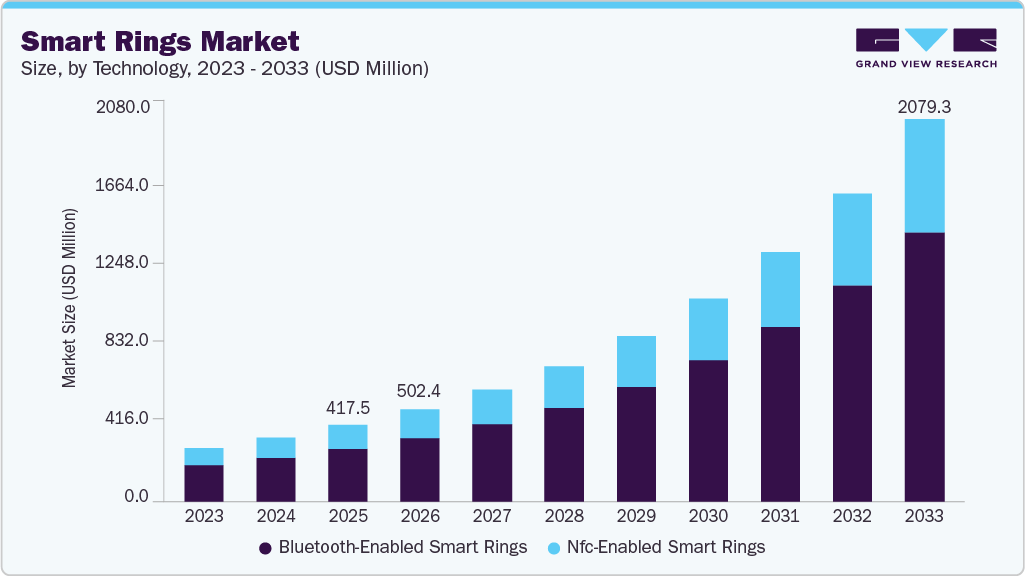
The global smart rings market size was estimated at USD 417.5 million in 2025 and is projected to reach USD 2,079.3 million by 2033, growing at a CAGR of 22.5% from 2026 to 2033. One of the primary drivers of the market is the increasing global adoption of smartphones.
Key Market Trends & Insights
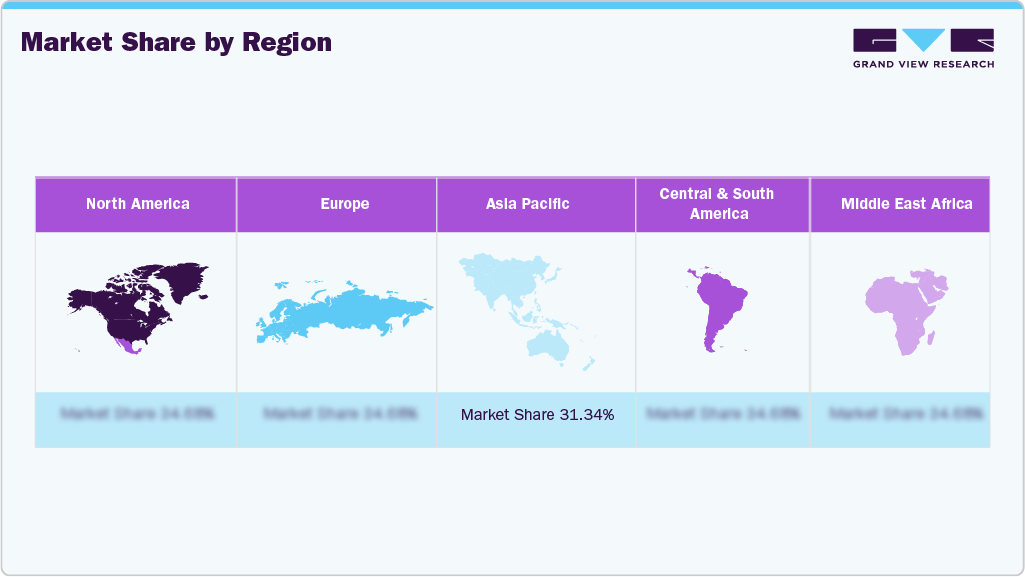
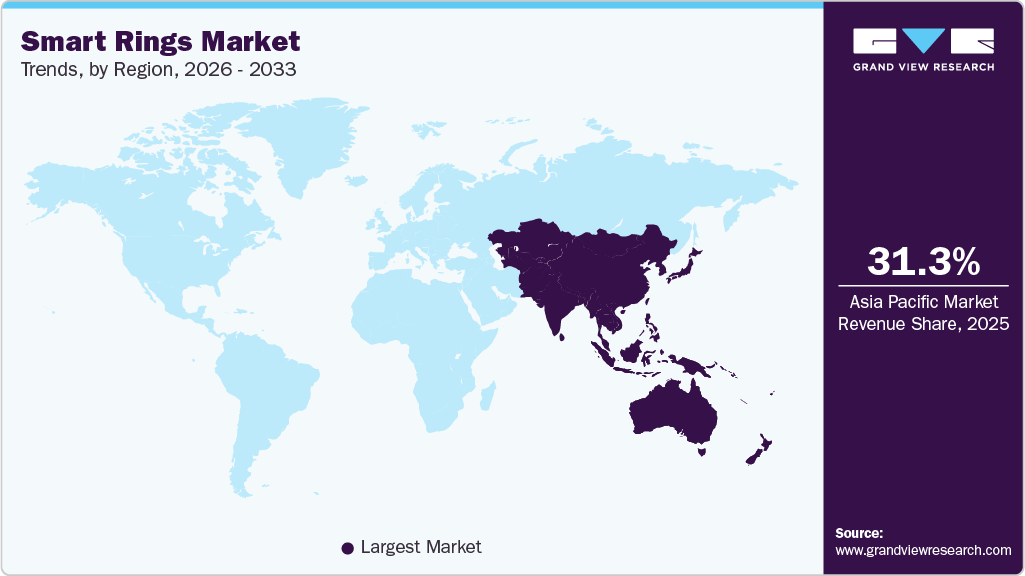
- Asia Pacific dominated the smart rings market with the largest revenue share of 31.34% in 2025.
- The smart rings market in the U.S. accounted for the largest market share in North America in 2025.
- Based on technology, the Bluetooth-enabled segment led the market with the largest revenue share of 68.72% in 2025.
- Based on application, the health & wellness segment led the market with the largest revenue share of 43.88% in 2025.
- Based on distribution channel, the online segment led the market with the largest revenue share of 62.99% in 2025.
Market Size & Forecast
- 2025 Market Size: USD 417.5 Million
- 2033 Projected Market Size: USD 2,079.3 Million
- CAGR (2026-2033): 22.5%
- Asia Pacific: Largest market in 2025
As smartphones become ubiquitous, they facilitate the integration of smart rings with other devices, enhancing their functionality. The tech-savvy population, particularly among younger demographics, is increasingly inclined towards wearable technology that offers convenience and connectivity. This trend fosters a favorable environment for adopting smart rings as they provide seamless access to notifications and applications directly from the user's finger. The evolution of microelectronics and sensor technology has significantly contributed to the market growth.Innovations in miniaturization enable manufacturers to incorporate advanced features into these compact devices without compromising performance or comfort. This technological progress allows smart rings to offer functionalities such as health monitoring, contactless payments, and data transfer, making them attractive to many consumers. Furthermore, advancements in artificial intelligence are enhancing user experiences by enabling personalized interactions with these devices.
There is a notable shift in consumer health consciousness, driving demand for wearable devices that facilitate health tracking. Smart rings are increasingly being recognized for their ability to monitor vital health metrics such as heart rate, sleep patterns, and physical activity levels.
This growing awareness of personal health management aligns with the rising popularity of fitness tracking technologies, making smart rings an appealing choice for health-conscious individuals. The convenience of continuous health monitoring offered by these devices supports the trend toward preventive healthcare. For instance, in January 2026, Dreame entered the wearables market with the launch of AI-enabled smart rings featuring ECG-based health monitoring, signaling its expansion beyond home appliances into personal health and lifestyle technology.
The trend towards contactless payment systems has emerged as a significant market driver for smart rings. As consumers seek more convenient and secure payment methods, smart rings equipped with Near Field Communication (NFC) technology are gaining traction. This functionality not only simplifies transactions but also aligns with the increasing demand for contactless solutions in various retail environments. The integration of payment capabilities into smart rings positions them as versatile tools that enhance everyday transactions.
In December 2025, Linktop partnered with Infineon to launch the world’s first NFC smart ring supporting the SECORA e wallet, enabling secure contactless payments, digital access, and health-tracking features.
The fusion of technology with fashion is another key factor driving market growth. Manufacturers are increasingly focusing on creating stylish designs that appeal to consumers looking for fashionable yet functional accessories. This emphasis on aesthetics allows smart rings to attract a broader audience beyond traditional tech enthusiasts, positioning them as trendy wearable devices suitable for various occasions. The growing acceptance of wearable technology as a fashion statement continues to fuel market growth. For instance, in December 2025, Diesel and Ultrahuman launched a smart ring in India that combines premium, fashion-led design with advanced health and activity-tracking technology, highlighting the convergence of wearables and luxury styling.
Brand Share Analysis
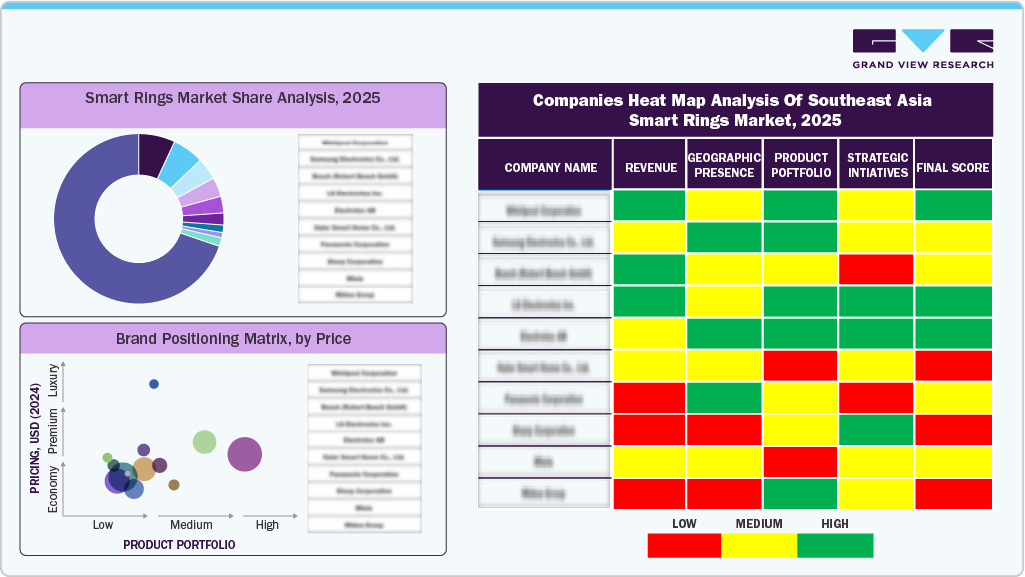
The global smart rings market is shaped by a mix of early technology pioneers, health-focused wearable specialists, and lifestyle and fashion-oriented brands targeting different consumer segments.
-
Established players: Oura, Ultrahuman, RingConn - lead health tracking with accurate sensors, sleep and recovery analytics, and strong mobile integration.
-
Premium/innovation entrants: Samsung, AI-focused brands - offer advanced biometrics, connectivity, and refined design.
-
Fashion/lifestyle brands: Diesel, luxury collaborators - combine smart ring tech with premium aesthetics.
-
Regional players (Asia Pacific): Offer competitively priced rings with health monitoring and NFC features, driving adoption among price-sensitive and style-conscious consumers.
Consumer Insights
Gender Distribution: Males make up around 55% of smart ring users, while females account for 45%. While men are early adopters driven by fitness tracking, women are increasingly attracted to devices that combine health monitoring with style and lifestyle appeal.
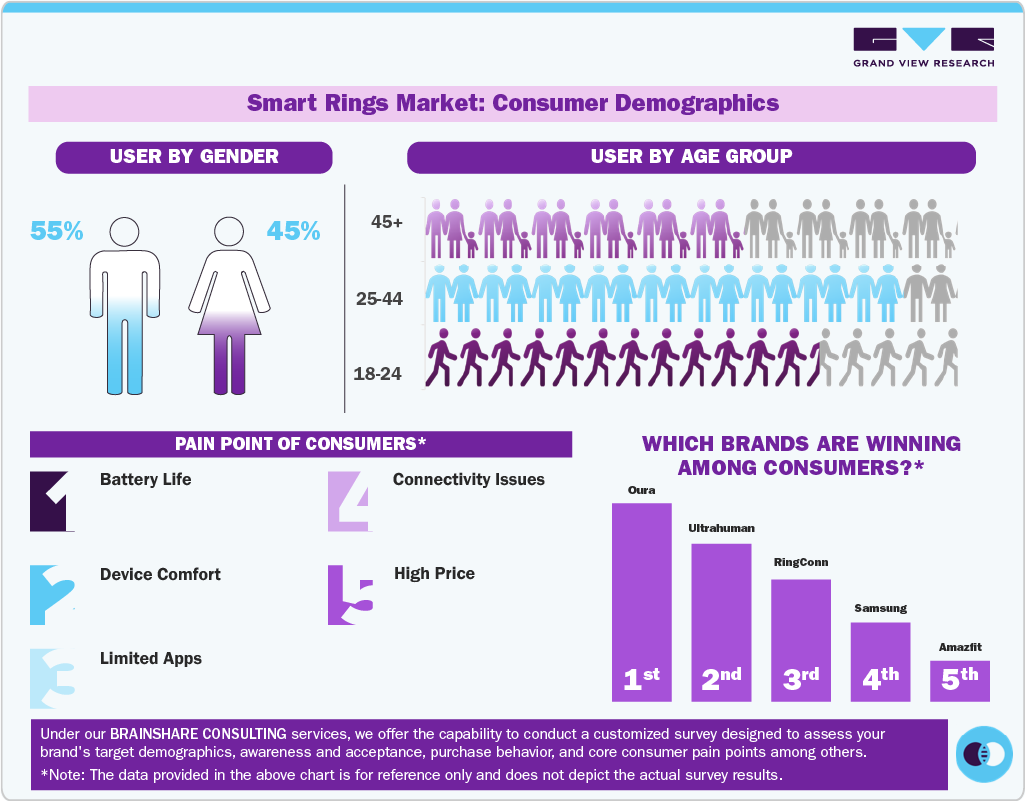
Age Group: The largest user segment is 25-44 years (50%), followed by 45+ (30%) and 18-24 (20%). This shows strong adoption among tech-savvy adults focused on wellness, while older users use smart rings for lifestyle and health tracking.
Consumer Pain Points: Key issues include battery life, device comfort, limited app support, connectivity challenges, and high price. Addressing these through longer battery, ergonomic design, and broader app ecosystems is critical for brands to retain users.
Leading Brands: Oura, Ultrahuman, RingConn, Samsung, and Amazfit are capturing consumer preference. Oura, Ultrahuman, and RingConn lead the health-tracking segment; Samsung appeals to tech-savvy users with advanced biometric features; and Amazfit offers affordable, feature-rich options for price-conscious consumers.
Pricing Analysis
The smart rings pricing in 2025 is mostly structured around functionality and brand positioning. Core health trackers sit in the mid-tier, offering advanced biometric and sleep monitoring. Tech ecosystem brands are priced higher due to connectivity and feature integration.
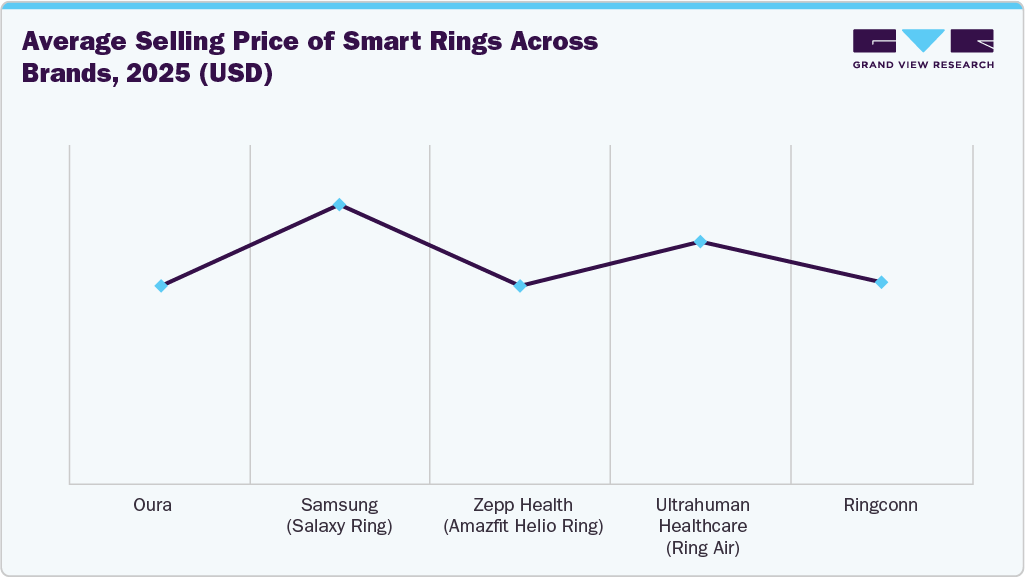
Value and regional brands focus on essential health tracking and payment features for cost-conscious consumers. Lifestyle and fashion collaborations command a premium through design and brand appeal, even if technical features are similar to mid-tier rings.
Application Insights
Based on application, the smart rings for health & wellness segment led the market with the largest revenue share of 43.88% in 2025, due to growing consumer focus on personal health, fitness, and recovery monitoring. Advanced features such as heart rate tracking, sleep and stress analysis, and integration with mobile health apps make smart rings a convenient and continuous health management tool, driving strong adoption among fitness enthusiasts, wellness-conscious adults, and early wearable adopters.
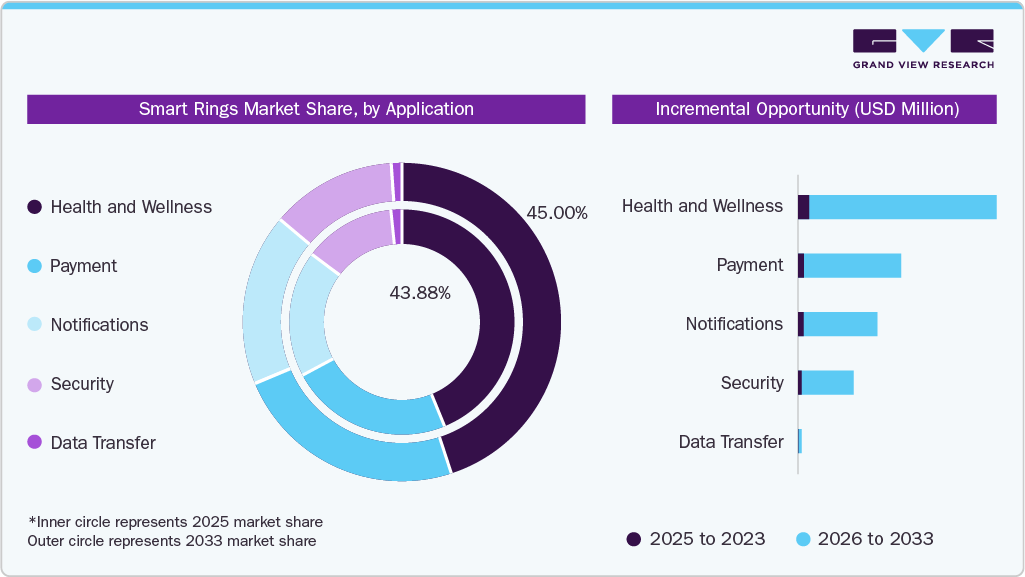
Based on application, the smart rings payment segment is anticipated to witness the fasted growth with a CAGR of 23.1% from 2026 to 2033, driven by increasing consumer adoption of contactless transactions and NFC-enabled wearables. Smart rings offering secure, convenient payment features are gaining traction in retail, transport, and fintech ecosystems, making them a preferred choice for seamless everyday transactions.
Technology Insights
Bluetooth-enabled smart rings led the market with the largest revenue share of 68.72% in 2025, due to their seamless connectivity with smartphones and wearable ecosystems, allowing real-time health tracking, notifications, and app integration. Their compatibility, low power consumption, and ease of use made them the preferred choice for consumers seeking reliable, always-on functionality in compact wearable devices.
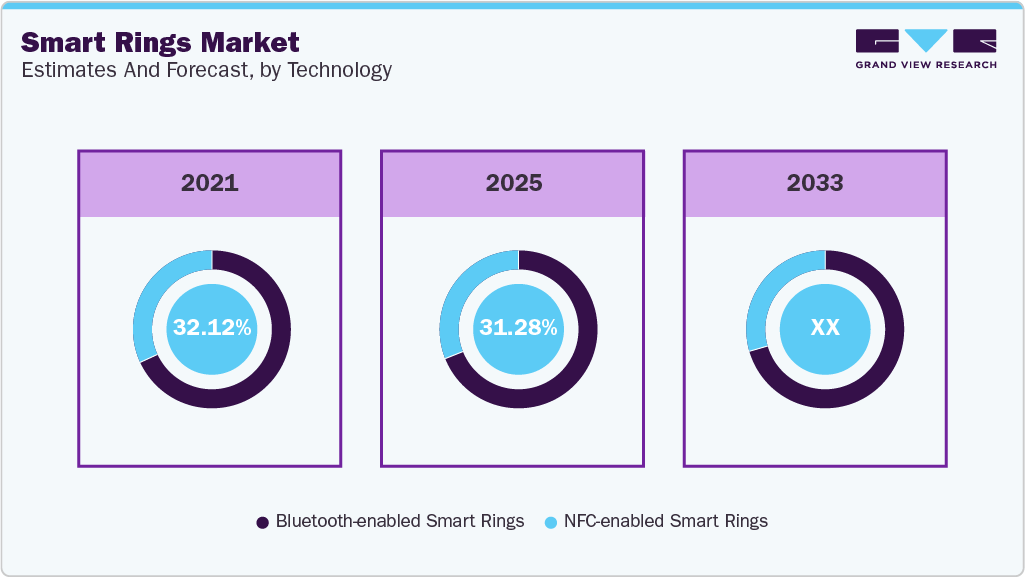
NFC-enabled smart rings are expected to witness a CAGR of 21.6% from 2026 to 2033, driven by rising demand for contactless payments, secure digital access, and integration with mobile and financial ecosystems. Their convenience, portability, and multi-functionality are boosting adoption among tech-savvy and on-the-go consumers.
Distribution Channel Insights
The sale of smart rings through online channel held a market share of 62.99% in 2025, due to strong consumer preference for direct-to-consumer websites and e-commerce platforms that offer wider product selection, transparent pricing, and access to the latest product launches. The ability to compare features, read reviews, and benefit from digital marketing and influencer promotions further supported higher online adoption.
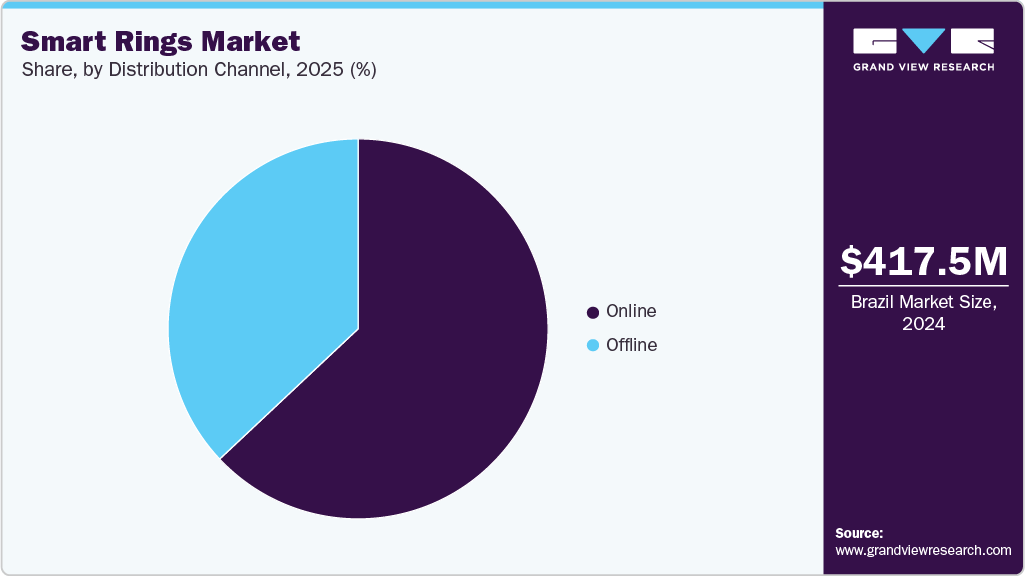
The sale of smart rings through offline channel is expected to grow at a CAGR of 22.1% from 2026 to 2033, driven by increasing consumer interest in trying wearable devices in-store, rising presence of smart rings in electronics and lifestyle retail outlets, and brand efforts to provide hands-on demonstrations and personalized guidance, enhancing purchase confidence and adoption.
Regional Insights
The Asia Pacific smart rings industry held a notable revenue share of 31.34% in 2025 due to rising investments in wearable technologies, expanding smartphone penetration, and growing consumer awareness of health monitoring and contactless features. In addition, the increasing availability of competitively priced devices from regional and global brands through online channels is driving market growth, even as overall adoption rates are still developing compared to those in mature markets.
North America Smart Rings Market Trends
The North America smart rings industry is anticipated to witness a CAGR of 22.6 % from 2025 to 2033, due to strong consumer spending on wearable technology, early adoption of health and wellness devices, and rising interest in advanced biometric tracking and contactless payment solutions.
U.S. Smart Rings Market Trends
The smart rings industry in the U.S. is expected to exhibit a CAGR of 21.7 % from 2026 to 2033, driven by early adoption of wearable technology, high consumer awareness of health and wellness tracking, and increasing interest in compact, always-on devices that integrate seamlessly with digital and mobile ecosystems.
Key Smart Rings Companies:
The following key companies have been profiled for this study on the smart rings market.
- Oura Health Ltd.
- Samsung
- Zepp Health Corporation (Amazfit)
- Ultrahuman Healthcare
- RingConn
- Movano Health
- Circular
- Gabbit
- Boat
- Noise
Recent Developments
-
In January 2026, Smalth launched an ultra-slim ceramic smart ring offering up to eight days of battery life and full health-tracking features, without subscription fees.
-
In October 2025, Reebok entered the smart rings market with the launch of its smart ring in partnership with F45 Training, integrating health and performance tracking into its connected fitness ecosystem.
-
In March 2025, Movano Health upgraded its Evie smart ring with new data visualization features, Apple Health integration, menstrual cycle tracking, and 7- to 30-day trend graphs for mood, sleep, and vital signs, enhancing its focus on women’s health and wellness.
Smart Rings Market Report Scope
Report Attribute
Details
Market size value in 2026
USD 502.4 million
Revenue forecast in 2033
USD 2,079.3 million
Growth rate (revenue)
CAGR of 22.5 % from 2026 to 2033
Actuals
2021 - 2025
Forecast period
2026 - 2033
Quantitative units
Revenue in USD million, volume in thousand units and CAGR from 2026 to 2033
Report coverage
Revenue forecast, company ranking, competitive landscape, growth factors, and trends
Segments covered
Application, technology, distribution channel, region
Regional scope
North America; Europe; Asia Pacific; Central & South America; Middle East & Africa
Country scope
U.S.; Canada; Mexico; UK; Germany; France; Italy; Spain; China; Japan; India; Australia & New Zealand ; South Korea; Brazil; South Africa
Key companies profiled
Oura Health Ltd.; Samsung; Zepp Health Corporation (Amazfit); Ultrahuman Healthcare; RingConn; Movano Health; Circular; Gabbit; Boat; Noise
Customization scope
Free report customization (equivalent up to 8 analysts working days) with purchase. Addition or alteration to country, regional & segment scope.
Pricing and purchase options
Avail customized purchase options to meet your exact research needs. Explore purchase options
Global Smart Rings Market Report Segmentation
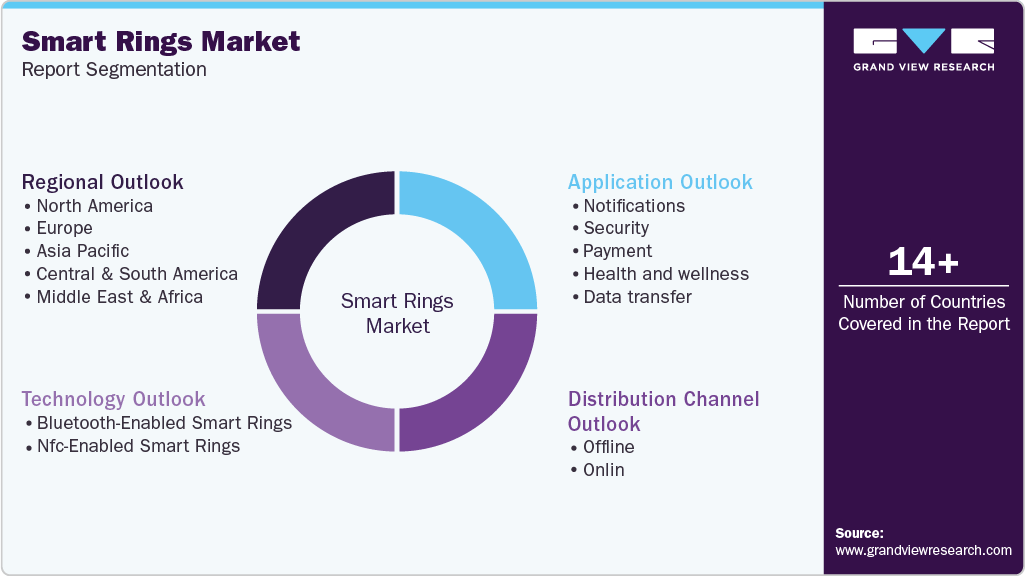
This report forecasts revenue growth at the global, regional, and country levels and provides an analysis of the latest industry trends and opportunities in each of the sub-segments from 2021 to 2033. For the purpose of this study, Grand View Research has segmented the global smart rings market report on the basis of application, technology, distribution channel, and region.
-
Application Outlook (Volume, Thousand Units; Revenue, USD Million, 2021 - 2033)
-
Notifications
-
Security
-
Payment
-
Health and wellness
-
Data transfer
-
-
Technology Outlook (Volume, Thousand Units; Revenue, USD Million, 2021 - 2033)
-
Bluetooth-enabled smart rings
-
NFC-enabled smart rings
-
-
Distribution Channel Outlook (Volume, Thousand Units; Revenue, USD Million, 2021 - 2033)
-
Offline
-
Online
-
-
Regional Outlook (Volume, Thousand Units; Revenue, USD Million, 2021 - 2033)
-
North America
-
U.S.
-
Canada
-
Mexico
-
-
Europe
-
UK
-
Germany
-
France
-
Italy
-
Spain
-
-
Asia Pacific
-
China
-
Japan
-
India
-
Australia & New Zealand
-
South Korea
-
-
Central & South America
-
Brazil
-
-
Middle East & Africa
-
South Africa
-
-
Frequently Asked Questions About This Report
b. Some key players operating in the smart rings market include Oura Health; Ultrahuman; McLear Ltd.; Ringly Inc.; Circular; Motiv; Bellabeat; Sky Labs; Tokenize Inc.; Jakcom Technology Co. Ltd.; Nimb Inc.; Wellnesys Inc.; E SENSES; Fujitsu Ltd.; Guangdong Jiu Zhi Technology Co. Ltd.
b. One of the primary drivers of the smart rings market is the growing adoption of smartphones globally. As smartphones become ubiquitous, they facilitate the integration of smart rings with other devices, enhancing their functionality. The tech-savvy population, particularly among younger demographics, is increasingly inclined towards wearable technology that offers convenience and connectivity. This trend fosters a favorable environment for adopting smart rings as they provide seamless access to notifications and applications directly from the user's finger.
b. The global smart rings market was valued at USD 417.5 million in 2025 and is expected to reach USD 502.4 million in 2026.
b. The global smart rings market is expected to grow at a CAGR of 22.5 % from 2026 to 2033 to reach USD 2,079.3 million by 2033.
b. Bluetooth-enabled smart rings were the most popular technology, accounting for 68.72% of revenue in 2025. Bluetooth technology enables seamless integration with devices such as smartphones, tablets, and smart home systems. This capability allows users to receive notifications for calls, messages, and social media alerts directly on their rings, enhancing the user experience by keeping them connected without having to check their phones frequently.


Share this report with your colleague or friend.
Need a Tailored Report?
Customize this report to your needs — add regions, segments, or data points, with 20% free customization.


ISO 9001:2015 & 27001:2022 Certified
We are GDPR and CCPA compliant! Your transaction & personal information is safe and secure. For more details, please read our privacy policy.
Trusted market insights - try a free sample
See how our reports are structured and why industry leaders rely on Grand View Research. Get a free sample or ask us to tailor this report to your needs.