- Home
- »
- Electronic & Electrical
- »
-
Smart Home Security Camera Market Size Report, 2033GVR Report cover
![Smart Home Security Camera Market Size, Share & Trends Report]()
Smart Home Security Camera Market (2026 - 2033) Size, Share & Trends Analysis Report By Technology (Wired Camera, Wireless Camera), By Application (Doorbell Camera, Indoor Camera, Outdoor Camera), By Region, And Segment Forecasts
- Report ID: GVR-4-68038-529-8
- Number of Report Pages: 120
- Format: PDF
- Historical Range: 2021 - 2025
- Forecast Period: 2026 - 2033
- Industry: Consumer Goods
- Report Summary
- Table of Contents
- Segmentation
- Methodology
- Download FREE Sample
-
 Download Sample Report
Smart Home Security Camera Market Summary
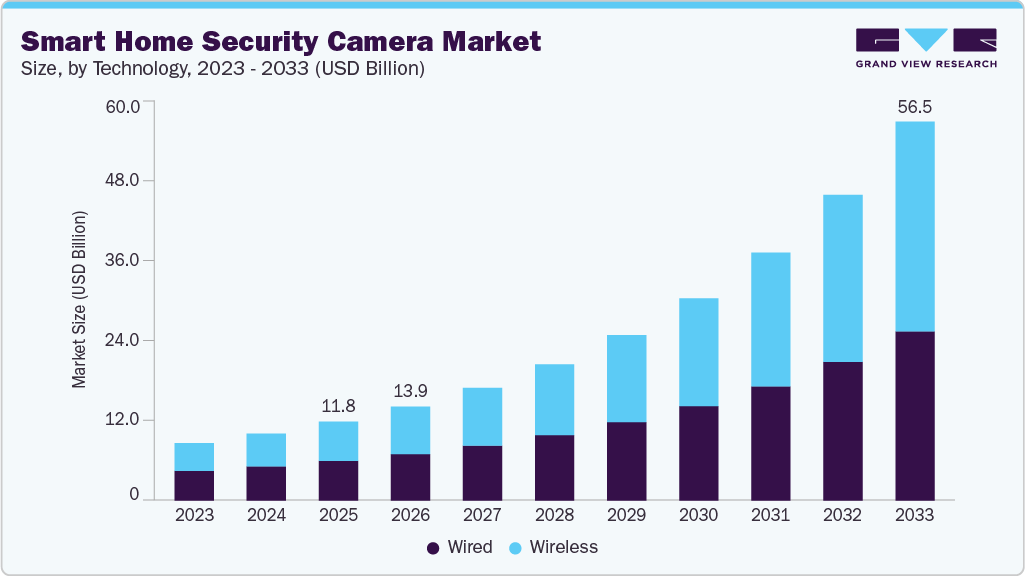
The global smart home security camera market size was estimated at USD 11.77 billion in 2025 and is projected to reach USD 56.47 billion by 2033, expanding at a CAGR of 22.1% from 2026 to 2033. The increase in smart home security camera usage is attributed to a surge in regional thefts and cameras' proven ability to prevent burglaries.
Key Market Trends & Insights
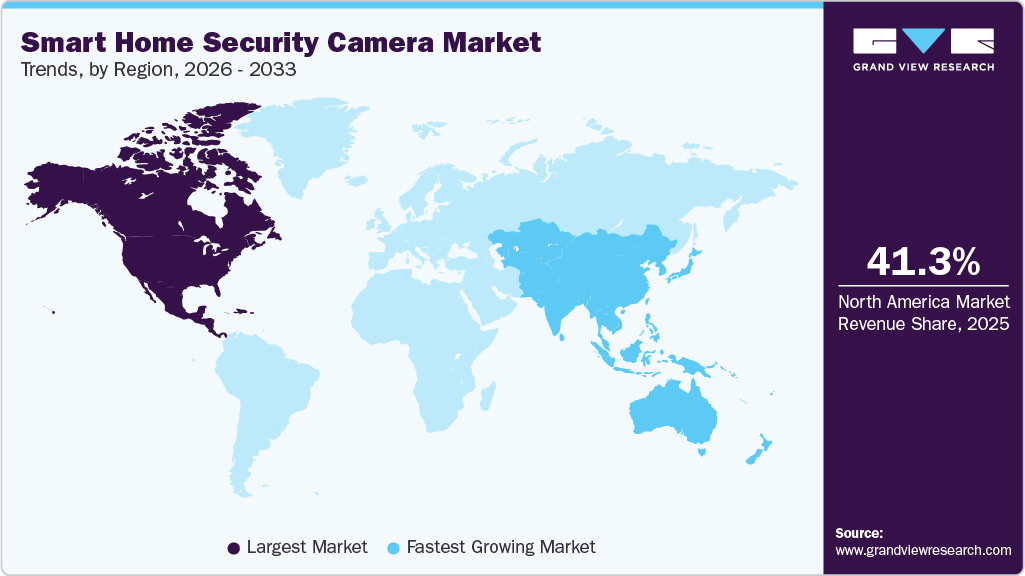
- North America held the largest share of the global smart home security camera market in 2025, accounting for 41.27%.
- The Asia Pacific smart home security camera market is experiencing significant growth, projecting a CAGR of 23.3%.
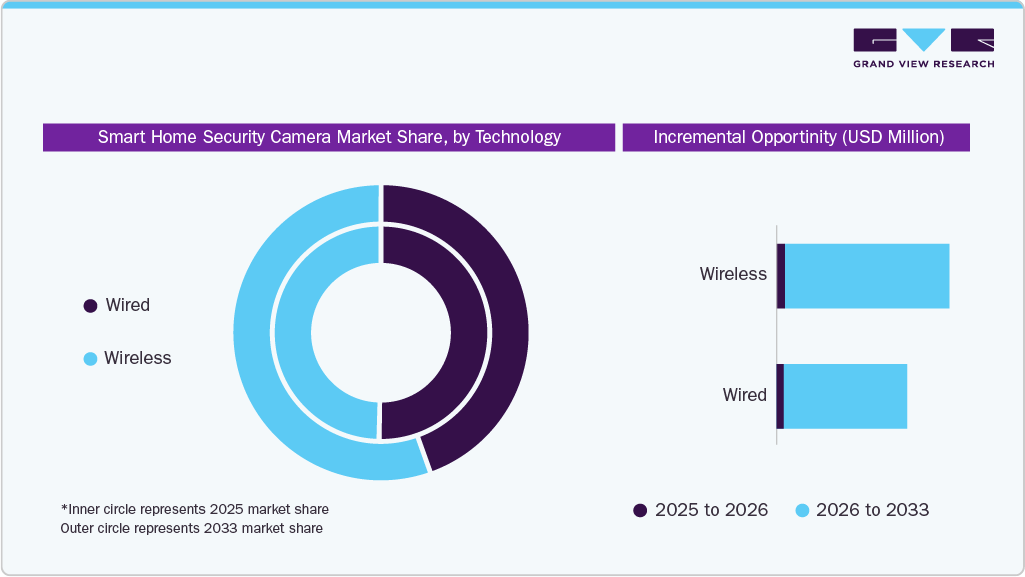
- By technology, wired smart home security cameras segment held the largest market share, accounting for 50.3%.
- By technology, the wireless smart home security camera segment is experiencing the fastest growth, projecting a CAGR of 23.7%.
- By application, smart indoor cameras segment accounted for a revenue share of 39.8% in 2025 in the smart home security camera market.
Market Size & Forecast
- 2025 Market Size: USD 11.77 Billion
- 2033 Projected Market Size: USD 56.47 Billion
- CAGR (2026-2033): 22.1%
- North America: Largest Market in 2025
- Asia Pacific: Fastest Growing Market
In addition, the integration of these cameras with the expanding smart home ecosystem is further propelling their popularity and driving the smart home security camera market. Advancements in technology have led to the development of sophisticated AI-powered security cameras that can differentiate between regular activities and potential threats. These intelligent systems enhance the overall efficiency of home security, reducing false alarms and providing more accurate threat detection.The rising incidence of thefts and break-ins is significantly fueling the demand for advanced home security solutions, particularly smart security cameras. With urban areas experiencing increased property crime, homeowners and businesses alike are increasingly prioritizing surveillance and security. As these incidents often lead to costly damage and loss, consumers are recognizing the need for proactive measures. Smart security cameras provide real-time monitoring, deterrence, and a sense of safety. This heightened security awareness is a primary factor driving the growth of the smart home security camera market.
As per the 2023 Home Security Market Report published by SafeHome, a significant 72% of households across the U.S. are equipped with at least one home security device. Among these households, 51 million have opted for video surveillance systems, while 39 million have installed alarm systems.
In addition, according to data by the Office for National Statistics, in the year 2023/2024, there were 181,617 reported home burglaries across England and Wales, averaging 498 burglaries per day, which equates to a house being burgled every 173 seconds. The London Metropolitan area recorded the highest number of burglaries at 37,416, translating to 103 per day or one every 14 minutes. Other regions with significant burglary rates included the West Midlands and Greater Manchester. Notably, 70% of burglaries involved entry through doors, and over 50% occurred while someone was home. The statistics indicate that while no area is completely safe, there are considerable regional differences in burglary frequency, emphasizing the importance of awareness for potential victims. This factor is expected to drive the demand and growth of smart home security camera market during the forecast period.
Furthermore, technological advancements have been significantly driving the smart home security camera industry. Smart cameras that notify users of any movements when no one is at home are gaining traction. An increasing number of younger consumers are buying homes, and this set of homeowners is no longer content with traditional devices. This scenario has driven the penetration of new technologically advanced smart devices such as smart plugs, smart locks, smart light bulbs, and smart home security, among others. The rising construction of smart homes, a combination of luxury and convenience-is also boosting the demand for smart home security cameras.
Consumers are more inclined to build homes that provide a sense of safety and increasingly opting for AI-powered gadgets. A smart home security camera not only helps conserve power and energy but also offers the ultimate convenience through different features such as motion sensor, window sensor, burglar alarm, glass break sensor, and spotlight camera.
According to 2023 package theft annual research by Security.org, porch pirates stole USD 8 Billion worth of goods, and 44% of Americans experienced package theft at some point; however, with a doorbell camera, consumers are notified as soon as the packages are delivered, and they can even instruct the deliverymen where to place them. Consumers are warned immediately if anyone passes by or attempts to steal the package and can call out to them through the doorbell camera speakers. Furthermore, these smart home security cameras provide 24-hour real-time alerts when connected to a smartphone or any other device. Some cameras also include additional features such as two-way audio, video analytics, motion detection, and high-resolution viewing. All these factors are expected to show notable growth to and demand for the smart home security camera market during the forecast period.
Brand Market Share Insights
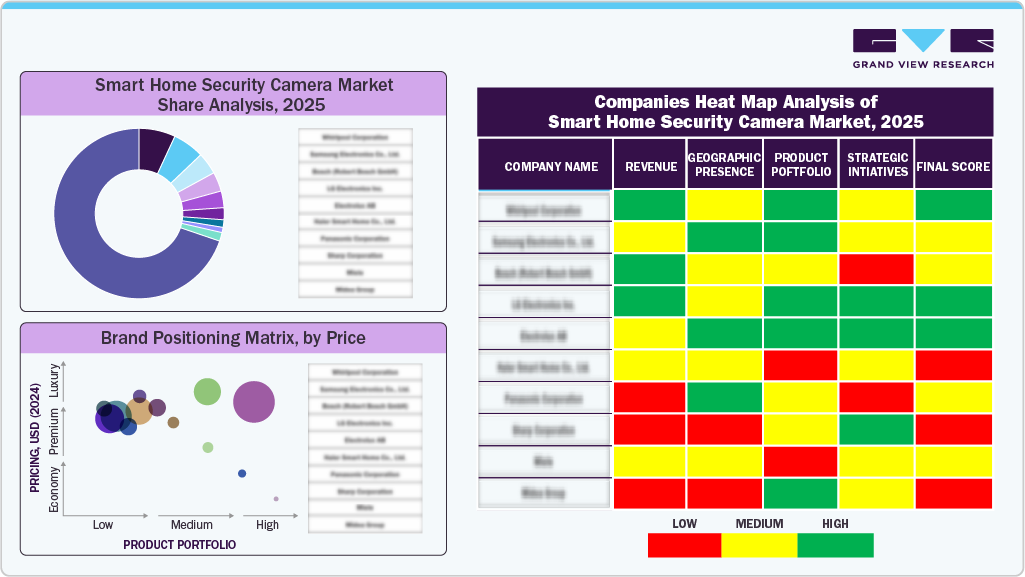
The smart home security camera market is characterized by the presence of both established technology companies and emerging smart-home specialists competing to address evolving consumer safety and connectivity needs. Manufacturers are actively investing in product innovation to enhance surveillance effectiveness and user convenience. Key developments include the integration of high-definition and ultra-HD video, night vision, wide-angle lenses, and AI-enabled motion detection that can distinguish between people, pets, and vehicles. Many brands are also incorporating cloud connectivity, mobile app integration, and real-time alerts to improve remote monitoring and control. In parallel, growing consumer concerns around data privacy and energy efficiency are shaping product strategies. Companies are increasingly emphasizing encrypted data storage, local recording options, and compliance with data protection standards to build consumer trust.
Consumer Insights
According to a 2023 survey by LendingTree, a U.S.-based online lending marketplace, most American homeowners, surpassing 50%, utilize home surveillance technology, which includes the deployment of cameras. When it comes to integrating electronic surveillance into their homes, younger homeowners show a higher inclination compared to their older counterparts.
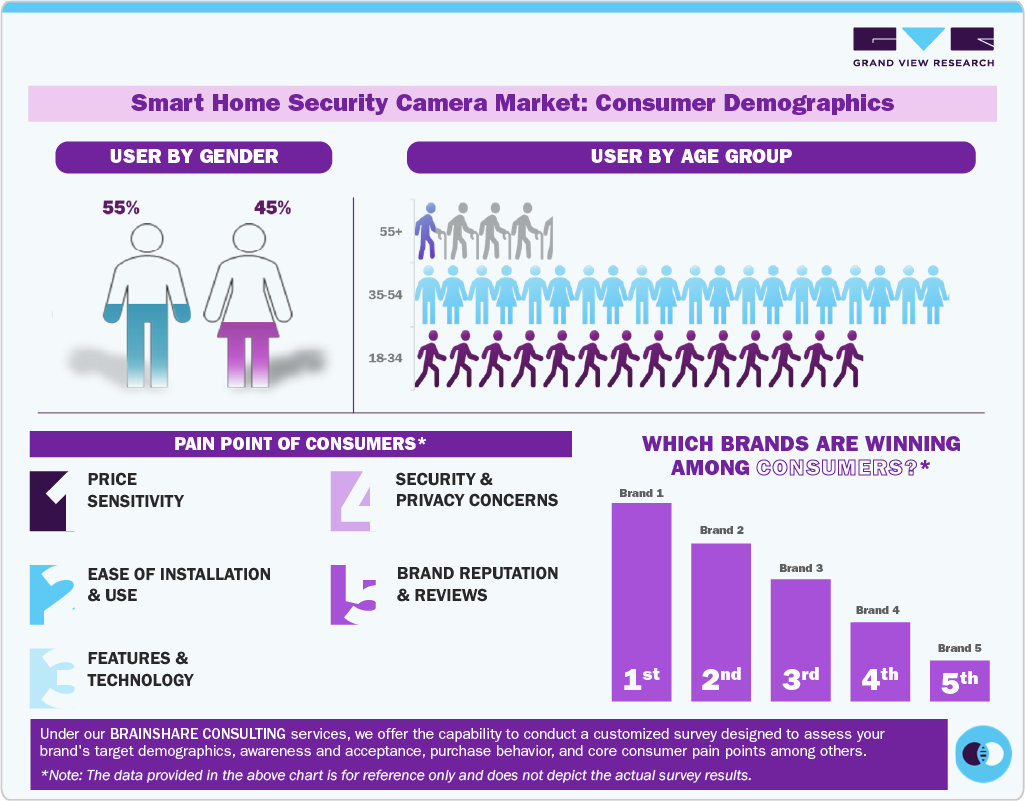
Millennial homeowners, falling within the age range of 27 to 42, lead this trend with an adoption rate of 72%, closely followed by Gen Z homeowners (aged 18 to 26) at 69%. Meanwhile, Gen X homeowners (aged 43 to 58) exhibit a usage rate of 47%, and baby boomer homeowners (aged 59 to 77) follow with a 30% adoption rate.
Buyers prioritize cameras for their ability to deliver clear surveillance and dependable monitoring, with key decision factors including video resolution, night vision capability, motion detection accuracy, and real-time alerts. Features such as HD and 4K video, wide field-of-view lenses, AI-based object recognition, and two-way audio have positioned smart security cameras as essential home safety devices rather than optional smart gadgets, particularly as concerns around home security and remote monitoring continue to rise worldwide.
At the same time, evolving lifestyle expectations are reshaping how consumers integrate security cameras into their living spaces. Design-led considerations such as compact form factors, discreet aesthetics, wireless installation, and seamless app-based control are increasingly influencing purchase decisions. Consumers show growing preference for cameras that blend into home interiors while offering flexible placement options for apartments, independent houses, and rental properties. Cloud storage subscriptions, smart assistant compatibility, and ecosystem integration with other smart home devices further enhance everyday usability and appeal.
The convergence of advanced security functionality and user-friendly design means consumers now evaluate smart home security cameras on both technical capability and lifestyle compatibility. Products are expected to provide robust protection while offering ease of installation, intuitive controls, and data privacy assurance. This dual expectation is reinforced by rising smart home adoption, increased awareness of residential safety, and greater acceptance of connected living, all of which continue to drive sustained engagement with smart home security cameras as a core component of modern households.
Technology Insights
Wired smart home security cameras accounted for a revenue share of 50.3% in 2025 in the smart home security cameras market. With rising instances of thefts, burglaries, and security breaches, homeowners are actively seeking effective surveillance systems to protect their properties. Wired smart home security cameras provide a stable and consistent connection, ensuring uninterrupted monitoring and prompt alerts in case of any suspicious activities.
Crime rates vary greatly from country to country and are influenced by many factors. Some of the world's lowest crime rates are seen in Switzerland, Denmark, Norway, Japan, and New Zealand. According to World Population Review, the 5 countries with the highest crime rate (crimes per 100,000 people) as identified in 2023 are: Venezuela, Papua New Guinea, South Africa, Afghanistan, and Honduras. This increase in crime rates in countries shows notable opportunities for the smart home security cameras market during the forecast period.
The wireless smart home security camera market is expected to grow at a CAGR of 23.7% from 2026 to 2033. Innovations such as customizable surveillance zones, hybrid connection, floodlight camera, and differentiation between pets, cars, or animals are increasing the demand for wireless smart home security cameras. In September 2023, Philips Hue launched Philips Hue Secure, marking the brand's entry into the smart home security industry. This self-installation security system features innovative cameras and sensors designed to seamlessly integrate with Philips Hue's intelligent lighting system, acting as a deterrent to potential intruders. In the event of a security alert, the synchronized Hue lights can dynamically flash in red or white, accompanied by an alarm from the connected camera.
Furthermore, wireless smart home security cameras provide wide range of advantages which includes - easier to set up, customize, and use, advanced features such as machine learning, Make extensive use of cloud storage, offering access to film from any location and very flexible in terms of placement. All these factors are expected to further augment the growth of the smart home security camera market during the forecast period.
Application Insights
Smart indoor cameras market accounted for a revenue share of 39.79% in 2025. There is an increase in the number of theft and burglary cases, which has raised public awareness about the importance of protecting one's house from criminal activity. Indoor smart cameras offer a variety of capabilities, including instant messaging in the event of a theft, alarm activation, and movement and behavior recognition, which has led to their widespread use in a variety of applications. Furthermore, an indoor security camera is an economical alternative to a full security system for consumers who live in a small apartment and want to keep an eye on their belongings when they are not at home. Nearly all freestanding security cameras link to a customer's home Wi-Fi so they can check on things from their cellphone or tablet. A majority of these cameras include built-in motion and sound sensors that send push and email notifications when those sensors are triggered.
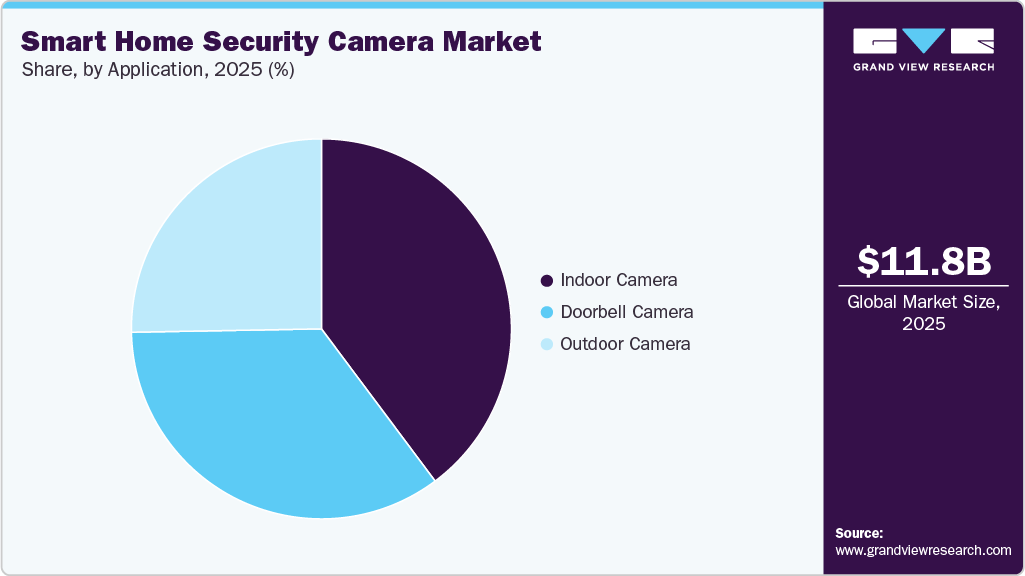
The smart doorbell security camera market is expected to grow with a CAGR of 22.7% from 2026 to 2033. According to 2023 package theft annual research by Security.org, porch pirates stole $8 Billion worth of goods, and 44% of Americans experienced package theft at some point; however, with a doorbell camera, consumers are notified as soon as the packages are delivered, and they can even instruct the deliverymen where to place them. Consumers are warned immediately if anyone passes by or attempts to steal the package and can call out to them through the doorbell camera speakers. These factors are expected to augment the demand and growth of the smart doorbell security camera market across the world during the forecast period.
Regional Insights
The North America smart home security camera market accounted for a revenue share of 41.27% in 2025. In North America, the demand for smart home security cameras is primarily driven by heightened safety concerns and rising crime rates in urban areas. As homeowners seek effective solutions to protect their properties and families, smart security cameras have emerged as a popular choice due to their ability to provide real-time monitoring, alerts, and remote access. The integration of advanced features such as high-definition video, night vision, and motion detection has made these cameras more appealing, allowing users to feel more secure and informed about their surroundings.
In addition, the growing trend of home automation plays a significant role in the increasing adoption of smart security cameras. As more consumers invest in smart home ecosystems that include devices like smart locks, lights, and voice assistants, the demand for security cameras that can seamlessly integrate with these systems has surged.
U.S. Smart Home Security Camera Market Trends
The U.S. smart home security camera market is expected to grow at a CAGR of 22.9% from 2026 to 2033. According to Parks Associates, the ownership of video doorbells in U.S. internet households has surged to 20% in 2023, up from 4% in 2017, reflecting increased consumer adoption of smart home security devices. In addition, as per the 2023 Home Security Market Report published by SafeHome, a significant 72% of households across the U.S. are equipped with at least one home security device. Among these households, 51 million have opted for video surveillance systems, while 39 million have installed alarm systems. These statistics shows high demand for the smart home security camera market in the U.S. during the forecast period.
Europe Smart Home Security Camera Market Trends
The Europe smart home security camera market is expected to grow at a CAGR of 21.6% from 2026 to 2033. Emerging technologies and applications such as multi-dimensional perception, UHD, low light imaging, artificial intelligence, and cloud technology open new possibilities for the security industry. At the same time, millions of cameras and other security devices are being connected into networks, making the security industry in Europe a very important part of the future European IoT world.
In addition, video doorbell cameras are becoming very popular in different parts of Europe. The biggest reason for choosing these cameras is that they can be operated both as rechargeable batteries or wired, driving the growth and demand for the smart home security camera market in the region during the forecast period.
The Germany smart home security camera market accounted for a revenue share of 26.14% in 2025. Market growth is being driven by rapid integration of smart cameras with artificial intelligence-based analytics, high-resolution imaging, and cloud-enabled storage systems that enhance real-time monitoring and threat detection. Increasing deployment of connected security devices within residential networks is strengthening Germany’s role in Europe’s broader IoT ecosystem, as smart cameras increasingly operate as part of integrated home security platforms.
UK smart home security camera market is expected to grow at a CAGR of 22.8% from 2026 to 2033. Growth is being driven by rising installation of security cameras in urban homes, apartments, and rental properties, where space constraints and shared access points increase demand for compact, app-controlled surveillance solutions. UK consumers show strong preference for subscription-based cloud storage, mobile alerts, and integration with existing smart home platforms, reflecting high digital maturity. In addition, increasing concerns around package theft, neighborhood monitoring, and remote property management are accelerating uptake, while widespread broadband coverage and strong consumer familiarity with connected devices continue to support rapid expansion of the market.
Asia Pacific Smart Home Security Camera Market Trends
Asia Pacific smart home security camera market is expected to grow at a CAGR of 23.3% from 2026 to 2033. Countries in Asia Pacific are heavily surveilled, and China is one of the most covered countries. Globally, there are already 770 million cameras in use, with 54% of these being in China. According to a survey by Comparitech in 2023, 16 out of the top 20 most surveilled cities (based on the number of cameras per 1,000 people) are in China. Indore, Hyderabad, and Delhi (all in India) were the only cities outside of China to make the top 20, taking the fourth, twelfth, and sixteenth places, respectively. Delhi, Chennai, Singapore, Seoul, and Mumbai, all feature within the top 20. Delhi and Chennai (India) have more cameras per square mile than any Chinese city. These figures prove that Asia Pacific is a highly lucrative market for smart home security cameras, which is expected to drive the regional market during the forecast period.
China smart home security camera market accounted for a revenue share of 54.48% in 2025. China smart home security camera industry is driven by widespread integration of artificial intelligence-based analytics, facial recognition, and high-resolution imaging in smart cameras, enabling advanced real-time monitoring and automated threat detection. Chinese households are increasingly deploying security cameras as part of broader smart home ecosystems, where devices are seamlessly connected through cloud platforms and mobile applications.
India smart home security camera market is expected to grow at a CAGR of 23.5% from 2026 to 2033. India smart home security camera industry is being supported by the rising installation of cameras in apartments, gated communities, and independent homes, where concerns around unauthorized access, safety of family members, and property monitoring are increasing. Indian consumers show a strong preference for affordable, easy-to-install cameras with mobile app control, real-time alerts, and local storage options that reduce recurring costs. In addition, expanding broadband and mobile internet penetration, wider availability of budget-friendly smart cameras through e-commerce platforms, and growing familiarity with smart devices are accelerating adoption, supporting the robust growth of the India smart home security camera market.
Central & South America Smart Home Security Camera Market Trends
Central & South America smart home security camera market is expected to grow at a CAGR of 16.7% from 2026 to 2033. Central & South America smart home security camera industry is driven by high crime awareness in major cities, which is increasing household investment in basic and mid-range surveillance solutions for apartments and independent homes. Adoption is particularly strong in metropolitan areas where residential density, informal housing patterns, and shared access points heighten the need for visual monitoring. Consumers in the region favor straightforward, value-oriented security cameras that offer mobile connectivity and remote viewing without complex system integration.
Middle East & Africa Smart Home Security Camera Market Trends
Middle East & Africa smart home security camera market is expected to grow at a CAGR of 11.4% from 2026 to 2033. Middle East & Africa smart home security camera industry is driven by rising security awareness among households, particularly in densely populated cities where apartments, villas, and mixed-use residential complexes are becoming more common. Demand is strengthening for reliable, easy-to-use security cameras that enable real-time monitoring through smartphones and remote access, without requiring complex installation or integration.
Key Smart Home Security Camera Companies:
The following key companies have been profiled for this study on the smart home security camera market.
- Vivint Smart Home, Inc.
- ADT Inc.
- SimpliSafe, Inc.
- Brinks Home Security
- Xiaomi Inc.
- Skylinkhome
- Samsung Electronics Co, Ltd.
- Frontpoint Security Solution, LLC
- Arlo Technologies, Inc.
- Wyze Lab, Inc.
- blink
- eufy (Anker Innovations)
- Ring LLC
Recent Developments
-
In August 2025, Arlo introduced a new range of smart home security solutions powered by its latest AI-driven Arlo Intelligence platform. The updated lineup focuses on more accurate detection, smarter alerts, and improved context awareness to enhance everyday home monitoring. The launch highlights Arlo’s continued push to differentiate through advanced artificial intelligence integrated across its security hardware and software ecosystem.
-
In August 2025, Wyze introduced the Duo Cam Pan, a dual-camera smart security solution designed to provide wider coverage and reduce blind spots inside the home. By combining two lenses with pan-and-tilt functionality in a single device, the camera delivers more comprehensive monitoring and smarter motion tracking. The launch reinforces Wyze’s strategy of offering feature-rich home security products at accessible price points.
-
In January 2025, Xthings unveiled its new Ulticam home security camera range, focusing on smarter monitoring without recurring subscription costs. The lineup uses on-device artificial intelligence to improve detection accuracy and deliver real-time alerts, while offering cloud storage without monthly fees. The launch positions Xthings to appeal to cost-conscious consumers seeking advanced, AI-enabled home security with simpler ownership economics.
Smart Home Security Camera Market Report Scope
Report Attribute
Details
Market size value in 2026
USD 13.99 billion
Revenue forecast in 2033
USD 56.47 billion
Growth rate (Revenue)
CAGR of 22.1% from 2026 to 2033
Actuals
2021 - 2025
Forecast period
2026 - 2033
Quantitative units
Revenue in USD million/billion, and CAGR from 2026 to 2033
Report coverage
Revenue forecast, company ranking, competitive landscape, growth factors, and trends
Segments covered
Technology, application, region
Regional scope
North America; Europe; Asia Pacific; Central & South America; Middle East & Africa
Country scope
U.S; Canada; Mexico; Germany; UK; France; Italy; Spain; China; Japan; India; Australia & New Zealand; South Korea; Brazil; South Africa
Key companies profiled
Vivint Smart Home, Inc.; ADT Inc.; SimpliSafe, Inc.; Brinks Home Security; Xiaomi Inc.; Skylinkhome; Samsung Electronics Co, Ltd.; Frontpoint Security Solution, LLC; Arlo Technologies, Inc.; Wyze Lab, Inc.; blink; eufy (Anker Innovations); Ring LLC
Customization scope
Free report customization (equivalent up to 8 analysts working days) with purchase. Addition or alteration to country, regional & segment scope.
Pricing and purchase options
Avail customized purchase options to meet your exact research needs. Explore purchase options
Global Smart Home Security Camera Market Segmentation
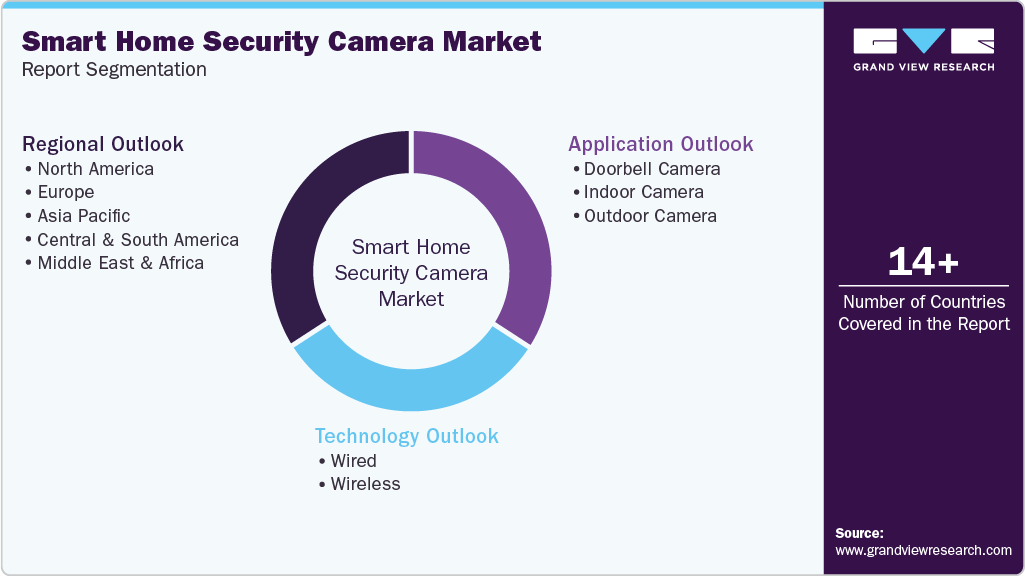
This report forecasts revenue growth at the global, regional, and country levels and provides an analysis of the latest industry trends and opportunities in each of the sub-segments from 2021 to 2033. For this study, Grand View Research has segmented the global smart home security camera market report on the basis of technology, application, and region.
-
Technology Outlook (Revenue, USD Million, 2021 - 2033)
-
Wired
-
Wireless
-
-
Application Outlook (Revenue, USD Million, 2021 - 2033)
-
Doorbell Camera
-
Indoor Camera
-
Outdoor Camera
-
-
Regional Outlook (Revenue, USD Million, 2021 - 2033)
-
North America
-
U.S.
-
Canada
-
Mexico
-
-
Europe
-
Germany
-
UK
-
France
-
Italy
-
Spain
-
-
Asia Pacific
-
China
-
Japan
-
India
-
Australia & New Zealand
-
South Korea
-
-
Central & South America
-
Brazil
-
-
Middle East & Africa
-
South Africa
-
-
Frequently Asked Questions About This Report
b. Key factors fueling growth in the global smart home security cameras market include rising consumer focus on home safety and the convenience of remote monitoring. Increasing adoption of smart home ecosystems and advancements in camera technology, such as AI-powered motion detection and high-definition video, are improving user experience and security effectiveness. Additionally, growing internet penetration, affordable pricing, and the integration of security systems with voice assistants are helping drive wider acceptance and market expansion.
b. Some key players operating in the smart home security camera market include Vivint Smart Home, Inc, ADT Inc, SimpliSafe, Inc, Brinks Home Security, Xiaomi Inc, Skylinkhome, Samsung Electronics Co, Ltd, eufy (Anker Innovations)., and Ring LLC.
b. The global smart home security camera market size was estimated at USD 11.77 billion in 2025 and is expected to reach USD 13.99 billion in 2026.
b. The wired smart home security cameras market accounted for a revenue share of 51.31% in 2025, driven by growing concerns over home safety and the need for real-time monitoring, the wired smart home security camera market is rapidly expanding. Consumers also prefer these systems for their reliability and constant power supply.
b. The global smart home security camera market is expected to grow at a compound annual growth rate (CAGR) of 22.1% from 2026 to 2033 to reach USD 56.47 billion by 2033.


Share this report with your colleague or friend.
Need a Tailored Report?
Customize this report to your needs — add regions, segments, or data points, with 20% free customization.


ISO 9001:2015 & 27001:2022 Certified
We are GDPR and CCPA compliant! Your transaction & personal information is safe and secure. For more details, please read our privacy policy.
Trusted market insights - try a free sample
See how our reports are structured and why industry leaders rely on Grand View Research. Get a free sample or ask us to tailor this report to your needs.