- Home
- »
- Paints, Coatings & Printing Inks
- »
-
Silane Market Size, Share & Trends, Industry Report, 2033GVR Report cover
![Silane Market Size, Share & Trends Report]()
Silane Market (2026 - 2033) Size, Share & Trends Analysis Report Product (Alkyl Silane, Sulfur Silane, Amino Silane, Vinyl Silane), By Application (Paints & Coatings, Adhesives & Sealants, Rubber & Plastics, Fiber Treatment), By Region, And Segment Forecasts
- Report ID: GVR-1-68038-613-4
- Number of Report Pages: 80
- Format: PDF
- Historical Range: 2018 - 2025
- Forecast Period: 2026 - 2033
- Industry: Bulk Chemicals
- Report Summary
- Table of Contents
- Segmentation
- Methodology
- Download FREE Sample
-
 Download Sample Report
Silane Market Summary
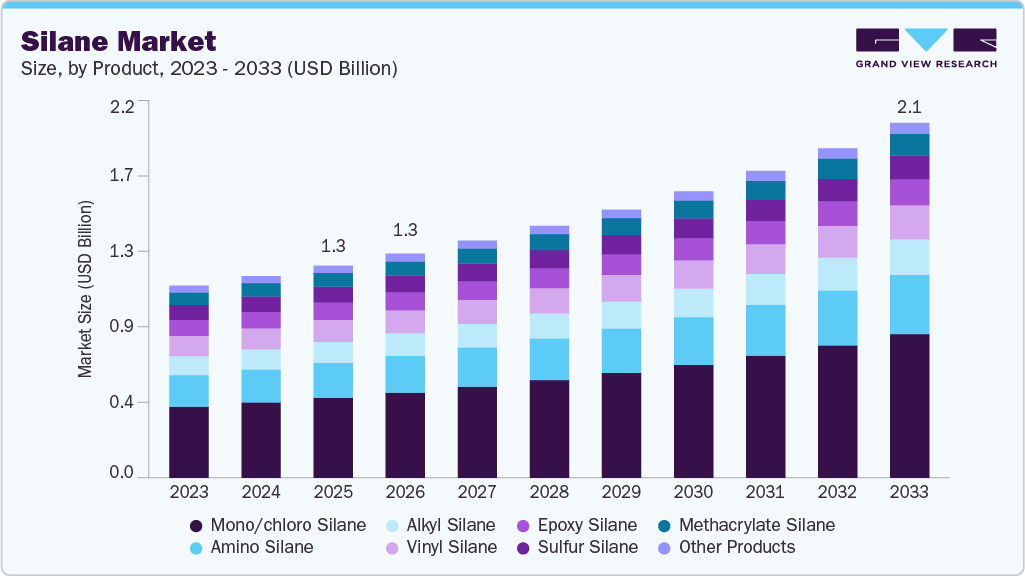
The global silane market size was estimated at USD 1,280.3 million in 2025 and is projected to reach USD 2,141.7 million by 2033, growing at a CAGR of 6.8% from 2026 to 2033. The market is primarily driven by rising demand for high-performance materials across construction, automotive, electronics, and advanced manufacturing industries, where silanes play a critical role as coupling agents, adhesion promoters, and surface modifiers.
Key Market Trends & Insights
- Asia Pacific dominated the silane market with the largest revenue share of 50.5% in 2025.
- China accounted for 44.8% of the global silane market in 2025.
- By product, the mono/chloro silane segment dominated the global silane market in 2025, accounting for the largest revenue share of 37.7%.
- By application, the paints & coatings segment held the largest revenue share of 29.2% in 2025 in terms of value.
Market Size & Forecast
- 2025 Market Size: USD 1,280.3 million
- 2033 Projected Market Size: USD 2,141.7 million
- CAGR (2026-2033): 6.8%
- Asia Pacific: Largest market in 2025
Rapid growth in infrastructure development, increasing adoption of lightweight composites and engineered plastics, and expanding use of silane-based additives in paints, coatings, adhesives, and sealants are significantly boosting consumption. In addition, technological advancements in rubber compounding, particularly in tire manufacturing, along with the accelerating expansion of the electronics and semiconductor sector, and the shift toward durable, energy-efficient, and sustainable materials, are further strengthening the demand outlook for silanes globally.The silane market presents significant growth opportunities driven by increasing adoption of advanced composites, lightweight materials, and high-performance polymers across automotive, aerospace, renewable energy, and electronics industries. Rising demand for sustainable and low-VOC formulations in construction chemicals, coatings, and adhesives, along with expanding applications in semiconductor manufacturing and electric vehicles, is creating new avenues for innovation and value-added silane products. Furthermore, rapid industrialization in the Asia Pacific, growing investments in infrastructure and smart manufacturing, and continuous R&D in specialty and multifunctional silanes are expected to unlock long-term growth potential and enhance market penetration across emerging and high-value application segments.
The market faces challenges stemming from volatility in raw material prices, particularly silicon metal and chlorosilanes, which directly impact production costs and profit margins. Stringent environmental regulations related to VOC emissions and hazardous chemical handling, coupled with complex manufacturing processes and high capital investment requirements, constrain capacity expansion and operational flexibility. Additionally, intense competition from alternative coupling agents and functional additives, along with supply chain disruptions and geopolitical uncertainties in key silicon-producing regions, further limit market growth and pricing stability.
Market Concentration & Characteristics
The global silane market is moderately consolidated, led by multinational chemical companies such as Evonik, Wacker Chemie, Dow, and Shin-Etsu, which leverage strong R&D capabilities, integrated silicon value chains, and diversified application portfolios to maintain technological and commercial leadership. These players benefit from economies of scale, global distribution networks, and long-term partnerships with end-use industries, enabling them to capture a significant share of demand across coatings, adhesives, rubber, plastics, and electronics.
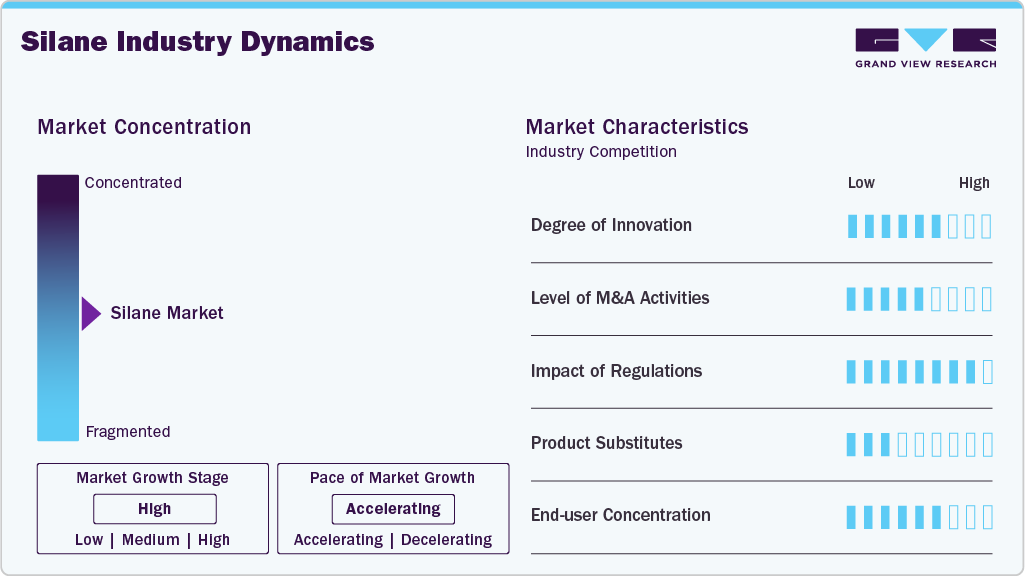
At the same time, regional and specialty manufacturers, particularly in Asia, are intensifying competition through cost-efficient production, specific application formulations, and expanding capacity. Competitive differentiation is increasingly driven by innovation in high-performance and sustainable silane solutions, purity-grade advancements, and customization for high-growth sectors such as electronics, automotive, and advanced composites, resulting in a dynamic market environment shaped by both global leaders and agile regional players.
Product Insights
The mono/chloro silane segment dominated the global silane market in 2025, accounting for the largest revenue share of 37.7%, primarily due to its critical role as a key intermediate in the production of organosilanes and silicone-based materials. Mono/chloro silanes serve as foundational building blocks in the silicon value chain, supporting large-scale manufacturing of functional silanes, silicones, and specialty chemicals used across construction, automotive, electronics, and consumer goods industries. Their widespread use in downstream synthesis, coupled with high-volume demand from integrated chemical producers and expanding silicone consumption, has positioned mono/chloro silanes as the most commercially significant product category in the market.
In contrast, functional silanes, including alkyl, sulfur, amino, vinyl, epoxy, and methacrylate silanes, are witnessing accelerated growth driven by their value-added performance in specific applications such as adhesion promotion, polymer modification, rubber compounding, and surface treatment. Amino and vinyl silanes represent core demand segments due to their extensive use in adhesives, coatings, and plastics, while sulfur silanes are increasingly critical in tire and rubber manufacturing. Epoxy and methacrylate silanes are gaining traction in high-performance coatings, composites, and electronics, supported by rising demand for advanced materials. Meanwhile, alkyl silanes and other specialty silanes continue to expand their footprint in construction and niche industrial applications, reflecting a gradual shift from commodity intermediates toward high-margin, application-driven silane products.
Application Insights
The paints & coatings segment dominated the global silane market in 2025, accounting for the largest revenue share of 29.2%, driven by the extensive use of silanes as adhesion promoters, crosslinking agents, and surface modifiers to enhance coating durability, corrosion resistance, and substrate compatibility. Strong demand from the construction and automotive industries, coupled with rising infrastructure development, urbanization, and refurbishment activities, significantly increased the consumption of silane-based additives in architectural, industrial, and protective coatings. Moreover, the growing shift toward high-performance and low-VOC coating formulations further reinforced the adoption of functional silanes in this segment.
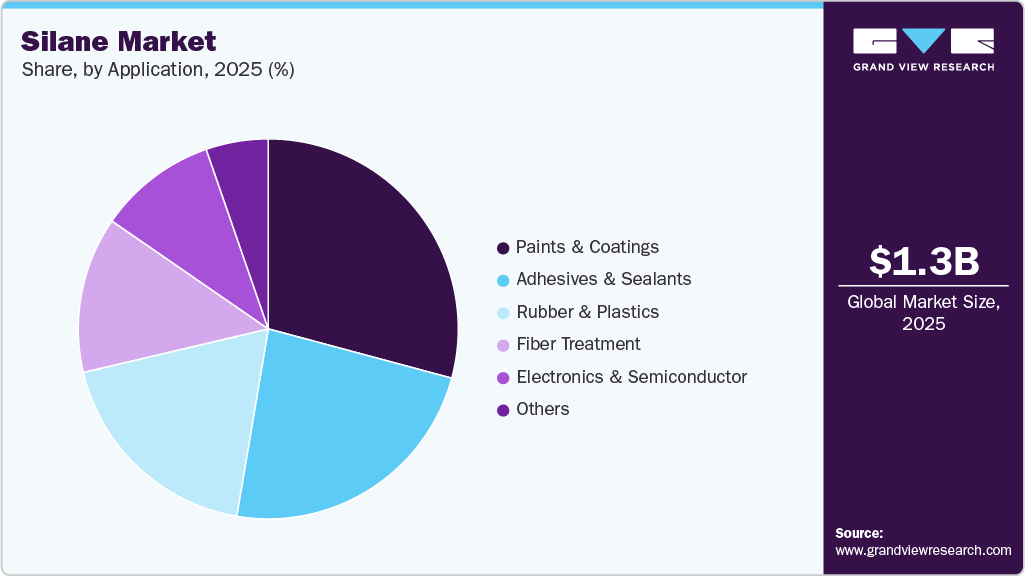
Beyond coatings, silanes play a critical role in adhesives & sealants and rubber & plastics, where they improve bonding strength, mechanical performance, and material stability, supporting demand from automotive, packaging, and industrial manufacturing sectors. Fiber treatment represents a growing application, particularly in glass fiber and composite materials used in aerospace, wind energy, and construction, while the electronics & semiconductor segment is gaining momentum due to the increasing need for high-purity silanes in advanced electronic components and surface modification processes. Other applications, including ceramics, life sciences, and specialty materials, continue to expand steadily, reflecting the broadening scope of silane utilization across high-value and technologically advanced industries.
Regional Insights
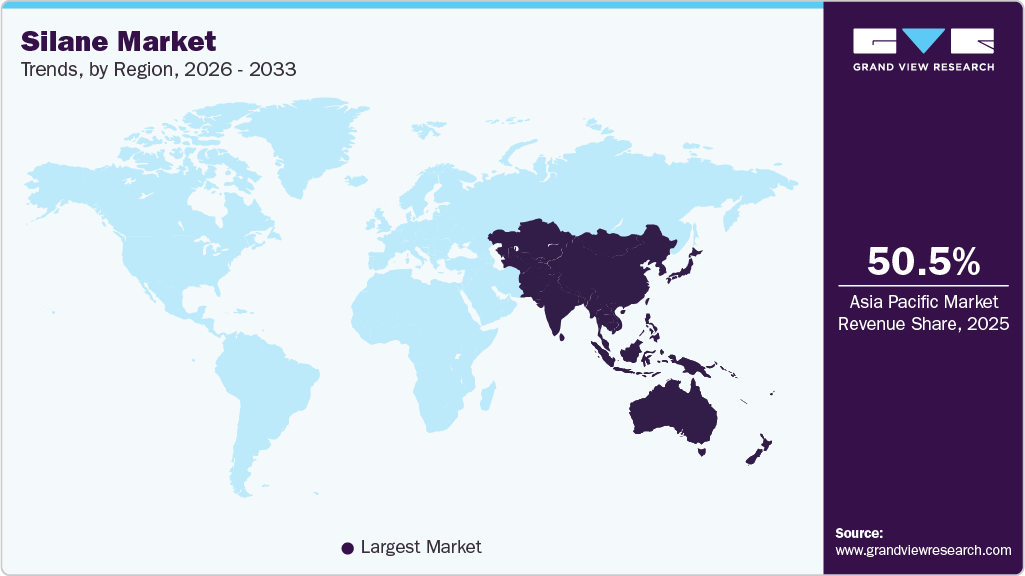
Asia Pacific dominated the global silane market in 2025 with a 50.5% share, driven by rapid industrialization, strong growth in construction, automotive, electronics, and polymer manufacturing, and the presence of a large downstream chemicals ecosystem. The region benefits from cost-efficient production, expanding infrastructure investments, and rising demand for high-performance materials, positioning it as the primary growth engine for both commodity and functional silanes.
China Silane Market Trends
China accounted for 44.8% of the global silane market in 2025, supported by its dominance in silicon metal production, extensive organosilicon manufacturing capacity, and large-scale consumption across construction, rubber, plastics, and electronics industries. Strong domestic demand, vertically integrated chemical value chains, and government-backed industrial expansion have reinforced China’s role as both a major producer and consumer of silanes.
North America Silane Market Trends
North America held a 22.4% share of the global silane market in 2025, driven by robust demand from advanced manufacturing sectors such as automotive, aerospace, electronics, and construction. The region’s emphasis on high-performance materials, technological innovation, and sustainable building solutions has accelerated the adoption of specialty and high-value silanes across multiple end-use industries.
The U.S. silane market accounted for 83.5% of the North American silane market in 2025, supported by a strong industrial base, significant investments in infrastructure and advanced materials, and a well-established coating, adhesives, and composites industry. The presence of leading chemical manufacturers and continuous R&D in specialty silanes further strengthened the country’s leadership in high-value applications.
Europe Silane Market Trends
Europe captured an 18.5% share of the global silane market in 2025, driven by stringent environmental regulations, strong demand for sustainable materials, and advanced manufacturing capabilities in automotive, construction, and electronics sectors. The region’s focus on high-performance, low-VOC formulations has driven steady adoption of functional silanes, particularly in specialty applications.
Germany silane market accounted for 22.0% of the European silane market in 2025, underpinned by its leadership in automotive manufacturing, industrial chemicals, and advanced materials. Strong R&D capabilities, a mature coatings and composites industry, and the presence of major organosilicon producers have positioned Germany as a key innovation and consumption hub for specialty silanes in Europe.
Middle East & Africa Silane Market Trends
The Middle East & Africa silane market is driven by expanding construction activity, infrastructure development, and growing petrochemical and polymer industries, particularly in the GCC countries. Rising investments in industrial diversification and urban development, coupled with increasing adoption of advanced coatings and sealants, are gradually strengthening regional demand for silanes, although market penetration remains lower compared to developed regions.
Central & South America Silane Market Trends
Central & South America represent an emerging silane market, supported by growth in construction, automotive assembly, and plastics manufacturing in countries such as Brazil and Mexico. Increasing infrastructure spending, gradual industrial modernization, and rising demand for performance-enhancing additives in coatings and polymers are driving steady market expansion, despite economic volatility and limited domestic organosilicon production capacity.
Key Silane Company Insights
Key players, such as Gelest, Inc., Shin-Etsu Chemical Co. Ltd., Nitrochemie Aschau GmbH, KKC Corporation, Silar (Entegris), Dow are dominating the market.
-
Dow
-
Dow is a prominent player in the global silane market, leveraging its strong expertise in organosilicon chemistry and integrated materials portfolio to supply a broad range of functional silanes for applications in coatings, adhesives, sealants, plastics, rubber, and construction materials. The company benefits from extensive global manufacturing capabilities, robust R&D infrastructure, and deep partnerships with downstream industries, enabling it to deliver high-performance and sustainable silane solutions tailored to evolving market requirements. Through continuous product innovation, focus on low-VOC and advanced material formulations, and strategic investments in capacity optimization and specialty chemicals, Dow has strengthened its competitive positioning in high-value silane applications across North America, Europe, and Asia Pacific.
-
Key Silane Companies:
The following key companies have been profiled for this study on the silane market.
- Gelest, Inc.
- Shin-Etsu Chemical Co. Ltd.
- Nitrochemie Aschau GmbH
- KKC Corporation
- Silar (Entegris)
- Dow
- Evonik Industries
- Wacker Chemie AG
- Power Chemical Corp
- Nanjing Shuhuang Chemical Group Co., Ltd.
Recent Developments
-
In January 2025, Evonik launched the “Smart Effects” business line by merging its Silica and Silanes divisions to enhance operational efficiency and innovation capabilities.
Silane Market Report Scope
Report Attribute
Details
Market size value in 2026
USD 1,351.8 million
Revenue forecast in 2033
USD 2,141.7 million
Growth rate
CAGR of 6.8% from 2026 to 2033
Base year for estimation
2025
Historical data
2018 - 2025
Forecast period
2026 - 2033
Quantitative units
Revenue in USD million, volume in kilotons, and CAGR from 2026 to 2033
Report coverage
Revenue forecast, company ranking, competitive landscape, growth factors, and trends
Segments covered
Product, application, region
Regional scope
North America; Europe; Asia Pacific; Middle East & Africa; Central & South America
Country scope
U.S.; Canada; Mexico; Germany; UK; France; Italy; Spain; China; India; Japan; South Korea; Brazil; Argentina; South Africa; Saudi Arabia
Key companies profiled
Gelest, Inc.; Shin-Etsu Chemical Co. Ltd.; Nitrochemie Aschau GmbH; KKC Corporation; Silar (Entegris); Dow; Evonik Industries; Wacker Chemie AG; Power Chemical Corp; Nanjing Shuhuang Chemical Group Co., Ltd.
Customization scope
Free report customization (equivalent up to 8 analysts’ working days) with purchase. Addition or alteration to country, regional & segment scope.
Pricing and purchase options
Avail customized purchase options to meet your exact research needs. Explore purchase options
Global Silane Market Report Segmentation
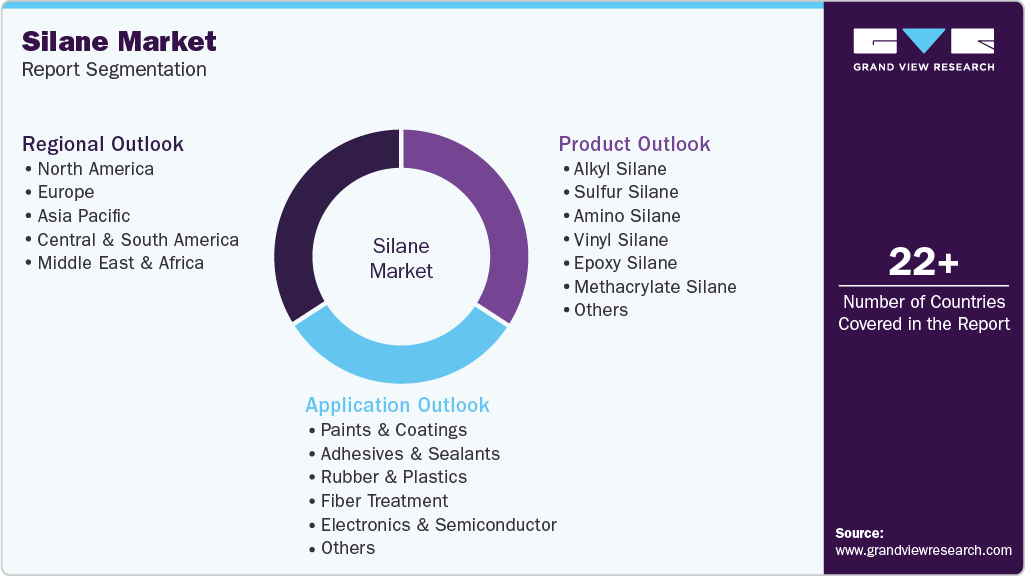
This report forecasts revenue growth at global, regional, and country levels and provides an analysis of the latest industry trends in each of the sub-segments from 2018 to 2033. For this study, Grand View Research has segmented the global silane market report based on product, application, and region:
-
Product Outlook (Volume, Kilotons; Revenue, USD Million; 2018 - 2033)
-
Alkyl Silane
-
Sulfur Silane
-
Amino Silane
-
Vinyl Silane
-
Epoxy Silane
-
Methacrylate Silane
-
Mono/Chloro Silane
-
Other Products
-
-
Application Outlook (Volume, Kilotons; Revenue, USD Million; 2018 - 2033)
-
Paints & Coatings
-
Adhesives & Sealants
-
Rubber & Plastics
-
Fiber Treatment
-
Electronics & Semiconductor
-
Others
-
-
Regional Outlook (Volume, Kilotons; Revenue, USD Million; 2018 - 2033)
-
North America
-
U.S.
-
Canada
-
Mexico
-
-
Europe
-
Germany
-
UK
-
France
-
Italy
-
-
Asia Pacific
-
China
-
India
-
Japan
-
South Korea
-
-
Central & South America
-
Brazil
-
Argentina
-
-
Middle East & Africa
-
Saudi Arabia
-
-
Frequently Asked Questions About This Report
b. The global silane market size was estimated at USD 1,280.3 million in 2025 and is expected to reach USD 1,351.8 million in 2026.
b. The silane market is expected to grow at a compound annual growth rate of 6.8% from 2026 to 2033 to reach USD 2,141.7 million by 2033.
b. The mono/chloro silane segment dominated the global silane market with a 37.7% revenue share in 2025 due to its critical role as a key intermediate in the production of organosilanes and silicone-based materials across multiple industries. Its high-volume consumption in downstream silicon chemistry, supported by strong demand from construction, automotive, electronics, and polymer manufacturing sectors, significantly contributed to its market leadership.
b. Some of the key players operating in the silane market include Gelest, Inc., Shin-Etsu Chemical Co. Ltd., Nitrochemie Aschau GmbH, KKC Corporation, Silar (Entegris), Dow, Evonik Industries, Wacker Chemie AG, Power Chemical Corp, and Nanjing Shuhuang Chemical Group Co., Ltd.
b. The global silane market is driven by rising demand for high-performance materials in construction, automotive, electronics, and polymer industries, where silanes enhance adhesion, durability, and material performance. The growing adoption of advanced composites, sustainable low-VOC formulations, and expanding semiconductor and infrastructure activities are accelerating silane consumption worldwide.


Share this report with your colleague or friend.
Need a Tailored Report?
Customize this report to your needs — add regions, segments, or data points, with 20% free customization.


ISO 9001:2015 & 27001:2022 Certified
We are GDPR and CCPA compliant! Your transaction & personal information is safe and secure. For more details, please read our privacy policy.
Trusted market insights - try a free sample
See how our reports are structured and why industry leaders rely on Grand View Research. Get a free sample or ask us to tailor this report to your needs.