- Home
- »
- Smart Textiles
- »
-
Self-contained Breathing Apparatus Market Size Report, 2033GVR Report cover
![Self-contained Breathing Apparatus Market Size, Share & Trends Report]()
Self-contained Breathing Apparatus Market (2026 - 2033) Size, Share & Trends Analysis Report By Type (Open-Circuit SCBA, Closed-Circuit SCBA), By End Use (Fire Services, Oil & Gas, Mining, Industrial), By Tank Type (Type I, Type II, Type III, Type IV), By Region, And Segment Forecasts
- Report ID: GVR-4-68040-038-3
- Number of Report Pages: 100
- Format: PDF
- Historical Range: 2021 - 2024
- Forecast Period: 2026 - 2033
- Industry: Advanced Materials
- Report Summary
- Table of Contents
- Interactive Charts
- Methodology
- Download FREE Sample
-
 Download Sample Report
Self-contained Breathing Apparatus Market Summary
The global self-contained breathing apparatus market size was valued at USD 1,651.7 million in 2025 and is projected to reach USD 2,611.6 million by 2033, growing at a CAGR of 6.0% from 2026 to 2033. Rapid industrialization, expansion of chemical storage facilities, and increased transportation of hazardous substances have elevated the risk profile of emergency response operations.
Key Market Trends & Insights
- North America dominated the safety helmets market with the largest revenue share of 31.1% in 2025.
- By type, the closed-circuit SCBA segment is expected to grow at a CAGR of 6.6% from 2026 to 2033 in terms of revenue.
- By end use, the chemical /petrochemical segment is expected to grow at a CAGR of 7.3% from 2026 to 2033 in terms of revenue.
- By tank type, the type IV segment is projected to expand at a CAGR of 6.6% from 2026 to 2033 in terms of revenue.
Market Size & Forecast
- 2025 Market Size: USD 1,651.7 Million
- 2033 Projected Market Size: USD 2,611.6 Million
- CAGR (2026-2033): 6.0%
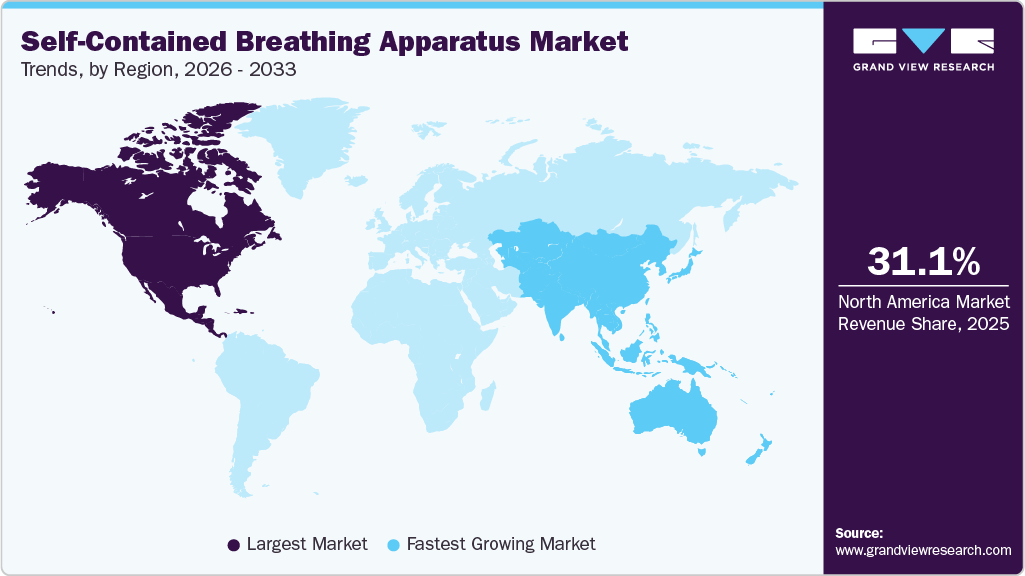
- North America: Largest market in 2025
- Asia Pacific: Fastest growing region
Fire departments and industrial emergency teams are therefore prioritizing self-contained breathing apparatus systems that offer extended air supply, ergonomic design, and improved mobility. The growing emphasis on preparedness and disaster response readiness, particularly in densely populated and industrialized regions, is supporting sustained market expansion.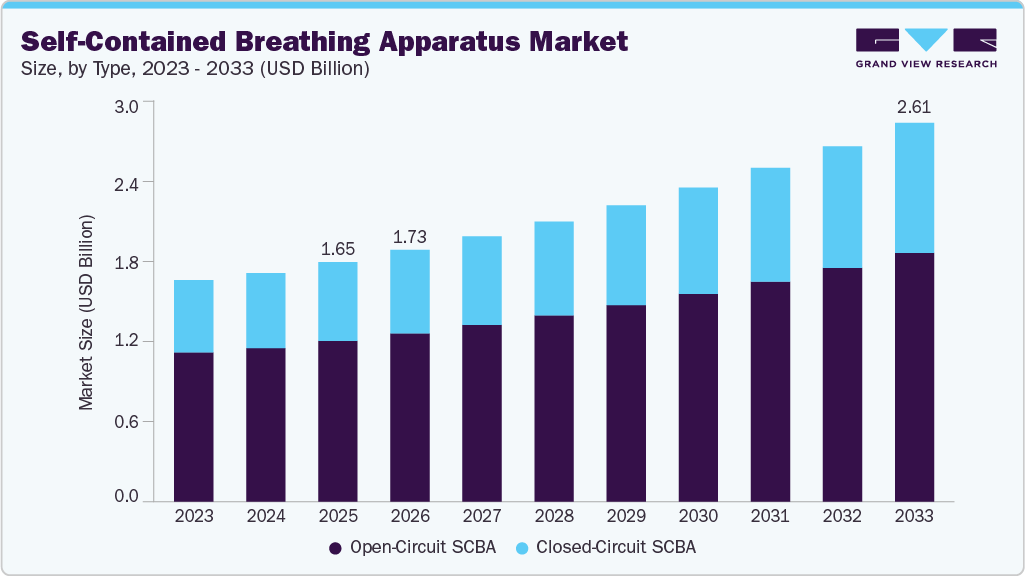
Technological advancements in self-contained breathing apparatus design are also contributing significantly to market growth. Manufacturers are focusing on lightweight composite cylinders, enhanced face seal materials, and integrated monitoring features that improve user comfort and operational efficiency. Innovations such as heads-up displays, real-time air status indicators, and compatibility with digital safety management systems are increasing the adoption of next-generation equipment.
Drivers, Opportunities & Restraints
The growth of the self-contained breathing apparatus market is being driven by increasingly stringent occupational safety regulations across high-risk industries such as firefighting, oil and gas, chemical processing, and mining. Regulatory bodies and industrial safety authorities are mandating the use of advanced respiratory protection to reduce exposure to toxic gases, smoke, and oxygen-deficient environments. Compliance requirements, coupled with heightened employer liability and enforcement intensity, are compelling organizations to invest in reliable and certified self-contained breathing apparatus systems.
The market presents strong growth opportunities driven by increasing demand for advanced, smart, and application-specific self-contained breathing apparatus solutions. Integration of digital technologies such as telemetry, location tracking, and real-time health monitoring is opening new avenues for product differentiation and value-added offerings. Emerging economies, where industrial safety frameworks are evolving and emergency response infrastructure is expanding, offer untapped potential for first-time adoption.
The growth of the self-contained breathing apparatus market is restrained by the high acquisition and lifecycle costs associated with these systems. Advanced self-contained breathing apparatus units involve significant upfront investment, along with recurring expenses related to cylinder testing, regulator servicing, and periodic component replacement to meet safety compliance standards. Budget constraints among smaller industrial operators and municipal fire departments often delay procurement or lead to extended use of older equipment. In addition, the need for regular user training, fit testing, and maintenance expertise increases operational complexity, limiting adoption in cost-sensitive and resource-constrained environments.
Market Concentration & Characteristics
The self-contained breathing apparatus market is moderately concentrated, with a limited number of established manufacturers commanding strong positions through extensive product portfolios, certifications, and long-standing relationships with institutional buyers. High entry barriers, including stringent performance standards, certification requirements, and brand trust in life-critical equipment, restrict the emergence of new players. In terms of consumer demand dynamics, end user concentration is relatively high, as procurement is dominated by organized segments such as firefighting departments, industrial safety teams, defense organizations, and large-scale process industries, where purchasing decisions are centralized and often governed by long-term contracts.
The threat of substitutes remains limited, as self-contained breathing apparatus systems are often mandatory in environments where ambient air is immediately dangerous to life or health. Alternative respiratory protection solutions, such as air-purifying respirators or supplied-air systems, are application-specific and cannot replace self-contained breathing apparatus in confined spaces, fire scenarios, or oxygen-deficient conditions. Regulatory frameworks play a decisive role in sustaining demand, as occupational safety standards and emergency response guidelines explicitly require the use of self-contained breathing apparatus in high-risk situations. Strict compliance and certification requirements reinforce product standardization and reduce substitution risk.
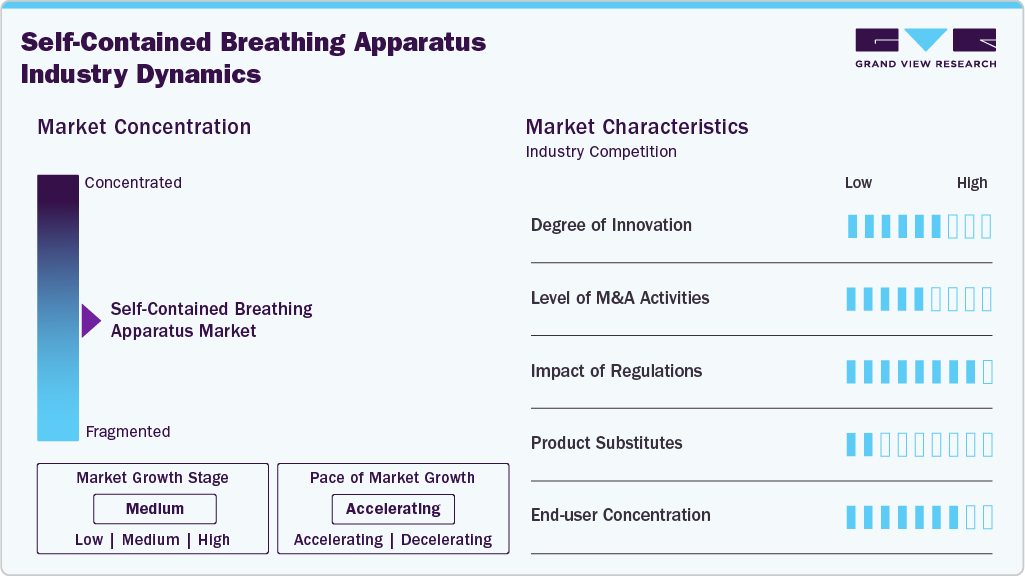
The technology landscape is evolving steadily, with manufacturers focusing on incremental innovation rather than disruptive change. Emphasis is placed on improving ergonomics, reducing equipment weight, enhancing durability, and integrating digital monitoring features that support operational safety and asset management. While advanced technologies are gaining traction among professional and industrial users, adoption is paced by certification timelines and conservative procurement practices.
Type Insights
The Open-Circuit SCBA type segment held the largest share in 2025, accounting for 67.0%. Demand for open-circuit self-contained breathing apparatus systems is driven by their widespread suitability for firefighting, emergency response, and industrial safety applications where immediate and reliable breathing air is critical. Their simpler operating principle, ease of training, and rapid deployment make them the preferred choice for municipal fire departments and industrial emergency teams. High regulatory acceptance and broad certification coverage further support adoption.
Demand for closed-circuit, self-contained breathing apparatus is supported by applications requiring extended duration and efficient air utilization, such as mining, tunneling, confined-space rescue, and military operations. Their ability to recycle exhaled air and operate for longer periods enhances suitability for prolonged missions in oxygen-deficient environments. Growing emphasis on worker safety in underground and enclosed industrial settings is strengthening adoption. Advances in compact design and reliability are further improving acceptance among specialized end users.
End Use Insights
The fire services end use segment held the largest share in 2025, holding 29.8% of the global revenue share. Demand from fire services is driven by the critical need for reliable respiratory protection in smoke-filled, toxic, and oxygen-deficient environments. Increasing urbanization and the vertical expansion of cities have intensified fire complexity, necessitating dependable self-contained breathing apparatus systems with high mobility and rapid deployment. Stringent firefighting safety standards and routine equipment replacement cycles further sustain demand. Emphasis on firefighter health and operational readiness continues to reinforce procurement.
The chemical/petrochemical segment drives demand due to frequent exposure risks associated with toxic gases, volatile chemicals, and confined processing areas. Strict occupational safety regulations mandate the use of self-contained breathing apparatus during routine maintenance, shutdowns, and emergency leak response. Expansion and modernization of refining and chemical processing facilities are increasing the installed base of safety equipment. Additionally, heightened focus on incident prevention and compliance audits supports consistent adoption.
Tank Type Insights
The type III tank segment led the market, holding 56.2% market share in 2025, driven by its suitability for industrial environments where moderate exposure durations and controlled risk conditions are prevalent. These systems are commonly adopted in manufacturing plants, utilities, and maintenance operations due to their balanced performance, durability, and cost efficiency. Regulatory compliance requirements for worker safety in confined and potentially hazardous areas further support adoption. Steady replacement demand from established industrial users underpins continued market traction.
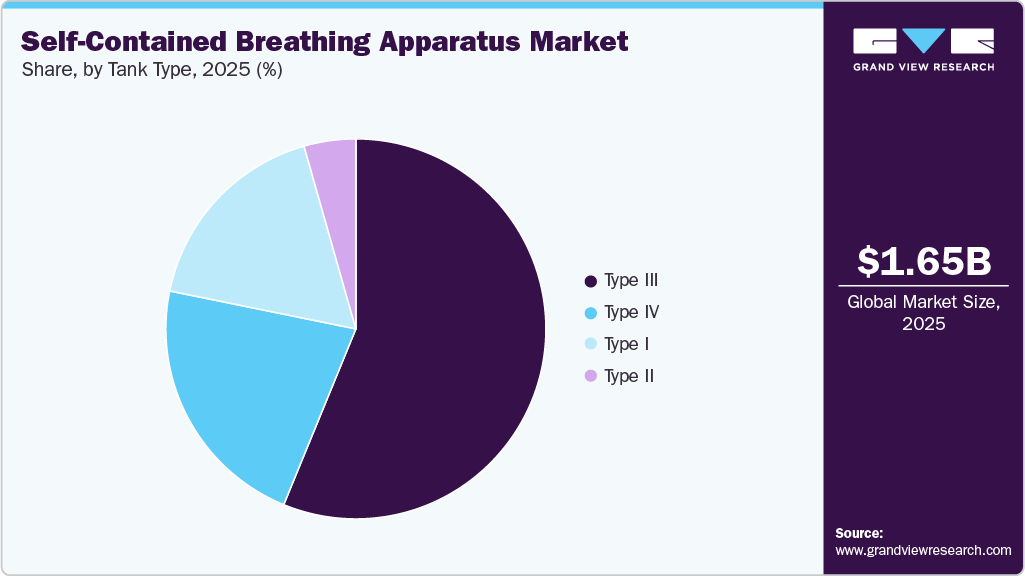
Type IV self-contained breathing apparatus demand is supported by high-risk applications requiring maximum protection, advanced performance, and extended operational reliability. These systems are preferred in firefighting, chemical emergency response, and high-hazard industrial scenarios due to enhanced design robustness and safety features. Increasing emphasis on responder protection and mission-critical performance is driving procurement. Ongoing technological upgrades and stricter safety expectations are accelerating replacement and upgrade cycles.
Regional Insights
North America dominates the SCBA market and accounted for 31.1% share in 2025, due to strong demand from fire services, oil & gas, and industrial safety sectors. Strict occupational safety regulations and regular equipment replacement cycles support consistent sales. High adoption of advanced, lightweight composite cylinders and smart SCBA features further strengthens the region. The presence of leading manufacturers and well-funded emergency services keeps the market mature and stable.
U.S. Self-Contained Breathing Apparatus Market Trends
The U.S. dominates the North American SCBA market, driven by large and well-funded fire services, strong oil & gas activity, and strict occupational safety regulations. Regular replacement cycles and early adoption of advanced, lightweight SCBA systems support steady demand. Federal and state safety standards push compliance across industrial and municipal users. The presence of leading manufacturers also strengthens domestic supply and innovation.
The Mexico SCBA market is being supported by the expansion in oil & gas, manufacturing, and chemical industries in the country. Rising enforcement of workplace safety norms is encouraging higher adoption of respiratory protection equipment. Investments in industrial infrastructure and emergency response capabilities are improving demand visibility. While price sensitivity remains, awareness and compliance are steadily increasing.
Europe Self-Contained Breathing Apparatus Market Trends
Europe shows steady growth supported by stringent workplace safety regulations and strong compliance culture. Fire brigades, chemical plants, and manufacturing facilities continue to invest in modern SCBA systems. Replacement demand for aging equipment and the shift toward lightweight, ergonomic designs are key factors. Sustainability and lifecycle management also influence purchasing decisions in the region.
The Germany SCBA market dominates the European SCBA market due to its strong industrial base and highly developed fire and emergency services. Strict occupational safety regulations drive consistent demand across manufacturing, chemical, and automotive sectors. Regular replacement of certified equipment and preference for high-quality, ergonomic systems support market leadership. Domestic presence of advanced safety equipment manufacturers further strengthens adoption.
The UK SCBA market is supported by ongoing upgrades in fire services and industrial safety programs. Tight health and safety regulations encourage continuous investment in respiratory protection equipment. Demand is also rising from oil & gas, utilities, and infrastructure maintenance activities. Increased focus on firefighter safety and modernization initiatives is driving market growth.
Asia Pacific Self-Contained Breathing Apparatus Market Trends
Asia Pacific is the fastest-growing region at a CAGR of 7.4% over the forecast period, driven by rapid industrialization, urbanization, and expanding fire safety infrastructure. Rising investments in oil & gas, chemicals, mining, and large-scale construction projects are increasing SCBA adoption. Governments are tightening worker safety norms, especially in China, India, and Southeast Asia. Growing awareness of occupational health and safety is accelerating new installations and upgrades.
The China SCBA market dominates the Asia Pacific SCBA market, supported by its large industrial base and extensive mining, chemical, and manufacturing activities. Rapid urbanization has increased investments in fire services and emergency response infrastructure. Stricter enforcement of workplace safety regulations is driving wider SCBA adoption across industries. Local manufacturing capacity also helps reduce costs and supports large-scale procurement.
The India SCBA market is being driven by expanding industrialization, infrastructure projects, and rising awareness of worker safety. Growth in oil & gas, chemicals, and power generation is increasing demand for respiratory protection equipment. Government initiatives to strengthen occupational health and safety standards support market expansion. Increasing investment in municipal fire services is further accelerating adoption.
Central & South America Self-Contained Breathing Apparatus Market Trends
Central & South America is a growing market, led by expansion in oil & gas, mining, and industrial sectors. Countries such as Brazil and Argentina are strengthening industrial safety standards, supporting gradual SCBA adoption. Demand is largely driven by new industrial projects and upgrades in emergency response capabilities. Budget constraints still limit penetration of premium systems, but awareness is improving.
The Argentina SCBA market is supported by expanding oil & gas, mining, and industrial activities. Increasing emphasis on workplace safety and emergency response preparedness is driving demand for respiratory protection equipment. Investments in industrial modernization and infrastructure projects are improving adoption rates. While budget constraints remain, awareness of safety compliance continues to rise.
Middle East & Africa Self-Contained Breathing Apparatus Market Trends
The Middle East & Africa region is growing due to investments in oil & gas, petrochemicals, mining, and large infrastructure projects. Fire safety and emergency preparedness are gaining priority, especially in Gulf countries. Adoption is supported by regulatory improvements and industrial expansion. However, the market remains uneven, with higher demand concentrated in industrialized and resource-rich economies.
The UAE SCBA market is driven by strong activity in oil & gas, petrochemicals, and large-scale infrastructure projects. Increasing focus on fire safety and emergency preparedness is boosting demand across industrial and commercial facilities. Strict safety standards in high-risk industries encourage regular upgrades of breathing apparatus systems. Investments in civil defense and industrial safety programs continue to support market growth.
Key Self-contained Breathing Apparatus (SCBA) Company Insights
Some of the key players operating in the market include 3M, Honeywell International Plc, and MSA Safety.
-
3M has a strong presence in the SCBA market through its focus on integrated respiratory protection solutions. The company emphasizes advanced materials, ergonomic facepieces, and reliable air-delivery systems for high-risk environments. Its SCBA offerings are closely aligned with stringent safety certifications required by fire services and industrial users. Continuous product upgrades focus on user comfort, durability, and performance under extreme conditions. Strong global distribution supports consistent adoption across developed and emerging markets.
-
Alpha Pro Tech Limited participates in the respiratory protection ecosystem with a focus on safety-driven product portfolios. The company’s approach centers on meeting regulatory and compliance requirements for hazardous work environments. Its offerings complement SCBA systems used in industrial, healthcare, and emergency response settings. Demand is supported by increasing emphasis on worker protection and contamination control. The company benefits from niche positioning rather than broad, mass-market SCBA manufacturing.
Key Self-contained Breathing Apparatus Companies:
The following key companies have been profiled for this study on the self-contained breathing apparatus market
- 3M
- Alpha Pro Tech Limited
- Avon Protection PLC
- MSA Safety Incorporated
- Drägerwerk AG & Co. KGaA
- Interspiro
- Worthington Industries
- Sure Safety
- Shanghai Yibei Safety Equipment Co., Ltd
- Protective Industrial Products (PIP)
Recent Developments
-
In April 2025, 3M introduced the Air-Pak XD SCBA as a next-generation breathing apparatus designed for modern firefighting conditions. The system features a durable, low-profile backframe to improve mobility and reduce snag risks in confined spaces. It supports advanced communication and telemetry capabilities for better on-scene awareness. The design prioritizes comfort, ruggedness, and compliance with current firefighting safety standards.
-
In April 2025, MSA Safety Incorporated announced upgrades to its G1 SCBA platform to improve firefighter usability and comfort. The enhancements include a redesigned regulator valve and improved harness and padding components. These changes make the system easier to don, clean, and operate in demanding conditions. The upgrades are designed to integrate seamlessly with existing G1 SCBA units.
Self-Contained Breathing Apparatus Market Report Scope
Report Attribute Details
Market size value in 2026
USD 1,736.2 million
Revenue forecast in 2033
USD 2,611.6 million
Growth rate
CAGR of 6.0% from 2026 to 2033
Historical data
2021 - 2024
Forecast period
2026 - 2033
Quantitative units
Revenue in USD million, Units, and CAGR from 2026 to 2033
Report coverage
Revenue forecast, company ranking, competitive landscape, growth factors, and trends
Segments covered
Type, End Use, Tank Type, And Region
Region scope
North America; Europe; Asia Pacific; Central & South America; Middle East & Africa
Key companies profiled
3M; Alpha Pro Tech Limited; Avon Protection PLC; MSA Safety Incorporated; Drägerwerk AG & Co. KGaA; Interspiro; Worthington Industries; Sure Safety; Shanghai Yibei Safety Equipment Co., Ltd; Protective Industrial Products (PIP)
Customization scope
Free report customization (equivalent up to 8 analysts working days) with purchase. Addition or alteration to country, regional & segment scope.
Pricing and purchase options
Avail customized purchase options to meet your exact research needs. Explore purchase options
Global Self-contained Breathing Apparatus Market Report Segmentation
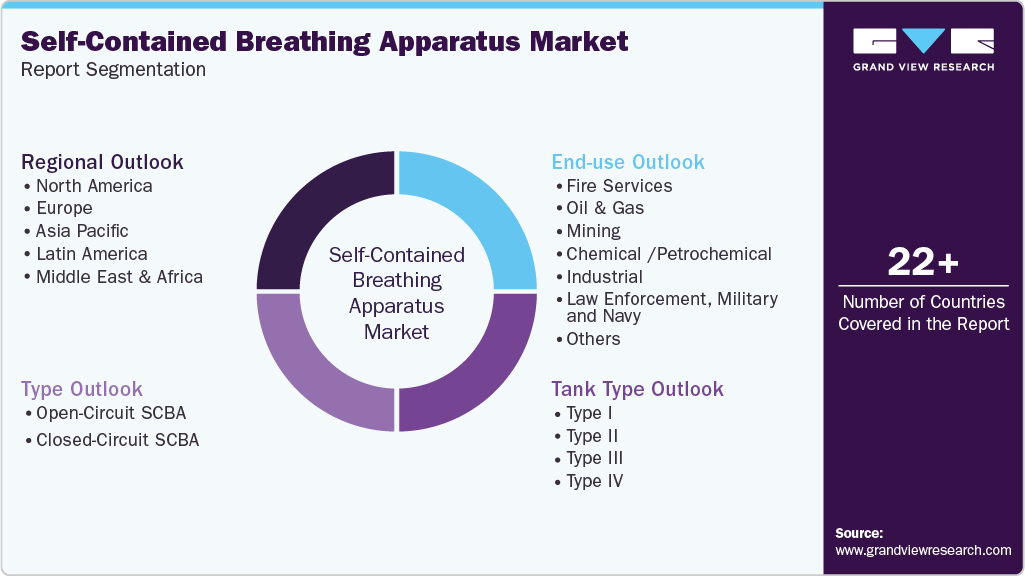
This report forecasts revenue growth at global, regional & country levels and provides an analysis on the industry trends in each of the sub-segments from 2021 to 2033. For the purpose of this study, Grand View Research has segmented the self-contained breathing apparatus market on the basis of type, end use, tank type, and region:
-
Type Outlook (Revenue, USD Million, 2021 - 2033)
-
Open-Circuit SCBA
-
Closed-Circuit SCBA
-
-
End Use Outlook (Revenue, USD Million, 2021 - 2033)
-
Fire Services
-
Oil & Gas
-
Mining
-
Chemical /Petrochemical
-
Industrial
-
Law Enforcement, Military and Navy
-
Others
-
-
Tank Type Outlook (Revenue, USD Million, 2021 - 2033)
-
Type I
-
Type II
-
Type III
-
Type IV
-
-
Regional Outlook (Revenue, USD Million, 2021 - 2033)
-
North America
-
U.S.
-
Canada
-
Mexico
-
-
Europe
-
Germany
-
France
-
Italy
-
UK
-
Spain
-
-
Asia Pacific
-
China
-
India
-
Japan
-
South Korea
-
Australia
-
-
Central & South America
-
Brazil
-
Argentina
-
-
Middle East & Africa
-
Saudi Arabia
-
South Africa
-
UAE
-
-
Frequently Asked Questions About This Report
b. Some of the key players operating in the self-contained breathing apparatus market include 3M, MSA, Drägerwerk AG & Co. KGaA, Avon Protection, Honeywell International Inc., Interspiro, Worthington Industries, Axiom Manufacturing, Afex Fire & Safety, MATISEC, SHIGEMATSU WORKS CO.,LTD., KOKEN LTD., Cam Lock Ltd, Sure Safety, Shanghai Fangzhan Fire Technology Co., Ltd., Bullard Limited
b. The self-contained breathing apparatus (SCBA) cylinders market is experiencing significant growth primarily due to increasing safety regulations across various industries. As governments and regulatory bodies impose stricter occupational health and safety standards, companies are compelled to invest in reliable safety equipment, including SCBA systems.
b. North America dominates the SCBA market and accounted for 31.1% share in 2025, due to strong demand from fire services, oil & gas, and industrial safety sectors. Strict occupational safety regulations and regular equipment replacement cycles support consistent sales. High adoption of advanced, lightweight composite cylinders and smart SCBA features further strengthens the region
b. The global self-contained breathing apparatus market size was estimated at USD 1,651.7 million in 2025 and is expected to reach USD 1,736.2 million in 2026
b. The global self-contained breathing apparatus market, in terms of revenue, is expected to grow at a compound annual growth rate of 6.0% from 2026 to 2033 to reach USD 2,611.6 million by 2033


Share this report with your colleague or friend.
Need a Tailored Report?
Customize this report to your needs — add regions, segments, or data points, with 20% free customization.


ISO 9001:2015 & 27001:2022 Certified
We are GDPR and CCPA compliant! Your transaction & personal information is safe and secure. For more details, please read our privacy policy.
Trusted market insights - try a free sample
See how our reports are structured and why industry leaders rely on Grand View Research. Get a free sample or ask us to tailor this report to your needs.