- Home
- »
- Biotechnology
- »
-
Scaffold-free 3D Cell Culture Market, Industry Report, 2033GVR Report cover
![Scaffold-free 3D Cell Culture Market Size, Share & Trends Report]()
Scaffold-free 3D Cell Culture Market (2026 - 2033) Size, Share & Trends Analysis Report By Technology (Hanging Drop Microplates, Spheroid Microplates With ULA Coating), By Application (Cancer Research, Stem Cell Research & Tissue Engineering), By End Use, By Region, And Segment Forecasts
- Report ID: GVR-4-68040-853-5
- Number of Report Pages: 120
- Format: PDF
- Historical Range: 2021 - 2024
- Forecast Period: 2026 - 2033
- Industry: Healthcare
- Report Summary
- Table of Contents
- Segmentation
- Methodology
- Download FREE Sample
-
 Download Sample Report
Scaffold-free 3D Cell Culture Market Summary
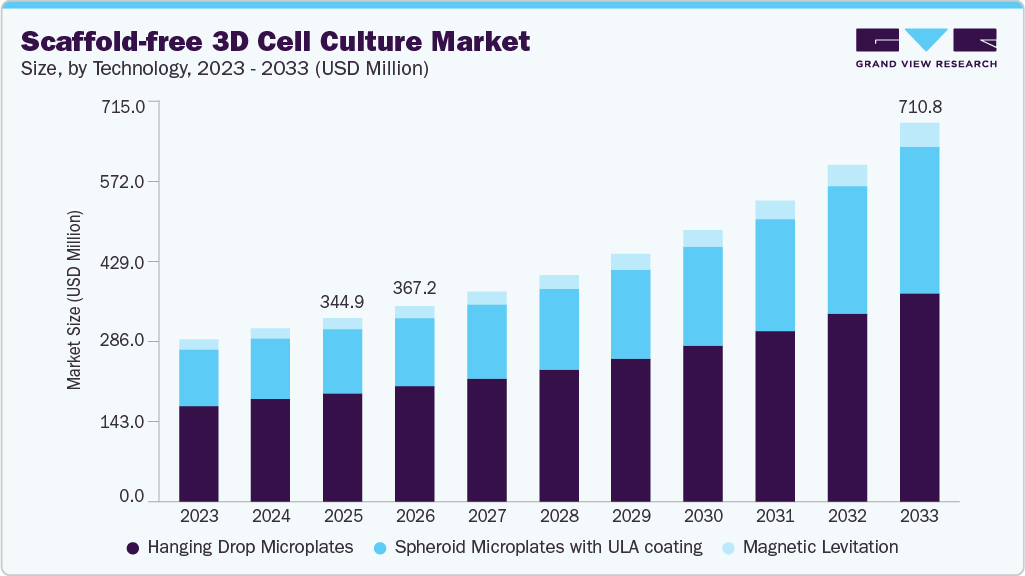
The global scaffold-free 3D cell culture market size was valued at USD 344.9 million in 2025 and is projected to reach USD 710.8 million by 2033, growing at a CAGR of 9.89% between 2026 and 2033. The growth is driven by the rising use of advanced in vitro models for drug discovery, regenerative medicine, personalized healthcare, and demand for cell culture systems that closely mimic native tissues.
Key Market Trends & Insights
- North America scaffold-free 3D cell culture industry held the largest global market share of 38.66% in 2025.
- The scaffold-free 3D cell culture industry in the U.S. is expected to grow over the forecast period due to the expanding aging population.
- Based on technology, the hanging drop microplates segment dominated the market with a share of 59.13% in 2025.
- Based on application, the stem cell research & tissue engineering segment dominated the market in 2025.
- Based on end use, the biotechnology & pharmaceutical companies segment dominated the market in 2025.
Market Size & Forecast
- 2025 Market Size: USD 344.9 Million
- 2033 Projected Market Size: USD 710.8 Million
- CAGR (2026-2033): 9.89%
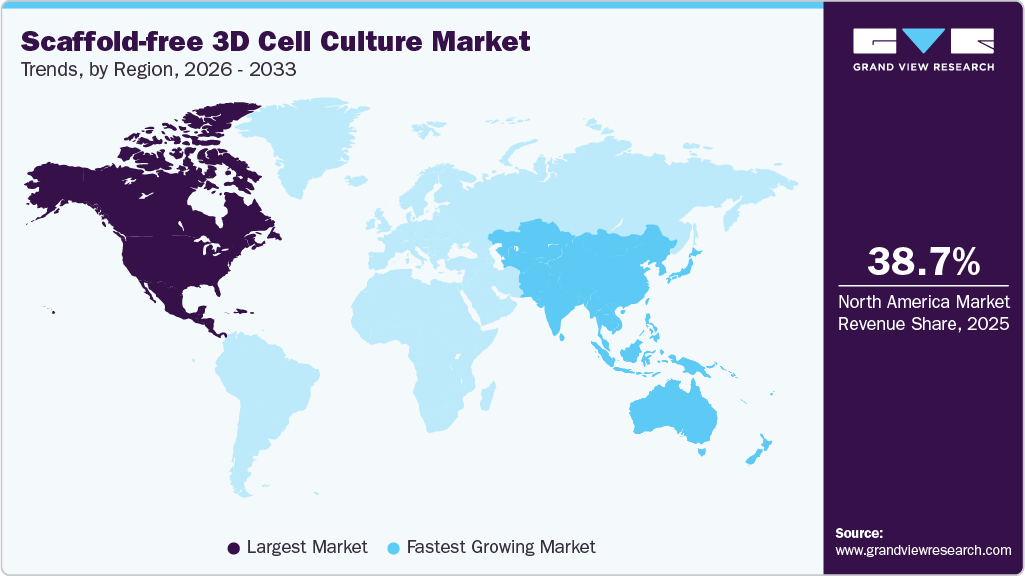
- North America: Largest market in 2025
- Asia Pacific: Fastest growing market
Rising Drug Discovery and Development ActivitiesThe pharmaceutical and biotechnology sectors are increasingly using scaffold‑free 3D cell culture systems to improve preclinical research. Unlike traditional 2D cultures, which poorly mimic tissue architecture and cellular interactions, scaffold‑free models like spheroids and organoids better replicate in vivo conditions, providing more accurate data on drug efficacy and toxicity and reducing costly late-stage failures.
Key Drug Statistics
Category
Number of Drugs
Total Number of Small Molecule Drugs
15,484
Total Number of Biotech Drugs
4,355
Total Number of Approved Drugs
4,794
Total Number of Approved Small Molecule Drugs
3,020
Total Number of Nutraceutical Drugs
135
Total Number of Experimental Drugs
8,902
Total Number of Illicit Drugs
205
Total Number of Withdrawn Drugs
915
Total Number of Drugs
19,839
Source: DrugBank, Secondary Research, Primary Interviews, Grand View Research
These systems also support high-throughput drug screening and toxicology testing, compatible with automated platforms and imaging technologies for large-scale compound evaluation. The rise of personalized medicine further drives adoption, as patient-derived 3D models enable testing of individualized treatment responses. Overall, scaffold-free 3D culture enhances predictive accuracy, scalability, and adaptability in modern drug discovery.
Need For More Physiologically Relevant In Vitro Models
Traditional 2D cell cultures limit cell interactions, morphology, and signaling, failing to replicate the complexity of living tissues. Scaffold-free 3D systems, like spheroids and organoids, allow cells to self-assemble in three dimensions, better mimicking tissue architecture and microenvironments. This improves predictive accuracy for drug response, toxicity, and disease modeling.
The pharmaceutical and biotechnology sectors are increasingly adopting scaffold-free 3D cultures for translational research. These models capture nutrient gradients, oxygen diffusion, and cell signaling, supporting personalized medicine with patient-derived organoids. Their higher biological relevance enhances preclinical data quality and reduces costly late-stage failures, driving global adoption in research laboratories.
Market Concentration & Characteristics
The global scaffold‑free 3D cell culture industry is propelled by technological innovation, including ultra-low attachment plates, micro-patterned surfaces, and automated spheroid systems. These advances improve reproducibility, scalability, and disease modeling, enabling more accurate drug screening, toxicology studies, and personalized medicine end uses.
The industry has seen moderate mergers and acquisitions as companies aim to expand their product portfolios, enhance technological capabilities, and enter new geographic markets. Strategic acquisitions of innovative startups and complementary platforms help established players accelerate R&D, strengthen competitive positioning, and meet growing demand for advanced 3D culture solutions.
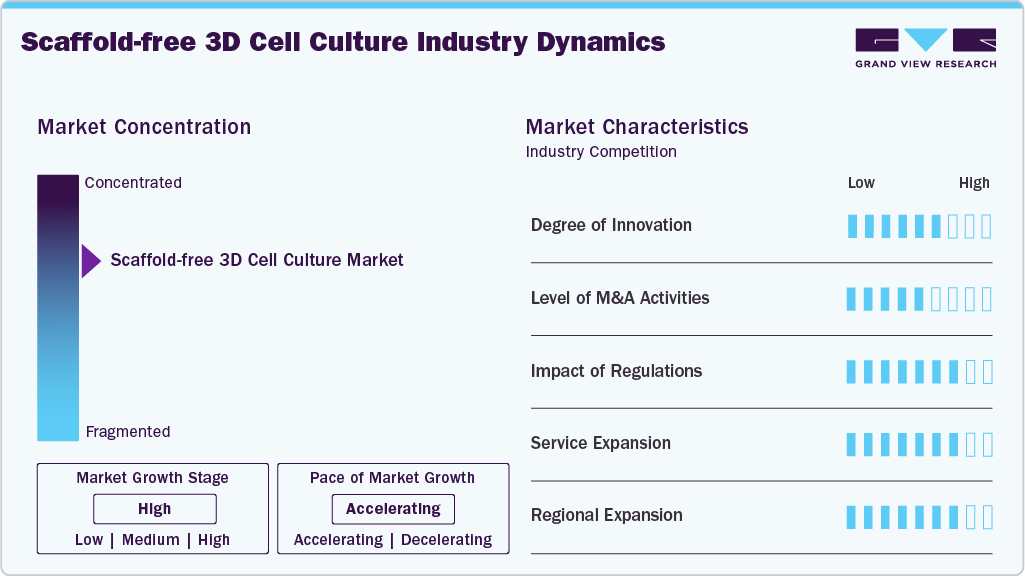
Regulatory frameworks promoting ethical research and reducing animal testing are positively impacting the scaffold-free 3D cell culture industry. Guidelines from agencies like the FDA and EMA encourage adoption of in vitro models for drug testing, toxicity studies, and disease modeling, driving demand for physiologically relevant and compliant 3D culture systems.
Companies in the scaffold-free 3D cell culture industry are continuously expanding their product portfolios by introducing advanced culture platforms, automated spheroid systems, and integrated imaging solutions. These innovations cater to diverse end uses in drug discovery, disease modeling, and regenerative medicine, helping firms strengthen their market presence and meet growing research demand.
Market players are expanding into emerging regions such as Asia Pacific and Latin America to tap into growing research infrastructure and rising demand for advanced cell culture technologies. Strategic partnerships, localized distribution, and new regional offices enable companies to increase market penetration and support the adoption of scaffold-free 3D culture systems globally.
Technology Insights
In 2025, the hanging drop microplates segment dominated the industry, accounting for the largest share of 59.13%. This leadership is driven by their simplicity, reproducibility, and ability to generate uniform spheroids, making them a preferred choice for drug screening, disease modeling, and toxicology studies. Its compatibility with high-throughput systems and easy integration into lab workflows drives widespread adoption in research laboratories.
The spheroid microplates with ultra-low attachment (ULA) coating segment is gaining traction because their design stops cell adhesion, which results in continuous spheroid production. The plates find extensive end use in drug screening and toxicology testing and disease modeling because they deliver consistent results and work well with high-throughput testing procedures.
Application Insights
The stem cell research & tissue engineering segment dominated the industry in 2025, holding a 33.78% share, due to the increasing use of 3D models for tissue regeneration studies, disease modeling, and development of personalized therapies. The segment’s growth is further supported by advancements in organoid technology and the rising demand for patient-specific models in regenerative medicine. In addition, collaborations between academic institutions and biotech firms are accelerating research adoption, driving consistent market expansion.
The cancer research segment is experiencing the fastest growth because scaffold-free 3D cultures, such as tumor spheroids and organoids, closely mimic the tumor microenvironment, enabling more accurate studies of cancer progression, drug response, and personalized therapies. Increasing adoption in immuno-oncology, high-throughput screening, and precision medicine is further driving market expansion.
End Use Insights
In 2025, the biotechnology & pharmaceutical companies segment held the largest share of 46.86% in the scaffold-free 3D cell culture market, because their research and development efforts were extensive and they used advanced three-dimensional models for drug development and developed methods to decrease preclinical testing failures. The increasing need for personalized medicine, together with high-throughput screening methods, creates additional demand for this market segment.
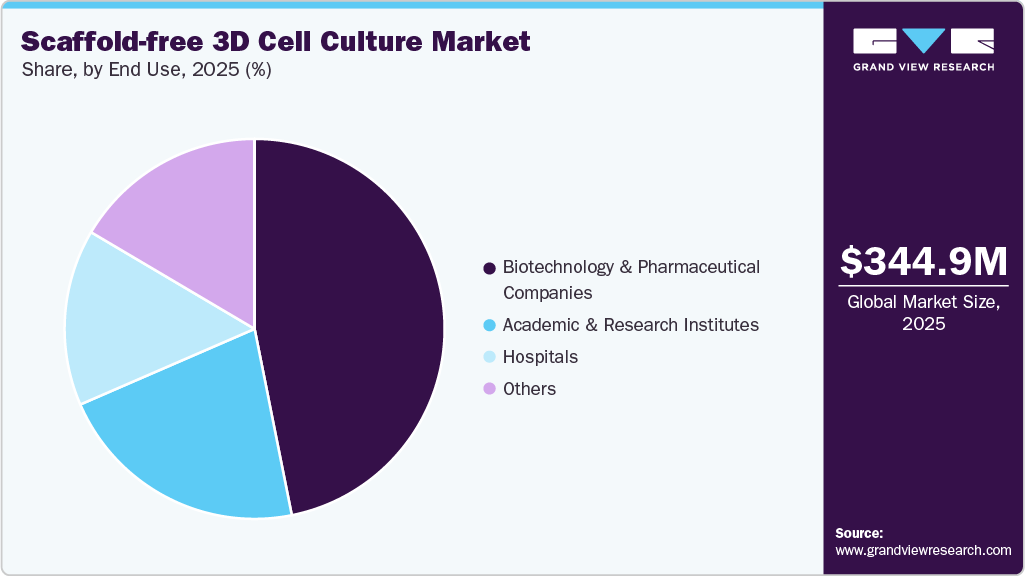
The academic & research institutes segment is expected to register the fastest CAGR over the forecast period, driven by increasing investments in life sciences research, the adoption of advanced scaffold-free 3D culture models for disease modeling, and growing demand for innovative tools in regenerative medicine and stem cell studies. Collaborations with biotech companies and access to high-throughput platforms further support this rapid growth.
Regional Insights
North America led the scaffold-free 3D cell culture industry in 2025 with a share of 38.66%, driven by its strong pharmaceutical and biotechnology sectors, extensive biologics pipeline, and a high concentration of CDMOs. The region’s focus on advanced drug discovery, regenerative medicine, and adoption of cutting-edge research tools further reinforces its market dominance.
U.S Scaffold-free 3D Cell Culture Market Trends
The scaffold-free 3D cell culture market in the U.S. is fueled by a strong pharma and biotech ecosystem, advanced R&D, and high adoption of organoid and spheroid technologies, supported by well-funded labs and CDMOs.
Europe Scaffold-free 3D Cell Culture Market Trends
The scaffold-free 3D cell culture market in Europe held a significant share in 2025 due to its well-established research infrastructure, rising investments in regenerative medicine and stem cell research, and stringent regulatory frameworks promoting advanced in vitro models. Countries such as Germany, the UK, and France are key contributors to market growth.
The UK scaffold-free 3D cell culture market holds a leading position in Europe due to its well-established academic and research institutions, growing investment in stem cell and tissue engineering research, and regulatory encouragement for innovative in vitro models. Collaborative projects with biotech firms are also accelerating adoption.
The scaffold-free 3D cell culture market in Germany is a key market in Europe, fueled by strong pharmaceutical R&D, advanced laboratory infrastructure, and increasing focus on personalized medicine and high-throughput 3D screening technologies. Government initiatives supporting biotech innovation further drive market growth.
Asia Pacific Scaffold-free 3D Cell Culture Market Trends
The scaffold-free 3D cell culture market in Asia Pacific is expected to grow with the fastest CAGR of 11.44% throughout the forecast period, fueled by increasing life sciences research investments, expansion of biotechnology hubs, and growing adoption of personalized medicine. Rising government initiatives and collaborations with global biotech firms are also accelerating market development in the region.
China scaffold-free 3D cell culture market is witnessing rapid growth due to substantial government support for biotechnology research, expansion of academic and industrial R&D facilities, and rising interest in personalized medicine. The growing pharmaceutical sector and rising demand for advanced vitro models are key market drivers.
Japan scaffold-free 3D cell culture market is a major contributor in Asia Pacific, with increasing adoption of scaffold-free 3D cultures in drug discovery and cancer research. Rising investments in regenerative medicine, stem cell studies, and collaborations with global biotech companies enhance the market’s expansion.
MEA Scaffold-free 3D Cell Culture Market Trends
The scaffold-free 3D cell culture market in the Middle East & Africa is still nascent but expanding steadily due to the establishment of new research institutions, government-backed initiatives, and increasing focus on modern biotechnology tools for drug discovery and disease modeling.
Kuwait scaffold-free 3D cell culture market is an emerging market in the Middle East, with growth driven by investments in research infrastructure, government initiatives supporting biotechnology, and increasing awareness of advanced 3D cell culture technologies in academic and clinical research.
Key Scaffold-free 3D Cell Culture Companies Insights
The scaffold-free 3D cell culture market is led by key players like Thermo Fisher Scientific, Merck KGaA, Corning, and Lonza, who dominate through strong product portfolios, collaborations, and global distribution of advanced 3D culture platforms.
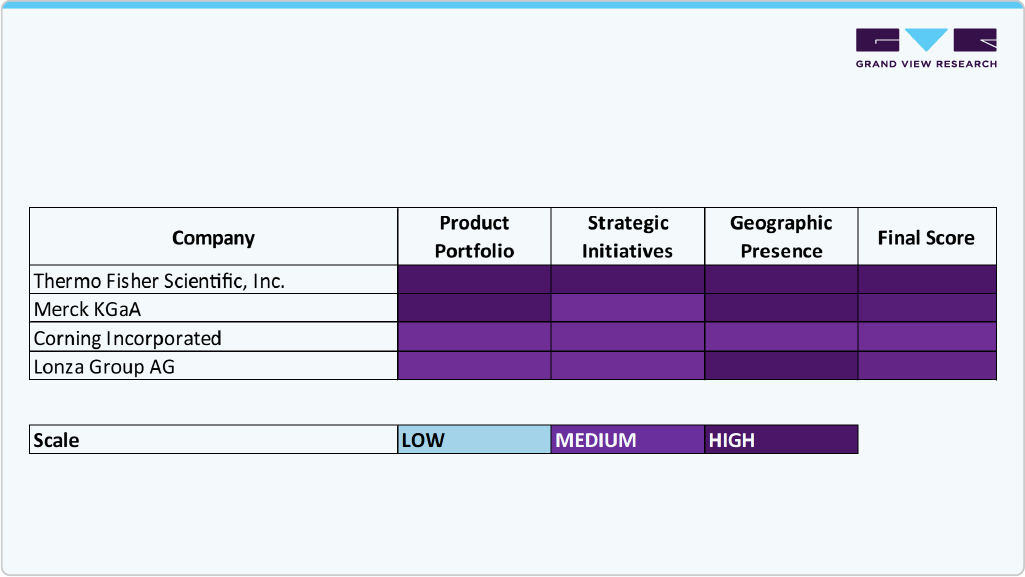
Companies such as Greiner Bio‑One, InSphero, REPROCELL, Nano3D, PromoCell, and Tecan are expanding by offering innovative, customized scaffold-free 3D culture solutions for academia, pharma, and biotech.
The scaffold-free 3D cell culture market is driven by mergers, alliances, and innovations in spheroid and organoid technologies, with companies combining scientific advances and customer-focused solutions leading the sector.
Key Scaffold-free 3D Cell Culture Companies:
The following key companies have been profiled for this study on the scaffold-free 3D cell culture market.
- Thermo Fisher Scientific Inc.
- Merck KGaA
- Corning Incorporated
- Lonza Group AG
- Greiner Bio‑One International GmbH
- InSphero AG
- REPROCELL Inc.
- Nano3D Biosciences, Inc.
- PromoCell GmbH
- Tecan Trading AG
Recent Developments
-
In January 2025, Merck acquired HUB Organoids Holding B.V., enhancing its cell culture portfolio with HUB’s patented organoid technologies to accelerate drug development and research end uses.
-
In February 2024, Corning Incorporated launched the Elplasia 12K flask, enabling bulk production of ~12,000 uniform spheroids per flask to support drug screening, cancer research, and advanced 3D cell culture end uses.
Scaffold-free 3D Cell Culture Market Report Scope
Report Attribute
Details
Market size value in 2026
USD 367.2 million
Revenue forecast in 2033
USD 710.8 million
Growth rate
CAGR of 9.89% from 2026 to 2033
Base year for estimation
2025
Historical data
2021 - 2024
Forecast period
2026 - 2033
Quantitative units
Revenue in USD million/billion and CAGR from 2026 to 2033
Report coverage
Revenue forecast, company ranking, competitive landscape, growth factors, and trends
Segments covered
Technology, application, end use, region
Regional scope
North America; Europe; Asia Pacific; Latin America; MEA
Country scope
U.S.; Canada; Mexico; UK; Germany; France; Italy; Spain; Denmark; Sweden; Norway; Japan; China; India; Australia; Thailand; South Korea; Brazil; Argentina; South Africa; Saudi Arabia, UAE; Kuwait
Key companies profiled
Thermo Fisher Scientific Inc.; Merck KGaA; Corning Incorporated; Lonza Group AG; Greiner Bio‑One International GmbH; InSphero AG; REPROCELL Inc.; Nano3D Biosciences, Inc.; PromoCell GmbH; Tecan Trading AG
Customization scope
Free report customization (equivalent up to 8 analyst’s working days) with purchase. Addition or alteration to country, regional & segment scope.
Global Scaffold-free 3D Cell Culture Market Report Segmentation
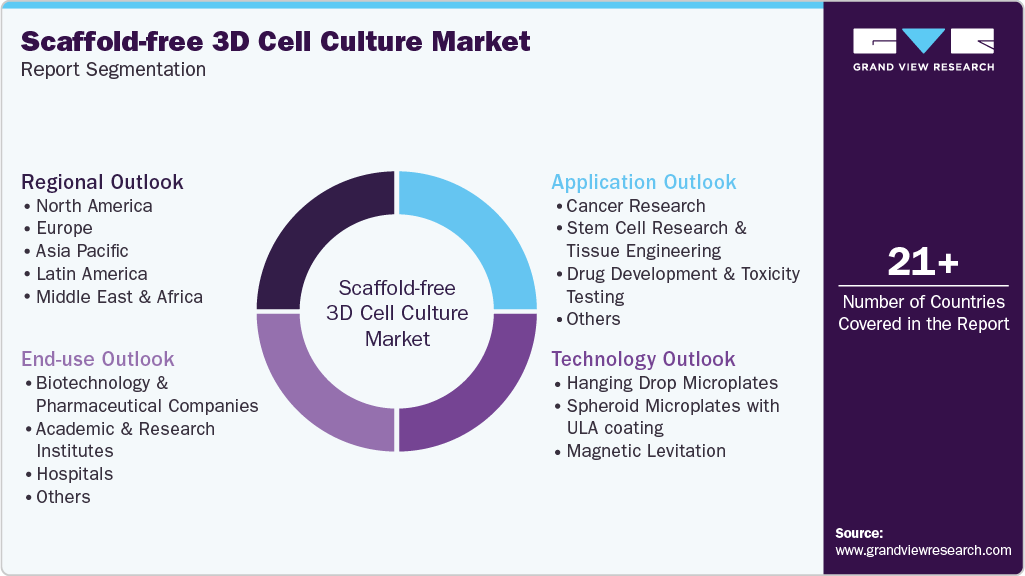
This report forecasts revenue growth at the global, regional and country levels and provides an analysis of the latest trends in each of the sub-segments from 2021 to 2033. For this study, Grand View Research has segmented the global scaffold-free 3D cell culture market report on the basis of technology, application, end use, and region.
-
Technology Outlook (Revenue, USD Million, 2021 - 2033)
-
Hanging Drop Microplates
-
Spheroid Microplates with ULA coating
-
Magnetic Levitation
-
-
Application Outlook (Revenue, USD Million, 2021 - 2033)
-
Cancer Research
-
Stem Cell Research & Tissue Engineering
-
Drug Development & Toxicity Testing
-
Others
-
-
End Use Outlook (Revenue, USD Million, 2021 - 2033)
-
Biotechnology & Pharmaceutical Companies
-
Academic & Research Institutes
-
Hospitals
-
Others
-
-
Regional Outlook (Revenue, USD Million, 2021 - 2033)
-
North America
-
U.S.
-
Canada
-
Mexico
-
-
Europe
-
UK
-
Germany
-
France
-
Italy
-
Spain
-
Denmark
-
Sweden
-
Norway
-
-
Asia Pacific
-
Japan
-
China
-
India
-
Australia
-
Thailand
-
South Korea
-
-
Latin America
-
Brazil
-
Argentina
-
-
Middle East and Africa
-
South Africa
-
Saudi Arabia
-
UAE
-
Kuwait
-
-
Frequently Asked Questions About This Report
b. The global scaffold-free 3D cell culture market size was estimated at USD 344.9 million in 2025 and is expected to reach USD 367.2 million in 2026.
b. The global scaffold-free 3D cell culture market is expected to grow at a compound annual growth rate of 9.89% from 2026 to 2033 to reach USD 710.8 billion by 2033.
b. The hanging drop microplates segment is expected to hold the largest share in 2025, primarily due to its widespread adoption for spheroid formation in cancer research and drug screening applications. Its cost-effectiveness, ease of use, and ability to generate uniform, reproducible spheroids without the need for external scaffolds are further driving segment growth across pharmaceutical and academic research settings.
b. A few of the key market players include Thermo Fisher Scientific Inc.; Merck KGaA; Corning Incorporated; Lonza Group AG; Greiner Bio‑One International GmbH; InSphero AG; REPROCELL Inc.; Nano3D Biosciences, Inc.; PromoCell GmbH; and Tecan Trading AG among others.
b. The scaffold-free 3D cell culture market is anticipated to grow owing to increasing adoption in drug discovery and cancer research, driven by its ability to better mimic in-vivo cellular behavior. This growth is further supported by rising demand for physiologically relevant in-vitro models and advances in cell culture technologies.


Share this report with your colleague or friend.
Need a Tailored Report?
Customize this report to your needs — add regions, segments, or data points, with 20% free customization.


ISO 9001:2015 & 27001:2022 Certified
We are GDPR and CCPA compliant! Your transaction & personal information is safe and secure. For more details, please read our privacy policy.
Trusted market insights - try a free sample
See how our reports are structured and why industry leaders rely on Grand View Research. Get a free sample or ask us to tailor this report to your needs.