- Home
- »
- Animal Health
- »
-
Ruminant Methane Reduction Market, Industry Report, 2033GVR Report cover
![Ruminant Methane Reduction Market Size, Share & Trends Report]()
Ruminant Methane Reduction Market (2026 - 2033) Size, Share & Trends Analysis Report By Product (Feed Additives/ Supplements), By Animal Type (Cattle, Sheep, Goats), By Region (North America, Europe, Asia Pacific, Latin America, MEA), And Segment Forecasts
- Report ID: GVR-4-68040-259-7
- Number of Report Pages: 150
- Format: PDF
- Historical Range: 2021 - 2025
- Forecast Period: 2026 - 2033
- Industry: Healthcare
- Report Summary
- Table of Contents
- Segmentation
- Methodology
- Download FREE Sample
-
 Download Sample Report
Ruminant Methane Reduction Market Summary
The global ruminant methane reduction market size was estimated at USD 3.18 billion in 2025 and is projected to reach USD 6.04 billion by 2033, growing at a CAGR of 8.4% from 2026 to 2033. The market is primarily propelling due to factors such as rising climate regulations targeting livestock methane emissions, growing livestock population, and expanding ruminant production, increasing investment in methane-reducing feed additives and biotechnology, and government funding and incentive programs for low-emission agriculture.
Key Market Trends & Insights
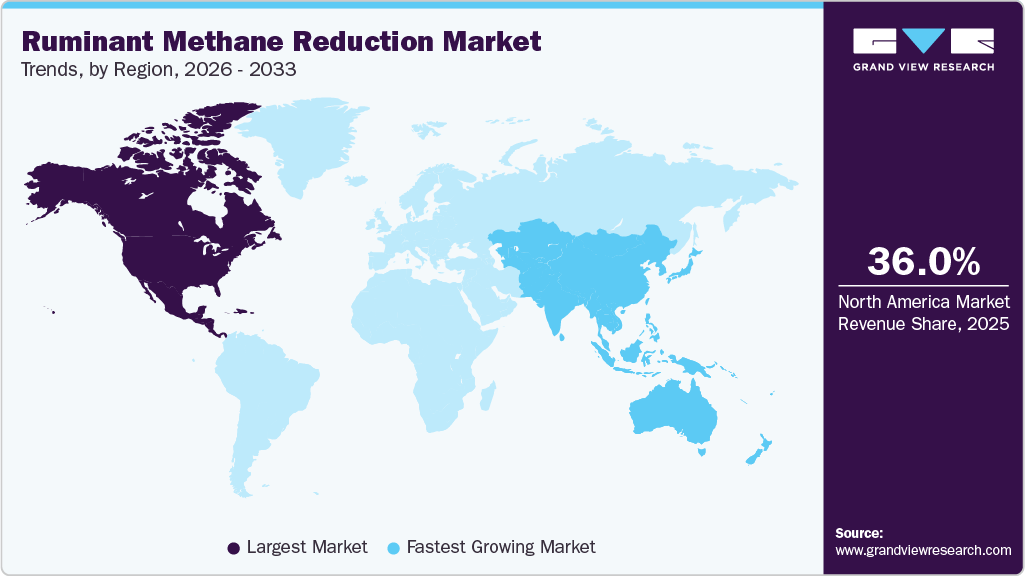
- North America ruminant methane reduction market held the largest revenue share of more than 36% in 2025.
- The U.S. dominated the North America region with the largest revenue share in 2025.
- By product, feed additives/supplements segment held the largest share over 89% of the market in 2025.
- By animal, cattle segment held the largest revenue share in 2025.
Market Size & Forecast
- 2025 Market Size: USD 3.18 Billion
- 2033 Projected Market Size: USD 6.04 Billion
- CAGR (2026-2033): 8.4%
- North America: Largest revenue share in 2025
- Asia Pacific: Fastest growing market
Sustained and diversified capital allocation toward feed additive innovation and biotechnology-driven mitigation platforms constitutes one of the primary structural drivers of the global ruminant methane reduction market. Investment activity spanning venture funding, institutional grant programs, and academic-industry collaborations is collectively accelerating the transition of methane-reducing solutions from laboratory validation to commercial deployment, thereby expanding the adoption and broadening farmer access to efficacious reduction tools.The investment landscape is increasingly multi-tiered. Private venture capital has targeted novel delivery mechanisms and biomass-based additive platforms, while philanthropic and institutional capital, such as the April 2025 Bezos Earth Fund and Global Methane Hub's joint USD 27.4 million initiative for low-methane livestock selection across four continents, has expanded the investment focus into biotech-driven genetic interventions, operating in parallel with conventional feed additive development. This capital diversification across technology categories is a distinguishing feature of the current sector phase, indicating that investors are treating ruminant methane reduction as a portfolio-level problem rather than a single-solution opportunity.
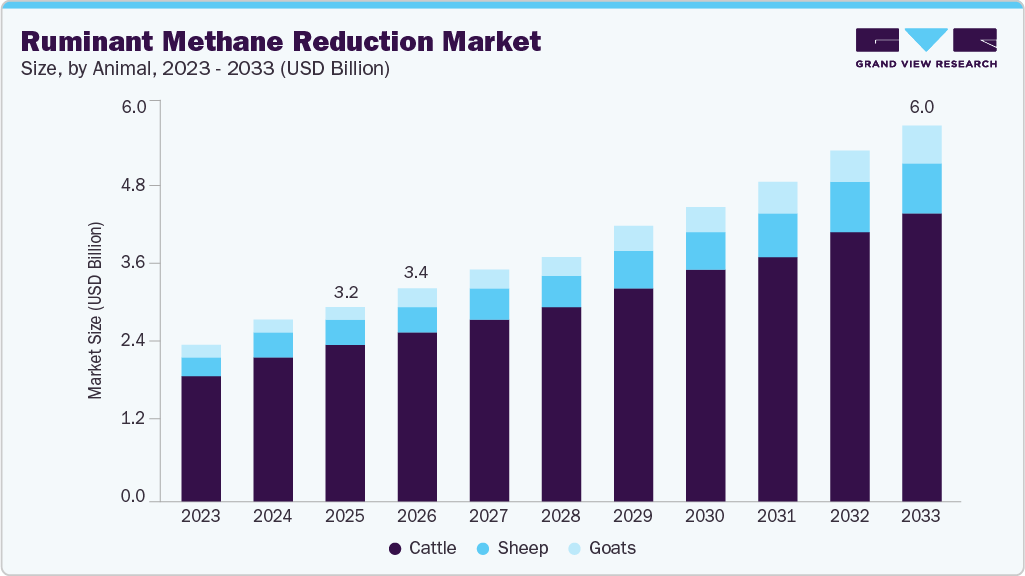
Moreover, recent investment activity has also shifted focus toward closing the farm-level adoption gap, a barrier that has historically constrained market penetration despite technical efficacy. For instance, in January 2026, a University of British Columbia-led partnership directed funding toward cost-effective methane measurement and management tools specifically designed to reduce the economic burden on cattle farmers, addressing cost and operational complexity as adoption constraints (UBC News). Furthermore, in September 2025, CH4 Global's commercial-scale Asparagopsis seaweed operations demonstrated that biomass-derived CH4 suppression is operationally viable beyond controlled trial conditions, validating the investment case for large-scale feed additive manufacturing infrastructure (CH4 Global).
The convergence of these capital flows is materially compressing the R&D-to-commercialization timeline, generating a sustained pipeline of market-ready reduction solutions and positioning investment intensity as a foundational driver of long-term market expansion.
Greener Cattle Initiative Key Grants 2026:
Parameter
Grant 1
Grant 2
Principal Investigator
Prof. Joe Jacobs
Dr. Stefan Muetzel
Institution
Australia's Department of Energy, Environment and Climate Action
Bioeconomy Science Institute
Grant Amount
USD 1,863,363
USD 704,104
Matching Funds
USD 409,991 (Agriculture Victoria Research & Sea Forest)
USD 6,667 (AgResearch & Ruminant Biotech Ltd.)
Research Focus
Effectiveness and safety of daily bromoform feeding in grazing dairy cows over a 10-month full lactation period
Whether continuous pulsed bromoform dosing can shift rumen microbes from methane generation to acetate production
Key Variables Assessed
Impact on cows, calves, and milk quality
Rumen microbiome shifts and feed energy utilization efficiency
Production System
Grazing dairy systems
Ruminant cattle (rumen-focused)
Potential Outcome
Bromoform validated as a commercial methane-mitigation tool for grazing dairy operations
Cows deriving greater energy from feed while releasing reduced methane volumes
Market Concentration & Characteristics
The global ruminant methane reduction market operates at a moderate concentration level, comprising large agri-nutrition incumbents such as DSM, Alltech, Elanco Animal Health, and Cargill alongside specialized biotech entrants including Rumin8, Zelp, and Symbrosia. No single player commands dominant market control. However, targeted product launches are gradually shifting this balance. Elanco's Bovaer commercialization and dsm-firmenich's North America distribution partnership, combined with Alltech's acquisition of Agolin, are progressively consolidating the commercial feed additive segment around well-capitalized players, steering the market toward a tiered competitive structure.
The global ruminant methane reduction sector is characterized by a high degree of innovation, driven by rapid advancements across multiple technology categories. Active R&D pipelines span enteric feed additives, rumen microbiome engineering, prototype vaccines, wearable methane capture devices, and slow-release bolus delivery mechanisms. Academic institutions, agri-biotech firms, and government-backed research programs are operating concurrently, generating a sustained pipeline of differentiated solutions and maintaining the market's high innovation tempo throughout the forecast period.
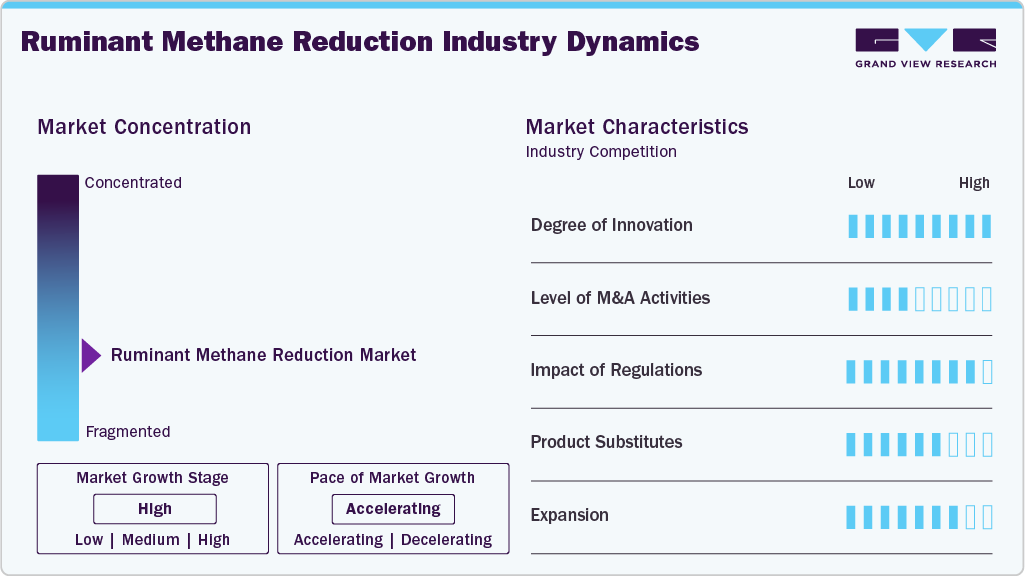
The ruminant methane reduction sector is characterized by a moderate level of merger and acquisition activity, primarily executed by large agri-nutrition incumbents seeking to internalize differentiated technologies and accelerate commercial product portfolios. Strategic acquisitions in this market are predominantly motivated by the need to gain validated intellectual property, established regulatory dossiers, and distribution infrastructure rather than revenue scale. As commercial opportunities expand, M&A frequency is expected to increase progressively over the forecast period.
Regulatory frameworks constitute a significant demand-activating force across the global ruminant methane reduction market. In the U.S., the Methane Emissions Reduction Action Plan under the Inflation Reduction Act directly targets ruminant agriculture. The European Union's emissions directives compel agricultural stakeholders to adopt certified reduction technologies, while the UK's Environmental Improvement Plan and Agriculture Bill provide structured compliance incentives. Canada's REME protocol introduced carbon offset credits for beef cattle farms adopting enteric methane management practices. Regulatory pressure is progressively converting voluntary adoption into compliance-driven procurement, materially expanding the market's commercial demand base across North America and Europe.
The threat of product substitutes remains low to moderate. While alternative mitigation approaches such as improved grazing management, selective livestock breeding programs, and dietary reformulation without commercial additives exist, none currently deliver the measurable, scalable CH4 reduction efficacy that certified feed additives and biotech interventions provide. The Nordic Methane Index, developed in Europe to breed genetically low-methane cattle, represents an emerging substitute pathway at the breeding level. However, given the multi-year timelines associated with genetic programs and the immediacy of regulatory compliance requirements, feed additive solutions retain a structural commercial advantage over substitute approaches.
Key market participants are actively extending their geographic footprint to align with growing demand for certified methane reduction solutions across diversified production geographies. Elanco Animal Health and dsm-firmenich are jointly advancing Bovaer's commercialization across the U.S., Canada, and Mexico within a coordinated North America expansion strategy. Other expansion activities include CH4 Global’s January 2025 construction commencement of the world's first commercial-scale Asparagopsis seaweed facility in Australia. These regional initiatives indicate that market participants are transitioning from single-market operations toward structured multi-geography commercial deployment frameworks.
Product Insights
Feed additives/supplements segment dominated the market, accounting for a share of over 89% in 2025. The segment's dominance is attributable to its direct integration into existing farm feeding operations, requiring minimal infrastructural modifications while delivering quantifiable CH4 reduction outcomes. Compatibility with established livestock management practices has accelerated producer adoption at scale, distinguishing this segment from higher-friction intervention categories such as vaccines or wearable devices. Sustained R&D has yielded highly targeted formulations such as Agolin SA's coriander seed oil, clove, and wild carrot-based additive, for instance, that simultaneously reduce emissions by 10% per animal while increasing milk production, further consolidating livestock producer preference for additive-based solutions.
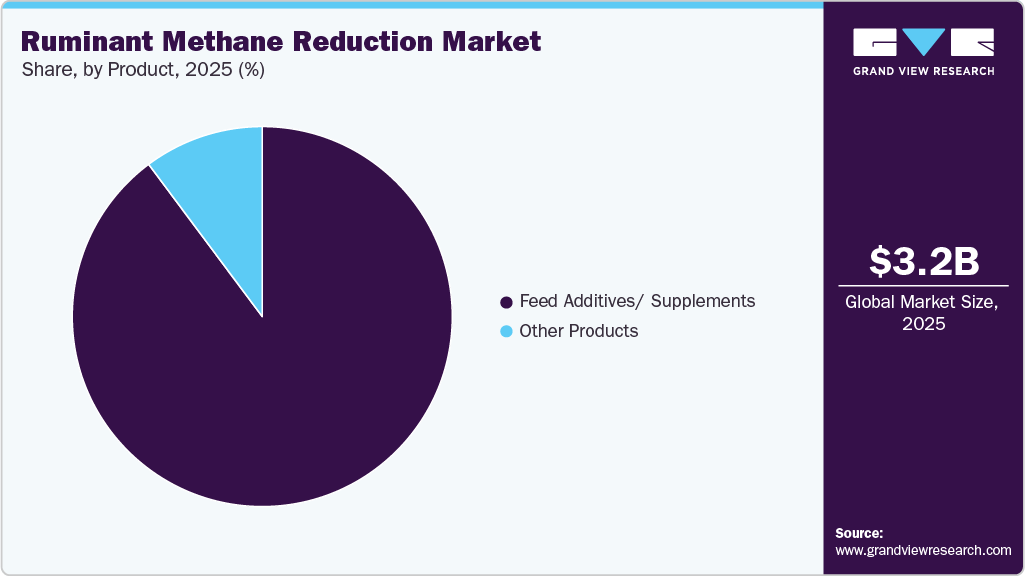
The other products segment is anticipated to register the fastest CAGR over the forecast period. This segment encompasses wearable methane capture devices such as Zelp and ozone-based drinking water interventions, representing a categorically distinct approach to enteric emission management. Growing awareness of methane's contribution to climate change is generating demand for non-additive, technology-driven reduction formats, expanding the R&D scope beyond conventional feed supplementation. Strategic partnerships between key market participants to co-develop and commercialize novel reduction platforms are further accelerating segment growth, broadening the solution landscape and attracting investment toward high-innovation, early-stage product.
Animal Insights
Cattle segment accounted for the largest revenue share in 2025, driven by the segment's outsized contribution to global enteric methane output relative to other ruminant categories. The scale of the global cattle population, concentrated across major livestock-producing economies including the U.S., India, China, and Brazil, has made cattle farming the primary focus of government emission reduction mandates, regulatory compliance frameworks, and commercial product development activity. This regulatory and commercial convergence around cattle-specific methane mitigation has sustained the segment's revenue dominance and is expected to maintain its leading position throughout the forecast period.
The goats segment represents the fastest growing in the market over the forecast period, due to increasing awareness of the environmental impact of methane emissions from goat farming, combined with an expanding global goat population, with India's 20th Livestock Census recording approximately 148.88 million goats, is generating incremental demand for targeted reduction solutions within this segment. The development of goat-specific dietary supplements, feed additives, and management practices tailored to the distinct rumen physiology of small ruminants is attracting focused R&D investment, progressively broadening the commercial solution base and driving above-average segment growth relative to cattle and sheep categories.
Regional Insights
North America Ruminant Methane Reduction Market Trends
North America dominated the market with largest revenue share of more than 36% in 2025. The region's leading position is attributable to a well-established regulatory infrastructure, active government funding mechanisms, and high commercial readiness of key market participants. The U.S. Methane Emissions Reduction Action Plan, USDA NIFA's February 2026 ~USD 10 million interdisciplinary investment, and Canada's REME protocol have collectively generated a structured demand environment, positioning North America as the most commercially mature regional market globally.
U.S. Ruminant Methane Reduction Market Trends
The ruminant methane reduction market in the U.S. accounted for the largest market share in the North America market, owing to government-led demand activation through the Methane Emissions Reduction Action Plan under the Inflation Reduction Act, combined with the USDA NIFA's investment in ruminant GHG mitigation initiatives, has established a structured incentive environment for livestock producer adoption. The FDA's approval of Bovaer and Elanco's subsequent commercial launch further concentrated market activity within the U.S., consolidating its regional dominance through both regulatory and commercial momentum.
The Canada ruminant methane reduction market is expected to grow at a fastest CAGR in the region during the forecast period.The introduction of the Reducing Enteric Methane Emissions from Beef Cattle (REME) protocol, which provides carbon offset credits for farms adopting enteric methane management practices, has created a tangible economic incentive framework for producer adoption. Additionally, Ruminant BioTech's designation of Canada as its global commercialization launchpad for its USD 5.6M research program, alongside the January 2026 UBC-led partnership targeting cost-effective farm-level methane management tools, is accelerating the region's commercial and research momentum throughout the forecast period.
Europe Ruminant Methane Reduction Market Trends
The ruminant methane reduction market in Europe is growing steadily as a result of a stringent regulatory environment that compels agricultural stakeholders to adopt certified emission reduction technologies. European Union directives and national policies establish legally binding emission targets, converting voluntary adoption into compliance-driven procurement across the region. The UK's Agriculture Bill, Clean Air Strategy, and Environmental Improvement Plan provide structured incentive frameworks supporting farmer-level implementation. Further, the introduction of the Nordic Methane Index by Viking Genetics, targeting a 20% reduction in cow emissions through selective breeding, signals that Europe is advancing mitigation across both feed additive and biotechnology-driven intervention categories simultaneously.
Ruminant methane reduction market in UK is expected to dominate the Europe in 2025. The government's structured policy environment, encompassing the Agriculture Bill, Clean Air Strategy, and Environmental Improvement Plan, has established a regulatory framework that actively incentivizes farmer adoption of methane suppression technologies. Furthermore, as per March 2025 article, UK Scientists are developing vaccines targeting cow methane emissions, which further positions the country at the forefront of biotech-driven intervention research within Europe. This combination of compliance-oriented policy instruments and active domestic R&D investment has sustained the UK's leadership position within the regional market.
The Denmark ruminant methane reduction market is expected to grow at the fastest in rate in Europe over the forecast period. Denmark's agricultural sector operates under the EU's stringent emissions directives while simultaneously advancing domestic mitigation initiatives. The development and adoption of the Nordic Methane Index by Viking Genetics, targeting a 20% reduction in cow emissions through selective breeding, is particularly relevant to Denmark's dairy-intensive livestock production structure. Denmark's government has additionally introduced direct carbon tax mechanisms on agricultural emissions, creating a compliance-driven procurement environment that accelerates the commercial uptake of certified feed additive and biotech-based methane reduction solutions across its livestock sector.
Asia Pacific Ruminant Methane Reduction Market Trends
Asia Pacific is expected to grow at the fastest CAGR over the forecast period. The region hosts a disproportionately large share of the global ruminant livestock population, generating substantial enteric methane output that is increasingly subject to government mitigation mandates. Rising climate policy commitments, expanding R&D activity across Japan, China, and India, and growing commercial deployment of feed additive solutions are collectively driving above-average regional growth. The Food and Agriculture Organization has specifically identified Asia Pacific's livestock sector as confronting critical emissions challenges, intensifying demand for reduction solutions.
The ruminant methane reduction market in China held the largest revenue share in the region. The growth is driven by China's 2023 drafted Methane Emission Control Action Plan, targeting emission reductions across agricultural sectors, established a formal policy mandate that concentrated commercial and institutional activity toward livestock methane mitigation. Structured collaborations between government agencies, research institutions, and industry stakeholders have enabled the development of reduction solutions tailored to China's large-scale ruminant production systems, sustaining the country's regional revenue leadership.
Ruminant methane reduction market in India is growing at the fastest rate in the region.The growth is driven by exceptionally large ruminant population. India's 20th Livestock Census recorded 303.76 million bovines and 148.88 million goats, collectively generating substantial enteric methane output. Growing government awareness of livestock emissions' contribution to India's overall GHG profile, combined with increasing private sector interest in deploying feed additive solutions across the country's dairy sector, is accelerating market adoption and sustaining above-average growth momentum.
Latin America Ruminant Methane Reduction Market Trends
Latin America's ruminant methane reduction market is gaining traction, driven by the region's substantial and expanding cattle population, which generates a significant share of global enteric methane output. Growing international pressure through frameworks such as the Global Methane Pledge, combined with satellite-based methane monitoring initiatives deployed across Latin America and Africa by the Global Methane Hub, is elevating accountability for regional agricultural emissions. These developments are collectively accelerating demand for feed additive and dietary modification solutions across the region's ruminant livestock production systems.
Brazil ruminant methane reduction market is gaining momentum, supported by growing awareness of livestock emissions' environmental impact and rising sustainability commitments within the country's dominant cattle farming sector. Brazil's "China cows" crossbreeding program, which has demonstrated measurable methane reduction potential through selective cattle genetics, signals an expanding mitigation approach beyond conventional feed additives. Efforts toward Amazon regeneration within cattle farming operations further position Brazil as a regional focal point for integrated emissions reduction strategies, attracting both domestic and international investment toward sustainable livestock production frameworks.
Middle East & Africa Ruminant Methane Reduction Market Trends
The ruminant methane reduction market in the Middle East & Africa is supported by growing collaboration among government agencies, nonprofits, private companies, and international partners working to address regional adoption barriers. Initiatives targeting limited awareness and high technology costs through grants, awareness campaigns, and supportive policy advocacy are progressively expanding market accessibility. The Global Methane Hub's satellite-based methane monitoring project, deployed across Latin America and Africa, is additionally strengthening emissions accountability frameworks, generating measurable demand for certified reduction solutions across the region's ruminant livestock production systems.
South Africa ruminant methane reduction market is expanding, fueled by rising awareness of methane's direct contribution to climate change, supported by government-led research and consumer demand for sustainable farming practices. The Department of Agriculture and Department of Environment jointly regulate agricultural methane reduction efforts, providing a structured compliance environment for livestock producers. International initiatives such as the ILRI-backed global push for low-methane resilient livestock are generating capacity-building opportunities and technology transfer pathways for South African farmers, progressively accelerating the adoption of feed additive solutions and improved grazing management practices across the country's ruminant production systems.
Ruminant methane reduction market in Saudi Arabia is expected to register the fastest growth rate within the MEA ruminant methane reduction market over the forecast period. The country's expanding livestock production base, combined with growing government commitment to climate mitigation targets under national sustainability frameworks, is generating structured demand for emission reduction technologies. Rising regional awareness of agricultural GHG contributions, international partnerships facilitating technology transfer, and capacity-building programs supporting the adoption of certified feed additive solutions are collectively positioning Saudi Arabia as the region's highest-growth market throughout the forecast period.
Key Ruminant Methane Reduction Company Insights
The global ruminant methane reduction market remains highly fragmented, with most operators serving city or regional areas. Large veterinary groups such as IVC Evidensia and Medivet integrate cremation and aftercare within clinic networks, which is strengthening service reach. Dedicated providers such as Gateway Services Inc. and InvoCare Australia Pty Ltd operate specialized crematoria and memorial facilities across multiple states. APAC players including Nirvana Asia Group are expanding premium memorial offerings in urban centers. Market share concentration remains low at the global level, as independent crematoriums dominate in North America and Europe. Companies compete on service transparency, urn customization, memorial products, and regulatory compliance, which is shaping brand differentiation and repeat referrals from veterinary clinics.
Key Ruminant Methane Reduction Companies:
The following key companies have been profiled for this study on the ruminant methane reduction market.
- DSM
- Blue Ocean Barns
- Alltech.
- CH4 GLOBAL, INC.
- Mootral Private
- Symbrosia Inc.
- Fonterra Co-operative Group Limited
- Elanco Animal Health Inc.
- Rumin8 Ltd
- Zelp Ltd
- Cargill, Incorporated
- FutureFeed
Recent Developments
-
In March 2026, UC ANR study conducted at its Yuba County research center examined the practical viability of incorporating Asparagopsis taxiformis red seaweed as a methane-reducing feed additive for grazing cattle on rangelands, extending prior controlled-setting research into real-world pasture conditions.
-
In September 2025, Orffa and Sea Forest announced an exclusive long-term distribution partnership for the SEAFEED range of Asparagopsis-derived methane reduction supplements, covering the European Union and selected global markets, applicable across dairy, beef, sheep, and goat production systems. The partnership positions SEAFEED as a standardized, commercially scalable enteric methane abatement solution, with Orffa's established European distribution network enabling broad market penetration across the ruminant feed industry.
-
In June 2025, A University of New England trial recorded 93% total methane reduction and 94% methane yield reduction in Angus-cross steers fed Rumin8's investigational veterinary product, with no adverse impact on dry matter intake, rumen pH, or animal health parameters. These findings align with a concurrent UC Davis study where Rumin8's oil-based formulation achieved 95% total methane reduction in cattle fed a total mixed ration.
Ruminant Methane Reduction Market Report Scope
Report Attribute
Details
Market size value in 2026
USD 3.42 billion
Revenue forecast in 2033
USD 6.04 billion
Growth rate
CAGR of 8.4% from 2026 to 2033
Actual data
2021 - 2025
Forecast period
2026 - 2033
Quantitative units
Revenue in USD million/billion and CAGR from 2026 to 2033
Report coverage
Revenue forecast, company ranking, competitive landscape, growth factors, and trends
Segments covered
Product, animal, region
Regional scope
North America; Europe; Asia Pacific; Latin America; MEA
Country scope
U.S.; Canada; Mexico; UK; Germany; France; Italy; Spain; Denmark; Sweden; Norway; Japan; China; India; Thailand; South Korea; Australia; Brazil; Argentina; South Africa; UAE; Saudi Arabia; Kuwait; Qatar; Oman
Key companies profiled
DSM; Blue Ocean Barns; Alltech.; CH4 GLOBAL, INC.; Mootral Private; Symbrosia Inc.; Fonterra Co-operative Group Limited; Elanco Animal Health Inc; Rumin8 Ltd; Zelp Ltd Cargill, Incorporated; FutureFeed
Customization scope
Free report customization (equivalent up to 8 analysts working days) with purchase. Addition or alteration to country, regional & segment scope.
Pricing and purchase options
Avail customized purchase options to meet your exact research needs. Explore purchase options
Global Ruminant Methane Reduction Market Report Segmentation
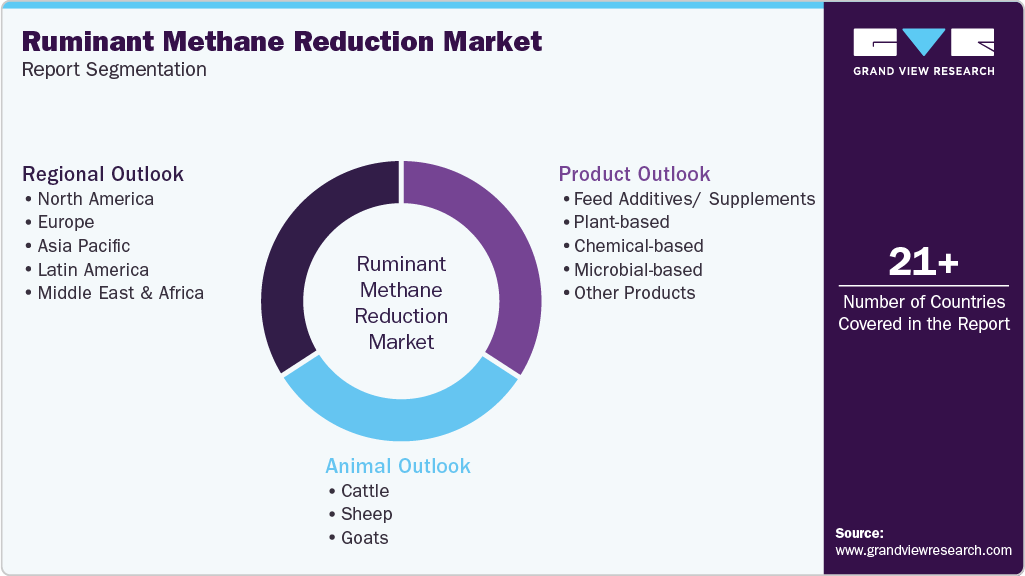
This report forecasts revenue growth at global, regional, and country levels and provides an analysis of the latest industry trends in each of the sub-segments from 2021 to 2033. For this study, Grand View Research has segmented the ruminant methane reduction market report based on product, animal, and region.
-
Product Outlook (Revenue, USD Million, 2021 - 2033)
-
Feed Additives/ Supplements
-
Plant-based
-
Chemical-based
-
Microbial-based
-
-
Other Products
-
-
Animal Outlook (Revenue, USD Million, 2021 - 2033)
-
Cattle
-
Sheep
-
Goats
-
-
Region Outlook (Revenue, USD Million, 2021 - 2033)
-
North America
-
U.S.
-
Canada
-
Mexico
-
-
Europe
-
UK
-
Germany
-
France
-
Italy
-
Spain
-
Denmark
-
Sweden
-
Norway
-
-
Asia Pacific
-
Japan
-
China
-
India
-
Australia
-
Thailand
-
South Korea
-
-
Latin America
-
Brazil
-
Argentina
-
-
Middle East & Africa
-
South Africa
-
UAE
-
Saudi Arabia
-
Kuwait
-
Qatar
-
Oman
-
-
Frequently Asked Questions About This Report
b. The global ruminant methane reduction market size was estimated at USD 2.79 billion in 2024 and is expected to reach USD 3.11 billion in 2025.
b. The global ruminant methane reduction market is expected to grow at a compound annual growth rate of 6.34% from 2025 to 2030 to reach USD 4.22 billion by 2030.
b. North America ruminant methane reduction market dominated the market in 2024. The investments in ruminant methane reduction initiatives and the availability of financial incentives and support mechanisms for methane reduction projects contribute to the expansion and sustainability of the ruminant methane reduction market in North America.
b. Some key players operating in the ruminant methane reduction market include DSM ; Blue Ocean Barns ; Alltech. ; CH4 GLOBAL, INC. ; Mootral Private ; Symbrosia Inc.; Fonterra Co-operative Group Limited ; Elanco Animal Health Inc; Rumin8 Ltd ; Zelp Ltd Cargill, Incorporated; FutureFeed
b. Key factors that are driving the market growth include rising investments in R&D, technological advancements, growing awareness about climate change and need for ruminant methane reduction and increasing in livestock population. According to the Livestock and Poultry: World Markets and Trade report of the U.S. Foreign Agricultural Service, the U.S. had 87.8 million cattle and 74.97 million swine stock as of January 2024.


Share this report with your colleague or friend.
Need a Tailored Report?
Customize this report to your needs — add regions, segments, or data points, with 20% free customization.


ISO 9001:2015 & 27001:2022 Certified
We are GDPR and CCPA compliant! Your transaction & personal information is safe and secure. For more details, please read our privacy policy.
Trusted market insights - try a free sample
See how our reports are structured and why industry leaders rely on Grand View Research. Get a free sample or ask us to tailor this report to your needs.