- Home
- »
- Network Security
- »
-
Railway Cybersecurity Market Size, Industry Report, 2033GVR Report cover
![Railway Cybersecurity Market Size, Share & Trends Report]()
Railway Cybersecurity Market (2026 - 2033) Size, Share & Trends Analysis Report By Component (Solution, Services), By Security Type (Network Security, Data Protection, Application Security, Endpoint Security, System Administration), By Type, By Application, And Segment Forecasts
- Report ID: GVR-4-68040-589-2
- Number of Report Pages: 120
- Format: PDF
- Historical Range: 2021 - 2025
- Forecast Period: 2026 - 2033
- Industry: Technology
- Report Summary
- Table of Contents
- Interactive Charts
- Methodology
- Download FREE Sample
-
 Download Sample Report
Railway Cybersecurity Market Summary
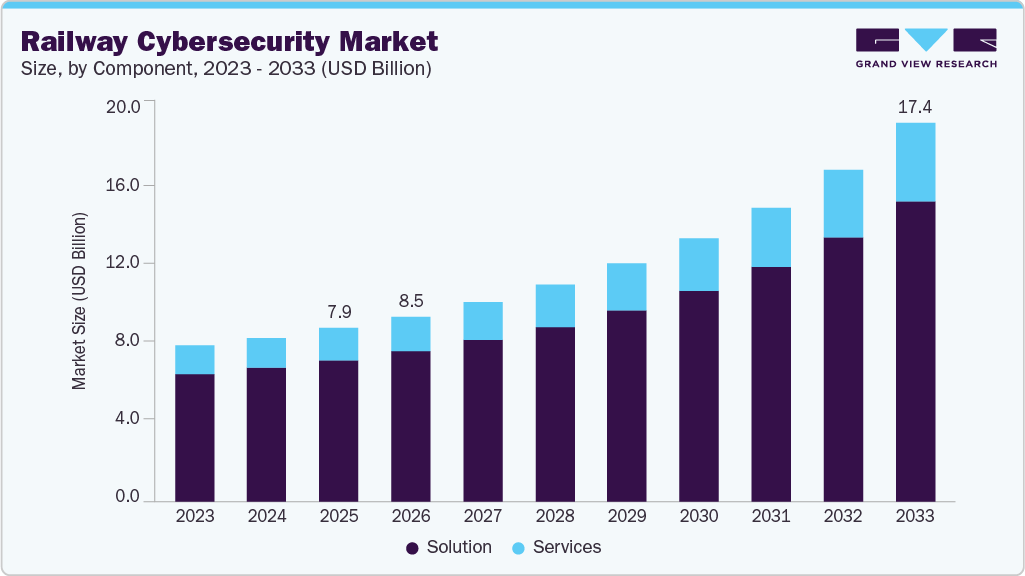
The global railway cybersecurity market size was estimated at USD 7.95 billion in 2025 and is projected to reach USD 17.36 billion by 2033, growing at a CAGR of 9.4% from 2026 to 2033. The global market is experiencing strong growth due to the rapid digitalization of railway infrastructure and the increasing integration of advanced technologies such as Internet of Things (IoT), cloud-based monitoring systems, automated signalling, and intelligent traffic management platforms.
Key Market Trends & Insights
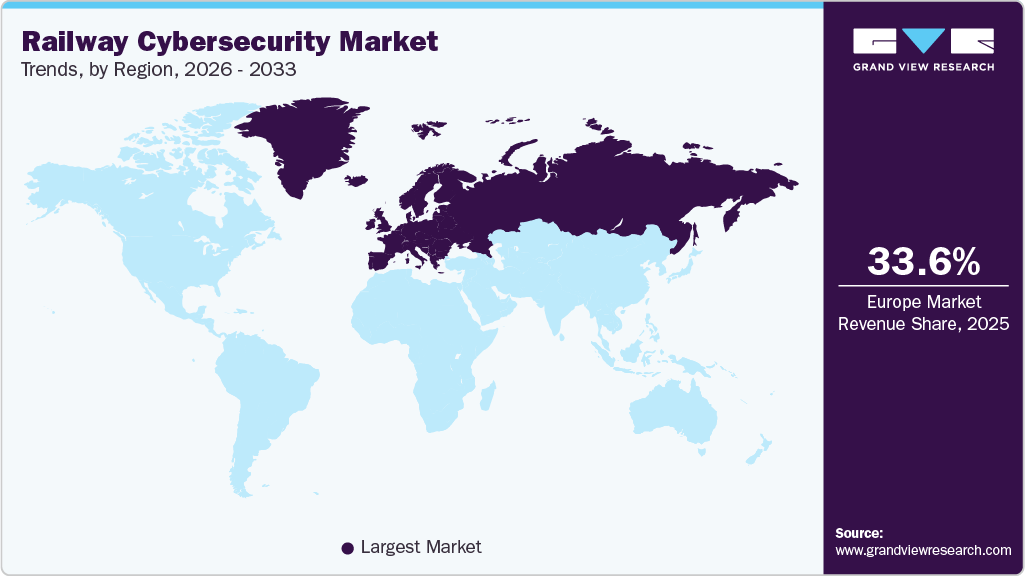
- Europe held 33.6% revenue share of the railway cybersecurity market.
- The U.S. railway cybersecurity market is growing due to the increasing digitalization of rail infrastructure and the rising frequency of cyber threats targeting critical transportation systems.
- By component, solution held the largest revenue share of 81.5% in 2025.
- By security type, network security held the largest revenue share in 2025.
- By type, on-board is expected to grow at the fastest CAGR during the forecast period.
Market Size & Forecast
- 2025 Market Size: USD 7.95 Billion
- 2033 Projected Market Size: USD 17.36 Billion
- CAGR (2026-2033): 9.4%
- Europe: Largest market in 2025
Modern rail networks rely heavily on interconnected operational technology (OT) and information technology (IT) systems to manage train control, ticketing, passenger information, and maintenance operations, which significantly expands the potential cyber-attack surface. As cyber threats targeting critical transportation infrastructure become more sophisticated, railway operators and governments are prioritizing investments in cybersecurity solutions to protect signalling systems, communication networks, on-board control units, and data centers from disruptions and unauthorized access.The increasing frequency and sophistication of cyberattacks targeting critical infrastructure are another major driver. Railways, as part of a nation's critical infrastructure, are attractive targets for cybercriminals, hacktivists, and even state-sponsored actors aiming to disrupt public services or cause economic damage. High-profile cyberattacks on transport systems, such as ransomware attacks and malware infiltrations, have highlighted the vulnerabilities in operational technology (OT) environments within the transportation sector. The need to protect signaling systems, ticketing networks, onboard communications, and freight management platforms from unauthorized access is compelling rail operators to adopt comprehensive cybersecurity strategies.
The expansion of smart rail infrastructure and high-speed rail projects is further contributing to market growth. Countries across Asia, Europe, and the Middle East are investing heavily in smart rail and metro systems, equipped with AI-driven analytics, real-time control centers, and autonomous operations. While these technologies improve passenger experience and operational efficiency, they also create new points of vulnerability that cyber threats can exploit. This has led to an increased demand for endpoint security, network segmentation, and threat intelligence solutions within rail systems.
The rise in urban mobility solutions and interconnected transit systems also drives the need for enhanced cybersecurity. As railways integrate with other transportation modes, such as buses, metros, ride-sharing, and digital ticketing platforms, through Mobility-as-a-Service (MaaS) models, the attack surface expands. The seamless connectivity between different systems makes it critical to ensure the confidentiality, integrity, and availability of data across platforms. Cybersecurity solutions that offer identity management, secure API communications, and multi-layered threat protection are thus becoming indispensable for multi-modal transit operators.
Furthermore, growing public awareness and concerns over passenger safety further reinforce the demand for railway cybersecurity. Cyberattacks on rail systems not only pose risks to financial and operational assets but also endanger human lives. A compromised signaling system or train control platform can have catastrophic consequences. As a result, public and stakeholder pressure is mounting on governments and operators to demonstrate proactive cybersecurity planning and preparedness. This, in turn, is prompting rail operators to invest in workforce training, cybersecurity audits, and robust incident response frameworks.
Component Insights
The solution segment accounted for the largest market share of 81.5% in 2025. The market is driven by the increasing sophistication and frequency of cyberattacks targeting critical railway infrastructure. Modern railway networks rely on interconnected digital systems such as signalling networks, train control systems, passenger information platforms, and operational technology (OT) environments, which makes them attractive targets for ransomware, malware, and advanced persistent threats. To mitigate these risks, railway operators are increasingly adopting threat intelligence and response solutions that enable real-time monitoring, early detection of suspicious activities, vulnerability assessment, and rapid incident response across both IT and OT environments.
The services segment is anticipated to grow at the highest CAGR during the forecast period. The market growth is driven by the modernization of legacy railway infrastructure. Many rail operators still run decades-old signaling, interlocking, and SCADA systems that were not designed with cybersecurity controls in mind. As modernization programs introduce digital interlocking, centralized traffic control (CTC), communication-based train control (CBTC), and cloud-enabled asset management, cybersecurity must be embedded during system integration. This creates sustained demand for consulting, system integration, security architecture design, penetration testing, and secure deployment services.
Security Type Insights
The network security segment dominated the market and accounted for the largest revenue share in 2025. This segment is driven by the deployment of high-speed rail and smart rail projects, particularly in the Asia Pacific, Europe, and the Middle East. These greenfield projects are designed with advanced digital signaling systems such as CBTC, ETCS, and centralized traffic management platforms that rely heavily on real-time IP-based communication. Securing these high-bandwidth, low-latency communication networks requires advanced network segmentation, deep packet inspection, and industrial protocol-aware firewalls. As new corridors are developed with digital-first architectures, network security is embedded at the infrastructure design stage, creating sustained demand.
The data protection segment is expected to register the highest CAGR from 2026 to 2033. The rising threat of ransomware and data exfiltration attacks fuels demand for advanced data protection mechanisms. Cybercriminals increasingly target transportation infrastructure to encrypt or steal sensitive information for financial gain or disruption. Backup encryption, immutable storage, data masking, and secure disaster recovery frameworks reduce the impact of such attacks by ensuring data resilience and recoverability. In safety-critical railway environments, rapid restoration of operational data is essential to avoid prolonged service interruptions and cascading economic effects.
Type Insights
The infrastructure segment dominated the market and accounted for the largest revenue share in 2025. The infrastructure type segment in the market is driven by the growing deployment of intelligent transportation systems (ITS) and smart station infrastructure. Modern railway stations and operational hubs increasingly incorporate digital ticketing systems, passenger information displays, surveillance networks, automated fare collection systems, and connected building management platforms. These technologies rely on interconnected infrastructure networks that manage large volumes of operational and passenger data. As these systems become more integrated with core railway networks, securing the underlying infrastructure becomes essential to prevent cyber intrusions that could disrupt services or compromise sensitive information.
The on-board segment is expected to register the highest CAGR from 2026 to 2033. A major driver of this segment is the rapid deployment of advanced train control technologies, including automatic train control, automatic train operation, and communication-based train control (CBTC). These technologies rely on continuous data exchange between trains and trackside infrastructure to manage speed, braking, and traffic flow. Because these functions are safety-critical, any cyber compromise of onboard control systems could disrupt train operations or endanger passengers.
Application Insights
The passenger trains segment accounted for the largest market share in 2025 in the railway cybersecurity industry. The rapid urbanization and expansion of metro and suburban rail systems in major cities contribute significantly to the segment. As urban populations grow, governments are investing heavily in metro rail, light rail transit (LRT), and commuter train systems to improve mobility and reduce congestion. These passenger rail systems rely on digitally integrated infrastructure, including automated signaling, centralized traffic management, smart ticketing, and connected train control systems. The increasing reliance on interconnected digital platforms increases exposure to cyber threats, prompting operators to deploy cybersecurity technologies that protect passenger train operations, communication networks, and onboard systems.
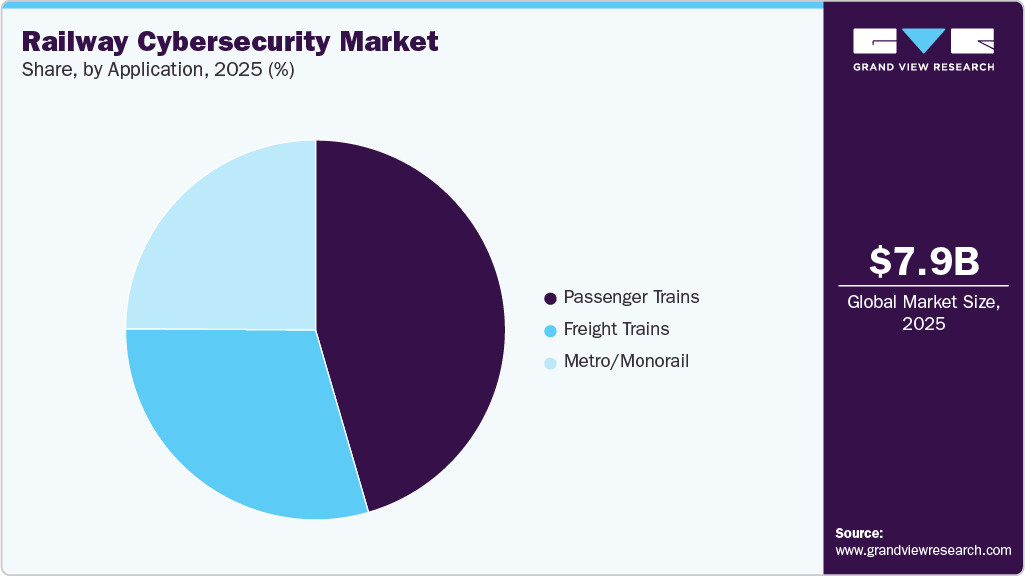
The metro/monorail segment is anticipated to register the highest CAGR during the forecast period. The metro/monorail segment is driven by the rapid expansion of urban metro rail projects across major cities worldwide. Governments are investing heavily in metro and monorail networks to address urban congestion, reduce carbon emissions, and improve public transportation efficiency. These new transit systems incorporate advanced digital technologies such as automated train operation, smart ticketing, and real-time monitoring platforms.
Regional Insights
Asia Pacific held a significant share of the railway cybersecurity market in 2025. A significant driver is the accelerating deployment of 5G-enabled railway communication networks. Countries such as China, Japan, and South Korea are integrating 5G into rail signaling, real-time diagnostics, autonomous train operations, and passenger connectivity services. While 5G improves bandwidth and latency performance for mission-critical applications, it also introduces virtualized network architectures and software-defined networking (SDN) layers that require advanced cybersecurity controls. The shift from legacy GSM-R systems to next-generation railway communication standards increases demand for encryption, network slicing security, and continuous threat monitoring solutions.
India Railway Cybersecurity Market Trends
The railway cybersecurity market in India is projected to grow during the forecast period. India’s market is expanding steadily, driven by large-scale modernization and digital transformation initiatives across the national rail network. India operates one of the world’s largest railway systems under Indian Railways, serving millions of passengers daily and managing extensive freight corridors. Ongoing upgrades such as electronic interlocking, centralized traffic control (CTC), automatic block signaling, and real-time train monitoring are increasing IT-OT convergence across operations.
Europe Railway Cybersecurity Market Trends
The railway cybersecurity market in Europe held the largest share in 2025. European rail networks are investing heavily in technologies such as the European Rail Traffic Management System (ERTMS), Communications-Based Train Control (CBTC), IoT sensor networks, and cloud-native traffic and asset management platforms to improve safety, capacity, and operational efficiency. While these innovations enhance service quality and cross-border interoperability, they also increase exposure to cyber risk by integrating legacy OT systems with modern IT environments.
The UK railway cybersecurity market is expected to grow during the forecast period. The rail network is designated as essential infrastructure, transporting millions of passengers annually and supporting freight corridors vital to supply chain continuity. Increasing ransomware incidents, supply chain compromises, and state-sponsored cyber activities targeting transport and logistics sectors have heightened board-level awareness of cyber risk. As a result, rail operators, rolling stock companies, and infrastructure managers are investing in Security Operations Centers (SOCs), endpoint detection and response (EDR) tools, threat intelligence integration, and structured incident response planning to strengthen operational resilience.
North America Railway Cybersecurity Market Trends
The railway cybersecurity market in North America is expected to grow at a significant CAGR from 2026 to 2033. The market growth is driven by the rapid digitalization of rail infrastructure, including the deployment of advanced signaling systems, Positive Train Control (PTC), Communications-Based Train Control (CBTC), Internet of Things (IoT)-enabled sensors, and cloud-based rail traffic management platforms. As rail operators modernize legacy infrastructure to improve operational efficiency and safety, the attack surface expands significantly.
U.S. Railway Cybersecurity Market Trends
The U.S. railway cybersecurity market is projected to grow significantly during the forecast period. Rail operators are adopting advanced signaling systems, cloud-based traffic management, IoT sensors, and automated control platforms to enhance efficiency, safety, and service reliability. They also expand the cyberattack surface, particularly at the intersection of Information Technology (IT) and Operational Technology (OT) systems such as SCADA and Positive Train Control (PTC).
Key Railway Cybersecurity Company Insights
Some of the key companies operating in the market, such as Thales, Cylus, ALSTOM SA, and Siemens, among others, are some of the leading participants in the market.
-
Thales, a French multinational corporation, operates in over 68 countries. The company specializes in designing and manufacturing a wide array of systems and equipment for various sectors, including aerospace, military, and cybersecurity. Thales has been instrumental in providing advanced signaling and automation solutions. The company developed SelTrac, a communications-based train control system widely adopted in urban transit networks. SelTrac enhances operational efficiency and safety by enabling real-time train monitoring and control. Thales' expertise in rail signaling was further solidified through the acquisition of Alcatel's Rail Signalling Solutions division in 2006, expanding its capabilities in transportation-based automation solutions.
-
Cylus is a cybersecurity company specializing in the protection of railway systems. Cylus's flagship product, CylusOne, is a rail-specific cybersecurity solution designed to safeguard signaling and control networks, both trackside and onboard trains. In February 2024, the company announced that CylusOne became the world's first rail cybersecurity solution to receive the IEC 62443-4-2 certification for Security Level 3. This certification, awarded by Bureau Veritas, underscores the robustness of CylusOne in meeting the stringent cybersecurity requirements for industrial automation and control systems.
Key Railway Cybersecurity Companies:
The following key companies have been profiled for this study on the railway cybersecurity market.
- ALSTOM SA
- Atos SE (Eviden)
- cervello
- Cisco Systems, Inc.
- Cyient
- Cylus Ltd.
- Fortinet, Inc.
- Hitachi Rail, Ltd.
- Huawei Technologies Co., Ltd.
- IBM
- Nokia
- Nozomi Networks Inc.
- Siemens
- Telefonaktiebolaget LM Ericsson
- Thales
Recent Developments
-
In March 2026, Huawei Technologies Co., Ltd. announced five new smart transportation solutions at MWC Barcelona 2026 that use technologies such as 5G, AI, and cloud to support intelligent transportation networks, including rail systems with secure and reliable digital infrastructure. These solutions help railway operators strengthen cybersecurity, improve network protection, and enable safer and more intelligent railway operations.
-
In February 2026, a consortium of Siemens Mobility and Stadler signed a framework contract with Danish State Railways (DSB) to supply 226 fully automated trains for the Copenhagen S-Bane network, creating the world’s largest open railway system with automated train operation. The project will increase rail capacity and service frequency, supporting millions of additional passenger journeys and modernizing Copenhagen’s public transport system
-
In January 2026, Nozomi Networks Inc. completed its acquisition by Mitsubishi Electric, making the cybersecurity company a wholly owned subsidiary while continuing to operate independently with its OT/IoT security technology. The deal strengthens Mitsubishi Electric’s capabilities in operational technology cybersecurity and positions Nozomi to expand its solutions and support for critical infrastructure protection globally.
-
In January 2025, Siemens Mobility secured four major contracts from HS2 Ltd to support the development and operation of the 225-kilometer high-speed rail line between London and the West Midlands. As part of the Rail Systems Alliance, Siemens will deliver an Engineering Management System for real-time equipment monitoring, partner with Costain Ltd on high-voltage power supply systems, and implement Operational Telecommunications and Security Systems across the HS2 route. The contracts, valued at around USD 755.5 million including long-term maintenance and optional extensions, are set to begin in 2025.
Railway Cybersecurity Market Report Scope
Report Attribute
Details
Market size value in 2026
USD 8.48 billion
Revenue forecast in 2033
USD 17.36 billion
Growth rate
CAGR of 9.4% from 2026 to 2033
Actual data
2021 - 2025
Forecast period
2026 - 2033
Quantitative units
Revenue in USD million/billion and CAGR from 2026 to 2033
Report coverage
Revenue forecast, company share, competitive landscape, growth factors, and trends
Segments covered
Component, security type, type, application, region
Regional scope
North America; Europe; Asia Pacific; Latin America; MEA
Country scope
U.S.; Canada; Mexico; UK; Germany; France; China; India; Japan; Australia; South Korea; Brazil; UAE; Saudi Arabia; South Africa
Key companies profiled
ALSTOM SA; Atos SE (Eviden); cervello; Cisco Systems, Inc.; Cyient; Cylus Ltd.; Fortinet, Inc.; Hitachi Rail, Ltd.; Huawei Technologies Co., Ltd.; IBM; Nokia; Nozomi Networks Inc.; Siemens; Telefonaktiebolaget LM Ericsson; Thales
Customization scope
Free report customization (equivalent to 8 analysts working days) with purchase. Addition or alteration to country, regional & segment scope.
Pricing and purchase options
Avail customized purchase options to meet your exact research needs. Explore purchase options
Global Railway Cybersecurity Market Report Segmentation
This report forecasts revenue growth at global, regional, and country levels and provides an analysis of the latest industry trends in each of the sub-segments from 2021 to 2033. For this study, Grand View Research has segmented the global railway cybersecurity market report based on component, security type, type, application, and region:
-
Component Outlook (Revenue, USD Billion, 2021 - 2033)
-
Solution
-
Risk and Compliance Management
-
Threat Intelligence and Response
-
Identity and Access Management
-
Data Loss Prevention
-
Others
-
-
Services
-
Consulting
-
Support
-
Integration
-
-
-
Security Type Outlook (Revenue, USD Billion, 2021 - 2033)
-
Application Security
-
Network Security
-
Data Protection
-
Endpoint Security
-
System Administration
-
-
Type Outlook (Revenue, USD Billion, 2021 - 2033)
-
Infrastructure
-
On-board
-
-
Application Outlook (Revenue, USD Billion, 2021 - 2033)
-
Passenger Trains
-
Freight Trains
-
Metro/Monorail
-
-
Regional Outlook (Revenue, USD Billion, 2021 - 2033)
-
North America
-
U.S.
-
Canada
-
Mexico
-
-
Europe
-
Germany
-
UK
-
France
-
-
Asia Pacific
-
China
-
India
-
Japan
-
South Korea
-
Australia
-
-
Latin America
-
Brazil
-
-
Middle East & Africa
-
UAE
-
Saudi Arabia
-
South Africa
-
-
Frequently Asked Questions About This Report
b. The global railway cybersecurity market size was estimated at USD 7.95 billion in 2025 and is expected to reach USD 8.48 billion in 2026.
b. The global railway cybersecurity market is expected to grow at a compound annual growth rate of 9.4% from 2026 to 2033 to reach USD 17.36 billion by 2033.
b. The solution segment accounted for the largest market share of over 81.0% in 2025 in the railway cybersecurity market. The increasing deployment of smart technologies across rail infrastructure is a key driver of growth in the solution segment.
b. Some key players operating in the market include Thales Group, Siemens Mobility, Alstom, Hitachi Rail, Nokia Networks, Huawei Technologies, Cylus, Cisco Systems, IBM Corporation, Raytheon Technologies, Fortinet, ABB, Toshiba Infrastructure Systems & Solutions, Wabtec Corporation, Atos SE
b. Factors such the adoption of the digital transformation of railway systems, The increasing frequency and sophistication of cyberattacks targeting critical infrastructure, and The expansion of smart rail infrastructure and high-speed rail projects are anticipated to accelerate the market growth.


Share this report with your colleague or friend.
Need a Tailored Report?
Customize this report to your needs — add regions, segments, or data points, with 20% free customization.


ISO 9001:2015 & 27001:2022 Certified
We are GDPR and CCPA compliant! Your transaction & personal information is safe and secure. For more details, please read our privacy policy.
Trusted market insights - try a free sample
See how our reports are structured and why industry leaders rely on Grand View Research. Get a free sample or ask us to tailor this report to your needs.