- Home
- »
- Plastics, Polymers & Resins
- »
-
Propylene Oxide Market Size & Share, Industry Report, 2033GVR Report cover
![Propylene Oxide Market Size, Share & Trends Report]()
Propylene Oxide Market (2026 - 2033) Size, Share & Trends Analysis Report By Production Process (Chlorohydrin Process, Styrene Monomer Process, Hydrogen Peroxide Process), By Application (Polyether Polyols), By End Use (Automotive), By Region, And Segment Forecasts
- Report ID: GVR-4-68040-848-8
- Number of Report Pages: 125
- Format: PDF
- Historical Range: 2018 - 2025
- Forecast Period: 2026 - 2033
- Industry: Bulk Chemicals
- Report Summary
- Table of Contents
- Segmentation
- Methodology
- Download FREE Sample
-
 Download Sample Report
Propylene Oxide Market Summary
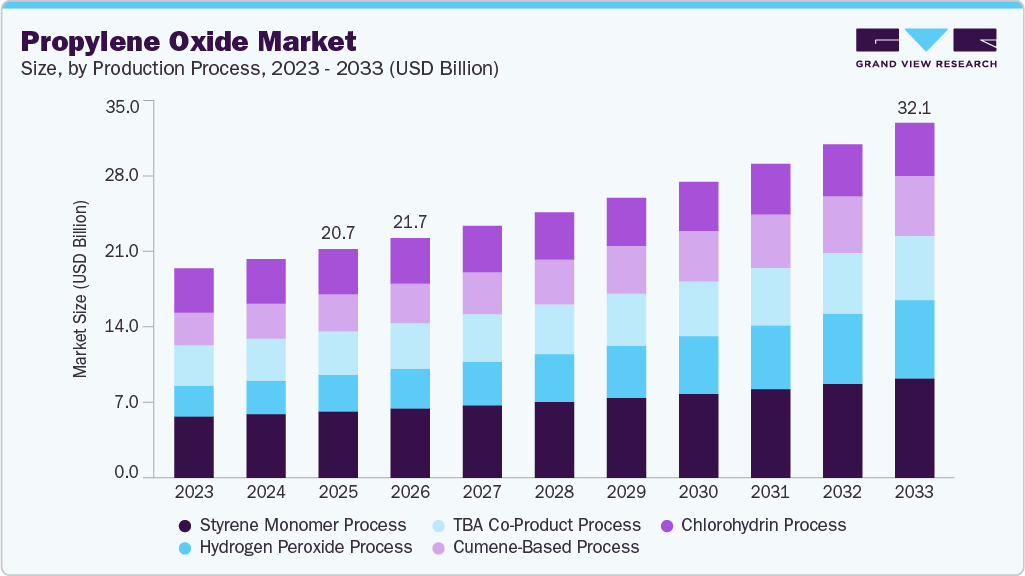
The global propylene oxide market size was estimated at USD 20,698.0 million in 2025 and is projected to reach USD 32,145.7 million by 2033, growing at a CAGR of 5.8% from 2026 to 2033. The growth of the propylene oxide market is primarily driven by rising demand for polyurethane foams, which represent the largest end-use application of propylene oxide globally.
Key Market Trends & Insights
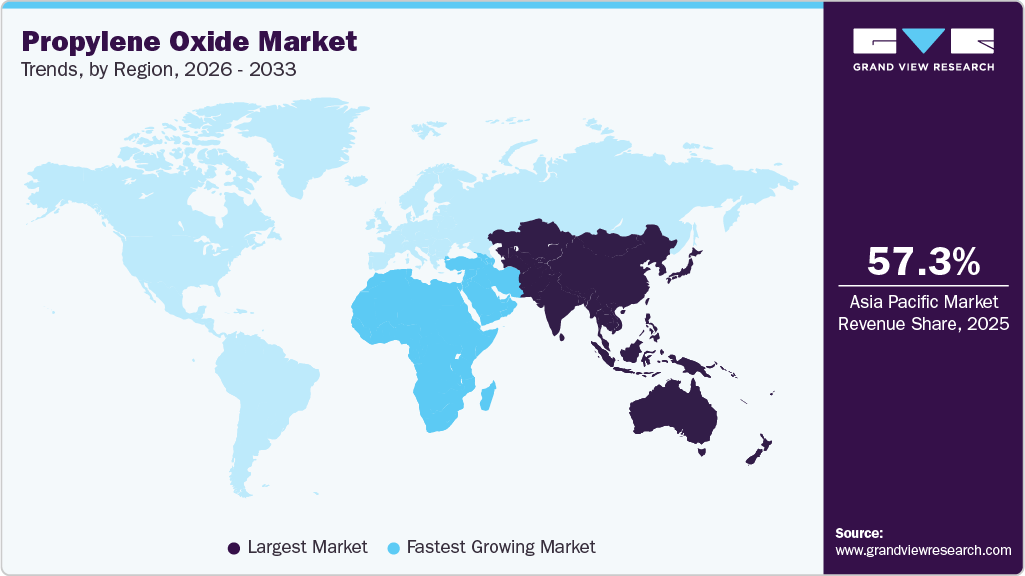
- Asia Pacific dominated the global propylene oxide market with the largest revenue share of 57.3% in 2025.
- The U.S. propylene oxide industry is expected to grow at a substantial CAGR of 4.8% from 2025 to 2033.
- By production process, the styrene monomer process segment held the highest market share of 29.1% in 2025 in terms of revenue.
- By end use, the electronics segment is expected to grow at a significant CAGR of 10.7% from 2025 to 2033 in terms of revenue
- By application, polyether polyols segment is expected to grow at a significant CAGR of 5.9% from 2025 to 2033 in terms of revenue.
Market Size & Forecast
- 2025 Market Size: USD 20,698.0 Million
- 2033 Projected Market Size: USD 32,145.7 Million
- CAGR (2025-2033): 5.8%
- Asia Pacific: Largest Market in 2025
- Middle East & Africa: Fastest Growing Market
These foams are extensively used in construction insulation, furniture, bedding, and automotive interiors due to their lightweight properties, energy efficiency, and thermal insulation performance.Rapid urbanization, infrastructure development, and increasing residential construction-particularly in Asia Pacific and emerging economies, are significantly expanding consumption of rigid and flexible polyurethane foams. As energy efficiency standards in buildings become stricter, the need for high-performance insulation materials continues to strengthen propylene oxide demand.
The expanding use of propylene oxide in the production of propylene glycol, which is widely applied in unsaturated polyester resins, antifreeze formulations, de-icing fluids, pharmaceuticals, and food-grade applications. Growth in automotive production, cold-chain logistics, and industrial coolants is directly supporting higher consumption of propylene glycol across developed and developing markets. In addition, increasing demand for personal care products, cosmetics, and pharmaceutical formulations-where propylene glycol functions as a solvent and humectant, further reinforces steady downstream demand for propylene oxide.
Sustainability trends and technological advancements in production processes are also positively influencing the propylene oxide market. Manufacturers are increasingly adopting hydrogen peroxide to propylene oxide (HPPO) technology, which offers higher efficiency, lower energy consumption, and reduced environmental impact compared to traditional chlorohydrin methods. This shift aligns with global decarbonization goals and regulatory pressures to minimize chemical waste and emissions. As producers invest in cleaner and more cost-effective production routes, propylene oxide capacity expansions are becoming more attractive, supporting long-term market growth and improved supply economics
Market Concentration & Characteristics
The propylene oxide market is moderately to highly concentrated, with a limited number of large, integrated chemical producers controlling a significant share of global capacity. Major players such as BASF SE, Dow Inc., LyondellBasell Industries N.V., Shell plc, and Covestro AG dominate production through large-scale plants and backward integration into propylene feedstock. High capital requirements, complex process technology, and stringent environmental regulations create substantial barriers to entry, limiting the emergence of new producers and reinforcing the market power of established manufacturers.
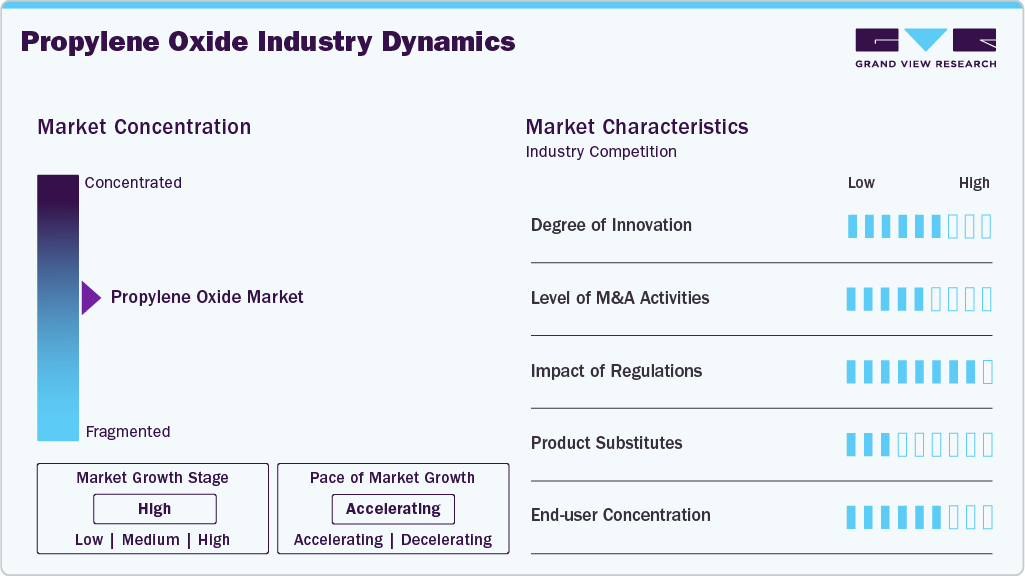
In addition, increasing adoption of proprietary production technologies-particularly HPPO (hydrogen peroxide to propylene oxide) processes-has further strengthened concentration among technology-owning firms and their strategic partners. Leading producers benefit from cost efficiencies, lower waste generation, and improved sustainability profiles, allowing them to operate at scale with superior margins. While regional producers exist in China and parts of the Middle East, global supply remains largely controlled by multinational corporations with integrated value chains and long-term customer contracts in polyurethanes and propylene glycol. As a result, competitive dynamics are shaped more by capacity expansions and technology deployment than by price-driven fragmentation, maintaining a consolidated market structure
Production Process Insights
The styrene monomer process dominated the market, accounting for the largest revenue share of 29.1% in 2025, primarily due to its strong cost efficiency and co-production of styrene, which is widely used in plastics, resins, and synthetic rubber manufacturing. This integrated production route allows manufacturers to maximize asset utilization while serving multiple high-volume downstream markets, making it economically attractive for large-scale chemical producers. In addition, the established infrastructure and long operating history of the styrene monomer process have resulted in stable supply chains, lower operational risks, and continued preference among integrated petrochemical complexes.
The hydrogen peroxide process segment is expected to grow at the fastest CAGR of 10.0% over the forecast period, driven by increasing adoption of environmentally sustainable and low-waste production technologies across the chemical industry. Compared to conventional methods, the HPPO route offers significantly lower energy consumption, reduced byproduct generation, and smaller plant footprints, aligning with tightening environmental regulations and corporate decarbonization targets. Rising investments in green chemical manufacturing, particularly in Asia Pacific and Europe, are accelerating capacity additions using HPPO technology, positioning it as the preferred process for future propylene oxide production.
Application Insights
The polyether polyols segment led the propylene oxide market with the largest revenue share of 60.8% in 2025, driven by strong demand from the polyurethane industry for flexible and rigid foams used in construction, automotive interiors, furniture, and insulation applications. Rapid urbanization, energy-efficient building standards, and lightweight material adoption in vehicles have significantly increased consumption of polyurethane-based products. As polyether polyols remain the primary raw material for these foams, their production continues to anchor propylene oxide demand globally.
The propylene glycols segment is expected to grow with a CAGR of 4.5% over the forecast period, supported by rising applications in antifreeze formulations, unsaturated polyester resins, pharmaceuticals, food processing, and personal care products. Growth in automotive production, cold-chain logistics, and industrial cooling systems is driving higher consumption of functional fluids. In addition, increasing use of propylene glycol as a low-toxicity solvent and humectant in consumer products is further strengthening long-term market expansion.
End Use Insights
The building & construction sector dominated the propylene oxide market with the largest revenue share of 34.1% in 2025. This is primarily driven due to extensive use of polyurethane foams in insulation panels, roofing systems, sealants, and structural materials. Growing urbanization, infrastructure investments, and stricter energy-efficiency regulations have accelerated demand for high-performance thermal insulation across residential and commercial buildings. As polyurethane-based products remain critical for improving building durability and energy savings, propylene oxide consumption continues to be strongly anchored in the construction sector.
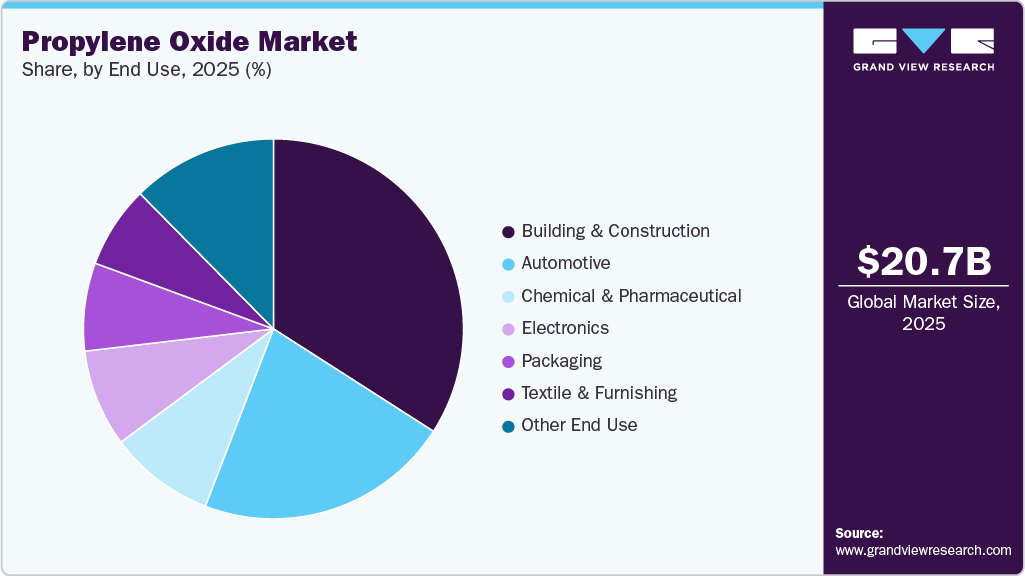
Electronics is expected to grow significantly with a CAGR of 10.7% during the forecast period, driven by rising demand for high-purity chemical intermediates used in circuit boards, encapsulation materials, and specialty coatings. Expansion of semiconductor manufacturing, consumer electronics production, and electric vehicle components is increasing the need for advanced polymer materials derived from propylene oxide. In addition, the shift toward miniaturization and high-performance electronic devices is further accelerating adoption of specialty polyols and resins, supporting rapid growth in this end-use segment.
Regional Insights
The North America propylene oxide market held a substantial market share in 2025. The North America propylene oxide market is driven by strong demand from the construction, automotive, and packaging sectors, supported by well-established polyurethane foam manufacturing capacity. The region benefits from advanced chemical infrastructure, high adoption of energy-efficient insulation materials, and steady investments in plant modernization. Growth is further supported by rising use of propylene glycol in industrial fluids, pharmaceuticals, and food-grade applications.
U.S. Propylene Oxide Market Trends
The U.S. propylene oxide market is supported by strong demand from construction insulation, automotive seating, and industrial polyurethane applications. Well-developed petrochemical infrastructure and large integrated producers ensure stable supply and cost efficiency. Growth is further driven by rising adoption of energy-efficient building materials and sustained consumption of propylene glycol in antifreeze, pharmaceuticals, and food-grade products.
Europe Propylene Oxide Market Trends
Europe represents a mature but technology-driven propylene oxide market, characterized by strong sustainability regulations and increasing adoption of low-emission production processes such as HPPO technology. Demand is anchored in rigid insulation foams for energy-efficient buildings, automotive lightweighting, and specialty chemical applications. While volume growth is moderate, premium-grade and environmentally compliant production continues to support stable market expansion.
Germany serves as a key propylene oxide market in Europe, supported by advanced chemical manufacturing, automotive production, and strong demand for high-performance insulation materials. The market is characterized by high adoption of sustainable production technologies and premium specialty chemical applications. While overall volume growth is moderate, regulatory-driven efficiency improvements and specialty polyurethane demand sustain stable market expansion.
Asia Pacific Propylene Oxide Market Trends
The Asia Pacific propylene oxide market dominated the global market, accounting for the largest revenue share of 57.3% in 2025. This is driven by rapid expansion of polyurethane foam production, large-scale infrastructure development, and strong growth in downstream plastics and construction industries across China, India, and Southeast Asia. The region benefits from significant capacity additions by integrated petrochemical producers, favorable manufacturing economics, and rising domestic demand for insulation materials, automotive components, and consumer goods.
In addition, increasing investments in sustainable production technologies such as HPPO plants and supportive government policies for chemical manufacturing are further strengthening Asia Pacific’s position as the primary growth engine of the global propylene oxide market.
China represents the largest and fastest-expanding propylene oxide market globally, driven by massive growth in construction, electronics manufacturing, and downstream polyurethane production. Significant capacity additions, including HPPO-based plants, are strengthening domestic supply and reducing import dependence. Rapid urbanization, infrastructure investments, and expanding consumer goods manufacturing continue to accelerate propylene oxide consumption
Latin America Propylene Oxide Market Trends
The Latin America propylene oxide market is witnessing gradual growth, supported by expanding construction activities, improving industrial output, and rising consumption of consumer goods. Brazil and Mexico remain key demand centers due to their automotive manufacturing and polyurethane processing industries. However, limited local production capacity and dependence on imports in some countries continue to constrain faster market development.
Middle East & Africa Propylene Oxide Market Trends
The Middle East & Africa propylene oxide market is expected to grow fastest with a CAGR of 6.6% during the forecast period. The market is driven primarily by petrochemical investments in the Gulf region, where integrated refining and chemical complexes support downstream polyurethane production. Rising infrastructure development and insulation demand are contributing to consumption growth, particularly in the Middle East. In Africa, the market remains smaller but is gradually expanding with improving industrialization and construction activity.
Key Propylene Oxide Company Insights
Some of the key companies in the global propylene oxide market are BASF SE, Mitsui Chemicals, Huntsman Corporation, Royal Dutch Shell, Asahi Glass Co., and LG Chem, among others. These companies invest in R&D, expand production capacity, production process strategic partnerships, and focus on sustainability. They adapt to evolving industry demands, particularly in batteries, cosmetics, and pharmaceuticals, while ensuring regulatory compliance and optimizing supply chains to meet growing international demand efficiently and cost-effectively.
-
BASF SE is a leading player in the coil coatings market, offering a wide range of offerings such as Petrochemicals, Intermediates, Performance Resins, Monomers, Dispersion & Resins, Performance Chemicals, Catalysts, Coatings, Care Chemicals, Nutrition & Health, and Agricultural Solutions.
Key Propylene Oxide Companies:
The following key companies have been profiled for this study on the propylene oxide market.
- BASF SE
- Mitsui Chemicals
- Dow Inc.
- Huntsman Corporation
- Lyondellbasell Industries Holdings
- Royal Dutch Shell
- Huntsman International
- Asahi Glass Co.,
- Repsol
- Tokuyama Corporation
- Sumitomo Chemical Co.,
- SKC
- LG Chem
- Celanese Corporation
- INEOS Group
- SABIC
Recent Developments
-
In March 2025, Dow Inc. has successfully commissioned its new world-scale Propylene Oxide and Tertiary Butyl Alcohol (PO/TBA) plant in Texas, significantly increasing production capacity and reinforcing its leadership in cost-effective, integrated PO manufacturing.
Propylene Oxide Market Report Scope
Report Attribute
Details
Market size value in 2026
USD 21,709.7 million
Revenue forecast in 2033
USD 32,145.7 million
Growth rate
CAGR of 5.8% from 2026 to 2033
Base year for estimation
2025
Historical data
2018 - 2025
Forecast period
2026 - 2033
Quantitative units
Volume in kilotons, revenue in USD million, and CAGR from 2026 to 2033
Report coverage
Revenue forecast, company ranking, competitive landscape, growth factors, and trends
Segments covered
Production process, application, end use, region
Regional scope
North America; Europe; Asia Pacific; Latin America; Middle East and Africa
Country scope
U.S.; Canada; Mexico; Germany; UK; France; Italy; Spain; China; India; Japan; South Korea; Brazil; Argentina; South Africa; Saudi Arabia
Key companies profiled
BASF SE, Dow Inc., Mitsui Chemicals; Huntsman Corporation; Lyondellbasell Industries Holdings; Royal Dutch Shell; Huntsman International; Asahi Glass Co.; Repsol; Tokuyama Corporation; Sumitomo Chemical Co.; SKC; LG Chem; Celanese Corporation; INEOS Group; SABIC
Customization scope
Free report customization (equivalent up to 8 analysts working days) with purchase. Addition or alteration to country, regional & segment scope.
Pricing and purchase options
Avail customized purchase options to meet your exact research needs. Explore purchase options
Global Propylene Oxide Market Report Segmentation
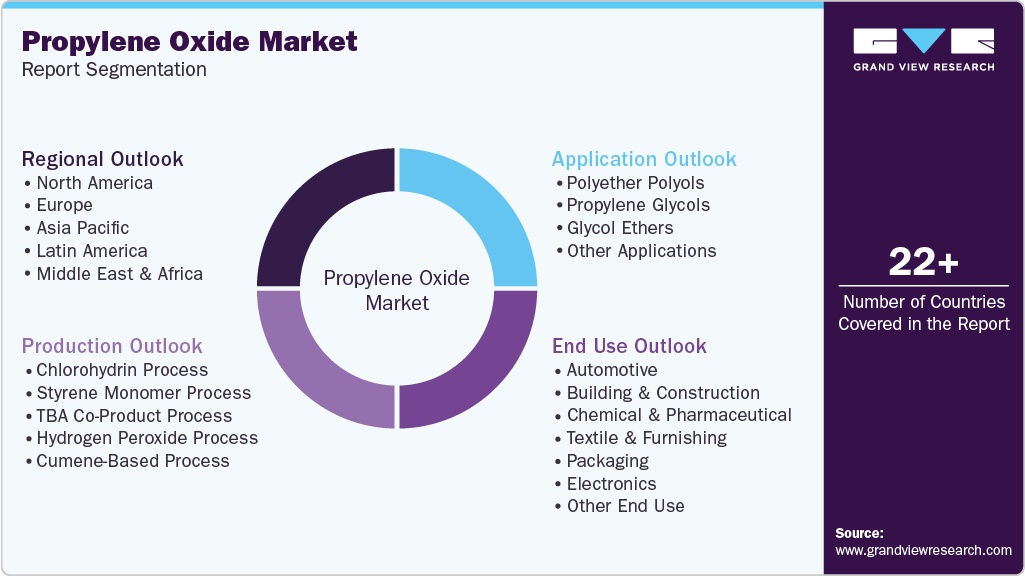
This report forecasts revenue growth at global, regional, and country levels and provides an analysis of the latest industry trends in each of the sub-segments from 2018 to 2033. For this study, Grand View Research has segmented the global propylene oxide market report based on production process, application, end use, and region:
-
Production Process Outlook (Volume, Kilotons; Revenue, USD Million, 2018 - 2033)
-
Chlorohydrin Process
-
Styrene Monomer Process
-
TBA Co-Product Process
-
Hydrogen Peroxide Process
-
Cumene-Based Process
-
-
Application Outlook (Volume, Kilotons; Revenue, USD Million, 2018 - 2033)
-
Polyether Polyols
-
Propylene Glycols
-
Glycol Ethers
-
Other Applications
-
-
End Use Outlook (Volume, Kilotons; Revenue, USD Million, 2018 - 2033)
-
Automotive
-
Building & Construction
-
Chemical & Pharmaceutical
-
Textile & Furnishing
-
Packaging
-
Electronics
-
Other End Use
-
-
Regional Outlook (Volume, Kilotons; Revenue, USD Million, 2018 - 2033)
-
North America
-
U.S.
-
Canada
-
Mexico
-
-
Europe
-
Germany
-
UK
-
France
-
Italy
-
Spain
-
-
Asia Pacific
-
China
-
India
-
Japan
-
South Korea
-
-
Latin America
-
Brazil
-
Argentina
-
-
Middle East and Africa (MEA)
-
South Africa
-
Saudi Arabia
-
-
Frequently Asked Questions About This Report
b. Some key players operating in the propylene oxide market include BASF SE, Dow Inc., Mitsui Chemicals, Huntsman Corporation, Lyondellbasell Industries Holdings, Royal Dutch Shell, Huntsman International, Asahi Glass Co., Repsol, Tokuyama Corporation, Sumitomo Chemical Co., SKC, LG Chem, Celanese Corporation, INEOS Group, and SABIC
b. The global propylene oxide market size was estimated at USD 20,698.0 million in 2025 and is expected to reach USD 21,709.7 million in 2026.
b. The global propylene oxide market is expected to grow at a compound annual growth rate of 5.8% from 2026 to 2033 to reach USD 32,145.7 million by 2033.
b. The Asia Pacific propylene oxide market dominated the global market, accounting for the largest revenue share of 57.3% in 2025. This is driven by rapid expansion of polyurethane foam production, large-scale infrastructure development, and strong growth in downstream plastics and construction industries across China, India, and Southeast Asia
b. The growth of the propylene oxide market is primarily driven by rising demand for polyurethane foams, which represent the largest end-use application of propylene oxide globally.


Share this report with your colleague or friend.
Need a Tailored Report?
Customize this report to your needs — add regions, segments, or data points, with 20% free customization.


ISO 9001:2015 & 27001:2022 Certified
We are GDPR and CCPA compliant! Your transaction & personal information is safe and secure. For more details, please read our privacy policy.
Trusted market insights - try a free sample
See how our reports are structured and why industry leaders rely on Grand View Research. Get a free sample or ask us to tailor this report to your needs.