- Home
- »
- Electronic Devices
- »
-
Printed Circuit Board Assembly Market, Industry Report, 2033GVR Report cover
![Printed Circuit Board Assembly Market Size, Share & Trends Report]()
Printed Circuit Board Assembly Market (2026 - 2033) Size, Share & Trends Analysis Report By Assembly Type (Surface Mount Technology (SMT), Through-Hole Technology (THT)), By Components Type, By Application, By End Use, By Distribution Channel, By Region, And Segment Forecasts
- Report ID: GVR-4-68040-862-6
- Number of Report Pages: 120
- Format: PDF
- Historical Range: 2021 - 2025
- Forecast Period: 2026 - 2033
- Industry: Semiconductors & Electronics
- Report Summary
- Table of Contents
- Segmentation
- Methodology
- Download FREE Sample
-
 Download Sample Report
Printed Circuit Board Assembly Market Summary
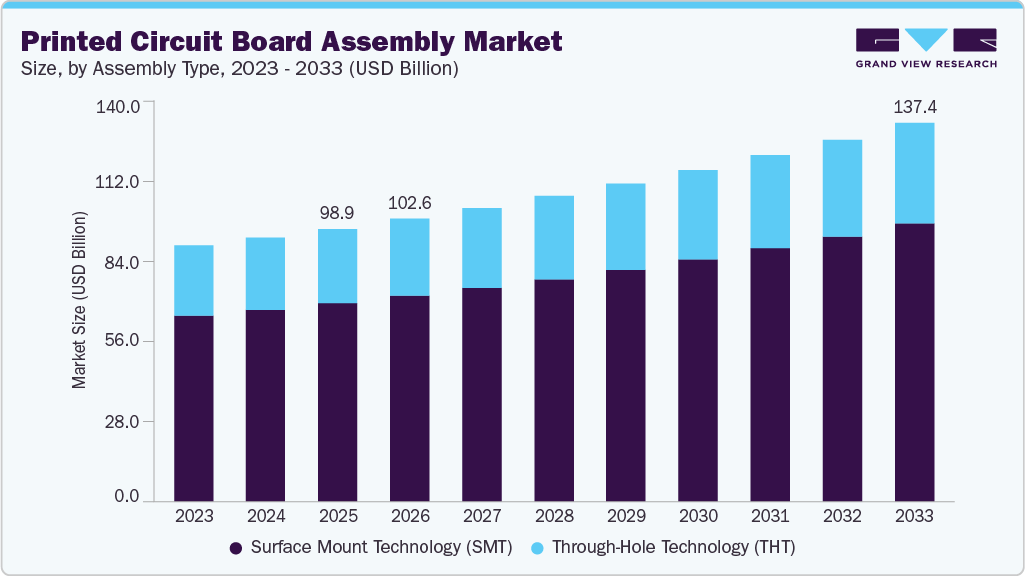
The global printed circuit board assembly market size was estimated at USD 98,927.7 million in 2025 and is projected to reach USD 137,425.48 million by 2033, growing at a CAGR of 4.3% from 2026 to 2033. The market is growing due to rapid cloud infrastructure expansion and increasing demand for high-performance computing hardware.
Key Market Trends & Insights
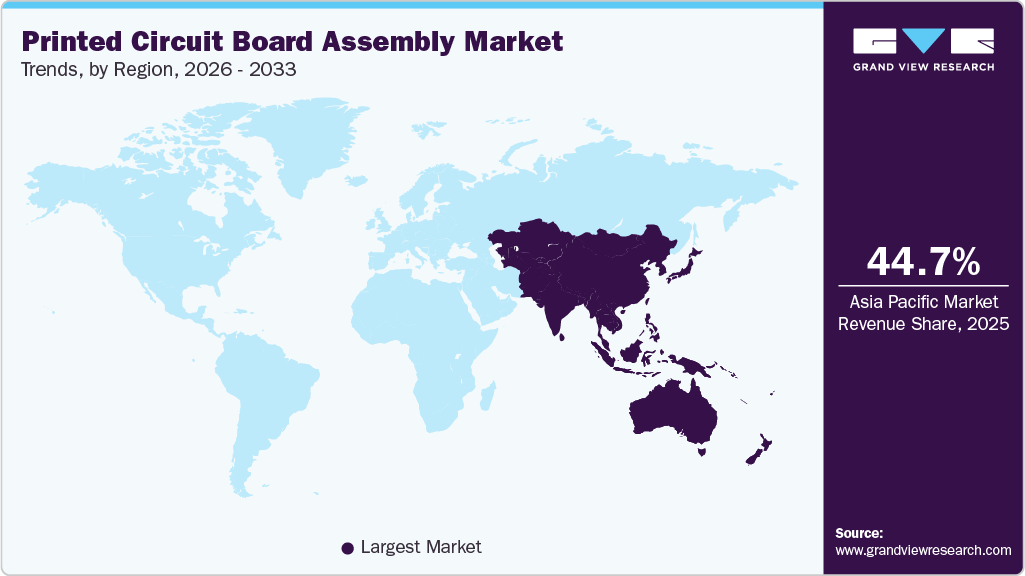
- Asia-Pacific is expected to hold a significant share of the global printed circuit board assembly market, with a revenue share of over 44.7% by 2025.
- The printed circuit board assembly market in China led the Asia Pacific market and held the largest revenue share in 2025.
- By assembly type, surface mount technology led the market and held the largest revenue share of over 72.7% in 2025.
- By components, the active segment led the market and held the largest revenue share of over 56.00% in 2025.
- By end use, automotive is expected to grow at the fastest CAGR of over 4.1% from 2026 to 2033.
Market Size & Forecast
- 2025 Market Size: USD 98,927.7 Million
- 2033 Projected Market Size: USD 137,425.48 Million
- CAGR (2026-2033): 4.3%
- Asia Pacific: Largest market in 2025
Rising adoption of artificial intelligence, automation, and data analytics is driving the need for complex, high-density PCB assemblies. The growing deployment of IoT and connected devices across industries is accelerating volume demand. In addition, heightened focus on cybersecurity, data protection, and reliable digital infrastructure is boosting advanced PCBA requirements. The market is being strongly driven by the rapid expansion of cloud infrastructure, hyperscale data centers, and high-performance computing systems that require complex and reliable electronic assemblies. Increasing cybersecurity concerns and stringent data protection requirements are boosting demand for advanced PCBAs used in secure servers, networking equipment, and encrypted communication hardware. Manufacturers are increasingly integrating artificial intelligence, automation, and advanced manufacturing technologies, driving the need for high-density, high-speed, and precision PCB assemblies. The growing importance of data analytics, edge computing, and big data platforms is accelerating demand for PCBAs in servers, storage systems, and networking devices. In addition, the widespread adoption of internet of things (IoT) and connected devices across industries is significantly increasing volume demand for scalable, cost-efficient, and high-reliability PCBA solutions.The accelerating shift toward cloud computing, remote connectivity, and digital-first business models is driving strong demand for advanced electronic hardware, thereby increasing the need for reliable and high-performance printed circuit board assemblies (PCBAs). Enterprises are expanding data centers, networking infrastructure, and edge computing deployments, which is boosting demand for complex, high-density PCBAs used in servers, routers, and communication equipment. Rising cybersecurity concerns and stricter data protection requirements are also increasing the adoption of secure and high-reliability PCB assemblies in critical IT and communication systems. This convergence of digital infrastructure expansion, cloud adoption, and security needs is significantly strengthening demand for PCBA solutions. As a result, these factors are acting as a major growth driver for the PCBA market.
The steady increase in global electronics and IT hardware spending, supported by the rapid adoption of cloud services, IoT platforms, and AI-enabled systems, is accelerating demand for large-scale and precision PCBA manufacturing. OEMs are increasingly outsourcing PCB assembly to specialized providers to reduce capital expenditure, improve scalability, and shorten product development cycles. The shift toward advanced packaging, miniaturization, and high-speed connectivity is further embedding PCBAs across data centers, industrial automation, consumer electronics, and automotive applications. This expanding role of PCBAs across multiple high-growth industries is expected to sustain robust market growth over the forecast period.
Assembly Type Insights
The surface mount technology (SMT) segment dominated the PCBA market with a share of over 72.7% in 2025, driven by increasing demand for high-density, lightweight, and compact electronic assemblies across data centers, consumer electronics, and industrial applications. Rising complexity of electronic designs and the need for high-speed signal performance have pushed manufacturers toward SMT due to its superior miniaturization and automation capabilities. The growing adoption of advanced electronics in cloud infrastructure, IoT devices, and AI-enabled systems has further accelerated demand for SMT-based PCB assemblies by enabling faster production, higher component density, and improved reliability. As OEMs prioritize performance, scalability, and cost efficiency, SMT continues to remain the dominant assembly technology in the global PCBA market.
Surface mount technology (SMT) is expected to grow at the highest CAGR due to the increasing demand for compact, lightweight, and high-performance electronic devices across data centers, IoT, automotive electronics, and consumer products. The rapid adoption of AI, cloud computing, and 5G infrastructure is driving the need for high-density and high-speed PCB assemblies, where SMT offers superior electrical performance. SMT supports advanced miniaturization and multi-layer PCB designs, enabling higher component density and reduced signal loss. The rising shift toward automation and smart manufacturing is further accelerating SMT adoption due to its compatibility with high-volume, automated assembly processes. In addition, growing emphasis on cost efficiency, faster production cycles, and improved reliability is reinforcing SMT as the preferred PCBA technology for next-generation electronics.
Components Insights
Active components dominated the market with the largest revenue share in 2025 due to the rising complexity and functionality of modern electronic systems. Increasing adoption of processors, microcontrollers, memory chips, power management ICs, and sensors across cloud infrastructure, AI hardware, and IoT devices significantly boosted active component integration in PCB assemblies. The rapid expansion of data centers and high-performance computing systems has further increased demand for advanced semiconductor-based components. In addition, growth in automotive electronics, industrial automation, and smart devices is driving higher value per board, as active components contribute a substantial portion of overall PCBA cost. As electronics continue to become more intelligent and performance-driven, active components remain the primary revenue contributor within PCBA assemblies
Active components are expected to grow at a significant CAGR due to the increasing integration of intelligence, processing power, and connectivity in electronic devices across industries. Rapid adoption of AI, IoT, 5G, and cloud computing infrastructure is driving higher demand for microprocessors, ICs, sensors, and power management components within PCB assemblies. Growth in electric vehicles, industrial automation, and smart consumer electronics is further increasing active component content per board. In addition, ongoing semiconductor innovation and rising functionality requirements are accelerating the value and volume of active components used in PCBA.
End Use Insights
Consumer electronics accounted for the largest revenue share in the PCBA market in 2025 due to high production volumes and continuous product innovation across smartphones, wearables, laptops, and smart home devices. Rapid replacement cycles and frequent model upgrades significantly increased demand for large-scale PCB assembly. The growing integration of advanced features such as AI processing, high-resolution displays, and wireless connectivity raised the complexity and value of PCB assemblies used in consumer devices. Expanding adoption of IoT-enabled and connected consumer products further boosted PCBA demand. In addition, strong manufacturing concentration in Asia and cost-efficient mass production supported sustained revenue dominance of the consumer electronics segment.
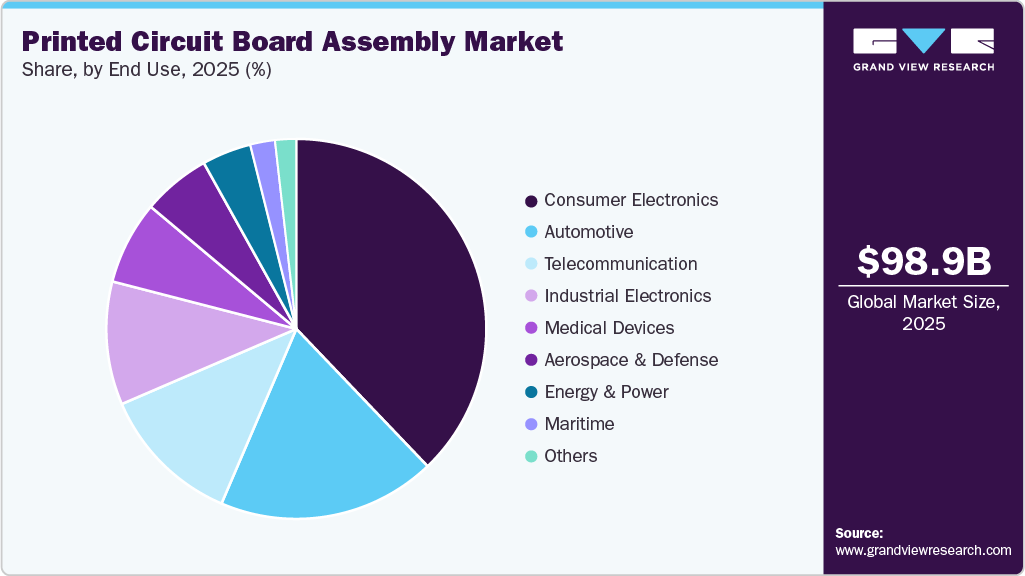
The automotive segment is expected to register the highest CAGR in the PCBA market due to the rapid shift toward electric vehicles, connected cars, and advanced driver-assistance systems (ADAS). Modern vehicles require a significantly higher number of PCB assemblies for battery management systems, power electronics, infotainment, and safety controls. Increasing integration of AI, sensors, radar, and camera systems is driving demand for high-reliability and high-performance PCBAs. Stringent safety, emission, and electrification regulations are further accelerating electronic content per vehicle. In addition, the transition toward autonomous and software-defined vehicles is expected to sustain strong long-term growth in automotive PCBA demand.
Application Insights
Signal processing dominated the PCBA market due to the growing demand for high-speed data transmission, real-time analytics, and advanced computing across multiple industries. Expansion of cloud data centers, 5G networks, and AI-driven applications has significantly increased the need for PCB assemblies capable of handling complex signal processing functions. Increasing adoption of networking equipment, servers, and communication devices has driven demand for high-frequency, low-latency PCB designs. The rising integration of sensors, imaging systems, and embedded intelligence in automotive and industrial applications further boosted signal processing requirements. In addition, advancements in semiconductor technology and digital signal processors increased the value and complexity of signal-processing-focused PCB assemblies.
Signal processing is expected to register the highest CAGR in the PCBA market due to rapid growth in data-intensive applications such as AI, machine learning, and real-time analytics. Increasing deployment of 5G infrastructure, high-speed networking equipment, and edge computing systems is driving demand for advanced signal-processing PCB assemblies. The rising adoption of ADAS, autonomous driving, and smart industrial systems is further increasing the need for precise and high-frequency signal handling. Growing use of sensors, imaging, and communication modules across IoT ecosystems is accelerating signal-processing requirements. In addition, continuous advancements in digital signal processors and high-speed interfaces are raising the complexity and value of signal-processing-focused PCBAs.
Distribution Channel Insights
Original equipment manufacturers (OEMs) dominated the PCBA market due to their large-scale electronics production volumes and strong control over product design and specifications. OEMs across consumer electronics, automotive, industrial, and data center segments require consistent, high-quality PCB assemblies to support mass manufacturing. Their increasing focus on product differentiation, performance optimization, and faster time-to-market has driven sustained demand for advanced PCBA solutions. OEMs also benefit from long-term supply agreements and strategic partnerships with PCBA providers, ensuring stable order flow. In addition, the growing complexity of electronic systems has strengthened OEM reliance on specialized PCB assembly capabilities, reinforcing their dominant market position.
The automotive segment is expected to grow at the highest CAGR in the PCBA market due to the rapid shift toward electric and hybrid vehicles. Electric vehicle (EV) require a significantly higher number of PCB assemblies for battery management systems, power electronics, and onboard charging units. Increasing integration of ADAS, infotainment, and vehicle connectivity features is further boosting electronic content per vehicle. Stringent emission and safety regulations are accelerating the adoption of advanced electronic control systems. The growing development of autonomous and software-defined vehicles is increasing demand for high-performance and high-reliability PCBAs. In addition, rising investments by automotive OEMs in next-generation mobility technologies are supporting sustained PCBA market growth.
Regional Insights
Asia Pacific dominated the global printed circuit board assembly (PCBA) market with a 44.7% revenue share in 2025, supported by its advanced electronics manufacturing ecosystem and strong demand from data centers, automotive, and aerospace sectors. The region benefits from the presence of leading technology and semiconductor companies such as Intel Corporation, Apple Inc., and NVIDIA Corporation, which continuously drive innovation in high-performance computing, AI hardware, and connected devices. These companies generate sustained demand for complex, high-density, and high-reliability PCB assemblies. Strong investments in cloud infrastructure, electric vehicles, and advanced defense electronics further reinforce PCBA adoption. As a result, Asia-Pacific remains a key hub for technologically advanced and high-value PCBA manufacturing and consumption deployment, and innovation-led growth.
China Printed Circuit Board Assembly Market Trends
The printed circuit board assembly (PCBA) market in China is growing with the highest CAGR due to its strong position as the world’s largest electronics manufacturing hub and a highly integrated supply chain. The country benefits from large-scale production of consumer electronics, smartphones, networking equipment, and industrial devices, which drives high-volume PCBA demand. Rising investments in data centers, 5G infrastructure, and AI hardware are increasing demand for advanced and high-density PCB assemblies. Strong government support for semiconductor and electronics self-sufficiency is further strengthening domestic PCBA capabilities. In addition, cost-efficient manufacturing, skilled labor availability, and rapid adoption of automation continue to enhance China’s competitiveness in the global PCBA market.
North America Printed Circuit Board Assembly Market Trends
The printed circuit board assembly (PCBA) market in North America is growing with a significant CAGR due to strong demand from data centers, cloud infrastructure, automotive electronics, and defense applications. The region benefits from the presence of major technology and semiconductor companies such as Intel Corporation, Apple Inc., and NVIDIA Corporation, which drive continuous innovation in high-performance and advanced electronics. Rapid adoption of AI, 5G, and edge computing is increasing demand for complex, high-density PCB assemblies. Growth in electric vehicles and advanced driver-assistance systems is further boosting automotive PCBA requirements. In addition, a strong focus on quality, reliability, and compliance in aerospace and defense electronics supports high-value PCBA production. These factors collectively position North America as a key growth region for advanced PCBA solutions.
Europe Printed Circuit Board Assembly Market Trends
The printed circuit board assembly (PCBA) market in Europe is growing steadily due to strong demand from automotive electronics, industrial automation, and renewable energy systems. The region benefits from the presence of leading electronics and industrial players such as Robert Bosch GmbH, Siemens AG, and STMicroelectronics, which drive innovation in power electronics, sensors, and embedded systems. Rapid adoption of electric vehicles and ADAS technologies is significantly increasing PCBA content per vehicle. Growth in Industry 4.0, smart factories, and automation is further boosting demand for high-reliability PCB assemblies. In addition, a strong regulatory focus on quality, safety, and sustainability supports demand for advanced and precision PCBA manufacturing across Europe.
Key Printed Circuit Board Assembly Company Insights
The market features several key players that significantly shape its global landscape. Foxconn Technology Group is a leading PCBA provider supporting large-scale electronics manufacturing for consumer electronics and data center hardware. Jabil Inc. offers advanced PCBA solutions across automotive, healthcare, and industrial electronics. Flex Ltd. specializes in high-reliability PCB assemblies for cloud infrastructure, automotive, and IoT applications. Meanwhile, Sanmina Corporation focuses on complex and mission-critical PCBA for aerospace, defense, and communications. These companies play a critical role in shaping innovation, scalability, and quality standards within the PCBA industry.
-
Foxconn Technology Group is a global electronics manufacturing leader delivering high-volume and high complexity printed circuit board assembly services. The company supports a wide range of industries, including consumer electronics, networking equipment, data centers, and automotive electronics. Foxconn’s strong automation capabilities, vertically integrated supply chain, and advanced SMT assembly processes enable cost-efficient and scalable PCBA production. Its continuous investments in smart manufacturing and advanced electronics position it as a dominant force in the global PCBA market.
-
Jabil Inc. provides end-to-end PCBA solutions covering design, prototyping, assembly, and lifecycle management. The company serves high-growth sectors such as electric vehicles, industrial automation, healthcare devices, and cloud infrastructure. Jabil emphasizes precision manufacturing, advanced testing, and quality compliance to support complex PCB assemblies. Through its global manufacturing footprint and focus on innovation, Jabil helps OEMs accelerate time-to-market and improve product reliability.
Key Printed Circuit Board Assembly Companies:
The following key companies have been profiled for this study on the printed circuit board assembly market.
- Foxconn Technology Group
- Jabil Inc.
- Flex Ltd.
- Sanmina Corporation
- Pegatron Corporation
- Wistron Corporation
- Celestica Inc.
- TTM Technologies
- Benchmark Electronics
- Sierra Circuits
Recent Development
-
In November 2025, Foxconn Technology Group expanded its advanced PCBA manufacturing capacity to support rising demand from AI servers, cloud data centers, and high-performance computing applications. The expansion focuses on high-density interconnect (HDI) and advanced SMT lines, enabling faster production cycles and improved reliability for next-generation electronics. This development reflects the growing importance of PCBA providers in supporting AI-driven and cloud-centric hardware ecosystems.
-
In December 2025, Jabil Inc. entered a multi-year manufacturing partnership with a global automotive OEM to support PCB assembly for electric vehicle power electronics and battery management systems. Under the agreement, Jabil will deliver high-reliability PCBAs designed to meet stringent automotive safety and performance standards. This partnership highlights the increasing reliance of automotive OEMs on specialized PCBA providers to support electrification and vehicle digitalization.
-
In March 2025, Flex Ltd. announced a strategic investment in advanced automation and Industry 4.0 technologies across its PCBA facilities. The initiative aims to enhance production efficiency, reduce defect rates, and support complex PCB assemblies used in 5G infrastructure and industrial IoT devices. This move underscores the industry-wide shift toward smart manufacturing to meet growing complexity and volume requirements.
-
In March 2025, Sanmina Corporation secured a major defense electronics contract to supply mission-critical PCB assemblies for secure communication and aerospace systems. The engagement emphasizes high-reliability manufacturing, advanced testing, and regulatory compliance. This development reflects sustained demand for specialized PCBA capabilities in defense and aerospace applications.
Printed Circuit Board Assembly Market Report Scope
Report Attribute
Details
Market size value in 2026
USD 102,609.8 million
Revenue forecast in 2033
USD 137,425.48 million
Growth rate
CAGR of 4.3% from 2026 to 2033
Actual data
2021 - 2025
Forecast period
2026 - 2033
Quantitative units
Revenue in USD billion/million and CAGR from 2026 to 2033
Report coverage
Revenue forecast, company ranking, competitive landscape, growth factors, and trends
Segments covered
Assembly type, component, application, distribution channel, end use, region
Regional scope
North America; Europe; Asia Pacific; Latin America; MEA
Country scope
U.S.; Canada; Mexico; Germany; UK; France; China; India; Japan; Australia; South Korea; Brazil; UAE; South Africa; KSA
Key companies profiled
Foxconn Technology Group; Jabil Inc.; Flex Ltd.; Sanmina Corporation; Pegatron Corporation; Wistron Corporation; Celestica Inc.; TTM Technologies; Benchmark Electronics; Hon Hai Precision Industry Co., Ltd.; Venture Corporation Limited; Sierra Circuits; Universal Scientific Industrial Co., Ltd.
Customization scope
Free report customization (equivalent up to 8 analysts working days) with purchase. Addition or alteration to country, regional & segment scope.
Pricing and purchase options
Avail customized purchase options to meet your exact research needs. Explore purchase options
Global Printed Circuit Board Assembly Market Report Segmentation
This report forecasts revenue growth at global, regional, and country levels and provides an analysis of the latest industry trends in each of the sub-segments from 2021 to 2033. For this study, Grand View Research has segmented the global printed circuit board assembly (PCBA) market report based on assembly type, component type, application, distribution channel, end use, and region:
-
Assembly Type (Revenue, USD Million, 2021 - 2033)
-
Surface Mount Technology (SMT)
-
Through-Hole Technology (THT)
-
-
Component Outlook (Revenue, USD Million, 2021 - 2033)
-
Active Components
-
Passive Components
-
-
Application Outlook (Revenue, USD Million, 2021 - 2033)
-
Signal Processing
-
Power Management
-
Control & Automation
-
Communication & Networking
-
Others
-
Distribution Channel (Revenue, USD Million, 2021 - 2033)
-
Original Equipment Manufacturers (OEMs)
-
Original Design Manufacturers (ODMs)
-
-
End Use Outlook (Revenue, USD Million, 2021 - 2033)
-
Consumer Electronics
-
Automotive
-
Telecommunication
-
Industrial Electronics
-
Medical Devices
-
Aerospace & Defense
-
Energy & Power
-
Maritime
-
Others
-
-
Regional Outlook (Revenue, USD Million, 2021 - 2033)
-
North America
-
U.S.
-
Canada
-
Mexico
-
-
Europe
-
UK
-
Germany
-
France
-
-
Asia Pacific
-
China
-
Japan
-
India
-
Australia
-
South Korea
-
-
Latin America
-
Brazil
-
-
Middle East and Africa (MEA)
-
KSA
-
UAE
-
South Africa
-
-
Frequently Asked Questions About This Report
b. The global printed circuit board assembly market size was estimated at USD 98,927.7 million in 2025 and is expected to reach USD 102,609.8 million in 2026.
b. The global printed circuit board assembly market is expected to grow at a compound annual growth rate of 4.3% from 2026 to 2033 to reach USD 137,425.48 million by 2033.
b. Asia-Pacific dominated the global printed circuit board assembly (PCBA) market with a 44.7% revenue share in 2025, supported by its advanced electronics manufacturing ecosystem and strong demand from data centers, automotive, and aerospace sectors.
b. Some key players operating in the printed circuit board assembly market include Key companies profiled Foxconn Technology Group; Jabil Inc.; Flex Ltd.; Sanmina Corporation; Pegatron Corporation; Wistron Corporation; Celestica Inc.; TTM Technologies; Benchmark Electronics; Hon Hai Precision Industry Co., Ltd.; Venture Corporation Limited; Universal Scientific Industrial Co., Ltd.
b. Key factors that are driving the market growth include rapid cloud infrastructure expansion and increasing demand for high-performance computing hardware, and heightened focus on cybersecurity, data protection, and reliable digital infrastructure


Share this report with your colleague or friend.
Need a Tailored Report?
Customize this report to your needs — add regions, segments, or data points, with 20% free customization.


ISO 9001:2015 & 27001:2022 Certified
We are GDPR and CCPA compliant! Your transaction & personal information is safe and secure. For more details, please read our privacy policy.
Trusted market insights - try a free sample
See how our reports are structured and why industry leaders rely on Grand View Research. Get a free sample or ask us to tailor this report to your needs.