- Home
- »
- Advanced Interior Materials
- »
-
Pool Heat Pump Market Size & Share, Industry Report, 2033GVR Report cover
![Pool Heat Pump Market Size, Share & Trends Report]()
Pool Heat Pump Market (2026 - 2033) Size, Share & Trends Analysis Report By Technology (Air Source, Water/Geothermal Source), By Capacity (Below 10 kW, 10 - 20 kW, Above 20 kW), By End Use (Residential, Commercial), By Region And Segment Forecasts
- Report ID: GVR-4-68040-875-4
- Number of Report Pages: 100
- Format: PDF
- Historical Range: 2021 - 2024
- Forecast Period: 2026 - 2033
- Industry: Advanced Materials
- Report Summary
- Table of Contents
- Segmentation
- Methodology
- Download FREE Sample
-
 Download Sample Report
Pool Heat Pump Market Summary
The global pool heat pump market size was estimated at USD 5,305.8 million in 2025 and is projected to reach USD 7,406 million by 2033, growing at a CAGR of 4.3% from 2026 to 2033. The market growth is primarily driven by the increasing demand for energy-efficient pool heating solutions.
Key Market Trends & Insights
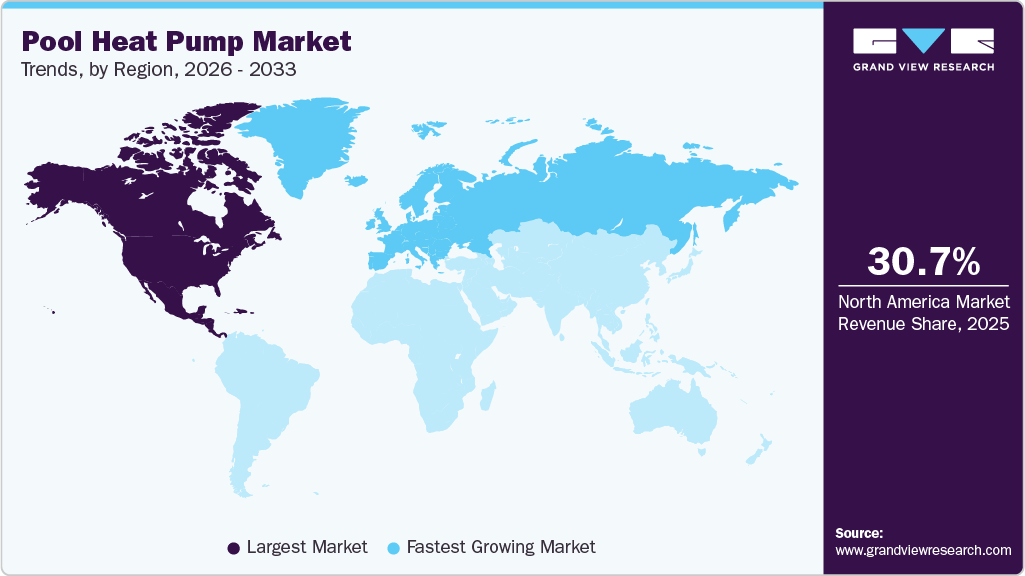
- The North America pool heat pump market led the global revenue share, holding 30.7% of the market in 2025.
- Based on technology, the air source segment represented the largest segment, holding 77.9% of the market revenue in 2025.
- On the basis of capacity, the below 10 kW segment accounted for the majority market share in 2025, holding 51.3%.
- Based on end use, the residential segment is estimated to register a CAGR of 5.2% during the forecast period.
Market Size & Forecast
- 2025 Market Size: USD 5,305.8 Million
- 2033 Projected Market Size: USD 7,406 Million
- CAGR (2026-2033): 4.3%
- North America: Largest market in 2025
- Europe: Fastest growing market
Pool heat pumps transfer heat from ambient air to pool water, allowing them to operate with significantly lower energy consumption compared to traditional gas or electric heaters. This high efficiency reduces operating costs for residential and commercial pool owners, making heat pumps an attractive long-term heating option.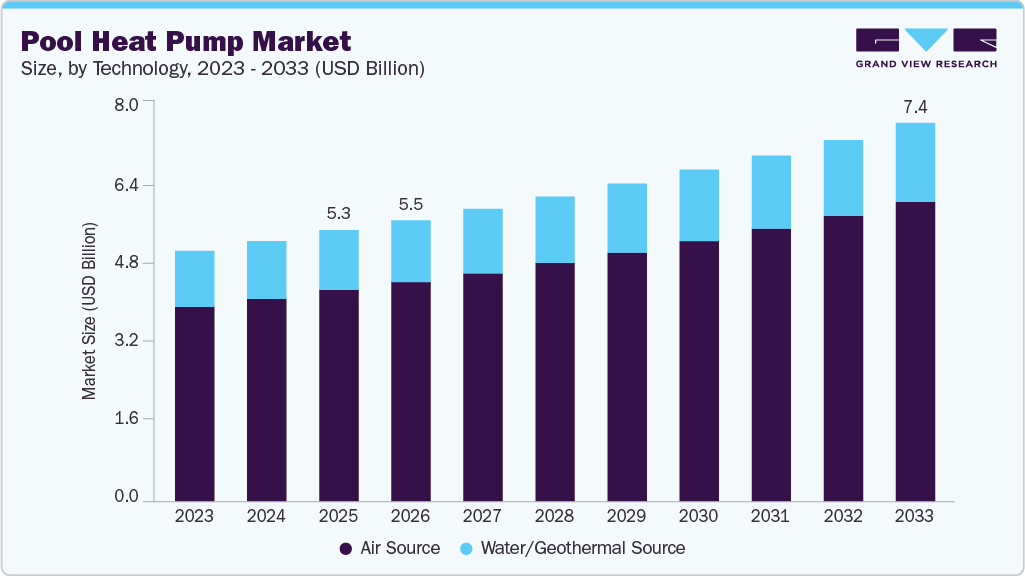
The rising construction of residential swimming pools, expansion of hospitality and leisure infrastructure, and increasing awareness of sustainable heating technologies support market expansion. Growth in tourism and resort development has led to higher installations of commercial pools that require efficient temperature control. Furthermore, improvements in heat pump design and increasing consumer preference for low-emission heating solutions are contributing to broader adoption.
Market Concentration & Characteristics
The pool heat pump industry is fragmented, with a mix of established HVAC equipment manufacturers and specialized pool equipment companies operating globally. Leading players compete through strong distribution networks, product reliability, and brand reputation, while regional manufacturers often focus on cost-competitive products for local markets.
The primary alternatives to pool heat pumps include gas heaters, electric resistance heaters, and solar pool heating systems. While gas heaters offer faster heating and solar systems provide renewable energy benefits, pool heat pumps remain competitive due to their balance of energy efficiency, operating cost savings, and relatively consistent heating performance across different climates.
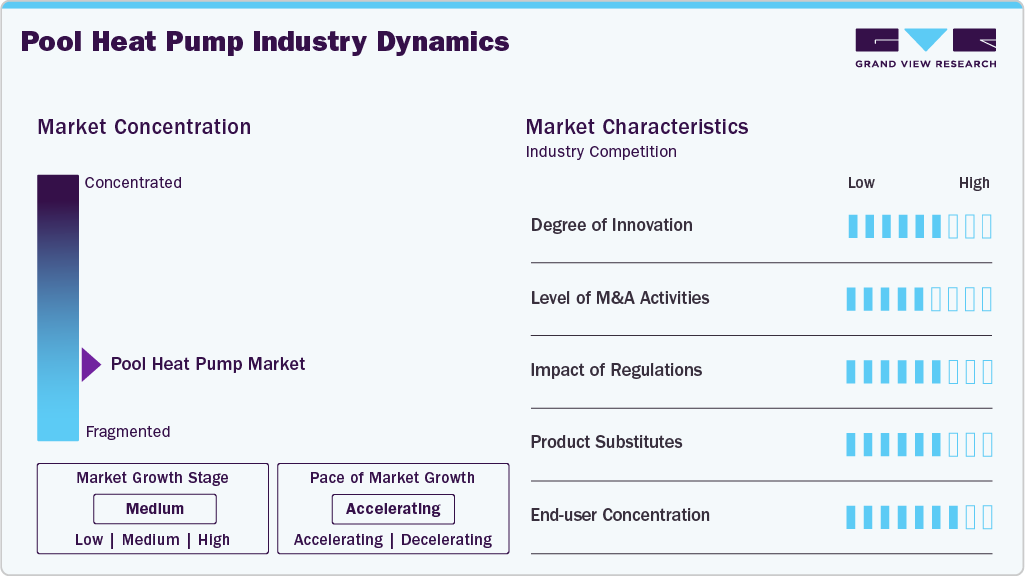
Energy efficiency regulations and environmental policies are influencing product development in the pool heating market, encouraging the adoption of high-efficiency heat pump systems with lower greenhouse gas emissions. Technological advancements, such as inverter-driven compressors, improved heat exchangers, and smart control systems, are enhancing system efficiency and operational reliability. Market players are focusing on product innovation, strategic partnerships with pool equipment distributors, and expansion into emerging markets to strengthen their competitive position.
Drivers, Opportunities & Restraints
The market is expanding due to a combination of energy efficiency advantages, rising swimming pool installations, and growing emphasis on environmentally friendly heating technologies. Increasing investments in residential housing, hotels, and recreational facilities are creating greater demand for reliable pool heating systems. In addition, technological advancements and supportive environmental policies promoting energy-efficient equipment are further accelerating market growth.
The global market is entering a strong growth phase, driven by its transition from a premium add-on to a core component of sustainable heating solutions. Moreover, a key opportunity lies in the adoption of full-inverter technology, which improves energy efficiency, reduces noise, and aligns with tightening environmental regulations and the replacement of fossil-fuel-based systems. Furthermore, market growth is supported by smart connectivity integration, enabling features such as predictive maintenance and energy optimization. Expanding residential and hospitality sectors in emerging regions, along with increasing demand for low-emission and year-round pool heating, are also significant factors positioning pool heat pumps as a preferred solution for aquatic climate control.
The performance of air-source pool heat pumps depends on ambient temperature, with efficiency declining significantly when temperatures fall below approximately 5°C to 10°C. As a result, in colder climates, additional auxiliary heating systems may be required to maintain desired pool temperatures, increasing overall system costs and limiting adoption in certain regions. Moreover, market growth is restrained in some cases by the relatively high upfront cost of pool heat pump systems compared with conventional heating options. The purchase and installation costs of pool heat pumps are typically two to three times higher than those of traditional gas or electric resistance heaters, which can discourage adoption among budget-conscious residential users.
Technology Insights
Air source pool heat pumps dominate the market due to its high installation flexibility and lower upfront capital requirements compared to other technologies. Modern units are increasingly adopting advanced full-inverter technology, which allows the compressor to vary its speed and maintain precise temperatures with 30%-50% more efficiency than traditional on/off models. Furthermore, the push for eco-friendly refrigerants like R32 and R290 is making these units more attractive to environmentally conscious consumers and ensuring compliance with tightening global emission standards.
The water/geothermal source segment is estimated to expand at a CAGR of 3.6% during the forecast period. The segment’s growth is driven by the demand for consistent year-round performance in extreme climates where air source efficiency typically drops. These systems leverage stable underground or water-body temperatures, providing a much higher and more reliable coefficient of performance (COP). The segment is also seeing a boost from high-end residential and large-scale commercial projects that prioritize long-term energy sovereignty and a significantly longer equipment lifespan, often exceeding 20 years.
Capacity Insights
The below 10 kW capacity segment led the market in 2025 due to the rising popularity of compact plunge pools and spools in urban residential areas where backyard space is at a premium. These smaller units are highly favored because they generally operate on standard single-phase residential electrical circuits, avoiding the need for expensive home wiring upgrades. In addition, the rapid growth of the luxury inflatable and portable pool market has created a new niche for these low-capacity, highly portable heating solutions.
The 10 - 20 kW capacity segment is expected to grow considerably from 2026 to 2033 in terms of revenue, registering a CAGR of 3.7%. This segment is driven by the widespread replacement of legacy gas and electric resistance heaters with more efficient heat pumps to offset rising electricity and gas prices. Innovations in this segment now often include smart home integration and Wi-Fi connectivity as standard features, allowing homeowners to optimize heating schedules based on off-peak utility rates.
End Use Insights
The commercial segment represents the key end use segment for pool heat pump manufacturers with a revenue share of 73.8% in 2025. Commercial facilities require reliable and energy-efficient heating systems to maintain consistent pool temperatures throughout the year while controlling operating costs. Expansion of tourism infrastructure, fitness centers, and recreational facilities continues to drive adoption of heat pump systems in commercial pool applications.
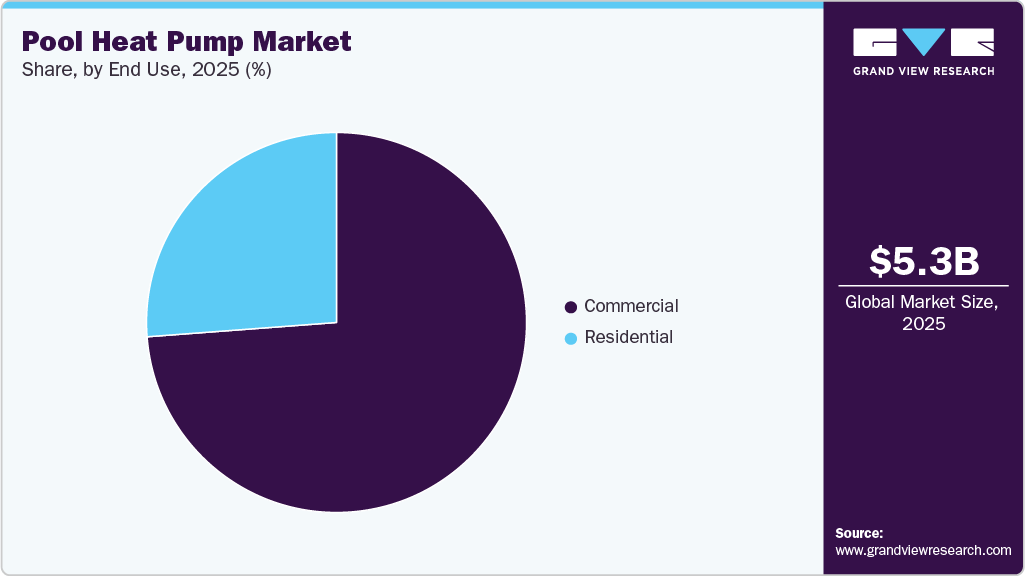
The increasing consumer interest in extending the swimming season. Homeowners are increasingly adopting heat pump systems as they offer energy-efficient and environmentally friendly heating compared with conventional pool heaters. Growing disposable income and rising demand for home leisure amenities further support residential market growth.
Regional Insights
The Asia Pacific region is emerging as a high-growth hub due to massive urbanization and a burgeoning middle class in countries like China, India, and Japan. The rapid expansion of the luxury residential sector and high-rise multi-unit dwellings is creating a surge in demand for compact, inverter-driven pool heating solutions that fit urban space constraints. Furthermore, the region is a global manufacturing powerhouse for heat pump components, ensuring high product availability and competitive pricing, while government-led smart city initiatives in various countries are integrating energy-efficient heating into new public and commercial infrastructure projects.
China Pool Heat Pump Market Trends
The pool heat pump market in China is expanding due to rapid urbanization, rising disposable incomes, and growing investments in tourism and recreational infrastructure. Hotels, resorts, and residential developments are increasingly incorporating swimming pools, creating demand for efficient pool heating systems. The country’s strong manufacturing base for heat pump equipment also supports wider adoption.
Japan pool heat pump market is supported by the country’s focus on energy efficiency and advanced heating technologies. Commercial facilities such as hotels, fitness clubs, and wellness centers are adopting heat pump systems to maintain comfortable pool temperatures while reducing energy consumption. The presence of established HVAC manufacturers and increasing interest in sustainable technologies further support market development.
North America Pool Heat Pump Market Trends
The pool heat pump market in North America is driven by a large installed base of residential and commercial swimming pools. Strong consumer preference for energy-efficient heating systems and rising electricity costs are encouraging the adoption of pool heat pumps as an alternative to gas heaters. In addition, increasing investments in residential housing, hospitality infrastructure, and recreational facilities continue to support demand for efficient pool heating technologies across the region.
The U.S. pool heat pump market is driven by the large number of residential swimming pools and strong demand for energy-efficient heating systems. Homeowners and commercial pool operators are increasingly adopting heat pumps as they offer lower operating costs compared to gas heaters. In addition, the expansion of residential housing, hotels, and recreational facilities continues to support demand for reliable pool heating solutions.
Europe Pool Heat Pump Market Trends
The pool heat pump market in Europe is currently the fastest-growing market, primarily fueled by the European Green Deal and the REPowerEU plan, which aim to rapidly phase out fossil-fuel-based heating. Stringent environmental regulations and the revision of the Energy Performance of Buildings Directive (EPBD) are mandating zero-emission standards for new constructions and encouraging retrofitting in existing properties. High energy price volatility and a strong consumer preference for sustainability have led to substantial adoption rates of air-source heat pumps.
Germany pool heat pump market is supported by the increasing adoption of energy-efficient heating technologies and strict energy efficiency regulations. Residential wellness facilities, indoor pools, and hotel swimming pools are increasingly using heat pump systems to maintain consistent water temperatures while reducing energy consumption. Growing awareness of sustainable heating solutions is also contributing to the adoption of pool heat pumps.
The pool heat pump market in the UK is driven by rising interest in residential wellness amenities and the expansion of hospitality and leisure infrastructure. Hotels, fitness centers, and public swimming pools are increasingly installing energy-efficient heating systems to control operating costs. In addition, supportive policies encouraging low-carbon heating technologies are contributing to market growth.
Latin America Pool Heat Pump Market Trends
The pool heat pump market in Latin America is largely driven by a flourishing hospitality and tourism sector, particularly in Brazil and the Caribbean, where resorts are shifting to heat pumps to lower massive operational overheads. Rising disposable incomes in major metropolitan areas are also boosting the installation of private residential pools as a lifestyle amenity. While the market is still developing, a growing awareness of energy conservation and the introduction of regional efficiency labels are gradually encouraging a shift away from traditional electric resistance heaters toward more cost-effective air-source technologies.
Brazil pool heat pump market is supported by favorable climatic conditions and the growing popularity of residential swimming pools in urban housing developments. Increasing construction of resorts, hotels, and leisure facilities is also driving demand for reliable pool heating systems. Rising awareness of energy-efficient technologies is gradually encouraging the adoption of pool heat pumps in the country.
Middle East & Africa Pool Heat Pump Market Trends
The pool heat pump market in the MEA is driven by the dual requirements of the region for water temperature regulation, where heat pumps are utilized for both heating in winter and cooling during extreme summer heat. Massive infrastructure projects and giga-projects in the region are prioritizing sustainable building practices and smart home technologies that feature integrated heat pump systems. In addition, regional governments are implementing new energy efficiency standards and subsidies to reduce domestic oil and gas consumption, driving a significant transition toward electrified heating in both the luxury residential and commercial hospitality segments.
Saudi Arabia pool heat pump market is driven by expanding luxury residential developments and large investments in hospitality and tourism infrastructure. Hotels, resorts, and recreational facilities require efficient heating systems to maintain comfortable pool temperatures, particularly during cooler seasons. Ongoing development of tourism projects and high-end residential communities continues to support demand for pool heat pump systems.
Key Pool Heat Pump Company Insights
Some of the key players operating in the market include Pentair and Fluidra.
-
Pentair plc is a company specializing in water treatment and pool equipment solutions for residential, commercial, and industrial applications. The company operates through business segments focused on water solutions and pool technologies, offering products such as pumps, filtration systems, automation controls, and pool heat pumps. It has a strong presence across the globe and serves a broad customer base.
-
Fluidra is a Spain-based global manufacturer of pool and wellness equipment, providing a comprehensive portfolio of products and solutions for residential and commercial swimming pools. The company’s offerings include pumps, filtration systems, pool heating equipment, water treatment solutions, automation technologies, and connected pool management systems. Fluidra operates globally through several well-known brands such as AstralPool, Jandy, Zodiac, and Polaris, supported by an extensive distribution and service network.
Key Pool Heat Pump Companies:
The following key companies have been profiled for this study on the pool heat pump market.
- Pentair
- Hayward Industries, Inc.
- Fluidra
- Rheem Manufacturing Company
- DAIKIN INDUSTRIES, LTD.
- AquaCal
- Guangdong PHNIX Eco-energy Solution Ltd.
- Fairland Group Limited
- Guangzhou SPRSUN New Energy Technology Development Co., Ltd
- Waterco
- Madimack Global
- Thermeau Industries Inc.
- Aquark Technology Limited
- Exinda
- GRAT ENERGY INC.
Recent Developments
-
In December 2024, Pentair plc acquired G&F Manufacturing LLC for approximately USD 108 million in cash. The Florida-based company manufactures and services pool heat pumps under the Gulfstream brand, primarily serving the southeastern United States. The acquisition expands Pentair’s pool equipment portfolio and strengthens its presence in a key regional market with a high concentration of swimming pools. The move aligns with the growing demand for energy-efficient pool heating solutions, and the deal is expected to contribute modestly to Pentair’s earnings starting in 2025.
-
In September 2025, PHNIX announced the launch of the Full Inverter R290 pool heat pump (i-GreenLine Ultra), integrating artificial intelligence-based control with an inverter compressor system to optimize heating performance. The unit uses the low-global-warming-potential R290 (propane) refrigerant and AI-driven algorithms that adjust compressor frequency based on water temperature, user habits, and ambient conditions, delivering around 30% higher energy savings compared with conventional inverter pool heat pumps. The launch highlights the industry’s shift toward intelligent, energy-efficient, and environmentally sustainable pool heating technologies.
Pool Heat Pump Market Report Scope
Report Attribute
Details
Market size value in 2026
USD 5,497.3 million
Revenue forecast in 2033
USD 7,406 million
Growth rate
CAGR of 4.3% from 2026 to 2033
Base year for estimation
2025
Historical data
2021 - 2024
Forecast period
2026 - 2033
Quantitative units
Revenue in USD million/billion and CAGR from 2026 to 2033
Report coverage
Revenue forecast, company market position analysis, competitive landscape, growth factors, and trends
Segments covered
Technology, capacity, end use, region
Regional scope
North America; Europe; Asia Pacific; Latin America; MEA
Country Scope
U.S.; Canada; Mexico; UK; Germany; France; Italy; Spain; China; India; Japan; South Korea; Australia; Brazil; Argentina; South Africa; Saudi Arabia; UAE
Key companies profiled
Pentair; Hayward Industries, Inc.; Fluidra, Rheem Manufacturing Company; Daikin Industries, Ltd.; AquaCal; Guangdong PHNIX Eco-energy Solution Ltd.; Fairland Group Limited; Guangzhou SPRSUN New Energy Technology Development Co., Ltd.; Waterco; Madimack Global; Thermeau Industries Inc.; Aquark Technology Limited; GRAT ENERGY INC.; Exinda
Customization scope
Free report customization (equivalent up to 8 analysts working days) with purchase. Addition or alteration to country, regional & segment scope.
Pricing and purchase options
Avail customized purchase options to meet your exact research needs. Explore purchase options
Global Pool Heat Pump Market Report Segmentation
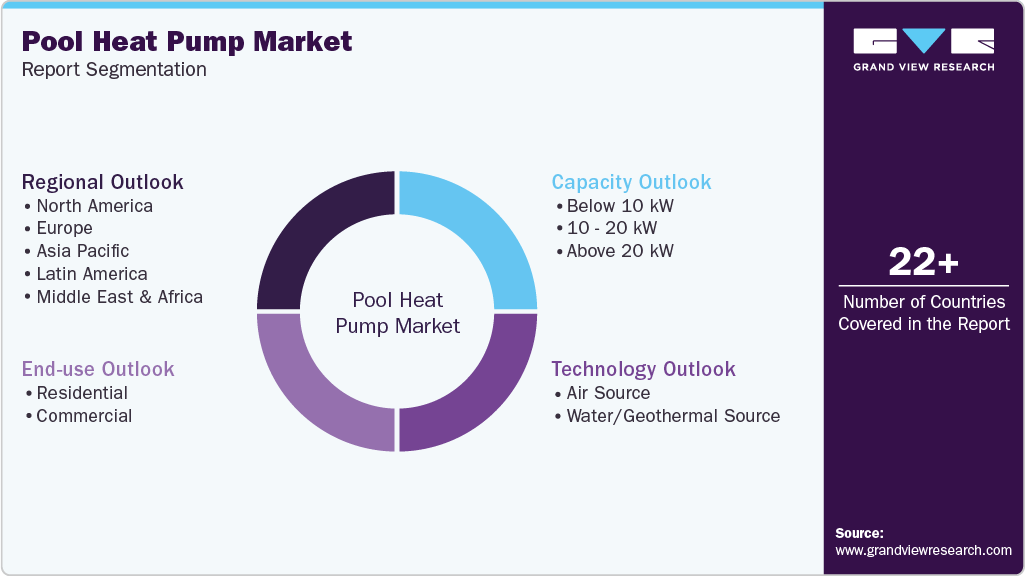
This report forecasts revenue growth at global, regional, and country levels and provides an analysis of the latest industry trends in each of the sub-segments from 2021 to 2033. For this study, Grand View Research has segmented the global pool heat pump market report based on technology, capacity, end use, and region:
-
Technology Outlook (Revenue, USD Million, 2021 - 2033)
-
Air Source
-
Water/Geothermal Source
-
-
Capacity Outlook (Revenue, USD Million, 2021 - 2033)
-
Below 10 kW
-
10 - 20 kW
-
Above 20 kW
-
-
End Use Outlook (Revenue, USD Million, 2021 - 2033)
-
Residential
-
Commercial
-
-
Regional Outlook (Revenue, USD Million, 2021 - 2033)
-
North America
-
U.S.
-
Canada
-
Mexico
-
-
Europe
-
UK
-
Germany
-
France
-
Italy
-
Spain
-
-
Asia Pacific
-
China
-
India
-
Japan
-
South Korea
-
Australia
-
-
Latin America
-
Brazil
-
Argentina
-
-
Middle East & Africa
-
South Africa
-
UAE
-
Saudi Arabia
-
-
Frequently Asked Questions About This Report
b. The global pool heat pump market size was estimated at USD 5,305.8 million in 2025 and is expected to be USD 5,497.3 million in 2026.
b. The global pool heat pump market, in terms of revenue, is expected to grow at a compound annual growth rate of 4.3% from 2026 to 2033 to reach USD 7,406 million by 2033.
b. The market in North America dominated the global revenue share in 2025 accounting for 30.7% in 2025, driven by the region’s large installed base of residential swimming pools, strong replacement demand for energy-efficient heating systems, and tightening state-level energy efficiency standards promoting electric pool heat pumps.
b. Some of the key players operating in the pool heat pump market include Pentair, Hayward Industries, Inc., Fluidra, Rheem Manufacturing Company, Daikin Industries, Ltd., AquaCal, Guangdong PHNIX Eco-energy Solution Ltd., Fairland Group Limited, Guangzhou SPRSUN New Energy Technology Development Co., Ltd., Waterco, Madimack Global, Thermeau Industries Inc., Aquark Technology Limited, GRAT ENERGY INC, and Exinda.
b. The pool heat pump market is primarily driven by increasing demand for energy-efficient pool heating systems, rising residential and commercial swimming pool installations, and growing adoption of environmentally friendly heating technologies.


Share this report with your colleague or friend.
Need a Tailored Report?
Customize this report to your needs — add regions, segments, or data points, with 20% free customization.


ISO 9001:2015 & 27001:2022 Certified
We are GDPR and CCPA compliant! Your transaction & personal information is safe and secure. For more details, please read our privacy policy.
Trusted market insights - try a free sample
See how our reports are structured and why industry leaders rely on Grand View Research. Get a free sample or ask us to tailor this report to your needs.