- Home
- »
- Electronic Devices
- »
-
Point-of-Sale Terminal Market Size, Industry Report, 2033GVR Report cover
![Point-of-Sale Terminal Market Size, Share & Trends Report]()
Point-of-Sale Terminal Market (2026 - 2033) Size, Share & Trends Analysis Report By Product (Fixed, Mobile), By Component (Hardware, Software, Services), By Deployment (Cloud, On-premise), By End Use, By Region, And Segment Forecasts
- Report ID: 978-1-68038-263-1
- Number of Report Pages: 120
- Format: PDF
- Historical Range: 2021 - 2025
- Forecast Period: 2026 - 2033
- Industry: Semiconductors & Electronics
- Report Summary
- Table of Contents
- Interactive Charts
- Methodology
- Download FREE Sample
-
 Download Sample Report
Point-of-Sale Terminal Market Summary
The global point-of-sale terminal market size was valued at USD 123.15 billion in 2025 and is projected to reach USD 226.87 billion by 2033, growing at a CAGR of 7.9% from 2026 to 2033. Point-of-Sale (POS) terminals are electronic devices designed to process card-based transactions across a wide range of establishments, including retail outlets, restaurants, hotels, gas stations, pharmacies, hospitals, and resorts.
Key Market Trends & Insights
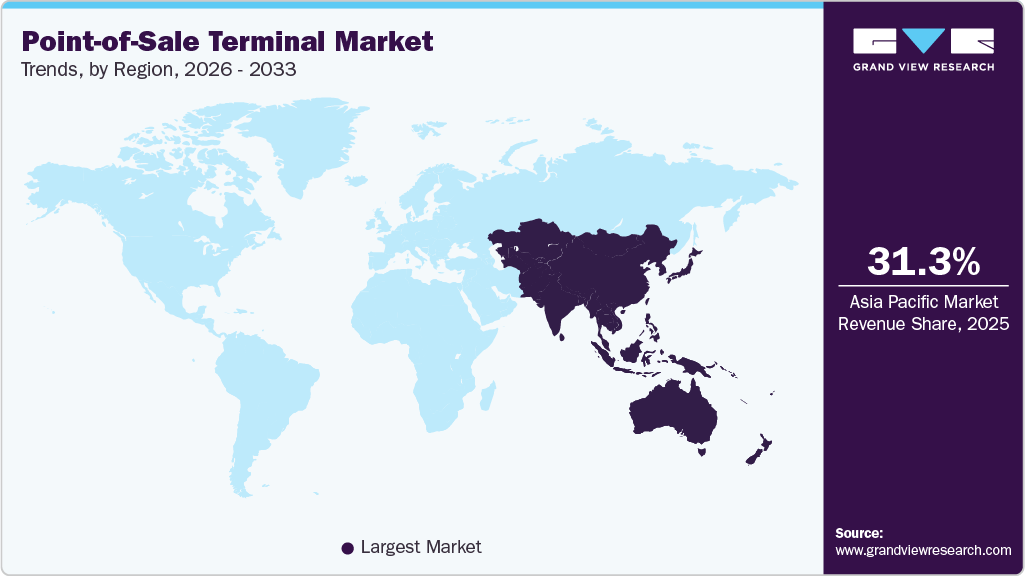
- Asia Pacific dominated the global point-of-sale terminal market with the largest revenue share of 31.33% in 2025.
- The point-of-sale terminal industry in U.S. is expected to grow significantly over the forecast period.
- By component, hardware segment led the market and held the largest revenue share in 2025.
- By deployment, on-premise segment led the market and held the largest revenue share in 2025.
Market Size & Forecast
- 2025 Market Size: USD 123.15 Billion
- 2033 Projected Market Size: USD 226.87 Billion
- CAGR (2025-2033): 7.9%
- Asia Pacific: Largest market in 2025
The increasing adoption of cost-effective wireless communication technologies has significantly contributed to the expansion of the POS terminal market. These systems leverage wireless connectivity to enable seamless payment processing for goods and services. Restaurants, bars, and food service providers heavily rely on POS technologies to streamline operations, manage inventory, monitor product movement, and track sales effectively. Modern POS systems often integrate various hardware components such as cash registers, barcode scanners, and computers, along with digital displays, to facilitate seamless online and offline transactions. The market is being propelled by the growing use of mobile-based POS terminals, advancements in payment technologies, and the widespread adoption of EMV (Europay, Mastercard, and Visa) standards. In addition, the expanding application of POS systems across the e-commerce and retail sectors is playing a significant role in driving the restaurant point of sale terminal market.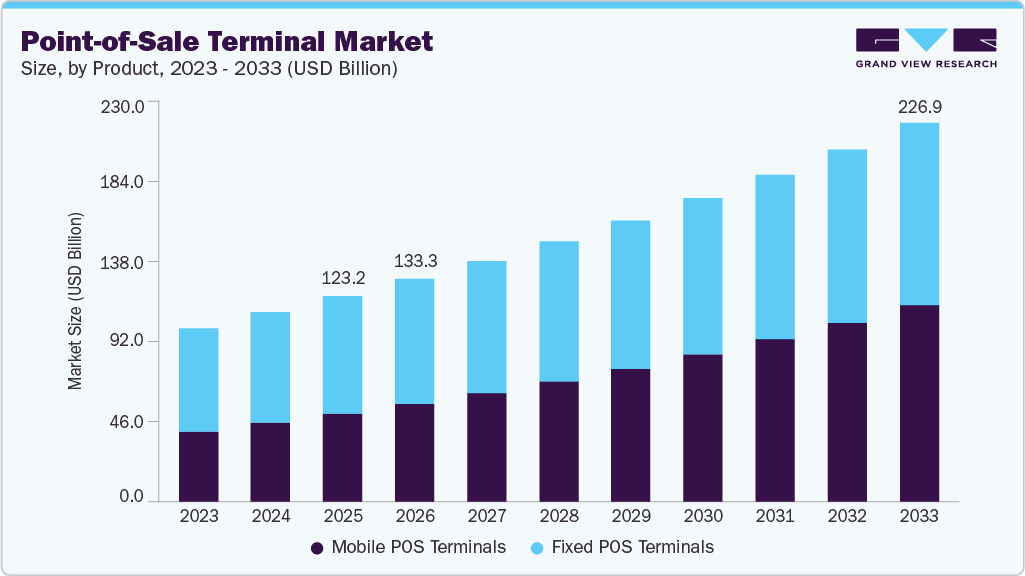
Rising use of debit and credit cards, contactless NFC payments, QR codes, and mobile wallets has increased the need for reliable payment acceptance infrastructure at merchant locations. Government-backed digital payment initiatives, such as real-time payment systems, UPI-type platforms, and financial inclusion programs, are accelerating merchant onboarding by reducing transaction costs and simplifying compliance. These initiatives encourage even small and informal businesses to adopt POS terminals to participate in the formal digital economy. At the same time, consumer behavior is changing rapidly, with customers increasingly expecting fast, secure, and convenient tap-and-pay or mobile payment options. To meet these expectations and remain competitive, merchants across retail, hospitality, and services are investing in modern POS terminals, directly expanding the installed base and driving the replacement of legacy cash-centric systems.
Mobile POS (mPOS) and cloud platforms are reshaping the POS terminal market by lowering cost barriers and increasing operational flexibility. Mobile POS terminals, which run on smartphones or tablets with card readers or QR capabilities, are seeing the fastest unit adoption due to their low upfront cost, portability, and ease of setup. They are particularly attractive to SMEs, delivery services, field sales teams, and outdoor or temporary vendors who do not require fixed checkout counters. In parallel, cloud-based POS systems are steadily replacing traditional on-premise solutions. Cloud POS enables real-time data synchronization across locations, remote device and software management, automatic updates, and seamless integration with e-commerce and omnichannel platforms. Together, mPOS and cloud platforms significantly expand merchant adoption and scalability.
Challenges such as privacy concerns and the risk of data misuse, including potential card information leakage, remain significant barriers to market growth. Additionally, consumer awareness of the security risks associated with POS systems further restricts market expansion. The market also faces security challenges due to the exposed nature of these systems within networks, as they handle critical information that requires robust protection. Managing these systems, especially in rural areas, adds another layer of complexity to ensuring their security and operational integrity.
Product Insights
The fixed segment dominated the market and accounted for the revenue share of 57.4% in 2025. The fixed POS segment is divided into kiosks and others. Large-scale vendors often opt for fixed POS terminals, driven by their substantial procurement and installation investments, which continue to support the growth of this segment. Additionally, end-users with an understanding of cloud and on-premises data storage solutions tend to prefer fixed POS systems for their ability to securely store data locally. These terminals are widely used for various functions, including bill printing, Customer Relationship Management (CRM), inventory control, and integration with diverse payment devices, making them a vital component in streamlining business operations.
The mobile segment is anticipated to grow at a significant CAGR during the forecast period. The mobile POS segment is divided into tablet and other devices. The growth is largely driven by the increasing adoption of in-store mobile payments by consumers worldwide. Mobile POS (mPOS) terminals enable transactions to be processed from any location within a store, enhancing flexibility and operational efficiency. Various end-users, particularly in the food service industry, such as restaurants, are increasingly implementing mPOS solutions to streamline payment processes during peak hours. This not only minimizes delays and prevents potential revenue loss but also boosts customer satisfaction. For example, Quick-Service Restaurants (QSRs) in China have adopted technologies such as digital kiosks and tablets for menu display and order placement. These innovations improve service delivery and the customer experience, thereby propelling market growth.
Component Insights
The hardware segment dominated the market, accounting for the largest revenue share in 2025. The upgrading of legacy systems in developing regions is a significant growth driver. Small and medium-sized enterprises (SMEs), especially in emerging markets across the Asia Pacific, Latin America, and Africa, are moving away from traditional cash registers to modern POS systems due to government initiatives promoting digitalization, financial inclusion, and formalization of unorganized retail. This wave of modernization opens a large market for cost-effective, durable, and scalable hardware solutions.
The software segment is expected to grow at a significant CAGR over the forecast period, owing to the integration of analytics and business intelligence tools within POS software. Retailers and service providers are leveraging these capabilities to gain insights into customer behavior, sales trends, and inventory performance. By utilizing analytics, businesses can make data-informed decisions that enhance customer engagement, optimize stock levels, and improve operational efficiency.
Deployment Insights
The on-premise segment dominated the market and accounted for the largest revenue share in 2025 due to the requirement for greater control, customization, and data ownership. Businesses in sectors such as high-end retail, hospitality, and healthcare often prefer on-premises deployments due to the sensitive nature of their data and the need for tailored system configurations that closely align with their unique operational workflows. Offline functionality and system reliability also contribute to the growth of on-premise POS deployments. In environments where internet connectivity is unstable or unreliable, such as remote locations, rural areas, or certain international markets, on-premises systems ensure uninterrupted operation.
The cloud segment is expected to grow at a significant CAGR over the forecast period, driven by the global shift toward digital transformation and the increasing demand for flexibility, scalability, and remote accessibility. One of the key drivers is the cost-effectiveness and lower upfront investment associated with cloud-based solutions. Unlike traditional on-premise systems, cloud POS platforms typically operate on a subscription-based model, allowing businesses, especially SMEs, to access advanced POS functionalities without the need for heavy infrastructure investment or maintenance costs.
End Use Insights
The retail segment dominated the market, accounting for the largest revenue share in 2025, driven by the global expansion of both brick-and-mortar and e-commerce retail operations. In addition to the rise of online shopping, physical retail stores remain crucial for customer engagement and experiential marketing. Retailers are increasingly adopting POS systems to enhance transaction speed, streamline inventory management, and deliver personalized customer experiences. Moreover, the emphasis on omnichannel retailing, where businesses aim to unify their online and offline sales channels also contributes to the growth of the segment. POS terminals, particularly those integrated with cloud-based systems, enable real-time synchronization of customer data, inventory levels, and sales transactions across all platforms.
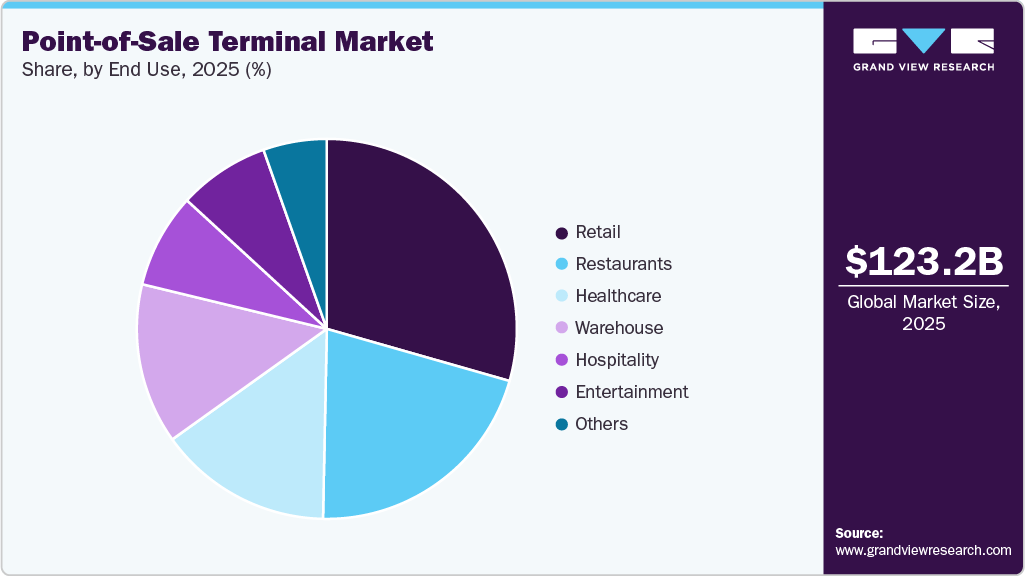
The healthcare segment is expected to grow at a significant CAGR over the forecast period, driven by the increasing need for streamlined administrative processes, accurate billing, and enhanced patient experiences. One of the primary growth drivers is the digitization of healthcare systems across both developed and emerging markets. Hospitals, clinics, pharmacies, and other healthcare providers are increasingly adopting POS systems to manage payments, inventory, and patient information more efficiently, replacing outdated manual systems and reducing administrative errors.
Regional Insights
The point-of-sale terminal market in North America held a significant share of 29.09% in 2025. The hospitality and healthcare sectors’ growing reliance on automation and payment efficiency is adding momentum to the POS terminal market. Restaurants, hotels, clinics, and pharmacies are using POS systems to streamline billing, manage reservations, monitor inventory, and offer faster service, all of which contribute to improved operational performance and customer satisfaction.
U.S. Point-of-Sale Terminal Market Trends
The U.S. point-of-sale terminal market is expected to grow significantly from 2026 to 2033. Consumers in the U.S. are increasingly opting for digital wallets, NFC (Near Field Communication) payment methods, and QR code-based transactions, particularly in light of the COVID-19 pandemic.
Europe Point-of-Sale Terminal Market Trends
The point-of-sale terminal market in Europe is anticipated to register a considerable growth from 2026 to 2033 due to the implementation of stringent regulatory frameworks such as the Payment Services Directive 2 (PSD2) and the General Data Protection Regulation (GDPR). PSD2, which mandates stronger authentication protocols for online payments, is driving the demand for more secure POS terminals that meet new compliance standards.
The UK point-of-sale terminal market is expected to grow rapidly in the coming years. SMEs are increasingly turning to affordable, cloud-based POS systems that are easy to deploy and manage, offering them a cost-effective alternative to traditional on-premise solutions. Cloud-based POS systems are particularly appealing because they offer scalability, remote management, and automatic updates without the need for extensive IT infrastructure or expertise.
The Germany point-of-sale terminal market held a substantial market share in 2025. The increasing use of online shopping and contactless payment methods are increasingly contributing to the growth of the point-of-sale terminal market in the Germany.
Asia Pacific Point-of-Sale Terminal Industry Trends
Asia Pacific is expected to register the highest CAGR of 9.5% from 2026 to 2033 due to the growth of the retail sector, both in physical stores and e-commerce. Retailers across the region are upgrading their POS infrastructure to provide better customer service, enhance the shopping experience, and integrate online and offline operations seamlessly. The rise of omnichannel retailing, where businesses aim to deliver a unified experience across physical stores, mobile apps, and e-commerce platforms, has increased demand for POS systems capable of synchronizing inventory, orders, and customer data across multiple channels.
The Japan point-of-sale terminal market is expected to grow rapidly in the coming years. Japan’s smart city and digital infrastructure development is creating new opportunities for the POS terminal market. As urban areas become more connected, with an emphasis on IoT (Internet of Things) and AI technologies, the demand for POS systems that can integrate seamlessly with smart city initiatives is rising.
The China point-of-sale terminal market held a substantial market share in 2025. The Chinese government has been actively promoting cashless payments and the digitalization of financial services, which has led to an increase in POS terminal installations across various sectors, including retail, hospitality, and healthcare. Regulations that require businesses to comply with data security standards and payment industry certifications are also pushing the adoption of more secure and advanced POS systems.
Key Point-of-Sale Terminal Company Insights
Key players operating in the point-of-sale terminal industry are NCR VOYIX, Oracle Corporation, Toast, Inc., payabl, Revel Systems, and TouchBistro. The companies are focusing on various strategic initiatives, including new product development, partnerships & collaborations, and agreements to gain a competitive advantage over their rivals. The following are some instances of such initiatives.
-
In August 2025, PG Electroplast signed an agreement with PAX India to manufacture PAX-branded POS (Point-of-Sale) devices in India, marking its entry into the fintech hardware segment. Production is planned to begin by late 2025, expanding PG Electroplast’s portfolio beyond consumer electronics.
-
In February 2025, NCR Voyix announced a strategic agreement with Worldpay, a UK-based provider of payment technology, to deliver a unified cloud-based software and payment solution tailored for retailers and restaurants. Through this partnership, NCR Voyix aims to integrate Worldpay’s advanced payment acquiring services into its offerings, enabling customers to access a seamless, all-in-one platform for both software management and payment processing.
-
In July 2024, Shift4, the parent company of Revel Systems, acquired a majority share in Vectron Systems AG, a European provider of point-of-sale (POS) systems for the restaurant and hospitality sectors. This strategic move is set to significantly expand Shift4's presence across the European market, granting access to Vectron’s extensive customer base and a robust distribution network comprising approximately 300 POS resellers.
Key Point-of-Sale Terminal Companies:
The following key companies have been profiled for this study on the point-of-sale terminal market.
- Acumera, Inc.
- AURES Group
- HP Development Company, L.P.
- Ingenico
- NCR Voyix
- Oracle Corporation
- POSaBIT Inc.
- Presto Phoenix Inc.
- Revel Systems
- Square
- Toast, Inc.
- Toshiba Global Commerce Solutions
- TouchBistro
- Verifone
- Xenial, Inc.
Point-of-Sale Terminal Market Report Scope
Report Attribute
Details
Market size value in 2026
USD 133.31 billion
Revenue forecast in 2033
USD 226.87 billion
Growth rate
CAGR of 7.9% from 2026 to 2033
Actual data
2021 - 2025
Forecast period
2026 - 2033
Quantitative units
Revenue in USD billion and CAGR from 2026 to 2033
Report enterprise size
Revenue forecast, company share, competitive landscape, growth factors, and trends
Segments covered
Product, Component, Deployment, End Use, and Region
Regional scope
North America; Europe; Asia Pacific; Latin America; Middle East & Africa
Country scope
U.S.; Canada; Mexico; UK; Germany; France; China; India; Japan; Australia; South Korea; Brazil; UAE; Kingdom of Saudi Arabia; South Africa
Key companies profiled
Acumera, Inc.; AURES Group; HP Development Company, L.P.; Ingenico; NCR Voyix; Oracle Corporation; POSaBIT Inc.; Presto Phoenix Inc.; Revel Systems; Square; Toast, Inc.; Toshiba Global Commerce Solutions; TouchBistro; Verifone; Xenial, Inc.
Customization scope
Free report customization (equivalent to 8 analysts working days) with purchase. Addition or alteration to country, regional & segment scope.
Pricing and purchase options
Avail customized purchase options to meet your exact research needs. Explore purchase options
Global Point-of-Sale Terminal Report Segmentation
This report forecasts revenue growth at global, regional, and country levels and provides an analysis of the latest industry trends in each of the sub-segments from 2021 to 2033. For this study, Grand View Research has segmented the point-of-sale terminal market report based on product, component, deployment, end use, and region.
-
Product Outlook (Revenue, USD Billion, 2021 - 2033)
-
Fixed
-
Kiosks
-
Others
-
-
Mobile
-
Tablet
-
Others
-
-
-
Component Outlook (Revenue, USD Billion, 2021 - 2033)
-
Hardware
-
Software
-
Services
-
-
Deployment Outlook (Revenue, USD Billion, 2021 - 2033)
-
Cloud
-
On-premise
-
-
End Use Outlook (Revenue, USD Billion, 2021 - 2033)
-
Restaurants
-
FSR
-
Fine Dine
-
Casual Dine
-
-
QSR
-
Drive-Thru
-
Others
-
-
Institutional
-
Fast Casual
-
Drive-Thru
-
Others
-
-
Others
-
-
Retail
-
Supermarkets/Hypermarkets
-
Convenience Stores
-
Grocery Stores
-
Specialty Stores
-
Gas Stations
-
Others
-
-
Hospitality
-
Spas
-
Hotels
-
Resorts
-
-
Healthcare
-
Pharmacies
-
Others
-
-
Warehouse
-
Entertainment
-
Cruise Lines/Ships
-
Cinema
-
Casinos
-
Golf Clubs
-
Stadiums
-
Amusement Parks
-
-
Others
-
-
Regional Outlook (Revenue, USD Billion, 2021 - 2033)
-
North America
-
U.S.
-
Canada
-
Mexico
-
-
Europe
-
UK
-
Germany
-
France
-
-
Asia Pacific
-
China
-
India
-
Japan
-
South Korea
-
Australia
-
-
Latin America
-
Brazil
-
-
Middle East & Africa
-
UAE
-
Saudi Arabia
-
South Africa
-
-
Frequently Asked Questions About This Report
b. The global point-of-sale terminal market size was valued at USD 123.15 billion in 2025 and is expected to reach USD 133.31 billion in 2026.
b. The global point-of-sale terminal market is expected to witness a compound annual growth rate of 7.9% from 2026 to 2033 to reach USD 226.87 billion by 2033.
b. The fixed segment dominated the market and accounted for the revenue share of over 57.0% in 2025. The fixed POS segment is divided into kiosks and others. Large-scale vendors often opt for fixed POS terminals, driven by their substantial procurement and installation investments, which continue to support the growth of this segment.
b. The hardware segment dominated the market and accounted for the revenue share of over 62.0% in 2025. The upgrading of legacy systems in developing regions is a significant growth driver. Small and medium-sized enterprises (SMEs), especially in emerging markets across Asia Pacific, Latin America, and Africa, are moving away from traditional cash registers to modern POS systems due to government initiatives promoting digitalization, financial inclusion, and formalization of unorganized retail.
b. The increasing adoption of cost-effective wireless communication technologies has significantly contributed to the expansion of the POS terminal market. These systems leverage wireless connectivity to enable seamless payment processing for goods and services. Restaurants, bars, and food service providers heavily rely on POS technologies to streamline operations, manage inventory, monitor product movement, and track sales effectively.


Share this report with your colleague or friend.
Need a Tailored Report?
Customize this report to your needs — add regions, segments, or data points, with 20% free customization.


ISO 9001:2015 & 27001:2022 Certified
We are GDPR and CCPA compliant! Your transaction & personal information is safe and secure. For more details, please read our privacy policy.
Trusted market insights - try a free sample
See how our reports are structured and why industry leaders rely on Grand View Research. Get a free sample or ask us to tailor this report to your needs.